REVIEW 4 major objections 6 minor 76 references
Imputation-free and Alignment-free: Incomplete Multi-view Clustering Driven by Consensus Semantic Learning
T0 review · 4 major / 6 minor · reviewed 2026-08-15 · deepseek-v4-flash
Pith's one-line read The paper claims that incomplete multi-view clustering can skip both imputation and alignment by learning consensus prototypes from all available observations, and that this yields more confident and robust cluster assignments than…
desk verdict A solid empirical IMVC paper whose theoretical guarantee does not survive scrutiny; useful if treated as a method contribution. read the letter →
The pith
A machine-rendered reading of the paper's core claim, the machinery that carries it, and where it could break.
The reading
What carries the argument
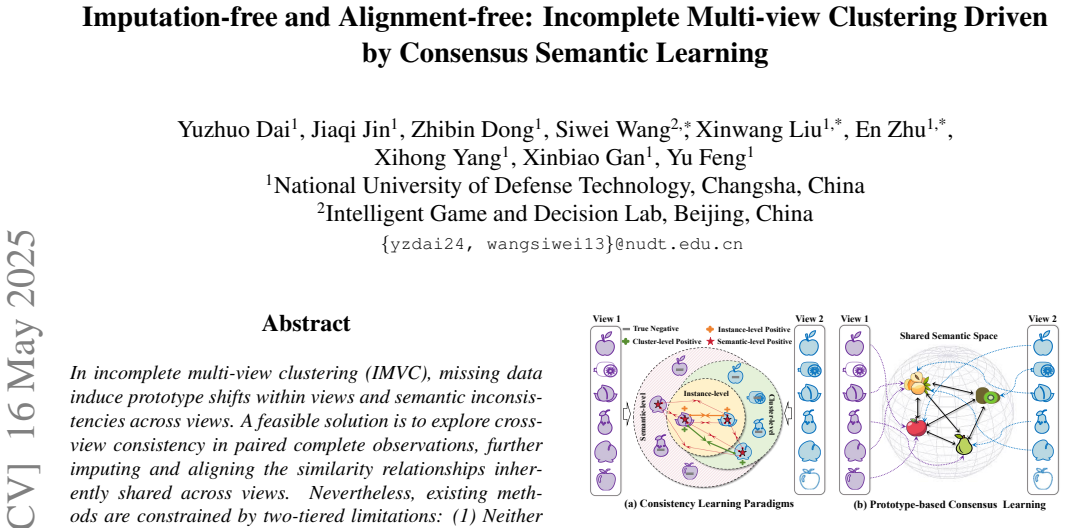
The carrying object is the set of consensus prototypes $\mathcal{C}=\{c_k\}_{k=1}^K$, obtained by $k$-means on consensus representations $Z=\sum_v w_v Z_v$, where the fusion weights $w_i^v$ are completeness statistics: the indicator that instance $i$ is observed in view $v$, divided by the number of views in which $i$ appears. Each view's semantic representation $h_i^v$ is projected onto the prototypes to give soft assignments $p_{i,k}=\exp(h_i^{\top}c_k/\tau)/\sum_{k'}\exp(h_i^{\top}c_{k'}/\tau)$, and paired views supervise each other through swapped knowledge distillation. A second module maximizes spectral modularity $\operatorname{Tr}((P^v)^{\top}B^vP^v)$ on per-view $k$-NN graphs, regularized by KL divergence toward self-supervised pseudo-labels from a Student's $t$-distribution, to inject within-view cluster structure. Together these create a shared semantic space in which unpaired but semantically similar observations pull together instead of being treated as false negatives, and within-view structure counteracts the coarseness of cluster-level consistency.
What would settle it
On a labeled benchmark with known ground-truth clusters, measure the empirical false-negative rate $P(C=1\mid I=0)$ among unpaired cross-view pairs under uniform random missingness and check whether it grows as $1/K+\beta r$; then run FreeCSL against instance-level and cluster-level baselines under non-uniform missingness (for example, a fixed subset of instances missing in all but one view). If the empirical false-negative statistics deviate from the assumed form, or if the method's advantage shrinks or reverses under blockwise missingness, the paper's central guarantee is contradicted even if the reported benchmark numbers are reproduced.
Extended reading notes
Core claim
The central claim is Theorem 1: consensus semantic learning, which assigns all available observations to a common set of consensus prototypes, yields more confident and robust cluster assignments than either instance-level or cluster-level consistency learning. Theorem 2 adds that paired cross-view observations, which already satisfy instance- and cluster-level consistency, automatically reach semantic consensus in the shared prototype space, so no explicit imputation or alignment is needed. The reported experiments support this with accuracy gains on six datasets against seven state-of-the-art methods: on ALOI-100 (100 clusters) the ACC advantage over the best competitor is 15.12, 26.38, 23.91, and 26.21 percentage points at $r=0.1, 0.3, 0.5, 0.7$, and on Caltech-5V at $r=0.7$ accuracy remains 83.64 percent while competitors fall to 60–80 percent.
Load-bearing premise
The main theorem assumes a specific statistical model of how missing data creates false-negative pairs — that the false-negative probability is $P(C=1\mid I=0)=1/K+\beta r$ and that the expected negative-pair count is $N_{in}=2r(1-r)N(N-1)$ — and then treats the semantic-level false-negative rate as approximately zero by construction in Eq. (26); these assertions are assumed rather than derived from a data-generating process, so the theorem's guarantee falls if the assumed missingness pattern does not hold.
Editorial extensions
If this is right
- At high missing rates ($r=0.5$ and $0.7$), the model degrades gradually because it does not depend on the shrinking pool of paired complete observations; reported ACC on Caltech-5V stays at 88.36 and 83.64 percent, and on NoisyMNIST at 96.04 and 92.19 percent.
- The claimed advantage grows on many-cluster, large-scale tasks: on ALOI-100 with 100 clusters the reported ACC gains over the best competitor are 15.12, 26.38, 23.91, and 26.21 percentage points as $r$ goes from 0.1 to 0.7.
- Because no imputation or alignment is performed, the method avoids error accumulation from graph-structure transfer and prototype alignment; the paper's control experiments (ILR and ISR) show that injecting $k$-NN imputation does not help and can hurt at high missing rates.
- The two modules are synergistic: ablations show the consensus semantic learning module contributes the most, but the modularity-based enhancement improves both reconstruction and semantic learning when added.
- Final cluster labels come from $k$-means on the consensus semantic representation, with no balancing weights and no imputation step, which the paper argues makes the framework simple to deploy end-to-end.
Reading between the lines
- The theoretical argument assumes missingness is uniform-random across views; a natural stress test is blockwise or view-correlated missingness, under which the completeness-weighted fusion could be dominated by the most complete views and the claimed robustness may not persist. The paper does not test this setting.
- The consensus-prototype recipe is generic: any partially observed multi-view task, such as retrieval, few-shot classification, or multimodal representation learning, could replace missing-data recovery with prototype-anchored contrasting over all available observations. This is an extension the paper does not make.
- The modularity term is doing the work of an intra-view clustering objective; one could test whether spectral modularity specifically is essential, or whether any within-view contrastive grouping gives the same enhancement.
- The proof of the main theorem rests on asserted false-negative statistics; a tightening would derive $P(C=1\mid I=0)$ from a concrete generative model of cluster structure and missingness, making the confidence-and-robustness claim checkable in closed form rather than by construction.
Signed reviews
Editorial analysis
A structured set of objections, weighed in public.
Referee Report
Summary. The paper proposes FreeCSL, an incomplete multi-view clustering method that avoids explicit imputation and cross-view alignment. It learns consensus semantic prototypes from all available observations via a prototypical contrastive clustering objective, and it adds a modularity-based within-view graph clustering module to sharpen cluster structure. The authors state two theorems: consensus semantic learning yields more confident and robust assignments than instance- and cluster-level paradigms (Theorem 1), and paired observations can reach semantic consensus through shared prototypes (Theorem 2). The experimental section compares FreeCSL against seven prior IMVC methods on six datasets at missing rates 0.1-0.7, with ablations, imputation control groups, similarity-matrix visualizations, and parameter sensitivity analyses.
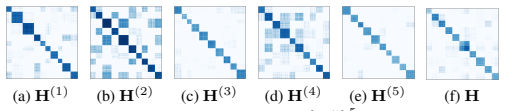
Significance. If the empirical results are representative, FreeCSL is a practically strong contribution: it achieves large accuracy gains on multi-cluster and large-scale benchmarks, degrades gracefully as the missing rate increases, and is competitive without imputation or alignment. The paper also ships a substantial experimental study, including ablations of every module, imputation control groups, and visual evidence of block-structured consensus representations. The main weakness is theoretical: the proof of Theorem 1 in Appendix B is not a valid derivation, and Theorem 2's proof is partly circular. Because the abstract and Section 1 present Theorem 1 as the motivation for the method, the theoretical claim needs to be either rigorously repaired or explicitly downgraded to a heuristic; the empirical contribution itself remains meaningful.
major comments (4)
- [Appendix B, Eq. (17)] The expression for the expected number of instance-level negative pairs is incorrect. Under missing-completely-at-random with rate r, the expected number of observed ordered cross-view negative pairs (i ≠ j, both views available) is (1-r)^2 N(N-1), not 2r(1-r)N(N-1). The expression used in Eq. (17) counts pairs in which exactly one of the two observations is missing, and such pairs do not enter any contrastive loss. Consequently, the amplified penalty term (1+ε)E[ρ⁻] in Eq. (18) is not derived from the model, and the subsequent comparison between paradigms is not quantitatively supported.
- [Appendix B, Eqs. (17) and (26)] The false-negative probability ε = P(C=1|I=0) = 1/K + βr is an unproven ansatz with an unspecified coefficient β. No data-generating mechanism or derivation is given for this linear form, and the proof later sets the semantic-level false-negative rate ε_sc to approximately zero in Eq. (26) by invoking shared prototypes. This effectively assumes the conclusion of Theorem 1 rather than establishing it. If the theorem is retained, the authors need to derive both quantities from a concrete statistical model or state them as assumptions and validate them empirically.
- [Section 2.3 and Appendix B, Eq. (15)] The proof of Theorem 1 analyzes a generic pairwise objective Eq. (15) with positive/negative pairs, but the implemented loss L_cc in Eq. (6) is a swapped-distillation loss computed over paired observations X^{m,n} only; it does not explicitly construct negative pairs over all observed cross-view instance pairs. Therefore the expected objective E[f_sc] in Eq. (27) does not directly correspond to the objective actually optimized in the paper. The authors should state explicitly which loss is being analyzed and prove the theorem for that loss, or reformulate the theoretical claim as a property of an idealized surrogate model.
- [Appendix B, Proof of Theorem 2] The proof of Theorem 2 is partly circular. Condition 2 assumes that because x_i^m and x_i^n belong to the same cluster (CC), their nearest prototype under the shared set C must be the same prototype c_k. But this is exactly the semantic consensus property that the theorem is supposed to establish; cluster-level consistency across views does not, by itself, guarantee the same argmax under a single prototype set. The proof needs an additional argument, for example a guarantee on prototype alignment or a statement of the conditions under which the swapped-distillation objective would recover that property.
minor comments (6)
- [Appendix B, Theorem numbering] Theorems are numbered 1 and 2 in the main text but appear as Theorems 3 and 4 in Appendix B; the numbering should be aligned.
- [Section 2.4, Eq. (12)] The Student's t-distribution kernel introduces a parameter γ, but γ is not defined or given a value anywhere in the paper.
- [Section 2.3, Eq. (7)] The notation Q^m and H^m is not defined before Eq. (7); it should be clarified that these are matrices of pseudo-labels and semantic representations for the paired observations in view m.
- [Table 2, YouTubeFace10 row] The competitor name 'DIVC' appears in the YouTubeFace10 block; elsewhere the same method is called 'DIVIDE'.
- [Appendix A, Section 5.1] Reference citations appear as '[49?]' and '[12, 49?]' in the related-work section; these should be corrected.
- [Appendix B, Eq. (22)] The definitions of N_cp and N_cn use the same prefactor (1-r)^2 N^2 and differ only in the same-cluster probability; if these are intended to be pair counts, the i≠j restriction and the N(N-1) factor should be made explicit.
Circularity Check
Theorem 1's guarantee is partially circular: the proof defines semantic-level false negatives to be ~0 via shared prototypes, so the theorem restates Definition 3; the empirical comparisons against external benchmarks are not circular.
-
self definitional
[Appendix B, Proof of Theorem 1, Eq. (26) (Section 6.1)]
"ϵsc =P(arg max_k ρ(xm_i,ck)≠ arg max_k ρ(xn_j,ck)|C=1) (26) •N_sp are constructed through consensus prototypes C, avoiding cross-view matching: ϵsc =P(S(xm_i,xn_j)=0|C(xm_i,xn_j)=1)≈0 Therefore, N_sc_fn∝ϵ_sc≈0"
Definition 3 defines semantic-level consensus S as sharing a prototype set C and satisfying arg max_k ρ(xm_i,ck)=arg max_k ρ(xn_j,ck). The proof then equates the semantic-level false-negative rate with P(S=0|C=1) and asserts it is ≈0 because positive pairs are 'constructed through consensus prototypes C'. That is the theorem's conclusion encoded in the definition: if Y=S is used in the generic objective (15), the semantic-level paradigm has zero false-negative noise by construction. The proof does not show that the implemented L_cc in Eq. (6), a swapped-distillation loss over paired observations, achieves S=1 for all same-cluster pairs; it simply defines the noise away.
-
self definitional
[Appendix B, Proof of Theorem 2, Condition 2 (Section 6.2)]
"Assume the nearest prototype for xm_i is ck: arg min_k d(xm_i,ck)=k. Since xm_i and xn_i belong to the same cluster ck (CC), and prototype ck is the central representation of this cluster, the nearest prototype for xn_i should also be ck. Otherwise, if the nearest prototype for xn_i is ck′ (k′≠k ), it would contradict the cluster consistency (CC)."
Theorem 2 is the stated basis for the swapped knowledge distillation in Eq. (5): 'Based on Theorem 2, (xm_i, xn_i) share the same cluster semantics on consensus prototypes C'. The proof assumes that cluster-level consistency (Definition 2: both observations belong to the same cluster k) forces the same nearest prototype in each view. But Definition 2 only asserts same-cluster membership; the paper's own motivation is that missing data cause prototype shifts, so paired observations can have different nearest prototypes across views. The proof thus derives semantic consensus from the very agreement of prototype assignments it is meant to establish.
full rationale
FreeCSL's experimental program is not circular: the headline results (Tables 2 and 8, plus ablations in Tables 3 and 9) compare against seven external SOTA methods on six public datasets, so the empirical ACC/NMI/ARI claims stand or fall on reproduction rather than on the paper's definitions. The circularity is confined to the formal framing. Theorem 1 is presented as a general guarantee ('Consensus semantic learning yields more confident and robust cluster assignments than instance- and cluster-level paradigms'), and the CSL module is said to be designed 'Based on Theorem 1'. But in the proof, Definition 3 defines semantic-level consensus S as sharing a prototype set and agreeing on arg max assignments; Eq. (26) then declares the semantic-level false-negative rate P(S=0|C=1)≈0 because positive pairs are 'constructed through consensus prototypes'. With the generic objective (15) parameterized by Y=S, the semantic paradigm has zero false negatives by construction, so the theorem restates the definition rather than proving a property of the implemented loss. Theorem 2 likewise proves paired observations reach semantic consensus by assuming their nearest prototype must be identical, which is exactly the conclusion used to justify swapped distillation in Eq. (5). Separately, Eq. (17) defines N_in as 2r(1-r)N(N-1), whereas observed unpaired cross-view pairs under MCAR number (1-r)^2N(N-1), and Eq. (18)'s (1+epsilon) amplification rests on this count; this is a correctness/rigor issue rather than a circularity, but it removes independent support from the formal robustness claim. No load-bearing self-citation is present. Overall, partial circularity: the theorem's formal guarantee reduces by definition, while the benchmark comparisons remain external and non-circular.
Assumptions & free parameters
free parameters (5)
- temperature tau =
0.1 or 0.2
- entropy smoothness alpha =
0.5
- graph neighbors zeta =
3
- KL regularizer weight lambda =
0.05 to 0.3
- false-negative slope beta =
unspecified
assumptions (5)
- domain assumption Multi-view data satisfy consistency and complementarity, so a linearly weighted fusion of view-specific representations produces a meaningful consensus representation.
- domain assumption k-means on the consensus representation Z yields reliable initial consensus prototypes C under high missing rates.
- ad hoc to paper P(C=1|I=0)=1/K+beta*r with beta unspecified.
- ad hoc to paper Semantic-level false-negative rate epsilon_sc is approximately zero.
- domain assumption The modularity null model on the KNN graph captures the true cluster structure of each view.
invented entities (1)
-
Consensus semantic prototypes C
Cite this review
Pith. "Pith review of Imputation-free and Alignment-free: Incomplete Multi-view Clustering Driven by Consensus Semantic Learning." pith.science (2026). https://pith.science/paper/H2SBW7O2
@misc{pith2026250511182,
  author       = {Pith},
  title        = {Pith review of: Imputation-free and Alignment-free: Incomplete Multi-view Clustering Driven by Consensus Semantic Learning},
  year         = {2026},
  howpublished = {\url{https://pith.science/paper/H2SBW7O2}},
  note         = {Machine review of arXiv:2505.11182}
}
read the original abstract
In incomplete multi-view clustering (IMVC), missing data induce prototype shifts within views and semantic inconsistencies across views. A feasible solution is to explore cross-view consistency in paired complete observations, further imputing and aligning the similarity relationships inherently shared across views. Nevertheless, existing methods are constrained by two-tiered limitations: (1) Neither instance- nor cluster-level consistency learning construct a semantic space shared across views to learn consensus semantics. The former enforces cross-view instances alignment, and wrongly regards unpaired observations with semantic consistency as negative pairs; the latter focuses on cross-view cluster counterparts while coarsely handling fine-grained intra-cluster relationships within views. (2) Excessive reliance on consistency results in unreliable imputation and alignment without incorporating view-specific cluster information. Thus, we propose an IMVC framework, imputation- and alignment-free for consensus semantics learning (FreeCSL). To bridge semantic gaps across all observations, we learn consensus prototypes from available data to discover a shared space, where semantically similar observations are pulled closer for consensus semantics learning. To capture semantic relationships within specific views, we design a heuristic graph clustering based on modularity to recover cluster structure with intra-cluster compactness and inter-cluster separation for cluster semantics enhancement. Extensive experiments demonstrate, compared to state-of-the-art competitors, FreeCSL achieves more confident and robust assignments on IMVC task.
Figures


Figures from the paper (7 more)



Reference graph
Works this paper leans on
-
[1]
Maximizing modularity is hard.arXiv preprint physics/0608255, 2006
Ulrik Brandes, Daniel Delling, Marco Gaertler, Robert G¨orke, Martin Hoefer, Zoran Nikoloski, and Dorothea Wag- ner. Maximizing modularity is hard.arXiv preprint physics/0608255, 2006. 5
arXiv 2006
-
[2]
Unsupervised learning of visual features by contrasting cluster assignments.Ad- vances in neural information processing systems, 33:9912– 9924, 2020
Mathilde Caron, Ishan Misra, Julien Mairal, Priya Goyal, Pi- otr Bojanowski, and Armand Joulin. Unsupervised learning of visual features by contrasting cluster assignments.Ad- vances in neural information processing systems, 33:9912– 9924, 2020. 2
2020
-
[3]
Incomplete con- trastive multi-view clustering with high-confidence guiding
Guoqing Chao, Yi Jiang, and Dianhui Chu. Incomplete con- trastive multi-view clustering with high-confidence guiding. InProceedings of the AAAI Conference on Artificial Intelli- gence, pages 11221–11229, 2024. 1, 5
work page 2024
-
[4]
A simple framework for contrastive learning of visual representations
Ting Chen, Simon Kornblith, Mohammad Norouzi, and Ge- offrey Hinton. A simple framework for contrastive learning of visual representations. InInternational conference on ma- chine learning, pages 1597–1607. PMLR, 2020. 1
2020
-
[5]
Chenhang Cui, Yazhou Ren, Jingyu Pu, Jiawei Li, Xiaorong Pu, Tianyi Wu, Yutao Shi, and Lifang He. A novel ap- proach for effective multi-view clustering with information- theoretic perspective.Advances in Neural Information Pro- cessing Systems, 36, 2024. 1
work page 2024
-
[6]
Subgraph propagation and con- trastive calibration for incomplete multiview data clustering
Zhibin Dong, Jiaqi Jin, Yuyang Xiao, Bin Xiao, Siwei Wang, Xinwang Liu, and En Zhu. Subgraph propagation and con- trastive calibration for incomplete multiview data clustering. IEEE Transactions on Neural Networks and Learning Sys- tems, 2024. 1, 2
work page 2024
-
[7]
Guowang Du, Lihua Zhou, Yudi Yang, Kevin L¨u, and Lizhen Wang. Deep multiple auto-encoder-based multi-view clus- tering.Data Science and Engineering, 6(3):323–338, 2021. 5
work page 2021
-
[8]
Uno Fang, Man Li, Jianxin Li, Longxiang Gao, Tao Jia, and Yanchun Zhang. A comprehensive survey on multi-view clustering.IEEE Transactions on Knowledge and Data En- gineering, 35(12):12350–12368, 2023. 1
work page 2023
Show all 76 references
-
[9]
Partial multi-view clustering via self-supervised network
Wei Feng, Guoshuai Sheng, Qianqian Wang, Quanxue Gao, Zhiqiang Tao, and Bo Dong. Partial multi-view clustering via self-supervised network. InProceedings of the AAAI Confer- ence on Artificial Intelligence, pages 11988–11995, 2024. 1
2024
-
[10]
Robust contrastive multi-view clustering against dual noisy correspondence.Advances in Neural Information Pro- cessing Systems, 37:121401–121421, 2024
Ruiming Guo, Mouxing Yang, Yijie Lin, Xi Peng, and Peng Hu. Robust contrastive multi-view clustering against dual noisy correspondence.Advances in Neural Information Pro- cessing Systems, 37:121401–121421, 2024. 2
2024
-
[11]
Robust variational contrastive learning for partially view- unaligned clustering
Changhao He, Hongyuan Zhu, Peng Hu, and Xi Peng. Robust variational contrastive learning for partially view- unaligned clustering. InProceedings of the 32nd ACM In- ternational Conference on Multimedia, pages 4167–4176,
-
[12]
Momentum contrast for unsupervised visual rep- resentation learning
Kaiming He, Haoqi Fan, Yuxin Wu, Saining Xie, and Ross Girshick. Momentum contrast for unsupervised visual rep- resentation learning. InProceedings of the IEEE/CVF con- ference on computer vision and pattern recognition, pages 9729–9738, 2020. 1
2020
-
[13]
Sharable and in- dividual multi-view metric learning.IEEE transactions on pattern analysis and machine intelligence, 40(9):2281–2288,
Junlin Hu, Jiwen Lu, and Yap-Peng Tan. Sharable and in- dividual multi-view metric learning.IEEE transactions on pattern analysis and machine intelligence, 40(9):2281–2288,
-
[14]
Deep supervised multi-view learning with graph priors.IEEE Transactions on Image Pro- cessing, 33:123–133, 2023
Peng Hu, Liangli Zhen, Xi Peng, Hongyuan Zhu, Jie Lin, Xu Wang, and Dezhong Peng. Deep supervised multi-view learning with graph priors.IEEE Transactions on Image Pro- cessing, 33:123–133, 2023. 1
2023
-
[15]
Fast multi-view clustering via ensembles: Towards scalability, su- periority, and simplicity.IEEE Transactions on Knowledge and Data Engineering, 35(11):11388–11402, 2023
Dong Huang, Chang-Dong Wang, and Jian-Huang Lai. Fast multi-view clustering via ensembles: Towards scalability, su- periority, and simplicity.IEEE Transactions on Knowledge and Data Engineering, 35(11):11388–11402, 2023. 5
2023
-
[16]
Deep se- mantic clustering by partition confidence maximisation
Jiabo Huang, Shaogang Gong, and Xiatian Zhu. Deep se- mantic clustering by partition confidence maximisation. In Proceedings of the IEEE/CVF conference on computer vi- sion and pattern recognition, pages 8849–8858, 2020. 1
2020
-
[17]
Multi-view spec- tral clustering network
Zhenyu Huang, Joey Tianyi Zhou, Xi Peng, Changqing Zhang, Hongyuan Zhu, and Jiancheng Lv. Multi-view spec- tral clustering network. InIJCAI, page 4, 2019. 5
2019
-
[18]
Partially view-aligned clustering.Advances in Neural Information Processing Systems, 33:2892–2902,
Zhenyu Huang, Peng Hu, Joey Tianyi Zhou, Jiancheng Lv, and Xi Peng. Partially view-aligned clustering.Advances in Neural Information Processing Systems, 33:2892–2902,
-
[19]
A decoder-free variational deep embedding for unsu- pervised clustering.IEEE Transactions on Neural Networks and Learning Systems, 33(10):5681–5693, 2021
Qiang Ji, Yanfeng Sun, Junbin Gao, Yongli Hu, and Baocai Yin. A decoder-free variational deep embedding for unsu- pervised clustering.IEEE Transactions on Neural Networks and Learning Systems, 33(10):5681–5693, 2021. 1
2021
-
[20]
Dm2c: Deep mixed-modal clus- tering.Advances in Neural Information Processing Systems, 32, 2019
Yangbangyan Jiang, Qianqian Xu, Zhiyong Yang, Xiaochun Cao, and Qingming Huang. Dm2c: Deep mixed-modal clus- tering.Advances in Neural Information Processing Systems, 32, 2019. 2
2019
-
[21]
Deep incomplete multi-view clustering with cross-view partial sample and prototype alignment
Jiaqi Jin, Siwei Wang, Zhibin Dong, Xinwang Liu, and En Zhu. Deep incomplete multi-view clustering with cross-view partial sample and prototype alignment. InProceedings of the IEEE/CVF conference on computer vision and pattern recognition, pages 11600–11609, 2023. 1, 2
2023
-
[22]
Rethinking multi-view representation learning via distilled disentangling
Guanzhou Ke, Bo Wang, Xiaoli Wang, and Shengfeng He. Rethinking multi-view representation learning via distilled disentangling. InProceedings of the IEEE/CVF Conference on Computer Vision and Pattern Recognition, pages 26774– 26783, 2024. 1
2024
-
[23]
An efficient heuristic pro- cedure for partitioning graphs.The Bell system technical journal, 49(2):291–307, 1970
Brian W Kernighan and Shen Lin. An efficient heuristic pro- cedure for partitioning graphs.The Bell system technical journal, 49(2):291–307, 1970. 5
1970
-
[24]
Incomplete multi-view cluster- ing via prototype-based imputation.arXiv preprint arXiv:2301.11045, 2023
Haobin Li, Yunfan Li, Mouxing Yang, Peng Hu, Dezhong Peng, and Xi Peng. Incomplete multi-view cluster- ing via prototype-based imputation.arXiv preprint arXiv:2301.11045, 2023. 1, 2, 5
2023 arXiv
-
[25]
Cross-view graph matching guided anchor align- ment for incomplete multi-view clustering.Information Fu- sion, 100:101941, 2023
Xingfeng Li, Yinghui Sun, Quansen Sun, Zhenwen Ren, and Yuan Sun. Cross-view graph matching guided anchor align- ment for incomplete multi-view clustering.Information Fu- sion, 100:101941, 2023. 1
2023
-
[26]
A survey of multi-view representation learning.IEEE transactions on knowledge and data engineering, 31(10):1863–1883, 2018
Yingming Li, Ming Yang, and Zhongfei Zhang. A survey of multi-view representation learning.IEEE transactions on knowledge and data engineering, 31(10):1863–1883, 2018. 1
2018
-
[27]
Contrastive clustering
Yunfan Li, Peng Hu, Zitao Liu, Dezhong Peng, Joey Tianyi Zhou, and Xi Peng. Contrastive clustering. InProceedings of the AAAI Conference on Artificial Intelligence, pages 8547– 8555, 2021. 2
2021
-
[28]
Twin contrastive learning for online clustering.International Journal of Computer Vision, 130 (9):2205–2221, 2022
Yunfan Li, Mouxing Yang, Dezhong Peng, Taihao Li, Jiantao Huang, and Xi Peng. Twin contrastive learning for online clustering.International Journal of Computer Vision, 130 (9):2205–2221, 2022. 1
2022
-
[29]
Completer: Incomplete multi-view clustering via contrastive prediction
Yijie Lin, Yuanbiao Gou, Zitao Liu, Boyun Li, Jiancheng Lv, and Xi Peng. Completer: Incomplete multi-view clustering via contrastive prediction. InProceedings of the IEEE/CVF Conference on Computer Vision and Pattern Recognition, pages 11174–11183, 2021. 6, 1, 5
2021
-
[30]
Dual contrastive prediction for incomplete multi-view representation learning.IEEE Trans- actions on Pattern Analysis and Machine Intelligence, 45(4): 4447–4461, 2022
Yijie Lin, Yuanbiao Gou, Xiaotian Liu, Jinfeng Bai, Jiancheng Lv, and Xi Peng. Dual contrastive prediction for incomplete multi-view representation learning.IEEE Trans- actions on Pattern Analysis and Machine Intelligence, 45(4): 4447–4461, 2022. 1
2022
-
[31]
Effi- cient token-guided image-text retrieval with consistent mul- timodal contrastive training.IEEE Transactions on Image Processing, 32:3622–3633, 2023
Chong Liu, Yuqi Zhang, Hongsong Wang, Weihua Chen, Fan Wang, Yan Huang, Yi-Dong Shen, and Liang Wang. Effi- cient token-guided image-text retrieval with consistent mul- timodal contrastive training.IEEE Transactions on Image Processing, 32:3622–3633, 2023. 1
2023
-
[32]
Late fusion incomplete multi-view clustering
Xinwang Liu, Xinzhong Zhu, Miaomiao Li, Lei Wang, Chang Tang, Jianping Yin, Dinggang Shen, Huaimin Wang, and Wen Gao. Late fusion incomplete multi-view clustering. IEEE transactions on pattern analysis and machine intelli- gence, 41(10):2410–2423, 2018. 1
2018
-
[33]
A survey on deep clustering: from the prior perspective.Vici- nagearth, 1(1):4, 2024
Yiding Lu, Haobin Li, Yunfan Li, Yijie Lin, and Xi Peng. A survey on deep clustering: from the prior perspective.Vici- nagearth, 1(1):4, 2024. 2
2024
-
[34]
Decoupled contrastive multi-view cluster- ing with high-order random walks
Yiding Lu, Yijie Lin, Mouxing Yang, Dezhong Peng, Peng Hu, and Xi Peng. Decoupled contrastive multi-view cluster- ing with high-order random walks. InProceedings of the AAAI Conference on Artificial Intelligence, pages 14193– 14201, 2024. 2, 1, 5
2024
-
[35]
Modularity and community structure in networks.Proceedings of the national academy of sciences, 103(23):8577–8582, 2006
Mark EJ Newman. Modularity and community structure in networks.Proceedings of the national academy of sciences, 103(23):8577–8582, 2006. 4
2006
-
[36]
Adap- tive feature imputation with latent graph for deep incomplete multi-view clustering
Jingyu Pu, Chenhang Cui, Xinyue Chen, Yazhou Ren, Xi- aorong Pu, Zhifeng Hao, S Yu Philip, and Lifang He. Adap- tive feature imputation with latent graph for deep incomplete multi-view clustering. InProceedings of the AAAI Confer- ence on Artificial Intelligence, pages 14633–1...
2024
-
[37]
You never cluster alone.Advances in Neural Information Processing Systems, 34:27734–27746,
Yuming Shen, Ziyi Shen, Menghan Wang, Jie Qin, Philip Torr, and Ling Shao. You never cluster alone.Advances in Neural Information Processing Systems, 34:27734–27746,
-
[38]
Robust multi-view clustering with noisy cor- respondence.IEEE Transactions on Knowledge and Data Engineering, 2024
Yuan Sun, Yang Qin, Yongxiang Li, Dezhong Peng, Xi Peng, and Peng Hu. Robust multi-view clustering with noisy cor- respondence.IEEE Transactions on Knowledge and Data Engineering, 2024. 2
2024
-
[39]
Deep safe multi-view cluster- ing: Reducing the risk of clustering performance degradation caused by view increase
Huayi Tang and Yong Liu. Deep safe multi-view cluster- ing: Reducing the risk of clustering performance degradation caused by view increase. InProceedings of the IEEE/CVF Conference on Computer Vision and Pattern Recognition, pages 202–211, 2022. 1, 2
2022
-
[40]
Incomplete multi-view learning: Review, analysis, and prospects.Applied Soft Computing, page 111278, 2024
Jingjing Tang, Qingqing Yi, Saiji Fu, and Yingjie Tian. Incomplete multi-view learning: Review, analysis, and prospects.Applied Soft Computing, page 111278, 2024. 1
2024
-
[41]
One-step multi- view clustering with diverse representation.IEEE Transac- tions on Neural Networks and Learning Systems, pages 1– 13, 2024
Xinhang Wan, Jiyuan Liu, Xinbiao Gan, Xinwang Liu, Siwei Wang, Yi Wen, Tianjiao Wan, and En Zhu. One-step multi- view clustering with diverse representation.IEEE Transac- tions on Neural Networks and Learning Systems, pages 1– 13, 2024. 1
2024
-
[42]
Fast continual multi-view clustering with incomplete views.IEEE Transactions on Image Processing, 33:2995–3008, 2024
Xinhang Wan, Bin Xiao, Xinwang Liu, Jiyuan Liu, Weixuan Liang, and En Zhu. Fast continual multi-view clustering with incomplete views.IEEE Transactions on Image Processing, 33:2995–3008, 2024. 1
2024
-
[43]
Cline: Contrastive learning with semantic negative examples for natural language understanding
Dong Wang, Ning Ding, Piji Li, and Haitao Zheng. Cline: Contrastive learning with semantic negative examples for natural language understanding. InProceedings of the 59th Annual Meeting of the Association for Computational Lin- guistics and the 11th International Joint Confere...
2021
-
[44]
Rethinking minimal sufficient representation in contrastive learning
Haoqing Wang, Xun Guo, Zhi-Hong Deng, and Yan Lu. Rethinking minimal sufficient representation in contrastive learning. InProceedings of the IEEE/CVF Conference on Computer Vision and Pattern Recognition, pages 16041– 16050, 2022. 1
2022
-
[45]
Generative partial multi-view clustering with adaptive fusion and cycle consistency.IEEE Transac- tions on Image Processing, 30:1771–1783, 2021
Qianqian Wang, Zhengming Ding, Zhiqiang Tao, Quanxue Gao, and Yun Fu. Generative partial multi-view clustering with adaptive fusion and cycle consistency.IEEE Transac- tions on Image Processing, 30:1771–1783, 2021. 1, 2
2021
-
[46]
Align then fusion: General- ized large-scale multi-view clustering with anchor matching correspondences.Advances in Neural Information Process- ing Systems, 35:5882–5895, 2022
Siwei Wang, Xinwang Liu, Suyuan Liu, Jiaqi Jin, Wenxuan Tu, Xinzhong Zhu, and En Zhu. Align then fusion: General- ized large-scale multi-view clustering with anchor matching correspondences.Advances in Neural Information Process- ing Systems, 35:5882–5895, 2022. 2
2022
-
[47]
Incomplete multi-view clustering via cross-view relation transfer.IEEE Transactions on Circuits and Systems for Video Technology, 2022
Yiming Wang, Dongxia Chang, Zhiqiang Fu, Jie Wen, and Yao Zhao. Incomplete multi-view clustering via cross-view relation transfer.IEEE Transactions on Circuits and Systems for Video Technology, 2022. 2, 1
2022
-
[48]
Deep incomplete multi-view multiple clusterings
Shaowei Wei, Jun Wang, Guoxian Yu, Carlotta Domeniconi, and Xiangliang Zhang. Deep incomplete multi-view multiple clusterings. In2020 IEEE International Conference on Data Mining (ICDM), pages 651–660. IEEE, 2020. 1
2020
-
[49]
Unsupervised feature learning via non-parametric instance discrimination
Zhirong Wu, Yuanjun Xiong, Stella X Yu, and Dahua Lin. Unsupervised feature learning via non-parametric instance discrimination. InProceedings of the IEEE conference on computer vision and pattern recognition, pages 3733–3742,
-
[50]
Detco: Unsuper- vised contrastive learning for object detection
Enze Xie, Jian Ding, Wenhai Wang, Xiaohang Zhan, Hang Xu, Peize Sun, Zhenguo Li, and Ping Luo. Detco: Unsuper- vised contrastive learning for object detection. InProceed- ings of the IEEE/CVF international conference on computer vision, pages 8392–8401, 2021. 1
2021
-
[51]
Unsupervised deep embedding for clustering analysis
Junyuan Xie, Ross Girshick, and Ali Farhadi. Unsupervised deep embedding for clustering analysis. InInternational conference on machine learning, pages 478–487. PMLR,
-
[52]
Adversarial incomplete multi-view cluster- ing
Cai Xu, Ziyu Guan, Wei Zhao, Hongchang Wu, Yunfei Niu, and Beilei Ling. Adversarial incomplete multi-view cluster- ing. InIJCAI, pages 3933–3939, 2019. 2
2019
-
[53]
Deep incomplete multi- view clustering via mining cluster complementarity
Jie Xu, Chao Li, Yazhou Ren, Liang Peng, Yujie Mo, Xi- aoshuang Shi, and Xiaofeng Zhu. Deep incomplete multi- view clustering via mining cluster complementarity. InPro- ceedings of the AAAI conference on artificial intelligence, pages 8761–8769, 2022. 3, 1, 5
2022
-
[54]
Multi-level feature learning for contrastive multi-view clustering
Jie Xu, Huayi Tang, Yazhou Ren, Liang Peng, Xiaofeng Zhu, and Lifang He. Multi-level feature learning for contrastive multi-view clustering. InProceedings of the IEEE/CVF Con- ference on Computer Vision and Pattern Recognition, pages 16051–16060, 2022. 5
2022
-
[55]
Adaptive feature projec- tion with distribution alignment for deep incomplete multi- view clustering.IEEE Transactions on Image Processing, 32:1354–1366, 2023
Jie Xu, Chao Li, Liang Peng, Yazhou Ren, Xiaoshuang Shi, Heng Tao Shen, and Xiaofeng Zhu. Adaptive feature projec- tion with distribution alignment for deep incomplete multi- view clustering.IEEE Transactions on Image Processing, 32:1354–1366, 2023. 2, 1
2023
-
[56]
Cmclrec: Cross-modal contrastive learning for user cold-start sequential recommendation
Xiaolong Xu, Hongsheng Dong, Lianyong Qi, Xuyun Zhang, Haolong Xiang, Xiaoyu Xia, Yanwei Xu, and Wanchun Dou. Cmclrec: Cross-modal contrastive learning for user cold-start sequential recommendation. InProceed- ings of the 47th International ACM SIGIR Conference on Research and...
2024
-
[57]
Differentiable information bottleneck for deterministic multi-view clustering
Xiaoqiang Yan, Zhixiang Jin, Fengshou Han, and Yangdong Ye. Differentiable information bottleneck for deterministic multi-view clustering. InProceedings of the IEEE/CVF Con- ference on Computer Vision and Pattern Recognition, pages 27435–27444, 2024. 1
2024
-
[58]
Deep cluster- ing analysis via dual variational autoencoder with spherical latent embeddings.IEEE Transactions on Neural Networks and Learning Systems, 34(9):6303–6312, 2021
Lin Yang, Wentao Fan, and Nizar Bouguila. Deep cluster- ing analysis via dual variational autoencoder with spherical latent embeddings.IEEE Transactions on Neural Networks and Learning Systems, 34(9):6303–6312, 2021. 1
2021
-
[60]
Partially view-aligned representation learn- ing with noise-robust contrastive loss
Mouxing Yang, Yunfan Li, Zhenyu Huang, Zitao Liu, Peng Hu, and Xi Peng. Partially view-aligned representation learn- ing with noise-robust contrastive loss. InProceedings of the IEEE/CVF conference on computer vision and pattern recognition, pages 1134–1143, 2021. 2
2021
-
[61]
Robust multi-view clustering with incom- plete information.IEEE Transactions on Pattern Analysis and Machine Intelligence, 45(1):1055–1069, 2022
Mouxing Yang, Yunfan Li, Peng Hu, Jinfeng Bai, Jiancheng Lv, and Xi Peng. Robust multi-view clustering with incom- plete information.IEEE Transactions on Pattern Analysis and Machine Intelligence, 45(1):1055–1069, 2022. 2
2022
-
[62]
Robust multi-view clustering with incom- plete information.IEEE Transactions on Pattern Analysis and Machine Intelligence, 2022
Mouxing Yang, Yunfan Li, Peng Hu, Jinfeng Bai, Jian Cheng Lv, and Xi Peng. Robust multi-view clustering with incom- plete information.IEEE Transactions on Pattern Analysis and Machine Intelligence, 2022. 1, 5
2022
-
[63]
Sparse low- rank multi-view subspace clustering with consensus anchors and unified bipartite graph.IEEE Transactions on Neural Networks and Learning Systems, 2023
Shengju Yu, Suyuan Liu, Siwei Wang, et al. Sparse low- rank multi-view subspace clustering with consensus anchors and unified bipartite graph.IEEE Transactions on Neural Networks and Learning Systems, 2023. 3
2023
-
[64]
A non- parametric graph clustering framework for multi-view data
Shengju Yu, Siwei Wang, Zhibin Dong, et al. A non- parametric graph clustering framework for multi-view data. InProceedings of the AAAI conference on artificial intelli- gence, pages 16558–16567, 2024. 4
2024
-
[65]
Semantic invariant multi- view clustering with fully incomplete information.IEEE Transactions on Pattern Analysis and Machine Intelligence, 46(4):2139–2150, 2023
Pengxin Zeng, Mouxing Yang, Yiding Lu, Changqing Zhang, Peng Hu, and Xi Peng. Semantic invariant multi- view clustering with fully incomplete information.IEEE Transactions on Pattern Analysis and Machine Intelligence, 46(4):2139–2150, 2023. 2
2023
-
[66]
Deep partial multi-view learning.IEEE transactions on pattern analysis and machine intelligence, 44(5):2402–2415, 2020
Changqing Zhang, Yajie Cui, Zongbo Han, Joey Tianyi Zhou, Huazhu Fu, and Qinghua Hu. Deep partial multi-view learning.IEEE transactions on pattern analysis and machine intelligence, 44(5):2402–2415, 2020. 2, 1, 5
2020
-
[67]
One-stage incomplete multi-view clustering via late fusion
Yi Zhang, Xinwang Liu, Siwei Wang, Jiyuan Liu, Sisi Dai, and En Zhu. One-stage incomplete multi-view clustering via late fusion. InProceedings of the 29th ACM international conference on multimedia, pages 2717–2725, 2021. 1
2021
-
[68]
Regularized in- stance weighting multiview clustering via late fusion align- ment.IEEE Transactions on Neural Networks and Learning Systems, 2024
Yi Zhang, Fengyu Tian, Chuan Ma, Miaomiao Li, Hengfu Yang, Zhe Liu, En Zhu, and Xinwang Liu. Regularized in- stance weighting multiview clustering via late fusion align- ment.IEEE Transactions on Neural Networks and Learning Systems, 2024. 3
2024
-
[69]
Deep robust clustering by contrastive learning
Huasong Zhong, Chong Chen, Zhongming Jin, and Xian- Sheng Hua. Deep robust clustering by contrastive learning. arXiv preprint arXiv:2008.03030, 2020. 2
2008 arXiv
-
[70]
A survey and an empirical evaluation of multi- view clustering approaches.ACM Computing Surveys, 56 (7):1–38, 2024
Lihua Zhou, Guowang Du, Kevin L ¨u, Lizheng Wang, and Jingwei Du. A survey and an empirical evaluation of multi- view clustering approaches.ACM Computing Surveys, 56 (7):1–38, 2024. 1
2024
-
[71]
Multi-view deep subspace clustering net- works.arXiv preprint arXiv:1908.01978, 2019
Pengfei Zhu, Xinjie Yao, Yu Wang, Binyuan Hui, Dawei Du, and Qinghua Hu. Multi-view deep subspace clustering net- works.arXiv preprint arXiv:1908.01978, 2019. 5 Imputation-free and Alignment-free: Incomplete Multi-view Clustering Driven by Consensus Semantic Learning Supplemen...
1908 arXiv
-
[72]
Appendix A: Related Work 5.1. Contrastive Learning for Consistency Learning Exploring consistency information from complete instances across views is an effective way to alleviate instance obser- vations missing and cluster distribution shifted in incom- plete multi-view clust...
-
[73]
DIVIDE [34] utilizes an anchor-based approach to identify out-of-domain samples through high- order random walks to mitigate the issue of false negatives
further discriminate false negative pairs by using a adaptive threshold calculated from distances of all positive and negative pairs. DIVIDE [34] utilizes an anchor-based approach to identify out-of-domain samples through high- order random walks to mitigate the issue of false...
-
[74]
leverage the power of AEs in encoding latent repre- sentations to mine view-specific information for imputa- tion; CPM-Nets [66] and GP-MVC [45] encode a com- mon representation with consistency and complementar- ity information across views and employ adversarial strate- gies...
-
[75]
Although they successfully apply view-specific information in impu- tation, they lose the cluster structure information within the missing views
and DCP [30] unify cross-view consistency learning and missing prediction into a deep framework to constrain both complete paired observations and incomplete recov- ered observations by maximizing mutual information and minimizing conditional entropy across views. Although the...
-
[76]
Appendix B: Theorem Proof Definition 1.Instance-level Consistency (IC):∀m̸=n,x m i andx n j are instance-level consistent across views ifi=j (they are cross-view observations of the same instancex), expressed asI(x m i ,xn j ) = 1and 0 otherwise. Definition 2.Cluster-level Con...
-
[77]
Appendix C: Experiments 7.1. Experimental Settings Datasets.From the perspective of clustering task complex- ity in the number of clusters, views, feature dimensions, and samples, six widely applied public datasets are selected for experiments: Competitors.To validate the effe...
1984
Reviewed August 15, 2026 · model on record in the stance chip above.
Discussion (0). Continue with ORCID to comment.