REVIEW 3 major objections 6 minor 45 references
What Can We Learn From MIMO Graph Convolutions?
T0 review · 3 major / 6 minor · reviewed 2026-08-15 · deepseek-v4-flash
Pith's one-line read The paper derives the MIMO graph convolution directly from the convolution theorem and proves its localized form is injective on multisets for almost every edge-weight choice.
desk verdict Useful unifying framework for linear MPNNs, but the headline injectivity and independence theorems are false as stated and need repair before they support the abstract's claims. read the letter →
The pith
A machine-rendered reading of the paper's core claim, the machinery that carries it, and where it could break.
The reading
What carries the argument
The load-bearing object is the decomposition of the graph convolution into a sum over computational graphs. In the exact MIMO-GC, the graphs are the rank-one matrices $A^{(k)} = u_k u_k^\top$ formed from Fourier eigenvectors; in the LMGC, they are arbitrary $K$ edge-weight matrices $\tilde{A}^{(k)}$ with entries $\alpha^{(i,j)}_k$, combined with shared channel-mixing matrices $W^{(k)}$. The expressivity proofs work by generic linear algebra: for any two distinct multisets, the difference of their LMGC updates is a linear combination of coefficient vectors, and the bad coefficient choices form kernels of fixed matrices, which are measure-zero sets. This almost-everywhere-in-coefficient-space mechanism lets the paper transfer multiset-injectivity and linear independence from nonlinear architectures to linear message passing.
What would settle it
Compute the Jacobian rank of the coefficient map in Eq. (14) at random parameter initializations on a fixed small graph; if the map's image is contained in a measure-zero set, train the same instantiation to separate neighborhoods $\{\{x\}\}$ and $\{\{x,x\}\}$ and check whether the proof's generic injectivity actually survives under the shared-parameter coefficient map.
Extended reading notes
Core claim
The paper's central claim is that the MIMO graph convolution has the form $\Theta * X = \sum_{k=1}^{n} A^{(k)} X W^{(k)}$, where $A^{(k)} = u_k u_k^\top$ is a rank-one graph built from the $k$-th Fourier basis vector and $W^{(k)}$ is the corresponding channel-mixing matrix; equivalently, each ordered pair of nodes $(i,j)$ receives its own linear transformation $W^{(i,j)}$. Localizing the sum to neighbors yields the LMGC $x'_i = \sum_{v_j \in \mathcal{N}_i} W^{(i,j)} x_j = \sum_{k \in [K]} \tilde{A}^{(k)} X W^{(k)}$, with freely chosen edge weights $\alpha^{(i,j)}_k$. The paper proves that for almost every choice of these coefficients and feature matrices, an LMGC with $K \ge 1$ is injective on finite multisets, and with $K > 1$ the resulting representations are pairwise linearly independent. It further shows that polynomial filters and the GCN are MIMO-GCs with constrained filters, and that softmax-normalized attention scores form a measure-zero exception to the injectivity guarantee.
Load-bearing premise
The almost-everywhere guarantees hold when edge-weight coefficients and feature-matrix entries vary as independent continuous parameters, the feature universe is countable, and the output dimension is at least two; the paper's own benchmarked instantiation (Eq. 14) computes its edge weights from a shared low-dimensional network whose image can be a measure-zero set, so the guarantees do not automatically transfer to the architecture actually trained in Section 6.
Editorial extensions
If this is right
- A single linear LMGC layer can distinguish node-neighborhood multisets for almost every edge-weight choice, matching the multiset expressivity that was previously thought to require nonlinear feature transformations as in GIN.
- Using $K > 1$ computational graphs yields pairwise linearly independent representations for almost every edge-weight choice, directly counteracting the shared component amplification that leads to over-smoothing and rank collapse.
- Because LMGC contains GCN, GAT, FAGCN, and ACM as special cases, any improvement proven for LMGCs applies to all of these models whenever their particular coefficient maps satisfy the genericity condition.
- Approximating the convolution directly in the MIMO case gives one architecture that, in the paper's experiments, reaches the lowest error on a universality task, ZINC graph regression, and six heterophilic node-classification datasets.
Reading between the lines
- An implication the paper leaves implicit is that its own Eq. (14) instantiation may not inherit the almost-everywhere guarantees: because the coefficients are produced by a shared low-dimensional network, their image can be a measure-zero set, so the trained model's injectivity is an empirical rather than a proven property.
- A concrete design rule follows from the paper's argument: choose coefficient maps with open image in $\mathbb{R}^K$ (e.g., tanh or unconstrained outputs rather than softmax) so that the generic injectivity and independence results apply to the learned parameters.
- The MIMO-GC universality result, which says any target output can be produced from any generic input on a fixed graph, suggests LMGCs could serve as a general-purpose node-wise transformation layer; a testable extension is to benchmark them on tasks requiring arbitrary node-to-node feature maps, with regularization to control the added flexibility.
Signed reviews
Editorial analysis
A structured set of objections, weighed in public.
Referee Report
Summary. The paper derives the multi-input multi-output graph convolution (MIMO-GC) from the convolution theorem, observes that its key structural feature is the use of multiple computational graphs (equivalently, distinct linear feature transformations between node pairs), and introduces the localized MIMO graph convolution (LMGC) as a unified framework that subsumes several linear message-passing networks. The main theoretical claims are that, for almost every choice of edge-weight coefficients, an LMGC with one computational graph is injective on finite multisets (Proposition 3), and that with more than one computational graph the resulting node representations are linearly independent (Proposition 4). The paper also presents an LMGC instantiation based on a GATv2/FAGCN-style coefficient function and reports experiments on a synthetic universality task, the ZINC/ZINC12k graph regression benchmark, and six heterophilic node-classification datasets.
Significance. If the theoretical results are repaired, the paper makes a useful conceptual contribution: the spectral derivation of the MIMO-GC is self-contained and the LMGC framework gives a clean unifying perspective on GCN, GAT, gating mechanisms, and neural sheaf diffusion. The experimental study is thorough and includes a reproducible implementation, competitive benchmark results, and a direct universality comparison. However, the current statements of Propositions 3 and 4 are not correct as written, and the benchmarked instantiation is not covered by the almost-everywhere guarantees. These issues are repairable, but they affect the paper's headline theoretical claims, so the manuscript needs substantial revision before publication.
major comments (3)
- [Section 4, Proposition 3; Appendix B.2] Proposition 3 is false as stated. If the countable set X contains the zero vector, take the multisets X1={0} and X2={0,0} with the same center element 0; then f(0,{0}) = W(0) = 0 and f(0,{0,0}) = 0 + 0 = 0 for every choice of coefficients and every W, so injectivity fails for all parameters. If the empty multiset is allowed, then f(x,∅)=0 for every x, which also breaks injectivity unless X has at most one element. The proof via X_s α_k ≠ 0 fails exactly when X_s is the zero matrix, because then ker(X_s) is the whole space. The theorem must assume 0∉X and restrict to nonempty multisets (or otherwise explicitly exclude the empty-neighborhood case). As written, the abstract's claim that LMGCs with K>0 are 'injective for almost every choice of edge weights' is not true.
- [Section 4, Proposition 4; Appendix B.2] Proposition 4 is missing necessary hypotheses and its proof is not rigorous. It must require output dimension c≥2: in R^1 no two nonzero vectors are linearly independent, so the statement is vacuous or false when c=1. It also inherits the zero-vector and empty-multiset problems from Proposition 3. More importantly, the proof's step 'there exists ... c(1,2) such that Eq. (23) holds for all k' is not a consequence of the assumed linear dependence of the two output vectors; the correct object is the algebraic set of parameters (α,W) for which f1∧f2=0, which needs to be shown to be a proper algebraic set of measure zero. The norm-based argument around Eq. (25) does not handle the uncountable family of scalar multipliers c, and the notation c is used inconsistently (output dimension vs. scalar multiplier, with 'c∈N'). A careful rewrite of both the statement and the proof is needed.
- [Section 6, Eq. (14)] The almost-everywhere results are proved for independently varying coefficients α^(i,j)_k. In the benchmarked instantiation, however, these coefficients are produced by Eq. (14) from shared matrices W^(k), vectors v^(k), and input features. The image of this map is typically a measure-zero subset of the full coefficient space, so Propositions 3 and 4 do not automatically transfer to the architecture actually trained in Section 6. The paper notes that softmax attention violates the genericity condition but does not verify that its own Eq. (14) satisfies it. The sentence 'A neural network can then approximate such a function' is not sufficient; the manuscript should either prove a suitable genericity property for Eq. (14), state an explicit assumption under which the transfer holds, or present the experimental instantiation as a heuristic whose theoretical guarantees are open.
minor comments (6)
- [Section 3, Eq. (7b)] The notation W(i,j) X_{j,:} is dimensionally inconsistent if X_{j,:} is a row vector; please clarify whether X_{j,:} denotes a column vector or transpose the product.
- [Appendix B.1, proof of Proposition 1] The displayed formula for the entries of W^(k) appears to have a typo: solving a^(k) W^(k)=b^(k) requires a denominator involving the input dimension d (or a similar normalization), not the output dimension c as written. Please check and correct.
- [Appendix B.2, Lemma 2] The coefficient superscripts in Eq. (18) and Eq. (19) are not consistently matched with the generic x_p,x_q notation used in the lemma; please make the pairing of coefficients with the two multisets explicit.
- [Section 4] The phrase 'injective on multisets' should be defined precisely: is the map over pairs (element, multiset) or over multisets only, are empty multisets allowed, and are repeated elements in a multiset permitted? These choices directly affect the validity of Proposition 3.
- [Appendix C.2] The cross-references in the hyperparameter tables are inconsistent: Table 6's caption refers to 'Table 3' but the entries correspond to Table 2, and Table 7's caption refers to 'Table 4' but the entries correspond to Table 3.
- [Title page] There is a typo in the affiliation: 'Lamarr Insitute' should be 'Lamarr Institute'.
Circularity Check
No significant circularity: the MIMO-GC derivation is self-contained, and the LMGC expressivity claims rest on measure-theoretic arguments rather than on fitted inputs or load-bearing self-citations.
full rationale
The derivation chain is self-contained. Theorem 1 follows directly from the convolution theorem, the graph Fourier transform, and the eigendecomposition of the graph Laplacian; no fitted parameter or external expressivity result is used to define the MIMO-GC. Propositions 3 and 4 are generic almost-everywhere measure arguments over the free coefficients alpha and weight matrices W, and they are not obtained by fitting to the benchmark data. The empirical sections are external comparisons (universality MSE, ZINC12k, heterophilic node classification) rather than inverse constructions that rename fitted constants as predictions. The self-citations to Roth and Liebig (2023) and Roth et al. (2024) are contextual, appearing as background on rank collapse and as an alignment note for linearly independent representations, and they are not used as premises in the main proofs. Two mathematical caveats exist but are not circularity: Proposition 3 as stated fails if the countable set X contains the zero vector, since the multisets {0} and {0, 0} produce identical zero outputs for every coefficient and weight choice, and Proposition 1's construction appears to require d = c or a denominator of d rather than c when d differs from c. These are correctness issues, not reductions of the conclusions to their inputs. No circular step can be exhibited, so the circularity score is 0.
Assumptions & free parameters
assumptions (4)
- standard math Graph Laplacian is diagonalizable with real orthonormal eigenvectors U for connected undirected graphs.
- domain assumption The feature space X is countable.
- ad hoc to paper Edge-weight coefficients alpha(i,j)_k are independent continuous free variables for the almost-everywhere claims.
- ad hoc to paper Output dimension c is at least 2 for the linear-independence statement in Proposition 4.
Cite this review
Pith. "Pith review of What Can We Learn From MIMO Graph Convolutions?." pith.science (2026). https://pith.science/paper/GDUGAG3V
@misc{pith2026250511346,
  author       = {Pith},
  title        = {Pith review of: What Can We Learn From MIMO Graph Convolutions?},
  year         = {2026},
  howpublished = {\url{https://pith.science/paper/GDUGAG3V}},
  note         = {Machine review of arXiv:2505.11346}
}
read the original abstract
Most graph neural networks (GNNs) utilize approximations of the general graph convolution derived in the graph Fourier domain. While GNNs are typically applied in the multi-input multi-output (MIMO) case, the approximations are performed in the single-input single-output (SISO) case. In this work, we first derive the MIMO graph convolution through the convolution theorem and approximate it directly in the MIMO case. We find the key MIMO-specific property of the graph convolution to be operating on multiple computational graphs, or equivalently, applying distinct feature transformations for each pair of nodes. As a localized approximation, we introduce localized MIMO graph convolutions (LMGCs), which generalize many linear message-passing neural networks. For almost every choice of edge weights, we prove that LMGCs with a single computational graph are injective on multisets, and the resulting representations are linearly independent when more than one computational graph is used. Our experimental results confirm that an LMGC can combine the benefits of various methods.
Figures


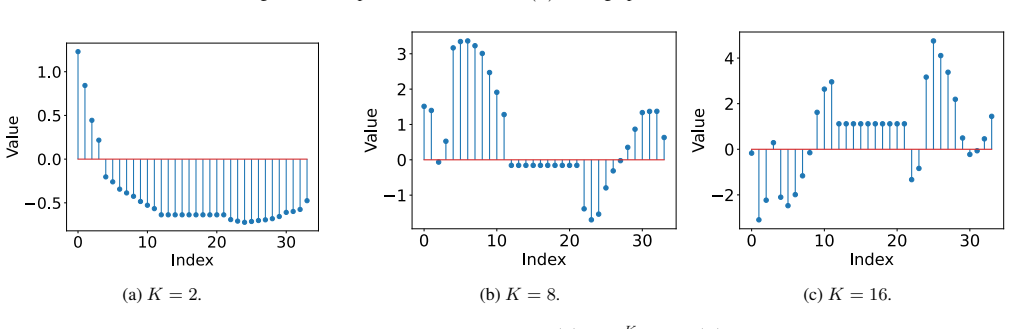
Figures from the paper (2 more)


Reference graph
Works this paper leans on
-
[1]
Beyond low-frequency information in graph convolutional networks
[Bo et al., 2021] Deyu Bo, Xiao Wang, Chuan Shi, and Huawei Shen. Beyond low-frequency information in graph convolutional networks. In Thirty-Fifth AAAI Confer- ence on Artificial Intelligence, Virtual Event, February 2- 9, pages 3950–3957. AAAI Press,
work page 2021
-
[4]
Spectral networks and locally connected networks on graphs
[Bruna et al., 2014] Joan Bruna, Wojciech Zaremba, Arthur Szlam, and Yann LeCun. Spectral networks and locally connected networks on graphs. In 2nd International Con- ference on Learning Representations, Banff, AB, Canada, April 14-16, Conference Track Proceedings,
work page 2014
-
[8]
Joshi, Anh Tuan Luu, Thomas Laurent, Yoshua Bengio, and Xavier Bresson
[Dwivedi et al., 2023] Vijay Prakash Dwivedi, Chaitanya K. Joshi, Anh Tuan Luu, Thomas Laurent, Yoshua Bengio, and Xavier Bresson. Benchmarking graph neural net- works. J. Mach. Learn. Res., 24:43:1–43:48,
work page 2023
-
[9]
ADR-GNN: advection-diffusion-reaction graph neural networks
[Eliasof et al., 2023] Moshe Eliasof, Eldad Haber, and Eran Treister. ADR-GNN: advection-diffusion-reaction graph neural networks. CoRR, abs/2307.16092,
arXiv 2023
-
[10]
[Erd˝os and R´enyi, 1959] P Erd ˝os and A R ´enyi. On random graphs i. Publicationes Mathematicae Debrecen, 6:290– 297,
work page 1959
-
[15]
OGB- LSC: A large-scale challenge for machine learning on graphs
[Hu et al., 2021] Weihua Hu, Matthias Fey, Hongyu Ren, Maho Nakata, Yuxiao Dong, and Jure Leskovec. OGB- LSC: A large-scale challenge for machine learning on graphs. In Proceedings of the Neural Information Process- ing Systems Track on Datasets and Benchmarks 1, Decem- ber 2021, virtual,
work page 2021
-
[16]
[Jin et al., 2022] Wei Jin, Xiaorui Liu, Yao Ma, Charu C. Aggarwal, and Jiliang Tang. Feature overcorrelation in deep graph neural networks: A new perspective. In KDD ’22: The 28th ACM SIGKDD Conference on Knowledge Discovery and Data Mining, Washington, DC, USA, Au- gust 14 - 18, pages 709–719. ACM,
work page 2022
-
[17]
[Kipf and Welling, 2017] Thomas N. Kipf and Max Welling. Semi-supervised classification with graph convolutional networks. In 5th International Conference on Learning Representations, ICLR 2017, Toulon, France, April 24-26, 2017, Conference Track Proceedings,
work page 2017
Show all 45 references
-
[20]
A reduction of a graph to a canonical form and an algebra arising during this reduction
[Leman and Weisfeiler, 1968] Andrei Leman and Boris We- isfeiler. A reduction of a graph to a canonical form and an algebra arising during this reduction. Nauchno- Technicheskaya Informatsiya, 2(9):12–16,
1968
-
[24]
Graph neural networks exponentially lose expressive power for node classification
[Oono and Suzuki, 2020] Kenta Oono and Taiji Suzuki. Graph neural networks exponentially lose expressive power for node classification. In 8th International Confer- ence on Learning Representations Addis Ababa, Ethiopia, April 26-30,
2020
-
[25]
Convolution operators and L(p,q ) spaces
[O’Neil, 1963] Richard O’Neil. Convolution operators and L(p,q ) spaces. Duke Mathematical Journal, 30(1):129 – 142,
1963
-
[27]
Recipe for a general, pow- erful, scalable graph transformer
[Ramp´asek et al., 2022] Ladislav Ramp ´asek, Michael Galkin, Vijay Prakash Dwivedi, Anh Tuan Luu, Guy Wolf, and Dominique Beaini. Recipe for a general, pow- erful, scalable graph transformer. In Advances in Neural Information Processing Systems 35: Annual Conference on Neural...
2022
-
[28]
Transforming pagerank into an infinite-depth graph neural network
[Roth and Liebig, 2022] Andreas Roth and Thomas Liebig. Transforming pagerank into an infinite-depth graph neural network. In Machine Learning and Knowledge Discovery in Databases - European Conference, ECML PKDD 2022, Grenoble, France, September 19-23, 2022, Proceedings, Part...
2022
-
[29]
Rank collapse causes over-smoothing and over-correlation in graph neural networks
[Roth and Liebig, 2023] Andreas Roth and Thomas Liebig. Rank collapse causes over-smoothing and over-correlation in graph neural networks. In Learning on Graphs Confer- ence, 27-30 November 2023, Virtual Event , volume 231, page
2023
-
[30]
Preventing representational rank collapse in mpnns by splitting the computational graph
[Roth et al., 2024] Andreas Roth, Franka Bause, Nils M Kriege, and Thomas Liebig. Preventing representational rank collapse in mpnns by splitting the computational graph. CoRR, abs/2409.11504,
2024 arXiv
-
[32]
Konstantin Rusch, Benjamin Paul Chamberlain, Michael W
[Rusch et al., 2023] T. Konstantin Rusch, Benjamin Paul Chamberlain, Michael W. Mahoney, Michael M. Bron- stein, and Siddhartha Mishra. Gradient gating for deep multi-rate learning on graphs. In The Eleventh Interna- tional Conference on Learning Representations, Kigali, Rwand...
2023
-
[33]
Discrete signal processing on graphs
[Sandryhaila and Moura, 2013] Aliaksei Sandryhaila and Jos´e MF Moura. Discrete signal processing on graphs. IEEE transactions on signal processing , 61(7):1644– 1656,
2013
-
[35]
[Sterling and Irwin, 2015] Teague Sterling and John J. Irwin. ZINC 15 - ligand discovery for everyone. J. Chem. Inf. Model., 55(11):2324–2337,
2015
-
[37]
Gomez, Lukasz Kaiser, and Illia Polosukhin
[Vaswani et al., 2017] Ashish Vaswani, Noam Shazeer, Niki Parmar, Jakob Uszkoreit, Llion Jones, Aidan N. Gomez, Lukasz Kaiser, and Illia Polosukhin. Attention is all you need. In Advances in Neural Information Processing Sys- tems 30: Annual Conference on Neural Information Pr...
2017
-
[38]
Graph attention networks
[Velickovicet al., 2018] Petar Velickovic, Guillem Cucurull, Arantxa Casanova, Adriana Romero, Pietro Li `o, and Yoshua Bengio. Graph attention networks. In 6th Interna- tional Conference on Learning Representations, Vancou- ver, BC, Canada, April 30 - May 3,
2018
-
[39]
Replacing softmax with relu in vision transformers
[Wortsman et al., 2023] Mitchell Wortsman, Jaehoon Lee, Justin Gilmer, and Simon Kornblith. Replacing softmax with relu in vision transformers. CoRR, abs/2309.08586,
2023 arXiv
-
[40]
Representation learning on graphs with jump- ing knowledge networks
[Xu et al., 2018] Keyulu Xu, Chengtao Li, Yonglong Tian, Tomohiro Sonobe, Ken-ichi Kawarabayashi, and Stefanie Jegelka. Representation learning on graphs with jump- ing knowledge networks. In Proceedings of the 35th International Conference on Machine Learning, Stock- holmsm¨a...
2018
-
[41]
How powerful are graph neural net- works? In 7th International Conference on Learning Rep- resentations, New Orleans, LA, USA, May 6-9,
[Xu et al., 2019] Keyulu Xu, Weihua Hu, Jure Leskovec, and Stefanie Jegelka. How powerful are graph neural net- works? In 7th International Conference on Learning Rep- resentations, New Orleans, LA, USA, May 6-9,
2019
-
[42]
Two sides of the same coin: Heterophily and oversmoothing in graph con- volutional neural networks
[Yan et al., 2022] Yujun Yan, Milad Hashemi, Kevin Swer- sky, Yaoqing Yang, and Danai Koutra. Two sides of the same coin: Heterophily and oversmoothing in graph con- volutional neural networks. In IEEE International Confer- ence on Data Mining, Orlando, FL, USA, November 28 - ...
2022
-
[43]
Multi-channel graph neural networks
[Zhou et al., 2020] Kaixiong Zhou, Qingquan Song, Xiao Huang, Daochen Zha, Na Zou, and Xia Hu. Multi-channel graph neural networks. InProceedings of the Twenty-Ninth International Joint Conference on Artificial Intelligence , pages 1352–1358. ijcai.org,
2020
-
[44]
We use the vectorized signal ˆx = vec(X) ∈ Rn·c by stacking its columns
Proof. We use the vectorized signal ˆx = vec(X) ∈ Rn·c by stacking its columns. The graph Fourier transform on ma- trices and tensors is applied along the node dimension, i.e., independently on each channel. For matrixX this results in F (X) =UTX∈ Rn×d and for tensor W in ˆW =...
2009
-
[45]
Proof. Similar to the proofs for Lemma 2 and Proposition 3 we need to show that for any element x1x2∈X and mul- tisetsX1X2⊂X with either x1̸= x2 orX1̸= b·X 2, we have X xp∈X1 W(1,p)xp−c· X xq∈X2 W(2,q)xq̸= 0 (21) Task Graph Regression Node Classification Dataset ZINC ZINC12k T...
-
[1959]
Marques, Alejandro Ribeiro, and Geert Leus
[Gama et al., 2018] Fernando Gama, Antonio G. Marques, Alejandro Ribeiro, and Geert Leus. MIMO graph fil- ters for convolutional neural networks. In 19th IEEE In- ternational Workshop on Signal Processing Advances in Wireless Communications, Kalamata, Greece, June 25-28, pages...
2018
-
[1963]
Geom-gcn: Geo- metric graph convolutional networks
[Pei et al., 2020] Hongbin Pei, Bingzhe Wei, Kevin Chen- Chuan Chang, Yu Lei, and Bo Yang. Geom-gcn: Geo- metric graph convolutional networks. In 8th International Conference on Learning Representations, Addis Ababa, Ethiopia, April 26-30,
2020
-
[1968]
Bronstein
[Levie et al., 2019] Ron Levie, Federico Monti, Xavier Bres- son, and Michael M. Bronstein. Cayleynets: Graph con- volutional neural networks with complex rational spectral filters. IEEE Trans. Signal Process., 67(1):97–109,
2019
-
[2009]
Hamilton, Vincent L´etourneau, and Prudencio Tossou
[Kreuzer et al., 2021] Devin Kreuzer, Dominique Beaini, William L. Hamilton, Vincent L´etourneau, and Prudencio Tossou. Rethinking graph transformers with spectral at- tention. In Advances in Neural Information Processing Systems 34: Annual Conference on Neural Information Pro...
2021
-
[2011]
Sheaf neural networks
[Hansen and Gebhart, 2020] Jakob Hansen and Thomas Gebhart. Sheaf neural networks. CoRR, abs/2012.06333,
2020 arXiv
-
[2013]
Rethinking softmax: Self-attention with polynomial acti- vations
[Saratchandran et al., 2024] Hemanth Saratchandran, Jian- qiao Zheng, Yiping Ji, Wenbo Zhang, and Simon Lucey. Rethinking softmax: Self-attention with polynomial acti- vations. CoRR, abs/2410.18613,
2024
-
[2014]
Convolutional learning on multigraphs
[Butler et al., 2023] Landon Butler, Alejandro Parada- Mayorga, and Alejandro Ribeiro. Convolutional learning on multigraphs. IEEE Trans. Signal Process., 71:933–946,
2023
-
[2015]
Where did the gap go? re- assessing the long-range graph benchmark
[T¨onshoff et al., 2024] Jan T ¨onshoff, Martin Ritzert, Eran Rosenbluth, and Martin Grohe. Where did the gap go? re- assessing the long-range graph benchmark. Trans. Mach. Learn. Res., 2024,
2024
-
[2016]
Long range graph benchmark
[Dwivedi et al., 2022] Vijay Prakash Dwivedi, Ladislav Ramp´asek, Michael Galkin, Ali Parviz, Guy Wolf, Anh Tuan Luu, and Dominique Beaini. Long range graph benchmark. In Advances in Neural Information Process- ing Systems 35: Annual Conference on Neural Information Processing...
2022
-
[2017]
Kolda and Brett W
[Kolda and Bader, 2009] Tamara G. Kolda and Brett W. Bader. Tensor decompositions and applications. SIAM Rev., 51(3):455–500,
2009
-
[2018]
Wavelets on graphs via spectral graph theory
[Hammond et al., 2011] David K Hammond, Pierre Van- dergheynst, and R´emi Gribonval. Wavelets on graphs via spectral graph theory. Applied and Computational Har- monic Analysis, 30(2):129–150,
2011
-
[2019]
Gpnet: Simpli- fying graph neural networks via multi-channel geometric polynomials
[Liu et al., 2025] Xun Liu, Alex Hay-Man Ng, Fangyuan Lei, Yikuan Zhang, and Zhengming Li. Gpnet: Simpli- fying graph neural networks via multi-channel geometric polynomials. Inf. Sci., 694:121696,
2025
-
[2020]
Deep residual learning for image recog- nition
[He et al., 2016] Kaiming He, Xiangyu Zhang, Shaoqing Ren, and Jian Sun. Deep residual learning for image recog- nition. In 2016 IEEE Conference on Computer Vision and Pattern Recognition, Las Vegas, NV , USA, June 27-30, pages 770–778. IEEE Computer Society,
2016
-
[2021]
Bronstein
[Bodnar et al., 2022] Cristian Bodnar, Francesco Di Gio- vanni, Benjamin Paul Chamberlain, Pietro Li ´o, and Michael M. Bronstein. Neural sheaf diffusion: A topo- logical perspective on heterophily and oversmoothing in gnns. In Advances in Neural Information Processing Sys- te...
2022
-
[2022]
How attentive are graph attention networks? In The Tenth International Conference on Learning Representa- tions, Virtual Event, April 25-29,
[Brody et al., 2022] Shaked Brody, Uri Alon, and Eran Ya- hav. How attentive are graph attention networks? In The Tenth International Conference on Learning Representa- tions, Virtual Event, April 25-29,
2022
-
[2023]
Convolutional neural networks on graphs with fast localized spectral filtering
[Defferrard et al., 2016] Micha¨el Defferrard, Xavier Bres- son, and Pierre Vandergheynst. Convolutional neural networks on graphs with fast localized spectral filtering. In Advances in Neural Information Processing Systems 29: Annual Conference on Neural Information Processin...
2016
-
[2024]
Simplifying the theory on over- smoothing
[Roth, 2024] Andreas Roth. Simplifying the theory on over- smoothing. CoRR, abs/2407.11876,
2024 arXiv
-
[2025]
Revisiting heterophily for graph neural networks
[Luan et al., 2022] Sitao Luan, Chenqing Hua, Qincheng Lu, Jiaqi Zhu, Mingde Zhao, Shuyuan Zhang, Xiao-Wen Chang, and Doina Precup. Revisiting heterophily for graph neural networks. In Advances in Neural Informa- tion Processing Systems 35: Annual Conference on Neural Informat...
2022
Reviewed August 15, 2026 · model on record in the stance chip above.
Discussion (0). Continue with ORCID to comment.