REVIEW 4 major objections 4 minor 45 references
EdgeWisePersona: A Dataset for On-Device User Profiling from Natural Language Interactions
T0 review · 4 major / 4 minor · reviewed 2026-08-15 · deepseek-v4-flash
Pith's one-line read The paper introduces a 10,000-session synthetic smart-home dataset and reports that compact, edge-deployable models recover almost none of a user's routines exactly, while large models reach 44 percent.
desk verdict Useful synthetic dataset and benchmark for on-device user profiling, but the evaluation lacks a no-session baseline, which leaves the central claim about reconstructing routines from sessions unproven; worth engaging with as a resource, not as stated results. read the letter →
The pith
A machine-rendered reading of the paper's core claim, the machinery that carries it, and where it could break.
The reading
What carries the argument
The central unit is a routine—a context-triggered rule of the form 'when [time, weather, sun phase, and temperature conditions] hold, adjust these devices to these settings.' A user's profile is the set of such routines plus a short personality description. The dataset is built by sampling realistic contexts, then asking a large language model to generate a dialogue consistent with the profile and context, so every session is anchored to known ground-truth routines; the authors call this self-validating because a model that recovers the routine from the dialogue demonstrates that the dialogue encodes it. The evaluation protocol then prompts a model to predict exactly as many routines as the ground truth contains and scores each prediction by exact match, partial overlap (Jaccard), and component-level accuracy for triggers, actions, scalar values, and categorical values. This mechanism—routine as ground truth and evaluation target—is what lets the benchmark separate the task of recognizing when a behavior occurs from the task of reproducing precisely how a user acts.
What would settle it
Run the same profile-reconstruction benchmark on real opt-in smart-home interaction logs for which the user's actual routines are known; if the gap between small and large models narrows or reverses, the synthetic benchmark's conclusion does not transfer to deployment. A cheaper probe is to feed the session generator only the personality descriptions and compare recovery rates, which would reveal whether routines are encoded in the dialogues or leak through stylistic cues.
Extended reading notes
Core claim
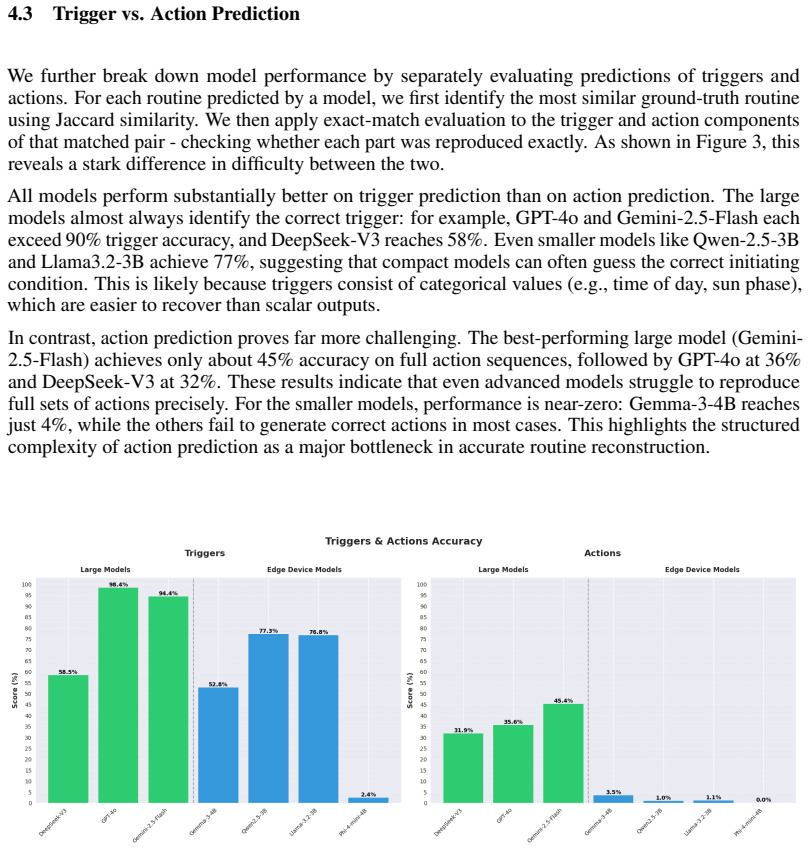
The paper's central discovery is that profile reconstruction from ordinary smart-home conversation is possible in principle but not yet attainable with current small, edge-deployable models. In the authors' evaluation, large models can capture most of a routine's components—trigger conditions are recovered correctly over 90% of the time—but exact, full-routine recovery remains hard even for them, with the best large model at 44%. Small models fall far behind: the strongest compact candidate reaches only 2% exact-match accuracy and its partial-overlap score is 66%, while the others are near zero on exact matches. The hardest component is the action sequence, particularly numeric device settings, where small models deviate by an order of magnitude more than large ones. The paper presents this large-versus-small gap, together with the dataset's self-validating design, as the empirical case for a benchmark that can drive work on privacy-preserving, on-device personalization.
Load-bearing premise
The paper's load-bearing premise is that sessions generated by a large language model from hand-designed profiles, after only light human correction, are realistic and varied enough to stand in for real smart-home user interactions; if that premise fails, the benchmark measures recovery of synthetic templates rather than actual user profiling.
Editorial extensions
If this is right
- Compact, edge-deployable models must move beyond recognizing routine triggers (which they already do reasonably well) to generating exact action sequences and numeric parameters, the components where they currently fail almost completely.
- Because the best large model still achieves only 44% exact-match routine recovery, exact full-structure prediction is not yet solved at any scale, so the benchmark defines a clear target for future work.
- The dataset's line-aligned structure—personality, routines, and sessions for each user stored in parallel files—supports both supervised training and standardized benchmarking of user profiling.
- The self-validating property gives researchers a quality check: if a large model recovers a routine from a generated session, that session demonstrably contains the behavior, so improvements in recovery reflect real progress in reading behavior from language.
- The benchmark's uniform prediction-count policy and component breakdowns provide a reusable template for evaluating other behavior-reconstruction tasks beyond smart homes.
Reading between the lines
- A reader might infer that the bottleneck for small models is structured output rather than context length: the small models can paraphrase routines but cannot emit them in the exact schema, so fine-tuning on schema-constrained generation could close more of the gap than adding parameters.
- The ease of trigger prediction suggests a cheap screening test: if a candidate on-device model can recover triggers from a short dialogue sample, researchers could fast-filter models before running the full structured decoding benchmark.
- The same routine-as-truth design could transfer to other device domains where behavior is defined by context and settings, such as automotive assistance or wearable health automation, with minimal changes to the protocols.
- A testable extension of the self-validating logic is to isolate the influence of the personality description: if removing it from the session prompts changes large-model recovery substantially, part of the measured profiling performance may come from stylistic cues rather than from behavior inferred from interaction.
Signed reviews
Editorial analysis
A structured set of objections, weighed in public.
Referee Report
Summary. The paper introduces EdgeWisePersona, a synthetic dataset of smart-home interaction sessions in which each user is associated with a structured profile of routines (context-triggered device-action patterns). Sessions are generated by DeepSeek-V3 from hand-designed profiles, then human-reviewed. The core benchmark task is profile reconstruction: given a user's 50 natural-language sessions, a model must output the user's routines. The authors benchmark three large models (GPT-4o, Gemini-2.5-Flash, DeepSeek-V3) and four compact edge-deployable models (Gemma-3-4B, Qwen-2.5-3B, Llama-3.2-3B, Phi-4-mini-4B), reporting exact-match, Jaccard, MAE on scalar fields, and categorical accuracy. They conclude that small models lag large models substantially, especially on exact action recovery, and that the dataset is a realistic testbed for on-device profiling.
Significance. If the benchmark measures what it claims, this is a useful public resource: it provides a structured, multi-session, profile-annotated dataset in a domain where such resources are scarce, and it ships open-source evaluation code. The reported gap between small and large models is qualitatively consistent across exact-match, Jaccard, MAE, and categorical metrics, which is a genuine empirical finding. The paper's main weakness is that the evaluation protocol leaks information about the ground truth and lacks control conditions that would show the scores reflect session content rather than generic priors; these issues affect the validity of the central claim that the benchmark measures profile reconstruction from interaction history.
major comments (4)
- [Section 4.1, Evaluation Protocol] The protocol states that 'models are prompted to predict exactly the same number of routines as the ground truth contains.' This leaks the routine count, which is part of the profile structure and is not available in a realistic setting where a model sees only the interaction history. Providing the count can materially inflate scores and weakens the claim that routines are inferred 'solely from interactions history.' The authors should either not provide the count, evaluate sensitivity to it, or justify it as a fixed deployment design choice with evidence that it does not drive the main conclusions.
- [Section 3 and Section 4 (no control condition)] No control condition is reported that ties the scores to the session content. Because the routine space is small (categorical triggers and a limited set of device actions), a model could produce plausible routines from priors alone, without reading the sessions. The paper's 'self-validating' argument in Section 3 only shows that the generator's priors align with the evaluator's priors. I request baselines such as: a majority-class routine predictor, a no-session prompt, a session-shuffled prompt, or a prompt containing random sessions. These controls are necessary to support the claim that high Jaccard values (e.g., Gemini 90%) reflect successful profiling rather than template matching.
- [Section 4.1 and Section 4.3 (matching procedure)] The evaluation does not specify how predicted routines are aligned to ground-truth routines for the routine-level exact-match and Jaccard metrics. Section 4.1 says there is 'one-to-one correspondence' after truncation/padding, but routines are not naturally ordered, and if predictions are compared positionally, any permutation would be penalized. Section 4.3 uses 'most similar ground-truth routine' for trigger/action breakdown, which suggests a matching step, but the routine-level metrics in Section 4.2 must use the same or an explicitly defined matching rule. Please describe the alignment algorithm precisely (e.g., greedy matching by Jaccard, Hungarian assignment) and report whether the conclusions are robust to the choice.
- [Section 3.2 and Section 4 (generator-as-benchmarked-model circularity)] DeepSeek-V3 generated all sessions and is also one of the benchmarked models. The paper even calls the dataset 'inherently self-validating.' This creates a circularity risk for DeepSeek-V3's scores and for the claim that strong large-model performance confirms 'internal coherence and task alignment.' The authors should discuss this explicitly and, if possible, report whether DeepSeek-V3's results change when it is evaluated on a held-out subset or on sessions it did not generate. At minimum, the 'self-validating' terminology should be replaced with a more cautious description of what the large-model scores demonstrate.
minor comments (4)
- [Section 3.2 (Human Review)] The human review step is described only as 'minor corrections are made when needed'; please quantify the number of annotators, the fraction of sessions edited, and any inter-annotator agreement measure, since the dataset's realism claim depends partly on this step.
- [Section 5 (Limitations)] The limitations section does not mention that the benchmark is fully synthetic and that no real-world validation is provided; given the paper's claims about 'realistic, structured testbed,' a sentence on this is warranted.
- [References] Reference [41] contains a typo: 'Adaptive Layer Tuning and V oting' should be 'Adaptive Layer Tuning and Voting.'
- [Appendix A (Schemas)] The appendix documents the routines and sessions schemas but not the characters.jsonl schema, although the dataset structure in Section 3.2 lists it as a core aligned file; please include it for completeness.
Circularity Check
The 'self-validating' dataset claim and the ground-truth routine-count leakage undercut the 'solely from interactions' framing, but the central small-vs-large model comparison is not reduced to fitted values.
-
self definitional
[Section 3, Dataset Design (first paragraph)]
"The dataset is synthetic, generated using the DeepSeek-V3 [7] language model, but has been meticulously designed according to a set of behavioral and contextual rules described below to ensure realism and consistency. It is inherently self-validating: since sessions are derived from known user routines, and the benchmark task is to recover these routines from the generated dialogues, strong performance by large language models confirms internal coherence and task alignment."
The validation argument assumes what it tries to prove: the sessions are generated from the routines, so recovering those routines from the generated dialogues measures generator consistency, not the realism or diversity of the sessions. The circularity is compounded because DeepSeek-V3 is both the generator and one of the benchmarked 'large language models,' so its high scores are partly self-prediction. Without controls such as shuffled sessions, no-session prompts, or real interaction logs, the reported scores cannot separate information carried by the sessions from priors shared between generator and evaluator.
-
other
[Section 4.1, Evaluation Protocol]
"Specifically, models are prompted to predict exactly the same number of routines as the ground truth contains. If a model generates more routines than the reference, we truncate the extra predictions; if it generates fewer, we retain the given predictions (leaving the missing routines as blank)."
The number of routines is a property of the target profile, not of the interaction history. Supplying this count to the models means the reconstruction is not performed 'solely from interactions history' as the abstract claims; the cardinality of the answer is provided by the ground truth. The reported per-routine metrics are therefore computed under a protocol that leaks target information, so the benchmark's headline claim that scores measure profile reconstruction from interaction history is weakened by construction.
full rationale
No load-bearing self-citation chain appears: the paper cites model technical reports and prior datasets, but does not rely on the authors' own uniqueness theorems or fitted parameters. The central comparison between small and large models is not reduced to the dataset's inputs, since all models see the same sessions and are scored against the same routines. However, two features of the paper's own text are circular or near-circular. First, the 'inherently self-validating' argument uses benchmark performance on generated sessions as evidence of dataset quality, and DeepSeek-V3 is both the generator and a benchmarked model. Second, the evaluation protocol leaks the ground-truth routine count into the prompt, contradicting the 'solely from interactions history' framing. These issues affect the interpretation of absolute scores and the dataset-validity argument, but they do not by construction force the small-vs-large gap, so the circularity is partial rather than total.
Assumptions & free parameters
assumptions (4)
- domain assumption DeepSeek-V3 generated sessions faithfully represent realistic user behavior in smart homes.
- domain assumption The routine/trigger/action schema is a valid model of user behavior, so reconstructing routines is a meaningful proxy for user profiling.
- domain assumption Human review ensures local coherence and fidelity to profiles.
- ad hoc to paper Providing the model with the exact number of ground-truth routines is a fair and realistic evaluation policy.
Cite this review
Pith. "Pith review of EdgeWisePersona: A Dataset for On-Device User Profiling from Natural Language Interactions." pith.science (2026). https://pith.science/paper/I2UQDK77
@misc{pith2026250511417,
  author       = {Pith},
  title        = {Pith review of: EdgeWisePersona: A Dataset for On-Device User Profiling from Natural Language Interactions},
  year         = {2026},
  howpublished = {\url{https://pith.science/paper/I2UQDK77}},
  note         = {Machine review of arXiv:2505.11417}
}
read the original abstract
This paper introduces a novel dataset and evaluation benchmark designed to assess and improve small language models deployable on edge devices, with a focus on user profiling from multi-session natural language interactions in smart home environments. At the core of the dataset are structured user profiles, each defined by a set of routines - context-triggered, repeatable patterns of behavior that govern how users interact with their home systems. Using these profiles as input, a large language model (LLM) generates corresponding interaction sessions that simulate realistic, diverse, and context-aware dialogues between users and their devices. The primary task supported by this dataset is profile reconstruction: inferring user routines and preferences solely from interactions history. To assess how well current models can perform this task under realistic conditions, we benchmarked several state-of-the-art compact language models and compared their performance against large foundation models. Our results show that while small models demonstrate some capability in reconstructing profiles, they still fall significantly short of large models in accurately capturing user behavior. This performance gap poses a major challenge - particularly because on-device processing offers critical advantages, such as preserving user privacy, minimizing latency, and enabling personalized experiences without reliance on the cloud. By providing a realistic, structured testbed for developing and evaluating behavioral modeling under these constraints, our dataset represents a key step toward enabling intelligent, privacy-respecting AI systems that learn and adapt directly on user-owned devices.
Figures


Reference graph
Works this paper leans on
-
[1]
Hewett, Mojan Javaheripi, Piero Kauffmann, James R
Marah Abdin, Jyoti Aneja, Harkirat Behl, Sébastien Bubeck, Ronen Eldan, Suriya Gunasekar, Michael Harrison, Russell J. Hewett, Mojan Javaheripi, Piero Kauffmann, James R. Lee, Yin Tat Lee, Yuanzhi Li, Weishung Liu, Caio C. T. Mendes, Anh Nguyen, Eric Price, Gustavo de Rosa, Olli Saarikivi, Adil Salim, Shital Shah, Xin Wang, Rachel Ward, Yue Wu, Dingli Yu,...
arXiv 2024
-
[2]
Amin Aminifar, Matin Shokri, and Amir Aminifar. 2024. Privacy-preserving edge federated learning for intelligent mobile-health systems. Future Generation Computer Systems 161 (Dec. 2024), 625–637. https://doi.org/10.1016/j.future.2024.07.035
-
[3]
Krisztian Balog and ChengXiang Zhai. 2025. User Simulation in the Era of Generative AI: User Modeling, Synthetic Data Generation, and System Evaluation. arXiv:2501.04410 [cs.AI] https://arxiv.org/ abs/2501.04410
arXiv 2025
-
[4]
Ryan Barker. 2025. Advancements in Mobile Edge Computing and Open RAN: Leveraging Artificial Intelligence and Machine Learning for Wireless Systems. arXiv:2502.02886 [cs.NI] https://arxiv. org/abs/2502.02886
work page Pith review arXiv 2025
-
[5]
Rune Birkmose, Nathan Mørkeberg Reece, Esben Hofstedt Norvin, Johannes Bjerva, and Mike Zhang
-
[6]
Home Assistant Requests Dataset. 2023. https://huggingface.co/datasets/acon96/ Home-Assistant-Requests Accessed: 2025-05-14
work page 2023
-
[7]
DeepSeek-AI. 2025. DeepSeek-V3 Technical Report. arXiv:2412.19437 [cs.CL] https://arxiv.org/ abs/2412.19437
arXiv 2025
-
[8]
ONNX Runtime developers. 2021. ONNX Runtime. https://onnxruntime.ai/. Version: x.y.z
work page 2021
Show all 45 references
-
[9]
Executorch. 2024. Executorch. GitHub repository. https://github.com/pytorch/executorch
2024
-
[10]
Georgi Gerganov. 2023. llama.cpp: Efficient Inference of LLMs on CPUs. GitHub repository. https: //github.com/ggerganov/llama.cpp
2023
-
[11]
Google DeepMind. 2025. Gemini 2.5 Flash Preview: Model Card . Technical Report. Google. https: //storage.googleapis.com/model-cards/documents/gemini-2.5-flash-preview.pdf Ac- cessed: 2025-05-15
2025
-
[12]
Rakshith Jayanth, Neelesh Gupta, and Viktor Prasanna. 2024. Benchmarking Edge AI Platforms for High-Performance ML Inference. arXiv:2409.14803 [cs.AI] https://arxiv.org/abs/2409.14803
2024 arXiv
-
[13]
Xiaotang Jiang, Huan Wang, Yiliu Chen, Ziqi Wu, Lichuan Wang, Bin Zou, Yafeng Yang, Zongyang Cui, Yu Cai, Tianhang Yu, Chengfei Lv, and Zhihua Wu. 2020. MNN: A Universal and Efficient Inference Engine. In MLSys
2020
-
[14]
Hyunwoo Kim, Jack Hessel, Liwei Jiang, Peter West, Ximing Lu, Youngjae Yu, Pei Zhou, Ronan Le Bras, Malihe Alikhani, Gunhee Kim, Maarten Sap, and Yejin Choi. 2022. SODA: Million-scale Dialogue Distillation with Social Commonsense Contextualization. ArXiv abs/2212.10465 (2022)
2022 arXiv
-
[15]
Minseo Kim, Wei Shu, and Mohsen Amini Salehi. 2024. HE2C: A Holistic Approach for Allocating Latency-Sensitive AI Tasks across Edge-Cloud. arXiv:2411.19487 [cs.DC] https://arxiv.org/abs/ 2411.19487
2024 arXiv
-
[16]
Andreas Köpf, Yannic Kilcher, Dimitri von Rütte, Sotiris Anagnostidis, Zhi-Rui Tam, Keith Stevens, Abdullah Barhoum, Nguyen Minh Duc, Oliver Stanley, Richárd Nagyfi, Shahul ES, Sameer Suri, David Glushkov, Arnav Dantuluri, Andrew Maguire, Christoph Schuhmann, Huu Nguyen, and A...
2023 arXiv
-
[17]
Chao-Lin Lee, Chun-Ping Chung, Sheng-Yuan Cheng, Jenq-Kuen Lee, and Robert Lai and. 2023. Accelerating AI performance with the incorporation of TVM and MediaTek NeuroPilot. Con- nection Science 35, 1 (2023), 2272586. https://doi.org/10.1080/09540091.2023.2272586 arXiv:https://...
2023
-
[18]
Jinhao Li, Jiaming Xu, Shan Huang, Yonghua Chen, Wen Li, Jun Liu, Yaoxiu Lian, Jiayi Pan, Li Ding, Hao Zhou, Yu Wang, and Guohao Dai. 2025. Large Language Model Inference Acceleration: A Comprehensive Hardware Perspective. arXiv:2410.04466 [cs.AR] https://arxiv.org/abs/2410.04466
2025 arXiv
-
[19]
LLM Stats. 2024. LLM Stats – Leaderboard and Metrics for Large Language Models. https://github. com/JonathanChavezTamales/LLMStats Project homepage: https://llm-stats.com, Accessed: 2025-05-14
2024
-
[20]
Yuyi Mao, Xianghao Yu, Kaibin Huang, Ying-Jun Angela Zhang, and Jun Zhang. 2024. Green Edge AI: A Contemporary Survey. arXiv:2312.00333 [cs.AI] https://arxiv.org/abs/2312.00333
2024 arXiv
-
[21]
Meta AI. 2024. Llama 3.2: Revolutionizing Edge AI and Vision with Open, Customizable Models. https: //ai.meta.com/blog/llama-3-2-connect-2024-vision-edge-mobile-devices/ . Accessed: 2025-05-15
2024
-
[22]
A. H. Miller, W. Feng, A. Fisch, J. Lu, D. Batra, A. Bordes, D. Parikh, and J. Weston. 2017. ParlAI: A Dialog Research Software Platform. arXiv preprint arXiv:1705.06476 (2017)
2017 arXiv
-
[23]
Mozhgan Navardi, Romina Aalishah, Yuzhe Fu, Yueqian Lin, Hai Li, Yiran Chen, and Tinoosh Mohsenin. 2025. GenAI at the Edge: Comprehensive Survey on Empowering Edge Devices. arXiv:2502.15816 [cs.DC] https://arxiv.org/abs/2502.15816
2025 arXiv
-
[24]
OpenAI. 2024. GPT-4 Technical Report. arXiv:2303.08774 [cs.CL] https://arxiv.org/abs/2303. 08774 10
2024 arXiv
-
[25]
OpenAI. 2024. GPT-4o System Card. arXiv:2410.21276 [cs.CL] https://arxiv.org/abs/2410. 21276
2024 arXiv
-
[26]
Qwen. 2025. Qwen2.5 Technical Report. arXiv:2412.15115 [cs.CL] https://arxiv.org/abs/2412. 15115
2025 arXiv
-
[27]
Shaibal Saha and Lanyu Xu. 2025. Vision Transformers on the Edge: A Comprehensive Survey of Model Compression and Acceleration Strategies. arXiv:2503.02891 [cs.CV] https://arxiv.org/abs/2503. 02891
2025 arXiv
-
[28]
Dasari, Brent Venable, and Brian Jalaian
Jacob Sander, Achraf Cohen, Venkat R. Dasari, Brent Venable, and Brian Jalaian. 2025. On Accelerating Edge AI: Optimizing Resource-Constrained Environments. arXiv:2501.15014 [cs.LG] https://arxiv. org/abs/2501.15014
2025 arXiv
-
[29]
Muhammad Shafique, Alberto Marchisio, Rachmad Vidya Wicaksana Putra, and Muhammad Abdullah Hanif. 2021. Towards Energy-Efficient and Secure Edge AI: A Cross-Layer Framework ICCAD Special Session Paper. In 2021 IEEE/ACM International Conference On Computer Aided Design (ICCAD) ...
2021
-
[30]
Shashi Suman, Francois Rivest, and Ali Etemad. 2022. Towards Personalization of User Preferences in Partially Observable Smart Home Environments. arXiv:2112.00971 [cs.AI] https://arxiv.org/abs/ 2112.00971
2022 arXiv
-
[31]
Tianxiang Tan and Guohong Cao. 2021. Deep Learning on Mobile Devices Through Neural Processing Units and Edge Computing. arXiv:2112.02439 [cs.NI] https://arxiv.org/abs/2112.02439
2021 arXiv
-
[32]
Jiuqiang Tang, Raman Sarokin, Ekaterina Ignasheva, Grant Jensen, Lin Chen, Juhyun Lee, Andrei Kulik, and Matthias Grundmann. 2025. Scaling On-Device GPU Inference for Large Generative Models. arXiv:2505.00232 [cs.LG] https://arxiv.org/abs/2505.00232
2025 arXiv
-
[33]
Gemini Team. 2025. Gemini: A Family of Highly Capable Multimodal Models. arXiv:2312.11805 [cs.CL] https://arxiv.org/abs/2312.11805
2025 arXiv
-
[34]
Gemma Team. 2025. Gemma 3 Technical Report. arXiv:2503.19786 [cs.CL] https://arxiv.org/ abs/2503.19786
2025 arXiv
-
[35]
Llama Team. 2024. The Llama 3 Herd of Models. arXiv:2407.21783 [cs.AI] https://arxiv.org/ abs/2407.21783
2024 arXiv
-
[36]
Xubin Wang and Weijia Jia. 2025. Optimizing Edge AI: A Comprehensive Survey on Data, Model, and System Strategies. arXiv:2501.03265 [cs.LG] https://arxiv.org/abs/2501.03265
2025
-
[37]
Xubin Wang, Zhiqing Tang, Jianxiong Guo, Tianhui Meng, Chenhao Wang, Tian Wang, and Weijia Jia
-
[38]
Rahmani, Varsha Ramineni, and Emine Yilmaz
Bin Wu, Zhengyan Shi, Hossein A. Rahmani, Varsha Ramineni, and Emine Yilmaz. 2024. Understanding the Role of User Profile in the Personalization of Large Language Models. arXiv:2406.17803 [cs.CL] https://arxiv.org/abs/2406.17803
2024 arXiv
-
[39]
Empowering Edge Intelligence: A Comprehensive Survey on On-Device AI Models. Comput. Surveys 57, 9 (April 2025), 1–39. https://doi.org/10.1145/3724420
2025 doi
-
[40]
Shengyuan Ye, Bei Ouyang, Liekang Zeng, Tianyi Qian, Xiaowen Chu, Jian Tang, and Xu Chen. 2025. Jupiter: Fast and Resource-Efficient Collaborative Inference of Generative LLMs on Edge Devices. arXiv:2504.08242 [cs.DC] https://arxiv.org/abs/2504.08242
2025 arXiv
-
[41]
Daliang Xu, Hao Zhang, Liming Yang, Ruiqi Liu, Gang Huang, Mengwei Xu, and Xuanzhe Liu. 2024. Fast On-device LLM Inference with NPUs. arXiv:2407.05858 [cs.AI] https://arxiv.org/abs/2407. 05858
2024 arXiv
-
[42]
Siyan Zhao, Mingyi Hong, Yang Liu, Devamanyu Hazarika, and Kaixiang Lin. 2025. Do LLMs Recognize Your Preferences? Evaluating Personalized Preference Following in LLMs. arXiv:2502.09597 [cs.LG] https://arxiv.org/abs/2502.09597
2025 arXiv
-
[43]
Zhongzhi Yu, Zheng Wang, Yuhan Li, Haoran You, Ruijie Gao, Xiaoya Zhou, Sreenidhi Reedy Bommu, Yang Katie Zhao, and Yingyan Celine Lin. 2024. EDGE-LLM: Enabling Efficient Large Language Model Adaptation on Edge Devices via Layerwise Unified Compression and Adaptive Layer Tunin...
2024 arXiv
-
[45]
morning" |
Lianmin Zheng, Wei-Lin Chiang, Ying Sheng, Tianle Li, Siyuan Zhuang, Zhanghao Wu, Yonghao Zhuang, Zhuohan Li, Zi Lin, Eric P. Xing, Joseph E. Gonzalez, Ion Stoica, and Hao Zhang. 2024. LMSYS-Chat-1M: A Large-Scale Real-World LLM Conversation Dataset. arXiv:2309.11998 [cs.CL] h...
2024 arXiv
-
[2025]
arXiv:2502.12923 [cs.CL] https://arxiv.org/abs/2502.12923 9
On-Device LLMs for Home Assistant: Dual Role in Intent Detection and Response Generation. arXiv:2502.12923 [cs.CL] https://arxiv.org/abs/2502.12923 9
Reviewed August 15, 2026 · model on record in the stance chip above.
Discussion (0). Continue with ORCID to comment.