REVIEW 3 major objections 6 minor 74 references
Pull-off force prediction in viscoelastic adhesive Hertzian contact by physics augmented machine learning
T0 review · 3 major / 6 minor · reviewed 2026-08-15 · deepseek-v4-flash
Pith's one-line read A physics-augmented machine-learning model trained on boundary-element simulations can predict the pull-off force and detachment work of a rigid sphere pulled from a viscoelastic substrate in milliseconds, covering regimes where analytic…
desk verdict A solid surrogate-model paper with genuinely useful data and models, but the wide-range generalization claim leans on an extrapolation that is checked only against the authors' own analytical model. read the letter →
The pith
A machine-rendered reading of the paper's core claim, the machinery that carries it, and where it could break.
The reading
What carries the argument
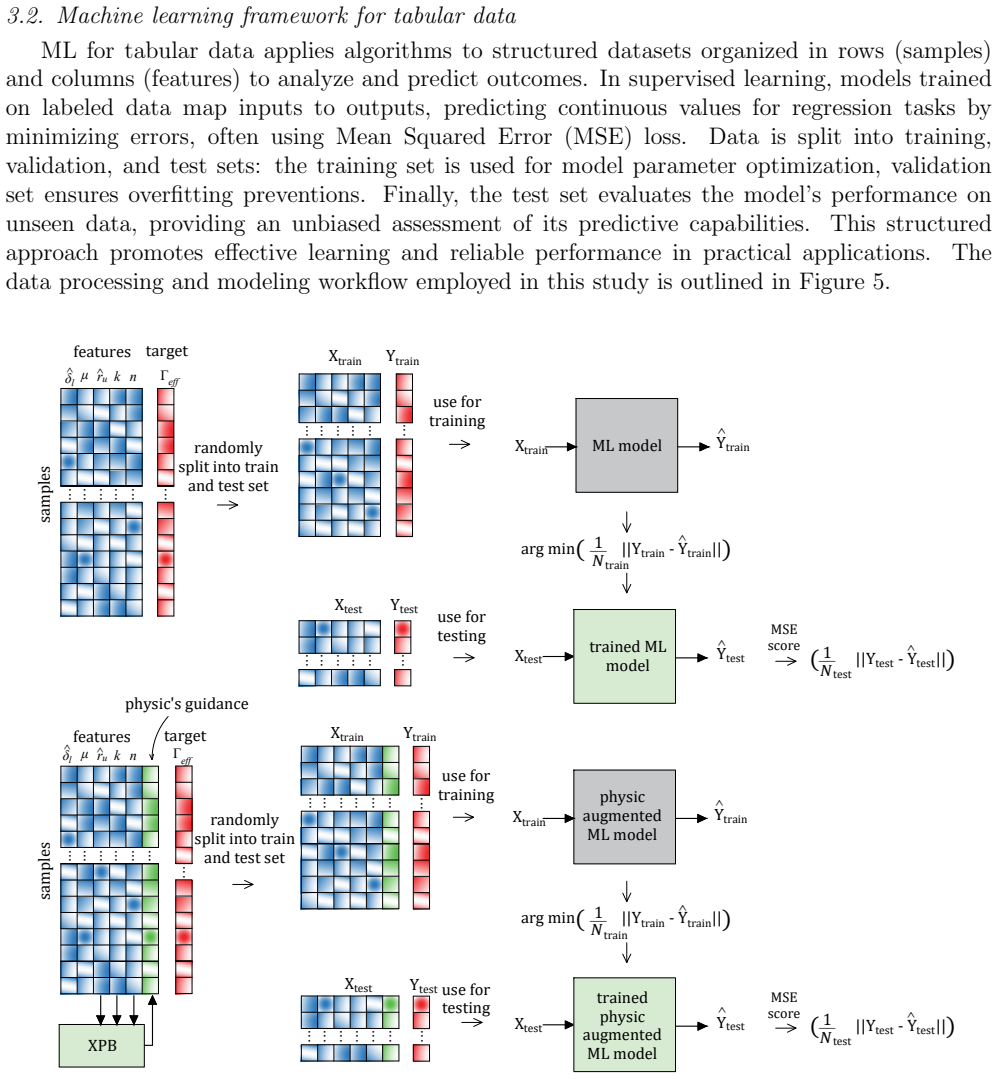
The machine is a supervised regression pipeline on tabular data with five dimensionless physical inputs, a boundary-element dataset generated from the intermolecular force-separation law, the Boltzmann history integral, and a modified power-law creep compliance, plus one extra input, the analytic XPB model's effective surface energy. XPB is a closed-form integral that extends steady-state viscoelastic crack theory to broad-band materials; feeding its output to the regressor lets the model learn only the residual between the analytic approximation and the numerical truth. This is what makes the surrogate fast, small, and interpretable, and it also gives the model a physically consistent anchor when extrapolating beyond the training set, for example to power-law exponents for which simulations failed to converge.
What would settle it
Run colloid-probe retraction experiments on a well-characterized silicone at fixed geometry, with independent viscoelastic characterization, over preloads from shallow to deep and retraction rates spanning the rubbery-to-glassy transition; if the measured normalized pull-off force or work-to-pull-off deviates from the PA-ML predictions by more than the stated test error in the low-Tabor, low-preload regime, the simulation-to-reality transfer claimed by the model is falsified. A cheaper internal check is to recompute a fresh random set of parameter combinations with an independent boundary-element implementation and compare against the surrogate.
Extended reading notes
Core claim
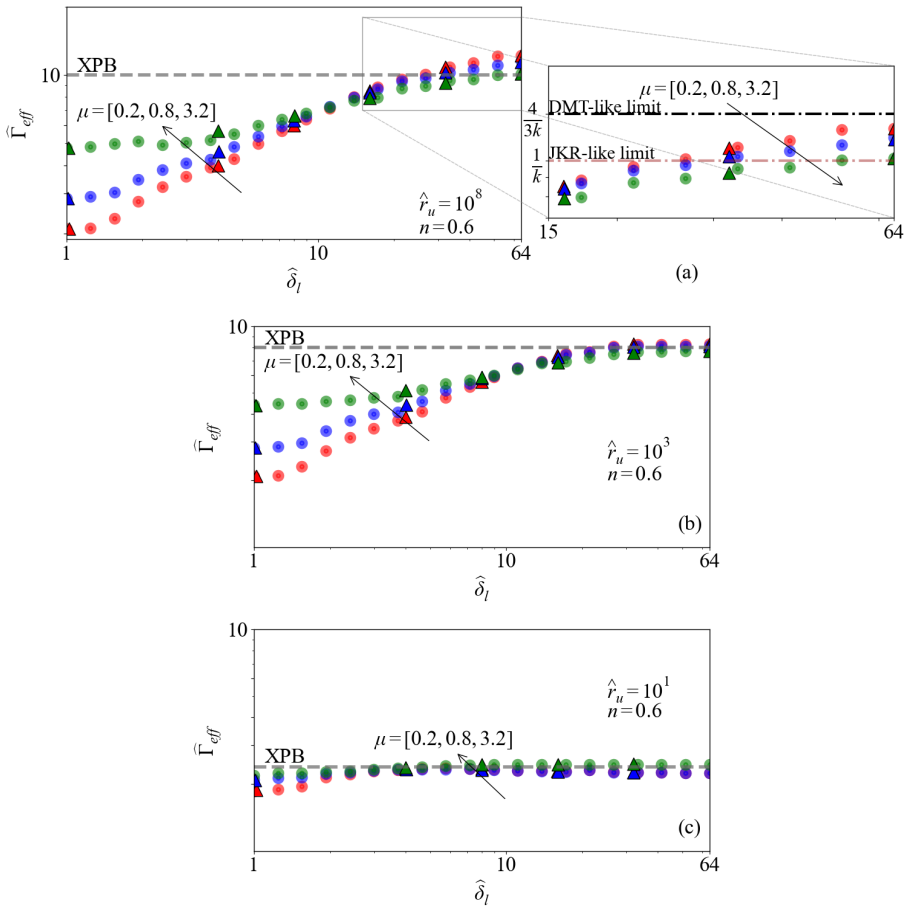
The central finding is that the analytic XPB prediction, used as a physics-guidance feature, lets tree-based regressors correct the analytic error rather than learn the whole contact law from data. This physics augmentation reduces cross-validated MSE from about $1.45 \times 10^{-4}$ to $5.75 \times 10^{-5}$ for effective surface energy and improves agreement with XPB in untrained regions, while remaining faithful to boundary-element test data where XPB is invalid, namely at low Tabor parameter, low indentation depth, and high unloading rate. Using the trained model to sweep parameters, the paper identifies a depth-dependent Tabor effect: at shallow indentation depths the effective surface energy grows with the Tabor parameter, while at deep indentations a larger Tabor parameter shifts behavior toward the short-range-adhesion (JKR) limit and lowers adhesion. For work-to-pull-off, the area under the tensile part of the unloading curve, no analytical model exists; the PA-ML model predicts a bell-shaped dependence on unloading rate and an interaction with the power-law exponent such that the exponent raises detachment work at low rates and lowers it at high rates.
Load-bearing premise
The load-bearing premise is that the boundary-element simulations, built on the force-separation law, the Boltzmann history integral, and the modified power-law compliance, faithfully represent real viscoelastic adhesive pull-off; the paper validates against its own numerical solver and the analytic XPB model, with no experimental data.
Editorial extensions
If this is right
- Contact simulations that took up to about 9.8 hours per case can be replaced by sub-millisecond predictions, making real-time adhesion control or design-loop optimization feasible for grippers, climbing robots, and soft-material manufacturing.
- The model spans the transition between short-range (JKR-like) and long-range (DMT-like) adhesion in viscoelastic contacts, including low-preload, low-Tabor, and high-rate regimes where the analytic XPB model fails, so it can serve as the general estimator there.
- Adhesion strength in soft viscoelastic contacts can be tuned through preload and indentation depth as well as retraction rate and material spectrum; the predicted depth-dependent Tabor effect is a new design lever.
- The work-to-pull-off predictions provide an energy-based detachment criterion where no analytical formula exists, useful for energy budget calculations in soft robotics and adhesive interfaces.
Reading between the lines
- The paper's accuracy claims are about reproducing simulated boundary-element physics; transferring the surrogate to real silicones or elastomers would require calibration or experimental validation, since no laboratory measurements appear in the training or test data.
- The success of feeding the XPB output as a feature suggests a general recipe: any closed-form contact approximation can be used to augment ML surrogates for other outputs, such as contact area, friction, or energy release rate, in regimes where the approximation is partly valid.
- The predicted depth-dependent Tabor effect is directly testable with colloid-probe or atomic-force-microscope retraction experiments at fixed rate and varying preload; if confirmed, it implies that shallow-indentation grippers benefit more from high-surface-energy materials than deep-indentation contacts do.
Signed reviews
Editorial analysis
A structured set of objections, weighed in public.
Referee Report
Summary. The manuscript proposes physics-augmented machine learning (PA-ML) surrogates for the normalized pull-off force (effective surface energy) and the work-to-pull-off of a rigid sphere unloaded from a viscoelastic adhesive half-space. Training targets are generated with a Boundary Element Method (BEM) that combines a Lennard-Jones traction law, a Boltzmann history integral, and a modified power-law creep compliance (Eqs. 1-4). The model inputs are the Tabor parameter, the power-law exponent, the modulus ratio, the indentation depth, and the unloading rate; the PA-ML variant adds the analytical XPB prediction (Eq. 5) as an additional feature. The authors compare linear regression, regression trees, random forest, and XGBoost using five-fold cross-validation, reporting R-squared values of about 0.9995 for effective surface energy and 0.9956 for work-to-pull-off, and they use the trained PA-ML model to explore rate-, depth-, and Tabor-parameter-dependent adhesion. The paper also provides open data and code on Zenodo and GitHub.
Significance. If the accuracy claim is understood as accuracy relative to the BEM model, this is a useful and reproducible surrogate- modelling contribution: the train/test split on BEM targets makes the interpolation evaluation non-circular, the data and code are openly available, and the predicted JKR and DMT limits in Figure 9 are physically sensible. The value of the surrogate lies in the region where XPB is invalid and BEM is expensive. However, the paper's broader claims extend to a region where BEM has no ground truth and where the only reference is XPB, which is also used as an input feature; that part of the claim is not independently established and should be re-scoped or supplemented.
major comments (3)
- [Section 4.1, Figure 6] The broad-band extrapolation claim for n=0.2, delta_l >= 73, and mu >= 3.24 is not validated by BEM, because the authors state that in this regime the BEM fails to determine the pull-off force at reasonable computational cost. The only reference used in Figure 6 is the XPB analytical model. Since Section 3.2 feeds the XPB output as an input feature to the PA-ML model, agreement with XPB in this regime is partly built into the model architecture and does not independently establish accuracy. Please either validate this regime with an independent numerical method or experiment, or explicitly rephrase the claims as interpolation plus consistency with XPB, rather than as validated 'wide range' accuracy.
- [Section 2, Appendix A] The ground truth throughout the paper is entirely numerical: there are no experimental measurements and no convergence or uncertainty quantification for the BEM solutions. The abstract's statement that the model 'properly predicts' pull-off in soft materials like silicones and elastomers therefore goes beyond what the manuscript demonstrates, because the BEM itself inherits the assumptions of the Lennard-Jones law, the Boltzmann integral, and the modified power-law compliance. Please add an explicit statement that accuracy is established only with respect to the BEM model, or add an experimental benchmark.
- [Section 3.2, Eq. (5), Tables 2 and 4] The XPB feature is not parameter-free: it depends on the fitted constants alpha ~ pi/9 and the crack-velocity relation v-hat = 2.887 r-hat_u^1.171 taken from reference [20]. Consequently, in the extrapolated regime the PA-ML model inherits any systematic error in XPB. The manuscript should state this limitation explicitly and, ideally, test the sensitivity of the PA-ML predictions to plausible variations of these constants, so that the reader can judge how much of the reported generalization comes from physics guidance rather than from a specific fitted analytical model.
minor comments (6)
- [Abstract] The text contains small language issues: 'an Hertzian profile' should be 'a Hertzian profile', and 'silicons' should be 'silicones'.
- [Section 5] There is a typo in 'inidentation depth' in the conclusions, and the word 'approachesd' appears in the final sentence of Section 5.
- [Section 3.2 vs Section 5] The paper states in Section 3.2 that the total number of data samples 'does not exceed 8505', while Section 5 says '8921 samples generated'. This numerical inconsistency should be reconciled.
- [Appendix A.1, Eq. (A.6)] Equation (A.6) contains an unmatched parenthesis and the notation 'XbGij' is not defined; please define the influence-matrix notation and correct the formula.
- [Figure 4] The axis labels in Figure 4 are difficult to read, with superscripts such as '^ru', '^n', and '^delta_l' appearing in a garbled typeset form; please regenerate the figure with clear mathematical notation.
- [Section 4.2, Tables 3 and 4] The comparison of PA-ML versus ML for work-to-pull-off uses the XPB-predicted effective surface energy as an additional feature. Since the physical connection between Gamma_eff and the work-to-pull-off is not discussed, please add a remark on why this feature is expected to help, rather than merely describing the MSE improvement.
Assumptions & free parameters
free parameters (2)
- XPB critical-stress factor alpha =
pi/9, approximately 0.349
- Crack velocity-unloading rate constants 2.887 and 1.171 =
v-hat = 2.887 r-hat-u^1.171
assumptions (5)
- domain assumption Lennard-Jones force-separation law (Eq. 1) governs interfacial adhesion.
- domain assumption Elastic-viscoelastic correspondence principle and Boltzmann history integral (Eq. 3) describe substrate deformation.
- domain assumption Modified power-law creep compliance (Eq. 4) with C0=1/E0 and C-infinity=1/E-infinity represents broad-band viscoelastic materials.
- domain assumption Substrate is initially fully relaxed and unloading starts from a specified indentation depth.
- ad hoc to paper XPB model output used as a feature is a trustworthy physics guide for effective surface energy in the augmented region.
Cite this review
Pith. "Pith review of Pull-off force prediction in viscoelastic adhesive Hertzian contact by physics augmented machine learning." pith.science (2026). https://pith.science/paper/AET3K3YJ
@misc{pith2026250511685,
  author       = {Pith},
  title        = {Pith review of: Pull-off force prediction in viscoelastic adhesive Hertzian contact by physics augmented machine learning},
  year         = {2026},
  howpublished = {\url{https://pith.science/paper/AET3K3YJ}},
  note         = {Machine review of arXiv:2505.11685}
}
read the original abstract
Understanding and predicting the adhesive properties of viscoelastic Hertzian contacts is crucial for diverse engineering applications, including robotics, biomechanics, and advanced material design. The maximum adherence force of a Hertzian indenter unloaded from a viscoelastic substrate has been studied with analytical and numerical models. Analytical models are valid within their assumptions, numerical methods offer precision but can be computationally expensive, necessitating alternative solutions. This study introduces a novel physics-augmented machine learning (PA-ML) framework as a hybrid approach, bridging the gap between analytical models and data-driven solutions, which is capable of rapidly predicting the pull-off force in an Hertzian profile unloaded from a broad band viscoelastic material, with varying Tabor parameter, preload and retraction rate. Compared to previous models, the PA-ML approach provides fast yet accurate predictions in a wide range of conditions, properly predicting the effective surface energy and the work-to-pull-off. The integration of the analytical model provides critical guidance to the PA-ML framework, supporting physically consistent predictions. We demonstrate that physics augmentation enhances predictive accuracy, reducing mean squared error (MSE) while increasing model efficiency and interpretability. We provide data-driven and PA-ML models for real-time predictions of the adherence force in soft materials like silicons and elastomers opening to the possibility to integrate PA-ML into materials and interface design. The models are openly available on Zenodo and GitHub.
Figures


Figures from the paper (8 more)





Reference graph
Works this paper leans on
-
[20]
A. Maghami, Q. Wang, M. Tricarico, M. Ciavarella, Q. Li, A. Papangelo, Bulk and fracture process zone contribution to the rate-dependent adhesion amplification in viscoelastic broad- band materials, Journal of the Mechanics and Physics of Solids 193 (2024) 105844
work page 2024
-
[1]
W. Ji, Z. Qian, B. Xu, G. Chen, D. Zhao, Apple viscoelastic complex model for bruise damage analysis in constant velocity grasping by gripper, Computers and Electronics in Agriculture 162 (2019) 907–920
work page 2019
-
[2]
Z. Liu, F. Yan, Switchable adhesion: on-demand bonding and debonding, Advanced Science 9 (12) (2022) 2200264
work page 2022
-
[3]
A. Papangelo, R. Nazari, M. Ciavarella, Friction for a sliding adhesive viscoelastic cylinder: Effect of maugis parameter, European Journal of Mechanics-A/Solids 107 (2024) 105348
work page 2024
-
[4]
M. Ciavarella, A. Papangelo, On the degree of irreversibility of friction in sheared soft adhe- sive contacts, Tribology letters 68 (3) (2020) 81
work page 2020
-
[5]
H. Guo, Y. Lan, Z. Gao, C. Zhang, L. Zhang, X. Li, J. Lin, A. Elsheikh, W. Chen, Interaction between eye movements and adhesion of extraocular muscles, Acta Biomaterialia 176 (2024) 304–320
work page 2024
-
[6]
G. Giordano, R. B. N. Scharff, M. Carlotti, M. Gagliardi, C. Filippeschi, A. Mondini, A. Pa- pangelo, B. Mazzolai, Mechanochromic suction cups for local stress detection in soft robotics, Advanced Intelligent Systems (2024) 2400254
work page 2024
-
[7]
B. Tao, Z. Gong, H. Ding, Climbing robots for manufacturing, National Science Review 10 (5) (2023) nwad042
work page 2023
Show all 74 references
-
[8]
Liang, Y
X. Liang, Y. Zhang, F. Liu, F. Richter, M. Yip, Autopeel: Adhesion-aware safe peeling trajectory optimization for robotic wound care, arXiv preprint arXiv:2409.14282 (2024)
2024 arXiv
-
[9]
K. D. Humfeld, D. Gu, G. A. Butler, K. Nelson, N. Zobeiry, A machine learning framework for real-time inverse modeling and multi-objective process optimization of composites for active manufacturing control, Composites Part B: Engineering 223 (2021) 109150. 23
2021
-
[10]
K. L. Johnson, K. Kendall, A. Roberts, Surface energy and the contact of elastic solids, Proceedings of the royal society of London. A. mathematical and physical sciences 324 (1558) (1971) 301–313
1971
-
[11]
B. V. Derjaguin, V. M. Muller, Y. P. Toporov, Effect of contact deformations on the adhesion of particles, Journal of Colloid and interface science 53 (2) (1975) 314–326
1975
-
[12]
Tabor, Surface forces and surface interactions, Journal of Colloid and Interface Science 58 (1) (1977) 2–13
D. Tabor, Surface forces and surface interactions, Journal of Colloid and Interface Science 58 (1) (1977) 2–13
1977
-
[13]
Maugis, Adhesion of spheres: the jkr-dmt transition using a dugdale model, Journal of colloid and interface science 150 (1) (1992) 243–269
D. Maugis, Adhesion of spheres: the jkr-dmt transition using a dugdale model, Journal of colloid and interface science 150 (1) (1992) 243–269
1992
-
[14]
Greenwood, Adhesion of elastic spheres, Proceedings of the Royal Society of London
J. Greenwood, Adhesion of elastic spheres, Proceedings of the Royal Society of London. Series A: Mathematical, Physical and Engineering Sciences 453 (1961) (1997) 1277–1297
1961
-
[15]
J. Q. Feng, Contact behavior of spherical elastic particles: a computational study of parti- cle adhesion and deformations, Colloids and Surfaces A: Physicochemical and Engineering Aspects 172 (1-3) (2000) 175–198
2000
-
[16]
Papangelo, M
A. Papangelo, M. Ciavarella, A numerical study on roughness-induced adhesion enhancement in a sphere with an axisymmetric sinusoidal waviness using lennard–jones interaction law, Lubricants 8 (9) (2020) 90
2020
-
[17]
Tricarico, M
M. Tricarico, M. Ciavarella, A. Papangelo, Enhancement of adhesion strength through mi- crovibrations: Modeling and experiments, Journal of the Mechanics and Physics of Solids 196 (2025) 106020
2025
-
[18]
Ciavarella, M
M. Ciavarella, M. Tricarico, A. Papangelo, On the dynamic jkr adhesion problem, Mechanics of Materials 202 (2025) 105252
2025
-
[19]
Maghami, M
A. Maghami, M. Tricarico, M. Ciavarella, A. Papangelo, Viscoelastic amplification of the pull-off stress in the detachment of a rigid flat punch from an adhesive soft viscoelastic layer, Engineering Fracture Mechanics 298 (2024) 109898
2024
-
[21]
Afferrante, G
L. Afferrante, G. Violano, On the effective surface energy in viscoelastic hertzian contacts, Journal of the Mechanics and Physics of Solids 158 (2022) 104669
2022
-
[22]
Violano, A
G. Violano, A. Chateauminois, L. Afferrante, A jkr-like solution for viscoelastic adhesive contacts, Frontiers in Mechanical Engineering 7 (2021) 664486
2021
-
[23]
R. A. Schapery, A theory of crack initiation and growth in viscoelastic media: I. theoretical development, International Journal of fracture 11 (1975) 141–159
1975
-
[24]
R. A. Schapery, A theory of crack initiation and growth in viscoelastic media ii. approximate methods of analysis, International Journal of Fracture 11 (1975) 369–388
1975
-
[25]
Greenwood, K
J. Greenwood, K. Johnson, The mechanics of adhesion of viscoelastic solids, Philosophical Magazine A 43 (3) (1981) 697–711. 24
1981
-
[26]
Greenwood, The theory of viscoelastic crack propagation and healing, Journal of Physics D: Applied Physics 37 (18) (2004) 2557
J. Greenwood, The theory of viscoelastic crack propagation and healing, Journal of Physics D: Applied Physics 37 (18) (2004) 2557
2004
-
[27]
R. A. Schapery, A theory of viscoelastic crack growth: revisited, International Journal of Fracture 233 (1) (2022) 1–16
2022
-
[28]
Persson, E
B. Persson, E. Brener, Crack propagation in viscoelastic solids, Physical Review E 71 (3) (2005) 036123
2005
-
[29]
Persson, Crack propagation in finite-sized viscoelastic solids with application to adhesion, Europhysics Letters 119 (1) (2017) 18002
B. Persson, Crack propagation in finite-sized viscoelastic solids with application to adhesion, Europhysics Letters 119 (1) (2017) 18002
2017
-
[30]
Persson, A simple model for viscoelastic crack propagation, The European Physical Jour- nal E 44 (2021) 1–10
B. Persson, A simple model for viscoelastic crack propagation, The European Physical Jour- nal E 44 (2021) 1–10
2021
-
[31]
Carbone, C
G. Carbone, C. Mandriota, N. Menga, Theory of viscoelastic adhesion and friction, Extreme Mechanics Letters 56 (2022) 101877
2022
-
[32]
Mandriota, N
C. Mandriota, N. Menga, G. Carbone, Adhesive contact mechanics of viscoelastic materials, International Journal of Solids and Structures 290 (2024) 112685
2024
-
[33]
Papangelo, M
A. Papangelo, M. Ciavarella, Detachment of a rigid flat punch from a viscoelastic material, Tribology letters 71 (2) (2023) 48
2023
-
[34]
Violano, L
G. Violano, L. Afferrante, Size effects in adhesive contacts of viscoelastic media, European Journal of Mechanics-A/Solids 96 (2022) 104665
2022
-
[35]
Q. Wang, A. Papangelo, M. Ciavarella, H. Gao, Q. Li, Rapid detachment of a rigid sphere adhered to a viscoelastic substrate: An upper bound model incorporating maugis parameter and preload effects, Journal of the Mechanics and Physics of Solids 196 (2025) 106028
2025
-
[36]
Violano, L
G. Violano, L. Afferrante, On the long and short-range adhesive interactions in viscoelastic contacts, Tribology Letters 70 (3) (2022) 68
2022
-
[37]
M. S. Ahmad-Abad, A. Maghami, M. Ghalishooyan, A. Shooshtari, A family of minimum residual displacement methods as nonlinear solution schemes for equilibrium path-following in structural mechanics, Computers & Structures 300 (2024) 107407
2024
-
[38]
F. V. Souza, D. H. Allen, Multiscale modeling of impact on heterogeneous viscoelastic solids containing evolving microcracks, International Journal for Numerical Methods in Engineering 82 (4) (2010) 464–504
2010
-
[39]
K. Guo, Z. Yang, C.-H. Yu, M. J. Buehler, Artificial intelligence and machine learning in design of mechanical materials, Materials Horizons 8 (4) (2021) 1153–1172
2021
-
[40]
Goodfellow, Y
I. Goodfellow, Y. Bengio, A. Courville, Deep Learning, MIT Press, 2016, http://www. deeplearningbook.org
2016
-
[41]
C. T. Mackay, D. Nowell, Informed machine learning methods for application in engineer- ing: A review, Proceedings of the Institution of Mechanical Engineers, Part C: Journal of Mechanical Engineering Science 237 (24) (2023) 5801–5818. 25
2023
-
[42]
J. Zhu, Y. Xue, Z. Liu, A transfer learning enhanced physics-informed neural network for parameter identification in soft materials, Applied Mathematics and Mechanics 45 (10) (2024) 1685–1704
2024
-
[43]
Javadi, A
S. Javadi, A. Maghami, S. M. Hosseini, A deep learning approach based on a data-driven tool for classification and prediction of thermoelastic wave’s band structures for phononic crystals, Mechanics of Advanced Materials and Structures 29 (27) (2022) 6612–6625
2022
-
[44]
Kellner, M
L. Kellner, M. Stender, H. Herrnring, S. Ehlers, N. Hoffmann, K. V. Høyland, et al., Estab- lishing a common database of ice experiments and using machine learning to understand and predict ice behavior, Cold regions science and technology 162 (2019) 56–73
2019
-
[45]
Eshkofti, S
K. Eshkofti, S. M. Hosseini, The modified physics-informed neural network (pinn) method for the thermoelastic wave propagation analysis based on the moore-gibson-thompson theory in porous materials, Composite Structures 348 (2024) 118485
2024
-
[46]
Y.-T. Wang, X. Zhang, X.-S. Liu, Machine learning approaches to rock fracture mechanics problems: Mode-i fracture toughness determination, Engineering Fracture Mechanics 253 (2021) 107890
2021
-
[47]
C. E. Athanasiou, X. Liu, B. Zhang, T. Cai, C. Ramirez, N. P. Padture, J. Lou, B. W. Sheldon, H. Gao, Integrated simulation, machine learning, and experimental approach to characterizing fracture instability in indentation pillar-splitting of materials, Journal of the Mechanic...
2023
-
[48]
R. Yi, D. Georgiou, X. Liu, C. E. Athanasiou, Mechanics-informed, model-free symbolic regression framework for solving fracture problems, Journal of the Mechanics and Physics of Solids (2024) 105916
2024
-
[49]
Perera, V
R. Perera, V. Agrawal, A generalized machine learning framework for brittle crack problems using transfer learning and graph neural networks, Mechanics of Materials 181 (2023) 104639
2023
-
[50]
X. Li, X. Zhang, W. Feng, Q. Wang, Machine learning-based prediction of fracture toughness and path in the presence of micro-defects, Engineering Fracture Mechanics 276 (2022) 108900
2022
-
[51]
Goodbrake, S
C. Goodbrake, S. Motiwale, M. S. Sacks, A neural network finite element method for contact mechanics, Computer Methods in Applied Mechanics and Engineering 419 (2024) 116671
2024
-
[52]
Motiwale, W
S. Motiwale, W. Zhang, R. Feldmeier, M. S. Sacks, A neural network finite element approach for high speed cardiac mechanics simulations, Computer Methods in Applied Mechanics and Engineering 427 (2024) 117060
2024
-
[53]
Kalliorinne, R
K. Kalliorinne, R. Larsson, F. P´ erez-R` afols, M. Liwicki, A. Almqvist, Artificial neural net- work architecture for prediction of contact mechanical response, Frontiers in Mechanical Engineering 6 (2021) 579825
2021
-
[54]
Sahin, M
T. Sahin, M. von Danwitz, A. Popp, Solving forward and inverse problems of contact me- chanics using physics-informed neural networks, Advanced Modeling and Simulation in En- gineering Sciences 11 (1) (2024) 11
2024
-
[55]
Sahin, D
T. Sahin, D. Wolff, A. Popp, Physics-informed neural networks for solving contact problems in three dimensions, arXiv preprint arXiv:2412.09022 (2024). 26
2024
-
[56]
Stender, M
M. Stender, M. Tiedemann, D. Spieler, D. Schoepflin, N. Hoffmann, S. Oberst, Deep learning for brake squeal: Brake noise detection, characterization and prediction, Mechanical Systems and Signal Processing 149 (2021) 107181
2021
-
[57]
Geier, S
C. Geier, S. Hamdi, T. Chancelier, P. Dufr´ enoy, N. Hoffmann, M. Stender, Machine learning- based state maps for complex dynamical systems: applications to friction-excited brake system vibrations, Nonlinear dynamics 111 (24) (2023) 22137–22151
2023
-
[58]
Sattari Baboukani, Z
B. Sattari Baboukani, Z. Ye, K. G Reyes, P. C. Nalam, Prediction of nanoscale friction for two-dimensional materials using a machine learning approach, Tribology Letters 68 (2020) 1–14
2020
-
[59]
Didonna, M
M. Didonna, M. Stender, A. Papangelo, F. Fontanela, M. Ciavarella, N. Hoffmann, Recon- struction of governing equations from vibration measurements for geometrically nonlinear systems, Lubricants 7 (8) (2019) 64
2019
-
[60]
Y. Kim, C. Yang, Y. Kim, G. X. Gu, S. Ryu, Designing an adhesive pillar shape with deep learning-based optimization, ACS applied materials & interfaces 12 (21) (2020) 24458–24465
2020
-
[61]
D. Son, V. Liimatainen, M. Sitti, Machine learning-based and experimentally validated op- timal adhesive fibril designs, Small 17 (39) (2021) 2102867
2021
-
[62]
A. Luo, H. Zhang, K. T. Turner, Machine learning-based optimization of the design of composite pillars for dry adhesives, Extreme Mechanics Letters 54 (2022) 101695
2022
-
[63]
Y. Kim, J. Yeo, K. Park, A. Destr´ ee, Z. Qin, S. Ryu, Designing directional adhesive pillars using deep learning-based optimization, 3d printing, and testing, Mechanics of Materials 185 (2023) 104778
2023
-
[64]
C. B. Dayan, D. Son, A. Aghakhani, Y. Wu, S. O. Demir, M. Sitti, Machine learning-based shear optimal adhesive microstructures with experimental validation, Small 20 (2) (2024) 2304437
2024
-
[65]
Shojaeifard, M
M. Shojaeifard, M. Ferraresso, A. Lucantonio, M. Bacca, Machine learning-based optimal design of fibrillar adhesives, Journal of the Royal Society Interface 22 (223) (2025) 20240636
2025
-
[66]
Johnson, J
K. Johnson, J. Greenwood, An adhesion map for the contact of elastic spheres, Journal of colloid and interface science 192 (2) (1997) 326–333
1997
-
[67]
Christensen, Theory of viscoelasticity: an introduction, Elsevier, 2012
R. Christensen, Theory of viscoelasticity: an introduction, Elsevier, 2012
2012
-
[68]
M. L. Williams, Structural analysis of viscoelastic materials, AIAA journal 2 (5) (1964) 785–808
1964
-
[69]
Shintake, V
J. Shintake, V. Cacucciolo, D. Floreano, H. Shea, Soft robotic grippers, Advanced materials 30 (29) (2018) 1707035
2018
-
[70]
Sahli, G
R. Sahli, G. Pallares, A. Papangelo, M. Ciavarella, C. Ducottet, N. Ponthus, J. Scheib- ert, Shear-induced anisotropy in rough elastomer contact, Physical Review Letters 122 (21) (2019) 214301
2019
-
[71]
Ciavarella, An upper bound for viscoelastic pull-off of a sphere with a maugis-dugdale model, The Journal of Adhesion 98 (13) (2022) 2118–2131
M. Ciavarella, An upper bound for viscoelastic pull-off of a sphere with a maugis-dugdale model, The Journal of Adhesion 98 (13) (2022) 2118–2131. 27
2022
-
[72]
K. L. Johnson, Contact Mechanics, Cambridge University Press, Cambridge, 1987
1987
-
[73]
Molnar, Interpretable Machine Learning: A Guide for Making Black Box Mod- els Explainable, 3rd Edition, 2025, retrieved from https://christophm.github.io/ interpretable-ml-book/
C. Molnar, Interpretable Machine Learning: A Guide for Making Black Box Mod- els Explainable, 3rd Edition, 2025, retrieved from https://christophm.github.io/ interpretable-ml-book/
2025
-
[74]
T. Chen, C. Guestrin, Xgboost: A scalable tree boosting system, in: Proceedings of the 22nd ACM SIGKDD International Conference on Knowledge Discovery and Data Mining, ACM, 2016, pp. 785–794. doi:10.1145/2939672.2939785. 28
2016
Reviewed August 15, 2026 · model on record in the stance chip above.
Discussion (0). Continue with ORCID to comment.