REVIEW 4 major objections 5 minor 1 cited by
Fair-PP: A Synthetic Dataset for Aligning LLM with Personalized Preferences of Social Equity
T0 review · 4 major / 5 minor · reviewed 2026-08-15 · deepseek-v4-flash
Pith's one-line read Synthetic role-play data lets a small LLM align to a target persona's equity preferences while staying distinct from other personas.
desk verdict A useful synthetic dataset and a sensible reweighting method, but the alignment claims only reach simulated personas until human validation is added. read the letter →
The pith
A machine-rendered reading of the paper's core claim, the machinery that carries it, and where it could break.
The reading
What carries the argument
The central mechanism is a persona-anchored preference space. The seven persona portrayals are fixed by their answer distributions over 34,089 questions, and any model's answer distribution is located in the space by 1 minus Jensen-Shannon distance to each persona anchor. The alignment mechanism is the sample reweighting formula $W_i = (T_i/N_i)/\sum_j T_j/N_j$, which upweights training examples where the target persona is in a small agreement tier and downweights common answers; the reweighted samples are then fed to SFT or DPO. This weighting is what converts a generic alignment step into a personalization step that separates the target persona from the others.
What would settle it
Give the FAIR-PP questionnaire to a representative sample of real people in each of the seven UK segments and compare their answer distributions with GPT-4o-mini's role-play responses; if the Jensen-Shannon distance between human and simulated distributions is not near zero on a held-out question set, the dataset's labels do not stand in for human preferences.
Extended reading notes
Core claim
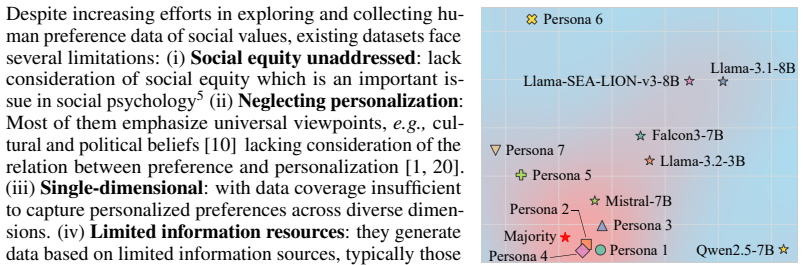
The paper builds FAIR-PP by combining 28 social groups, 98 equity topics, and five binary perspective dimensions (meritocracy versus egalitarianism, procedural versus distributive justice, individualism versus collectivism, social norm versus equity concerns, moral versus legal), producing multiple-choice questions with two value-opposed options and an N/A option. A commercial LLM, GPT-4o-mini, answers every question under seven persona prompts derived from a 2020 UK survey, yielding 238,623 preference records. The paper treats the seven personas as anchor points in a personalized preference space, and positions six open-weight regional LLMs inside that space; all six sit closest to Persona 3, the Disengaged Battlers. For alignment, it proposes sample-level reweighting: answers on which the target persona agrees with many other personas are down-weighted, and answers unique to the target persona are up-weighted, with weights set by the formula $W_i = (T_i/N_i)/\sum_j T_j/N_j$ where $T_i$ is the agreement-frequency tier and $N_i$ the count in that tier. Fine-tuning Llama-3.2-3B with weighted DPO raises similarity to target Persona 6 to 0.98 on held-out questions while increasing average distance from the other personas by 10.20 to 12.00 percent over vanilla DPO; on generated scenario variants it reaches 0.87 similarity and cuts similarity to other personas by 37.80 percent relative to vanilla.
Load-bearing premise
The load-bearing premise is that a language model instructed to role-play a persona produces equity preferences matching those of real people in that social segment, so the synthetic labels are treated as ground truth for human preferences.
Editorial extensions
If this is right
- Personalized social-equity alignment can be done from synthetic role-play data alone, avoiding the cost of collecting new human preference labels.
- Weighting training samples by how distinctive they are for the target persona improves both alignment to the target and separation from the other personas; weighted DPO is the strongest of the tested methods.
- Mainstream open-weight LLMs are not value-neutral in the FAIR-PP space: all six tested models are nearest to the Disengaged Battlers persona, Persona 3.
- Persona alignment transfers to generated scenario variants of the test questions, indicating the fine-tuning is not merely memorizing template wording.
- The same resource can serve both as a benchmark for mapping LLM value positions and as training data for re-targeting those positions.
Reading between the lines
- Since evaluation uses the same synthetic persona space that generated the labels, the reported gains show consistency with simulated personas; a human validation study is needed before claiming alignment with real human values.
- The uniqueness weighting treats rarity as persona identity, so it may overfit to idiosyncratic or low-quality questions; holding out entire equity topics would test whether the persona profile is coherent rather than memorized.
- The same role-play-plus-reweighting recipe could extend to other contested value domains, but the paper only demonstrates it for social equity with personas from one country and one time point.
- Mapping non-UK models against UK-derived persona anchors may reflect the anchor set more than actual regional value differences.
Signed reviews
Editorial analysis
A structured set of objections, weighed in public.
Referee Report
Summary. The paper introduces FAIR-PP, a synthetic dataset of 238,623 personalized preference records on social equity, generated by having GPT-4o-mini role-play seven personas derived from the 2020 UK More in Common survey. The dataset is built from a question bank covering 28 social groups, 98 equity topics, and five preference dimensions. The authors also contribute an automated data generation framework, an analysis of where six mainstream LLMs sit in the resulting persona-anchored preference space, and a sample-reweighting method (WSFT/WDPO) for aligning a model with a target persona while increasing divergence from other personas. Experiments on Llama-3.2-3B report that WDPO achieves 0.98 similarity to Persona 6 on the held-out original test set and 0.87 on the generation-based simulation set, outperforming DPO and SFT baselines.
Significance. If the results hold, FAIR-PP is a useful resource for studying persona-conditioned preference alignment at scale, and the reweighting idea—upweighting preference samples that are unique to a target persona—is a simple, plausible mechanism for increasing alignment specificity. The public release of the dataset and code is a concrete strength, and the automated generation framework could be adapted to other survey-derived value dimensions. The main significance is qualified by a fundamental external-validity gap: all training labels and evaluation anchors come from the same GPT-4o-mini role-play process, so the reported alignment gains have not been shown to transfer to actual human segments. The paper's contribution is better described as 'alignment with simulated personas' unless independent human validation is added.
major comments (4)
- [Section 2.5 and Sections 3.2–3.3] The training preference labels and the evaluation anchors are both produced by GPT-4o-mini role-playing the same seven persona descriptions defined in Section 2.5. The held-out test set is a random split of the same synthetic data, and the simulation set in Section 3.3 is generated by GPT-4o from the test questions. Consequently, the 0.98 similarity to Persona 6 reported in Table 2 measures agreement with the label generator's role-play distribution, not with any real human segment. The paper should either add an independent human validation subset (e.g., real survey responses matched to the seven UK segments) or systematically reframe all 'personalized preferences' claims as 'simulated persona preferences' throughout the abstract, introduction, and conclusions.
- [Tables 2 and 3] No error bars, multiple seeds, or significance tests are reported. The central comparison between WDPO and DPO is numerically identical on the original test set for Persona 6 (0.98 vs. 0.98 in Table 2), and the simulation-set difference (0.87 vs. 0.77 in Table 3) could fall within run-to-run noise. The authors should report mean and standard deviation over at least three to five random seeds and include a paired significance test (e.g., bootstrap or Wilcoxon) for the differences that support the central claim.
- [Section 3.2 and Equation (1)] The reported 'margin' improvements of 10.20% and 12.00% are undefined, and the phrase 'compared to vanilla' is ambiguous (vanilla DPO or unaligned vanilla?). Please define a scalar divergence metric, for example the average 1 - Jensen-Shannon distance to all non-target personas, and state the baseline explicitly. In addition, the reweighting formula depends on the arbitrary mapping from matching-frequency counts to tier numbers in Appendix E (Table 4); report the sensitivity of the results to reasonable alternative mappings.
- [Section 3.1 and Table 1] The claim of positioning LLMs 'across five major global regions' is not supported by the experimental design. Each region is represented by at most one model (two models for North America), so the observed similarities, such as Qwen2.5-7B being closest to Persona 3, conflate model architecture/company with regional representation. To support a regional claim, the authors should either include multiple models per region or explicitly temper the contribution to 'positioning of several representative open-weight models.'
minor comments (5)
- [Section 2.2 and Abstract] The text says the topics total 97 specific topics, while the abstract and Figure 2 report 98 equity topics. Please reconcile the count.
- [Section 2.6] The cross-reference 'In the subsequent Section 2.1' appears to intend Section 3.1, since Section 2.1 is about social groups. Please correct the reference.
- [Section 3.3] The statement that WDPO 'decrease[s] 37.80% compared to vanilla' does not specify the baseline (vanilla DPO or unaligned vanilla) or the metric used. Please define both.
- [Appendix E] There is a formatting issue: 'batch size to32and16' should read 'batch size to 32 and 16'. Please also define all hyperparameters for the reweighting tiers in a single table.
- [Abstract] The abstract mentions 'five major global regions,' but Section 3.1 evaluates six models from five regions. Please clarify whether the analysis is at the model level or the region level.
Circularity Check
No significant circularity: the synthetic dataset and alignment evaluation form an internally consistent benchmark, with human-validation absence as a correctness limitation, not a derivation loop.
full rationale
I find no step in the claimed derivation chain that reduces to its own inputs by construction. FAIR-PP is explicitly introduced as a synthetic dataset: Section 2.5 states that 'we leverage GPT-4o-mini to simulate seven representative personas to capture the diverse personalized preference,' and the persona anchors used for evaluation are constructed from the same role-play procedure. The alignment experiments in Sections 3.2 and 3.3 split this synthetic dataset into held-out training and test portions and measure 1 - Jensen-Shannon distance to those anchors. That is a self-contained internal benchmark rather than a circular derivation: the reported scores (e.g., 0.98 toward Persona 6) are empirical generalization results on held-out synthetic labels, not quantities that equal the training objective by definition. The sample reweighting formula in Equation (1) is a method applied to the dataset, and its reported gains are relative comparisons against vanilla SFT and DPO on the same held-out data. There are no load-bearing self-citations; the cited works for the similarity metric and self-calibration prompt are external and not authored by the present paper's authors. The paper's own Section 5 limitation—'incorporating human survey responses or validation could further enhance data quality'—correctly identifies the absence of human validation. This is an external-validity concern about whether the synthetic labels reflect real human equity preferences, not a circularity in the paper's internal derivation. The central claims are honestly scoped to a synthetic preference space, so the circularity score is 0.
Assumptions & free parameters
free parameters (1)
- Frequency tier mapping for sample reweighting =
Tier mapping 6->1, 5->2, 4->3, 3->4, 2->5, 1->6, 0->7; weights 0.015 to 0.205
assumptions (4)
- domain assumption LLM role-play with self-calibration produces valid proxies for real human personas
- domain assumption The seven UK More in Common personas generalize to global regions
- domain assumption The five preference dimensions span the relevant equity preference space
- standard math Jensen-Shannon distance is an appropriate similarity metric for preference distributions
Cite this review
Pith. "Pith review of Fair-PP: A Synthetic Dataset for Aligning LLM with Personalized Preferences of Social Equity." pith.science (2026). https://pith.science/paper/BC2HAZN2
@misc{pith2026250511861,
  author       = {Pith},
  title        = {Pith review of: Fair-PP: A Synthetic Dataset for Aligning LLM with Personalized Preferences of Social Equity},
  year         = {2026},
  howpublished = {\url{https://pith.science/paper/BC2HAZN2}},
  note         = {Machine review of arXiv:2505.11861}
}
read the original abstract
Human preference plays a crucial role in the refinement of large language models (LLMs). However, collecting human preference feedback is costly and most existing datasets neglect the correlation between personalization and preferences. To address this issue, we introduce Fair-PP, a synthetic dataset of personalized preferences targeting social equity, derived from real-world social survey data, which includes 28 social groups, 98 equity topics, and 5 personal preference dimensions. Leveraging GPT-4o-mini, we engage in role-playing based on seven representative persona portrayals guided by existing social survey data, yielding a total of 238,623 preference records. Through Fair-PP, we also contribute (i) An automated framework for generating preference data, along with a more fine-grained dataset of personalized preferences; (ii) analysis of the positioning of the existing mainstream LLMs across five major global regions within the personalized preference space; and (iii) a sample reweighting method for personalized preference alignment, enabling alignment with a target persona while maximizing the divergence from other personas. Empirical experiments show our method outperforms the baselines.
Figures


Figures from the paper (5 more)


Forward citations
Cited by 1 Pith paper
-
Reward Shaping for (Inference-Time) Alignment: A Stackelberg Game Perspective
The optimal reward for KL-regularized LLM alignment is a threshold function—reward B above a prompt-dependent cutoff, 0 below—which can be estimated from base-model samples and integrated into decoding-time alignment.
Reference graph
Works this paper leans on
-
[1]
Richard C Huseman, John D Hatfield, and Edward W Miles. A new perspective on equity theory: The equity sensitivity construct.Academy of management Review, 12(2):222–234, 1987
work page 1987
-
[2]
Nikhita Tuli, Kunal Shrivastava, and Disha Khattar. Understanding equity sensitivity through the lens of personality: a review of associations and underlying nature.Management Research Review, 46(9):1261–1277, 2023
work page 2023
-
[3]
Beavertails: Towards improved safety alignment of llm via a human-preference dataset.Advances in Neural Information Processing Systems, 36:24678–24704, 2023
Jiaming Ji, Mickel Liu, Josef Dai, Xuehai Pan, Chi Zhang, Ce Bian, Boyuan Chen, Ruiyang Sun, Yizhou Wang, and Yaodong Yang. Beavertails: Towards improved safety alignment of llm via a human-preference dataset.Advances in Neural Information Processing Systems, 36:24678–24704, 2023
2023
-
[4]
Xiangyu Qi, Ashwinee Panda, Kaifeng Lyu, Xiao Ma, Subhrajit Roy, Ahmad Beirami, Prateek Mittal, and Peter Henderson. Safety alignment should be made more than just a few tokens deep.arXiv preprint arXiv:2406.05946, 2024
arXiv 2024
-
[5]
Da Yin, Haoyi Qiu, Kung-Hsiang Huang, Kai-Wei Chang, and Nanyun Peng. Safeworld: Geo-diverse safety alignment.Advances in Neural Information Processing Systems, 37:128734– 128768, 2024
work page 2024
-
[6]
Lisa: Lazy safety alignment for large language models against harmful fine-tuning attack.Advances in Neural Information Processing Systems, 37:104521–104555, 2024
Tiansheng Huang, Sihao Hu, Fatih Ilhan, Selim Tekin, and Ling Liu. Lisa: Lazy safety alignment for large language models against harmful fine-tuning attack.Advances in Neural Information Processing Systems, 37:104521–104555, 2024
2024
-
[7]
Cultural bias and cultural alignment of large language models.PNAS nexus, 3(9):pgae346, 2024
Yan Tao, Olga Viberg, Ryan S Baker, and René F Kizilcec. Cultural bias and cultural alignment of large language models.PNAS nexus, 3(9):pgae346, 2024
2024
-
[8]
Investigating cultural alignment of large language models
Badr Alkhamissi, Muhammad ElNokrashy, Mai Alkhamissi, and Mona Diab. Investigating cultural alignment of large language models. InProceedings of the 62nd Annual Meeting of the Association for Computational Linguistics (Volume 1: Long Papers), pages 12404–12422, 2024
work page 2024
Show all 42 references
-
[9]
Culturellm: Incorporating cultural differences into large language models.Advances in Neural Information Processing Systems, 37:84799–84838, 2024
Cheng Li, Mengzhuo Chen, Jindong Wang, Sunayana Sitaram, and Xing Xie. Culturellm: Incorporating cultural differences into large language models.Advances in Neural Information Processing Systems, 37:84799–84838, 2024
2024
-
[10]
Cul- turepark: Boosting cross-cultural understanding in large language models.arXiv preprint arXiv:2405.15145, 2024
Cheng Li, Damien Teney, Linyi Yang, Qingsong Wen, Xing Xie, and Jindong Wang. Cul- turepark: Boosting cross-cultural understanding in large language models.arXiv preprint arXiv:2405.15145, 2024
2024 arXiv
-
[11]
Towards measuring the representation of subjective global opinions in language models.arXiv preprint arXiv:2306.16388, 2023
Esin Durmus, Karina Nguyen, Thomas I Liao, Nicholas Schiefer, Amanda Askell, Anton Bakhtin, Carol Chen, Zac Hatfield-Dodds, Danny Hernandez, Nicholas Joseph, et al. Towards measuring the representation of subjective global opinions in language models.arXiv preprint arXiv:2306....
2023 arXiv
-
[12]
Whose opinions do language models reflect? InInternational Conference on Machine Learning, pages 29971–30004
Shibani Santurkar, Esin Durmus, Faisal Ladhak, Cinoo Lee, Percy Liang, and Tatsunori Hashimoto. Whose opinions do language models reflect? InInternational Conference on Machine Learning, pages 29971–30004. PMLR, 2023
2023
-
[13]
Value kaleidoscope: Engaging ai with pluralistic human values, rights, and duties
Taylor Sorensen, Liwei Jiang, Jena D Hwang, Sydney Levine, Valentina Pyatkin, Peter West, Nouha Dziri, Ximing Lu, Kavel Rao, Chandra Bhagavatula, et al. Value kaleidoscope: Engaging ai with pluralistic human values, rights, and duties. InProceedings of the AAAI Conference on A...
2024
-
[14]
Worldvaluesbench: A large-scale benchmark dataset for multi-cultural value awareness of language models
Wenlong Zhao, Debanjan Mondal, Niket Tandon, Danica Dillion, Kurt Gray, and Yuling Gu. Worldvaluesbench: A large-scale benchmark dataset for multi-cultural value awareness of language models. InProceedings of the 2024 Joint International Conference on Computational Linguistics...
2024
-
[15]
Alpacafarm: A simulation framework for methods that learn from human feedback.Advances in Neural Information Processing Systems, 36:30039–30069, 2023
Yann Dubois, Chen Xuechen Li, Rohan Taori, Tianyi Zhang, Ishaan Gulrajani, Jimmy Ba, Carlos Guestrin, Percy S Liang, and Tatsunori B Hashimoto. Alpacafarm: A simulation framework for methods that learn from human feedback.Advances in Neural Information Processing Systems, 36:3...
2023
-
[16]
Ultrafeedback: Boosting language models with scaled ai feedback.arXiv preprint arXiv:2310.01377, 2023
Ganqu Cui, Lifan Yuan, Ning Ding, Guanming Yao, Bingxiang He, Wei Zhu, Yuan Ni, Guotong Xie, Ruobing Xie, Yankai Lin, et al. Ultrafeedback: Boosting language models with scaled ai feedback.arXiv preprint arXiv:2310.01377, 2023
-
[17]
Social change, cultural evolution, and human development.Current Opinion in Psychology, 8:84–92, 2016
Patricia M Greenfield. Social change, cultural evolution, and human development.Current Opinion in Psychology, 8:84–92, 2016
2016
-
[18]
Humans adapt to social diversity over time.Proceedings of the National Academy of Sciences, 116(25):12244– 12249, 2019
Miguel R Ramos, Matthew R Bennett, Douglas S Massey, and Miles Hewstone. Humans adapt to social diversity over time.Proceedings of the National Academy of Sciences, 116(25):12244– 12249, 2019
2019
-
[19]
Modeling and forecasting the evolution of prefer- ences over time: A hidden markov model of travel behavior.arXiv preprint arXiv:1707.09133, 2017
Feras El Zarwi, Akshay Vij, and Joan Walker. Modeling and forecasting the evolution of prefer- ences over time: A hidden markov model of travel behavior.arXiv preprint arXiv:1707.09133, 2017
2017 arXiv
-
[20]
The measurement of equity sensitivity.Journal of Occupational and Organizational Psychology, 67(2):133–142, 1994
Wesley C King Jr and Edward W Miles. The measurement of equity sensitivity.Journal of Occupational and Organizational Psychology, 67(2):133–142, 1994
1994
-
[21]
Britain’s choice: Polarisation or cohesion.The Political Quarterly, 92(1):119– 124, 2021
Paula Surridge. Britain’s choice: Polarisation or cohesion.The Political Quarterly, 92(1):119– 124, 2021
2021
-
[22]
Belief in egalitarianism and meritocracy.Economics Letters, 221:110896, 2022
Hideaki Goto. Belief in egalitarianism and meritocracy.Economics Letters, 221:110896, 2022
2022
-
[23]
Procedural justice, distributive justice: How experiences with downsizing condition their impact on organizational commitment.Social Psychology Quarterly, 68(1):89–102, 2005
Jody Clay-Warner, Karen A Hegtvedt, and Paul Roman. Procedural justice, distributive justice: How experiences with downsizing condition their impact on organizational commitment.Social Psychology Quarterly, 68(1):89–102, 2005
2005
-
[24]
Culture matters: Individualism vs
Rebecca LeFebvre and V olker Franke. Culture matters: Individualism vs. collectivism in conflict decision-making.Societies, 3(1):128–146, 2013
2013
-
[25]
Social norms and gender disparities with a focus on female labor force participation in south asia.The World Bank Research Observer, 39(1):124– 158, 2024
Maurizio Bussolo, Jessy Amarachi Ezebuihe, Ana Maria Muñoz Boudet, Stavros Poupakis, Tasmia Rahman, and Nayantara Sarma. Social norms and gender disparities with a focus on female labor force participation in south asia.The World Bank Research Observer, 39(1):124– 158, 2024
2024
-
[26]
Achieving ethics and fairness in hiring: Going beyond the law.Journal of Business Ethics, 68:449–464, 2006
G Stoney Alder and Joseph Gilbert. Achieving ethics and fairness in hiring: Going beyond the law.Journal of Business Ethics, 68:449–464, 2006
2006
-
[27]
Gpt-4 technical report.arXiv preprint arXiv:2303.08774, 2023
Josh Achiam, Steven Adler, Sandhini Agarwal, Lama Ahmad, Ilge Akkaya, Florencia Leoni Aleman, Diogo Almeida, Janko Altenschmidt, Sam Altman, Shyamal Anadkat, et al. Gpt-4 technical report.arXiv preprint arXiv:2303.08774, 2023
2023 arXiv
-
[28]
Modular pluralism: Pluralistic alignment via multi-llm collaboration.arXiv preprint arXiv:2406.15951, 2024
Shangbin Feng, Taylor Sorensen, Yuhan Liu, Jillian Fisher, Chan Young Park, Yejin Choi, and Yulia Tsvetkov. Modular pluralism: Pluralistic alignment via multi-llm collaboration.arXiv preprint arXiv:2406.15951, 2024
2024 arXiv
-
[29]
Falcon 3 family of open foundation models, December 2024
TII Team. Falcon 3 family of open foundation models, December 2024
2024
-
[30]
The llama 3 herd of models.arXiv preprint arXiv:2407.21783, 2024
Aaron Grattafiori, Abhimanyu Dubey, Abhinav Jauhri, Abhinav Pandey, Abhishek Kadian, Ahmad Al-Dahle, Aiesha Letman, Akhil Mathur, Alan Schelten, Alex Vaughan, et al. The llama 3 herd of models.arXiv preprint arXiv:2407.21783, 2024
2024 arXiv
-
[31]
Sea-lion: Southeast asian languages in one network.arXiv preprint arXiv:2504.05747, 2025
Raymond Ng, Thanh Ngan Nguyen, Yuli Huang, Ngee Chia Tai, Wai Yi Leong, Wei Qi Leong, Xianbin Yong, Jian Gang Ngui, Yosephine Susanto, Nicholas Cheng, et al. Sea-lion: Southeast asian languages in one network.arXiv preprint arXiv:2504.05747, 2025
2025
-
[32]
Albert Q Jiang, Alexandre Sablayrolles, Arthur Mensch, Chris Bamford, and Devendra Singh Chaplot. Diego de las casas.Florian Bressand, Gianna Lengyel, Guillaume Lample, Lucile Saulnier, Lélio Renard Lavaud, Marie-Anne Lachaux, Pierre Stock, Teven Le Scao, Thibaut Lavril, Thoma...
2023
-
[33]
An Yang, Baosong Yang, Beichen Zhang, Binyuan Hui, Bo Zheng, Bowen Yu, Chengyuan Li, Dayiheng Liu, Fei Huang, Haoran Wei, et al. Qwen2. 5 technical report.arXiv preprint arXiv:2412.15115, 2024
2024 arXiv
-
[34]
Direct preference optimization: Your language model is secretly a reward model
Rafael Rafailov, Archit Sharma, Eric Mitchell, Christopher D Manning, Stefano Ermon, and Chelsea Finn. Direct preference optimization: Your language model is secretly a reward model. Advances in Neural Information Processing Systems, 36:53728–53741, 2023
2023
-
[35]
Deep reinforcement learning from human preferences.Advances in neural information processing systems, 30, 2017
Paul F Christiano, Jan Leike, Tom Brown, Miljan Martic, Shane Legg, and Dario Amodei. Deep reinforcement learning from human preferences.Advances in neural information processing systems, 30, 2017
2017
-
[36]
Fine-tuning language models from human preferences
Daniel M Ziegler, Nisan Stiennon, Jeffrey Wu, Tom B Brown, Alec Radford, Dario Amodei, Paul Christiano, and Geoffrey Irving. Fine-tuning language models from human preferences. arXiv preprint arXiv:1909.08593, 2019
1909 arXiv
-
[37]
Training a helpful and harmless assistant with reinforcement learning from human feedback.arXiv preprint arXiv:2204.05862, 2022
Yuntao Bai, Andy Jones, Kamal Ndousse, Amanda Askell, Anna Chen, Nova DasSarma, Dawn Drain, Stanislav Fort, Deep Ganguli, Tom Henighan, et al. Training a helpful and harmless assistant with reinforcement learning from human feedback.arXiv preprint arXiv:2204.05862, 2022
2022 arXiv
-
[38]
Normad: A framework for measuring the cultural adaptability of large language models.arXiv preprint arXiv:2404.12464, 2024
Abhinav Rao, Akhila Yerukola, Vishwa Shah, Katharina Reinecke, and Maarten Sap. Normad: A framework for measuring the cultural adaptability of large language models.arXiv preprint arXiv:2404.12464, 2024
2024 arXiv
-
[39]
Hannah Rose Kirk, Alexander Whitefield, Paul Rottger, Andrew M Bean, Katerina Margatina, Rafael Mosquera-Gomez, Juan Ciro, Max Bartolo, Adina Williams, He He, et al. The prism alignment dataset: What participatory, representative and individualised human feedback reveals about...
2024
-
[40]
Group robust preference optimization in reward-free rlhf.Advances in Neural Information Processing Systems, 37:37100–37137, 2024
Shyam Sundhar Ramesh, Yifan Hu, Iason Chaimalas, Viraj Mehta, Pier Giuseppe Sessa, Haitham Bou Ammar, and Ilija Bogunovic. Group robust preference optimization in reward-free rlhf.Advances in Neural Information Processing Systems, 37:37100–37137, 2024
2024
-
[41]
Interpretable preferences via multi-objective reward modeling and mixture-of-experts.arXiv preprint arXiv:2406.12845, 2024
Haoxiang Wang, Wei Xiong, Tengyang Xie, Han Zhao, and Tong Zhang. Interpretable preferences via multi-objective reward modeling and mixture-of-experts.arXiv preprint arXiv:2406.12845, 2024
2024 arXiv
-
[42]
Whose boat does it float? improving personalization in preference tuning via inferred user personas.arXiv preprint arXiv:2501.11549, 2025
Nishant Balepur, Vishakh Padmakumar, Fumeng Yang, Shi Feng, Rachel Rudinger, and Jor- dan Lee Boyd-Graber. Whose boat does it float? improving personalization in preference tuning via inferred user personas.arXiv preprint arXiv:2501.11549, 2025. A Details about social groups a...
2025 arXiv
Reviewed August 15, 2026 · model on record in the stance chip above.
Discussion (0). Continue with ORCID to comment.