REVIEW 4 major objections 5 minor 72 references
J1: Exploring Simple Test-Time Scaling for LLM-as-a-Judge
T0 review · 4 major / 5 minor · reviewed 2026-08-15 · deepseek-v4-flash
Pith's one-line read Training with verifiable rewards, not fine-tuning, gives LLM judges a test-time scaling trend, and a 7B model trained this way outperforms prior open judges by 4.8%.
desk verdict A useful recipe for making a 7B judge improve with test-time compute, with a genuinely interesting RL-attribution finding — but the missing dedup analysis between the RL data and the eval benchmarks is the first thing to check. read the letter →
The pith
A machine-rendered reading of the paper's core claim, the machinery that carries it, and where it could break.
The reading
What carries the argument
The engine of the paper is Simple Test-Time Scaling (STTS), a budget-forcing trick adopted from prior work (Muennighoff et al., 2025) that replaces the closing </think> token with a reflective prompt such as "Wait," so the judge generates additional reasoning before committing to a verdict. The training pipeline that makes this effective consists of (1) rejection sampling with DeepSeek-R1 over HelpSteer2, OffsetBias, WildGuard, and Magpie to build an SFT set of correct reflection trajectories, including trajectories fixed by reflection; (2) RL (default Reinforce++, with PPO and GRPO ablations) on the RISE English DPO subset, with a reward of 1 if the predicted preference matches the ground truth and 0 otherwise; and (3) the paper's measurement device, the relative improvement metric ΔRelative%, which normalizes accuracy gains by the remaining headroom to 100% accuracy. The argument that RL is the source of scaling ability rests on tracking the STTS slope (r-values from linear regression of relative improvement across attempts) across RL checkpoints.
What would settle it
Run the same two-stage training recipe with an RL set constructed to be disjoint from RewardBench, RewardMath, Anthropic Harmless, and CodePrefBench (e.g., by n-gram dedup or by sourcing from different preference corpora) and check whether the 4.8% overall gain and the 5.1% scaling-trend advantage persist; alternatively, scan the RISE English DPO subset for near-duplicates of evaluation examples.
Extended reading notes
Core claim
The paper's central claim is that existing LLM-as-a-Judge models do not inherently exhibit a scaling trend under Simple Test-Time Scaling (STTS), and that fine-tuning on reflection-enhanced data alone is insufficient; significant scaling emerges primarily during RL training with a verifiable reward, and this is what makes J1-7B outperform previous open-source judges by 4.8% average accuracy while showing a 5.1% stronger scaling trend. The three key findings are (1) existing judges do not naturally scale with added reflective tokens, (2) SFT on reflection-enhanced datasets preserves that weak scaling, and (3) the scaling trend grows as RL training progresses, measured by the slope of relative improvement across checkpoints.
Load-bearing premise
The RL training data (the English DPO subset of RISE) is assumed not to overlap with the four evaluation benchmarks, but the paper reports no deduplication or leakage check; any overlap would inflate the reported 4.8% gain and the 5.1% scaling-trend advantage.
Editorial extensions
If this is right
- A judge trained with verifiable-reward RL can outperform far larger or closed-source models on preference discrimination at the same inference budget.
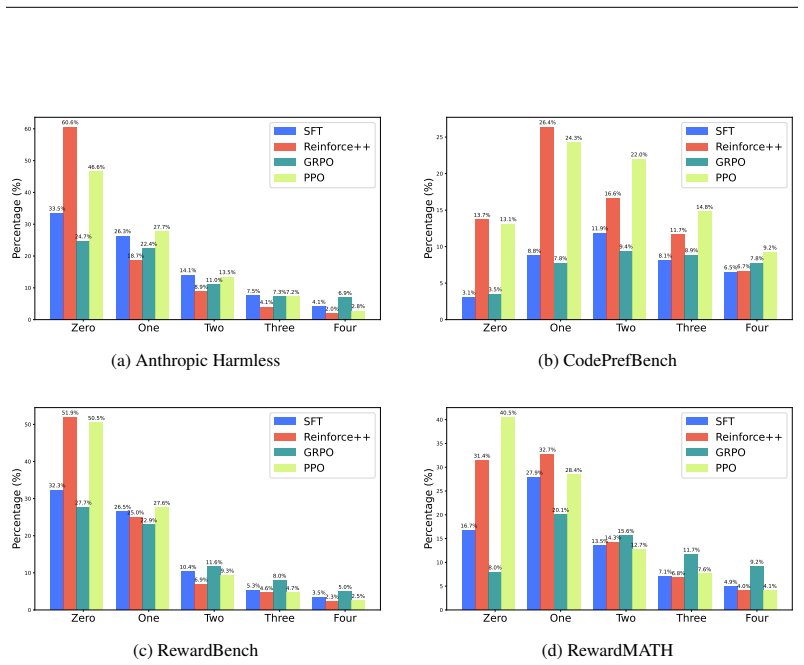
- STTS scaling shows diminishing or negative returns after roughly two "wait" tokens on some benchmarks (e.g., RewardBench), suggesting the budget must be tuned per task.
- Because GRPO-trained models already produce long reflective chains, additional forced reflection adds little; algorithm choice affects whether test-time scaling pays off.
- The scaling trend emerges progressively across RL checkpoints, so early stopping or insufficient RL steps would miss the STTS benefit.
- The 5.1% stronger scaling trend refers to relative improvement over remaining headroom, not raw accuracy, so it is best read with the initial accuracy gap in mind.
Reading between the lines
- The paper does not check for overlap between its RL training set (RISE English DPO subset) and the four evaluation benchmarks; if any examples appear in both, the 4.8% and 5.1% figures would be inflated. Auditing and re-measuring on a disjoint set is a concrete next step.
- The same recipe could be tested on other verifiable supervision tasks, e.g., judging factuality with a retrieval check, where a 'verdict plus explanation' reward might produce even steeper scaling than 'wait' tokens alone.
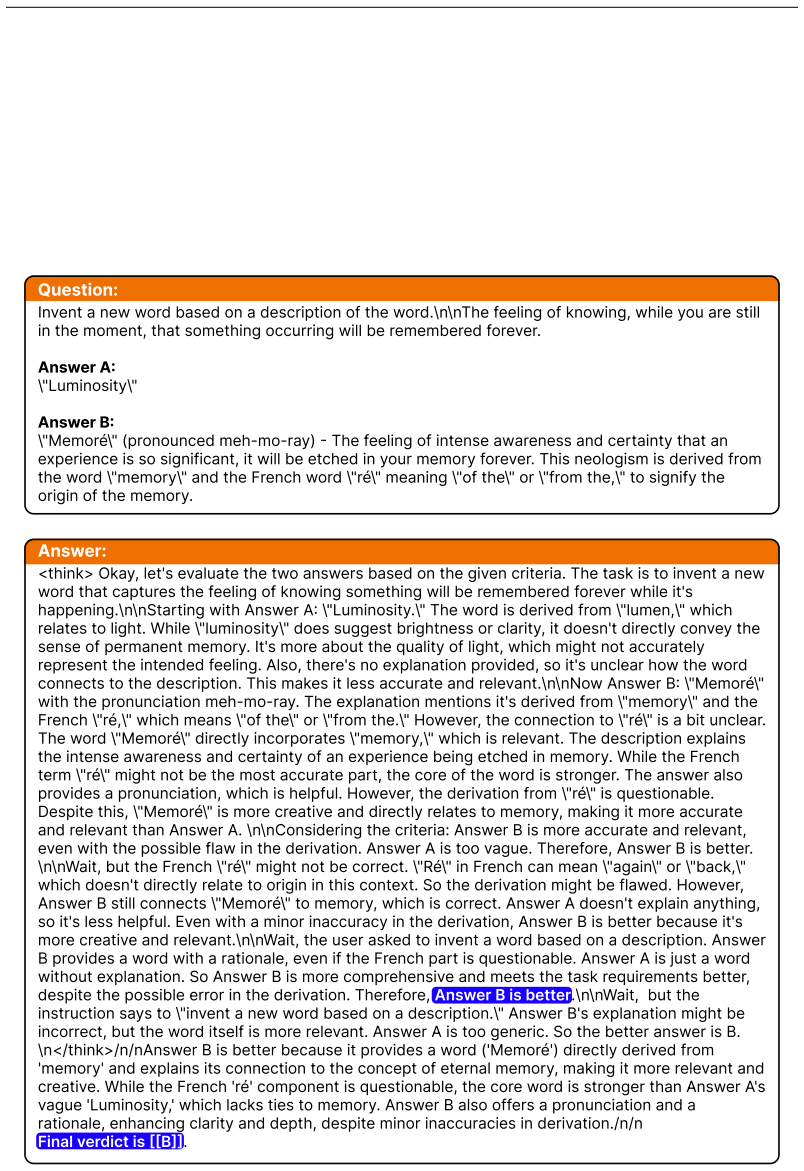
- The case studies show reflection sometimes flips a correct verdict to wrong by changing criteria; a policy that decides when to reflect (e.g., only when the model's confidence is low) could outperform the fixed budget-forcing schedule.
- A testable extension is to run the same two-stage training on a leakage-free, independently sourced RL set (e.g., synthetic preference pairs not drawn from any evaluation benchmark) and confirm the gains persist.
Signed reviews
Editorial analysis
A structured set of objections, weighed in public.
Referee Report
Summary. The paper proposes J1-7B, a 7B-parameter LLM-as-a-judge built on Qwen2.5-7B-Base, trained in two stages: first SFT on rejection-sampled, reflection-augmented preference data, then RL with a verifiable accuracy reward. At inference, the authors apply Simple Test-Time Scaling (STTS) by repeatedly injecting reflective tokens such as "wait" before the final verdict. Experiments on RewardBench, RewardMath, Anthropic Harmless, and CodePrefBench report that J1-7B surpasses the previous open-source state of the art, RISE-Judge, by 4.8% overall and shows a 5.1% stronger scaling trend under STTS. The paper also claims three findings: existing judges do not naturally scale with STTS, SFT alone does not impart this scaling, and the scaling capability emerges mainly during the RL phase. The appendix includes data construction statistics, additional ablations on RL data mixtures and algorithms, checkpoint analyses, case studies, and the prompt template.
Significance. If the central claims hold, the practical contribution is meaningful: a compact 7B judge that outperforms larger closed models on preference-pair accuracy, produces interpretable reasoning traces, and benefits from cheap test-time scaling. The checkpoint analysis in Section 4.7 is a useful empirical exploration of when STTS capability is acquired. The paper is also candid about limitations such as unfaithful reasoning and decision flips during reflection. However, the claimed 4.8% improvement and the RL-phase attribution rest on assumptions about train/eval separation and metric comparability that are not verified in the manuscript. The paper would be significantly strengthened by reporting confidence intervals, defining the scaling-trend measure, and addressing the overlap risk between RL training data and evaluation benchmarks. The significance is therefore conditional on these checks.
major comments (4)
- [§3.3, §4.1, Table 1] The paper never establishes that the RISE English DPO subset used for RL training is disjoint from the four evaluation benchmarks. RISE is an aggregated preference corpus, and RewardBench and Anthropic Harmless are widely used preference corpora, so overlap is a concrete risk. If any RewardBench, RewardMath, Anthropic Harmless, or CodePrefBench tuples appear in the RL training set, Eq. (3) rewards the model for matching test labels, which would inflate the Table 1 accuracy gain (75.98 vs. 71.17) and confound the Section 4.7 claim that STTS capability emerges during RL. The paper should list the sources and sizes of RISE's English DPO subset, perform exact-match and near-duplicate deduplication against all eval sets, and rerun the main experiments on a verifiably disjoint training set. Appendix F.1 ablates data mixtures but does not address evaluation overlap.
- [Appendix C, Table 1] The RewardMath evaluation deviates from the benchmark's standard scoring: the paper computes an instance-wise accuracy rather than problem-wise accuracy, calling the standard metric 'overly strict.' This raises the question of whether the baseline RewardMath numbers in Table 1 (e.g., RISE-Judge 81.69) were recomputed under the same instance-wise protocol or taken from prior work using problem-wise scoring. If the baselines were not recomputed, the comparison is unfair and the headline 4.8% improvement may be an artifact of the metric change. The authors should state explicitly which scoring protocol was used for each model, provide both instance-wise and problem-wise results, and re-evaluate the baselines under the same protocol.
- [Abstract, §4.4, Eq. (7)] The '5.1% stronger scaling trend' is never defined. Equation (7) defines relative improvement per STTS attempt, but no equation or procedure specifies what 'scaling trend' means (e.g., slope of relative improvement versus attempt count, area under the curve, or average gain per token) or how 5.1% is computed from the four benchmark curves. Without this definition, the abstract's central quantitative claim is unverifiable. The paper should define the scaling-trend metric in the main text and show the per-benchmark values that lead to 5.1%.
- [§4.7, Figure 6] The evidence for the claim that 'significant scaling trend emerges primarily during the RL phase' is statistically fragile. Figure 6b reports per-checkpoint Pearson correlations across only five STTS attempts, and these r-values fluctuate widely (e.g., for Anthropic Harmless, from -0.751 to 0.980) with a regression slope of 0.10 and r=0.47 across checkpoints. No confidence intervals, standard errors, or repeated-run variability are provided. The checkpoint trend is not clearly monotonic (Figure 6c also varies non-monotonically). The authors should provide error bars or confidence intervals, define what 'significant' means here, and apply a formal trend test across checkpoints. Otherwise the third key finding is not sufficiently supported.
minor comments (5)
- [§4.2, Table 1] The model name 'IntermLM2-7B-Reward' appears to be a typo for 'InternLM2-7B-Reward'; please correct it.
- [Figure 3] The figure labels are garbled, e.g., 'Δ = 1 . 3 5 5 . 0' and the y-axis formatting is inconsistent across panels. Please redraw the figure with clean labels and consistent axes.
- [§4.4 and §4.5] The notation 'Attempt 1' through 'Attempt 5' is used without a precise description of how many reflective tokens are appended at each attempt; please state the mapping explicitly (e.g., Attempt k means k-1 'wait' tokens appended) and report token counts.
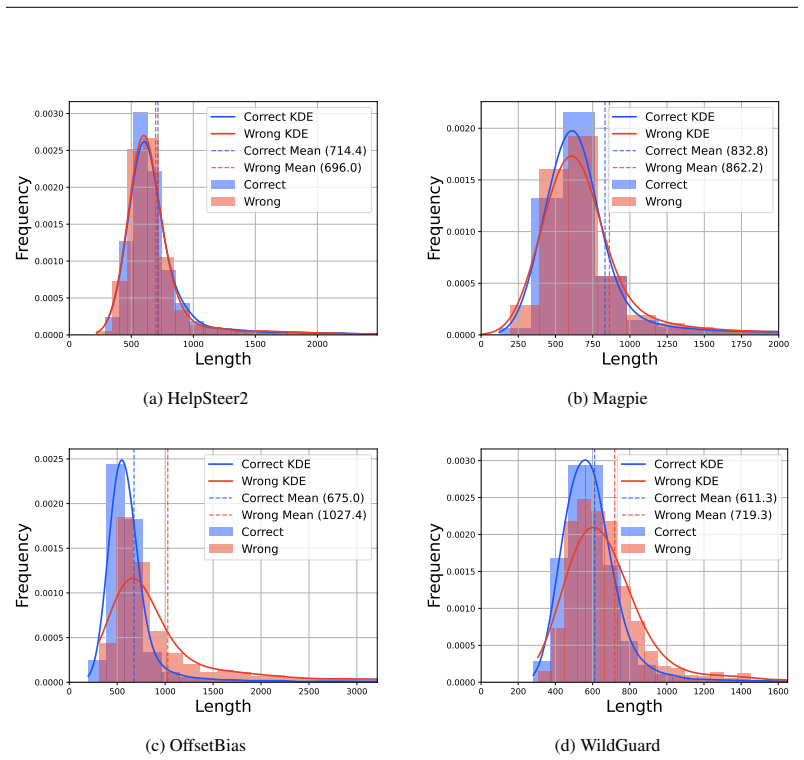
- [Appendix A] The claim that STTS outputs are 'significantly greater diversity' than parallel decoding is supported only by PCA visualizations of 100 instances with no quantitative diversity metric or statistical test; please add a numerical measure (e.g., embedding distance distribution) and report the sample size.
- [Appendix H] The prompt template says 'Please first analysis both of the answer step by step' — this should be 'analyze'. Also ensure the template is verbatim identical across all baselines and describe how parsing of the '[[A]]' verdict was implemented.
Circularity Check
No significant circularity: J1-7B's training and STTS claims are empirical and evaluated against external benchmarks; self-citations are not load-bearing.
full rationale
The paper's central claims are empirical: J1-7B is trained via SFT on rejection-sampled reflection data and RL with a verifiable reward, and then evaluated on four preference benchmarks. No equation in the paper defines the evaluation metric in terms of the training objective, and no fitted parameter is renamed as a prediction. The RL reward in Eq. (3) is a standard accuracy indicator on training tuples, while the STTS gains are measured on separate benchmark sets. Self-citations such as RQ-RAG and LLaSA appear only in related-work enumerations and do not support any load-bearing premise. The 'STTS emerges during RL' finding is supported by checkpoint-level regressions and ablations, not by construction. A possible data-contamination risk between the RISE English DPO subset and the evaluation benchmarks is a correctness or leakage concern, not circularity, because the paper does not demonstrate a specific overlap and no claimed prediction reduces to a training-set label by definition.
Assumptions & free parameters
assumptions (4)
- domain assumption Human preference labels in the SFT and RL datasets and in the evaluation benchmarks are correct and reliable ground truth for response quality.
- domain assumption The RISE English DPO subset used for RL does not overlap with the four evaluation benchmarks.
- domain assumption Instance-wise scoring on RewardMath is a valid accuracy measure for judge preference.
- domain assumption Appending 'wait' tokens at the end of the initial thinking phase elicits additional genuine reflection.
Cite this review
Pith. "Pith review of J1: Exploring Simple Test-Time Scaling for LLM-as-a-Judge." pith.science (2026). https://pith.science/paper/6Y3UMYT7
@misc{pith2026250511875,
  author       = {Pith},
  title        = {Pith review of: J1: Exploring Simple Test-Time Scaling for LLM-as-a-Judge},
  year         = {2026},
  howpublished = {\url{https://pith.science/paper/6Y3UMYT7}},
  note         = {Machine review of arXiv:2505.11875}
}
abstract
The current focus of AI research is shifting from emphasizing model training towards enhancing evaluation quality, a transition that is crucial for driving further advancements in AI systems. Traditional evaluation methods typically rely on reward models assigning scalar preference scores to outputs. Although effective, such approaches lack interpretability, leaving users often uncertain about why a reward model rates a particular response as high or low. The advent of LLM-as-a-Judge provides a more scalable and interpretable method of supervision, offering insights into the decision-making process. Moreover, with the emergence of large reasoning models, which consume more tokens for deeper thinking and answer refinement, scaling test-time computation in the LLM-as-a-Judge paradigm presents an avenue for further boosting performance and providing more interpretability through reasoning traces. In this paper, we introduce $\textbf{J1-7B}$, which is first supervised fine-tuned on reflection-enhanced datasets collected via rejection-sampling and subsequently trained using Reinforcement Learning (RL) with verifiable rewards. At inference time, we apply Simple Test-Time Scaling (STTS) strategies for additional performance improvement. Experimental results demonstrate that $\textbf{J1-7B}$ surpasses the previous state-of-the-art LLM-as-a-Judge by $ \textbf{4.8}$\% and exhibits a $ \textbf{5.1}$\% stronger scaling trend under STTS. Additionally, we present three key findings: (1) Existing LLM-as-a-Judge does not inherently exhibit such scaling trend. (2) Model simply fine-tuned on reflection-enhanced datasets continues to demonstrate similarly weak scaling behavior. (3) Significant scaling trend emerges primarily during the RL phase, suggesting that effective STTS capability is acquired predominantly through RL training.
Figures


Figures from the paper (24 more)











Reference graph
Works this paper leans on
-
[1]
Critique-out-loud reward models
Zachary Ankner, Mansheej Paul, Brandon Cui, Jonathan D Chang, and Prithviraj Ammanabrolu. Critique-out-loud reward models. arXiv preprint arXiv:2408.11791, 2024
arXiv 2024
-
[2]
Chain-of-thought reasoning in the wild is not always faithful
Iv \'a n Arcuschin, Jett Janiak, Robert Krzyzanowski, Senthooran Rajamanoharan, Neel Nanda, and Arthur Conmy. Chain-of-thought reasoning in the wild is not always faithful. arXiv preprint arXiv:2503.08679, 2025
arXiv 2025
-
[3]
Training a helpful and harmless assistant with reinforcement learning from human feedback
Yuntao Bai, Andy Jones, Kamal Ndousse, Amanda Askell, Anna Chen, Nova DasSarma, Dawn Drain, Stanislav Fort, Deep Ganguli, Tom Henighan, et al. Training a helpful and harmless assistant with reinforcement learning from human feedback. arXiv preprint arXiv:2204.05862, 2022
arXiv 2022
-
[4]
Rank analysis of incomplete block designs: I
Ralph Allan Bradley and Milton E Terry. Rank analysis of incomplete block designs: I. the method of paired comparisons. Biometrika, 39 0 (3/4): 0 324--345, 1952
1952
-
[5]
Large language monkeys: Scaling inference compute with repeated sampling
Bradley Brown, Jordan Juravsky, Ryan Ehrlich, Ronald Clark, Quoc V Le, Christopher R \'e , and Azalia Mirhoseini. Large language monkeys: Scaling inference compute with repeated sampling. arXiv preprint arXiv:2407.21787, 2024
arXiv 2024
-
[6]
Internlm2 technical report, 2024
Zheng Cai, Maosong Cao, Haojiong Chen, Kai Chen, Keyu Chen, Xin Chen, Xun Chen, Zehui Chen, Zhi Chen, Pei Chu, Xiaoyi Dong, Haodong Duan, Qi Fan, Zhaoye Fei, Yang Gao, Jiaye Ge, Chenya Gu, Yuzhe Gu, Tao Gui, Aijia Guo, Qipeng Guo, Conghui He, Yingfan Hu, Ting Huang, Tao Jiang, Penglong Jiao, Zhenjiang Jin, Zhikai Lei, Jiaxing Li, Jingwen Li, Linyang Li, S...
2024
-
[7]
Rq-rag: Learning to refine queries for retrieval augmented generation
Chi-Min Chan, Chunpu Xu, Ruibin Yuan, Hongyin Luo, Wei Xue, Yike Guo, and Jie Fu. Rq-rag: Learning to refine queries for retrieval augmented generation. arXiv preprint arXiv:2404.00610, 2024
arXiv 2024
-
[8]
Codemonkeys: Scaling test-time compute for software engineering
Ryan Ehrlich, Bradley Brown, Jordan Juravsky, Ronald Clark, Christopher R \'e , and Azalia Mirhoseini. Codemonkeys: Scaling test-time compute for software engineering. arXiv preprint arXiv:2501.14723, 2025
arXiv 2025
Show all 72 references
-
[9]
Scaling laws for reward model overoptimization
Leo Gao, John Schulman, and Jacob Hilton. Scaling laws for reward model overoptimization. In International Conference on Machine Learning, pp.\ 10835--10866. PMLR, 2023
2023
-
[10]
Gemini 2.0 flash thinking mode
Google. Gemini 2.0 flash thinking mode. https://cloud.google.com/vertex-ai/generative-ai/docs/thinking-mode, December 2024. Accessed: 2025-04-29
2024
-
[11]
The llama 3 herd of models
Aaron Grattafiori, Abhimanyu Dubey, Abhinav Jauhri, Abhinav Pandey, Abhishek Kadian, Ahmad Al-Dahle, Aiesha Letman, Akhil Mathur, Alan Schelten, Alex Vaughan, et al. The llama 3 herd of models. arXiv preprint arXiv:2407.21783, 2024
2024 arXiv
-
[12]
A survey on llm-as-a-judge
Jiawei Gu, Xuhui Jiang, Zhichao Shi, Hexiang Tan, Xuehao Zhai, Chengjin Xu, Wei Li, Yinghan Shen, Shengjie Ma, Honghao Liu, et al. A survey on llm-as-a-judge. arXiv preprint arXiv:2411.15594, 2024
2024 arXiv
-
[13]
Deepseek-r1: Incentivizing reasoning capability in llms via reinforcement learning
Daya Guo, Dejian Yang, Haowei Zhang, Junxiao Song, Ruoyu Zhang, Runxin Xu, Qihao Zhu, Shirong Ma, Peiyi Wang, Xiao Bi, et al. Deepseek-r1: Incentivizing reasoning capability in llms via reinforcement learning. arXiv preprint arXiv:2501.12948, 2025
2025 arXiv
-
[14]
Wildguard: Open one-stop moderation tools for safety risks, jailbreaks, and refusals of llms
Seungju Han, Kavel Rao, Allyson Ettinger, Liwei Jiang, Bill Yuchen Lin, Nathan Lambert, Yejin Choi, and Nouha Dziri. Wildguard: Open one-stop moderation tools for safety risks, jailbreaks, and refusals of llms. arXiv preprint arXiv:2406.18495, 2024
2024 arXiv
-
[15]
Metrics for explainable ai: Challenges and prospects
Robert R Hoffman, Shane T Mueller, Gary Klein, and Jordan Litman. Metrics for explainable ai: Challenges and prospects. arXiv preprint arXiv:1812.04608, 2018
2018 arXiv
-
[16]
Human feedback is not gold standard
Tom Hosking, Phil Blunsom, and Max Bartolo. Human feedback is not gold standard. arXiv preprint arXiv:2309.16349, 2023
2023 arXiv
-
[17]
Reinforce++: A simple and efficient approach for aligning large language models
Jian Hu. Reinforce++: A simple and efficient approach for aligning large language models. arXiv preprint arXiv:2501.03262, 2025
2025 arXiv
-
[18]
open-r1/openr1-math-220k
HuggingFace. open-r1/openr1-math-220k. https://huggingface.co/datasets/open-r1/OpenR1-Math-220k, 2025. Accessed: 2025-04-29
2025
-
[19]
Pku-saferlhf: Towards multi-level safety alignment for llms with human preference
Jiaming Ji, Donghai Hong, Borong Zhang, Boyuan Chen, Josef Dai, Boren Zheng, Tianyi Qiu, Boxun Li, and Yaodong Yang. Pku-saferlhf: Towards multi-level safety alignment for llms with human preference. arXiv preprint arXiv:2406.15513, 2024
2024 arXiv
-
[20]
On scalable oversight with weak llms judging strong llms
Zachary Kenton, Noah Siegel, J \'a nos Kram \'a r, Jonah Brown-Cohen, Samuel Albanie, Jannis Bulian, Rishabh Agarwal, David Lindner, Yunhao Tang, Noah Goodman, et al. On scalable oversight with weak llms judging strong llms. Advances in Neural Information Processing Systems, 3...
2024
-
[21]
Evaluating robustness of reward models for mathematical reasoning
Sunghwan Kim, Dongjin Kang, Taeyoon Kwon, Hyungjoo Chae, Jungsoo Won, Dongha Lee, and Jinyoung Yeo. Evaluating robustness of reward models for mathematical reasoning. arXiv preprint arXiv:2410.01729, 2024
2024 arXiv
-
[22]
The past, present and better future of feedback learning in large language models for subjective human preferences and values
Hannah Rose Kirk, Andrew M Bean, Bertie Vidgen, Paul R \"o ttger, and Scott A Hale. The past, present and better future of feedback learning in large language models for subjective human preferences and values. arXiv preprint arXiv:2310.07629, 2023
-
[23]
Rewardbench: Evaluating reward models for language modeling
Nathan Lambert, Valentina Pyatkin, Jacob Morrison, LJ Miranda, Bill Yuchen Lin, Khyathi Chandu, Nouha Dziri, Sachin Kumar, Tom Zick, Yejin Choi, et al. Rewardbench: Evaluating reward models for language modeling. arXiv preprint arXiv:2403.13787, 2024
2024 arXiv
-
[24]
From generation to judgment: Opportunities and challenges of llm-as-a-judge
Dawei Li, Bohan Jiang, Liangjie Huang, Alimohammad Beigi, Chengshuai Zhao, Zhen Tan, Amrita Bhattacharjee, Yuxuan Jiang, Canyu Chen, Tianhao Wu, et al. From generation to judgment: Opportunities and challenges of llm-as-a-judge. arXiv preprint arXiv:2411.16594, 2024
2024
-
[25]
Generative judge for evaluating alignment
Junlong Li, Shichao Sun, Weizhe Yuan, Run-Ze Fan, Hai Zhao, and Pengfei Liu. Generative judge for evaluating alignment. arXiv preprint arXiv:2310.05470, 2023
2023 arXiv
-
[26]
Let's verify step by step
Hunter Lightman, Vineet Kosaraju, Yuri Burda, Harrison Edwards, Bowen Baker, Teddy Lee, Jan Leike, John Schulman, Ilya Sutskever, and Karl Cobbe. Let's verify step by step. In The Twelfth International Conference on Learning Representations, 2023
2023
-
[27]
Skywork-reward: Bag of tricks for reward modeling in llms
Chris Yuhao Liu, Liang Zeng, Jiacai Liu, Rui Yan, Jujie He, Chaojie Wang, Shuicheng Yan, Yang Liu, and Yahui Zhou. Skywork-reward: Bag of tricks for reward modeling in llms. arXiv preprint arXiv:2410.18451, 2024 a
2024 arXiv
-
[28]
Video-t1: Test-time scaling for video generation
Fangfu Liu, Hanyang Wang, Yimo Cai, Kaiyan Zhang, Xiaohang Zhan, and Yueqi Duan. Video-t1: Test-time scaling for video generation. arXiv preprint arXiv:2503.18942, 2025 a
2025 arXiv
-
[29]
Learning code preference via synthetic evolution
Jiawei Liu, Thanh Nguyen, Mingyue Shang, Hantian Ding, Xiaopeng Li, Yu Yu, Varun Kumar, and Zijian Wang. Learning code preference via synthetic evolution. arXiv preprint arXiv:2410.03837, 2024 b
2024 arXiv
-
[30]
Inference-time scaling for generalist reward modeling
Zijun Liu, Peiyi Wang, Runxin Xu, Shirong Ma, Chong Ruan, Peng Li, Yang Liu, and Yu Wu. Inference-time scaling for generalist reward modeling. arXiv preprint arXiv:2504.02495, 2025 b
2025
-
[31]
Principal components analysis (pca)
Andrzej Ma \'c kiewicz and Waldemar Ratajczak. Principal components analysis (pca). Computers & Geosciences, 19 0 (3): 0 303--342, 1993
1993
-
[32]
Self-refine: Iterative refinement with self-feedback
Aman Madaan, Niket Tandon, Prakhar Gupta, Skyler Hallinan, Luyu Gao, Sarah Wiegreffe, Uri Alon, Nouha Dziri, Shrimai Prabhumoye, Yiming Yang, et al. Self-refine: Iterative refinement with self-feedback. Advances in Neural Information Processing Systems, 36: 0 46534--46594, 2023
2023
-
[33]
Llm critics help catch llm bugs
Nat McAleese, Rai Michael Pokorny, Juan Felipe Ceron Uribe, Evgenia Nitishinskaya, Maja Trebacz, and Jan Leike. Llm critics help catch llm bugs. arXiv preprint arXiv:2407.00215, 2024
2024 arXiv
-
[34]
s1: Simple test-time scaling
Niklas Muennighoff, Zitong Yang, Weijia Shi, Xiang Lisa Li, Li Fei-Fei, Hannaneh Hajishirzi, Luke Zettlemoyer, Percy Liang, Emmanuel Cand \`e s, and Tatsunori Hashimoto. s1: Simple test-time scaling. arXiv preprint arXiv:2501.19393, 2025
2025 arXiv
-
[35]
Learning to reason with llms
OpenAI. Learning to reason with llms. https://openai.com/index/learning-to-reason-with-llms/, September 2024. Accessed: 2025-04-29
2024
-
[36]
Training language models to follow instructions with human feedback
Long Ouyang, Jeffrey Wu, Xu Jiang, Diogo Almeida, Carroll Wainwright, Pamela Mishkin, Chong Zhang, Sandhini Agarwal, Katarina Slama, Alex Ray, et al. Training language models to follow instructions with human feedback. Advances in neural information processing systems, 35: 0 2...
2022
-
[37]
Offsetbias: Leveraging debiased data for tuning evaluators
Junsoo Park, Seungyeon Jwa, Meiying Ren, Daeyoung Kim, and Sanghyuk Choi. Offsetbias: Leveraging debiased data for tuning evaluators. arXiv preprint arXiv:2407.06551, 2024
2024 arXiv
-
[38]
Codeforces cots
Guilherme Penedo, Anton Lozhkov, Hynek Kydlíček, Loubna Ben Allal, Edward Beeching, Agustín Piqueres Lajarín, Quentin Gallouédec, Nathan Habib, Lewis Tunstall, and Leandro von Werra. Codeforces cots. https://huggingface.co/datasets/open-r1/codeforces-cots, 2025
2025
-
[39]
Learning to plan & reason for evaluation with thinking-llm-as-a-judge
Swarnadeep Saha, Xian Li, Marjan Ghazvininejad, Jason Weston, and Tianlu Wang. Learning to plan & reason for evaluation with thinking-llm-as-a-judge. arXiv preprint arXiv:2501.18099, 2025
2025 arXiv
-
[40]
High-dimensional continuous control using generalized advantage estimation
John Schulman, Philipp Moritz, Sergey Levine, Michael Jordan, and Pieter Abbeel. High-dimensional continuous control using generalized advantage estimation. arXiv preprint arXiv:1506.02438, 2015
2015 arXiv
-
[41]
Proximal policy optimization algorithms
John Schulman, Filip Wolski, Prafulla Dhariwal, Alec Radford, and Oleg Klimov. Proximal policy optimization algorithms. arXiv preprint arXiv:1707.06347, 2017
2017 arXiv
-
[42]
Rethinking reflection in pre-training
Darsh J Shah, Peter Rushton, Somanshu Singla, Mohit Parmar, Kurt Smith, Yash Vanjani, Ashish Vaswani, Adarsh Chaluvaraju, Andrew Hojel, Andrew Ma, et al. Rethinking reflection in pre-training. arXiv preprint arXiv:2504.04022, 2025
2025 arXiv
-
[43]
Deepseekmath: Pushing the limits of mathematical reasoning in open language models
Zhihong Shao, Peiyi Wang, Qihao Zhu, Runxin Xu, Junxiao Song, Xiao Bi, Haowei Zhang, Mingchuan Zhang, YK Li, Y Wu, et al. Deepseekmath: Pushing the limits of mathematical reasoning in open language models. arXiv preprint arXiv:2402.03300, 2024
2024 arXiv
-
[44]
Skywork critic model series
Tu Shiwen, Zhao Liang, Chris Yuhao Liu, Liang Zeng, and Yang Liu. Skywork critic model series. https://huggingface.co/Skywork, September 2024. URL https://huggingface.co/Skywork
2024
-
[45]
Scaling llm test-time compute optimally can be more effective than scaling model parameters
Charlie Snell, Jaehoon Lee, Kelvin Xu, and Aviral Kumar. Scaling llm test-time compute optimally can be more effective than scaling model parameters. arXiv preprint arXiv:2408.03314, 2024
2024 arXiv
-
[46]
Kimi Team, Angang Du, Bofei Gao, Bowei Xing, Changjiu Jiang, Cheng Chen, Cheng Li, Chenjun Xiao, Chenzhuang Du, Chonghua Liao, et al. Kimi k1. 5: Scaling reinforcement learning with llms. arXiv preprint arXiv:2501.12599, 2025
2025 arXiv
-
[47]
Openr: An open source framework for advanced reasoning with large language models
Jun Wang, Meng Fang, Ziyu Wan, Muning Wen, Jiachen Zhu, Anjie Liu, Ziqin Gong, Yan Song, Lei Chen, Lionel M Ni, et al. Openr: An open source framework for advanced reasoning with large language models. arXiv preprint arXiv:2410.09671, 2024 a
-
[48]
Minilm: Deep self-attention distillation for task-agnostic compression of pre-trained transformers
Wenhui Wang, Furu Wei, Li Dong, Hangbo Bao, Nan Yang, and Ming Zhou. Minilm: Deep self-attention distillation for task-agnostic compression of pre-trained transformers. Advances in neural information processing systems, 33: 0 5776--5788, 2020
2020
-
[49]
Pandalm: An automatic evaluation benchmark for llm instruction tuning optimization
Yidong Wang, Zhuohao Yu, Zhengran Zeng, Linyi Yang, Cunxiang Wang, Hao Chen, Chaoya Jiang, Rui Xie, Jindong Wang, Xing Xie, et al. Pandalm: An automatic evaluation benchmark for llm instruction tuning optimization. arXiv preprint arXiv:2306.05087, 2023
2023 arXiv
-
[50]
Helpsteer2: Open-source dataset for training top-performing reward models
Zhilin Wang, Yi Dong, Olivier Delalleau, Jiaqi Zeng, Gerald Shen, Daniel Egert, Jimmy J Zhang, Makesh Narsimhan Sreedhar, and Oleksii Kuchaiev. Helpsteer2: Open-source dataset for training top-performing reward models. arXiv preprint arXiv:2406.08673, 2024 b
2024 arXiv
-
[51]
Codeultrafeedback: An llm-as-a-judge dataset for aligning large language models to coding preferences
Martin Weyssow, Aton Kamanda, Xin Zhou, and Houari Sahraoui. Codeultrafeedback: An llm-as-a-judge dataset for aligning large language models to coding preferences. arXiv preprint arXiv:2403.09032, 2024
2024 arXiv
-
[52]
Meta-rewarding language models: Self-improving alignment with llm-as-a-meta-judge
Tianhao Wu, Weizhe Yuan, Olga Golovneva, Jing Xu, Yuandong Tian, Jiantao Jiao, Jason Weston, and Sainbayar Sukhbaatar. Meta-rewarding language models: Self-improving alignment with llm-as-a-meta-judge. arXiv preprint arXiv:2407.19594, 2024 a
2024 arXiv
-
[53]
Inference scaling laws: An empirical analysis of compute-optimal inference for problem-solving with language models
Yangzhen Wu, Zhiqing Sun, Shanda Li, Sean Welleck, and Yiming Yang. Inference scaling laws: An empirical analysis of compute-optimal inference for problem-solving with language models. arXiv preprint arXiv:2408.00724, 2024 b
2024 arXiv
-
[54]
Iterative preference learning from human feedback: Bridging theory and practice for rlhf under kl-constraint, 2024
Wei Xiong, Hanze Dong, Chenlu Ye, Ziqi Wang, Han Zhong, Heng Ji, Nan Jiang, and Tong Zhang. Iterative preference learning from human feedback: Bridging theory and practice for rlhf under kl-constraint, 2024
2024
-
[55]
Llava-o1: Let vision language models reason step-by-step
Guowei Xu, Peng Jin, Li Hao, Yibing Song, Lichao Sun, and Li Yuan. Llava-o1: Let vision language models reason step-by-step. arXiv preprint arXiv:2411.10440, 2024 a
2024 arXiv
-
[56]
Magpie: Alignment data synthesis from scratch by prompting aligned llms with nothing
Zhangchen Xu, Fengqing Jiang, Luyao Niu, Yuntian Deng, Radha Poovendran, Yejin Choi, and Bill Yuchen Lin. Magpie: Alignment data synthesis from scratch by prompting aligned llms with nothing. arXiv preprint arXiv:2406.08464, 2024 b
2024 arXiv
-
[57]
An Yang, Baosong Yang, Beichen Zhang, Binyuan Hui, Bo Zheng, Bowen Yu, Chengyuan Li, Dayiheng Liu, Fei Huang, Haoran Wei, et al. Qwen2. 5 technical report. arXiv preprint arXiv:2412.15115, 2024
2024 arXiv
-
[58]
Mastering complex control in moba games with deep reinforcement learning
Deheng Ye, Zhao Liu, Mingfei Sun, Bei Shi, Peilin Zhao, Hao Wu, Hongsheng Yu, Shaojie Yang, Xipeng Wu, Qingwei Guo, et al. Mastering complex control in moba games with deep reinforcement learning. In Proceedings of the AAAI conference on artificial intelligence, volume 34, pp....
2020
-
[59]
Llasa: Scaling train-time and inference-time compute for llama-based speech synthesis
Zhen Ye, Xinfa Zhu, Chi-Min Chan, Xinsheng Wang, Xu Tan, Jiahe Lei, Yi Peng, Haohe Liu, Yizhu Jin, Zheqi DAI, et al. Llasa: Scaling train-time and inference-time compute for llama-based speech synthesis. arXiv preprint arXiv:2502.04128, 2025
2025 arXiv
-
[60]
Improving reward models with synthetic critiques
Zihuiwen Ye, Fraser Greenlee-Scott, Max Bartolo, Phil Blunsom, Jon Ander Campos, and Matthias Gall \'e . Improving reward models with synthetic critiques. arXiv preprint arXiv:2405.20850, 2024
2024 arXiv
-
[61]
Improve llm-as-a-judge ability as a general ability
Jiachen Yu, Shaoning Sun, Xiaohui Hu, Jiaxu Yan, Kaidong Yu, and Xuelong Li. Improve llm-as-a-judge ability as a general ability. arXiv preprint arXiv:2502.11689, 2025 a
2025 arXiv
-
[62]
Self-generated critiques boost reward modeling for language models
Yue Yu, Zhengxing Chen, Aston Zhang, Liang Tan, Chenguang Zhu, Richard Yuanzhe Pang, Yundi Qian, Xuewei Wang, Suchin Gururangan, Chao Zhang, et al. Self-generated critiques boost reward modeling for language models. arXiv preprint arXiv:2411.16646, 2024
2024 arXiv
-
[63]
Z1: Efficient test-time scaling with code
Zhaojian Yu, Yinghao Wu, Yilun Zhao, Arman Cohan, and Xiao-Ping Zhang. Z1: Efficient test-time scaling with code. arXiv preprint arXiv:2504.00810, 2025 b
2025 arXiv
-
[64]
Llama-berry: Pairwise optimization for o1-like olympiad-level mathematical reasoning
Di Zhang, Jianbo Wu, Jingdi Lei, Tong Che, Jiatong Li, Tong Xie, Xiaoshui Huang, Shufei Zhang, Marco Pavone, Yuqiang Li, et al. Llama-berry: Pairwise optimization for o1-like olympiad-level mathematical reasoning. arXiv preprint arXiv:2410.02884, 2024 a
-
[65]
Openprm: Building open-domain process-based reward models with preference trees
Kaiyan Zhang, Jiayuan Zhang, Haoxin Li, Xuekai Zhu, Ermo Hua, Xingtai Lv, Ning Ding, Biqing Qi, and Bowen Zhou. Openprm: Building open-domain process-based reward models with preference trees. In The Thirteenth International Conference on Learning Representations, 2025
2025
-
[66]
Generative verifiers: Reward modeling as next-token prediction
Lunjun Zhang, Arian Hosseini, Hritik Bansal, Mehran Kazemi, Aviral Kumar, and Rishabh Agarwal. Generative verifiers: Reward modeling as next-token prediction. arXiv preprint arXiv:2408.15240, 2024 b
2024 arXiv
-
[67]
Judging llm-as-a-judge with mt-bench and chatbot arena
Lianmin Zheng, Wei-Lin Chiang, Ying Sheng, Siyuan Zhuang, Zhanghao Wu, Yonghao Zhuang, Zi Lin, Zhuohan Li, Dacheng Li, Eric Xing, et al. Judging llm-as-a-judge with mt-bench and chatbot arena. Advances in Neural Information Processing Systems, 36: 0 46595--46623, 2023
2023
-
[68]
Judgelm: Fine-tuned large language models are scalable judges
Lianghui Zhu, Xinggang Wang, and Xinlong Wang. Judgelm: Fine-tuned large language models are scalable judges. arXiv preprint arXiv:2310.17631, 2023
2023 arXiv
-
[69]
write newline
" write newline "" before.all 'output.state := FUNCTION n.dashify 't := "" t empty not t #1 #1 substring "-" = t #1 #2 substring "--" = not "--" * t #2 global.max substring 't := t #1 #1 substring "-" = "-" * t #2 global.max substring 't := while if t #1 #1 substring * t #2 gl...
-
[70]
@esa (Ref
\@ifxundefined[1] #1\@undefined \@firstoftwo \@secondoftwo \@ifnum[1] #1 \@firstoftwo \@secondoftwo \@ifx[1] #1 \@firstoftwo \@secondoftwo [2] @ #1 \@temptokena #2 #1 @ \@temptokena \@ifclassloaded agu2001 natbib The agu2001 class already includes natbib coding, so you should ...
-
[71]
\@lbibitem[] @bibitem@first@sw\@secondoftwo \@lbibitem[#1]#2 \@extra@b@citeb \@ifundefined br@#2\@extra@b@citeb \@namedef br@#2 \@nameuse br@#2\@extra@b@citeb \@ifundefined b@#2\@extra@b@citeb @num @parse #2 @tmp #1 NAT@b@open@#2 NAT@b@shut@#2 \@ifnum @merge>\@ne @bibitem@firs...
-
[72]
wait" step across four benchmark tasks. Because the proportion of responses altered after adding each
@open @close @open @close and [1] URL: #1 \@ifundefined chapter * \@mkboth \@ifxundefined @sectionbib * \@mkboth * \@mkboth\@gobbletwo \@ifclassloaded amsart * \@ifclassloaded amsbook * \@ifxundefined @heading @heading NAT@ctr thebibliography [1] @ \@biblabel @NAT@ctr \@bibset...
Reviewed August 15, 2026 · model on record in the stance chip above.
Discussion (0). Continue with ORCID to comment.