REVIEW 3 major objections 6 minor 34 references
Proactive tactile exploration for object-agnostic shape reconstruction from minimal visual priors
T0 review · 3 major / 6 minor · reviewed 2026-08-15 · deepseek-v4-flash
Pith's one-line read A robot can reconstruct an unknown object's whole surface from a small single-view point cloud and a few cautious touches, by treating the object as a deformed ellipsoid and picking each touch to shrink uncertainty without missing the…
desk verdict A genuinely new contact-failure-aware exploration objective buried under an over-broad 'object-agnostic' claim and cherry-picked baseline reporting. read the letter →
The pith
A machine-rendered reading of the paper's core claim, the machinery that carries it, and where it could break.
The reading
What carries the argument
The load-bearing component is the two-step coarse-to-fine mesh fitting together with the exploration objective in Eq. (3). Global shape is estimated by gradient-descent fitting of an ellipsoid template, with parameters rotation $R$, translation $t$ and scales $s$, to the attractor points through a least-squares loss. Local shape is then resolved by a thin-plate-spline interpolator $F$ that displaces each mesh vertex along its normal, so the mesh can represent bumps and dents. Uncertainty from each attractor is spread to nearby vertices with a heavy-tailed weight $1/(1+t^2)$, and the next contact is the vertex $w$ maximizing $\alpha_G G_j + \alpha_U U_j$ subject to having at least one 'confident' neighbor and uncertainty above a threshold. The force/torque-based uncertainty of Eq. (1) turns each tactile reading into a reliability score, and the whole loop iterates until the uncertainty map is sufficiently low.
What would settle it
Run the same pipeline on a torus or a box with a handle, using the same 50-contact budget and evaluation metrics; if the chamfer distance fails to drop below 4 mm or the contact-failure rate stays high, the claim that a single ellipsoid prior suffices for object-agnostic reconstruction is falsified. A simpler observational test is to watch whether the reconstructed mesh ever creates a hole: the thin-plate-spline deformation cannot change topology, so a successful torus reconstruction would require a mechanism the paper does not provide.
Extended reading notes
Core claim
The central claim is that a single ellipsoid template, deformed in two stages, plus a cautious active-touch policy is enough to recover the shape of common objects from almost no visual information. The key discovery is that the exploration strategy—not the fitting subroutine—does the heavy lifting: choosing touch points that maximize a weighted sum of geodesic distance from confident vertices and local uncertainty, subject to having at least one confident neighbor, drives a depth-first traversal of the surface that discovers the global structure while keeping contact failures low. The paper reports that for the most challenging objects in its test set (a coffee can, a sugar box, a mustard container), this strategy achieves reconstruction errors substantially below a standard uncertainty-only baseline over the same 50 contact attempts—for example, 3.82 mm versus 9.97 mm chamfer distance for the sugar box—with far fewer failed pokes. The same pipeline also works on a real robot, reconstructing a 3D-printed mustard container to 4.1 mm chamfer error in 30 iterations despite the noise of a real depth camera and tactile sensor.
Load-bearing premise
The whole approach stands on the assumption that the target object's shape is roughly ellipsoidal—globally convex with no through-holes—so that a single ellipsoid fit gets close enough to the real surface for the local deformation stage to finish the job.
Editorial extensions
If this is right
- After 50 contacts, all simulated objects—including a coffee can, a sugar box, and a mustard container—reach chamfer distances below 4 mm, with no prior object model beyond the ellipsoid assumption.
- The proactive strategy cuts contact failures by roughly a factor of two to three compared with uncertainty-only exploration on the hardest objects, and it avoids the failure loops that can stall the baseline.
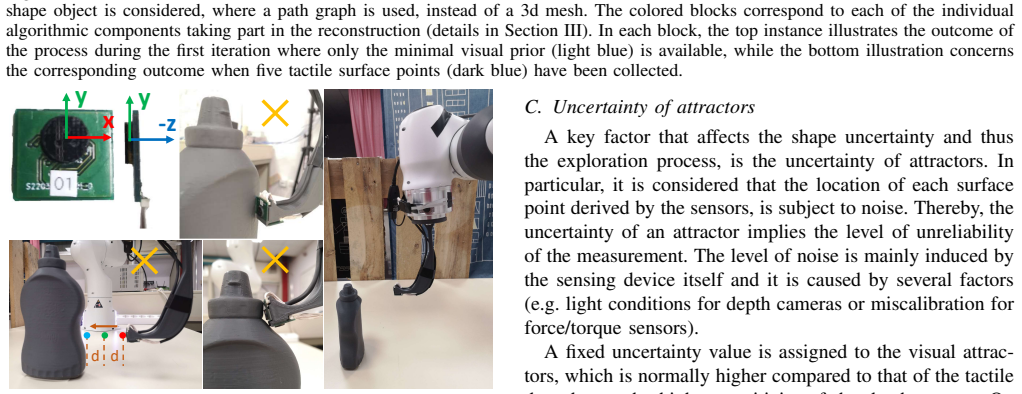
- The method transfers to a real 7-DoF arm with a depth camera and force/torque tactile sensors, reconstructing a 3D-printed mustard container to 4.1 mm chamfer error in 30 iterations.
- The output includes a per-vertex uncertainty map, which tells a downstream manipulation system which regions of the surface are still unexplored and therefore where additional touch or visual data would be most valuable.
Reading between the lines
- A comparable cautious depth-first policy could be applied to other active-perception problems, such as tracing object boundaries or segmenting a cluttered scene, but the present paper only demonstrates it for single-object surface reconstruction.
- The fixed ellipsoid template is the likely ceiling: an object with a through-hole or sharp concavity would break the global fit, so a natural next step is online selection among multiple templates, which the paper only lists as future work.
- The paper's contact-failure metric (a 15 mm deviation between estimated and real contact) is a geometric proxy; in real manipulation, failures also depend on approach speed, friction, and surface compliance, so the risk reduction may not transfer unchanged to dynamic tasks.
- Because visual points are assigned a fixed high uncertainty, the method is conservative near the camera view; a testable tweak would be to set visual uncertainty per-pixel from the depth sensor's noise model, which could speed up exploration on visually reliable regions.
Signed reviews
Editorial analysis
A structured set of objections, weighed in public.
Referee Report
Summary. The paper proposes an iterative visuo-tactile pipeline for 3D object shape reconstruction from a minimal single-view point cloud. Starting from this visual prior, the method fits a single ellipsoid template to the sparse attractors, refines the surface locally with a thin-plate-spline deformation, propagates sensor-derived uncertainty to mesh vertices, and then selects the next tactile contact by maximizing a weighted combination of geodesic distance from confident vertices and uncertainty, subject to confidence constraints (Eq. 3). The approach is evaluated in simulation on seven objects (lamp, wine bottle, and five YCB objects) and on a real robotic setup with a 3D-printed mustard container, using chamfer distance and number of contact failures as metrics and comparing against a minU baseline that minimizes uncertainty without failure awareness.
Significance. If the results hold, the paper offers a practical contribution: it shows that a reasonably accurate surface can be recovered with a small number of tactile contacts and a deliberately failure-avoiding exploration policy, and it validates the idea on a real robot. The explicit uncertainty model for tactile measurements (Eq. 1) and the real-robot demonstration are strengths, as is the inclusion of a quantitative baseline comparison. However, the central 'object-agnostic' claim is broader than the evidence: all tested objects are genus-0 and approximately ellipsoidal, and the single-template deformation cannot represent holes, handles, or deep undercuts. The comparison with minU also excludes some failed baseline runs, which inflates the apparent advantage. With a scoped claim and a more complete comparison, the method would be a solid contribution to active visuo-tactile perception.
major comments (3)
- [III-A, III-D, III-E; title and abstract] The central claim of object-agnostic reconstruction is not supported by the single-ellipsoid template. The local deformation in Section III-E moves each vertex along its original normal (Eq. 2), so the mesh cannot change genus or create holes/handles; Section III-A states that only an ellipsoid template is considered. The evaluation in Table I and Figs. 4-5 covers the lamp, wine bottle, pear, ball, coffee can, mustard container, and sugar box, all genus-0 objects that are qualitatively ellipsoidal. The paper's own Future Work (Section V) concedes that template selection would be needed for broader applicability. Please either replace the term 'object-agnostic' with a scope-limited description (e.g., 'ellipsoid-like objects') throughout, or add experiments with non-ellipsoidal topologies (objects with holes, handles, or deep undercuts) and discuss failure modes.
- [Table I and Section IV-B] The quantitative comparison to minU is affected by selection bias. The text states that 'the results presented in Table I concern only the cases where minU strategy managed to make relatively significant progress in reconstruction,' and that minU was sometimes trapped in an infinite loop of contact failures. Excluding those runs removes the worst outcomes of the baseline, yet Table I still reports mean and standard deviation over 'three executions' without indicating how many runs were discarded. Please report all runs, including the number of discarded/trapped cases, or use a metric that penalizes divergence, so that the comparison is conservative and reproducible.
- [Section III-G, Eq. (3), and Section IV] The exploration strategy and its evaluation depend on several parameters that are not reported: the weights alpha_G and alpha_U, the thresholds u'_min and u'_max, the maximum tactile uncertainty u_max, the visual-attractor uncertainty (given as 0.4 only for the real experiment), and the traverse threshold for uncertainty propagation. Without these values (or a sensitivity study), the simulation results cannot be reproduced and it is unclear how robust the improvement over minU is to parameter choice. Please include a parameter table and, ideally, an analysis of how the chamfer distance and failure count vary with the weights and thresholds.
minor comments (6)
- [Fig. 6 and Table I] The caption of Fig. 6 says the plots correspond to the mean of chamfer distances after five independent executions, while the caption of Table I says the mean and standard deviation are after three executions; please reconcile these numbers.
- [IV-A and IV-C] The size of the visual prior is not quantified (number of points, angular coverage, or percentage of the object surface). Since 'minimal visual priors' is a central claim, please report this quantity for the simulation and real experiments.
- [III-G] The definition of the geodesic distance G_j and the 'confident vertices of its neighborhood' used in Eq. (3) is informal. Please specify the graph construction (mesh edges, k-ring, or other), how the mean geodesic distance is computed, and how the confidence thresholds u'_min and u'_max are chosen.
- [III-C] In Eq. (1), please state what happens when F_z,i is near zero, and whether the force and torque measurements are filtered or averaged over the contact duration before computing the uncertainty.
- [IV-B] The phrase 'for the same number of contact attempts' should clarify that contact-failure iterations consume an attempt but do not update the reconstruction, so OURS and minU receive different numbers of successful contacts even at the same iteration count.
- [Fig. 4] The caption says 'the first two objects are examined here,' but the third row shows the real mustard container from Section IV-C; please clarify that the third row corresponds to the real-robot experiment.
Circularity Check
No circularity: external ground-truth evaluation; ellipsoid assumption is a scope limitation, not a self-referential derivation.
full rationale
The derivation chain is not circular. The reconstruction pipeline fits an ellipsoid template to visual and tactile attractors (Section III-D) and then applies a thin-plate-spline interpolation so that each attractor satisfies Eq. 2, with vertex displacements computed from the fitted interpolator (Section III-E). Attractor uncertainties come from sensor measurements via Eq. 1 and are propagated to mesh vertices by proximity weighting (Section III-F); none of these equations defines the reported chamfer distance. The quantitative evaluation in Table I compares the reconstructed meshes against external ground-truth object meshes after 50 iterations, and the comparison against the minU baseline uses identical reconstruction parameters and initial conditions, differing only in the exploration objective (Eq. 3). That objective is a weighted combination of propagated uncertainty and geodesic distance; it is a heuristic for choosing contacts, not the evaluation metric, so the lower chamfer error reported for the proposed strategy is an externally measured outcome rather than a consequence of definition. The reference list contains no self-citations by the authors, and no uniqueness theorem is imported. The main caveat is the ellipsoid-template assumption stated in Section II ('a wide variety of shapes and objects could be seen as mildly or severely deformed ellipsoids') and operationalized in Section III-D: since the local deformation step displaces vertices along their normals, it cannot introduce holes, handles, or other non-ellipsoidal topology, so the 'object-agnostic' title overstates the tested scope. The authors themselves acknowledge this in Section V, noting that 'a template selection strategy could choose among multiple templates in real-time.' That is a correctness and generalization limitation, not circularity: the claimed reconstruction results are not encoded in the inputs by construction. Therefore no circular step is identified, and the appropriate score is 0.
Assumptions & free parameters
free parameters (6)
- exploration weights alpha_G, alpha_U =
not reported
- uncertainty thresholds u'_min, u'_max =
not reported
- maximum tactile uncertainty u_max =
not reported
- visual attractor uncertainty =
0.4 (real experiment)
- contact failure threshold =
15 mm
- traverse threshold =
5 edges
assumptions (5)
- domain assumption Target objects can be adequately approximated as deformed ellipsoids.
- domain assumption The single-view depth camera provides a small but sufficient point cloud to locate the object and initialize the ellipsoid fit.
- domain assumption The uncertainty propagation heuristic (multiplying attractor uncertainty by 1/(1+t^2) and keeping the minimum for each vertex) accurately reflects the spatial uncertainty of the reconstructed surface.
- domain assumption The exploration objective in Eq. 3, maximizing weighted geodesic distance from confident vertices plus uncertainty, is an effective proxy for minimizing total reconstruction uncertainty with few contacts.
- domain assumption The tactile sensor uncertainty formula (Eq. 1), derived from measured torques and forces, correctly models the reliability of each contact point.
Cite this review
Pith. "Pith review of Proactive tactile exploration for object-agnostic shape reconstruction from minimal visual priors." pith.science (2026). https://pith.science/paper/VJQUTWXY
@misc{pith2026250511975,
  author       = {Pith},
  title        = {Pith review of: Proactive tactile exploration for object-agnostic shape reconstruction from minimal visual priors},
  year         = {2026},
  howpublished = {\url{https://pith.science/paper/VJQUTWXY}},
  note         = {Machine review of arXiv:2505.11975}
}
read the original abstract
The perception of an object's surface is important for robotic applications enabling robust object manipulation. The level of accuracy in such a representation affects the outcome of the action planning, especially during tasks that require physical contact, e.g. grasping. In this paper, we propose a novel iterative method for 3D shape reconstruction consisting of two steps. At first, a mesh is fitted on data points acquired from the object's surface, based on a single primitive template. Subsequently, the mesh is properly adjusted to adequately represent local deformities. Moreover, a novel proactive tactile exploration strategy aims at minimizing the total uncertainty with the least number of contacts, while reducing the risk of contact failure in case the estimated surface differs significantly from the real one. The performance of the methodology is evaluated both in 3D simulation and on a real setup.
Figures


Figures from the paper (2 more)


Reference graph
Works this paper leans on
-
[1]
Humans integrate visual and haptic information in a statistically optimal fashion,
M. O. Ernst and M. S. Banks, “Humans integrate visual and haptic information in a statistically optimal fashion,”Nature, vol. 415, no. 6870, pp. 429–433, 2002
2002
-
[2]
Deepsdf: Learning continuous signed distance functions for shape representation,
J. J. Park, P. Florence, J. Straub, R. Newcombe, and S. Lovegrove, “Deepsdf: Learning continuous signed distance functions for shape representation,” inProceedings of the IEEE/CVF Conference on Computer Vision and Pattern Recognition (CVPR), June 2019
work page 2019
-
[3]
Shape completion enabled robotic grasping,
J. Varley, C. DeChant, A. Richardson, J. Ruales, and P. Allen, “Shape completion enabled robotic grasping,” in2017 IEEE/RSJ international conference on intelligent robots and systems (IROS). IEEE, 2017, pp. 2442–2447
work page 2017
-
[4]
Robust grasp planning over uncertain shape completions,
J. Lundell, F. Verdoja, and V . Kyrki, “Robust grasp planning over uncertain shape completions,” in2019 IEEE/RSJ International Con- ference on Intelligent Robots and Systems (IROS). IEEE, 2019, pp. 1526–1532
work page 2019
-
[5]
Completion and reconstruction with primitive shapes,
R. Schnabel, P. Degener, and R. Klein, “Completion and reconstruction with primitive shapes,”Computer Graphics F orum, vol. 28, no. 2, pp. 503–512, 2009. [Online]. Available: https://onlinelibrary.wiley.com/ doi/abs/10.1111/j.1467-8659.2009.01389.x
arXiv 2009
-
[6]
Active haptic perception in robots: a review,
L. Seminara, P. Gastaldo, S. J. Watt, K. F. Valyear, F. Zuher, and F. Mastrogiovanni, “Active haptic perception in robots: a review,” Frontiers in neurorobotics, vol. 13, p. 53, 2019
work page 2019
-
[7]
T. Matsubara and K. Shibata, “Active tactile exploration with uncer- tainty and travel cost for fast shape estimation of unknown objects,” Robotics and Autonomous Systems, vol. 91, pp. 314–326, 2017
work page 2017
-
[8]
Active perception: Building objects’ models using tactile exploration,
N. Jamali, C. Ciliberto, L. Rosasco, and L. Natale, “Active perception: Building objects’ models using tactile exploration,” in2016 IEEE-RAS 16th International Conference on Humanoid Robots (Humanoids), 2016, pp. 179–185
work page 2016
Show all 34 references
-
[9]
Active tactile object exploration with gaussian processes,
Z. Yi, R. Calandra, F. Veiga, H. van Hoof, T. Hermans, Y . Zhang, and J. Peters, “Active tactile object exploration with gaussian processes,” in2016 IEEE/RSJ International Conference on Intelligent Robots and Systems (IROS), 2016, pp. 4925–4930
2016
-
[10]
Active learning with query paths for tactile object shape exploration,
D. Driess, P. Englert, and M. Toussaint, “Active learning with query paths for tactile object shape exploration,” in2017 IEEE/RSJ Inter- national Conference on Intelligent Robots and Systems (IROS), 2017, pp. 65–72
2017
-
[11]
Iterative closest labeled point for tactile object shape recognition,
S. Luo, W. Mou, K. Althoefer, and H. Liu, “Iterative closest labeled point for tactile object shape recognition,” in2016 IEEE/RSJ Inter- national Conference on Intelligent Robots and Systems (IROS), 2016, pp. 3137–3142
2016
-
[12]
Ergodic exploration using binary sensing for nonparametric shape estimation,
I. Abraham, A. Prabhakar, M. J. Hartmann, and T. D. Murphey, “Ergodic exploration using binary sensing for nonparametric shape estimation,”IEEE robotics and automation letters, vol. 2, no. 2, pp. 827–834, 2017
2017
-
[13]
Multi-contact haptic exploration and grasping with tactile sensors,
N. Sommer and A. Billard, “Multi-contact haptic exploration and grasping with tactile sensors,”Robotics and autonomous systems, vol. 85, pp. 48–61, 2016
2016
-
[14]
Online active and dynamic object shape exploration with a multi-fingered robotic hand,
F. Khadivar, K. Yao, X. Gao, and A. Billard, “Online active and dynamic object shape exploration with a multi-fingered robotic hand,” Robotics and Autonomous Systems, vol. 166, p. 104461, 2023
2023
-
[15]
Visuo- haptic object perception for robots: an overview,
N. Navarro-Guerrero, S. Toprak, J. Josifovski, and L. Jamone, “Visuo- haptic object perception for robots: an overview,”Autonomous Robots, vol. 47, no. 4, pp. 377–403, 2023
2023
-
[16]
Enhancing visual perception of shape through tactile glances,
M. Bj ¨orkman, Y . Bekiroglu, V . H¨ogman, and D. Kragic, “Enhancing visual perception of shape through tactile glances,” in2013 IEEE/RSJ International Conference on Intelligent Robots and Systems. IEEE, 2013, pp. 3180–3186
2013
-
[17]
3d shape perception from monocular vision, touch, and shape priors,
S. Wang, J. Wu, X. Sun, W. Yuan, W. T. Freeman, J. B. Tenenbaum, and E. H. Adelson, “3d shape perception from monocular vision, touch, and shape priors,” in2018 IEEE/RSJ International Conference on Intelligent Robots and Systems (IROS). IEEE, 2018, pp. 1606– 1613
2018
-
[18]
Implicit geometric regularization for learning shapes,
A. Gropp, L. Yariv, N. Haim, M. Atzmon, and Y . Lipman, “Implicit geometric regularization for learning shapes,” inProceedings of the 37th International Conference on Machine Learning, ser. Proceedings of Machine Learning Research, H. D. III and A. Singh, Eds., vol
-
[19]
Visual- tactile fusion for 3d objects reconstruction from a single depth view and a single gripper touch for robotics tasks,
M. Tahoun, O. Tahri, J. A. Corrales Ram ´on, and Y . Mezouar, “Visual- tactile fusion for 3d objects reconstruction from a single depth view and a single gripper touch for robotics tasks,” in2021 IEEE/RSJ International Conference on Intelligent Robots and Systems (IROS), 2021,...
2021
-
[20]
Shapemap 3-d: Efficient shape mapping through dense touch and vision,
S. Suresh, Z. Si, J. G. Mangelson, W. Yuan, and M. Kaess, “Shapemap 3-d: Efficient shape mapping through dense touch and vision,” in2022 International Conference on Robotics and Automation (ICRA), 2022, pp. 7073–7080
2022
-
[21]
Active visuo-haptic object shape completion,
L. Rustler, J. Lundell, J. K. Behrens, V . Kyrki, and M. Hoffmann, “Active visuo-haptic object shape completion,”IEEE Robotics and Automation Letters, vol. 7, no. 2, pp. 5254–5261, 2022
2022
-
[22]
Active 3d shape reconstruction from vision and touch,
E. Smith, D. Meger, L. Pineda, R. Calandra, J. Malik, A. Romero Soriano, and M. Drozdzal, “Active 3d shape reconstruction from vision and touch,” inAdvances in Neural Information Processing Systems, M. Ranzato, A. Beygelzimer, Y . Dauphin, P. Liang, and J. W. Vaughan, Eds., vo...
2021
-
[23]
3d shape reconstruction from vision and touch,
E. Smith, R. Calandra, A. Romero, G. Gkioxari, D. Meger, J. Malik, and M. Drozdzal, “3d shape reconstruction from vision and touch,” Advances in Neural Information Processing Systems, vol. 33, pp. 14 193–14 206, 2020
2020
-
[24]
Vihope: Visuotactile in-hand object 6d pose estimation with shape completion,
H. Li, S. Dikhale, S. Iba, and N. Jamali, “Vihope: Visuotactile in-hand object 6d pose estimation with shape completion,”IEEE Robotics and Automation Letters, vol. 8, no. 11, pp. 6963–6970, 2023
2023
-
[25]
Gaussian process implicit surfaces for shape estimation and grasping,
S. Dragiev, M. Toussaint, and M. Gienger, “Gaussian process implicit surfaces for shape estimation and grasping,” in2011 IEEE Interna- tional Conference on Robotics and Automation, 2011, pp. 2845–2850
2011
-
[26]
Gaussian process im- plicit surfaces,
O. Williams and A. Fitzgibbon, “Gaussian process im- plicit surfaces,” inGaussian Processes in Practice, April
-
[27]
Learning efficient haptic shape exploration with a rigid tactile sensor array,
S. Fleer, A. Moringen, R. L. Klatzky, and H. Ritter, “Learning efficient haptic shape exploration with a rigid tactile sensor array,” PLOS ONE, vol. 15, no. 1, pp. 1–22, 01 2020. [Online]. Available: https://doi.org/10.1371/journal.pone.0226880
2020 doi
-
[28]
Active tactile exploration using shape- dependent reinforcement learning,
S. Jiang and L. L. Wong, “Active tactile exploration using shape- dependent reinforcement learning,” in2022 IEEE/RSJ International Conference on Intelligent Robots and Systems (IROS), 2022, pp. 8995– 9002
2022
-
[29]
Actexplore: Active tactile explo- ration on unknown objects,
A.-H. Shahidzadeh, S. J. Yoo, P. Mantripragada, C. D. Singh, C. Ferm ¨uller, and Y . Aloimonos, “Actexplore: Active tactile explo- ration on unknown objects,” in2024 IEEE International Conference on Robotics and Automation (ICRA), 2024, pp. 3411–3418
2024
-
[30]
Active multi-contact contin- uous tactile exploration with gaussian process differential entropy,
D. Driess, D. Hennes, and M. Toussaint, “Active multi-contact contin- uous tactile exploration with gaussian process differential entropy,” in 2019 International Conference on Robotics and Automation (ICRA), 2019, pp. 7844–7850
2019
-
[31]
T. Inc. Shokac chip 6dof-p18. Accessed on February 25, 2024. [Online]. Available: http://www.touchence.jp/en/company.html
2024
-
[32]
The ycb object and model set: Towards common benchmarks for manipulation research,
B. Calli, A. Singh, A. Walsman, S. Srinivasa, P. Abbeel, and A. M. Dollar, “The ycb object and model set: Towards common benchmarks for manipulation research,” in2015 International Conference on Advanced Robotics (ICAR), 2015, pp. 510–517
2015
-
[119]
3789–3799
PMLR, 13–18 Jul 2020, pp. 3789–3799. [Online]. Available: https://proceedings.mlr.press/v119/gropp20a.html
2020
-
[2007]
Available: https://www.microsoft.com/en-us/research/ publication/gaussian-process-implicit-surfaces-2/
[Online]. Available: https://www.microsoft.com/en-us/research/ publication/gaussian-process-implicit-surfaces-2/
Reviewed August 15, 2026 · model on record in the stance chip above.
Discussion (0). Continue with ORCID to comment.