REVIEW 4 major objections 6 minor 1 cited by
Modelling helium in exoplanet atmospheres. A revised network with photoelectron-driven processes
T0 review · 4 major / 6 minor · reviewed 2026-08-15 · deepseek-v4-flash
Pith's one-line read Penning ionization of H atoms and a weaker stellar spectrum explain the missing helium 1.08 μm absorption at GJ 436 b.
desk verdict A substantive update to the He 1.08 micron network—new H2/photoelectron chemistry and a careful Penning rate—but the GJ 436 b match hinges on an unvalidated SED, so the observational claim is provisional. read the letter →
The pith
A machine-rendered reading of the paper's core claim, the machinery that carries it, and where it could break.
The reading
What carries the argument
The central machinery is a five-state helium atom model (ground, two metastables, two P states) embedded in a network of about 200 chemical-collisional-radiative processes that also tracks H2 and the H2+, H3+, and HeH+ ions, coupled to a Monte Carlo model that follows the energy degradation of photoelectrons. Its linchpin is the revised rate coefficient for Penning ionization, He($2^{3}$S)+H -> He($1^{1}$S)+H+ + e-, with a small branch to HeH+ + e-, computed from published cross sections and extrapolated with $E^{-0.2}$ and $E^{-1}$ laws. The competing electron-impact channels He($2^{3}$S)+e- -> He($2^{1}$S), He($2^{3}$P) make the line core sensitive to temperature, H density, and electron density.
What would settle it
A high-quality empirical spectrum of GJ 436 in the extreme-ultraviolet and far-ultraviolet would settle the SED question: if its fluxes match the stronger of the two reconstructions, the paper's solar-metallicity model would predict a 1.08 μm excess absorption clearly above the published upper limits, falsifying the claimed consistency.
Extended reading notes
Core claim
The central claim is that the strength of the He I 1.08 μm signal at GJ 436 b is governed by competition between Penning ionization of H atoms and electron-impact excitation out of He($2^{3}$S), with radiative recombination feeding the metastable state; once the Penning rate coefficient is updated to the most recent experimental and theoretical cross sections, and once the stellar spectrum is represented by the weaker of two tested SED reconstructions, the predicted in-transit excess absorption falls close to the published upper limits. The paper argues that earlier models overpredicted the line because they omitted Penning ionization (or used an older rate coefficient) and adopted a stronger stellar SED. It also claims that photoelectrons alter the He($2^{3}$S) population mainly deep in the atmosphere at this planet, and that in H2-rich outflows with deep molecule-to-atom transitions photoelectron effects may be stronger for transit spectra.
Load-bearing premise
The reconciliation with the non-detections assumes that GJ 436's true ultraviolet-X-ray spectrum is the weaker of the two reconstructions tested—the one stitched beyond 2800 Å with a blackbody discontinuity the author calls unphysical—and that the lower boundary has solar composition with a somewhat arbitrary H mixing ratio of $10^{-3}$.
Editorial extensions
If this is right
- For H2-rich outflows like GJ 436 b, radiative recombination is the main source of the He(2^3S) that absorbs during transit, while Penning ionization with H and electron-impact excitation keep its lifetime below one second in the line-forming layers.
- Using the older Penning rate coefficient biases the predicted core strength of the 1.08 μm line by more than typical measurement errors, so model-observation comparisons should adopt the updated rate.
- Photoelectron-driven chemistry changes the He(2^3S) population only in layers deeper than those probed in transit for GJ 436 b, implying that ignoring photoelectrons is acceptable for this target but not necessarily elsewhere.
- The predicted in-transit excess absorption changes substantially between the two tested stellar SEDs, so SED choice, not just chemistry, controls whether a non-detection is considered consistent with escape.
- If the weaker SED is correct, the published upper limits do not require a high-metallicity, small-scale-height atmosphere; a solar-metallicity H2-dominated outflow can hide the helium line.
Reading between the lines
- Should the result transfer to hotter or more strongly irradiated H2-rich planets, the deep-layer-only caveat for photoelectrons might invert: in an atomic-gas region photoelectrons ionize more than recombine, which can change the ion balance in the line-forming layers.
- A dedicated retrieval or atmospheric model that treats the SED as a free parameter, anchored to an empirical spectrum, would convert the reported 'consistent with non-detection' into a sharper constraint on metallicity and escape.
- The $E^{-0.2}$ and $E^{-1}$ extrapolations of the Penning cross sections are a testable weak point; new measurements of He(2^3S)+H ionization below 1 eV would either validate the rate or force a revision with direct transit-spectrum consequences.
- For the growing sample of He I detections, the revised network implies that reported abundance constraints should be re-derived with the updated Penning rate before drawing conclusions about H/He ratios.
Signed reviews
Editorial analysis
A structured set of objections, weighed in public.
Referee Report
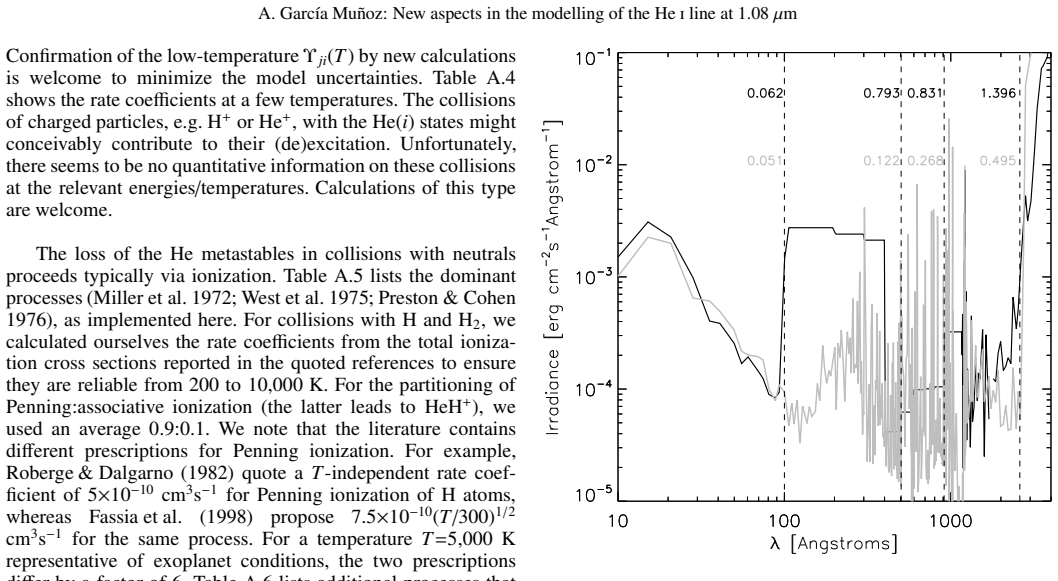
Summary. The paper presents a revised chemical-collisional-radiative network for modelling the He(2^3S) metastable population that sets the He I 1.08 micron in-transit absorption. It adds processes involving H2 and molecular ions, and couples a Monte Carlo photoelectron energy-degradation model to a hydrodynamic escape model. The network is applied to GJ 436 b. The main findings are that Penning ionization of H is a key He(2^3S) loss channel near the line-forming region, that the rate coefficient for this process should be updated from published cross sections, and that photoelectron-driven processes affect only deep atmospheric layers for this planet. The predicted in-transit signal is strongly dependent on the adopted stellar SED: models with the MUSCLES SED clearly overpredict the published non-detections, while models with the X-Exoplanets SED are described as notably closer to, and reasonably consistent with, those upper limits.
Significance. If the conclusions hold, the paper offers a more complete and explicitly documented framework for interpreting He I 1.08 micron observations, particularly for atmospheres where H2 remains abundant to high altitudes. The strengths of the work are the transparent appendix tables of rate coefficients, the forward-modeling approach in which no parameter is fitted to the He observations, the Monte Carlo treatment of photoelectrons, and the explicit sensitivity analysis of the Penning ionization rate. These qualities make the paper a useful reference for the community. The quantitative value is, however, limited by the qualitative comparison to the GJ 436 b non-detections and by the strong sensitivity of the main observational claim to a single, partly unvalidated SED reconstruction and to an arbitrary lower-boundary H abundance.
major comments (4)
- [Sec. 5, Fig. 6] The central observational claim that the GJ 436 b non-detections are reasonably consistent with the X-Exoplanets models is supported only qualitatively. The text states that the MUSCLES-based spectra are clearly inconsistent while the X-Exoplanets-based spectra are notably closer to the upper limits, but it does not report whether the modelled line-core excess absorption lies below the limits of Nortmann et al. (2018), Guilluy et al. (2024), and Masson et al. (2024), nor by what margin. Because this comparison is the basis for the abstract's main conclusion, please provide a quantitative comparison, for example the model EA at line center versus each upper limit together with a defined consistency metric.
- [Sec. 2, Fig. 1] The X-Exoplanets SED is extended above 2,800 A with an unphysical blackbody splice, and the decisive EUV flux is not independently validated. Since it is the X-Exoplanets SED, not the MUSCLES SED, that brings the model into agreement with the non-detections, the agreement is only as credible as the SED reconstruction. The paper's argument that the blackbody extension does not matter for He(2^1S) photoionization does not validate the EUV portion that sets the He+ production and outflow. Please either validate the 0-500 A flux against an independent empirical reconstruction, or treat the SED as an explicitly varied input and show the range of predictions across plausible EUV fluxes.
- [Sec. 2, lower boundary conditions] The lower boundary H mixing ratio is described as somewhat arbitrary and set to 1e-3, with solar metallicity assumed. Penning ionization of H is identified as a key He(2^3S) loss process near the line-forming peak, and the H density there depends on the location of the H2-to-H transition, which in turn depends on the boundary H abundance and metallicity. Please add a sensitivity run that varies the boundary H mixing ratio and/or the metallicity, or justify the adopted value from photochemistry timescales; without this, the central Penning-loss conclusion is not fully pinned down.
- [Appendix A, Tables A.1-A.2] The effective recombination coefficients, which dominate He(2^3S) production near the line-forming peak (Fig. 4), are built on an assumed 1:3 singlet-to-triplet partitioning for recombinations into n>10 states and on assigning all such recombinations to n=10. This assumption is not tested, yet recombination is a central production channel for the metastable state. Please include a sensitivity test (e.g., extreme 0:1 or 1:0 partitionings, or an alternative cascade treatment) or provide a quantitative argument for why the 1:3 choice is conservative and does not materially affect the predicted spectra.
minor comments (6)
- [Throughout] Several inline expressions appear garbled in the typeset text, such as p/greaterorsimilar10^-2 dyn cm^-2 and i,i/nequal1; these should be cleaned before publication.
- [Table A.4] Some entries in Table A.4 are written with a space instead of a multiplication sign, e.g., 2.31 -20 instead of 2.31E-20; please make the scientific notation consistent throughout the table.
- [Fig. 6] The Nortmann et al. (2018) and Guilluy et al. (2024) upper limits are only mentioned in the text and caption; plotting all three upper limits in Fig. 6 would make the comparison with the model spectra more transparent.
- [Data Availability] The text promises that fits to the rate coefficients can be found through a link, but no URL or DOI appears in the arXiv version; please provide a persistent identifier or repository reference.
- [Sec. 5] The suggestion that Roberge & Dalgarno (1982) may have mistakenly adopted the cross sections for He(2^3S)+D is speculative; it would be better phrased as one of several possible explanations for the discrepancy.
- [Sec. 2] The statement that photoexcitation between bound states is omitted would benefit from a clarification of whether this includes stellar pumping of He(2^3S) to higher triplet states, since such pumping could affect line formation and is only briefly deferred to future work.
Circularity Check
No significant circularity: the Penning rate update and the GJ 436 b non-detection comparison are forward calculations from independent inputs, not fits to the target observations.
full rationale
The paper's central results are not restatements of its inputs. The revised He(2^3S) network is assembled from externally published cross sections and rate data (NORAD, Wiese & Fuhr, Berrington & Kingston, Bray et al., Movre & Meyer, etc.), and the Penning-ionization rate coefficient is explicitly calculated from published cross sections rather than adjusted to reproduce any spectrum. The in-transit spectra for GJ 436 b are forward predictions from a coupled hydrodynamic/Monte Carlo model with fixed boundary conditions; the comparison to the Masson et al. (2024) non-detection upper limit uses no fitted parameter. The two SEDs (MUSCLES and X-Exoplanets) are independent external inputs, and the paper reports both outcomes, including that the MUSCLES predictions are inconsistent with the upper limits; selecting the X-Exoplanets SED as a better match is a model-comparison statement, not a parameter fit disguised as a prediction. The 'somewhat arbitrary' H mixing ratio and the acknowledged unphysical blackbody splice above 2800 Å are stated limitations, but neither is tuned to the He I non-detections, and the paper's own sensitivity discussion shows the main SED dependence lies in the EUV flux. Self-citations to García Muñoz (2023a), García Muñoz & Bataille (2024), and García Muñoz & Schneider (2019) are methodological references (Monte Carlo photoelectron treatment and spectral synthesis routines); they are not invoked as external proof of the present conclusions, and the load-bearing physics is grounded in the cited atomic data and cross sections. No equation in the paper is defined in terms of the quantity it purports to predict, and no fitted parameter is renamed as a prediction. The acknowledged gaps (low-temperature electron-collision data, neutral-collision rate coefficients, empirical SED verification) are uncertainty caveats, not circularity.
Assumptions & free parameters
free parameters (3)
- Lower boundary H mixing ratio =
10^-3
- Penning versus associative ionization branching ratio =
0.9:0.1
- Choice of stellar SED =
X-Exoplanets (extended with blackbody above 2800 Å)
assumptions (5)
- domain assumption Line opacity prevents radiative decay of He states into the ground state, so cascade probabilities p_ji exclude transitions to the ground state.
- ad hoc to paper The He atom model is truncated at i<=5 and He^2+ is omitted, with recombination from n>10 assigned to n=10 using a 1:3 singlet to triplet partitioning.
- ad hoc to paper Cross sections for Penning ionization are extrapolated with an E^-0.2 law at low energies and an E^-1 law at high energies.
- domain assumption The coupled Monte Carlo photoelectron model and hydrodynamic model converge to steady state with only a few Monte Carlo calculations.
- ad hoc to paper Charge-exchange rate coefficients from Loreau et al. (2018) are extrapolated to temperatures below 3,000 K using private communication.
Cite this review
Pith. "Pith review of Modelling helium in exoplanet atmospheres. A revised network with photoelectron-driven processes." pith.science (2026). https://pith.science/paper/QBWYHYFJ
@misc{pith2026250512148,
  author       = {Pith},
  title        = {Pith review of: Modelling helium in exoplanet atmospheres. A revised network with photoelectron-driven processes},
  year         = {2026},
  howpublished = {\url{https://pith.science/paper/QBWYHYFJ}},
  note         = {Machine review of arXiv:2505.12148}
}
abstract
The He I line at 1.08 $\mu$m is a valuable tracer of atmospheric escape in exoplanet atmospheres. We expand past networks used to predict the absorbing He(2$^3S$) by including, firstly, processes that involve H$_2$ and some molecular ions and, secondly, the interaction of photoelectrons with the atmosphere. We survey the literature on the chemical-collisional-radiative processes that govern the production-loss of He(2$^3S$). We simulate the atmospheric outflow from the Neptune-sized GJ 436 b by coupling a hydrodynamic model that solves the bulk properties of the gas and a Monte Carlo model that tracks the energy degradation of the photoelectrons. We identify Penning ionization of H as a key He(2$^3S$) loss process at GJ 436 b and update its rate coefficient to a value consistent with the most recent available cross sections. The update affects notably the predicted strength of the He I line. For GJ 436 b, photoelectron-driven processes (mainly ionization and excitation) modify the He(2$^3S$) population in layers too deep to affect the in-transit spectrum. The situation might be different for other atmospheres though. The spectral energy distribution of GJ 436 has a strong effect on the predicted in-transit signal. The published non-detections of the He I line for GJ 436 b are reasonably consistent with our model predictions for a solar-metallicity atmosphere when the model adopts a recently proposed spectral energy distribution. The interpretation of the He I line at 1.08 $\mu$m is model-dependent. Our revised network provides a general framework to extract more robust conclusions from measurements of this line, especially in atmospheres where H$_2$ remains abundant to high altitudes. We will explore additional, previously-ignored processes in future work.
Figures


Figures from the paper (2 more)


Forward citations
Cited by 1 Pith paper
-
A Self-Consistent 3D Hydrodynamic Model for Helium Transit Signatures in Evaporating Hot Jupiters
A 3D hydrodynamic model with self-consistent hydrogen-helium chemistry shows stellar winds compress escaping hot-Jupiter atmospheres and suppress the 1083 nm helium triplet signal, while a young star's strong XUV flux...
Reference graph
Works this paper leans on
-
[1]
Driessen, F. A. 2024, MNRAS, 527, 4657
work page 2024
- [2]
-
[3]
Bean, J. L., Raymond, S. N., & Owen, J. E. 2021, Journal of Geop hysical Research (Planets), 126, e06639 Ben-Jaffel, L., Ballester, G. E., Garc´ ıa Mu˜ noz, A., et al. 2022, Nature Astronomy, 6, 141
work page 2021
-
[4]
Berrington, K. A. & Kingston, A. E. 1987, Journal of Physics B Atomic Molecular Physics, 20, 6631
work page 1987
-
[5]
Biassoni, F., Caldiroli, A., Gallo, E., et al. 2024, A&A, 682 , A115
work page 2024
-
[6]
Black, J. H. 1978, ApJ, 222, 125
work page 1978
-
[7]
Bourrier, V ., Lecavelier des Etangs, A., Ehrenreich, D., et al. 2018, A&A, 620, A147
work page 2018
-
[8]
Bray, I., Burgess, A., Fursa, D. V ., & Tully, J. A. 2000, A&AS, 146, 481
work page 2000
Show all 63 references
-
[9]
W., Wang, J., Shkolnik, E
Cauley, P . W., Wang, J., Shkolnik, E. L., et al. 2021, AJ, 161, 152
2021
-
[10]
2009, A&A, 496, 863
Cecchi-Pestellini, C., Ciaravella, A., Micela, G., & Penz, T. 2009, A&A, 496, 863
2009
-
[11]
Cohen, J. S. & Lane, N. F. 1973, Journal of Physics B Atomic Molecular Physics, 6, L113
1973
-
[12]
Cohen, J. S. & Lane, N. F. 1977, J. Chem. Phys., 66, 586
1977
-
[13]
Courtney, E. D. S., Forrey, R. C., McArdle, R. T., Stancil, P . C., & Babb, J. F. 2021, ApJ, 919, 70
2021
-
[14]
2022, A&A, 657, A6 De Fazio, D
Czesla, S., Lamp´ on, M., Sanz-Forcada, J., et al. 2022, A&A, 657, A6 De Fazio, D. 2014, Physical Chemistry Chemical Physics (Inc orporating Faraday Transactions), 16, 11662 Dos Santos, L. A., Vidotto, A. A., Vissapragada, S., et al. 20 22, A&A, 659, A62
2022
-
[15]
Drake, G. W. F. 1986, Phys. Rev. A, 34, 2871
1986
-
[16]
J., et al
Ehrenreich, D., Bourrier, V ., Wheatley, P . J., et al. 2015, Nature, 522, 459
2015
-
[17]
Fassia, A., Meikle, W. P . S., Geballe, T. R., et al. 1998, MNRA S, 299, 150
1998
-
[18]
Florescu-Mitchell, A. I. & Mitchell, J. B. A. 2006, Phys. Rep ., 430, 277
2006
-
[19]
J., Pesnelle, A., & Watel, G
Fort, J., Laucagne, J. J., Pesnelle, A., & Watel, G. 1978, Phy s. Rev. A, 18, 2063
1978
-
[20]
France, K., Loyd, R. O. P ., Y oungblood, A., et al. 2016, ApJ, 820, 89 Garc´ ıa Mu˜ noz, A. 2007, Planet. Space Sci., 55, 1426 Garc´ ıa Mu˜ noz, A. 2023a, Icarus, 392, 115373 Garc´ ıa Mu˜ noz, A. 2023b, A&A, 672, A77 Garc´ ıa Mu˜ noz, A. & Bataille, E. 2024, ACS Earth and Spa...
2016
-
[21]
2023, A&A, 680, A33
Gillet, A., Garc´ ıa Mu˜ noz, A., & Strugarek, A. 2023, A&A, 680, A33
2023
-
[22]
2025, A&A, 696, A64
Gillet, A., Strugarek, A., & Garc´ ıa Mu˜ noz, A. 2025, A&A, 696, A64
2025
-
[23]
Grasser, N., Snellen, I. A. G., Landman, R., Picos, D. G., & Ga ndhi, S. 2024, A&A, 688, A191
2024
-
[24]
C., Bonomo, A
Guilluy, G., D’Arpa, M. C., Bonomo, A. S., et al. 2024, A&A, 68 6, A83
2024
-
[25]
Hickman, A. P . & Morgner, H. 1977, J. Chem. Phys., 67, 5484
1977
-
[26]
A., Benneke, B., Deming, D., & Homeier, D
Knutson, H. A., Benneke, B., Deming, D., & Homeier, D. 2014, N ature, 505, 66
2014
-
[27]
2010, Atomic Energy Levels and Spectra Bibliogr aphic Database, version 2.0 (Gaithesburg, MD: NIST)
Kramida, A. 2010, Atomic Energy Levels and Spectra Bibliogr aphic Database, version 2.0 (Gaithesburg, MD: NIST)
2010
-
[28]
Kramida, A., Ralchenko, Y ., J., R., & Team, N. A. 2018, NIST Atomid Spectra Database, version 5.5.6 (Gaithesburg, MD: N IST), https://physics.nist.gov/asd
2018
-
[29]
R., France, K., Linsky, J., & Loyd, R
Kulow, J. R., France, K., Linsky, J., & Loyd, R. O. P . 2014, ApJ , 786, 132 Lamp´ on, M., L ´ opez-Puertas, M., Sanz-Forcada, J., et al. 2023, A&A, 673, A140
2014
-
[30]
2024, Planetary Sc ience Journal, 5, 58
Locci, D., Aresu, G., Petralia, A., et al. 2024, Planetary Sc ience Journal, 5, 58
2024
-
[31]
M., & V aeck, N.2018, Journal of Physics B Atomic Molecular Physics, 51, 085205
Loreau, J., Ryabchenko, S., Mu˜ noz Burgos, J. M., & V aeck, N.2018, Journal of Physics B Atomic Molecular Physics, 51, 085205
2018
-
[32]
& Seager, S
Madhusudhan, N. & Seager, S. 2011, ApJ, 729, 41
2011
-
[33]
2024, A&A, 688, A179
Masson, A., Vinatier, S., B´ ezard, B., et al. 2024, A&A, 688, A179
2024
-
[34]
H., Slocomb, C
Miller, W. H., Slocomb, C. A., & Schaefer, III, H. F. 1972, J. C hem. Phys., 56, 1347
1972
-
[35]
& Niehaus, A
Morgner, H. & Niehaus, A. 1979, Journal of Physics B Atomic Mo lecular Physics, 12, 1805
1979
-
[36]
V ., Knutson, H., Line, M., et al
Morley, C. V ., Knutson, H., Line, M., et al. 2017, AJ, 153, 86
2017
-
[37]
I., Line, M
Moses, J. I., Line, M. R., Visscher, C., et al. 2013, ApJ, 777, 34
2013
-
[38]
& Meyer, W
Movre, M. & Meyer, W. 1997, J. Chem. Phys., 106, 7139
1997
-
[39]
W., & Hotop, H
Movre, M., Meyer, W., Merz, A., Ruf, M. W., & Hotop, H. 1994, Ch emical Physics Letters, 230, 276
1994
-
[40]
J., et al
Mukherjee, S., Schlawin, E., Bell, T. J., et al. 2025, arXiv e -prints, arXiv:2502.17418
2025 arXiv
-
[41]
Nahar, S. N. 2010, New A, 15, 417
2010
-
[42]
Neynaber, R. H. & Tang, S. Y . 1978, J. Chem. Phys., 69, 4851
1978
-
[43]
2018, Science, 362, 1388 Oklopˇ ci´ c, A
Nortmann, L., Pall´ e, E., Salz, M., et al. 2018, Science, 362, 1388 Oklopˇ ci´ c, A. 2019, ApJ, 881, 133 Oklopˇ ci´ c, A. & Hirata, C. M. 2018, ApJ, 855, L11
2018
-
[44]
Orient, O. J. 1977, Chemical Physics Letters, 52, 264
1977
-
[45]
Owen, J. E. 2019, Annual Review of Earth and Planetary Scienc es, 47, 67
2019
-
[46]
L., et al
Peacock, S., Barman, T., Shkolnik, E. L., et al. 2019, ApJ, 88 6, 77
2019
-
[47]
Preston, R. K. & Cohen, J. S. 1976, J. Chem. Phys., 65, 1589
1976
-
[48]
K., Kato, T., et al
Ralchenko, Y ., Janev, R. K., Kato, T., et al. 2008, Atomic Data and Nuclear Data Tables, 94, 603
2008
-
[49]
& Dalgarno, A
Roberge, W. & Dalgarno, A. 1982, ApJ, 255, 489
1982
-
[50]
S., Khodachenko, M
Rumenskikh, M. S., Khodachenko, M. L., Shaikhislamov, I. F. , et al. 2023, MNRAS, 526, 4120
2023
-
[51]
2025, A&A, 693, A285
Sanz-Forcada, J., L ´ opez-Puertas, M., Lamp´ on, M., et al. 2025, A&A, 693, A285
2025
-
[52]
M., Je fferts, S
Schauer, M. M., Je fferts, S. R., Barlow, S. E., & Dunn, G. H. 1989, J. Chem. Phys., 91, 4593
1989
-
[53]
E., Spake, J
Schreyer, E., Owen, J. E., Spake, J. J., Bahroloom, Z., & Di Gi ampasquale, S. 2024, MNRAS, 527, 5117
2024
-
[54]
& Sasselov, D
Seager, S. & Sasselov, D. D. 2000, ApJ, 537, 916
2000
-
[55]
I., Ionov, D
Shematovich, V . I., Ionov, D. E., & Lammer, H. 2014, A&A, 571, A94
2014
-
[56]
J., Sing, D
Spake, J. J., Sing, D. K., Evans, T. M., et al. 2018, Nature, 55 7, 68
2018
-
[57]
D., Christie, D., Arras, P ., Johnson, R
Turner, J. D., Christie, D., Arras, P ., Johnson, R. E., & Schm idt, C. 2016, MNRAS, 458, 3880
2016
-
[58]
A., Greklek-McKeon, M., et al
Vissapragada, S., Knutson, H. A., Greklek-McKeon, M., et al . 2022, AJ, 164, 234
2022
-
[59]
W., & Hotop, H
Waibel, H., Ruf, M. W., & Hotop, H. 1988, Zeitschrift fur Phys ik D Atoms Molecules Clusters, 9, 191
1988
-
[60]
C., et al
Wakelam, V ., Herbst, E., Loison, J. C., et al. 2012, ApJS, 199 , 21
2012
-
[61]
P ., Cook, T
West, W. P ., Cook, T. B., Dunning, F. B., Rundel, R. D., & Stebbings, R. F. 1975, J. Chem. Phys., 63, 1237
1975
-
[62]
Wiese, W. L. & Fuhr, J. R. 2009, Journal of Physical and Chemic al Reference Data, 38, 565 Y an, D., Seon, K.-I., Guo, J., Chen, G., & Li, L. 2022, ApJ, 936 , 177 Y an, F. & Henning, T. 2018, Nature Astronomy, 2, 714
2009
-
[63]
1991, Phys
Zygelman, B. 1991, Phys. Rev. A, 43, 575 8 A. Garc´ ıa Mu˜ noz: New aspects in the modelling of the Hei line at 1.08 µm Appendix A: Helium network For reference, Tables A.1–A.8 list information that descri bes the species and Ch-C-R processes specific to helium in our model. In...
2008
Reviewed August 15, 2026 · model on record in the stance chip above.
Discussion (0). Continue with ORCID to comment.