Join gate with memory in token-conserving Brownian circuits and the thermodynamic cost
Pith reviewed 2026-05-22 14:34 UTC · model grok-4.3
The pith
A quantum dot circuit with one-bit memory implements a token-conserving join gate whose thermodynamic cost stays within a few multiples of k_B T under periodic resets.
A machine-rendered reading of the paper's core claim, the machinery that carries it, and where it could break.
Core claim
By equipping a quantum dot circuit with a double quantum dot that stores the direction of two-particle transfer, the conservative join can be realized while conserving tokens. Under periodic resets the thermodynamic cost equals the work performed on the resets minus the entropy decrease they produce, and this cost remains bounded from below by a few multiples of k_B T. The same protocol combined with the speed-limit inequality applied to a subsystem gives a relatively tight upper bound on the number of emitted particles in terms of the subsystem's irreversible entropy production rate and dynamical activity rate.
What carries the argument
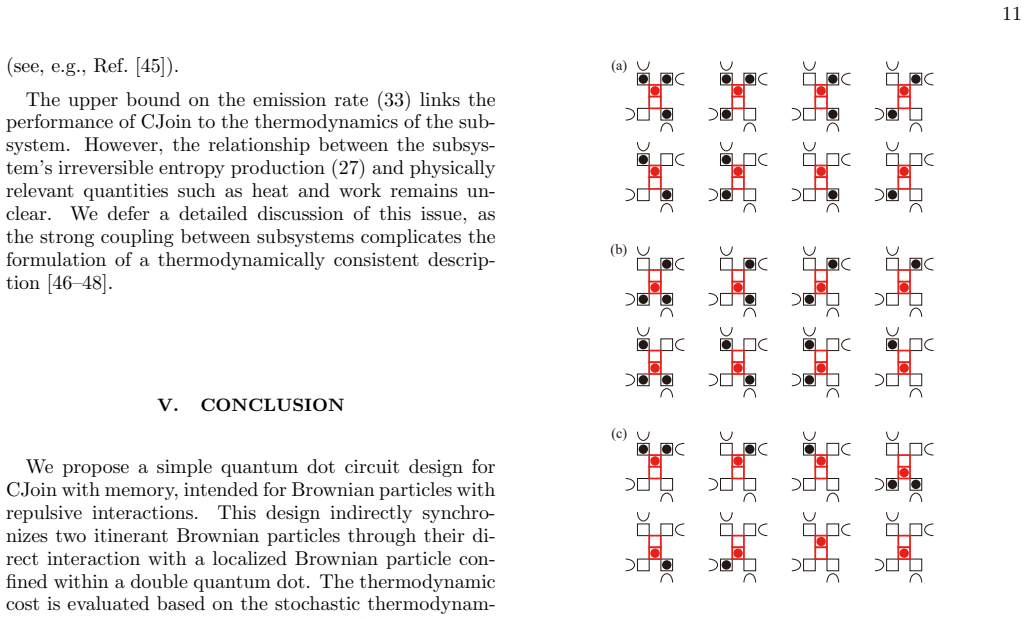
The conservative join (CJoin) realized by a quantum dot circuit that uses a double quantum dot as a one-bit memory to store transfer direction, together with a periodic reset protocol that enforces directional particle emission.
If this is right
- The CJoin element can be cascaded to construct larger token-conserving Brownian circuits with controlled synchronization.
- Thermodynamic costs remaining near a few k_B T per operation make nanoscale implementation with repelling particles such as electrons or skyrmions feasible.
- The derived bound on emitted particles supplies a practical design constraint relating circuit activity to dissipation.
- The reset-and-memory approach extends the set of logic primitives available for Brownian computation without breaking conservation laws.
Where Pith is reading between the lines
- Similar memory-assisted reset protocols could be adapted to other elementary gates in Brownian circuits to achieve comparable cost bounds.
- The speed-limit bound may help quantify the trade-off between computational speed and particle leakage in scaled-up networks.
- The framework suggests testable predictions for the scaling of dissipation when multiple CJoin elements operate in parallel.
Load-bearing premise
The periodic reset protocol can be implemented without introducing uncontrolled extra dissipation or violating token conservation, and the bipartite speed-limit relation applies directly to the chosen subsystem.
What would settle it
An experiment that measures the actual work supplied during the resets, computes the irreversible entropy production rate of the subsystem, and checks whether the observed number of emitted particles exceeds the speed-limit upper bound derived from those quantities.
Figures


read the original abstract
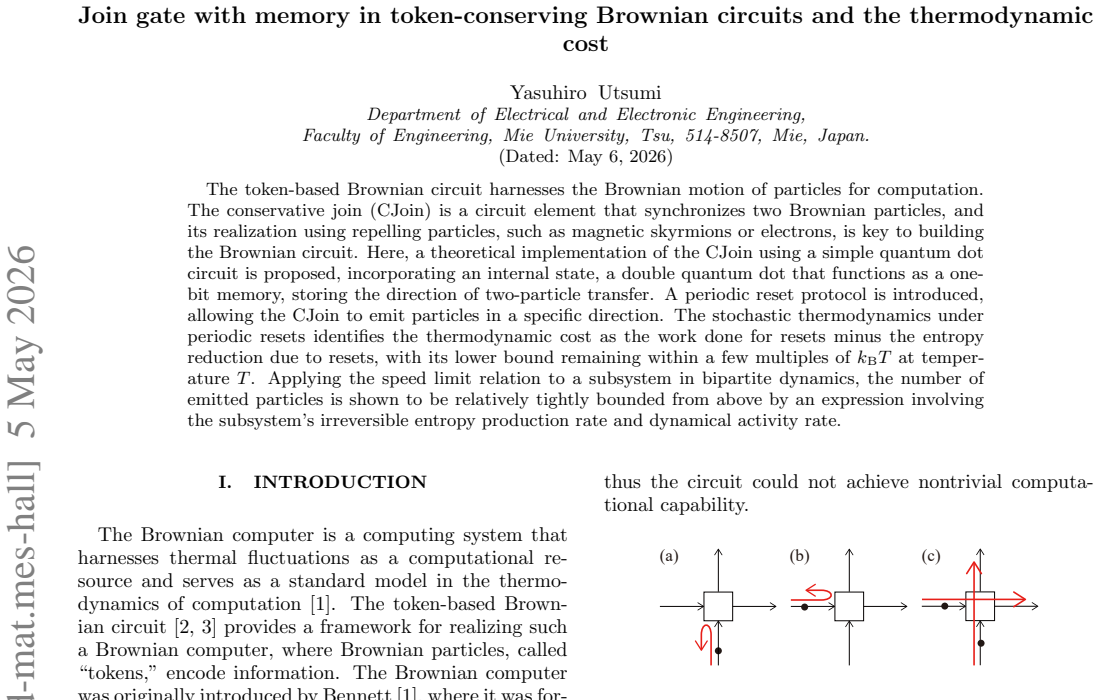
The token-based Brownian circuit harnesses the Brownian motion of particles for computation. The conservative join (CJoin) is a circuit element that synchronizes two Brownian particles, and its realization using repelling particles, such as magnetic skyrmions or electrons, is key to building the Brownian circuit. Here, a theoretical implementation of the CJoin using a simple quantum dot circuit is proposed, incorporating an internal state-a double quantum dot that functions as a one-bit memory, storing the direction of two-particle transfer. A periodic reset protocol is introduced, allowing the CJoin to emit particles in a specific direction. The stochastic thermodynamics under periodic resets identifies the thermodynamic cost as the work done for resets minus the entropy reduction due to resets, with its lower bound remaining within a few multiples of $k_{\rm B} T$ at temperature $T$. Applying the speed limit relation to a subsystem in bipartite dynamics, the number of emitted particles is shown to be relatively tightly bounded from above by an expression involving the subsystem's irreversible entropy production rate and dynamical activity rate.
Editorial analysis
A structured set of objections, weighed in public.
Referee Report
Summary. The manuscript proposes a theoretical implementation of the conservative join (CJoin) gate for token-conserving Brownian circuits using a double-quantum-dot circuit that incorporates an internal one-bit memory to store transfer direction. A periodic reset protocol is introduced to enable directed particle emission. Stochastic thermodynamics is applied under this protocol to define the thermodynamic cost as the work performed during resets minus the entropy reduction, with a claimed lower bound of a few multiples of k_B T. The bipartite speed-limit relation is then applied to a chosen subsystem to derive an upper bound on the number of emitted particles expressed in terms of the subsystem's irreversible entropy production rate and dynamical activity rate.
Significance. If the central bounds hold after addressing correlation issues, the work supplies a concrete mesoscopic realization of a key primitive for Brownian computing, together with explicit thermodynamic-cost and performance bounds that are directly relevant to experimental platforms such as quantum dots or skyrmion systems. The combination of memory-assisted token conservation and periodic resetting constitutes a useful step toward assessing the practical feasibility of such circuits.
major comments (2)
- [bipartite speed-limit application] In the section applying the bipartite speed-limit relation to the subsystem (abstract and the corresponding derivation), the upper bound on emitted-particle number is obtained by direct substitution into the standard bipartite speed-limit inequality. Because the double-quantum-dot memory is internally coupled to the particle dynamics, persistent correlations between the chosen subsystem and the memory degree of freedom can survive the periodic reset; these correlations contribute additional non-negative terms that loosen the bound. The manuscript should either derive the correlation-corrected inequality or demonstrate explicitly that the reset protocol eliminates the relevant cross-correlations.
- [stochastic thermodynamics under periodic resets] In the stochastic-thermodynamics analysis under periodic resets, the thermodynamic cost is stated to remain within a few multiples of k_B T. The manuscript provides neither the explicit Hamiltonian of the double-quantum-dot circuit nor numerical verification of the reset protocol. Without these, it is impossible to confirm that token conservation is preserved and that no uncontrolled dissipation is introduced by the reset operations themselves.
minor comments (2)
- [implementation section] The notation for the one-bit memory state and its coupling to the particle coordinates should be defined more explicitly, preferably with a diagram or explicit operator expressions.
- [discussion] A short discussion of how the claimed bounds compare with existing speed-limit results in the literature would help readers assess novelty.
Simulated Author's Rebuttal
We thank the referee for the careful reading of our manuscript and the constructive comments. We address each major comment below and indicate the revisions we intend to make.
read point-by-point responses
-
Referee: [bipartite speed-limit application] In the section applying the bipartite speed-limit relation to the subsystem (abstract and the corresponding derivation), the upper bound on emitted-particle number is obtained by direct substitution into the standard bipartite speed-limit inequality. Because the double-quantum-dot memory is internally coupled to the particle dynamics, persistent correlations between the chosen subsystem and the memory degree of freedom can survive the periodic reset; these correlations contribute additional non-negative terms that loosen the bound. The manuscript should either derive the correlation-corrected inequality or demonstrate explicitly that the reset protocol eliminates the relevant cross-correlations.
Authors: We thank the referee for highlighting the possible effect of persistent correlations. In the proposed reset protocol the memory degree of freedom is returned to a fixed reference state at fixed intervals independently of the instantaneous particle configuration. This operation is constructed to erase cross-correlations between the chosen subsystem and the memory. To make the argument rigorous we will derive the correlation-corrected form of the bipartite speed-limit inequality in the revised manuscript and show explicitly that the extra non-negative terms vanish under the periodic reset. A short calculation demonstrating the decorrelation will be added as well. revision: yes
-
Referee: [stochastic thermodynamics under periodic resets] In the stochastic-thermodynamics analysis under periodic resets, the thermodynamic cost is stated to remain within a few multiples of k_B T. The manuscript provides neither the explicit Hamiltonian of the double-quantum-dot circuit nor numerical verification of the reset protocol. Without these, it is impossible to confirm that token conservation is preserved and that no uncontrolled dissipation is introduced by the reset operations themselves.
Authors: We agree that an explicit Hamiltonian and supporting numerical checks would improve clarity and verifiability. The double-quantum-dot circuit is currently described via its effective potentials and transition rates; we will insert the explicit Hamiltonian expression in the revised manuscript. We will also add numerical simulations of the full reset protocol (Monte-Carlo trajectories) that verify token conservation and quantify any additional dissipation introduced by the resets; these results will appear as a new figure or supplementary section. revision: yes
Circularity Check
No circularity: thermodynamic cost defined from first principles and speed-limit bound applied from external inequality
full rationale
The paper defines the thermodynamic cost explicitly as work performed during resets minus entropy reduction under the periodic reset protocol, then computes its lower bound numerically or analytically within the model; this is a direct evaluation rather than a tautological re-expression of inputs. The upper bound on emitted particles is obtained by direct substitution of the subsystem's irreversible entropy production rate and dynamical activity into a pre-existing bipartite speed-limit inequality drawn from the literature. No equation reduces to a fitted parameter renamed as a prediction, no self-citation supplies the uniqueness or ansatz that carries the central claim, and the derivation remains self-contained against external benchmarks once the speed-limit relation is granted as independent input.
Axiom & Free-Parameter Ledger
axioms (1)
- domain assumption The system obeys Markovian stochastic dynamics with local detailed balance under the periodic reset protocol.
invented entities (1)
-
Double quantum dot one-bit memory
no independent evidence
Reference graph
Works this paper leans on
-
[1]
Reset cost The total system is divided into two subsystems, the circuit (subsystemX) and the memory (subsystemY), as described in (14) and (15). The solid line in Fig. 7 (a) represents the time evolution of the probability of finding the memory in the↓state in the unbiased case. Initially, the memory is equally distributed between the ↑and↓states,p y=↑,↓ ...
-
[2]
Subsystem information flow Figure 9 shows the time dependences of subsystem entropies in the biased case. Panel (a) corresponds to the circuit (subsystemX). The heat emission to the circuit is always zero, ∆S X r = 0 (dotted line). After the reset, ∆S X + ∆SX r (dashed line) becomes negative, then increases, and subsequently decreases again. Since ∆SX +∆S...
-
[3]
In each panel, all quantities are mea- sured from the initial time or from the reset time, i.e
Subsystem speed limit relation Figure 10 shows theL 1 distance (31) versus time for various subsystems. In each panel, all quantities are mea- sured from the initial time or from the reset time, i.e. τi =τ (m) reset whenτ (m) reset < τf =τ≤τ (m+1) reset . The solid line in panel (a) shows theL 1 distance for QD1↑, which increases and approaches 1. The das...
-
[4]
Detailed fluctuation relation for subsystem We summarize the derivation of the detailed FR for the subsystem, following Ref. [31]. In the bipartite dynamics, the transition rate associated with the transition from ω′ = (x′, y′) toω= (x, y) is constrained in the following form: D ω ˆL ω′ E =W ω,ω ′ =W y x,x′δy,y ′ +W y,y ′ x δx,x′ .(D1) A forward trajector...
-
[5]
Periodic resets Next, we extend the previous discussion to include periodic resets. The derivation of the integral fluctua- tion relation (FR) under periodic resets resembles the approach used in the Sagawa–Ueda relation [18], rather than that for stochastic resetting systems [49]. We let the total system evolve during the time intervalτ interval and then...
-
[6]
Anti-reset transition matrix We extend the reset transition matrix (10) to allow an error with the error probabilityϵ ′, ˆM(s),ϵ′ σ→¯σ = (1−ϵ ′) +ϵ ′ ˆXs ˆM(s) σ→¯σ (D31) = X σ′=σ,¯σ ϕ(s) σ→¯σ, σ′ (|σ ′⟩ ⟨1|)s ,(D32) where⟨1|= P σ′ ⟨σ′|andϕ (s) σ→¯σ, σ =ϵ ′ andϕ (s) σ→¯σ,¯σ= 1−ϵ ′. Let us consider the reset of thesth bit and write the state before the res...
-
[7]
C. H. Bennett, The thermodynamics of computation—a review, International Journal of Theoretical Physics21, 905 (1982)
work page 1982
-
[8]
F. Peper, J. Lee, J. Carmona, J. Cortadella, and K. Morita, Brownian circuits: Fundamentals, J. Emerg. Technol. Comput. Syst.9, 10.1145/2422094.2422097 (2013)
-
[9]
J. Lee, F. Peper, S. Cotofana, M. Naruse, M. Ohtsu, T. Kawazoe, Y. Takahashi, T. Shimokawa, L. B. Kish, and T. Kubota, Brownian circuits: Designs, International Journal of Unconventional Computing12, 341 (2016)
work page 2016
-
[10]
P. Patra and D. S. Fussell, Conservative delay-insensitive circuits, inProceedings of the Workshop on Physics and Computation(1996) pp. 248–259
work page 1996
-
[11]
J. Lee, S. Adachi, and F. Peper, A partitioned cellular automaton approach for efficient implementation of asyn- chronous circuits, The Computer Journal54, 1211 (2011)
work page 2011
- [12]
- [13]
-
[14]
I. Agbo, S. Safiruddin, and S. Cotofana, Implementable building blocks for fluctuation based calculation in single electron tunneling technology, in2009 9th IEEE Confer- ence on Nanotechnology (IEEE-NANO)(2009) pp. 366– 369
work page 2009
-
[15]
I. Ercan, Z. D. S¨ otg¨ ol, and F. O. ¨Ozhan, Physical lim- itations on fundamental efficiency of set-based brownian circuits, Entropy23, 10.3390/e23040406 (2021)
-
[16]
Y. Jibiki, M. Goto, E. Tamura, J. Cho, S. Miki, R. Ishikawa, H. Nomura, T. Srivastava, W. Lim, S. Auffret, C. Baraduc, H. Bea, and Y. Suzuki, Skyrmion brownian circuit implemented in continu- ous ferromagnetic thin film, Applied Physics Letters 117, 082402 (2020), https://pubs.aip.org/aip/apl/article- pdf/doi/10.1063/5.0011105/13545698/082402 1 online.pdf
-
[17]
R. Ishikawa, M. Goto, H. Nomura, and Y. Suzuki, Imple- mentation of skyrmion cellular automaton using brownian motion and magnetic dipole interaction, Applied Physics Letters119, 072402 (2021)
work page 2021
-
[19]
J. C. B. Souza, N. P. Vizarim, C. J. O. Reichhardt, C. Re- ichhardt, and P. A. Venegas, Controlled skyrmion ratchet in linear protrusion defects, Phys. Rev. B109, 054407 (2024)
work page 2024
-
[20]
S. Yu, J. Lee, and T. Isokawa, Universality of a surface chemical reaction network using only bi-molecular reac- tions, Journal of Membrane Computing6, 169 (2024)
work page 2024
-
[21]
J. M. R. Parrondo, J. M. Horowitz, and T. Sagawa, Thermodynamics of information, Nature Physics11, 131 (2015)
work page 2015
-
[22]
N. Shiraishi, K. Saito, and H. Tasaki, Universal trade- off relation between power and efficiency for heat engines, Phys. Rev. Lett.117, 190601 (2016)
work page 2016
-
[23]
U. Seifert, Stochastic thermodynamics, fluctuation the- orems and molecular machines, Reports on Progress in Physics75, 126001 (2012)
work page 2012
-
[24]
N. Shiraishi, Thermodynamic uncertainty relation, inAn Introduction to Stochastic Thermodynamics: From Basic to Advanced(Springer Nature Singapore, Singapore, 2023) pp. 329–362
work page 2023
-
[25]
D. H. Wolpert, J. Korbel, C. W. Lynn, F. Tasnim, J. A. Grochow, G. Karde¸ s, J. B. Aimone, V. Balasub- ramanian, E. D. Giuli, D. Doty, N. Freitas, M. Marsili, T. E. Ouldridge, A. W. Richa, P. Riechers, ´Edgar Rold´ an, B. Rubenstein, Z. Toroczkai, and J. Paradiso, Is stochastic thermodynamics the key to understanding the energy costs of computation?, Proc...
-
[26]
G. Manzano, G. Karde¸ s, E. Rold´ an, and D. H. Wolpert, Thermodynamics of computations with absolute irre- versibility, unidirectional transitions, and stochastic com- putation times, Phys. Rev. X14, 021026 (2024)
work page 2024
-
[27]
P. Strasberg, J. Cerrillo, G. Schaller, and T. Bran- des, Thermodynamics of stochastic turing machines, Phys. Rev. E92, 042104 (2015)
work page 2015
-
[28]
N. Freitas, J.-C. Delvenne, and M. Esposito, Stochastic thermodynamics of nonlinear electronic circuits: A realis- tic framework for computing aroundkt, Phys. Rev. X11, 031064 (2021)
work page 2021
-
[29]
D. Yoshino and Y. Tokura, Thermodynamics of computation for cmos nand gate, Journal of the Physical Society of Japan92, 124004 (2023), https://doi.org/10.7566/JPSJ.92.124004
- [30]
-
[31]
J. V. Koski, A. Kutvonen, I. M. Khaymovich, T. Ala- Nissila, and J. P. Pekola, On-chip maxwell’s demon as an information-powered refrigerator, Phys. Rev. Lett.115, 260602 (2015)
work page 2015
-
[32]
G. Manzano, D. Subero, O. Maillet, R. Fazio, J. P. Pekola, and E. Rold´ an, Thermodynamics of gambling demons, Phys. Rev. Lett.126, 080603 (2021)
work page 2021
-
[33]
K. Takahashi and Y. Utsumi, Generalized speed limits for classical stochastic systems and their applications to relaxation, annealing, and pumping processes, Phys. Rev. Res.5, 013217 (2023)
work page 2023
-
[34]
D. A. Bagrets and Y. V. Nazarov, Full counting statistics of charge transfer in coulomb blockade systems, Phys. Rev. B67, 085316 (2003)
work page 2003
-
[35]
J. M. Horowitz and M. Esposito, Thermodynamics with continuous information flow, Phys. Rev. X4, 031015 (2014)
work page 2014
- [36]
-
[37]
N. Shiraishi and T. Sagawa, Fluctuation theorem for par- tially masked nonequilibrium dynamics, Phys. Rev. E91, 012130 (2015)
work page 2015
-
[38]
T. Van Vu and K. Saito, Thermodynamic unification of optimal transport: Thermodynamic uncertainty relation, minimum dissipation, and thermodynamic speed limits, Phys. Rev. X13, 011013 (2023). 17
work page 2023
-
[39]
(2026), see the Supplemental Material at [URL] for a de- tailed analysis on the reduction from CJoin with memory to the 1×1 Join
work page 2026
-
[40]
J. P. Pekola, Towards quantum thermodynamics in elec- tronic circuits, Nature Physics11, 118 (2015)
work page 2015
- [41]
-
[42]
R. Garreis, J. D. Gerber, V. Star´ a, C. Tong, C. Gold, M. R¨ o¨ osli, K. Watanabe, T. Taniguchi, K. Ensslin, T. Ihn, and A. Kurzmann, Counting statistics of single electron transport in bilayer graphene quantum dots, Phys. Rev. Res.5, 013042 (2023)
work page 2023
-
[43]
A. Samanta, M. Muruganathan, M. Hori, Y. Ono, H. Mizuta, M. Tabe, and D. Moraru, Single-electron quan- tization at room temperature in a-few-donor quantum dot in silicon nano-transistors, Applied Physics Letters 110, 093107 (2017), https://pubs.aip.org/aip/apl/article- pdf/doi/10.1063/1.4977836/14495264/093107 1 online.pdf
-
[44]
S. Lee, Y. Lee, E. B. Song, and T. Hiramoto, Observation of single electron transport via multiple quantum states of a silicon quantum dot at room temperature, Nano Letters 14, 71 (2014)
work page 2014
-
[45]
K. Nishiguchi and A. Fujiwara, Single-electron counting statistics and its circuit application in nanoscale field- effect transistors at room temperature, Nanotechnology 20, 175201 (2009)
work page 2009
-
[47]
(2026), see Supplemental Material at [URL] for the de- tailed calculation of the inter-skyrmion distance depen- dence of the magnetostatic energy for single-layer and bi- layer structures
work page 2026
-
[48]
Z. Qin, Y. Wang, S. Zhu, C. Jin, J. Fu, Q. Liu, and J. Cao, Stabilization and reversal of skyrmion lattice in Ta/CoFeB/MgO multilayers, ACS Ap- plied Materials & Interfaces10, 36556 (2018), https://doi.org/10.1021/acsami.8b12694
-
[49]
H. Imanishi, E. Tamura, S. Miki, R. Ishikawa, H. No- mura, M. Goto, and Y. Suzuki, Simulation study on con- servative join (c-join) in skyrmion brownian circuit (2025), arXiv:2502.05700 [cond-mat.mes-hall]
- [50]
-
[51]
S. Nakajima and Y. Utsumi, Asymptotic expansion of the solution of the master equation and its application to the speed limit, Phys. Rev. E104, 054139 (2021)
work page 2021
-
[52]
Seifert, First and second law of thermodynamics at strong coupling, Phys
U. Seifert, First and second law of thermodynamics at strong coupling, Phys. Rev. Lett.116, 020601 (2016)
work page 2016
-
[53]
P. Strasberg and M. Esposito, Stochastic thermodynam- ics in the strong coupling regime: An unambiguous ap- proach based on coarse graining, Phys. Rev. E95, 062101 (2017)
work page 2017
-
[54]
P. Talkner and P. H¨ anggi, Colloquium: Statistical me- chanics and thermodynamics at strong coupling: Quan- tum and classical, Rev. Mod. Phys.92, 041002 (2020)
work page 2020
-
[55]
A. Pal and S. Rahav, Integral fluctuation theorems for stochastic resetting systems, Phys. Rev. E96, 062135 (2017). 18 Supplemental Material for ‘Conservative Join with memory in token-based Brownian circuits and its thermodynamic cost’ Analysis of the reduction from CJoin with memory to the 1×1 Join and calculations of the inter-skyrmion distance depende...
work page 2017
-
[56]
[S3, S4], the Brownian motion of magnetic skyrmions was observed in Ta/CoFeB/MgO layer structures
Results and discussion In Refs. [S3, S4], the Brownian motion of magnetic skyrmions was observed in Ta/CoFeB/MgO layer structures. The diameter of the skyrmions ranges fromR= 1µm to 2µm. They are considered to be dipolar skyrmions, for which the inter-skyrmion interaction is dominated by magnetostatic (dipole–dipole) interactions. In the following, we cal...
-
[57]
Since each skyrmion is formed in a magnetic thin film, which is parallel to thexyplane (See Fig
Derivation of∆E ms We begin with the following form of the magnetostatic energy, which is derived from the Lagrangian of a static magnetic field coupled to the magnetization: Ems[M] = µ0 2 Z d3r d3r′ ∇ ·M(r)∇ ′ ·M(r ′) 4π|r−r ′| − µ0 2 Z d3r|M(r)| 2 ,(S3) whereµ 0 is the vacuum permeability andMis the magnetization. Since each skyrmion is formed in a magn...
discussion (0)
Sign in with ORCID, Apple, or X to comment. Anyone can read and Pith papers without signing in.