REVIEW 3 major objections 6 minor 99 references
Exploring the spectroscopic features of double-strangeness tetraquark states
T0 review · 3 major / 6 minor · reviewed 2026-08-15 · deepseek-v4-flash
Pith's one-line read This paper predicts a bound $ss\bar{n}\bar{n}$ tetraquark with $I(J^P)=0(1^+)$ at about 1310 MeV, plus a resonance near 1783 MeV, arising from coupling meson-meson and diquark-antidiquark configurations.
desk verdict Solid quark-model calculation with a genuinely new 1310 MeV tetraquark candidate, undermined by a 17 vs 5.6 MeV resonance-width inconsistency between the abstract and Section III.B. read the letter →
The pith
A machine-rendered reading of the paper's core claim, the machinery that carries it, and where it could break.
The reading
What carries the argument
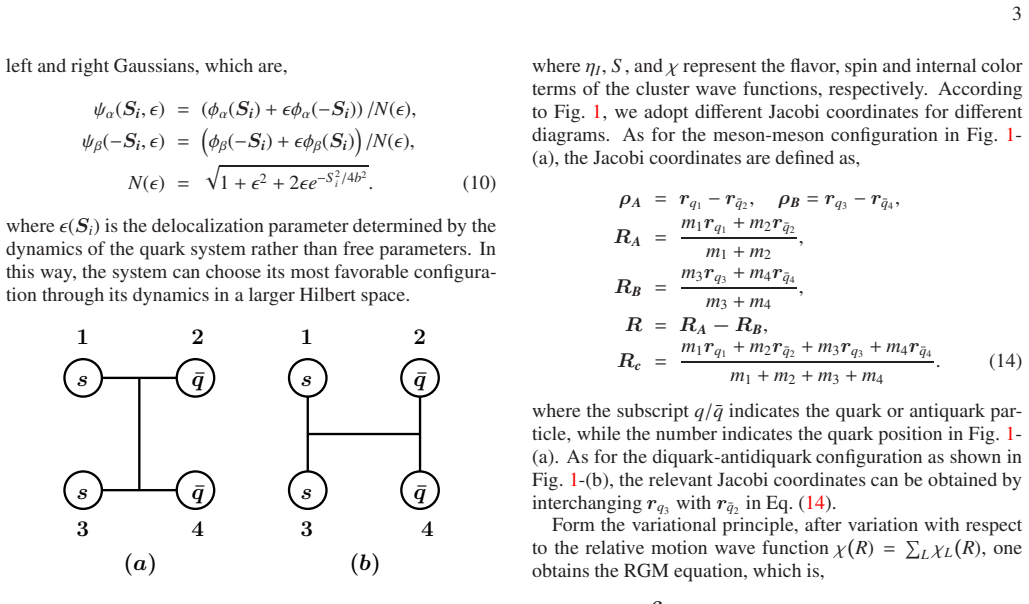
The load-bearing mechanism is the Quark Delocalization Color Screening Model (QDCSM): quarks are allowed to spread between two cluster centers through a delocalization parameter, and the confining interaction between quarks in different clusters is screened by a color-screening function. Working with the Resonating Group Method (RGM), the paper solves a generalized eigenvalue problem for the relative motion of two clusters, and builds the four-quark wave function from five flavor-spin-color channels: three meson-meson channels ($\bar{K}^0 K^{*-}$, $\bar{K}^{*0} K^-$, $\bar{K}^{*0} K^{*-}$) and two diquark-antidiquark color structures ($6_c\otimes\bar{6}_c$ and $\bar{3}_c\otimes 3_c$). Delocalization plus color screening creates effective hidden-color channel coupling that mixes color-octet meson clusters with the physical color-singlet channels; this coupling is what lowers the $0(1^+)$ energy by about 76 MeV below the $\bar{K}^0 K^{*-}$ threshold. The real-scaling method, which monitors eigenvalue behavior as a basis scale parameter grows, identifies resonances through avoided crossings, and a width formula extracts the resonance width from the slopes at the crossing.
What would settle it
A lattice QCD calculation of the $I=0$, $J^P=1^+$ $ss\bar{n}\bar{n}$ scattering amplitude below 1.5 GeV would settle the bound-state claim: if the $\bar{K}^0 K^{*-}$ phase shift contains no pole near 1310 MeV, or a pole at a significantly different energy, the predicted bound state is ruled out. For the resonance, a high-statistics search in weak decays of $B$ mesons looking for a narrow peak near 1783 MeV with a width of roughly 5 to 17 MeV would provide a direct experimental test.
Extended reading notes
Core claim
On its own terms, the paper claims that the $I(J^P)=0(1^+)$ $ss\bar{n}\bar{n}$ system supports a compact tetraquark bound state at approximately 1310 MeV, with binding energy about $-76.5$ MeV relative to the $\bar{K}^0 K^{*-}$ threshold, once the meson-meson and diquark-antidiquark configurations are coupled. Single-channel estimates give shallow bound states in $\bar{K}^0 K^{*-}$, $\bar{K}^{*0} K^-$ and $\bar{K}^{*0} K^{*-}$ with binding energies near $-1.5$, $-1.5$ and $-4.4$ MeV respectively; channel coupling within the meson-meson sector deepens the binding to about $-61.4$ MeV, and the full coupling brings it to $-76.5$ MeV. The resulting state is about 59% $\bar{K}^0 K^{*-}/\bar{K}^{*0} K^-$, 38% $\bar{K}^{*0} K^{*-}$, and 3% diquark-antidiquark, with an RMS radius near 0.81 fm, which the authors read as a compact tetraquark rather than a loosely bound molecule. Using the real-scaling (stabilization) method, the paper also identifies a resonance at about 1783 MeV with an RMS radius near 0.58 fm and a composition dominated by $\bar{K}^{*0} K^{*-}$ and diquark-antidiquark components; the abstract and summary quote its width as about 17 MeV, while the detailed avoided-crossing estimate gives about 5.6 MeV. For isospin 1, all quantum numbers considered ($1(0^+)$, $1(1^+)$, $1(2^+)$) show no bound states and no resonances.
Load-bearing premise
The deepest binding depends on the model assumption that quark delocalization and color screening generate effective hidden-color attraction strong enough to lower the energy by about 76 MeV; that mechanism is fitted to nucleon-nucleon and nucleon-hyperon scattering and to ground meson masses, but is not benchmarked against any independent calculation of a compact four-quark system.
Editorial extensions
If this is right
- The 1310 MeV state lies below the $\bar{K}^0 K^{*-}$ threshold, so strong decay to two kaons is kinematically forbidden; it should decay weakly or electromagnetically and appear as a narrow peak.
- The 1783 MeV resonance, if confirmed, should show up in $\bar{K}^* \bar{K}^*$ and $\bar{K} \bar{K}^*$ channels with a width of order 5 to 17 MeV depending on which estimate is used.
- The $I=1$ channels are predicted to have no bound states or resonances, matching earlier findings of repulsive $\bar{K}\bar{K}$ interactions.
- Single-channel $\bar{K}^*\bar{K}$ and $\bar{K}^*\bar{K}^*$ bound states are shallow and molecular-like, but full channel coupling converts the ground state into a compact object, so the two pictures are complementary pieces of one state.
- Searches for light-quark exotics in $B$-meson weak decays should target the $0(1^+)$ channel at roughly 1.31 GeV and near 1.78 GeV.
Reading between the lines
- If the 1310 MeV state is confirmed, it would demonstrate that hidden-color coupling, not just meson-exchange attraction, can bind a light-quark tetraquark, distinguishing quark-model compact tetraquarks from purely molecular interpretations.
- The difference between the 17 MeV width quoted in the abstract and summary and the 5.6 MeV stabilization estimate deserves clarification; until then the resonance width should be treated as uncertain.
- A natural next step would be to recompute the same $0(1^+)$ system with a different method, such as complex scaling or lattice QCD, to test whether the 76 MeV binding survives outside the Gaussian-basis RGM implementation.
- The composition analysis suggests the 1783 MeV resonance is predominantly $\bar{K}^{*0}K^{*-}$ plus diquark-antidiquark; this could be tested by comparing partial widths into $\bar{K}K^*$ versus $\bar{K}^*K^*$ final states.
Signed reviews
Editorial analysis
A structured set of objections, weighed in public.
Referee Report
Summary. The manuscript applies the quark delocalization color screening model (QDCSM) with the resonating group method (RGM) to study double-strange ss nbar nbar tetraquark systems in the S-wave with quantum numbers I(J^P) = 0(1+), 1(0+), 1(1+), and 1(2+). Both meson-meson and diquark-antidiquark configurations are considered, with channel coupling within and between the configurations. The authors report single-channel bound states for the Kbar0K*-, Kbar*0K-, and Kbar*0K*- channels, and a deeply bound state at approximately 1310 MeV with binding energy -76.5 MeV relative to the KbarK* threshold after full channel coupling. They also report a resonance near 1783 MeV identified by the real-scaling method, with the abstract and summary quoting a decay width of about 17 MeV while Section III B quotes about 5.6 MeV. For isospin I=1 systems, no bound or resonance states are found.
Significance. If the central predictions hold, the 1310 MeV I(J^P)=0(1+) state would be a new double-strange tetraquark candidate in the light-quark sector, complementing the double-charm T_cc(3875) and earlier one-boson-exchange and chiral quark model predictions for KbarK* and Kbar*K* molecules. A notable strength is that the model parameters are fixed from meson spectra, deuteron properties, and NN/NY scattering rather than fitted to the target ss nbar nbar states, so the predictions are not circular. The paper also provides a systematic survey of all allowed quantum numbers and explicitly constructs the color, flavor, and spin bases in the appendix. However, the significance is limited by the absence of convergence and sensitivity studies, the tiny single-channel binding energies, and an unresolved internal inconsistency in the quoted resonance width, so the quantitative predictions are not yet fully established.
major comments (3)
- [Section III B, Eq. (20), and Section IV] The resonance decay width is reported as approximately 5.6 MeV in Section III B, but the abstract and Section IV quote approximately 17 MeV. Since Eq. (20) depends on V_min, k_r, and k_c, none of which are tabulated or extracted numerically in the text or Fig. 6, a reader cannot determine which value actually follows from the calculation. This is a direct internal inconsistency in one of the two headline quantitative results and must be resolved before publication.
- [Section III A, Table II, and Eq. (16)] The single-channel binding energies of -1.5 MeV for Kbar0K*- and Kbar*0K- are of the same order as typical variational truncation errors, yet the paper gives no convergence study with respect to the number of Gaussian basis functions n and no estimate of numerical uncertainty. The subsequent channel coupling amplifies these tiny bindings to -76.5 MeV, so the existence and depth of the 1310 MeV bound state must be shown to be stable against parameter variations (mu_ij, V0, b) within the ranges allowed by the NN/NY scattering and meson-spectrum fits described in Section II A. Without such a sensitivity analysis, the central bound-state claim is not fully supported.
- [Section III B and Fig. 6] The resonance identification at approximately 1783 MeV is made from avoided crossings in the real-scaling method, but the figure does not provide numerical values of the slopes k_r and k_c or the energy gap V_min(S), and no stabilization table is given. Consequently the extracted mass and width cannot be independently checked. The text also states that the width stabilizes with increasing spatial range, yet no sequence of width estimates versus S_m is reported.
minor comments (6)
- [Abstract] The abstract states that single-channel estimations indicate the presence of two bound states, Kbar*K and Kbar*K*, whereas Section III A and Table II list three bound channels (Kbar0K*-, Kbar*0K-, and Kbar*0K*-). Please reconcile the wording.
- [Eq. (20)] There is a stray 'bv' immediately before Eq. (20), presumably intended as 'by'.
- [Throughout] There are numerous typos, including 'double-strangene' in the title, 'tetaquark' in the Introduction, 'Additionaly' in the Introduction, 'theoretical esmations' in Section II A, and 'Squark brackets' in the caption of Table I.
- [Fig. 6 caption] In the caption of Fig. 6, 'bule' should be 'blue' and 'solpe' should be 'slope'.
- [Section III A] The phrase 'the lowest eigenenergy of approximately -100 MeV less than the lowest single-channel theoretical threshold' is ambiguous; please state the actual numerical energy and threshold.
- [Table II] The column header 'Eth' is not defined in the text; please state explicitly that it denotes the theoretical threshold energy.
Circularity Check
No derivation step reduces to its own inputs: QDCSM parameters are fixed from independent meson and NN/NY data, and the bound-state and resonance claims emerge from solving the RGM equations, though the abstract and summary width of 17 MeV contradicts the 5.6 MeV reported in Section III B.
full rationale
The derivation chain is self-contained. Model parameters entering Eqs. (1)-(8) are fixed externally to the target ss-bar-n-bar-n states: the color-screening parameter mu_ij is "determined by fitting the deuteron properties, NN and NY scattering phase shifts [62-64]", the quark-gluon couplings are "fixed by reproducing the mass difference of the low-lying mesons with S = 0 and S = 1", and the remaining parameters are "the same as the ones in Ref. [65], which were determined by reproducing the mass spectrum of the ground mesons" (Section II A). No parameter of the calculation is fitted to the double-strange tetraquark states themselves, so the 1309.7 MeV bound state (Emix, Table II) and the approximately 1783 MeV resonance are emergent outputs of solving the RGM eigenvalue problem (Eq. 19), not inputs by construction; the binding energy is defined relative to the model's own threshold (E_b = E_i - E_4(infinity)), which is a standard cancellation, not a circular fit. The self-citations (Refs. [65], [74], [71]-[73]) are methodological: they supply parameter values validated on the ground meson spectrum and prior applications of the real-scaling method, and neither the binding energy nor the resonance energy is imported from those papers, so the self-citation is minor and not load-bearing. One separate issue is flagged as a correctness/presentation problem rather than circularity: the abstract and Section IV quote a resonance "decay width of approximately 17 MeV", while Section III B states "The estimated decay width is approximately 5.6 MeV" from Eq. (20), and the inputs to Eq. (20) (V_min, k_r, k_c) are not tabulated; the paper therefore does not currently support both numbers, but this inconsistency does not make either prediction equivalent to its inputs.
Assumptions & free parameters
free parameters (7)
- Constituent quark masses m_u,d and m_s
- Confinement strength a_c and constant V0_q_i_q_j
- Color screening parameters mu_ij
- Quark-gluon coupling alpha_s^(q_i q_j)
- Chiral coupling g_ch, cutoff Lambda_chi, mixing angle theta_P
- Gaussian width parameter b
- Number of Gaussian basis functions n
assumptions (6)
- domain assumption Nonrelativistic constituent quark model with two-body potentials is an adequate approximation for low-lying tetraquarks.
- domain assumption Clusters are frozen in their internal ground states inside the tetraquark (RGM two-cluster approximation).
- domain assumption Only S-wave positive parity states are considered, so spin-orbit and tensor interactions vanish.
- domain assumption The real-scaling/stabilization method reliably separates genuine resonances from continuum by avoided-crossing behavior.
- domain assumption Quark delocalization parameter epsilon(S_i) is variationally determined in a two-Gaussian Hilbert space, effectively simulating hidden-color channel coupling.
- standard math Color antisymmetrization with A = 1 - P13 - P24 + P13P24 correctly handles identical quarks and antiquarks.
invented entities (2)
-
Bound ss-bar-n-bar-n tetraquark state with I(JP)=0(1+), mass about 1310 MeV
independent evidence
-
Resonance ss-bar-n-bar-n state near 1783 MeV
independent evidence
Cite this review
Pith. "Pith review of Exploring the spectroscopic features of double-strangeness tetraquark states." pith.science (2026). https://pith.science/paper/O5MWZ4Y4
@misc{pith2026250512828,
  author       = {Pith},
  title        = {Pith review of: Exploring the spectroscopic features of double-strangeness tetraquark states},
  year         = {2026},
  howpublished = {\url{https://pith.science/paper/O5MWZ4Y4}},
  note         = {Machine review of arXiv:2505.12828}
}
abstract
Since the discovery of the $T_{cc}$ double-charm tetaquark by the LHCb collaboration, the field of the theoretical research on heavy quarks has advanced rapidly, with increasing interest in exploring the light quark sector. In this study, the quark model is employed to systematically analyze the double-strange tetraquark system. Both the meson-meson configuration and diquark-antidiquark configuration are considered. The interactions between hadron pairs under various quantum numbers, as well as the possibilities of bound states and resonances, are evaluated. The results indicate the presence of two bound states, $ \bar{K}^{\ast }\bar{K}$ and $\bar{K}^{\ast }\bar{K}^{\ast}$, with quantum number $I(J^{P})=0(1^{+})$ in single-channel estimations. Additionally, by considering the channel coupling between the two configurations, a bound state with quantum numbers $I(J^{P})=0(1^{+})$ and a mass of approximately $1310$ MeV is obtained. Moreover, through the application of Resonance Ground Method, a resonance state is identified in the $I(J^{P})=0(1^{+})$ $\ssqq$ system, with an estimated mass of around 1783 MeV and a decay width of approximately 17 MeV.
Figures


Figures from the paper (3 more)


Reference graph
Works this paper leans on
-
[1]
[σ] = [222] gives the total color symmetry. The symbols I, S , L, and J represent flavor, spin, orbit angular momentum, and total angular mo- mentum of ss ¯q ¯q system, respectively.ψA andψB are the wave functions of the two-quark cluster, which are, ψA = ( 1 2πb2 ) 3/4 e−ρ 2 A/(4b2)ηIA S Aχc A, ψB = ( 1 2πb2 ) 3/4 e−ρ 2 B/(4b2)ηIB S Bχc B, (13) whereηI, S...
1982
-
[2]
In this section, the goal is to construct the colorless wave function of a 4-quark system
The color wave function Plenty of color structures in multiquark systems will be available with respect to those of conventional hadrons suc h as q ¯q mesons and qqq baryons. In this section, the goal is to construct the colorless wave function of a 4-quark system. For the meson-meson configurations, the color wave func- tions of a q ¯q cluster are listed. C1
-
[3]
The spin wave function For the spin, the total spin S of tetraquark states ranges from 0 to 2. All of them are considered. The wave functions of two body clusters are χ11 = αα, χ10 = √ 1 2 (αβ +βα) χ1−1 = ββ χ00 = √ 1 2 (αβ −βα) (A6) Then, the total spin wave functions S i s are obtained by con- sidering the coupling of two subcluster spin wave functions ...
-
[4]
C. A. Meyer and E. S. Swanson, Prog. Part. Nucl. Phys. 82, 21 (2015), 1502.07276
arXiv 2015
-
[5]
= √ 1 6 (−r¯r − g ¯g + 2b¯b), (A1) where the subscript [111] and [21] stand for color-singlet (1c) and color-octet (8c), respectively. So, the S U(3)color wave functions of color-singlet (two color-singlet cluters, 1c ⊗ 1c) and hidden-color (two color-octet clusters, 8c ⊗ 8c) channels are given, respectively, χc 1 = C1 [111]C1 [111], χc 2 = √ 1 8 (C2 [21]C7
-
[6]
− C3 [21]C6 [21] + C8 [21]C8
-
[7]
+ C9 [21]C9 [21] − C5 [21]C4
-
[8]
(A2) For the diquark-antidiquark structure, the color wave func - tions of the diquark clusters are given, C1
+ C7 [21]C2 [21]). (A2) For the diquark-antidiquark structure, the color wave func - tions of the diquark clusters are given, C1
Show all 99 references
-
[9]
= √ 1 2 (rg + gr), C3
-
[10]
= √ 1 2 (rb + br), C5
-
[11]
= √ 1 2 (gb + bg), C6
-
[12]
= √ 1 2 (rg − gr), C8
-
[13]
= √ 1 2 (rb − br), C9
-
[14]
(A3) While the color wave functions of the antidiquark clusters c an be writen as: C1
= √ 1 2 (gb − bg). (A3) While the color wave functions of the antidiquark clusters c an be writen as: C1
- [15]
-
[16]
= √ 1 2 (¯r ¯b + ¯b¯r), C5
-
[17]
= − √ 1 2 ( ¯g¯b + ¯b ¯g), C6
- [18]
-
[19]
= − √ 1 2 (¯r ¯b − ¯b¯r), C9
-
[20]
= √ 1 2 ( ¯g¯b − ¯b¯g). (A4) The color-singlet wave functions of the diquark-antidiqua rk configuration can be the product of color sextet and antisext et clusters (6c ⊗ ¯6c) or the product of color-triplet and antitriplet cluster (3c ⊗ ¯3c), which read, χc 3 = √ 1 6 (C1 [2]C1
-
[21]
= √ 1 2 (r¯r − g ¯g), C9
-
[22]
= − √ 1 2 (¯r ¯g + ¯g¯r), C3
-
[23]
+ C3 [2]C3 [22] + C4 [2]C4
-
[24]
+ C6 2C6 22), χc 4 = √ 1 3 (C7 [11]C7
-
[25]
+ C9 [11]C9 [211]). (A5)
-
[26]
From the Table 1, the ss ¯q ¯q tetraquark flavor wave function can be cat- egorized as Fi I , the superscript ”I” means the total isospin of ss ¯q ¯q tetraquark states
The flavor wave function For the flavor degree of freedom, the di fferent coupling methods generate di fferent flavor wave function. From the Table 1, the ss ¯q ¯q tetraquark flavor wave function can be cat- egorized as Fi I , the superscript ”I” means the total isospin of ss ¯q ¯q ...
-
[27]
Gell-Mann, Phys
M. Gell-Mann, Phys. Lett. 8, 214 (1964)
1964
-
[28]
D. B. Lichtenberg and S. P . Rosen, eds., DEVELOPMENTS IN THE QUARK THEORY OF HADRONS. VOL. 1. 1964 - 1978 (1980)
1980
-
[29]
R. L. Workman et al. (Particle Data Group), PTEP 2022, 083C01 (2022)
2022
-
[30]
H.-X. Chen, W. Chen, X. Liu, and S.-L. Zhu, Phys. Rept. 639, 1 (2016), 1601.02092
2016 arXiv
- [31]
-
[32]
F.-K. Guo, C. Hanhart, U.-G. Meißner, Q. Wang, Q. Zhao, and B.-S. Zou, Rev. Mod. Phys. 90, 015004 (2018), [Erratum: Rev.Mod.Phys. 94, 029901 (2022)], 1705.00141
2018 arXiv
-
[33]
Liu, H.-X
Y .-R. Liu, H.-X. Chen, W. Chen, X. Liu, and S.-L. Zhu, Prog . Part. Nucl. Phys. 107, 237 (2019), 1903.11976
2019 arXiv
-
[34]
Brambilla, S
N. Brambilla, S. Eidelman, C. Hanhart, A. Nefediev, C.-P . Shen, C. E. Thomas, A. V airo, and C.-Z. Y uan, Phys. Rept.873, 1 (2020), 1907.07583
2020 arXiv
-
[35]
H.-X. Chen, W. Chen, X. Liu, Y .-R. Liu, and S.-L. Zhu, Rep t. Prog. Phys. 86, 026201 (2023), 2204.02649
2023 arXiv
-
[36]
Liu, Y .-W
M.-Z. Liu, Y .-W. Pan, Z.-W. Liu, T.-W. Wu, J.-X. Lu, and L.-S. Geng, Phys. Rept. 1108, 1 (2025), 2404.06399
2025 arXiv
-
[37]
S. K. Choi et al. (Belle), Phys. Rev. Lett. 91, 262001 (2003), hep-ex/0309032
2003 arXiv
-
[38]
Aubert et al
B. Aubert et al. (BaBar), Phys. Rev. D 71, 071103 (2005), hep- ex/0406022
2005
- [39]
-
[40]
Y . Ma, L. Meng, Y .-K. Chen, and S.-L. Zhu, Phys. Rev. D 109, 074001 (2024), 2309.17068
2024 arXiv
-
[41]
V . M. Abazov et al. (D0), Phys. Rev. Lett. 93, 162002 (2004), hep-ex/0405004
2004 arXiv
- [42]
-
[43]
L. Qiu, C. Gong, and Q. Zhao, Phys. Rev. D 109, 076016 (2024), 2311.10067
2024 arXiv
- [44]
-
[45]
Z. Q. Liu et al. (Belle), Phys. Rev. Lett. 110, 252002 (2013), [Erratum: Phys.Rev.Lett. 111, 019901 (2013)], 1304.0121
2013 arXiv
-
[46]
Wang, X.-D
F.-L. Wang, X.-D. Yang, R. Chen, and X. Liu, Phys. Rev. D 104, 094010 (2021), 2103.04698
2021 arXiv
- [47]
-
[48]
Hosaka, T
A. Hosaka, T. Iijima, K. Miyabayashi, Y . Sakai, and S. Ya sui, PTEP 2016, 062C01 (2016), 1603.09229
2016 arXiv
- [49]
-
[50]
R. F. Lebed, R. E. Mitchell, and E. S. Swanson, Prog. Part . Nucl. Phys. 93, 143 (2017), 1610.04528
2017 arXiv
-
[51]
S. L. Olsen, T. Skwarnicki, and D. Zieminska, Rev. Mod. P hys. 90, 015003 (2018), 1708.04012
2018 arXiv
-
[52]
L. Meng, B. Wang, G.-J. Wang, and S.-L. Zhu, Phys. Rept. 1019, 1 (2023), 2204.08716
2023 arXiv
-
[53]
Aaij et al
R. Aaij et al. (LHCb), Nature Phys. 18, 751 (2022), 2109.01038
2022
- [54]
-
[55]
Weng, W.-Z
X.-Z. Weng, W.-Z. Deng, and S.-L. Zhu, Chin. Phys. C 46, 013102 (2022), 2108.07242
2022 arXiv
-
[56]
T. Guo, J. Li, J. Zhao, and L. He, Phys. Rev. D 105, 014021 (2022), 2108.10462
2022 arXiv
-
[57]
Liu, W.-X
X.-Y . Liu, W.-X. Zhang, and D. Jia, Phys. Rev. D 108, 054019 (2023), 2303.03923
2023 arXiv
-
[58]
Q. Meng, E. Hiyama, M. Oka, A. Hosaka, and C. Xu, Phys. Lett. B 846, 138221 (2023), 2308.05466
2023 arXiv
- [59]
- [60]
-
[61]
Wang, K.-R
D. Wang, K.-R. Song, W.-L. Wang, and F. Huang, Phys. Rev. D 109, 074026 (2024), 2403.15187
2024 arXiv
- [62]
-
[63]
Li, Y .-R
S.-Y . Li, Y .-R. Liu, Z.-L. Man, Z.-G. Si, and J. Wu, Phys. Rev. D 110, 094044 (2024), 2401.00115
2024 arXiv
-
[64]
Meng, Y .-K
L. Meng, Y .-K. Chen, Y . Ma, and S.-L. Zhu, Phys. Rev. D 108, 11 114016 (2023), 2310.13354
2023 arXiv
-
[65]
Y . Xue, X. Jin, H. Huang, and J. Ping, Phys. Rev. D103, 054010 (2021), 2008.09516
2021 arXiv
-
[66]
Asanuma, Y
T. Asanuma, Y . Yamaguchi, and M. Harada, Phys. Rev. D 110, 074030 (2024), 2311.04695
2024 arXiv
- [67]
-
[68]
Hiyama, M
E. Hiyama, M. Kamimura, A. Hosaka, H. Toki, and M. Yahiro , Phys. Lett. B 633, 237 (2006), hep-ph /0507105
2006
-
[69]
Zhao, Z.-Y
M.-J. Zhao, Z.-Y . Wang, C. Wang, and X.-H. Guo, Phys. Rev . D 105, 096016 (2022), 2112.12633
2022 arXiv
- [70]
-
[71]
Padmanath and S
M. Padmanath and S. Prelovsek, Phys. Rev. Lett. 129, 032002 (2022), 2202.10110
2022 arXiv
-
[72]
Y . Lyu, S. Aoki, T. Doi, T. Hatsuda, Y . Ikeda, and J. Meng, Phys. Rev. Lett. 131, 161901 (2023), 2302.04505
2023 arXiv
-
[73]
L.-Y . Dai, X. Sun, X.-W. Kang, A. P . Szczepaniak, and J.-S. Y u, Phys. Rev. D 105, L051507 (2022), 2108.06002
2022 arXiv
-
[74]
Y . Liu, M. A. Nowak, and I. Zahed, Phys. Rev. D 105, 054021 (2022), 1909.02497
2022 arXiv
-
[75]
Wang, S.-Q
F.-L. Wang, S.-Q. Luo, R.-Q. Qian, and X. Liu, Phys. Rev. D 110, 114041 (2024), 2410.15339
2024 arXiv
-
[76]
J. Ji, Y . Xing, X. Wu, N. Xu, and Y . Tan, Chin. Phys. C 49, 013101 (2025), 2409.08933
2025 arXiv
-
[77]
S. R. Beane, T. C. Luu, K. Orginos, A. Parreno, M. J. Savag e, A. Torok, and A. Walker-Loud (NPLQCD), Phys. Rev. D 77, 094507 (2008), 0709.1169
2008 arXiv
-
[78]
Kanada-En’yo and D
Y . Kanada-En’yo and D. Jido, Phys. Rev. C 78, 025212 (2008), 0804.3124
2008 arXiv
-
[79]
N. V . Shevchenko and J. Haidenbauer, Phys. Rev. C 92, 044001 (2015), 1507.08839
2015 arXiv
-
[80]
R. Y . Kezerashvili, S. M. Tsiklauri, I. N. Filikhin, V . M. Suslov, and B. Vlahovic, EPJ Web Conf. 113, 07005 (2016)
2016
-
[81]
Marri, S
S. Marri, S. Z. Kalantari, and J. Esmaili, Eur. Phys. J. A 52, 361 (2016), 1612.00685
2016 arXiv
- [82]
-
[83]
De Rujula, H
A. De Rujula, H. Georgi, and S. L. Glashow, Phys. Rev. D 12, 147 (1975)
1975
-
[84]
Isgur and G
N. Isgur and G. Karl, Phys. Rev. D 18, 4187 (1978)
1978
-
[85]
Isgur and G
N. Isgur and G. Karl, Phys. Rev. D 19, 2653 (1979), [Erratum: Phys.Rev.D 23, 817 (1981)]
1979
-
[86]
Isgur and G
N. Isgur and G. Karl, Phys. Rev. D 20, 1191 (1979)
1979
-
[87]
M. Chen, H. Huang, J. Ping, and F. Wang, Phys. Rev. C 83, 015202 (2011)
2011
-
[88]
J. L. Ping, F. Wang, G. H. Wu, L. J. Teng, and J. T. Goldman, in 13th International Conference on Particles and Nuclei (1993), pp. 526–528
1993
-
[89]
F. Wang, D. Qing, P . Xu, and J.-L. Ping, Nucl. Phys. A 631, 462C (1998)
1998
-
[91]
Kamimura, Nucl
M. Kamimura, Nucl. Phys. A 351, 456 (1981)
1981
-
[92]
Kamimura, Prog
M. Kamimura, Prog. Theor. Phys. Suppl. 62, 236 (1977)
1977
-
[94]
Hiyama, A
E. Hiyama, A. Hosaka, M. Oka, and J.-M. Richard, Phys. Re v. C 98, 045208 (2018), 1803.11369
2018 arXiv
-
[95]
Z. Xia, S. Fan, X. Zhu, H. Huang, and J. Ping, Phys. Rev. C 105, 025201 (2022), 2105.14723
2022 arXiv
-
[96]
X. Jin, Y . Xue, H. Huang, and J. Ping, Eur. Phys. J. C 80, 1083 (2020), 2006.13745
2020 arXiv
-
[97]
X. Liu, H. Huang, J. Ping, D. Chen, and X. Zhu, Eur. Phys. J . C 81, 950 (2021), 2103.12425
2021 arXiv
-
[98]
X. Liu, D. Chen, H. Huang, J. Ping, X. Chen, and Y . Yang, Sc i. China Phys. Mech. Astron. 66, 221012 (2023), 2204.08104
2023 arXiv
-
[99]
Huang, P
H. Huang, P . Xu, J. Ping, and F. Wang, Phys. Rev. C84, 064001 (2011), 1109.5607
2011 arXiv
-
[111]
= √ 1 3 (r¯r + g ¯g + b¯b), C2
-
[211]
= √ 1 2 (¯r ¯g − ¯g¯r), C8
Reviewed August 15, 2026 · model on record in the stance chip above.
Discussion (0). Continue with ORCID to comment.