REVIEW 4 major objections 5 minor 36 references
Granular Loco-Manipulation: Repositioning Rocks Through Strategic Sand Avalanche
T0 review · 4 major / 5 minor · reviewed 2026-08-15 · deepseek-v4-flash
Pith's one-line read DiffusiveGRAIN claims that a quadruped can reposition closely spaced rocks on a sand slope by deliberately triggering avalanches, and that a diffusion-based environment and robot-state predictor lets it do so while moving to its own target.
desk verdict DiffusiveGRAIN is a genuine empirical advance over GRAIN for rock repositioning on sand slopes, but the headline success rates rest on thin trial counts and the manipulator-to-robot transfer is more assumed than shown. read the letter →
The pith
A machine-rendered reading of the paper's core claim, the machinery that carries it, and where it could break.
The reading
What carries the argument
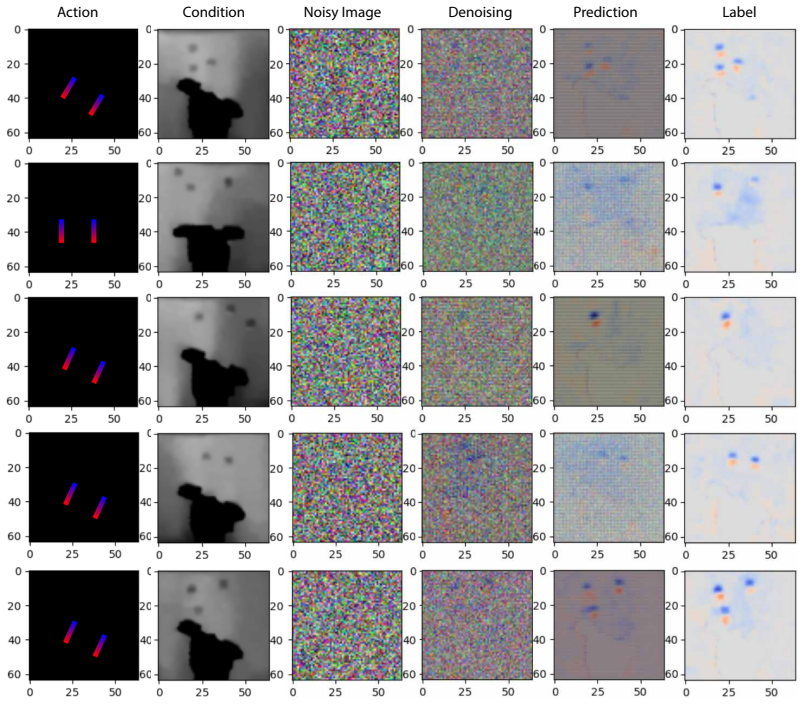
The machinery is two U-Net predictors over depth images plus a correction step. The environment predictor $f_e$ is a diffusion model that takes the current depth image $I_t$ and an RGB action image $A_t$ and outputs the sand-surface depth change $f_e(I_t,A_t)$; the robot-state predictor $f_r$ is a U-Net that outputs the robot's 2D position and 1D orientation change. Effective Action Adjustment (EAA) is the compensation step: it assumes the avalanche produced while the robot moves from $x_0$ to $x_2$ equals the avalanche a stationary manipulator would produce at the midpoint $x_1=(x_0+x_2)/2$, and it redraws the action image at $x_1$ before feeding it to $f_e$. Predicted robot pixels are then spliced into the predicted environment image, and a four-step, discounted receding-horizon search over six actions selects the sequence that minimizes a weighted cost of target distance and obstacle danger-zone proximity.
What would settle it
Run the robot on a 20-degree slope with a single AF or RP action while a top-down depth camera records the avalanche; compare the measured depth-change field and obstacle displacements against the prediction made with the midpoint $x_1=(x_0+x_2)/2$. If the predicted avalanche footprint shifts from the measured one by more than roughly the obstacle radius, or the obstacle displacement error exceeds the paper's success threshold, the EAA premise is falsified.
Extended reading notes
Core claim
On its own terms, the paper's discovery is that the granular flow that moves rocks and the robot state change caused by digging must be modeled together, and that a diffusion-based image predictor can do both if given an action representation and a midpoint correction. The environment predictor learns the depth-change field of the sand surface for one to five obstacles rather than treating each rock as an isolated object. The robot-state predictor learns the 2D position and orientation change caused by each of six leg-action groups. During execution, Effective Action Adjustment moves the action image to the midpoint between the robot's start and predicted end states, compensating for the fact that training data came from a fixed gantry rather than the moving robot. The claim is that this combined predictor, paired with four-step receding-horizon planning, is what lets a quadruped reach its own target while pushing rocks to theirs.
Load-bearing premise
The load-bearing premise is that the avalanche generated by the moving robot's legs can be represented by the fixed-gantry manipulator's avalanche at the midpoint state $x_1=(x_0+x_2)/2$, and that the environment predictor trained on gantry data transfers to the robot without direct validation; if either fails, every planned step inherits a misaligned action.
Editorial extensions
If this is right
- If the claim is right, a legged robot can treat granular slopes as partially shapeable terrain, using leg excavation both to move rocks and to reposition itself.
- Planners for granular environments must model close obstacles as coupled; the paper reports that a second obstacle at 2 cm and 0 cm fore-aft distance cuts the first obstacle's displacement to 67% and 42%, respectively.
- Leg-action groups give different locomotive and manipulative trade-offs: AF moves the robot fore-aft most, LP/RP rotate it most, and FP/LFE/RFE trigger localized avalanches with small robot state change.
- The predictor transfers to unseen rock shapes and nearby slope angles without fine-tuning, with 65-70% success on out-of-distribution trials.
- Removing EAA increases obstacle-state prediction error from 2.44 cm to 2.80 cm mean absolute error, suggesting the correction is load-bearing for accurate manipulation planning.
Reading between the lines
- A direct extension would be to measure whether EAA's midpoint approximation degrades as excavation speed, step length, or slope angle increases; if so, a learned correction for the robot's continuous motion could replace the fixed midpoint.
- The coupling result suggests a compact, distance-dependent interaction model, where rocks within a few centimeters suppress fore-aft displacement, could be combined with the learned image predictor to improve data efficiency.
- Because the planner enumerates all six actions over a four-step horizon, scaling to larger action sets or longer horizons would likely require a learned policy or sampling-based planner rather than exhaustive search.
- One testable consequence of the danger-zone cost is that a robot using this method should avoid direct leg-rock contact in most successful trials; counting contact events across trials would check whether the safety term is doing the work intended.
Signed reviews
Editorial analysis
A structured set of objections, weighed in public.
Referee Report
Summary. The paper proposes DiffusiveGRAIN, a learning-based method for a quadrupedal robot to perform loco-manipulation on a granular sand slope by strategically inducing avalanches to reposition rocks. The system combines a U-Net-based diffusion environment predictor, a U-Net robot state predictor, and an 'Effective Action Adjustment' (EAA) heuristic to align the action representation with the predicted robot state. A receding-horizon planner with hand-tuned costs selects among six leg-excavation actions. Training uses 240 gantry-manipulator trials and 60 robot locomotion trials; deployment evaluates 90 physical trials. The central reported result is a 70% success rate on in-distribution loco-manipulation versus 20% for the GRAIN baseline, and 65–70% success in out-of-distribution trials with real rocks on 16°, 20°, and 24° slopes.
Significance. If the reported results hold, the paper makes a valuable empirical contribution: it demonstrates that a legged robot can leverage granular avalanche dynamics to indirectly manipulate multiple, closely spaced rocks while simultaneously moving itself, and that learned predictors can support such integrated planning. The authors provide substantial physical experimentation (375 systematic trials plus 90 deployment trials), multiple ablations (E2E-Diffusion, Pose-Diffusion, GRAIN, and DiffusiveGRAIN without EAA), and an out-of-distribution generalization test with real rocks. The idea of joint environment/robot state prediction for loco-manipulation is a plausible and interesting direction for terradynamics and legged robotics. However, the strength of evidence is limited by small per-condition trial counts, the absence of confidence intervals on success rates, and two unvalidated load-bearing assumptions (the EAA midpoint approximation and the manipulator-to-robot transfer of the environment predictor). The paper's significance is therefore conditional on additional validation of these assumptions and more statistically robust deployment measurements.
major comments (4)
- [Sec. 4.3] The EAA midpoint assumption, x1 = (x0 + x2)/2, is load-bearing for the entire planning loop: the adjusted action image A'_t is fed to fe, and if the assumed avalanche location is not the actual leg-sand interaction region, every planned step inherits a spatial misalignment. The only quantitative support in Table 3 is an obstacle-state MAE improvement from 2.80 cm (without EAA) to 2.44 cm (with EAA) on an experiment dataset, while robot-state MAE is identical (1.17 cm). This is not a deployment success-rate ablation. Please provide a deployment ablation (with vs. without EAA) and/or a direct measurement comparing the predicted avalanche centroid with the actual affected sand region.
- [Sec. 4.2 / Appendix D] The environment predictor fe is trained exclusively on gantry-manipulator depth images but deployed on robot-captured depth images. Appendix D states 'We believe the diffusion model learns to ignore these appearance differences' as the only justification. This transfer is load-bearing for the central claim, because the planner optimizes over fe's predictions. Please add quantitative evidence: for example, compare fe's obstacle displacement predictions against ground truth on robot trials, or report a domain-shift analysis showing that the appearance difference does not systematically bias the predicted avalanche fields.
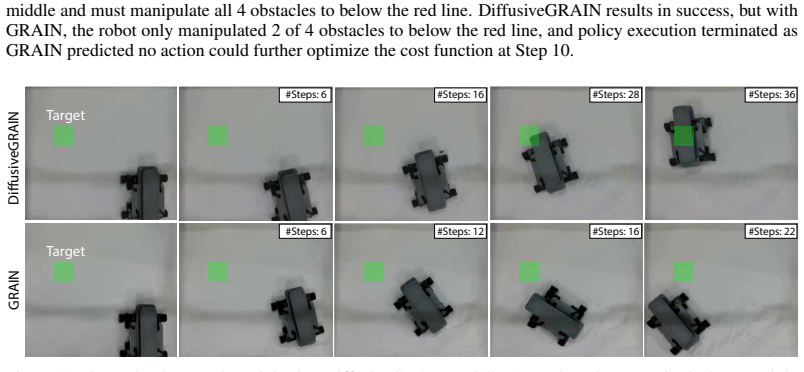
- [Sec. 5.3 / Table 1] The headline loco-manipulation result, 70% vs. 20% success, is based on 10 trials per method. With 7/10 vs. 2/10 successes, the difference is not statistically significant at the 95% level (Fisher's exact test p ≈ 0.07). Success rates in Tables 1 and 2 are reported without confidence intervals, and the threshold that defines a successful trial is not explicitly stated. The phrase 'significantly high success rate' in the Conclusion is not supported by the reported statistics. Please report confidence intervals, exact p-values, or additional trials, and define the success criterion quantitatively.
- [Sec. 4.4 / 4.5] The receding-horizon planner depends on cost weights w1...w6 and parameters alpha, beta, gamma, all of which are hand-chosen. No sensitivity analysis is provided, so it is unclear whether the reported success is robust to these choices or whether the performance gap could change under plausible alternative weightings. Please add a sensitivity study, even on a subset of the deployment trials, to establish that the results are not an artifact of one specific tuning.
minor comments (5)
- [Abstract / Title] The title in the provided text reads 'Strategic Sand A valanche' with an erroneous space; please correct to 'Avalanche'.
- [Sec. 5.3 / Table 2] The out-of-distribution results (65%, 70%, 65% for 16°, 20°, 24°) are based on 20 trials each, but no confidence intervals are given. Please add binomial confidence intervals or exact values for the success counts.
- [Sec. 4.5] The success criteria for manipulation, locomotion, and loco-manipulation trials are not explicitly defined in the main text (e.g., a distance threshold from the target). Please state them concretely, since repeatability and interpretation of the success rates depend on this definition.
- [Fig. 5 / Fig. 10] The figures rely on color cues (red horizontal line, green target) that may be ambiguous in grayscale. Consider adding labels or distinct markers to improve readability.
- [Sec. 2] There is a missing space in '0.3 mmglass beads'; please fix the typo.
Circularity Check
No circularity: DiffusiveGRAIN's success rates come from held-out physical deployments, and the EAA and manipulator-to-robot transfer are modeling assumptions, not fitted predictions.
full rationale
The paper's central claims rest on measured deployment outcomes: Table 1 reports 70% success for DiffusiveGRAIN versus 20% for GRAIN on in-distribution loco-manipulation, and Table 2 reports 65-70% success on out-of-distribution trials at 16, 20, and 24 degree slopes. These success rates are not used as training targets or fitted parameters; they are evaluated on physical trials after training the environment predictor fe and robot state predictor fr on separate gantry and robot datasets. The Effective Action Adjustment (EAA) in Section 4.3 relies on the midpoint assumption x1 = (x0 + x2)/2, where x2 comes from fr, but this is a fixed heuristic, not a fitted input whose success is then re-reported as a prediction. The Appendix D statement that 'the diffusion model learns to ignore these appearance differences' is an unverified belief, and the manipulator-to-robot transfer is an acknowledged approximation; these are correctness risks and potential limitations, but they do not make the derivation circular. The self-citations to GRAIN [12], authored by overlapping authors, are used as background and as a comparison baseline, not as the justification for the claimed result; the empirical comparison actually shows DiffusiveGRAIN outperforming GRAIN. No equation in the paper reduces a prediction to its input by construction, and no fitted parameter is renamed as a prediction. Therefore, no significant circularity is present.
Assumptions & free parameters
free parameters (9)
- w1 =
0.6
- w2 =
0.4
- w3 =
0.8
- w4 =
0.2
- w5 =
0.4
- w6 =
0.6
- alpha =
4
- beta =
pi/4
- gamma =
0.8
assumptions (6)
- domain assumption 0.3 mm glass beads behave qualitatively like natural sand
- domain assumption Manipulator leg excavation produces the same avalanche as robot leg excavation for the same action
- domain assumption Obstacle positions do not affect robot state change unless the leg directly contacts an obstacle
- domain assumption The avalanche during robot motion x0 to x2 equals the avalanche at fixed midpoint x1=(x0+x2)/2
- domain assumption Depth image and action image are sufficient to predict environment and robot state changes
- domain assumption The diffusion model learns to ignore appearance differences between the manipulator and the robot
Cite this review
Pith. "Pith review of Granular Loco-Manipulation: Repositioning Rocks Through Strategic Sand Avalanche." pith.science (2026). https://pith.science/paper/H3GNZ765
@misc{pith2026250512934,
  author       = {Pith},
  title        = {Pith review of: Granular Loco-Manipulation: Repositioning Rocks Through Strategic Sand Avalanche},
  year         = {2026},
  howpublished = {\url{https://pith.science/paper/H3GNZ765}},
  note         = {Machine review of arXiv:2505.12934}
}
read the original abstract
Legged robots have the potential to leverage obstacles to climb steep sand slopes. However, efficiently repositioning these obstacles to desired locations is challenging. Here we present DiffusiveGRAIN, a learning-based method that enables a multi-legged robot to strategically induce localized sand avalanches during locomotion and indirectly manipulate obstacles. We conducted 375 trials, systematically varying obstacle spacing, robot orientation, and leg actions in 75 of them. Results show that the movement of closely-spaced obstacles exhibits significant interference, requiring joint modeling. In addition, different multi-leg excavation actions could cause distinct robot state changes, necessitating integrated planning of manipulation and locomotion. To address these challenges, DiffusiveGRAIN includes a diffusion-based environment predictor to capture multi-obstacle movements under granular flow interferences and a robot state predictor to estimate changes in robot state from multi-leg action patterns. Deployment experiments (90 trials) demonstrate that by integrating the environment and robot state predictors, the robot can autonomously plan its movements based on loco-manipulation goals, successfully shifting closely located rocks to desired locations in over 65% of trials. Our study showcases the potential for a locomoting robot to strategically manipulate obstacles to achieve improved mobility on challenging terrains.
Figures


Figures from the paper (13 more)





Reference graph
Works this paper leans on
-
[1]
P. E. Schiebel, J. M. Rieser, A. M. Hubbard, L. Chen, and D. I. Goldman. Collisional diffrac- tion emerges from simple control of limbless locomotion. In Conference on Biomimetic and Biohybrid Systems, pages 611–618. Springer, 2017
work page 2017
-
[2]
P. E. Schiebel, J. M. Rieser, A. M. Hubbard, L. Chen, D. Z. Rocklin, and D. I. Goldman. Mechanical diffraction reveals the role of passive dynamics in a slithering snake. Proceedings of the National Academy of Sciences, 116(11):4798–4803, 2019
work page 2019
-
[3]
F. Qian and D. E. Koditschek. An obstacle disturbance selection framework: emergent robot steady states under repeated collisions. The International Journal of Robotics Research, 2020
work page 2020
-
[4]
R. Othayoth, G. Thoms, and C. Li. An energy landscape approach to locomotor transitions in complex 3d terrain. Proceedings of the National Academy of Sciences, 117(26):14987–14995, 2020
work page 2020
-
[5]
J. M. Rieser, P. E. Schiebel, A. Pazouki, F. Qian, Z. Goddard, K. Wiesenfeld, A. Zangwill, D. Negrut, and D. I. Goldman. Dynamics of scattering in undulatory active collisions.Physical Review E, 99(2):022606, 2019
work page 2019
-
[6]
T. Wang, C. Pierce, V . Kojouharov, B. Chong, K. Diaz, H. Lu, and D. I. Goldman. Me- chanical intelligence simplifies control in terrestrial limbless locomotion. arXiv preprint arXiv:2304.08652, 2023
work page Pith review arXiv 2023
- [7]
-
[8]
H. Hu, X. Liao, W. Du, and F. Qian. Multi-robot connection towards collective obstacle field traversal, 2024. URL https://arxiv.org/abs/2409.11709
work page Pith review arXiv 2024
Show all 36 references
-
[9]
Ramesh, A
D. Ramesh, A. Kathail, D. E. Koditschek, and F. Qian. Modulation of robot orientation via leg-obstacle contact positions. IEEE Robotics and Automation Letters, 5(2):2054–2061, 2020
2020
-
[10]
Chakraborty, H
K. Chakraborty, H. Hu, M. D. Kvalheim, and F. Qian. Planning of obstacle-aided navigation for multi-legged robots using a sampling-based method over directed graphs. IEEE Robotics and Automation Letters, 7(4):8861–8868, 2022
2022
-
[11]
Qian and D
F. Qian and D. Goldman. Anticipatory control using substrate manipulation enables trajectory control of legged locomotion on heterogeneous granular media. InMicro-and Nanotechnology Sensors, Systems, and Applications VII, volume 9467, page 94671U. International Society for Opt...
2015
-
[12]
H. Hu, F. Qian, and D. Seita. Learning granular media avalanche behavior for indirectly ma- nipulating obstacles on a granular slope. In 8th Annual Conference on Robot Learning, 2024. 9
2024
-
[13]
Barker and A
G. Barker and A. Mehta. Two types of avalanche behaviour in model granular media. Physica A: Statistical Mechanics and its Applications, 283(3-4):328–336, 2000
2000
-
[14]
S. P. Pudasaini and K. Hutter. Avalanche dynamics: dynamics of rapid flows of dense granular avalanches. Springer Science & Business Media, 2007
2007
-
[15]
Gravish and D
N. Gravish and D. I. Goldman. Effect of volume fraction on granular avalanche dynamics. Physical Review E, 90(3):032202, 2014
2014
-
[16]
Pavlov and A
C. Pavlov and A. M. Johnson. Soil displacement terramechanics for wheel-based trenching with a planetary rover. In 2019 International Conference on Robotics and Automation (ICRA), pages 4760–4766. IEEE, 2019
2019
-
[17]
Y . Wang, Y . Li, K. Driggs-Campbell, L. Fei-Fei, and J. Wu. Dynamic-Resolution Model Learning for Object Pile Manipulation. In Robotics: Science and Systems (RSS), 2023
2023
-
[18]
S. Xue, S. Cheng, P. Kachana, and D. Xu. Neural Field Dynamics Model for Granular Object Piles Manipulation. In Conference on Robot Learning (CoRL), 2023
2023
-
[19]
Schenck, J
C. Schenck, J. Tompson, S. Levine, and D. Fox. Learning robotic manipulation of granular media. In Conference on Robot Learning (CoRL), 2017
2017
-
[20]
Ronneberger, P
O. Ronneberger, P. Fischer, and T. Brox. U-Net: Convolutional Networks for Biomedical Im- age Segmentation. In International Conference on Medical Image Computing and Computer- Assisted Intervention (MICCAI), 2015
2015
-
[21]
Sohl-Dickstein, E
J. Sohl-Dickstein, E. A. Weiss, N. Maheswaranathan, and S. Ganguli. Deep unsupervised learning using nonequilibrium thermodynamics. In International Conference on Machine Learning (ICML), 2015
2015
-
[22]
L. Yang, Z. Zhang, Y . Song, S. Hong, R. Xu, Y . Zhao, W. Zhang, B. Cui, and M.-H. Yang. Diffusion models: A comprehensive survey of methods and applications. ACM Computing Surveys, 56(4):1–39, 2023
2023
-
[23]
J. Ho, A. Jain, and P. Abbeel. Denoising Diffusion Probabilistic Models. InNeural Information Processing Systems (NeurIPS), 2020
2020
-
[24]
R. D. Maladen, Y . Ding, C. Li, and D. I. Goldman. Undulatory swimming in sand: subsurface locomotion of the sandfish lizard. science, 325(5938):314–318, 2009
2009
-
[25]
C. Li, T. Zhang, and D. I. Goldman. A terradynamics of legged locomotion on granular media. science, 339(6126):1408–1412, 2013
2013
-
[26]
J. R. Finn, M. Li, and S. V . Apte. Particle based modelling and simulation of natural sand dynamics in the wave bottom boundary layer. Journal of Fluid Mechanics , 796:340–385, 2016
2016
-
[27]
Albert, I
R. Albert, I. Albert, D. Hornbaker, P. Schiffer, and A.-L. Barab´asi. Maximum angle of stability in wet and dry spherical granular media. Physical Review E, 56(6):R6271, 1997
1997
-
[28]
Shrivastava, A
S. Shrivastava, A. Karsai, Y . O. Aydin, R. Pettinger, W. Bluethmann, R. O. Ambrose, and D. I. Goldman. Material remodeling and unconventional gaits facilitate locomotion of a robophysi- cal rover over granular terrain. Science robotics, 5(42):eaba3499, 2020
2020
-
[29]
Karsai, D
A. Karsai, D. Kerimoglu, D. Soto, S. Ha, T. Zhang, and D. I. Goldman. Real-time remodeling of granular terrain for robot locomotion. Advanced Intelligent Systems, 4(12):2200119, 2022
2022
-
[30]
Kerimoglu, D
D. Kerimoglu, D. Soto, M. L. Hemsley, J. Brunner, S. Ha, T. Zhang, and D. I. Goldman. Learning manipulation of steep granular slopes for fast mini rover turning. In 2024 IEEE International Conference on Robotics and Automation (ICRA) , pages 16985–16990. IEEE, 2024. 10
2024
-
[31]
Schwarz, M
M. Schwarz, M. Beul, D. Droeschel, S. Sch ¨uller, A. S. Periyasamy, C. Lenz, M. Schreiber, and S. Behnke. Supervised autonomy for exploration and mobile manipulation in rough terrain with a centaur-like robot. Frontiers in Robotics and AI, 3:57, 2016
2016
-
[32]
Dosovitskiy, L
A. Dosovitskiy, L. Beyer, A. Kolesnikov, D. Weissenborn, X. Zhai, T. Unterthiner, M. De- hghani, M. Minderer, G. Heigold, S. Gelly, et al. An image is worth 16x16 words: Transform- ers for image recognition at scale. In International Conference on Learning Representations (ICLR), 2021
2021
-
[33]
B ¨orzs¨onyi, T
T. B ¨orzs¨onyi, T. C. Halsey, and R. E. Ecke. Avalanche dynamics on a rough inclined plane. Physical Review E—Statistical, Nonlinear, and Soft Matter Physics, 78(1):011306, 2008
2008
-
[34]
G. Bradski. The OpenCV Library. Dr. Dobb’s Journal of Software Tools, 2000
2000
-
[35]
Qian and D
F. Qian and D. I. Goldman. The dynamics of legged locomotion in heterogeneous terrain: universality in scattering and sensitivity to initial conditions. InRobotics: Science and Systems (RSS), 2015
2015
-
[36]
loco-manipulation
A. Daerr and S. Douady. Two types of avalanche behaviour in granular media. Nature, 399 (6733):241–243, 1999. 11 We structure the Appendix as follows: • App. A presents additional hardware details. • App. B has additional experimental results. • App. C presents and evaluates m...
1999
Reviewed August 15, 2026 · model on record in the stance chip above.
Discussion (0). Continue with ORCID to comment.