REVIEW 3 major objections 6 minor 2 cited by
KinTwin: Imitation Learning with Torque and Muscle Driven Biomechanical Models Enables Precise Replication of Able-Bodied and Impaired Movement from Markerless Motion Capture
T0 review · 3 major / 6 minor · reviewed 2026-08-15 · deepseek-v4-flash
Pith's one-line read KinTwin shows that one imitation-learning policy can turn markerless video of able-bodied and impaired movement into accurate kinematics, joint torques, and muscle activations.
desk verdict Kinematic replication is solid and worth peer review; the clinically meaningful kinetic claims are not yet supported and need a corrected Eq. (5), residual-force reporting, and force-plate/EMG validation. read the letter →
The pith
A machine-rendered reading of the paper's core claim, the machinery that carries it, and where it could break.
The reading
What carries the argument
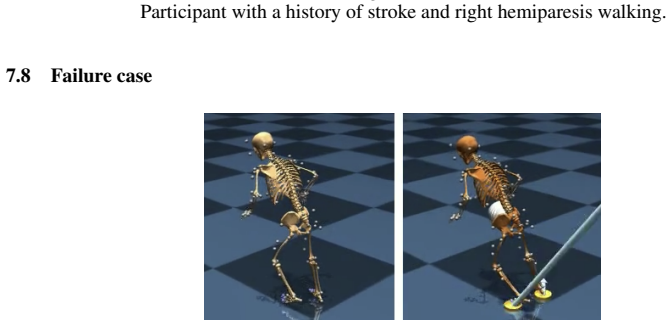
The load-bearing mechanism is a goal-conditioned imitation-learning policy that maps the simulator state and future samples of the target trajectory, at look-ahead times of 0, 1, 2, 4, 8, and 16 steps, to either joint torques or muscle activations. Two named ingredients carry the argument. First, residual force control (RFC) adds a non-physical six-degree-of-freedom force to the pelvis, letting the policy track movements that involve canes, walkers, therapist hands, or chairs without abandoning the target trajectory; an ablation without RFC raises the failure rate from 3.8 percent to 61.2 percent. Second, the biomechanical models are individualized to each participant via eight body-scale parameters, which is what lets one policy replicate many different body shapes and impairments. Training uses dense tracking rewards, squared-error pose and velocity losses, plus action penalties that discourage large or fast-changing residual forces.
What would settle it
Run KinTwin on a cohort of walkers captured simultaneously with markerless video, force plates, and surface EMG, and compare the inferred joint torques and muscle activations against the measured values; if the inferred peak hip or knee moments differ by more than a standard gait laboratory's measurement error, or the muscle-activation timing diverges systematically, the claim of clinically meaningful kinetic inference is falsified. A simpler preliminary check is to inspect the pelvis residual force in trials with no assistive device, since large forces there would show the policy depends on non-physical assistance.
Extended reading notes
Core claim
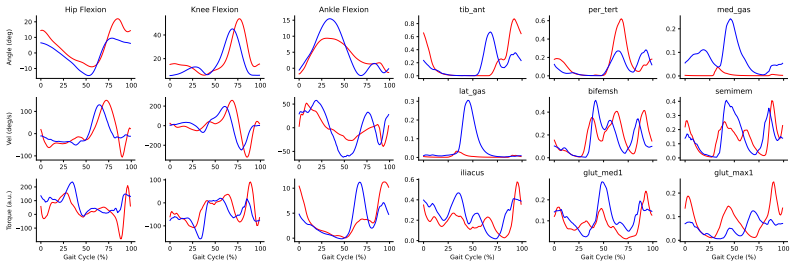
The central discovery is that a single goal-conditioned imitation-learning policy can closely track the kinematics of both able-bodied and impaired movement in a physics simulator and, in doing so, infer the kinetics behind the motion. Using a torque-driven biomechanical model, the policy tracks unseen test participants with mean joint-angle errors below one degree and horizontal pelvis errors near 4 cm across a range of mobility assessments; a muscle-driven model with 92 lower-limb muscles tracks with 1.68 degrees mean joint-angle error. The inferred vertical ground reaction forces match instrumented-walkway events with median foot-contact errors of about 80 ms and stride-length errors of about 20 mm. The paper further reports that the inferred torques and muscle activations differ across clinical conditions in expected ways, such as reduced propulsion on the prosthetic side of a transfemoral amputee and reduced hamstring activation on the hemiparetic side after stroke, indicating sensitivity to clinically meaningful features.
Load-bearing premise
The kinetic outputs are clinically meaningful only if the invisible extra force the policy applies to the pelvis truly stands in for external support like canes, walkers, or therapist hands, and does not quietly do work that should come from the legs; the paper does not report how large that force is for any trial or compare inferred torques or muscle activations against force-plate or EMG measurements.
Editorial extensions
If this is right
- If correct, the approach lets clinicians obtain joint torques, ground reaction forces, and muscle activations from multi-camera video, without instrumented walkways or force plates.
- The reported tracking accuracy suggests the policy could quantify spatiotemporal gait parameters, such as stride length and foot-contact timing, across a population that includes amputees and people with neurological impairments.
- The muscle-driven variant shows that asymmetric activation patterns, such as reduced hamstring drive on a hemiparetic side, can be extracted from video, opening a path to video-based muscle assessment without wearable sensors.
- Because the policy is validated on held-out participants, the method may generalize to new patients with similar impairments, supporting longitudinal tracking of recovery or intervention response.
Reading between the lines
- The residual force's magnitude and direction, currently a modeling artifact, could be reinterpreted as an estimate of external support load from canes, walkers, or therapist assistance, turning KinTwin into a tool for quantifying assistive-device use during clinical assessments.
- Since the policy must use larger residual forces to track poorly balanced or unstable movements, the residual-force signal might serve as a video-derived proxy for fall risk or balance impairment, a hypothesis the paper does not test.
- Combining the 30 Hz markerless trajectories with higher-rate inertial or video data could sharpen stance-phase and foot-off timing estimates, addressing the temporal-resolution limitation the paper acknowledges.
- The same training pipeline could be applied to longitudinal data from individual patients to detect changes in torque or activation asymmetry before they become visible in kinematics, an extension the paper frames only as future characterization work.
Signed reviews
Editorial analysis
A structured set of objections, weighed in public.
Referee Report
Summary. The paper presents KinTwin, an imitation learning system that tracks human movement in a physics simulator using a biomechanical human model. The system is trained with PPO on a large dataset of markerless motion capture from 467 participants, including many with movement impairments, and is evaluated on 41 held-out participants. The authors use both a torque-driven model and a muscle-driven model with 92 lower-limb muscles, and they introduce residual force control (RFC) at the pelvis to handle external forces such as canes, walkers, or therapist assistance. Kinematic tracking errors are small (0.65 deg mean joint angle error for the torque model) and gait-event timing errors against an instrumented walkway are moderate (80 ms foot contact, 20 mm stride length). The paper further claims that the inferred joint torques and muscle activations capture clinically meaningful differences, with qualitative examples from a transfemoral amputee and a person with hemiparetic gait. The central claim is that imitation learning can provide a 'digital kinetic twin' from markerless video, making full kinetic analysis broadly accessible.
Significance. If the kinetic inferences were valid, this would be an important contribution to clinical movement analysis, as it would allow joint torques and muscle activations to be estimated from widely available video. The kinematic results are solid: the held-out participant split, the large dataset, and the instrumented-walkway comparison are clear strengths, and the 0.65 deg angular error and 20 mm stride error are impressive. The use of a muscle-driven model with GPU acceleration is a technical advance. However, the kinetic claims are currently supported only by qualitative examples and by a residual-force mechanism whose effect on the estimated kinetics is not quantified. The paper's own limitations section acknowledges that substantial tuning and 3D GRF validation remain. The significance is therefore conditional on resolving the residual-force issue and either validating the kinetics or scaling back the conclusions.
major comments (3)
- [Section 3.5, Eq. (5)] Eq. (5) contains a sign error that is load-bearing for the kinetic interpretation. The text states that the term '-w_RFC ||a_t^(0:6)||^2' is an 'additional penalization to discourage using the RFC actions', but a negative squared norm rewards large residual forces: with w_RFC=0.075, minimizing la with respect to the RFC action increases the magnitude of the 6-DOF pelvis force. The policy is therefore actively incentivized to apply non-physical assistance, rather than to minimize it. The paper never reports the magnitude of the residual force for any trial, so the reader cannot determine whether the inferred joint torques and muscle activations in Figures 1 and 3 reflect the subject's neuromuscular output or the residual actuator. Please correct the sign (if a penalty is intended), report the distribution of residual forces in the test set, and relate the magnitudes to plausible external forces (e.g., cane or therapist loads).
- [Sections 4.2, 5.1, and abstract] The abstract and Section 5 state that the policy can infer 'clinically meaningful differences in joint torques and muscle activations', but the experimental evidence does not support this claim. The instrumented-walkway validation in Section 4.2 only checks the timing of thresholded vertical GRF events and stride length; it does not validate force magnitudes, mediolateral or anteroposterior GRF, joint moments, or muscle activations. The Limitations section (5.1) concedes that 'substantial work will be required to fully tune both the torques and muscle activations' and that validating 3D GRFs against force plates is 'an important future direction'. Without force-plate or EMG ground truth, the 'clinically meaningful differences' in Figures 1 and 3 are qualitative and could arise from the policy's non-physical residual forces. Please either add validation on a subset of trials or temper the abstract and conclusions to state that the kinetic outputs are plausible but unvalidated.
- [Section 7.2, Table 1] The reported tracking accuracy is partly conditioned on the fact that the target trajectories are produced with the same biomechanical model used in the simulator. Section 7.2 states: 'The biomechanical model used to reconstruct their kinematic trajectories was the same one used in the imitation learning environment.' Consequently, the target and the simulator share the same kinematic chain, joint limits, and body scaling, so the 0.65 deg joint-angle error is not a fully independent measure of how well KinTwin reproduces markerless motion capture; it measures how well the policy tracks trajectories that were themselves fitted with the identical model. The instrumented-walkway comparison is an external anchor and is genuinely valuable, but the paper should acknowledge this circularity explicitly and, where possible, report the markerless fitting error (e.g., reprojection error) so readers can estimate the component of tracking error attributable to the motion-capture pipeline.
minor comments (6)
- [Abstract] The phrase 'our work differences in several ways' should be 'our work differs in several ways'.
- [Table 1 caption] The word 'faluers' should be 'failures'.
- [Section 7.4] The phrase 'the different between the stride lengths' should be 'the difference between the stride lengths'.
- [Section 7.1] The list of body scale parameters reads 'an overall size, the pelvis, left thigh, left leg and foot, right thigh, right leg and foot, the left arm, and the left leg'; the final 'left leg' appears to be a typo, likely intended to be 'right arm' or another segment. Please check.
- [Figures 1 and 3 and Table 1] Joint torques are reported in arbitrary units (a.u.) without any normalization or conversion factor. This limits clinical interpretability; please state how the torques are scaled or provide a calibration to SI units if one exists.
- [Tables 1 and 2] Metrics are reported as point estimates without measures of variability. Given 41 test participants, reporting standard deviations or bootstrap confidence intervals would substantially strengthen the evaluation.
Circularity Check
No significant circularity: the core learning and evaluation pipeline is not reducible to its inputs by construction.
full rationale
The paper's central claim is that an imitation-learning policy can track kinematic trajectories and infer torques and muscle activations. The trajectories come from markerless video processed through a differentiable biomechanical model (Section 7.2), and the same model is used in the simulation environment. This does reduce the external validity of the 0.65-degree tracking error, since the target and the simulator share the same kinematic chain and scaling; it is a self-consistency check rather than an independent human-motion benchmark. However, this is not circularity in the derivation sense: the target still encodes real video keypoints, and the instrumented walkway provides an independent external anchor for foot-contact timing and stride length. The kinetic claims are not validated against force plates or EMG, and the residual force control channel is unmonitored, but these are validation and identifiability gaps, not inputs that are renamed as outputs. The self-citations to the author's prior markerless pipeline and to the MSE reward design are methodological and not load-bearing as uniqueness or forcing arguments. The sign issue in Eq. (5) and the unreported residual-force magnitudes are correctness concerns, not circular reductions. No load-bearing step reduces to its own input by definition or by fitted-parameter renaming.
Assumptions & free parameters
free parameters (3)
- Reward weights (wq, w_qdot, wa, w_delta_a, w_rfc, r_alive, pelvis vertical weight) =
wq=10; w_qdot(joint)=0.01, w_qdot(pelvis)=0.1; wa=0.01; w_delta_a=0.01; w_rfc=0.075; r_alive=10; pelvis vertical pose…
- Per-trial body scale parameters beta (8 values) =
Not given per participant
- Muscle tendon length rescaling for the scaled model =
Adjusted tendon_length0 per muscle
assumptions (4)
- domain assumption The LocoMujoco/Hamner musculoskeletal model is a sufficiently accurate model of human neuromusculoskeletal dynamics for the intended inverse-dynamics inference.
- domain assumption The markerless motion capture reconstruction pipeline (from Cotton [3]) produces trajectories accurate enough for physics tracking after filtering at 20 px reprojection error.
- ad hoc to paper External forces from walkers, canes, therapists, and chairs can be wholly represented by a 6-DOF residual force at the pelvis without distorting lower-limb kinetic estimates.
- domain assumption Muscle activations predicted by the policy correspond to physiological recruitment patterns without EMG validation.
Cite this review
Pith. "Pith review of KinTwin: Imitation Learning with Torque and Muscle Driven Biomechanical Models Enables Precise Replication of Able-Bodied and Impaired Movement from Markerless Motion Capture." pith.science (2026). https://pith.science/paper/ECVBW6CP
@misc{pith2026250513436,
  author       = {Pith},
  title        = {Pith review of: KinTwin: Imitation Learning with Torque and Muscle Driven Biomechanical Models Enables Precise Replication of Able-Bodied and Impaired Movement from Markerless Motion Capture},
  year         = {2026},
  howpublished = {\url{https://pith.science/paper/ECVBW6CP}},
  note         = {Machine review of arXiv:2505.13436}
}
read the original abstract
Broader access to high-quality movement analysis could greatly benefit movement science and rehabilitation, such as allowing more detailed characterization of movement impairments and responses to interventions, or even enabling early detection of new neurological conditions or fall risk. While emerging technologies are making it easier to capture kinematics with biomechanical models, or how joint angles change over time, inferring the underlying physics that give rise to these movements, including ground reaction forces, joint torques, or even muscle activations, is still challenging. Here we explore whether imitation learning applied to a biomechanical model from a large dataset of movements from able-bodied and impaired individuals can learn to compute these inverse dynamics. Although imitation learning in human pose estimation has seen great interest in recent years, our work differences in several ways: we focus on using an accurate biomechanical model instead of models adopted for computer vision, we test it on a dataset that contains participants with impaired movements, we reported detailed tracking metrics relevant for the clinical measurement of movement including joint angles and ground contact events, and finally we apply imitation learning to a muscle-driven neuromusculoskeletal model. We show that our imitation learning policy, KinTwin, can accurately replicate the kinematics of a wide range of movements, including those with assistive devices or therapist assistance, and that it can infer clinically meaningful differences in joint torques and muscle activations. Our work demonstrates the potential for using imitation learning to enable high-quality movement analysis in clinical practice.
Figures


Figures from the paper (10 more)



Forward citations
Cited by 2 Pith papers
-
Imitation Learning from Human Motion Alone Does Not Guarantee Biomechanically Plausible Gait Kinetics
Motion-only imitation learning reproduces walking kinematics but produces inaccurate ground reaction forces and joint moments; adding GRF and center-of-pressure rewards brings simulated kinetics closer to inverse dynamics.
-
The embodied brain: Bridging the brain, body, and behavior with biorealistic neuromechanical models
Neuromechanical digital twins—simulated bodies with artificial neural controllers—are maturing into tools that can infer unmeasurable physiological variables, test hypotheses, and link neuroscience with robotics and r...
Reference graph
Works this paper leans on
-
[1]
Robert M. Kanko, Elise K. Laende, Elysia M. Davis, W. Scott Selbie, and Kevin J. Deluzio. Concurrent Assessment of Gait Kinematics Using Marker-Based and Markerless Motion Capture.Journal of Biomechanics, 127:110665, oct 11 2021. ISSN 1873-2380. doi: 10.1016/j.jbiomech.2021.110665
arXiv 2021
-
[2]
Uhlrich, Antoine Falisse, Łukasz Kidzi ´nski, Julie Muccini, Michael Ko, Akshay S
Scott D. Uhlrich, Antoine Falisse, Łukasz Kidzi ´nski, Julie Muccini, Michael Ko, Akshay S. Chaudhari, Jennifer L. Hicks, and Scott L. Delp. Opencap: Human Movement Dynamics from Smartphone Videos.PLOS Computational Biology, 19(10):e1011462, oct 19 2023. ISSN 1553-7358. doi: 10.1371/journal.pcbi.1011462. URL https://journals.plos.org/ ploscompbiol/article...
-
[3]
R. James Cotton. Differentiable Biomechanics Unlocks Opportunities for Markerless Motion Capture. InIEEE International Consortium for Rehabilitation Robotics. arXiv, 2025. URL http://arxiv.org/abs/2402.17192. [Online; accessed 2024-02-28]
arXiv 2025
-
[5]
Louis N. Awad, Michael D. Lewek, Trisha M. Kesar, Jason R. Franz, and Mark G. Bowden. These Legs Were Made for Propulsion: Advancing the Diagnosis and Treatment of Post-Stroke Propulsion Deficits.Journal of Neuroengineering and Rehabilitation, 17(1):139, oct 21 2020. ISSN 1743-0003. doi: 10.1186/s12984-020-00747-6
-
[6]
David J. Clark, Lena H. Ting, Felix E. Zajac, Richard R. Neptune, and Steven A. Kautz. Merging of Healthy Motor Modules Predicts Reduced Locomotor Performance and Muscle Coordination Complexity Post-Stroke.Journal of Neurophysiology, 103(2):844–857, 2 2010. ISSN 0022-3077. doi: 10.1152/jn.00825.2009. URL http://journals.physiology.org/ doi/full/10.1152/jn...
arXiv 2010
-
[7]
Rebecca L. Routson, David J. Clark, Mark G. Bowden, Steven A. Kautz, and Richard R. Neptune. The Influence of Locomotor Rehabilitation on Module Quality and Post-Stroke Hemiparetic Walking Performance.Gait And Posture, 38(3):511–517, 7 2013. ISSN 1879-2219. doi: 10.1016/j.gaitpost.2013.01.020
-
[8]
Seungmoon Song, Łukasz Kidzi´nski, Xue Bin Peng, Carmichael Ong, Jennifer Hicks, Sergey Levine, Christopher G. Atkeson, and Scott L. Delp. Deep Reinforcement Learning for Modeling Human Locomotion Control in Neuromechanical Simulation.Journal of NeuroEngineering and Rehabilitation, 18(1):126, aug 16 2021. ISSN 1743-0003. doi: 10.1186/s12984-021-00919-y. U...
-
[9]
Matthew Loper, Naureen Mahmood, Javier Romero, Gerard Pons-Moll, and Michael J. Black. Smpl: A Skinned Multi-Person Linear Model.ACM Transactions on Graphics, 34(6):1–16, oct 26 2015. ISSN 07300301. doi: 10.1145/2816795.2818013. URL http://dl.acm.org/ citation.cfm?doid=2816795.2818013. [Online; accessed 2019-09-26]
arXiv 2015
Show all 36 references
-
[10]
Karen Liu, and Michael J
Marilyn Keller, Keenon Werling, Soyong Shin, Scott Delp, Sergi Pujades, C. Karen Liu, and Michael J. Black. From Skin to Skeleton: Towards Biomechanically Accurate 3d Digital Humans.ACM Transactions on Graphics, 42(6):253:1–253:12, dec 5 2023. ISSN 0730-
2023
-
[11]
Mujoco: A Physics Engine for Model-Based Control
Emanuel Todorov, Tom Erez, and Yuval Tassa. Mujoco: A Physics Engine for Model-Based Control. In2012 IEEE/RSJ International Conference on Intelligent Robots and Systems, pages 5026–5033, 10 2012. doi: 10.1109/IROS.2012.6386109. URLhttps://ieeexplore.ieee. org/document/6386109....
2012
-
[12]
Myosuite – A Contact-Rich Simulation Suite for Musculoskeletal Motor Control
Vittorio Caggiano, Huawei Wang, Guillaume Durandau, Massimo Sartori, and Vikash Ku- mar. Myosuite – A Contact-Rich Simulation Suite for Musculoskeletal Motor Control. http://arxiv.org/abs/2205.13600, may 26 2022. URL http://arxiv.org/abs/2205.13600. [Online; accessed 2023-12-28]
2022 arXiv
-
[13]
Locomujoco: A Comprehensive Imitation Learning Benchmark for Locomotion
Firas Al-Hafez, Guoping Zhao, Jan Peters, and Davide Tateo. Locomujoco: A Comprehensive Imitation Learning Benchmark for Locomotion. http://arxiv.org/abs/2311.02496, nov 30 2023. URLhttp://arxiv.org/abs/2311.02496. [Online; accessed 2023-12-26]
2023 arXiv
-
[14]
Physcap: Physically Plausible Monocular 3d Motion Capture in Real Time
Soshi Shimada, Vladislav Golyanik, Weipeng Xu, and Christian Theobalt. Physcap: Physically Plausible Monocular 3d Motion Capture in Real Time. [Online; accessed 2021-06-24], dec 9
2021
-
[15]
Neural Monocular 3d Human Motion Capture with Physical Awareness
Soshi Shimada, Vladislav Golyanik, Weipeng Xu, Patrick Pérez, and Christian Theobalt. Neural Monocular 3d Human Motion Capture with Physical Awareness. [Online; accessed 2021-06-24], may 3 2021. URLhttp://arxiv.org/abs/2105.01057
2021 arXiv
-
[16]
Motionet: 3d Human Motion Reconstruction from Monocular Video with Skeleton Consistency.ACM Transactions on Graphics, 40(1), jun 22 2020
Mingyi Shi, Kfir Aberman, Andreas Aristidou, Taku Komura, Dani Lischinski, Daniel Cohen- Or, and Baoquan Chen. Motionet: 3d Human Motion Reconstruction from Monocular Video with Skeleton Consistency.ACM Transactions on Graphics, 40(1), jun 22 2020. URL http: //arxiv.org/abs/20...
2020 arXiv
-
[17]
Sfv: Reinforcement Learning of Physical Skills from Videos.ACM Trans
Xue Bin Peng, Angjoo Kanazawa, Jitendra Malik, Pieter Abbeel, and Sergey Levine. Sfv: Reinforcement Learning of Physical Skills from Videos.ACM Trans. Graph., 37(6), 12
-
[18]
Deepmimic: Example- guided Deep Reinforcement Learning of Physics-Based Character Skills.ACM Trans
Xue Bin Peng, Pieter Abbeel, Sergey Levine, and Michiel van de Panne. Deepmimic: Example- guided Deep Reinforcement Learning of Physics-Based Character Skills.ACM Trans. Graph., 37(4):143:1–143:14, 7 2018. ISSN 0730-0301. doi: 10.1145/3197517.3201311. URL http: //doi.acm.org/1...
2018
-
[19]
Scalable Muscle-Actuated Human Simulation and Control.ACM Transactions on Graphics, 38(4):1–13, jul 12 2019
Seunghwan Lee, Moonseok Park, Kyoungmin Lee, and Jehee Lee. Scalable Muscle-Actuated Human Simulation and Control.ACM Transactions on Graphics, 38(4):1–13, jul 12 2019. ISSN 07300301. doi: 10.1145/3306346.3322972. URL http://dl.acm.org/citation. cfm?doid=3306346.3322972. [Onli...
2019
-
[20]
Residual Force Control for Agile Human Behavior Imitation and Extended Motion Synthesis
Ye Yuan and Kris Kitani. Residual Force Control for Agile Human Behavior Imitation and Extended Motion Synthesis. InAdvances in Neural Information Processing Systems, volume 33, pages 21763–21774. Curran Associates, Inc., 2020. URL https://proceedings.neurips. cc/paper/2020/ha...
2020
-
[21]
Simpoe: Simulated Character Control for 3d Human Pose Estimation
Ye Yuan, Shih-En Wei, Tomas Simon, Kris Kitani, and Jason Saragih. Simpoe: Simulated Character Control for 3d Human Pose Estimation. In2021 IEEE/CVF Conference on Computer Vision and Pattern Recognition (CVPR), pages 7155–7165, 6 2021. doi: 10.1109/CVPR46437. 2021.00708
2021
-
[22]
Perpetual Hu- manoid Control for Real-time Simulated Avatars
Zhengyi Luo, Jinkun Cao, Alexander Winkler, Kris Kitani, and Weipeng Xu. Perpetual Hu- manoid Control for Real-time Simulated Avatars. In2023 IEEE/CVF International Conference on Computer Vision (ICCV). arXiv, may 10 2023. doi: 10.48550/arXiv.2305.06456. URL http://arxiv.org/a...
-
[23]
Universal Humanoid Motion Representations for Physics-Based Control
Zhengyi Luo, Jinkun Cao, Josh Merel, Alexander Winkler, Jing Huang, Kris Kitani, and Weipeng Xu. Universal Humanoid Motion Representations for Physics-Based Control. In The Twelfth International Conference on Learning Representations. arXiv, 2024. doi: 10. 48550/arXiv.2310.045...
-
[24]
James Cotton
Nikolaos Smyrnakis, Tasos Karakostas, and R. James Cotton. Advancing Monocular Video- Based Gait Analysis Using Motion Imitation with Physics-Based Simulation. In2024 10th IEEE RAS/EMBS International Conference for Biomedical Robotics and Biomechatronics (BioRob), pages 102–10...
2024
-
[25]
Proximal Policy Optimization Algorithms
John Schulman, Filip Wolski, Prafulla Dhariwal, Alec Radford, and Oleg Klimov. Proximal Policy Optimization Algorithms. jul 19 2017. URL http://arxiv.org/abs/1707.06347. [Online; accessed 2019-12-16]
2017 arXiv
-
[26]
Daniel Freeman, Erik Frey, Anton Raichuk, Sertan Girgin, Igor Mordatch, and Olivier Bachem
C. Daniel Freeman, Erik Frey, Anton Raichuk, Sertan Girgin, Igor Mordatch, and Olivier Bachem. Brax – A Differentiable Physics Engine for Large Scale Rigid Body Simulation. In NeurIPS 2021 Track on Datasets and Benchmarks, jun 24 2021. URL http://arxiv.org/ abs/2106.13281. [On...
2021 arXiv
-
[27]
Reinforcement Learning- Based Motion Imitation for Physiologically Plausible Musculoskeletal Motor Control
Merkourios Simos, Alberto Silvio Chiappa, and Alexander Mathis. Reinforcement Learning- Based Motion Imitation for Physiologically Plausible Musculoskeletal Motor Control. http://arxiv.org/abs/2503.14637, mar 18 2025. URL http://arxiv.org/abs/2503.14637. [Online; accessed 2025-03-20]
2025
-
[28]
Rattay, Ludger Schöls, Martin Giese, and Daniel F
Christian Lassmann, Winfried Ilg, Tim W. Rattay, Ludger Schöls, Martin Giese, and Daniel F. B. Haeufle. Dysfunctional Neuro-Muscular Mechanisms Explain Gradual Gait Changes in Prodromal Spastic Paraplegia.Journal of NeuroEngineering and Rehabilitation, 20:90, jul 15 2023. doi:...
2023 doi
-
[29]
Accelerated policy learning with parallel differentiable simulation
Jie Xu, Viktor Makoviychuk, Yashraj Narang, Fabio Ramos, Wojciech Matusik, Animesh Garg, and Miles Macklin. Accelerated policy learning with parallel differentiable simulation. In International Conference on Learning Representations, 2021
2021
-
[30]
Adap- tive Horizon Actor-Critic for Policy Learning in Contact-Rich Differentiable Simulation
Ignat Georgiev, Krishnan Srinivasan, Jie Xu, Eric Heiden, and Animesh Garg. Adap- tive Horizon Actor-Critic for Policy Learning in Contact-Rich Differentiable Simulation. http://arxiv.org/abs/2405.17784, jun 3 2024. URL http://arxiv.org/abs/2405.17784. [Online; accessed 2024-06-06]
2024 arXiv
-
[31]
Calm: Conditional Adversarial Latent Models for Directable Virtual Characters
Chen Tessler, Yoni Kasten, Yunrong Guo, Shie Mannor, Gal Chechik, and Xue Bin Peng. Calm: Conditional Adversarial Latent Models for Directable Virtual Characters. InACM SIGGRAPH 2023 Conference Proceedings, SIGGRAPH ’23, pages 1–9, New York, NY , USA, jul 23 2023. Association ...
2023
-
[32]
Hamner, Ajay Seth, and Scott L
Samuel R. Hamner, Ajay Seth, and Scott L. Delp. Muscle Contributions to Propulsion and Support during Running.Journal of Biomechanics, 43(14):2709–2716, oct 19 2010. ISSN 1873-2380. doi: 10.1016/j.jbiomech.2010.06.025
2010 doi
-
[33]
Saeed Ghorbani, Kimia Mahdaviani, Anne Thaler, Konrad Kording, Douglas James Cook, Gunnar Blohm, and Nikolaus F. Troje. Movi: A Large Multi-Purpose Human Motion and Video Dataset.PLOS ONE, 16(6):e0253157, jun 17 2021. ISSN 1932-6203. doi: 10.1371/journal.pone.0253157. URL http...
2021 doi
-
[34]
Learning 3d Human Pose Estimation from Dozens of Datasets Using a Geometry-Aware Autoencoder to Bridge Between Skeleton Formats
István Sárándi, Alexander Hermans, and Bastian Leibe. Learning 3d Human Pose Estimation from Dozens of Datasets Using a Geometry-Aware Autoencoder to Bridge Between Skeleton Formats. InIEEE/CVF Winter Conference on Applications of Computer Vision (WACV). arXiv, 2023. doi: 10.4...
-
[301]
URL https://dl.acm.org/doi/10.1145/3618381
doi: 10.1145/3618381. URL https://dl.acm.org/doi/10.1145/3618381. [Online; accessed 2023-12-12]. 10
2023 doi
-
[2018]
doi: 10.1145/3272127.3275014
ISSN 0730-0301. doi: 10.1145/3272127.3275014. URL https://doi.org/10.1145/ 3272127.3275014
-
[2020]
URLhttp://arxiv.org/abs/2008.08880
2008 arXiv
Reviewed August 15, 2026 · model on record in the stance chip above.
Discussion (0). Continue with ORCID to comment.