REVIEW 3 major objections 6 minor 1 cited by
TransFit: An Efficient Framework for Transient Light-Curve Fitting with Time-Dependent Radiative Diffusion
T0 review · 3 major / 6 minor · reviewed 2026-08-15 · deepseek-v4-flash
Pith's one-line read TransFit claims that solving a time-dependent dimensionless diffusion equation computes supernova light curves with Monte Carlo-level accuracy at semi-analytic speed, including early shock-cooling phases.
desk verdict A useful fast light-curve solver with a correct core idea, but the printed PDE is missing the heating-amplitude factor and the reported Sedona validation is absent; fixable, not rejectable. read the letter →
The pith
A machine-rendered reading of the paper's core claim, the machinery that carries it, and where it could break.
The reading
What carries the argument
The central object is the dimensionless energy-diffusion equation $\partial e/\partial y = x^{-2}\partial_x[D(x,y)\partial_x e] + S(x,y)$, with $D(x,y)=x^2\eta_{ej}(x)^{-1}(R_{\max}/R_0)$ as the diffusion coefficient and $S(x,y)=\eta_{ej}(x)\xi_{heat}(x)f_{heat}(y)(R_{\max}/R_0)$ as the heating source; here $x=r/R_{\max}$ is the comoving radius and $y=t/t_{diff}$ is time in units of the characteristic diffusion time. This equation carries the argument because it replaces the fixed-shape single mode of the Arnett model with a full numerical solution: a Crank-Nicolson finite-difference scheme on a tridiagonal grid whose inner boundary condition can represent either a reflecting core or a central-engine luminosity and whose outer boundary uses the Eddington surface condition. The bolometric luminosity is then read directly from the diffusive flux at the outer grid cell.
What would settle it
Fit a supernova that has an independent ejecta-mass constraint, for example from nebular spectroscopy, with TransFit using opacities of 0.1 and 0.4 cm$^2$ g$^{-1}$; if the inferred ejecta mass and kinetic energy shift by more than the observational uncertainties, the single-opacity assumption is the practical bottleneck. A second check is to compare the predicted rise time against a frequency-dependent time-dependent radiative-transfer calculation for an event with strong line blanketing.
Extended reading notes
Core claim
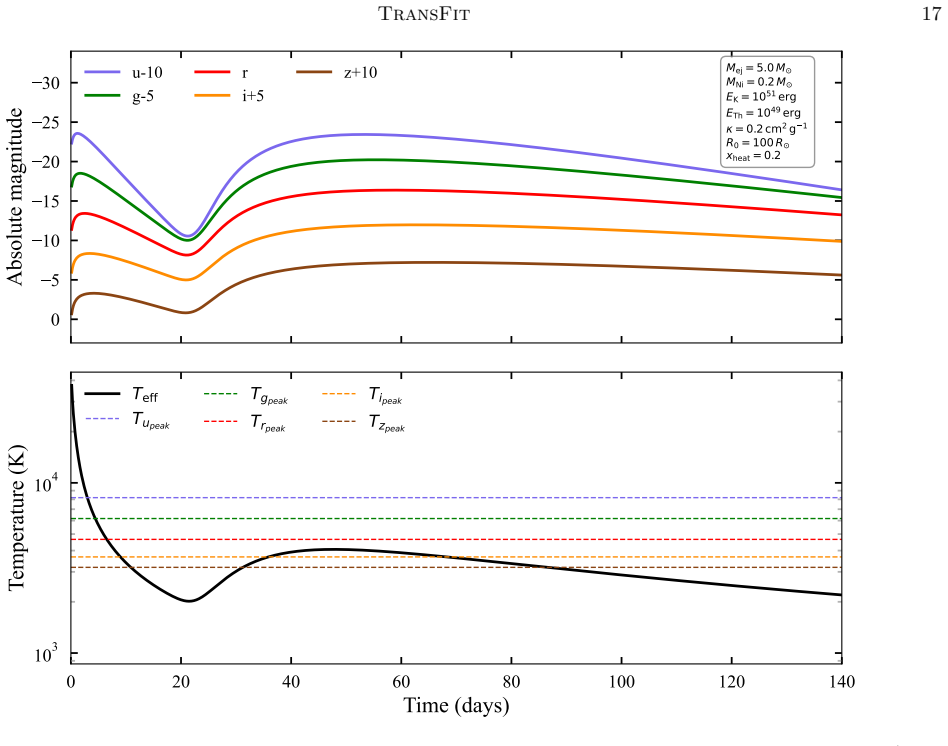
The paper's central claim is that a dimensionless diffusion equation for the internal energy density, $\partial e/\partial y = x^{-2}\partial_x[D(x,y)\partial_x e] + S(x,y)$, solved on a comoving grid, captures the light-curve signatures that semi-analytic models miss. Unlike Arnett-type solutions based on separation of variables and a single diffusion timescale, TransFit lets a radiative diffusion wave propagate through an evolving energy profile. That evolution is what produces the early 'dark phase' before diffusion breakout, the shock-cooling dip, and the sensitivity to the nickel mixing radius; it also makes the transition from shock cooling to radioactive or magnetar power self-consistent. The authors report agreement with Monte Carlo radiative transfer simulations across a range of transient scenarios, and reproduce the double-peaked SN 1993J light curve and the magnetar-powered SN 2011kl light curve.
Load-bearing premise
The model assumes one time-independent gray opacity for the entire ejecta and keeps the diffusion approximation valid down to optical depth near unity; real supernovae have wavelength- and time-dependent line opacity, and gamma-ray leakage matters in the late tail.
Editorial extensions
If this is right
- Early-time behavior—the shock-cooling dip, the diffusion-delayed dark phase, and the rise to the nickel-powered peak—can be modeled in one self-consistent framework rather than patched together.
- Arnett's law, which equates peak luminosity with the instantaneous heating rate, breaks down for centrally concentrated heating; TransFit implies that nickel masses and engine parameters inferred from Arnett fits can be systematically biased.
- Because a single model evaluation costs a fraction of a second, Bayesian parameter estimation becomes practical for the thousands of transients expected from wide-field time-domain surveys.
- The spatial distribution of heating (nickel mixing radius or central engine) becomes a fit parameter rather than a fixed input, and the model handles radioactive and magnetar power sources with the same machinery.
Reading between the lines
- If the single gray-opacity assumption is the weakest link, re-fitting a sample with slightly different opacity values would show how much of the measured scatter in ejecta mass and nickel mass is an opacity artifact rather than astrophysics.
- The same normalized diffusion equation with a different heating function could be applied to kilonovae and fast blue optical transients, giving a uniform cross-class fitting tool.
- The explicitly evolving temperature profile could be mapped to filter-specific magnitudes more consistently than the paper's bolometric-plus-effective-temperature treatment, which would strengthen multi-band fits.
- The duration of the pre-breakout dark phase could serve as an early alert diagnostic, since it is sensitive to ejecta mass and opacity within days of discovery.
Signed reviews
Editorial analysis
A structured set of objections, weighed in public.
Referee Report
Summary. The paper introduces TransFit, a one-dimensional time-dependent radiation-diffusion model for supernova and transient light curves. The model solves a dimensionless energy-conservation partial differential equation for the internal-energy density of homologously expanding ejecta, with radioactive or central-engine heating, using a Crank-Nicolson finite-difference scheme. The authors explore how the light-curve morphology depends on ejecta mass, kinetic energy, opacity, initial thermal energy, progenitor radius, density profile, nickel mixing, and magnetar parameters, compare the model with Arnett and one-zone semi-analytic models, and apply it to SN 1993J and SN 2011kl. The abstract and introduction also claim validation against Monte Carlo radiative transfer codes such as Sedona.
Significance. If the derivation and validation were sound, TransFit would fill a practical niche: a fast finite-difference solver that relaxes the self-similar temperature-profile assumption of Arnett-like models while remaining inexpensive enough for survey-scale fitting. The numerical scheme in Appendix B is a standard Crank-Nicolson discretization and is likely stable, and the parameter study reproduces several expected qualitative trends, including the effects of nickel mixing, gray opacity, ejecta mass, and magnetar spin-down. The comparison with Arnett and one-zone models usefully illustrates when Arnett's law fails. However, as written the central dimensionless equation is internally inconsistent, and the promised Sedona validation is absent, so the paper's main claims currently rest on unverified or incorrect derivations.
major comments (3)
- [§2, Eq. (13)] The dimensionless source term as printed omits the heating amplitude. Substituting Eqs. (7)-(10) into Eq. (1) yields a source term S = (rho0 tdiff epsilon_heat0 / u0) eta_ej(x) xi_heat(x) f_heat(y) (Rmax/R0), whereas Eq. (13) defines S without the prefactor rho0 tdiff epsilon_heat0 / u0. Taken literally, the partial differential equation no longer depends on epsilon_heat0 (and hence on MNi or engine luminosity), so varying MNi would leave e(x,y) and therefore Lbol unchanged, contradicting Figure 3. The normalization u0 = rho0 tdiff epsilon_heat0 is introduced only in §4.1 near Eq. (50), not in the general derivation, and adopting it makes ETh,in dependent on epsilon_heat0 through Eq. (15), which is inconsistent with Section 3.4 and Table 1, where ETh,in and MNi are treated as independent inputs. The authors must either include the explicit prefactor in Eq. (13) or state the normalization and its consequences for the free parameters; the current text is internally inconsistent.
- [Abstract and §1] The abstract and Section 1 state that validation comparisons with sophisticated Monte Carlo radiative transfer simulations such as Sedona demonstrate excellent agreement across a variety of transient scenarios, but no Sedona comparison appears anywhere in the body, the appendices, or the figures. The actual comparisons are limited to the Arnett and one-zone analytic models and to two observed objects. Since this is a central validation claim for the framework, the authors need either to add genuine Sedona comparison runs or to substantially soften the wording so that the claim matches the content of the paper.
- [§5, Tables 1 and 2] The paper describes these applications as fits, but no inference procedure is presented. Tables 1 and 2 give point values for Mej, MNi, EK, R0, ETh,in, Pi, and Bd, yet there is no likelihood function, no prior distributions, no search or MCMC algorithm, no convergence check, and no reported uncertainties or goodness-of-fit statistics. The text says that 'identical priors' are used without defining them. Moreover, because the model parameters are adjusted to reproduce the same light curves that are then shown as agreement, the comparison is at best an illustrative model match and cannot serve as validation. The authors should either describe an actual fitting methodology with uncertainties or explicitly present these as manually tuned illustrative models.
minor comments (6)
- [Eq. (15)] The integrand appears as 4πr^2 a u dr, but u already denotes the internal-energy density; the factor a is likely a typographical artifact and should be removed.
- [Eq. (22)] The optical depth is written as tau0 = kappa0 rho0 R0 I_tau, with kappa0, while the opacity elsewhere is denoted kappa; the notation should be made consistent.
- [Figure 2] The legend does not display the xheat values used in the mixing-radius comparison, which makes the qualitative trend difficult to evaluate directly from the figure.
- [§2.2 and §3.1] It is unclear whether central-engine heating enters through the source term S(x,y) or through the inner boundary condition f_ib(y) of Eq. (27); the text says the source term is 'incorporated into this inner boundary condition,' but Section 3.1 also motivates a radial heating profile for centrally concentrated heating. The authors should clarify how the two descriptions are reconciled to avoid double counting.
- [§1 and §3.3] The introduction promises flexibility for 'compositionally dependent opacity variations,' but Section 3.3 implements a single, time-independent gray opacity; this should either be clarified as a future extension or the introductory claim should be adjusted.
- [Throughout] There are several small typographical errors, including 'the the' in the captions of Figures 4 and 5 and 'bolometric ligtcurve' in Section 5.2; these should be corrected in a revision.
Circularity Check
No significant circularity: TransFit is a forward numerical solver; the two SN applications are openly fits, and self-citations are not load-bearing.
full rationale
The core derivation starts from a stated energy-conservation equation (Eq. 1) and reduces it to a dimensionless PDE (Eq. 11) with boundary conditions (Section 2.2) and a Crank-Nicolson scheme (Appendix B). The resulting bolometric luminosity (Eq. 33, B20) is an output of solving that PDE, not a fitted quantity. Section 5 explicitly frames the SN 1993J and SN 2011kl comparisons as fitting published light curves with listed parameters (Tables 1 and 2), so those comparisons are not out-of-sample predictions. The self-citations (e.g., Liu et al. 2018b for photospheric radius behavior, Yu et al. 2017/2018 for magnetar contexts) are contextual remarks and do not carry any uniqueness theorem or ansatz that forces the model choice. No cited prior work by the authors is used as the sole justification of the central equation. One caveat: Eq. (13) as printed omits the amplitude factor rho0*tdiff*epsilon_heat0/u0 that the reduction of Eq. (1) would produce; this is an internal-consistency or presentation issue, not a circularity, and it does not make any prediction equivalent to an input by construction. The abstract's claimed Sedona validation is not shown in this manuscript, which is a missing-support issue rather than circularity.
Assumptions & free parameters
free parameters (9)
- Mej (ejecta mass) =
1.8 Msun (SN 1993J); 1.4 Msun (SN 2011kl)
- MNi (nickel mass) =
0.10 Msun (SN 1993J); not used for magnetar model of SN 2011kl
- EK (kinetic energy) =
1.5e51 erg (SN 1993J); 5.0e51 erg (SN 2011kl)
- ETh,in (initial thermal energy) =
4e49 erg (SN 1993J); not constrained for SN 2011kl
- R0 (initial radius) =
3.1e13 cm (SN 1993J); fixed at 10 Rsun for magnetar scenarios
- kappa (gray opacity) =
0.2 cm2/g (assumed in both fits)
- xheat (mixing radius) =
0.2 (default, not fitted)
- Pi (initial magnetar spin period) =
10.8 ms (SN 2011kl)
- Bd (dipole magnetic field) =
5e14 G (SN 2011kl)
assumptions (5)
- domain assumption Homologous expansion from the chosen initial time with Rmax = R0 + vmax t.
- domain assumption Radiation pressure dominates and the equation of state is u = aT^4 (P = u/3).
- domain assumption A single, time-independent gray opacity kappa describes the ejecta at all depths and times.
- domain assumption Eddington (plane-parallel, gray-atmosphere) boundary condition at the photosphere.
- domain assumption Heating sources are either a step-function 56Ni distribution (Eq. 35) or a central magnetar dipole spin-down luminosity (Eq. 37-38).
Cite this review
Pith. "Pith review of TransFit: An Efficient Framework for Transient Light-Curve Fitting with Time-Dependent Radiative Diffusion." pith.science (2026). https://pith.science/paper/WUH722II
@misc{pith2026250513825,
  author       = {Pith},
  title        = {Pith review of: TransFit: An Efficient Framework for Transient Light-Curve Fitting with Time-Dependent Radiative Diffusion},
  year         = {2026},
  howpublished = {\url{https://pith.science/paper/WUH722II}},
  note         = {Machine review of arXiv:2505.13825}
}
abstract
Modeling the light curves (LCs) of luminous astronomical transients, such as supernovae, is crucial for understanding their progenitor physics, particularly with the exponential growth of survey data. However, existing methods face limitations: efficient semi-analytical models (e.g., Arnett-like) employ significant physical simplifications (like time-invariant temperature profiles and simplified heating distributions), often compromising accuracy, especially for early-time LCs. Conversely, detailed numerical radiative transfer simulations, while accurate, are computationally prohibitive for large datasets. This paper introduces TransFit, a novel framework that numerically solves a generalized energy conservation equation, explicitly incorporating time-dependent radiative diffusion, continuous radioactive or central engine heating, and ejecta expansion dynamics. The model accurately captures the influence of key ejecta properties and diverse heating source characteristics on light curve morphology, including peak luminosity, rise time, and overall shape. Furthermore, TransFit provides self-consistent modeling of the transition from shock-cooling to $^{56}$Ni}-powered light curves. By combining physical realism with computational speed, TransFit provides a powerful tool for efficiently inverting LCs and extracting detailed physical insights from the vast datasets of current and future transient surveys.
Figures


Figures from the paper (9 more)


Forward citations
Cited by 1 Pith paper
-
X-rays breaking out of pre-explosion ejecta mark a supernova's first light
EP260321a is a thermal soft X-ray shock breakout from a ~300 R_⊙ CSM shell around a stripped-envelope progenitor, followed by SN Ic-BL 2026gzf.
Reference graph
Works this paper leans on
-
[1]
Arnett, W. D. 1979, ApJL, 230, L37, doi: 10.1086/182957 —. 1980, ApJ, 237, 541, doi: 10.1086/157898 —. 1982, ApJ, 253, 785, doi: 10.1086/159681
doi:10.1086/182957 1979
-
[2]
2025, arXiv e-prints, arXiv:2504.21096, doi: 10.48550/arXiv.2504.21096
Aryan, A., Chen, T.-W., Yang, S., et al. 2025, arXiv e-prints, arXiv:2504.21096, doi: 10.48550/arXiv.2504.21096
-
[3]
Bellm, E. C., Kulkarni, S. R., Graham, M. J., et al. 2019, PASP, 131, 018002, doi: 10.1088/1538-3873/aaecbe
-
[4]
Bersten, M. C., Benvenuto, O. G., Orellana, M., & Nomoto, K. 2016, ApJL, 817, L8, doi: 10.3847/2041-8205/817/1/L8
-
[5]
I., & Bartunov, O
Blinnikov, S. I., & Bartunov, O. S. 1993, A&A, 273, 106
1993
-
[6]
Blinnikov, S. I., Eastman, R., Bartunov, O. S., Popolitov, V. A., & Woosley, S. E. 1998, ApJ, 496, 454, doi: 10.1086/305375
doi:10.1086/305375 1998
-
[7]
Blondin, S., Dessart, L., Hillier, D. J., & Khokhlov, A. M. 2013, MNRAS, 429, 2127, doi: 10.1093/mnras/sts484
-
[8]
Cano, Z., Johansson Andreas, K. G., & Maeda, K. 2016, MNRAS, 457, 2761, doi: 10.1093/mnras/stw122
Show all 66 references
-
[9]
2017, Advances in Astronomy, 2017, 8929054, doi: 10.1155/2017/8929054
Cano, Z., Wang, S.-Q., Dai, Z.-G., & Wu, X.-F. 2017, Advances in Astronomy, 2017, 8929054, doi: 10.1155/2017/8929054
2017 doi
-
[10]
C., & Vinko, J
Chatzopoulos, E., Wheeler, J. C., & Vinko, J. 2012, ApJ, 746, 121, doi: 10.1088/0004-637X/746/2/121
2012 doi
-
[11]
Chevalier, R. A. 1982, ApJ, 258, 790, doi: 10.1086/160126
1982 doi
-
[12]
A., & Fransson, C
Chevalier, R. A., & Fransson, C. 1994, ApJ, 420, 268, doi: 10.1086/173557
1994 doi
-
[13]
R., Soderberg, A
Drout, M. R., Soderberg, A. M., Gal-Yam, A., et al. 2011, ApJ, 741, 97, doi: 10.1088/0004-637X/741/2/97
2011 doi
-
[14]
M., & Slane, P
Gaensler, B. M., & Slane, P. O. 2006, ARA&A, 44, 17, doi: 10.1146/annurev.astro.44.051905.092528
2006 arXiv
-
[15]
2019, ARA&A, 57, 305, doi: 10.1146/annurev-astro-081817-051819
Gal-Yam, A. 2019, ARA&A, 57, 305, doi: 10.1146/annurev-astro-081817-051819
2019 doi
-
[16]
2016, ApJ, 826, 141, doi: 10.3847/0004-637X/826/2/141
Gao, H., Lei, W.-H., You, Z.-Q., & Xie, W. 2016, ApJ, 826, 141, doi: 10.3847/0004-637X/826/2/141
2016 doi
-
[17]
2019, ApJ, 883, 203, doi: 10.3847/1538-4357/ab391e
Gong, Y., Liu, X., Cao, Y., et al. 2019, ApJ, 883, 203, doi: 10.3847/1538-4357/ab391e
2019 doi
-
[18]
A., Kann, D
Greiner, J., Mazzali, P. A., Kann, D. A., et al. 2015, Nature, 523, 189, doi: 10.1038/nature14579
2015 doi
-
[19]
M., Bianco, F
Hambleton, K. M., Bianco, F. B., Street, R., et al. 2023, PASP, 135, 105002, doi: 10.1088/1538-3873/acdb9a
2023 doi
-
[20]
J., & Dessart, L
Hillier, D. J., & Dessart, L. 2012, MNRAS, 424, 252, doi: 10.1111/j.1365-2966.2012.21192.x
2012
-
[21]
J., Jerkstrand, A., et al
Inserra, C., Smartt, S. J., Jerkstrand, A., et al. 2013, ApJ, 770, 128, doi: 10.1088/0004-637X/770/2/128
2013 doi
-
[22]
2016, ApJ, 833, 110, doi: 10.3847/1538-4357/833/1/110
Ioka, K., Hotokezaka, K., & Piran, T. 2016, ApJ, 833, 110, doi: 10.3847/1538-4357/833/1/110
2016 doi
-
[23]
A., Schady, P., Olivares E., F., et al
Kann, D. A., Schady, P., Olivares E., F., et al. 2019, A&A, 624, A143, doi: 10.1051/0004-6361/201629162
2019 doi
-
[24]
2017, in Handbook of Supernovae, ed
Kasen, D. 2017, in Handbook of Supernovae, ed. A. W. Alsabti & P. Murdin (Springer), 939, doi: 10.1007/978-3-319-21846-5 32
2017 doi
-
[25]
2010, ApJ, 717, 245, doi: 10.1088/0004-637X/717/1/245
Kasen, D., & Bildsten, L. 2010, ApJ, 717, 245, doi: 10.1088/0004-637X/717/1/245
2010 doi
-
[26]
C., & Nugent, P
Kasen, D., Thomas, R. C., & Nugent, P. 2006, ApJ, 651, 366, doi: 10.1086/506190
2006 doi
-
[27]
K., & Kasen, D
Khatami, D. K., & Kasen, D. N. 2019, ApJ, 878, 56, doi: 10.3847/1538-4357/ab1f09 —. 2024, ApJ, 972, 140, doi: 10.3847/1538-4357/ad60c0
2019 doi
-
[28]
X., Zhu, Z
Li, W. X., Zhu, Z. P., Zou, X. Z., et al. 2025, arXiv e-prints, arXiv:2504.17034, doi: 10.48550/arXiv.2504.17034
2025 doi
-
[29]
2018a, ApJ, 856, 59, doi: 10.3847/1538-4357/aab157
Liu, L.-D., Wang, L.-J., Wang, S.-Q., & Dai, Z.-G. 2018a, ApJ, 856, 59, doi: 10.3847/1538-4357/aab157
-
[30]
2017, ApJ, 842, 26, doi: 10.3847/1538-4357/aa73d9
Liu, L.-D., Wang, S.-Q., Wang, L.-J., et al. 2017, ApJ, 842, 26, doi: 10.3847/1538-4357/aa73d9
2017 doi
-
[31]
2018b, ApJL, 868, L24, doi: 10.3847/2041-8213/aaeff6 24 Liu et al
Liu, L.-D., Zhang, B., Wang, L.-J., & Dai, Z.-G. 2018b, ApJL, 868, L24, doi: 10.3847/2041-8213/aaeff6 24 Liu et al
- [32]
-
[33]
D., Margalit, B., Kasen, D., & Quataert, E
Metzger, B. D., Margalit, B., Kasen, D., & Quataert, E. 2015, MNRAS, 454, 3311, doi: 10.1093/mnras/stv2224
2015 doi
-
[34]
D., & Piro, A
Metzger, B. D., & Piro, A. L. 2014, MNRAS, 439, 3916, doi: 10.1093/mnras/stu247
2014 doi
-
[35]
J., Blinnikov, S
Moriya, T. J., Blinnikov, S. I., Tominaga, N., et al. 2013, MNRAS, 428, 1020, doi: 10.1093/mnras/sts075
2013 doi
-
[36]
L., Renzo, M., et al
Morozova, V., Piro, A. L., Renzo, M., et al. 2015, ApJ, 814, 63, doi: 10.1088/0004-637X/814/1/63
2015 doi
-
[37]
Nagy, A. P. 2018, ApJ, 862, 143, doi: 10.3847/1538-4357/aace56
2018 doi
-
[38]
P., & Vink´ o, J
Nagy, A. P., & Vink´ o, J. 2016, A&A, 589, A53, doi: 10.1051/0004-6361/201527931
2016 doi
-
[39]
2017, ApJ, 850, 55, doi: 10.3847/1538-4357/aa9334
Nicholl, M., Guillochon, J., & Berger, E. 2017, ApJ, 850, 55, doi: 10.3847/1538-4357/aa9334
2017 doi
-
[40]
J., Jerkstrand, A., et al
Nicholl, M., Smartt, S. J., Jerkstrand, A., et al. 2015, MNRAS, 452, 3869, doi: 10.1093/mnras/stv1522
2015 doi
-
[41]
K., & Yokoi, K
Nomoto, K., Thielemann, F. K., & Yokoi, K. 1984, ApJ, 286, 644, doi: 10.1086/162639
1984 doi
- [42]
- [43]
-
[44]
L., & Nakar, E
Piro, A. L., & Nakar, E. 2013, ApJ, 769, 67, doi: 10.1088/0004-637X/769/1/67
2013 doi
- [45]
-
[46]
W., Treffers, R
Richmond, M. W., Treffers, R. R., Filippenko, A. V., et al. 1994, AJ, 107, 1022, doi: 10.1086/116915
1994 doi
-
[47]
2014, MNRAS, 440, 1498, doi: 10.1093/mnras/stu350
Scalzo, R., Aldering, G., Antilogus, P., et al. 2014, MNRAS, 440, 1498, doi: 10.1093/mnras/stu350
2014 doi
-
[48]
R., Ciaraldi-Schoolmann, F., R¨ opke, F
Seitenzahl, I. R., Ciaraldi-Schoolmann, F., R¨ opke, F. K., et al. 2013, MNRAS, 429, 1156, doi: 10.1093/mnras/sts402
2013 doi
-
[49]
1994, ApJ, 420, 341, doi: 10.1086/173564
Shigeyama, T., Suzuki, T., Kumagai, S., et al. 1994, ApJ, 420, 341, doi: 10.1086/173564
1994 doi
-
[50]
A., Sollerman, J., & Benetti, S
Stritzinger, M., Mazzali, P. A., Sollerman, J., & Benetti, S. 2006, A&A, 460, 793, doi: 10.1051/0004-6361:20065514
2006 doi
-
[51]
Janka, H. T. 2016, ApJ, 821, 38, doi: 10.3847/0004-637X/821/1/38
2016 doi
-
[52]
X., Liu, L
Sun, H., Li, W. X., Liu, L. D., et al. 2024, arXiv e-prints, arXiv:2410.02315, doi: 10.48550/arXiv.2410.02315 van Dalen, J. N. D., Levan, A. J., Jonker, P. G., et al. 2025, ApJL, 982, L47, doi: 10.3847/2041-8213/adbc7e
2024 doi
-
[53]
A., Guillochon, J., Berger, E., et al
Villar, V. A., Guillochon, J., Berger, E., et al. 2017, ApJL, 851, L21, doi: 10.3847/2041-8213/aa9c84
2017 doi
-
[54]
2017, ApJ, 850, 148, doi: 10.3847/1538-4357/aa95c5
Wang, S.-Q., Cano, Z., Wang, L.-J., et al. 2017, ApJ, 850, 148, doi: 10.3847/1538-4357/aa95c5
2017 doi
-
[55]
2023, Science China
Wang, T., Liu, G., Cai, Z., et al. 2023, Science China
2023
-
[56]
Physics, Mechanics, and Astronomy, 66, 109512, doi: 10.1007/s11433-023-2197-5
-
[57]
Woosley, S. E. 2010, ApJL, 719, L204, doi: 10.1088/2041-8205/719/2/L204
2010 doi
-
[58]
E., Eastman, R
Woosley, S. E., Eastman, R. G., Weaver, T. A., & Pinto, P. A. 1994, ApJ, 429, 300, doi: 10.1086/174319
1994 doi
-
[59]
E., Heger, A., & Weaver, T
Woosley, S. E., Heger, A., & Weaver, T. A. 2002, Reviews of Modern Physics, 74, 1015, doi: 10.1103/RevModPhys.74.1015
2002 doi
-
[60]
E., & Weaver, T
Woosley, S. E., & Weaver, T. A. 1986, ARA&A, 24, 205, doi: 10.1146/annurev.aa.24.090186.001225
1986
-
[61]
2019, ApJL, 877, L21, doi: 10.3847/2041-8213/ab1f85
Yu, Y.-W., Chen, A., & Li, X.-D. 2019, ApJL, 877, L21, doi: 10.3847/2041-8213/ab1f85
2019 doi
-
[62]
2015, ApJL, 806, L6, doi: 10.1088/2041-8205/806/1/L6
Yu, Y.-W., Li, S.-Z., & Dai, Z.-G. 2015, ApJL, 806, L6, doi: 10.1088/2041-8205/806/1/L6
2015 doi
-
[63]
2018, ApJ, 861, 114, doi: 10.3847/1538-4357/aac6e5
Yu, Y.-W., Liu, L.-D., & Dai, Z.-G. 2018, ApJ, 861, 114, doi: 10.3847/1538-4357/aac6e5
2018 doi
-
[64]
2013, ApJL, 776, L40, doi: 10.1088/2041-8205/776/2/L40
Yu, Y.-W., Zhang, B., & Gao, H. 2013, ApJL, 776, L40, doi: 10.1088/2041-8205/776/2/L40
2013 doi
-
[65]
2017, ApJ, 840, 12, doi: 10.3847/1538-4357/aa6c27
Yu, Y.-W., Zhu, J.-P., Li, S.-Z., L¨ u, H.-J., & Zou, Y.-C. 2017, ApJ, 840, 12, doi: 10.3847/1538-4357/aa6c27
2017 doi
-
[66]
2020, in Society of Photo-Optical Instrumentation Engineers (SPIE) Conference Series, Vol
Yuan, X., Li, Z., Liu, X., et al. 2020, in Society of Photo-Optical Instrumentation Engineers (SPIE) Conference Series, Vol. 11445, Ground-based and Airborne Telescopes VIII, ed. H. K. Marshall, J. Spyromilio, & T. Usuda, 114457M, doi: 10.1117/12.2562334
2020 doi
Reviewed August 15, 2026 · model on record in the stance chip above.
Discussion (0). Continue with ORCID to comment.