REVIEW 4 major objections 6 minor 28 references
Quantum Opacity, Classical Clarity: A Hybrid Approach to Quantum Circuit Obfuscation
T0 review · 4 major / 6 minor · reviewed 2026-08-15 · deepseek-v4-flash
Pith's one-line read A classical key can decrypt a corrupted quantum circuit
desk verdict A clean little correction trick, but the security claim dies on its own threat model: the 'key' is just the appended gates the compiler can see. read the letter →
The pith
A machine-rendered reading of the paper's core claim, the machinery that carries it, and where it could break.
The reading
What carries the argument
The key machinery is the gate-index key together with a lookup table of classical gate equivalents (X as a bit flip, CNOT as a controlled flip, SWAP as a bit swap, and phase-only gates as identity). The key is a stack-like (LIFO) list of gate-index and qubit pairs that tells the user which classical operations to apply to the measured bits and in what order. This machinery carries the argument because it converts the obfuscation problem from a quantum-reversal problem into a classical post-processing problem, and it works only because the inserted gates are restricted to operations that either flip bits or change only the phase, never creating superpositions.
What would settle it
Using the paper's own QAOA case study, take the circuit file that is sent to the compiler, extract the trailing gates (which are visible in the file), apply their classical equivalents to the measurement outcomes, and check whether the original output distribution reappears; if it does, the encryption provides no confidentiality against anyone who inspects the delivered circuit.
Extended reading notes
Core claim
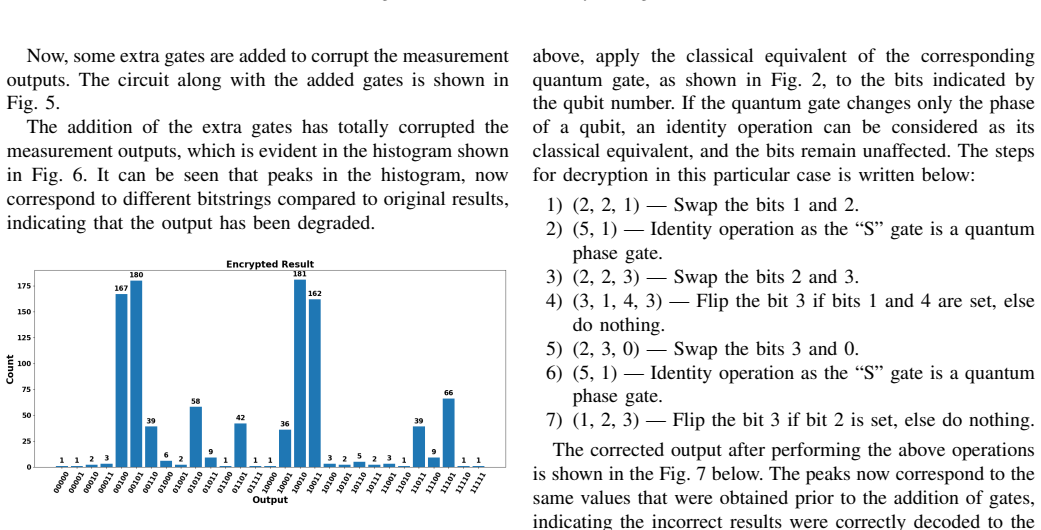
The central discovery is that deobfuscation does not require reversing the inserted gates quantumly; it only requires applying the classical equivalents of those gates to the measured bitstrings. Because phase-only gates such as S and Z do not change measurement probabilities, their classical correction is the identity, while state-changing gates such as X, CNOT, SWAP, and their controlled versions correspond to bit flips, conditional flips, and swaps. By recording each appended gate as an index–qubit pair and applying the corrections in reverse order of insertion, the original output distribution is exactly recovered. The paper demonstrates this recovery in a QAOA example and reports TVD and DFC values across five algorithms, concluding that the method offers a lightweight, practical security layer for untrusted compilation flows.
Load-bearing premise
The load-bearing premise is that whoever receives the obfuscated circuit cannot simply read off the appended gates and apply the same classical corrections, so the key stays secret.
Editorial extensions
If this is right
- Circuits protected this way can be optimized by untrusted compilers without barriers, so the security layer does not sacrifice compilation quality.
- The user needs no personal quantum compiler or quantum computer to deobfuscate, since correction happens on the classical measurement results.
- The method works for circuits measured in a single basis per execution; multi-basis measurements, such as Hamiltonian terms like XX+ZY+YI, are not supported without more complex post-processing.
- The simulation results across five algorithms suggest the scheme is broadly applicable to different circuit structures, though functional corruption is stronger for some algorithms than for others.
- Randomly chosen gates from a shared pool already give strong statistical distortion, and the paper suggests algorithm-specific or heuristic gate selection could improve functional corruption further.
Reading between the lines
- Because the appended gates are visible in the circuit handed to the compiler, the scheme's security appears to rely on the compiler being passive rather than actively adversarial; a malicious compiler could strip the trailing gates or classically invert them, so the practical threat model may be narrower than stated.
- The TVD and DFC metrics measure how much the output distribution changes, not how hard it is to recover the original circuit; a stronger confidentiality test would directly measure the mutual information between the obfuscated circuit and the plaintext circuit.
- The same classical-correction idea could be extended to multi-basis measurements by inserting basis-change operations before measurement, which the paper identifies as future work; this could be tested by constructing an XX+ZY Hamiltonian term and checking whether a corrected measurement recovers the expectation value.
- The gate-index key can be randomized, but its entropy is limited by the number of gates and qubits in the circuit, so a small circuit has few possible appendage patterns and brute-force over key candidates may be practical.
Signed reviews
Editorial analysis
A structured set of objections, weighed in public.
Referee Report
Summary. The manuscript proposes a hybrid quantum-classical circuit obfuscation method: before sending a circuit to an untrusted compiler, the user appends a layer of reversible, non-Hadamard gates; after execution, the user classically transforms the measured bitstrings using a key that records the appended gates. The method is illustrated on a QAOA MaxCut circuit and evaluated on five benchmark algorithms with Qiskit's noise-free AerSimulator, reporting median TVD above 0.5 and negative median DFC for all five. The paper claims this is a practical and effective solution for protecting proprietary circuits in untrusted compilation flows.
Significance. If the security claim were correct, the method would be an attractive lightweight alternative to quantum inverse-circuit insertion or barrier-based dummy gates. The manuscript has presentation strengths: the workflow is clearly described, the QAOA case study is concrete, the classical correction rules are explicit, and an anonymized code repository is provided. However, the central security claim is not supported: the circuit sent to the compiler contains the full information defining the key, the correction rules are deterministic and public, and the evaluation metrics measure only statistical and functional distortion, not resistance to an adversary holding the obfuscated circuit. The correctness of classical deobfuscation in noise-free simulation is by construction, so it does not validate security.
major comments (4)
- [V.A.2, V.A.4, Fig. 2] The load-bearing security assumption is false: the appended encryptor gates are visible in the circuit sent to the untrusted compiler. Section V.A.2 says gates are appended 'to the end of the original quantum circuit' before compilation, and Section V.A.4 calls the key 'only available to the user,' but the transmitted circuit encodes the key's exact gate identities, qubit targets, and ordering. Since the classical correction rules in Fig. 2 are deterministic and public, an adversary who can read the circuit can reconstruct the key, apply the same correction, or simply delete the trailing encryptor suffix and execute the original circuit. The manuscript does not define a threat model or an adversary with access to the obfuscated circuit, so the central claim of protecting IP in untrusted compilation flows is unsupported.
- [VI.B, Table I] The evaluation metrics do not test the security claim. TVD and DFC compare the output of the original circuit with the output of the obfuscated circuit before classical correction; they quantify corruption, not resistance to an adversary who possesses the obfuscated circuit. In particular, no experiment attempts key recovery, suffix stripping, or inversion of the appended gates by an adversary, and no metric measures indistinguishability or one-wayness. Therefore the results in Table I cannot be read as evidence for the paper's central security conclusion.
- [V.A.4, VI] The successful recovery of the original output distribution is tautological in the paper's setup. Because the classical corrections are, by construction, the inverses of the appended gates, applying them to noise-free simulation counts must return the original distribution; Section V.B demonstrates exactly this on QAOA. This verifies implementation consistency rather than any security property, so it should not be presented as validating the obfuscation scheme.
- [VII] The Limitations section does not address the most important threat: the key material is present in the transmitted circuit. It lists random gate selection and multi-basis measurement as limitations but omits that the compiler can strip or invert the visible encryptor layer, which would defeat the scheme under the paper's own stated scenario. This omission is load-bearing because it directly concerns the untrusted-compiler threat that the paper claims to solve.
minor comments (6)
- [Eq. (2)] The phrase 'normalized by the number of shots' is imprecise; the denominator is 2 times the number of shots, which is correct for comparing empirical histograms but should be stated more clearly.
- [Abstract, VI.B] The threshold 'TVD above 0.5' is arbitrary; no justification or statistical test is given for why 0.5 indicates sufficient obfuscation.
- [Table I] DFC values for QAOA (median -0.1123) are close to zero; the claim of 'consistently negative DFC' is technically true but obscures that some circuits are only weakly functionally corrupted.
- [V.A.1, V.A.4] The terms 'encryptor' and 'key' suggest cryptographic security, but no formal key space, key entropy, or attack game is defined; the paper should either define a security notion or use weaker language such as 'obfuscating layer.'
- [III] The related-work comparison is qualitative; a table comparing gate overhead, use of barriers, and deobfuscation requirements with references [12], [13], [14], [15], and [20] would help position the contribution.
- [Throughout] There are minor typographical issues, for example 'SW AP' in Section II.A.3, and the reference list has inconsistent capitalization and spacing; these do not affect the technical content.
Circularity Check
The classical deobfuscation step is the exact inverse of the appended encryptor gates, so the demonstrated recovery of the original output distribution is self-definitional; the TVD/DFC metrics themselves are independent and not circular.
-
self definitional
[Section V.A.4 and Section V.B ('Corrected output' paragraph, Fig. 7)]
"Once the gate and qubit(s) are identified, the output is corrected classically, by applying appropriate classical operations as shown in fig. 2. ... The corrected output after performing the above operations is shown in the Fig. 7 below. The peaks now correspond to the same values that were obtained prior to the addition of gates, indicating the incorrect results were correctly decoded to the actual measurement results."
The correction operations are constructed from the same inserted gates that generated the key: for X, CNOT, SWAP, and Toffoli, the classical equivalents in Fig. 2 are the exact inverses of the appended gates, and phase gates are declared to have no effect on measurement. Since every appended gate acts as a permutation (or identity) on computational-basis measurement outcomes, applying these classical operations to the measured bitstrings must return the original distribution in a noise-free simulation. Fig. 7 therefore verifies an identity by construction rather than providing an independent empirical test of the obfuscation or correction scheme.
full rationale
The only circular step found is the demonstration that the obfuscated outputs can be classically corrected: the correction rule is literally the inverse of the gates the user appended, so the recovered histogram matching the original histogram is guaranteed by construction, not by empirical validation. This circularity is limited because it does not affect the reported TVD and DFC values, which are computed before correction and are independent measures of how much the appended gates change the output distribution. There are no load-bearing self-citations or imported uniqueness theorems. The paper's broader security claim is weakened by a separate, non-circular flaw: the 'key—which is only available to the user' is merely a description of the gates appended to the circuit, and those gates are fully visible in the circuit sent to the untrusted compiler, so an adversary who receives the obfuscated circuit can reconstruct the same key. That is a threat-model gap rather than a circular derivation, and it does not by itself raise the circularity score.
Assumptions & free parameters
assumptions (3)
- standard math The inserted gates act as deterministic reversible classical operations on computational basis measurement outcomes, so the classical correction recovers the original distribution exactly.
- ad hoc to paper The untrusted compiler cannot identify or remove the appended encryptor gates, so the key remains secret.
- domain assumption Measurements are performed in a single computational basis per execution; multi-basis measurements are out of scope.
Cite this review
Pith. "Pith review of Quantum Opacity, Classical Clarity: A Hybrid Approach to Quantum Circuit Obfuscation." pith.science (2026). https://pith.science/paper/BX5L7XFW
@misc{pith2026250513848,
  author       = {Pith},
  title        = {Pith review of: Quantum Opacity, Classical Clarity: A Hybrid Approach to Quantum Circuit Obfuscation},
  year         = {2026},
  howpublished = {\url{https://pith.science/paper/BX5L7XFW}},
  note         = {Machine review of arXiv:2505.13848}
}
read the original abstract
Quantum computing leverages quantum mechanics to achieve computational advantages over classical hardware, but the use of third-party quantum compilers in the Noisy Intermediate-Scale Quantum (NISQ) era introduces risks of intellectual property (IP) exposure. We address this by proposing a novel obfuscation technique that protects proprietary quantum circuits by inserting additional quantum gates prior to compilation. These gates corrupt the measurement outcomes, which are later corrected through a lightweight classical post-processing step based on the inserted gate structure. Unlike prior methods that rely on complex quantum reversals, barriers, or physical-to-virtual qubit mapping, our approach achieves obfuscation using compiler-agnostic classical correction. We evaluate the technique across five benchmark quantum algorithms -- Shor's, QAOA, Bernstein-Vazirani, Grover's, and HHL -- using IBM's Qiskit framework. The results demonstrate high Total Variation Distance (above 0.5) and consistently negative Degree of Functional Corruption (DFC), confirming both statistical and functional obfuscation. This shows that our method is a practical and effective solution for the security of quantum circuit designs in untrusted compilation flows.
Figures


Figures from the paper (9 more)




Reference graph
Works this paper leans on
-
[1]
IBM, “Quantum Computing,” IBM, [Online]. Available: https://www.ibm.com/think/topics/quantum-computing. [Accessed: Apr. 9, 2025]
work page 2025
-
[2]
Polynomial-time algorithms for prime factorization and discrete logarithms on a quantum computer,
P. W. Shor, “Polynomial-time algorithms for prime factorization and discrete logarithms on a quantum computer,” SIAM J. Comput., vol. 26, no. 5, pp. 1484–1509, Oct. 1997
work page 1997
-
[3]
Quantum computing with molecules,
N. Gershenfeld and I. L. Chuang, “Quantum computing with molecules,” Scientific American, vol. 278, no. 6, pp. 66–71, 1998
work page 1998
-
[4]
Quantum computing for energy systems op- timization: Challenges and opportunities,
A. Ajagekar and F. You, “Quantum computing for energy systems op- timization: Challenges and opportunities,” Energy, vol. 179, pp. 76–89, 2019
work page 2019
-
[5]
Quantum error correction below the surface code threshold,
Google Quantum AI and Collaborators, “Quantum error correction below the surface code threshold,” Nature, vol. 638, pp. 920–926, 2025
work page 2025
-
[6]
Interferometric single-shot parity measurement in InAs–Al hybrid devices,
Microsoft Azure Quantum, M. Aghaee, A. Alcaraz Ramirez et al., “Interferometric single-shot parity measurement in InAs–Al hybrid devices,” Nature, vol. 638, pp. 651–655, 2025. doi: https://doi.org/10.1038/s41586-024-08445-2
-
[7]
Quantum Computing in the NISQ era and beyond,
J. Preskill, “Quantum Computing in the NISQ era and beyond,” Quan- tum, vol. 2, p. 79, Aug. 2018, doi: 10.22331/q-2018-08-06-79
-
[8]
A Survey and Tutorial on Security and Resilience of Quantum Computing,
A. A. Saki, M. Alam, K. Phalak, A. Suresh, R. O. Topaloglu and S. Ghosh, “A Survey and Tutorial on Security and Resilience of Quantum Computing,” 2021 IEEE European Test Symposium (ETS), Bruges, Belgium, 2021, pp. 1-10, doi: 10.1109/ETS50041.2021.9465397
arXiv 2021
Show all 28 references
-
[9]
Qiskit: An open-source framework for quantum com- puting,
IBM Quantum, “Qiskit: An open-source framework for quantum com- puting,” IBM, [Online]. Available: https://qiskit.org [Accessed: Dec. 2024]
2024
-
[10]
t|ket⟩: A retargetable compiler for NISQ devices,
S. Sivarajah, S. Dilkes, A. Cowtan, W. Simmons, A. Edgington, and R. Duncan, “t|ket⟩: A retargetable compiler for NISQ devices,”Quantum Sci. Technol., vol. 6, no. 1, p. 014003, Nov. 2020. [Online]. Available: https://dx.doi.org/10.1088/2058-9565/ab8e92
2020 doi
-
[11]
Quilc: The Quil compiler,
Rigetti Computing, “Quilc: The Quil compiler,” Rigetti Computing, [Online]. Available: https://rigetti.com [Accessed: April. 2025]
2025
-
[12]
Randomized reversible gate-based obfus- cation for secured compilation of quantum circuit,
S. Das and S. Ghosh, “Randomized reversible gate-based obfus- cation for secured compilation of quantum circuit,” arXiv preprint arXiv:2305.01133, 2023
2023 arXiv
-
[13]
Short Paper: A Quantum Circuit Obfuscation Methodology for Security and Privacy,
A. Suresh, A. A. Saki, M. Alam, R. O. Topaloglu, and S. Ghosh, “Short Paper: A Quantum Circuit Obfuscation Methodology for Security and Privacy,” in Proc. 10th Int. Workshop Hardware Archit. Support Security Privacy (HASP ’21), Virtual, CT, USA, 2022, Art. no. 6, doi: 10.1145/...
2022
-
[14]
Quantum logic locking for security,
R. O. Topaloglu, “Quantum logic locking for security,” J, vol. 6, no. 3, pp. 411–420, 2023
2023
-
[15]
E-LoQ: Enhanced Locking for Quantum Circuit IP Protection,
Y . Liu, J. John, and Q. Wang, “E-LoQ: Enhanced Locking for Quantum Circuit IP Protection,” arXiv preprint arXiv:2412.17101, 2025
2025 arXiv
-
[16]
An Introduction to Quantum Computing,
P. Kaye, R. Laflamme, and M. Mosca, “An Introduction to Quantum Computing,” Oxford University Press, Inc., New York, NY , USA, Jan. 2007
2007
-
[17]
Optimal layout synthesis for quantum computing,
B. Tan and J. Cong, “Optimal layout synthesis for quantum computing,” in Proc. 39th Int. Conf. Computer-Aided Design (ICCAD), 2020, pp. 1–9
2020
-
[18]
EPIC: Ending piracy of integrated circuits,
J. A. Roy, F. Koushanfar, and I. L. Markov, “EPIC: Ending piracy of integrated circuits,” inProc. Conf. Design, Autom. Test Eur ., 2008, pp. 1069–1074
2008
-
[19]
Impact of noise on the resilience and the security of quantum computing,
A. A. Saki, M. Alam and S. Ghosh, “Impact of noise on the resilience and the security of quantum computing,” 2021 22nd International Symposium on Quality Electronic Design (ISQED), Santa Clara, CA, USA, 2021, pp. 186-191, doi: 10.1109/ISQED51717.2021.9424258
2021
-
[20]
OPAQUE: Obfuscating Phase in Quantum Circuit Compilation for Efficient IP Protection,
A. Rehman, V . Langford, and Y . Liu, “OPAQUE: Obfuscating Phase in Quantum Circuit Compilation for Efficient IP Protection,” arXiv preprint arXiv:2502.16605, 2025
2025 arXiv
-
[21]
Total variation distance and the distribution of relative infor- mation,
S. Verd ´u, “Total variation distance and the distribution of relative infor- mation,” in Proc. 2014 Information Theory and Applications Workshop (ITA), San Diego, CA, USA, 2014, pp. 1–6
2014
-
[22]
J. E. Hopcroft, J. D. Ullman, and A. V . Aho, Data Structures and Algorithms, vol. 175. Boston, MA, USA: Addison-Wesley, 1983
1983
-
[23]
A tutorial on quantum approximate op- timization algorithm (QAOA): Fundamentals and applications,
J. Choi and J. Kim, “A tutorial on quantum approximate op- timization algorithm (QAOA): Fundamentals and applications,” in Proc. 2019 Int. Conf. on Information and Communication Tech- nology Convergence (ICTC), IEEE, 2019, pp. 1264–1266, doi: 10.1109/ICTC46691.2019.8939860
2019
-
[24]
Quantum Approximate Optimization Algorithm,
IBM Quantum, “Quantum Approximate Optimization Algorithm,” IBM Quantum Learning, [Online]. Available: https://learning.quantum.ibm. com/tutorial/quantum-approximate-optimization-algorithm [Accessed: Apr. 16, 2025]
2025
-
[25]
Quantum Obfuscation,
Anonymous, “Quantum Obfuscation,” 4open.science, [Online]. Available: https://anonymous.4open.science/r/quantum-obfuscation/ [Accessed: Apr. 16, 2025]
2025
-
[26]
Entanglement and coherence in the Bernstein-Vazirani al- gorithm,
M. Naseri, T. V . Kondra, S. Goswami, M. Fellous-Asiani, and A. Streltsov, “Entanglement and coherence in the Bernstein-Vazirani al- gorithm,” Phys. Rev. A, vol. 106, no. 6, p. 062429, 2022, doi: 10.1103/PhysRevA.106.062429
2022 doi
-
[27]
A fast quantum mechanical algorithm for database search,
L. K. Grover, “A fast quantum mechanical algorithm for database search,” Proceedings of the Twenty-Eighth Annual ACM Sympo- sium on Theory of Computing (STOC ’96), New York, NY , USA: Association for Computing Machinery, 1996, pp. 212–219, doi: 10.1145/237814.237866
1996
-
[28]
A step-by-step HHL algorithm walkthrough to enhance understanding of critical quantum computing concepts,
A. Zaman, H. J. Morrell, and H. Y . Wong, “A step-by-step HHL algorithm walkthrough to enhance understanding of critical quantum computing concepts,” IEEE Access, vol. 11, pp. 77117–77131, 2023, doi: 10.1109/ACCESS.2023.3293185
2023
Reviewed August 15, 2026 · model on record in the stance chip above.
Discussion (0). Continue with ORCID to comment.