REVIEW 3 major objections 5 minor 59 references
Investigation of the neural origin of non-Euclidean visual space and analysis of visual phenomena using information geometry
T0 review · 3 major / 5 minor · reviewed 2026-08-15 · deepseek-v4-flash
Pith's one-line read The paper argues that visual space is intrinsically hyperbolic because Fisher information in Gaussian neural population codes acts like a stress-energy tensor, forcing constant negative curvature and fixing the Fisher-Rao distance as the…
desk verdict The paper dresses a standard Fisher-Rao geometry result in a neural-origin story, but the central field equation is an algebraic identity and the empirical fit is calibration; the thesis does not survive close reading. read the letter →
The pith
A machine-rendered reading of the paper's core claim, the machinery that carries it, and where it could break.
The reading
What carries the argument
The engine is the identification of a point stimulus with a Gaussian probability density $p(x;\mu,\sigma)$ and the visual space with the upper half-plane $H_f = \{(\mu,\sigma) \in \mathbb{R}^2 : \sigma > 0\}$. The Fisher-Rao metric computed from this density is $ds_f^2 = (d\mu^2 + 2d\sigma^2)/\sigma^2$, which is the Poincar\'e upper half-plane metric after rescaling $\omega = \mu + i\sqrt{2}\sigma$; the Poincar\'e disk model is obtained by a M\'obius transformation. This metric carries the argument because its constant negative curvature $R=-1$ is the claimed neural origin of hyperbolic visual space, and its geodesics are the claimed loci of the Helmholtz horopter. The metric also supplies the psychometric distance, since for fixed width it reduces to $|\mu_1-\mu_2|/\sigma$, which the paper uses to simulate distance-estimation biases.
What would settle it
Record or simulate population responses to point stimuli at several eccentricities and estimate the local Fisher information from the empirical tuning curves; if the metric does not scale as $1/\sigma^2$ or the scalar curvature is not $-1$, the central claim fails. More directly, if one can find a condition in which tuning curves are clearly non-Gaussian but perceived visual space remains hyperbolic, or vice versa, the proposed neural origin of the curvature is refuted.
Extended reading notes
Core claim
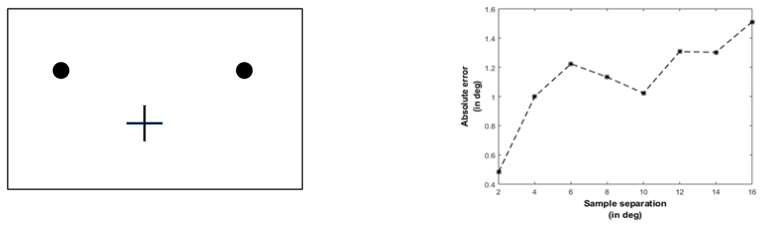
The central claim is that Fisher information contained in the neural population code serves as an energy-momentum tensor, generating the space-dependent metric tensor and therefore a curved visual space. With Gaussian tuning curves the Fisher-Rao metric becomes $ds_f^2 = (d\mu^2 + 2d\sigma^2)/\sigma^2$, and the scalar curvature computed from the Christoffel symbols and Ricci tensor is constant, $R = -1$, so the visual space is a hyperbolic manifold. The paper recasts the geometric field equation as $R_{\mu\nu} - \frac{1}{2}g_{\mu\nu}R - \frac{1}{2}(n-2)g_{\mu\nu} = T_{\mu\nu}$, where $T_{\mu\nu}$ is a stress-energy tensor built from Fisher information, so the presence of information changes curvature. In this space, the Fisher-Rao distance between two Gaussian codes with the same width is $|\mu_1-\mu_2|/\sigma$, and the paper adopts this as the psychometric distance. Simulated distance-estimation errors match the experimental curve up to roughly $4^\circ$ of separation, and beyond that an attention-induced narrowing of the tuning width is added; the resulting correlation with the psychophysical data is $0.9224$. The Helmholtz horopter is derived as a geodesic of this hyperbolic space, matching data for three observers.
Load-bearing premise
The whole construction rests on treating a point stimulus as encoded by a bell-shaped Gaussian tuning curve whose peak marks position and whose width marks uncertainty, and on assuming that this bell shape survives unchanged from the retina through the dLGN to the parietal cortex.
Editorial extensions
If this is right
- Visual space in frameless or dark-room conditions is hyperbolic with constant curvature $-1$, so Euclidean geometry is not the right model for perceived spatial relations in such conditions.
- The Fisher-Rao distance is the appropriate psychometric distance, meaning that perceived separation between two points should scale inversely with the width of the underlying neural tuning curves.
- The Helmholtz horopter is a geodesic of this hyperbolic space, and the same construction can account for parallel and distance alleys and the M\"uller-Lyer illusion in one framework.
- Any factor that changes the tuning width $\sigma$, such as attention, eccentricity, or receptive-field size, changes the metric and hence the perceived distance, giving a concrete neural handle on geometric visual illusions.
- If the tuning curves deviate from Gaussian under rich background cues, the visual space loses constant curvature, which the paper connects to measured curvature varying from elliptic in near space to hyperbolic in far space.
Reading between the lines
- A testable consequence of the paper's logic is that manipulating tuning width without changing stimulus position, for example by adaptation or pharmacological intervention, should measurably distort perceived distance in the direction predicted by the $1/\sigma$ Fisher-Rao distance.
- If the argument is read as a general mechanism rather than a vision-specific one, the same Fisher-Rao construction would predict non-Euclidean perceptual geometry in any modality whose population codes are approximately Gaussian, such as auditory or haptic space.
- The derivation depends on the Gaussian form of tuning curves, so a natural extension is to compute the Fisher-Rao metric and curvature for empirically measured non-Gaussian population codes; the sign and magnitude of the curvature would then be a physiological observable rather than an assumption.
- The field-equation analogy suggests that the perceived curvature of space could be read as a proxy for the local information content of the neural code, connecting information-theoretic measures of coding efficiency to psychophysical geometry.
Signed reviews
Editorial analysis
A structured set of objections, weighed in public.
Referee Report
Summary. The paper proposes that the non-Euclidean, hyperbolic structure of visual space arises from the Fisher information contained in Gaussian neural population codes. The authors model the population response to a point stimulus as a Gaussian tuning curve, compute the Fisher-Rao metric on the half-plane of parameters (mean, standard deviation), obtain constant scalar curvature R = -1, and introduce an information-geometric field equation (Eq. 23) in which Fisher information plays the role of a stress-energy tensor. They then fit the model to Oleksiak et al.'s distance-estimation data by iteratively adjusting the tuning-curve width, and they simulate Helmholtz horopters as geodesics of the hyperbolic visual space using Luneburg's transformation. The paper concludes that Fisher information creates the curved visual space and that the Fisher-Rao distance is the correct psychometric distance.
Significance. If the central claim were correct, the paper would provide a neural-origin mechanism for the long-studied hyperbolic geometry of visual space, connecting population coding, information geometry, and Luneburg's classical model. The mathematical computation of the Gaussian Fisher metric and its constant negative curvature is correct, and the formal connection between the Fisher-Rao upper half-plane and the Poincaré disk is a useful pedagogical observation. The paper also demonstrates the possibility of reproducing psychophysical distance-error data and horopter shapes within a hyperbolic-geometry framework. However, the advertised causal mechanism—that Fisher information acts as a stress-energy tensor and thereby generates curvature—is an algebraic identity rather than a physical or neural mechanism, and the empirical agreement is obtained by fitting a free parameter. These issues undermine the paper's central claim as stated.
major comments (3)
- [Section 3, Eqs. (20)–(23)] The central mechanism is an algebraic identity. Defining ρμν = Rμν + gμν (Eq. 20) and Tμν = ρμν − (1/2)gμνρ (Eq. 22), one obtains by substitution Tμν = Gμν − (n−2)/2 gμν, where Gμν is the Einstein tensor. Hence Eq. (23) is identically satisfied for every Riemannian metric and imposes no constraint on the geometry. In the paper's n = 2 visual space the Einstein tensor vanishes identically, so Eq. (23) reduces to 0 = 0. Consequently the claim that Fisher information 'creates' the curved visual space is not supported: the constant negative curvature R = −1 follows directly from the Gaussian ansatz in Eq. (12), not from any dynamical equation involving information. The statement in the text that 'the curvature of the space changes when information appears in it' is also unsupported because no information-dependent variation of the metric is ever computed.
- [Section 3.1, Steps 4–5 and Figure 6] The claimed empirical verification is a curve fit, not a prediction. The authors first compute distance errors using σe from Eq. (24), find disagreement beyond 4°, and then 'keep on modifying the value of σe iteratively till the difference between the simulated and experimental values of the error reaches a minimum.' The reported correlation 0.9224 between simulated and experimental curves is therefore obtained by tuning a free parameter per data set. The subsequent attentional-gain analysis (Eq. 25) does not provide an independent test; it solves for the attentional width σA using the already-fitted σR. This procedure cannot distinguish the Fisher-Rao metric from any other distance function with a suitably adjusted width parameter.
- [Section 2 and Step 4, Section 3.1] The load-bearing assumption that neural tuning curves are exactly Gaussian, with the same width parameter retained from retinal ganglion cells through dLGN to LIP, is asserted rather than derived. The DOG-based response equations (3)–(5) contain factors of (1 − exp(...)) and incomplete gamma functions; the step to a normalized Gaussian population code is an additional idealization. Because the Fisher metric (Eq. 12) and the scalar curvature R = −1 depend entirely on this Gaussian form, the paper's central geometric results rest on an unvalidated phenomenological assumption. No neural-recording evidence or formal derivation is supplied to justify the claim that the Gaussian shape is preserved unchanged along the dorsal pathway.
minor comments (5)
- [Section 2, references] There is a typographical error: 'Enviol et al.' should be 'Einevoll et al.' (reference [24]).
- [Section 3.1] The sentence 'Further to note that the interaction of attentional influence and the neural response has two contrastive natures' is duplicated verbatim in consecutive paragraphs; one occurrence should be deleted.
- [Figure 6 caption] The caption refers to 'σe as given by Equation (20)', but the relevant formula for σe is Equation (24); the cross-reference should be corrected.
- [Eq. (9)] The expansion of the Kullback-Leibler divergence contains unclear notation ('1/P2(x; θ)') and the signs in the intermediate expression are not clearly justified; a cleaner derivation with explicit Taylor expansion would improve readability.
- [Reference [57]] Reference [57] appears to have the same title as reference [56] (Zajaczkowska), which is likely a citation error; the actual title of [57] should be verified.
Circularity Check
The central claim that Fisher information acts as a stress-energy tensor and generates curvature is an algebraic identity: Eq. (23) follows from the definition of Tμν, and in the 2D visual space it reduces to 0 = 0.
-
self definitional
[Section 3, Eqs. (20)-(23), around 'We can further rewrite Equation (20) as...']
"Rµν + gµν = ρµν (20) ... We can further rewrite Equation (20) as, Rµν + gµν− 1 2gµνρ = ρµν− 1 2gµνρ = Tµν (22) ... finally, we can write Equation (22) as, Rµν− 1 2gµνR− 1 2(n−2)gµν = Tµν (23) ... Therefore the curvature of the space changes when information appears in it."
Tµν is not an independent gravitational source. Eq. (22) defines Tµν via ρµν, and Eq. (20) defines ρµν = Rµν + gµν. Substituting that definition into Eq. (22) yields exactly Eq. (23); the field equation is therefore an algebraic identity, not a mechanism by which Fisher information creates curvature. In the n = 2 visual space the Einstein tensor vanishes and n − 2 = 0, so Eq. (23) reduces to 0 = 0 and imposes no constraint on the metric. The constant negative curvature R = −1 is a property of the Gaussian Fisher–Rao metric, Eq. (12), not a dynamical consequence of a stress-energy tensor.
-
fitted input called prediction
[Section 3.1, Step 5 and simulation discussion after Figure 6]
"Then we keep on modifying the value of σe iteratively till the difference between the simulated and experimental values of the error reaches a minimum. The simulated curve is shown by the curve presented by the (–o) line ... The correlation between the experimental (-*) and simulated curve (-o) is computed and found to be 0.9224."
The 'simulated' error curve is obtained by adjusting σe (and hence σR via Eq. (25)) until the simulated error matches the experimental error from Oleksiak et al. That makes the reported 0.9224 correlation a measure of the quality of a parameter fit, not an independent prediction of the Fisher–Rao metric. Because the fitted width parameter is used to produce the very data being compared, this step does not provide independent empirical confirmation of the hyperbolic visual space.
1 more flagged steps
-
self citation load bearing
[Section 3.2, derivation of horopter geodesics after Eqs. (26a)-(26b)]
"In a past publication [36] we derived the locus of the geodesics of the hyperbolic visual space by solving the geodesic equations ... The general equation of the geodesics in the visual space represented by the upper half plane model is obtained as [36], 2σ 2 + µ2−Cµ = 1 ... Therefore, we obtain the equation of the Helmholtz horopters in the Poincare disc model using the same Mobius transformation[36]."
The load-bearing identification of Helmholtz horopters with geodesics of the visual space is imported from the authors' own arXiv preprint [36] rather than derived or verified here. Reference [36] is not an external, machine-checked, or independently reproduced result, so the paper's application section leans on a self-citation chain for the central geometric identification. The earlier preprint invokes the same upper half-plane Fisher–Rao model, so it cannot independently ground the present claim of a neural origin for hyperbolic visual space.
full rationale
The Gaussian Fisher–Rao metric calculation (Eq. 12), the Christoffel symbols, and the scalar curvature R = −1 are self-contained mathematical steps and are not circular: given a Gaussian population code with mean μ and width σ, the standard information-geometric computation does yield a hyperbolic metric. What is circular is the advertised mechanism connecting Fisher information to curvature: Eqs. (20)–(23) define the 'stress-energy tensor' Tμν in terms of the Ricci tensor and metric, so Eq. (23) is an identity rather than a field equation that lets Fisher information generate curvature; in the 2D visual space it reduces to 0 = 0. The empirical comparison in Section 3.1 also fits σe to the experimental error before reporting the correlation, so that match is a fitted-input result rather than an independent prediction. Finally, the horopter-as-geodesic result is taken from the authors' own earlier preprint [36], making that application load-bearing on self-citation. These are specific, quotable reductions; the paper nevertheless has independent mathematical content in the Fisher metric computation itself, so the overall circularity is substantial (8/10) rather than total (10/10).
Assumptions & free parameters
free parameters (2)
- Retinal / tuning-curve scale sigma_e (iteratively adjusted) =
varies with eccentricity; reconstructed in Fig. 6c
- DOG parameters (sigma_e0, sigma_s, w, I(L)) =
sigma_e = 0.6 deg, sigma_s = 1.2 deg, w = 0.5, I = 200 spikes/s; sigma_s = 1.6 sigma_e in Step 1
assumptions (4)
- domain assumption A point stimulus is represented by a univariate Gaussian population code p(r; mu, sigma) whose mean mu encodes location and whose standard deviation sigma encodes uncertainty.
- domain assumption Each Gaussian population code is a point in the upper half-plane (mu, sigma) with sigma > 0, and the visual space is this statistical parameter space.
- domain assumption The Gaussian shape of the population code is preserved without distortion from retina through dLGN to LIP.
- ad hoc to paper The information-geometric field equation (Eq. 23), with Fisher information as stress-energy tensor T_mu_nu, is a physically meaningful analogue of Einstein's equation for visual space.
Cite this review
Pith. "Pith review of Investigation of the neural origin of non-Euclidean visual space and analysis of visual phenomena using information geometry." pith.science (2026). https://pith.science/paper/AVP5UQX4
@misc{pith2026250513917,
  author       = {Pith},
  title        = {Pith review of: Investigation of the neural origin of non-Euclidean visual space and analysis of visual phenomena using information geometry},
  year         = {2026},
  howpublished = {\url{https://pith.science/paper/AVP5UQX4}},
  note         = {Machine review of arXiv:2505.13917}
}
read the original abstract
The present paper aims to develop a mathematical model concerning the visual perception of spatial information. It is a challenging problem in theoretical neuroscience to investigate how the spatial information of the objects in the physical space is encoded and decoded in the neural processes in the brain. In the past, researchers conjectured the existence of an abstract visual space where spatial information processing takes place. Based on several experimental data it was conjectured that the said psychological manifold is non-Euclidean. However, the consideration of the neural origin of the non-Euclidean character of the visual space was not explicit in the models. In the present paper, we showed that the neural mechanism and specifically the Fisher information contained in the neural population code plays the role of energy-momentum tensor to create the space-dependent metric tensor resulting in a curved space described by a curvature tensor. The theoretical prediction of information geometry regarding the emergence of curved manifolds in the presence of the Fisher information is verified in the present work in the domain of neural processing of spatial information at mid-level vision. Several well-known phenomena of visual optics are analyzed using the notion of non-Euclidean visual space, the geodesics of the space, and the Fisher-Rao metric as the suitable psychometric distance.
Figures


Figures from the paper (7 more)


Reference graph
Works this paper leans on
-
[1]
David Marr. Vision: A computational investigation into the human represen- tation and processing of visual information . MIT press, 2010. 26
work page 2010
-
[2]
Space and geometry in the light of physiological, psychological and physical inquiry
Ernst Mach. Space and geometry in the light of physiological, psychological and physical inquiry. Open Court Classics, 1906
work page 1906
-
[3]
Mathematical analysis of binocular vision
Rudolf Karl Luneburg. Mathematical analysis of binocular vision. Princeton University Press, 1947
work page 1947
-
[4]
The luneburg theory of binocular visual space
Albert A Blank. The luneburg theory of binocular visual space. JOSA, 43(9):717–727, 1953
work page 1953
-
[5]
The global structure of visual space , volume 1
Tarow Indow. The global structure of visual space , volume 1. World Scien- tific, 2004
work page 2004
-
[6]
Methods of information geometry , volume 191
Shun-ichi Amari and Hiroshi Nagaoka. Methods of information geometry , volume 191. American Mathematical Soc., 2000
2000
-
[7]
Edwin T Jaynes et al. Gibbs vs boltzmann entropies. American Journal of Physics, 33(5):391–398, 1965
work page 1965
-
[8]
Dissi- pation: The phase-space perspective
Ryoichi Kawai, Juan MR Parrondo, and Christian Van den Broeck. Dissi- pation: The phase-space perspective. Physical review letters, 98(8):080602, 2007
work page 2007
Show all 59 references
-
[9]
Stochastic time evolution, information ge- ometry, and the cram´er-rao bound
Sosuke Ito and Andreas Dechant. Stochastic time evolution, information ge- ometry, and the cram´er-rao bound. Physical Review X, 10(2):021056, 2020
2020
-
[10]
Measuring fisher information accurately in correlated neural pop- ulations
Ingmar Kanitscheider, Ruben Coen-Cagli, Adam Kohn, and Alexandre Pouget. Measuring fisher information accurately in correlated neural pop- ulations. PLoS computational biology, 11(6):e1004218, 2015
2015
-
[11]
Information thermodynamics on causal networks
Sosuke Ito and Takahiro Sagawa. Information thermodynamics on causal networks. Physical review letters, 111(18):180603, 2013
2013
-
[12]
Information is physical
Rolf Landauer. Information is physical. Physics Today, 44(5):23–29, 1991
1991
-
[13]
The physical nature of information
Rolf Landauer. The physical nature of information. Physics letters A, 217(4- 5):188–193, 1996
1996
-
[14]
Information, physics, quantum: The search for links
John Archibald Wheeler. Information, physics, quantum: The search for links. Feynman and computation, pages 309–336, 2018
2018
-
[15]
Operationally invariant information in quantum measurements
ˇCaslav Brukner and Anton Zeilinger. Operationally invariant information in quantum measurements. Physical review letters, 83(17):3354, 1999. 27
1999
-
[16]
Information flow in entangled quantum systems
David Deutsch and Patrick Hayden. Information flow in entangled quantum systems. Proceedings of the Royal Society of London. Series A: Mathemati- cal, Physical and Engineering Sciences , 456(1999):1759–1774, 2000
1999
-
[17]
Emergent general relativity from fisher information met- ric
Hiroaki Matsueda. Emergent general relativity from fisher information met- ric. arXiv preprint arXiv:1310.1831, 2013
2013 arXiv
-
[18]
Riemannian geometry of fluctuation theory: An in- troduction
Luisberis Velazquez. Riemannian geometry of fluctuation theory: An in- troduction. In Journal of Physics: Conference Series , volume 720, page 012005. IOP Publishing, 2016
2016
-
[19]
The visual repre- sentation of space in the primate brain
Stefan Dowiasch, Andre Kaminiarz, and Frank Bremmer. The visual repre- sentation of space in the primate brain. Neuroforum, 28(4):199–209, 2022
2022
-
[20]
Cortical high-density counterstream architectures
Nikola T Markov, M ´aria Ercsey-Ravasz, David C Van Essen, Kenneth Knoblauch, Zolt ´an Toroczkai, and Henry Kennedy. Cortical high-density counterstream architectures. Science, 342(6158):1238406, 2013
2013
-
[21]
Receptive fields of single neurones in the cat’s striate cortex
David H Hubel and Torsten N Wiesel. Receptive fields of single neurones in the cat’s striate cortex. The Journal of Physiology, 148(3):574, 1959
1959
-
[22]
Two cortical visual systems, volume 549
Leslie G Ungerleider. Two cortical visual systems, volume 549. MIT press, 1982
1982
-
[23]
Separate visual pathways for per- ception and action
Melvyn A Goodale and A David Milner. Separate visual pathways for per- ception and action. Trends in neurosciences, 15(1):20–25, 1992
1992
-
[24]
Mathematical models for the spatial receptive-field organization of nonlagged x-cells in dorsal lateral geniculate nucleus of cat
Gaute T Einevoll and Paul Heggelund. Mathematical models for the spatial receptive-field organization of nonlagged x-cells in dorsal lateral geniculate nucleus of cat. Visual neuroscience, 17(6):871–885, 2000
2000
-
[25]
Non-linear model of neural responses in cat visual cortex in computational models of visual processing
DJ Heeger. Non-linear model of neural responses in cat visual cortex in computational models of visual processing. Landy MS, Movshon JA, 1991
1991
-
[26]
Quantitative analysis of cat retinal ganglion cell response to visual stimuli
Robert W Rodieck. Quantitative analysis of cat retinal ganglion cell response to visual stimuli. Vision research, 5(12):583–601, 1965
1965
-
[27]
Information processing with population codes
Alexandre Pouget, Peter Dayan, and Richard Zemel. Information processing with population codes. Nature Reviews Neuroscience, 1(2):125–132, 2000
2000
-
[28]
Organization of the dorsal lat- eral geniculate nucleus in the mouse
Daniel Kerschensteiner and William Guido. Organization of the dorsal lat- eral geniculate nucleus in the mouse. Visual neuroscience, 34:E008, 2017. 28
2017
-
[29]
Wiring and rewiring of the retinogeniculate synapse
Y Kate Hong and Chinfei Chen. Wiring and rewiring of the retinogeniculate synapse. Current opinion in neurobiology, 21(2):228–237, 2011
2011
-
[30]
Population coding of visual space: comparison of spatial representations in dorsal and ventral pathways
Anne B Sereno and Sidney R Lehky. Population coding of visual space: comparison of spatial representations in dorsal and ventral pathways. Fron- tiers in computational neuroscience, 4:159, 2011
2011
-
[31]
Distance estimation is influenced by encoding conditions
Anna Oleksiak, Mirosława Ma ´nko, Albert Postma, Ineke JM van der Ham, Albert V van den Berg, and Richard JA van Wezel. Distance estimation is influenced by encoding conditions. Plos one, 5(3):e9918, 2010
2010
-
[32]
Peripheral vision and perceived visual direction
S Mateeff and A Gourevich. Peripheral vision and perceived visual direction. Biological Cybernetics, 49(2):111–118, 1983
1983
-
[33]
Effects of blur and eccentric- ity on differential spatial displacement discrimination
A Toet, HP Snippe, and JJ Koenderink. Effects of blur and eccentric- ity on differential spatial displacement discrimination. Vision Research, 28(4):535–553, 1988
1988
-
[34]
Retinal metric: a stimulus distance measure derived from population neural responses
Ga ˇsper Tka ˇcik, Einat Granot-Atedgi, Ronen Segev, and Elad Schneidman. Retinal metric: a stimulus distance measure derived from population neural responses. Physical review letters, 110(5):058104, 2013
2013
-
[35]
Rao’s distance measure
Colin Atkinson and Ann FS Mitchell. Rao’s distance measure. Sankhy¯a: The Indian Journal of Statistics, Series A , pages 345–365, 1981
1981
-
[36]
Representation of 2d frame less visual space as a neu- ral manifold and its information geometric interpretation
Debasis Mazumdar. Representation of 2d frame less visual space as a neu- ral manifold and its information geometric interpretation. arXiv preprint arXiv:2011.13585, 2020
2011 arXiv
-
[37]
Curvature of binocular visual space
Albert A Blank. Curvature of binocular visual space. an experiment. JOSA, 51(3):335–339, 1961
1961
-
[38]
A new method for determining the per- sonal constants in the luneburg theory of binocular visual space
Genichi Hagino and Ichiro Yoshioka. A new method for determining the per- sonal constants in the luneburg theory of binocular visual space. Perception & Psychophysics, 19(6):499–509, 1976
1976
-
[39]
Direct mea- surement of the curvature of visual space
Jan J Koenderink, Andrea J Van Doorn, and Joseph S Lappin. Direct mea- surement of the curvature of visual space. Perception, 29(1):69–79, 2000
2000
-
[40]
Convergence of probability measures
Patrick Billingsley. Convergence of probability measures . John Wiley & Sons, 2013. 29
2013
-
[41]
Hyperbolic geometry
James W Anderson. Hyperbolic geometry . Springer Science & Business Media, 2006
2006
-
[42]
Axioms for geodesics and their implications
Herbert Busemann. Axioms for geodesics and their implications. In Studies in Logic and the F oundations of Mathematics , volume 27, pages 146–159. Elsevier, 1959
1959
-
[43]
Uniformity of monkey striate cortex: a parallel relationship between field size, scatter, and magnification factor
David H Hubel and Torsten N Wiesel. Uniformity of monkey striate cortex: a parallel relationship between field size, scatter, and magnification factor. Journal of Comparative Neurology, 158(3):295–305, 1974
1974
-
[44]
Multi-area visuotopic map complexes in macaque striate and extra-striate cortex
Jonathan R Polimeni, Mukund Balasubramanian, and Eric L Schwartz. Multi-area visuotopic map complexes in macaque striate and extra-striate cortex. Vision research, 46(20):3336–3359, 2006
2006
-
[45]
A new psychophysical estimation of the receptive field size
Arash Yazdanbakhsh and Simone Gori. A new psychophysical estimation of the receptive field size. Neuroscience Letters, 438(2):246–251, 2008
2008
-
[46]
Theory of edge detection
David Marr and Ellen Hildreth. Theory of edge detection. Proceedings of the Royal Society of London. Series B. Biological Sciences, 207(1167):187–217, 1980
1980
-
[47]
Feature-based attention influences motion processing gain in macaque visual cortex
JC Treue, S Martınez Trujillo. Feature-based attention influences motion processing gain in macaque visual cortex. Nature, 399:575–579, 1999
1999
-
[48]
Feature-based attention increases the se- lectivity of population responses in primate visual cortex.Curr Biol, 14:744– 751, 2004
JC Martınez Trujillo and S Treue. Feature-based attention increases the se- lectivity of population responses in primate visual cortex.Curr Biol, 14:744– 751, 2004
2004
-
[49]
Parallel and serial neural mecha- nisms for visual search in macaque area v4
NP Bichot, AF Rossi, and R Desimone. Parallel and serial neural mecha- nisms for visual search in macaque area v4. Science, 308:529–34, 05 2005
2005
-
[50]
Attention to both space and feature mod- ulates neuronal responses in macaque area v4
CJ McAdams and J.H Maunsell. Attention to both space and feature mod- ulates neuronal responses in macaque area v4. J. Neurophysiol, 83:1751– 1755, 2000
2000
-
[51]
Spatial attention effects in macaque area v4
C.E Connor, D.C Preddie, J.L Gallant, and D.C Van Essen. Spatial attention effects in macaque area v4. J Neurosci, 17:3201–3214, 1997
1997
-
[52]
Attention to both space and feature modulates neuronal responses in macaque area v4
J Moran and R Desimone. Attention to both space and feature modulates neuronal responses in macaque area v4. Science, 229:782–784, 1985. 30
1985
-
[53]
Dynamic shifts of visual receptive fields in cortical area mt by spatial attention
T Womelsdorf, K Anton-Erxleben, F Pieper, and S Treue. Dynamic shifts of visual receptive fields in cortical area mt by spatial attention. Nat Neurosci, 9:1156 – 1160, 2006
2006
-
[54]
Dreceptive field shift and shrinkage in macaque middle temporal area through attentional gain modu- lation
T Womelsdorf, K Anton-Erxleben, and S Treue. Dreceptive field shift and shrinkage in macaque middle temporal area through attentional gain modu- lation. J.Neurosci, 28(36):8934–8944, 2008
2008
-
[55]
Helmholtz
H.V . Helmholtz. Treatise on Psychological Optics, volume 3. Optical Soci- ety of America, 1925
1925
-
[56]
Experimental test of luneburg’s theory
A Zajaczkowska. Experimental test of luneburg’s theory. horopter and alley experiments. J.Opt.Soc.of America, 46.No.7:514–527, 1956
1956
-
[57]
Experimental test of luneburg’s theory
Ojha Rahul Kumar, Mandal Mainak, Mazumdar Debasis, and Ghosh Kuntal. Experimental test of luneburg’s theory. horopter and alley experiments.11th International Conference, Spatial Cognition, Tubingen, Germany , pages 514–527, 2018
2018
-
[58]
Modelling muller-lyer illusion using information geometry
Mazumdar Debasis, Mitra Soma, Ghosh Kuntal, and Bhaumik Kamales. Modelling muller-lyer illusion using information geometry. 3rd In- ternational Conference on Data Intelligence and Cognitive Informatics, Tirunelveli, India, pages 514–527, 2022
2022
-
[59]
Place units in the hippocampus of the freely moving rat
John O’keefe. Place units in the hippocampus of the freely moving rat. Experimental Neurology, 51 issue (1):78–109, 1976. 31
1976
Reviewed August 15, 2026 · model on record in the stance chip above.
Discussion (0). Continue with ORCID to comment.