REVIEW 4 major objections 6 minor 19 references
WirelessMathBench: A Mathematical Modeling Benchmark for LLMs in Wireless Communications
T0 review · 4 major / 6 minor · reviewed 2026-08-07 · deepseek-v4-flash
Pith's one-line read The paper's central claim is that current LLMs, however strong on recall, fail at multi-step symbolic derivation in wireless communications: even the best model, DeepSeek-R1, averages 38.05% accuracy and completes only 7.83% of fully…
desk verdict Worth a serious look, but the headline numbers rest on an unvalidated GPT-4o judge; the progressive-masking design is a real contribution, and the qualitative degradation finding likely survives, but treat the absolute accuracies as provisional. read the letter →
The pith
A machine-rendered reading of the paper's core claim, the machinery that carries it, and where it could break.
The reading
What carries the argument
The load-bearing mechanism is the progressive masking ladder, which turns a single formula from a source paper into a graded series of independent questions: a multiple-choice recognition, three fill-in-the-blank tasks with increasing portions of the equation hidden, and a full equation completion where only the scenario description remains. Because every rung of the ladder uses the same underlying equation, the benchmark isolates whether a model's failure is a recall failure or a derivation failure. Scoring of the free-form answers is delegated to an LLM judge (GPT-4o) that checks symbolic equivalence and dimensional plausibility.
What would settle it
Take a random sample of, say, 100 full-equation completion outputs from DeepSeek-R1 and have wireless engineers score them against the same rubric; if human agreement with GPT-4o is poor, the benchmark's headline numbers would need recalibration, and possibly the ordering of models would change.
Extended reading notes
Core claim
On its own terms, the paper establishes that state-of-the-art LLMs can identify the right wireless formula when it is placed in front of them, but cannot reliably reconstruct it when parts are hidden. The evidence is a performance cliff as masking increases: DeepSeek-R1 drops from 76.00% on multiple-choice to 60.00% at mask level 1, 34.91% at level 2, 12.50% at level 3, and 7.83% on full equation completion; sixteen tested models show the same monotone decline. The paper reads this as evidence that current LLMs lack the capacity for domain-grounded, multi-step symbolic manipulation under dimensional and physical constraints, and releases the benchmark and evaluation toolkit to make that gap measurable.
Load-bearing premise
The results stand on the assumption that GPT-4o scores free-form equation answers accurately enough that the reported percentages reflect real model ability, not judge leniency or strictness.
Editorial extensions
If this is right
- Domain-adaptive training and retrieval-augmented methods will need to be measured against full-equation derivations, not just factual recall, or they will appear successful while remaining unusable for engineering.
- Chain-of-thought prompting does not close the gap: the paper's own CoT experiments show marginal or negative effects on the hardest tasks, so improvements will have to come from architecture or specialized training.
- WirelessMathBench's scores provide a baseline: any claim that an LLM can assist with wireless system analysis should be expected to beat DeepSeek-R1's 38.05% average and 7.83% full-equation rate.
- The monotone decline with masking level offers a diagnostic: a model that holds up at high mask levels is doing genuine symbolic reconstruction, not memorized retrieval.
Reading between the lines
- Provided the paper's results hold, a reader could test whether the GPT-4o judge changes the picture by having humans re-score a sample of outputs; if human agreement is poor, the headline numbers and model ordering would shift.
- The same progressive-masking ladder could be applied to other engineering fields, such as control theory or circuit design, where derivations carry physical constraints, making the failure pattern visible outside wireless.
- The paper's error taxonomy—partial fill mismatch, symbol misinterpretation, derivation path errors, and system mixing—suggests a concrete extension: fine-tune on masked-equation data that penalizes symbol substitution errors and check whether level-3 accuracy, specifically, improves.
Editorial analysis
A structured set of objections, weighed in public.
Referee Report
Summary. The paper introduces WirelessMathBench, a benchmark of 587 wireless-communications mathematical modeling questions derived from 40 arXiv papers, organized into multiple-choice questions (MCQ), progressively masked fill-in-the-blank tasks at three difficulty levels, and full equation completion (FEC) tasks. Sixteen LLMs are evaluated zero-shot; the authors report that accuracy drops sharply as masking increases, with the best model (DeepSeek-R1) achieving 38.05% average accuracy and only 7.83% on FEC. The paper also includes an error analysis based on 40 sampled failures and a set of chain-of-thought experiments. The benchmark and evaluation toolkit are released publicly.
Significance. If the reported results are reliable, the benchmark fills a genuine gap: existing math benchmarks do not cover expert-level, domain-specific symbolic derivation in engineering, and the finding that state-of-the-art LLMs fall to single-digit accuracy on full equation completion is a substantive and potentially influential observation for the community. The paper has real strengths: the data are sourced from peer-reviewed papers and pass a multi-round expert review; the task design (progressive masking) creates a useful difficulty gradient; and the public release of the benchmark and toolkit supports reproducibility and follow-up work. The central weakness is that the headline numbers are calibrated by an unvalidated GPT-4o judge and a single run, so the absolute accuracies should be treated as provisional until human-rescoring evidence is provided.
major comments (4)
- [§4.1 and Appendix C] The automated evaluation for all non-MCQ tasks uses GPT-4o as judge, but the judge is never validated. There is no human-expert rescoring sample, no inter-judge agreement statistic, and no analysis of false positives versus false negatives. This is load-bearing because the headline FEC accuracy of 7.83% (DeepSeek-R1) corresponds to roughly 9 correct answers out of the FEC item count; a modest judge error rate could move this figure substantially, and the same applies to the Level-3 and average-accuracy numbers. Please report a human-rescored subset (e.g., 100+ items), agreement measures, and results under stricter/looser judging criteria, or an independent symbolic-equivalence check.
- [§4.2, Table 4] The definition of 'Avg. Acc' is not specified. It is ambiguous whether it is the unweighted mean of the five per-metric accuracies or the total number of correct answers divided by 587. Because the five metrics are likely to have different numbers of items (MCQ has many items, FEC fewer), these two computations can differ. Please report per-metric item counts and the exact formula used to compute the average.
- [Appendix D] The appendix states that 'all results are the results of a single run.' Combined with the LLM judge, there are no variance estimates for any reported number. At minimum for the main models (DeepSeek-R1, OpenAI-o1, GPT-4o, DeepSeek-V3), please report repeated runs (or a determinism check at temperature 0) and provide standard deviations or confidence intervals for the key metrics.
- [§3.2] The paper asserts that tasks are reformulated to 'avoid word-for-word reproductions' and to reduce contamination, but no quantitative contamination analysis is provided. Since the 40 source papers are freely available on arXiv and likely appear in LLM pretraining corpora, please measure overlap between the task prompts and the source texts (e.g., n-gram or embedding similarity) and report results on a contamination-filtered subset, especially for the MCQ task where memorization is most plausible.
minor comments (6)
- [Table 3] The model name 'Gemini-Famliy' contains a typo; it should read 'Gemini-Family'.
- [§4.2] The paragraph beginning 'Progressive Masking Emphasizes Multi-Step Reasoning Gaps' contains a duplicated sentence: 'When forced to reconstruct partially hidden expressions, model performance declines in proportion to the level of masking' is immediately followed by a near-identical sentence. Please remove the duplicate.
- [§3.3] 'To full evaluate the capabilities' should be 'To fully evaluate the capabilities'.
- [Limitations] The phrase 'Radio frequency (RF) measurements measurements' contains a duplicated word; remove one occurrence.
- [§4.3] The error analysis is based on only 40 randomly sampled errors, with no sample-size justification or confidence intervals for the reported percentages (31%, 29%, 24%, 11%, 4%). Please state whether the sample is sufficient to support the claimed error taxonomy or present the analysis as illustrative.
- [Abstract] The phrase 'mathematical modeling challenges to wireless communications engineering' reads awkwardly; consider 'challenges in wireless communications engineering'.
Circularity Check
No significant circularity; the benchmark's ground truth is externally sourced and expert-validated, and the headline accuracy figures are measured rather than fitted.
full rationale
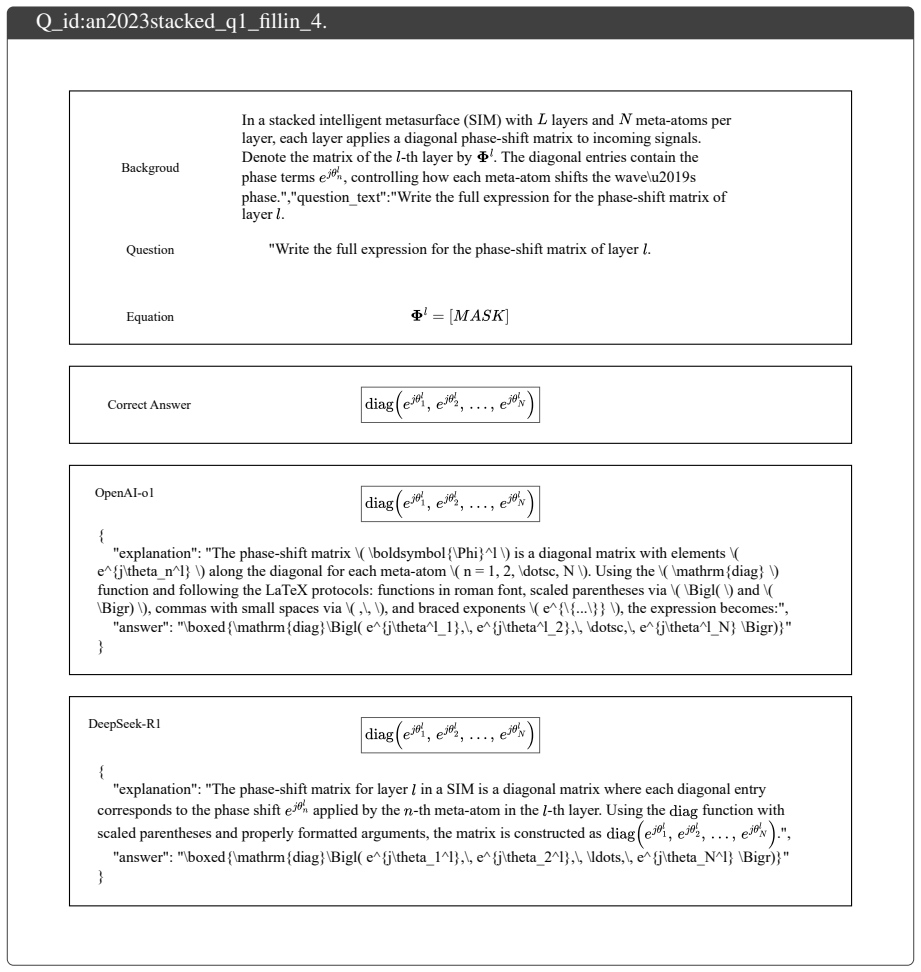
WirelessMathBench is an empirical benchmark paper, not a derivation. Ground-truth answers are external artifacts: they come from 40 published, peer-reviewed papers and are cross-validated by domain experts (Appendix B). The headline accuracies (38.05% and 7.83%) are measured outcomes, not fitted parameters: no parameter is tuned to a target result, and no equation is predicted from an input that already contains the answer. The GPT-4o judge used for free-form answers (Section 4.1) is an implementation choice that affects measurement validity, and Appendix D's single-run setting adds variance, but neither makes the claim equivalent to its inputs. Some source papers are authored by the benchmark creators (e.g., the 'an2023stacked' example in Appendix E), yet the benchmark's correctness does not rest on those citations: the questions are independently expert-reviewed and the LLM scores are observed consequences of model behavior, not of the authors' prior claims. I find no circular step.
Assumptions & free parameters
assumptions (4)
- domain assumption Equations from the 40 selected peer-reviewed papers are correct and can serve as ground truth.
- domain assumption Domain expert review guarantees question correctness, clarity, and unambiguity.
- domain assumption GPT-4o can accurately judge whether free-form model outputs are symbolically equivalent to the ground truth.
- domain assumption Zero-shot, single-run responses are representative of model capability.
Cite this review
Pith. "Pith review of WirelessMathBench: A Mathematical Modeling Benchmark for LLMs in Wireless Communications." pith.science (2026). https://pith.science/paper/DL6IEZSH
@misc{pith2026250514354,
  author       = {Pith},
  title        = {Pith review of: WirelessMathBench: A Mathematical Modeling Benchmark for LLMs in Wireless Communications},
  year         = {2026},
  howpublished = {\url{https://pith.science/paper/DL6IEZSH}},
  note         = {Machine review of arXiv:2505.14354}
}
read the original abstract
Large Language Models (LLMs) have achieved impressive results across a broad array of tasks, yet their capacity for complex, domain-specific mathematical reasoning-particularly in wireless communications-remains underexplored. In this work, we introduce WirelessMathBench, a novel benchmark specifically designed to evaluate LLMs on mathematical modeling challenges to wireless communications engineering. Our benchmark consists of 587 meticulously curated questions sourced from 40 state-of-the-art research papers, encompassing a diverse spectrum of tasks ranging from basic multiple-choice questions to complex equation completion tasks, including both partial and full completions, all of which rigorously adhere to physical and dimensional constraints. Through extensive experimentation with leading LLMs, we observe that while many models excel in basic recall tasks, their performance degrades significantly when reconstructing partially or fully obscured equations, exposing fundamental limitations in current LLMs. Even DeepSeek-R1, the best performer on our benchmark, achieves an average accuracy of only 38.05%, with a mere 7.83% success rate in full equation completion. By publicly releasing WirelessMathBench along with the evaluation toolkit, we aim to advance the development of more robust, domain-aware LLMs for wireless system analysis and broader engineering applications.
Figures


Figures from the paper (11 more)




Reference graph
Works this paper leans on
-
[1]
Each question in WirelessMathBench was re- viewed by a minimum of two experts. 13
-
[2]
Experts independently verified both the math- ematical correctness and clarity of each ques- tion
-
[3]
Deepseek-v3 technical report. Preprint, arXiv:2412.19437. Mengbing Liu, Jiancheng An, Huang Chongwen, and Chau Yuen. 2025a. Over-the-air ode-inspired neural network for dual task-oriented semantic communica- tions. IEEE Transaction on on Cognitive Communi- cations and Networkingn (TCCN). Mengbing Liu, Chongwen Huang, Alhammadi Ahmed, Marco Di Renzo, mérou...
arXiv 2022
-
[4]
Scibench: Evaluating college-level scientific problem-solving abilities of large language models. Stephen Wolfram. 2003. The mathematica book. Wol- fram Research, Inc. An Yang, Beichen Zhang, Binyuan Hui, Bofei Gao, Bowen Yu, Chengpeng Li, Dayiheng Liu, Jian- hong Tu, Jingren Zhou, Junyang Lin, Keming Lu, Mingfeng Xue, Runji Lin, Tianyu Liu, Xingzhang Ren...
arXiv 2003
-
[5]
IEEE Wireless Com- munications, 31(3):140–147
Mobile cell-free massive MIMO: Challenges, solutions, and future directions. IEEE Wireless Com- munications, 31(3):140–147. Kunhao Zheng, Jesse Michael Han, and Stanislas Polu
-
[6]
Consensus Discussion: Resolution of any discrepancies between reviewer assessments
-
[7]
arXiv preprint arXiv:2407.09424
TelecomGPT: A framework to build telecom- specfic large language models. arXiv preprint arXiv:2407.09424. 12 A Dataset Details A.1 Topics and Papers Selection Our study addresses modern wireless communica- tion challenges by selecting topics based on three key criteria that ensure both the academic rigor and practical relevance of our work. First, we targ...
arXiv 2024
-
[10]
When disagreements arose, the reviewers en- gaged in detailed discussions until consensus was reached
Show all 19 references
-
[11]
For particularly complex derivations, a third expert was consulted to provide additional ver- ification
-
[12]
This protocol ensured that all questions accu- rately reflected real-world wireless communica- tions challenges while maintaining clear formu- lation and unambiguous answers
All multiple-choice distractors were examined to ensure they represented plausible but incor- rect options. This protocol ensured that all questions accu- rately reflected real-world wireless communica- tions challenges while maintaining clear formu- lation and unambiguous ans...
-
[13]
Initial Extraction: Semi-automated extrac- tion of system models from research papers
-
[14]
Question Formulation: Transformation of system models into question-answer pairs with varying difficulty levels
-
[15]
First Review: Initial expert review focus- ing on mathematical correctness, dimensional consistency, and domain applicability
-
[16]
Refinement: Modification of questions based on first review feedback
-
[17]
Second Review: Independent validation by a different expert, focusing on clarity and peda- gogical value
-
[19]
explanation
Final Approval: Acceptance of questions into the benchmark dataset after successfully passing all reviews. Throughout this process, reviewers paid particu- lar attention to: • Dimensional consistency of all equations • Proper use of notation and symbols • Physical feasibility ...
-
[2022]
In International Conference on Learning Representations
miniF2F: a cross-system benchmark for for- mal olympiad-level mathematics. In International Conference on Learning Representations. Hang Zou, Qiyang Zhao, Yu Tian, Lina Bariah, Faouzi Bader, Thierry Lestable, and Merouane Debbah
-
[2023]
In The 2023 Conference on Empirical Methods in Natural Language Processing
Have LLMs advanced enough? a challenging problem solving benchmark for large language mod- els. In The 2023 Conference on Empirical Methods in Natural Language Processing. Emil Bjornson, Michail Matthaiou, and Merouane Debbah. 2013. A new look at dual-hop relay- ing: Performan...
2023
-
[2024]
In Forty-first International Conference on Machine Learning
Mlagentbench: Evaluating language agents on machine learning experimentation. In Forty-first International Conference on Machine Learning. Albert Q Jiang, Alexandre Sablayrolles, Arthur Men- sch, Chris Bamford, Devendra Singh Chaplot, Diego de las Casas, Florian Bressand, Gian...
2023 arXiv
Reviewed August 7, 2026 · model on record in the stance chip above.
Discussion (0). Sign in to comment.