REVIEW 4 major objections 5 minor 16 references
Interpretable Neural System Dynamics: Combining Deep Learning with System Dynamics Modeling to Support Critical Applications
T0 review · 4 major / 5 minor · reviewed 2026-08-07 · deepseek-v4-flash
Pith's one-line read An integrated pipeline that combines concept learning, causal learning, and equation learning can make deep-learning system dynamics models interpretable and causally reliable.
desk verdict A clear, well-motivated PhD proposal that describes a plausible integration of interpretability methods, but offers no evidence and under-specifies the causal discovery step on which its central promise rests. read the letter →
The pith
A machine-rendered reading of the paper's core claim, the machinery that carries it, and where it could break.
The reading
What carries the argument
The load-bearing construction is the three-stage pipeline. Stage one, concept learning, uses concept-based interpretability to map raw sensor or operational data onto high-level human-meaningful variables. Stage two, causal learning, applies causal machine learning and causal discovery, including the neural causal models framework, to infer a directed causal graph over those concepts, optionally informed by background knowledge. Stage three, equation learning, uses mechanistic interpretability, with graph-based architectures such as graph neural networks, to derive explicit structural equations describing how the concepts evolve over time. The claim is that the causal graph is the piece that anchors the neural model to real mechanisms; the equations inherit their causal reliability from that graph.
What would settle it
Run the pipeline on a synthetic dynamical system whose true causal graph and structural equations are known, such as a benchmark epidemic or multimodal-terminal model, and compare the learned causal graph and equations against that ground truth; if the recovered graph omits a known edge, adds a spurious one, or yields equations that fail to reproduce the system under an intervention not seen in training, the central claim of causal reliability is contradicted.
Extended reading notes
Core claim
The central claim is that the perceived trade-off between deep learning's predictive power and system dynamics' interpretability is not necessary: a three-step Interpretable Neural System Dynamics pipeline can deliver both. The paper's way of stating this is that semantic opacity, mechanistic opacity, and causal unreliability should be addressed jointly, not separately as they usually are in XAI research. The pipeline's output is a neural model that operates on semantically meaningful variables, embeds a learned causal directed graph, and is governed by explicit structural equations, so predictions can be traced back to concepts and causes, and interventions can be simulated. The author proposes to validate this on intermodal terminal operations in the AutoMoTIF project, where understanding and causal reliability are required for risk assessment and compliance.
Load-bearing premise
The framework stands or falls on the assumption that step two, causal learning, can recover the true causal dependencies among the learned concepts from data and background knowledge; if the learned graph does not match the real mechanisms, the structural equations derived from it will not be causally reliable even if they are interpretable.
Editorial extensions
If this is right
- If the pipeline works as proposed, neural system dynamics models could be audited by tracing any prediction to the defining concepts and to the causal influences among them.
- Operators in high-risk logistics settings could simulate interventions such as increasing crane availability and see predicted long-term effects instead of receiving an unexplained forecast.
- The same architecture could be carried to other critical domains where transparency is mandatory, including healthcare, environmental monitoring, and finance.
- Because the equations are explicit, the resulting models may support the kind of documentation and risk assessment that high-risk AI regulation asks for, such as under the EU AI Act.
Reading between the lines
- A natural extension the author leaves implicit: the causal-learning step may need interventional or counterfactual data, or much stronger background knowledge, because passive observation alone cannot generally disambiguate which of several graphs consistent with the data is the true one.
- The proposal could be made falsifiable earlier by first testing the pipeline on a synthetic benchmark with a known causal graph, and only then moving to the AutoMoTIF case; real-world evaluation alone cannot show whether failures come from causal discovery or equation learning.
- The temporal aspect of concept learning is flagged as underdeveloped; an implicit consequence is that the pipeline's success may hinge on new methods that make concepts evolve over time, rather than applying static concept classifiers.
Editorial analysis
A structured set of objections, weighed in public.
Referee Report
Summary. The paper proposes a research plan for an 'Interpretable Neural System Dynamics' (INSD) pipeline that combines concept-based interpretability, causal machine learning, and mechanistic interpretability to build neural models of dynamical systems that are interpretable and causally reliable. It motivates the work by contrasting deep learning's predictive power with its opacity and lack of causal reliability, and positions System Dynamics as a source of interpretable, causal structure. The pipeline is to be validated on the AutoMoTIF freight-transportation scenario. The manuscript explicitly frames the project as a doctoral research proposal, stating working hypotheses and listing milestones, with no implementation, experiments, or formal derivations.
Significance. The paper identifies a real and timely research gap: deep learning models for dynamical systems lack semantic and mechanistic interpretability as well as causal reliability, and existing XAI methods address these aspects separately. The proposed integration of concept-based interpretability, causal learning, and mechanistic interpretability is a plausible and potentially valuable research direction, and the AutoMoTIF application provides a concrete and relevant testbed. The strengths of the manuscript are its clear problem statement, structured research questions, and explicit milestones. However, the central claim that the INSD pipeline will deliver causally reliable and interpretable models is only a working hypothesis; the paper contains no derivations, no algorithms, no empirical evidence, and no falsifiable predictions. Any assessment of the pipeline's feasibility, soundness, or expected impact therefore rests entirely on plausibility rather than demonstrated results.
major comments (4)
- [§3.2] The central claim that the pipeline will achieve 'causal reliability' depends on the causal discovery step recovering the true causal dependencies among the concepts from data and background knowledge. The paper states that CML and Neural Causal Models will 'uncover the underlying causal structure of a system by learning a graph,' but it provides no identifiability conditions, no discussion of Markov equivalence classes, and no explanation of how background knowledge would resolve graph underdetermination. Without such conditions, the learned graph may be one of many compatible with the data, and the structural equations learned in §3.3 would not be causally reliable.
- [§3.1–§3.3] The three pipeline steps are described only at the level of research themes; no concrete algorithms, formal problem statements, or computational procedures are given for concept learning, causal discovery, or equation learning. For instance, §3.3 mentions graph neural networks and 'mechanistic interpretability' but does not specify how structural dynamic equations are represented, how their parameters are estimated, or how the inferred causal graph constrains them. As presented, the pipeline is not implementable or testable, making it impossible to scrutinize the claimed behavior.
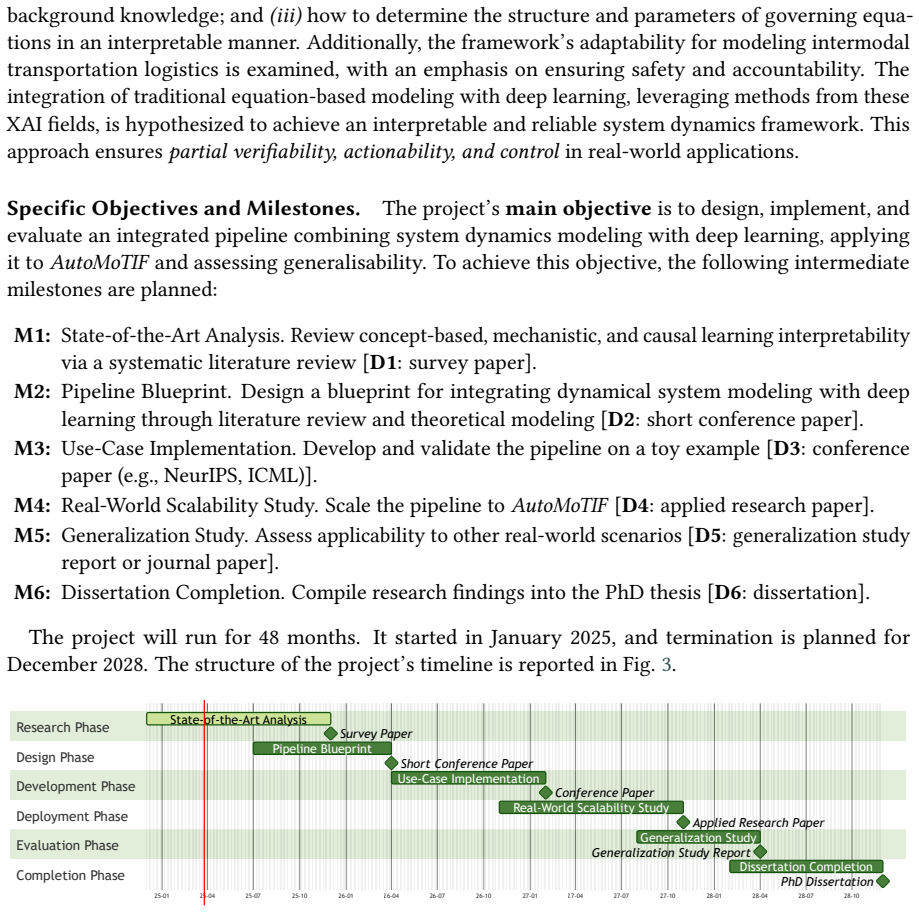
- [§4] The milestones (M1–M6) list planned deliverables (D1–D6) but no quantitative success criteria, evaluation metrics, baselines, or validation protocols. The paper says the pipeline will be 'validated' on the AutoMoTIF scenario, but it never defines what would count as a successful validation, either for interpretability or for causal reliability. This absence prevents any empirical assessment of the central claim, even in principle.
- [§3.2] Causal discovery is performed on concepts that are themselves learned from raw data in Step 1, meaning the discovery algorithm operates on estimated variables rather than ground-truth quantities. The paper does not address how concept-estimation error, measurement noise, or potential information loss in the concept bottleneck could introduce confounding or spurious dependency edges. This is a load-bearing issue because any error in the concept layer propagates into the learned causal graph and the subsequent equations.
minor comments (5)
- [Section 1] In the sentence 'the proposed approach focuses on the construction of a interpretable by design neural systems dynamic framework,' 'a interpretable' should be 'an interpretable.'
- [Figure 1] The figure caption contains 'Casual Reliability,' which should be 'Causal Reliability.'
- [Abstract and Full Text] The phrase 'operating onsemantically meaningful variables' appears without a space between 'on' and 'semantically'; fix the typo.
- [Throughout] Section headings are inconsistent in capitalization (e.g., 'Causal Learning' vs 'causal learning'); use a consistent heading style.
- [References] Reference [7] is a preprint with a version number; if a peer-reviewed version exists, it should be cited instead of or in addition to the arXiv version.
Circularity Check
No significant circularity: the paper is a research proposal whose central claims are asserted rather than derived from fitted inputs or self-citations.
full rationale
The paper presents a doctoral research proposal and does not contain a substantive derivation chain, empirical predictions, or fitted parameters. The INSD pipeline is described as three planned learning steps — concept learning, causal learning, and equation learning — but none of these steps is executed, and no result is claimed to be predicted from a fitted input. The term 'causal reliability' is introduced via citation [2], but only as a definitional label for a known problem, not as a conclusion derived from that citation. Similarly, the reliance on concept-based interpretability, causal machine learning, and mechanistic interpretability is supported by external survey and methodology references that are independent of the proposal's own claims. There is no self-citation chain that forces the conclusion, no uniqueness theorem imported from the authors' prior work, and no ansatz smuggled in via citation. The main vulnerability noted in Section 3.2 — that causal discovery must recover true dependencies from data and background knowledge without stated identifiability conditions — is a correctness or feasibility risk, not a circularity. Because the proposal makes no concrete predictive claim that reduces by construction to its own assumptions or inputs, the circularity score is 0.
Assumptions & free parameters
assumptions (3)
- domain assumption Concepts can be learned from raw data in a semantically meaningful way
- domain assumption Causal discovery from data and background knowledge can recover the true causal graph
- domain assumption Mechanistic interpretability can derive explicit structural equations from neural networks
Cite this review
Pith. "Pith review of Interpretable Neural System Dynamics: Combining Deep Learning with System Dynamics Modeling to Support Critical Applications." pith.science (2026). https://pith.science/paper/V3YG222S
@misc{pith2026250514428,
  author       = {Pith},
  title        = {Pith review of: Interpretable Neural System Dynamics: Combining Deep Learning with System Dynamics Modeling to Support Critical Applications},
  year         = {2026},
  howpublished = {\url{https://pith.science/paper/V3YG222S}},
  note         = {Machine review of arXiv:2505.14428}
}
read the original abstract
The objective of this proposal is to bridge the gap between Deep Learning (DL) and System Dynamics (SD) by developing an interpretable neural system dynamics framework. While DL excels at learning complex models and making accurate predictions, it lacks interpretability and causal reliability. Traditional SD approaches, on the other hand, provide transparency and causal insights but are limited in scalability and require extensive domain knowledge. To overcome these limitations, this project introduces a Neural System Dynamics pipeline, integrating Concept-Based Interpretability, Mechanistic Interpretability, and Causal Machine Learning. This framework combines the predictive power of DL with the interpretability of traditional SD models, resulting in both causal reliability and scalability. The efficacy of the proposed pipeline will be validated through real-world applications of the EU-funded AutoMoTIF project, which is focused on autonomous multimodal transportation systems. The long-term goal is to collect actionable insights that support the integration of explainability and safety in autonomous systems.
Figures


Reference graph
Works this paper leans on
-
[1]
G. Quaranta, W. Lacarbonara, S. F. Masri, A review on computational intelligence for identification of nonlinear dynamical systems, Nonlinear Dynamics 99 (2020) 1709–1761. URL: http://link. springer.com/10.1007/s11071-019-05430-7. doi:10.1007/s11071-019-05430-7
-
[2]
A. Termine, G. Primiero, Causality Problems in Machine Learning Systems, in: The Routledge Handbook of Causality and Causal Methods, 1 ed., Routledge, New York, 2024, pp. 325–341. URL: https://www.taylorfrancis.com/books/9781003528937/chapters/10.4324/9781003528937-37. doi:10.4324/9781003528937-37
arXiv 2024
-
[3]
F. Flammini, C. Alcaraz, E. Bellini, S. Marrone, J. Lopez, A. Bondavalli, Towards Trustworthy Autonomous Systems: Taxonomies and Future Perspectives, IEEE Transactions on Emerging Topics in Computing 12 (2024) 601–614. URL: https://ieeexplore.ieee.org/document/9979717/. doi:10.1109/TETC.2022.3227113
-
[4]
B. P. Bhuyan, A. Ramdane-Cherif, R. Tomar, T. P. Singh, Neuro-symbolic artificial intelligence: a survey, Neural Computing and Applications 36 (2024) 12809–12844. URL: https://link.springer. com/10.1007/s00521-024-09960-z. doi: 10.1007/s00521-024-09960-z
-
[5]
E. Poeta, G. Ciravegna, E. Pastor, T. Cerquitelli, E. Baralis, Concept-based Explainable Artificial Intelligence: A Survey, 2023. URL: http://arxiv.org/abs/2312.12936. doi:10.48550/arXiv.2312. 12936, arXiv:2312.12936 [cs]
-
[6]
L. Bereska, E. Gavves, Mechanistic Interpretability for AI Safety – A Review, 2024. URL: http: //arxiv.org/abs/2404.14082. doi:10.48550/arXiv.2404.14082, arXiv:2404.14082 [cs]
-
[7]
J. Kaddour, A. Lynch, Q. Liu, M. J. Kusner, R. Silva, Causal Machine Learning: A Survey and Open Problems, 2022. URL: https://arxiv.org/abs/2206.15475. doi:10.48550/ARXIV.2206.15475, version Number: 2
-
[8]
A. Bellogín, O. Grau, S. Larsson, G. Schimpf, B. Sengupta, G. Solmaz, The EU AI Act and the Wager on Trustworthy AI, Communications of the ACM 67 (2024) 58–65. URL: https://dl.acm.org/doi/10. 1145/3665322. doi:10.1145/3665322
doi:10.1145/3665322 2024
Show all 16 references
-
[9]
Borrelli, S
M. Borrelli, S. Musch, S. Khan, Applying the EU AI Act to the Automotive Industry: Ensuring Explainability and Transparency, SSRN Electronic Journal (2024). URL: https://www.ssrn.com/ abstract=4819226. doi:10.2139/ssrn.4819226
2024 doi
- [10]
-
[11]
Facchini, A
A. Facchini, A. Termine, Towards a Taxonomy for the Opacity of AI Systems, in: V. C. Müller (Ed.), Philosophy and Theory of Artificial Intelligence 2021, volume 63, Springer International Publishing, Cham, 2022, pp. 73–89. URL: https://link.springer.com/10.1007/978-3-031-09153...
2021 doi
-
[12]
Kästner, B
L. Kästner, B. Crook, Explaining AI through mechanistic interpretability, European Journal for Philosophy of Science 14 (2024) 52. URL: https://link.springer.com/10.1007/s13194-024-00614-4. doi:10.1007/s13194-024-00614-4
2024 doi
-
[13]
Scholkopf, F
B. Scholkopf, F. Locatello, S. Bauer, N. R. Ke, N. Kalchbrenner, A. Goyal, Y. Bengio, Toward Causal Representation Learning, Proceedings of the IEEE 109 (2021) 612–634. URL: https://ieeexplore. ieee.org/document/9363924/. doi:10.1109/JPROC.2021.3058954
2021
-
[14]
Pearl, Causality: Models, Reasoning, and Inference, 2 ed., Cambridge University Press,
J. Pearl, Causality: Models, Reasoning, and Inference, 2 ed., Cambridge University Press,
- [15]
-
[2009]
URL: https://www.cambridge.org/core/product/identifier/9780511803161/type/book. doi:10. 1017/CBO9780511803161
Reviewed August 7, 2026 · model on record in the stance chip above.
Discussion (0). Continue with ORCID to comment.