REVIEW 4 major objections 7 minor 46 references
CrypticBio: A Large Multimodal Dataset for Visually Confusing Biodiversity
T0 review · 4 major / 7 minor · reviewed 2026-08-15 · deepseek-v4-flash
Pith's one-line read A 166-million-image dataset captures visually confusing species by how humans misidentify them, and adding location data measurably improves zero-shot species identification.
desk verdict A genuinely useful large-scale dataset of commonly confused species, but the 'cryptic' framing and the location-gain claim need stronger validation before the paper's headline conclusions hold. read the letter →
The pith
A machine-rendered reading of the paper's core claim, the machinery that carries it, and where it could break.
The reading
What carries the argument
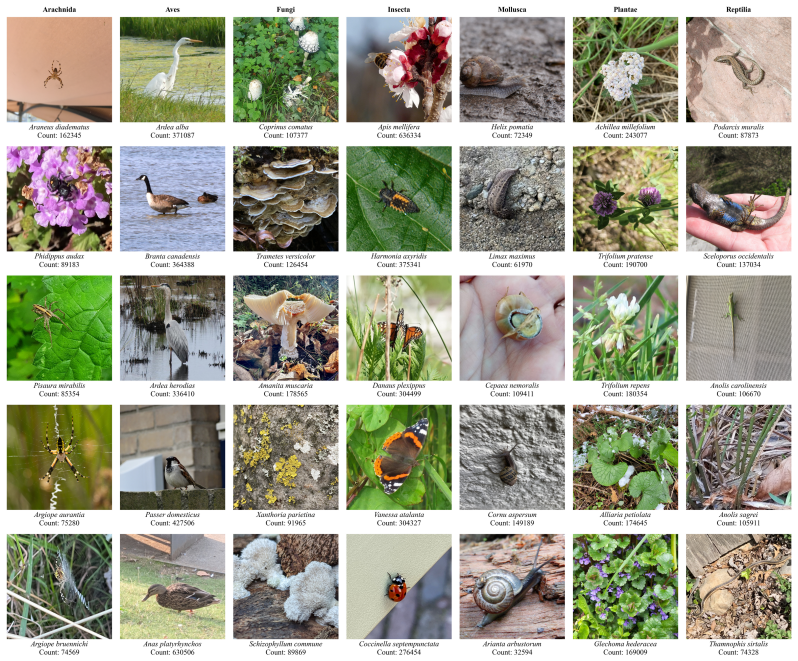
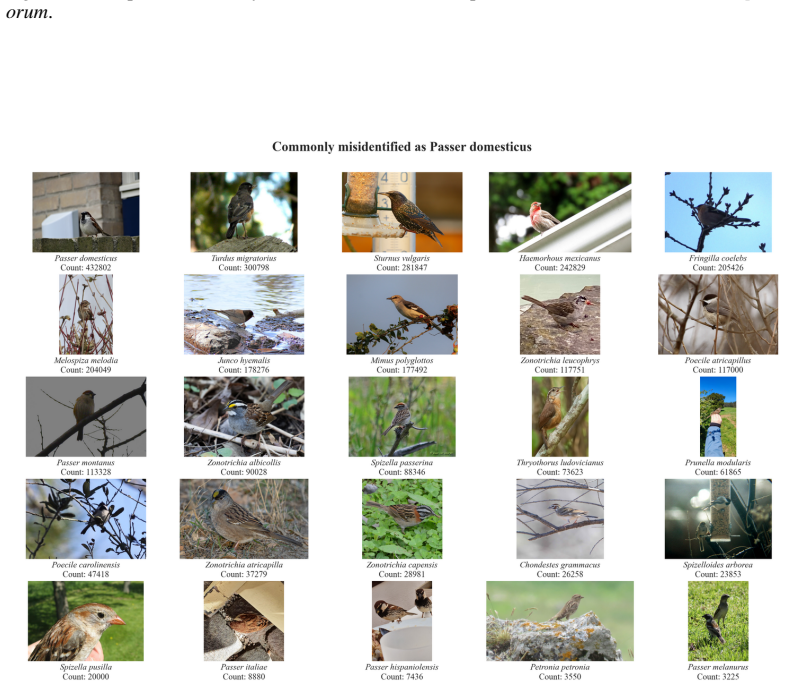
The load-bearing object is the data-driven 'cryptic group': a set of species that community annotators have historically misidentified with one another, harvested from a citizen-science platform's 'Similar Species' records and merged with research-grade occurrence data. The evaluation machinery is a zero-shot vision-language protocol that adds embeddings from a pretrained location encoder to image embeddings and measures whether classification accuracy on cryptic species improves. The cryptic group connects the dataset's scale (52,000 groups, 67,000 species, 166 million images) to a real signal of visual confusion, and the location-embedding comparison is the mechanism used to argue that multimodal context helps.
What would settle it
Take species pairs that expert taxonomists independently confirm as morphologically cryptic but that lack recorded annotation confusion on the platform, and check whether CRYPTIC BIO includes them as a group; if a substantial share are absent, the data-driven definition misses true cryptic species. Separately, compare zero-shot accuracy with and without location embeddings on cryptic groups whose member species have largely overlapping observed ranges; if the gain disappears, location is acting as a proxy for sampling and range separation rather than as genuine disambiguation.
Extended reading notes
Core claim
The central claim is that morphologically cryptic species can be captured at scale through the misidentification history of a large citizen-science community, and that doing so yields a dataset and benchmarks exposing a failure mode that broad taxonomic datasets miss. Concretely, the paper constructs groups from records in which an observation originally labeled as one species was later corrected to another, enriches each observation with a six-level taxonomy, multicultural and multilingual vernacular names, date, and geographic coordinates, and then benchmarks vision-language models in zero-shot mode with and without location embeddings. The authors report that location embeddings significantly improve top-1 zero-shot accuracy on the new cryptic benchmarks, and they release a curation pipeline so others can build custom subsets. Their stated significance is that geography, combined with pixels and text, can disambiguate species that look alike.
Load-bearing premise
The load-bearing premise is that the citizen-science platform's automated 'Similar Species' lists correctly capture which species are visually confusing; the paper itself notes these lists are community-driven, not manually curated, and can be missing for rarely observed taxa, so any blind spot there becomes a blind spot in CRYPTIC BIO.
Editorial extensions
If this is right
- Models trained or evaluated on CRYPTIC BIO are tested against the actual set of species that annotators confuse, so reported accuracy reflects misidentification difficulty rather than easy visual separation.
- Location metadata becomes a usable zero-shot signal, which matters for field-deployable identification tools that lack task-specific labeled data.
- The endangered and invasive subsets give conservation and biosecurity a concrete benchmark for the confusion cases where identification errors are costliest.
- The open-source curation pipeline lets others compose custom subsets, making the resource extensible beyond the released benchmarks.
- The finding that environmental features alone hurt accuracy warns that not every context modality helps, so multimodal designs need per-modality evaluation.
Reading between the lines
- Because cryptic groups are inferred from historical misidentifications, the dataset is biased toward commonly observed and commonly confused species; expert-recognized look-alikes that are rarely photographed will be missing, so performance on rare taxa may be lower than headline benchmarks suggest.
- The reported location benefit may partly reflect geographic separation between species rather than genuine use of range information; a test on co-occurring cryptic groups would separate these explanations.
- The multilingual and multicultural vernacular names are only benchmarked in English here, so whether they improve zero-shot identification for non-English users remains an untested consequence of the dataset design.
- The same misidentification-history construction could be applied to other citizen-science platforms or to other visually confusing object classes, yielding confusion-aware benchmarks beyond biodiversity.
Signed reviews
Editorial analysis
A structured set of objections, weighed in public.
Referee Report
Summary. CrypticBio (CRYPTIC BIO) is a dataset paper introducing, the authors claim, the largest publicly available multimodal resource of visually confusing species: over 166M images spanning 67K species organized into 52K 'cryptic groups,' curated from GBIF records of iNaturalist and Observation.org together with iNaturalist's 'Similar Species' misidentification lists. Each record is annotated with scientific and English vernacular names, a six-level taxonomic hierarchy, location, date, and similar-species group membership. The authors release the curation pipeline (CRYPTIC BIO-CURATE) and four new zero-shot benchmarks (COMMON, COMMON UNSEEN, ENDANGERED, INVASIVE) evaluated with BioCLIP, two BioTrove-CLIP variants, and TaxaBind, using image-only versus image-plus-location and image-plus-environmental embeddings. The paper's central empirical claim is that location embeddings significantly improve zero-shot classification of cryptic species (p-value < 0.05); the central dataset claim is that iNaturalist misidentification clusters define visually confusing species groups at scale.
Significance. If the claims hold, this is a substantial contribution to AI for biodiversity: it is orders of magnitude larger than existing cryptic-species datasets (Table 2), spans seven taxa rather than a single group, enriches records with spatiotemporal context and multilingual name annotations, and ships a reproducible pipeline with publicly released data. The evaluation is also largely sound in design: it uses external pretrained models in a zero-shot setting, fits no parameters on the benchmarks, and the location-gain measurement is therefore an empirical result rather than a circular derivation. These are genuine strengths that should be credited. The significance of the headline claims, however, depends on two premises the paper does not yet establish: that iNaturalist 'Similar Species' lists correspond to genuine visual crypticity rather than incidental confusability, and that the location benefit is consistent enough across models and subsets to support the abstract's 'substantial impact' wording.
major comments (4)
- [3, B.4, 5 (Limitations)] The dataset's defining premise — that a 'cryptic group' means visually near-indistinguishable species — rests entirely on iNaturalist's 'Similar Species' tab, without any validation. Section 3 describes these groups as derived from 'historical misidentifications,' and B.4 states the feature 'relies entirely on community-driven data and automated algorithms... it is not manually curated.' Section 5 concedes a recall gap ('may miss rarely observed lookalike species'), but no precision analysis is given: species may be co-listed because of shared vernacular names, similar size or season, or geographic overlap rather than morphological near-indistinguishability. Because the four benchmarks in Section 4.1 are constructed directly from these groups, the interpretation of the location gains as 'cryptic-species improvements' inherits this unvalidated premise. I ask for a precision check — for example, agreement of a random sample of groups with expert-curated cryptic complexes, including the Table 2 benchmark taxa and published cryptic-species treatments — or, failing that, re-scoping of the abstract's 'visually confusing' claim to 'commonly misidentified species.'
- [4.2, Table 4, Tables 17-19] Section 4.2's claim that 'location embeddings significantly improve model performance... (p-value < 0.05)' is not supported by the reported numbers taken as a whole. In Table 4, the location gains are +0.1 to +0.3 points for TaxaBind (with 0.0 on CB-E), +1.6 to +4.9 but −0.6 to −0.3 on CB-E for the BioTrove variants, and inconsistent on CB-E across all models; the only systematic gains are for BioTrove-CLIP-B on CB-C, CB-CU, and CB-I. No p-value is reported anywhere, and the aggregation across models, benchmarks, and classes underlying 'p-value < 0.05' is unspecified. Please report per-model, per-benchmark deltas with the McNemar statistics and multiple-comparison handling, and revise the abstract, Section 4.2, and the conclusion so that the 'substantial impact' wording is scoped to the models and subsets that actually benefit. In addition, the interpretive defense in Section 4.2 — that random sampling 'without explicit regional or taxonomic filtering' rules out spatial-bias artifacts — is under-supported, since Figure 4 shows heavy Europe/North America concentration and the COMMON benchmark is restricted to species with more than 10K observations.
- [4.1, D.2, Appendix E] The CRYPTIC BIO-COMMON UNSEEN subset (Section 4.1; D.2) is claimed to contain species 'not encountered during model training,' and Appendix E states the observations are 'entirely held out from training,' but the paper provides no verification. The 133 species are drawn from the COMMON pool of species with more than 10K observations each, i.e., species that the iNaturalist-trained evaluation models (BioTrove, BioCLIP) certainly encountered at the species level; the date window (01-09-2024 to 01-04-2025) is not shown to postdate the models' training data, and no image-level deduplication against training images is reported. Either verify non-overlap with each model's training set or re-scope the benchmark and all related statements to 'recent post-cutoff observations' without the 'unseen/held out' language.
- [4.1, D.3, D.4, Table 13] Two load-bearing details of the new benchmarks need fixing. First, Table 13 lists 'Vipera aspis vivipara' as the Reptilia selection for the ENDANGERED benchmark, but Vipera aspis is assessed as Least Concern on the IUCN Red List; the selection criterion (Section 4.1) therefore appears violated for this taxon, and the IUCN status and the associated cryptic group should be re-verified. Second, the sampling rule in Section 4.1 ('100 samples from each species in a cryptic group where there are more than 150 observations per species') does not specify how species below the threshold are handled or how the reported n per benchmark (158, 133, 37, 72) is derived from the group sizes in Tables 12-14, so the 'rigorously balance[d]' claim cannot be checked. Please state the exact inclusion/exclusion rule and report the number of dropped species per benchmark.
minor comments (7)
- [Tables 4, 17-19] The reported 95% confidence intervals are roughly twice as wide as binomial-proportion intervals for the implied per-benchmark sample sizes (e.g., CB-C, n≈15,800: ±1.61 vs ≈±0.77 expected); state the CI aggregation method or recompute the intervals.
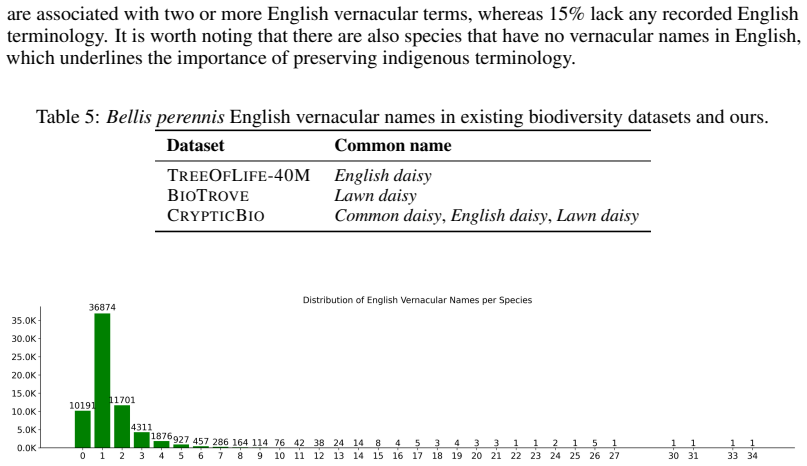
- [Abstract, Table 1, B.3] The abstract and Table 1 advertise 'multicultural and multilingual species terminology' as included annotations, but B.3 says only English vernacular names are included and other languages require running the pipeline; align these claims in the final text.
- [Throughout] Numbers are inconsistent across the paper: 166M (abstract, Section 2) vs 166.5M (Table 1) vs 166.0M (Table 11); 52K (abstract) vs 52.7K (Table 1); D.2 says '26 species less' but 158−133=25; Table 3's '627 Parquet formats' is unclear.
- [Throughout] Typos and caption errors: 'CRYPTIC BIO-ENGENDERED' (Table 4 caption, should be ENDANGERED), 'were avaiable' (Section 4.2), 'CONFOUNDING BIO' (B.1), 'relevent' and 'accoridng' (B.1), 'Santinel-2' (Table 1).
- [4.2, Tables 4, 17-19] The I+E rows show large accuracy drops relative to I alone (e.g., BT-B I+E 25.9 vs I 58.9 on CB-C), which the paper reports without comment; this undercuts the general 'context helps' narrative and should be discussed.
- [2, 5] The paper states that data and code are publicly available but provides no URLs or DOIs for the HuggingFace dataset and GitHub pipeline; stable links are essential for a dataset contribution.
- [4.2, Table 16] The exact text template for the 'scientific + vernacular' prompts is only exemplified in Table 16; since all reported accuracies depend on the template, it should be specified exactly.
Circularity Check
No significant circularity: the dataset construction and benchmark evaluation are externally grounded and do not reduce to their own inputs.
full rationale
The paper's derivation chain is empirical rather than deductive. Cryptic groups are extracted from iNaturalist's externally maintained 'Similar Species' lists, and no fitted parameter is later renamed as a prediction. The benchmark evaluations use external pretrained models (BioCLIP, BioTrove, TaxaBind) on held-out or newly curated subsets, and the location embeddings are not trained on CrypticBio labels. The reported accuracy gain from adding location embeddings is a measured comparison, not a quantity forced by construction. The closest self-referential aspect is that both the research-grade observation labels and the cryptic-group definitions arise from the same iNaturalist community ecosystem; however, the paper explicitly discloses this in its limitations ('data-driven identification of cryptic groups may miss rarely observed lookalike species') and treats it as a construct-validity caveat, not as a derivation step. No equation, fitted value, or self-citation chain is reused as evidence for the central claims, so the analysis is self-contained against external benchmarks and warrants a score of 0.
Assumptions & free parameters
assumptions (4)
- domain assumption iNaturalist 'Similar Species' entries define the ground-truth cryptic species groups used throughout the dataset and benchmarks.
- domain assumption Research-grade labels from iNaturalist and Observation.org are reliable enough to serve as ground-truth species identity.
- domain assumption Observations dated 01-09-2024 to 01-04-2025 are absent from the training data of BioCLIP, BioTrove, and TaxaBind, making the 'unseen' benchmark genuinely unseen.
- domain assumption Randomly sampling 100 images per species from species with at least 150 observations yields representative and statistically adequate benchmark subsets.
Cite this review
Pith. "Pith review of CrypticBio: A Large Multimodal Dataset for Visually Confusing Biodiversity." pith.science (2026). https://pith.science/paper/D2QUJRPS
@misc{pith2026250514707,
  author       = {Pith},
  title        = {Pith review of: CrypticBio: A Large Multimodal Dataset for Visually Confusing Biodiversity},
  year         = {2026},
  howpublished = {\url{https://pith.science/paper/D2QUJRPS}},
  note         = {Machine review of arXiv:2505.14707}
}
read the original abstract
We present CrypticBio, the largest publicly available multimodal dataset of visually confusing species, specifically curated to support the development of AI models in the context of biodiversity applications. Visually confusing or cryptic species are groups of two or more taxa that are nearly indistinguishable based on visual characteristics alone. While much existing work addresses taxonomic identification in a broad sense, datasets that directly address the morphological confusion of cryptic species are small, manually curated, and target only a single taxon. Thus, the challenge of identifying such subtle differences in a wide range of taxa remains unaddressed. Curated from real-world trends in species misidentification among community annotators of iNaturalist, CrypticBio contains 52K unique cryptic groups spanning 67K species, represented in 166 million images. Rich research-grade image annotations--including scientific, multicultural, and multilingual species terminology, hierarchical taxonomy, spatiotemporal context, and associated cryptic groups--address multimodal AI in biodiversity research. For easy dataset curation, we provide an open-source pipeline CrypticBio-Curate. The multimodal nature of the dataset beyond vision-language arises from the integration of geographical and temporal data as complementary cues to identifying cryptic species. To highlight the importance of the dataset, we benchmark a suite of state-of-the-art foundation models across CrypticBio subsets of common, unseen, endangered, and invasive species, and demonstrate the substantial impact of geographical context on vision-language zero-shot learning for cryptic species. By introducing CrypticBio, we aim to catalyze progress toward real-world-ready biodiversity AI models capable of handling the nuanced challenges of species ambiguity.
Figures


Figures from the paper (17 more)






Reference graph
Works this paper leans on
-
[1]
Bioclip: A vision foundation model for the tree of life
Stevens, Samuel, Wu, Jiaman, Thompson, Matthew J, Campolongo, Elizabeth G, Song, Chan Hee, Carlyn, David Edward, Dong, Li, Dahdul, Wasila M, Stewart, Charles, Berger-Wolf, Tanya, others. Bioclip: A vision foundation model for the tree of life. Proceedings of the IEEE/CVF Conference on Computer Vision and Pattern Recognition, 19412–19424, 2024
work page 2024
-
[2]
BioTrove: A Large Curated Image Dataset Enabling AI for Biodiversity
Yang, Chih-Hsuan, Feuer, Benjamin, Jubery, Talukder, Deng, Zi, Nakkab, Andre, Hasan, Md Zahid, Chiranjeevi, Shivani, Marshall, Kelly, Baishnab, Nirmal, Singh, Asheesh, others. BioTrove: A Large Curated Image Dataset Enabling AI for Biodiversity. Advances in Neural Information Processing Systems, 37, 102101–102120, 2024
work page 2024
-
[3]
TaxaBind: A Unified Embedding Space for Ecological Applications
Sastry, Srikumar, Khanal, Subash, Dhakal, Aayush, Ahmad, Adeel, Jacobs, Nathan. TaxaBind: A unified embedding space for ecological applications. arXiv preprint arXiv:2411.00683, 2024
work page Pith review arXiv 2024
-
[4]
iNaturalist. https://www.inaturalist.org/. Accessed via inaturalist.org on 2025-03-26, 2025
work page 2025
-
[5]
Observation.org, Nature data from around the World
Observation.org. Observation.org, Nature data from around the World. Occurrence dataset. https://doi.org/10.15468/5nilie, 2025
doi:10.15468/5nilie 2025
-
[6]
Deep learning powered real-time identification of insects using citizen science data
Chiranjeevi, Shivani, Sadaati, Mojdeh, Deng, Zi K, Koushik, Jayanth, Jubery, Talukder Z, Mueller, Daren, Neal, Matthew EO, Merchant, Nirav, Singh, Aarti, Singh, Asheesh K, others. Deep learning powered real-time identification of insects using citizen science data. arXiv preprint arXiv:2306.02507, 2023
arXiv 2023
-
[7]
Global Biodiversity Information Facility
GBIF.org. Global Biodiversity Information Facility. https://www.gbif.org, 2025
work page 2025
-
[8]
A step towards worldwide biodiversity assessment: The BIOSCAN-1M insect dataset
Gharaee, Zahra, Gong, ZeMing, Pellegrino, Nicholas, Zarubiieva, Iuliia, Haurum, Joakim Bruslund, Lowe, Scott, McKeown, Jaclyn, Ho, Chris, McLeod, Joschka, Wei, Yi-Yun, others. A step towards worldwide biodiversity assessment: The BIOSCAN-1M insect dataset. Advances in Neural Information Processing Systems, 36, 43593–43619, 2023
work page 2023
Show all 46 references
-
[9]
WorldClim 2: new 1-km spatial resolution climate surfaces for global land areas
Fick, Stephen E, Hijmans, Robert J. WorldClim 2: new 1-km spatial resolution climate surfaces for global land areas. International Journal of Climatology, 37(12), 4302–4315, 2017
2017
-
[10]
Identification of morphologically cryptic species with computer vision models: wall lizards (Squamata: Lacertidae: Podarcis) as a case study
Pinho, Catarina, Kaliontzopoulou, Antigoni, Ferreira, Carlos A, Gama, João. Identification of morphologically cryptic species with computer vision models: wall lizards (Squamata: Lacertidae: Podarcis) as a case study. Zoological Journal of the Linnean Society, 198(1), 184–201, 2022
2022
-
[11]
Cryptic species conservation: a review
Hending, Daniel. Cryptic species conservation: a review. Biological Reviews, 100(1), 258–274, 2025
2025
-
[12]
Observation Accuracy Experiment v0.4: Research Grade Results
iNaturalist. Observation Accuracy Experiment v0.4: Research Grade Results. https://www.inaturalist.org/observation_accuracy_experiments/5?tab= research_grade_results, 2024
2024
-
[13]
Validation
Observation.org. Validation. https://observation.org/pages/validation/, 2025
2025
-
[14]
Getting Started Guide
Observation International. Getting Started Guide. https://observation.org/pages/getting-started/, 2025
2025
-
[15]
Getting Started Guide
Observation.org. Getting Started Guide. https://observation.org/pages/getting-started/, 2025
2025
-
[16]
What is geoprivacy? What does it mean for an observation to be obscured?
iNaturalist. What is geoprivacy? What does it mean for an observation to be obscured?. https://shorturl.at/kCnM2, 2025
2025
-
[17]
iNaturalist Taxonomy Archive (Darwin Core Archive)
iNaturalist. iNaturalist Taxonomy Archive (Darwin Core Archive). https://www.inaturalist.org/taxa/inaturalist-taxonomy.dwca.zip, 2025
2025
-
[18]
The Global Invasive Species Database
Global Invasive Species Database (GISD). The Global Invasive Species Database. https://www.iucngisd.org/gisd, 2015. 10
2015
-
[19]
Invasive alien species records are exponentially rising across the Earth
Mormul, Roger Paulo, Vieira, Denner Serafim, Bailly, Dayani, Fidanza, Karina, da Silva, Valéria Flávia Batista, da Graça, Weferson Júnior, Pontara, Vanessa, Bueno, Marcelo Leandro, Thomaz, Sidinei Magela, Mendes, Renio Santos. Invasive alien species records are exponentially r...
2022
-
[20]
Fine-grained image classification on bats using VGG16-CBAM: a practical example with 7 horseshoe bats taxa (CHIROPTERA: Rhinolophidae: Rhinolophus) from Southern China
Cao, Zhong, Wang, Kunhui, Wen, Jiawei, Li, Chuxian, Wu, Yi, Wang, Xiaoyun, Yu, Wenhua. Fine-grained image classification on bats using VGG16-CBAM: a practical example with 7 horseshoe bats taxa (CHIROPTERA: Rhinolophidae: Rhinolophus) from Southern China. Frontiers in Zoology,...
2024
-
[21]
Assessing the potential for deep learning and computer vision to identify bumble bee species from images
Spiesman, Brian J, Gratton, Claudio, Hatfield, Richard G, Hsu, William H, Jepsen, Sarina, McCornack, Brian, Patel, Krushi, Wang, Guanghui. Assessing the potential for deep learning and computer vision to identify bumble bee species from images. Scientific Reports, 11(1), 7580, 2021
2021
-
[22]
Xerces Society - Bumble Bee Watch
Hatfield, Rich, Kerr, Jeremy, Larrivée, Max. Xerces Society - Bumble Bee Watch. https://doi.org/10.15468/t4rau8, 2024
2024 doi
-
[23]
BugGuide.Net: Identification, Images, & Information for Insects, Spiders & Their Kin for the United States & Canada
BugGuide.Net contributors. BugGuide.Net: Identification, Images, & Information for Insects, Spiders & Their Kin for the United States & Canada. https://bugguide.net/node/view/15740, 2025
2025
-
[24]
Hierarchical image classification using transfer learning to improve deep learning model performance for amazon parrots
Kim, Jung-Il, Baek, Jong-Won, Kim, Chang-Bae. Hierarchical image classification using transfer learning to improve deep learning model performance for amazon parrots. Scientific Reports, 15(1), 3790, 2025
2025
-
[25]
eBird: An online database of bird distribution and abundance
eBird. eBird: An online database of bird distribution and abundance. https://www.ebird.org, 2021
2021
-
[26]
Deep learning-based image classification of sea turtles using object detection and instance segmentation models
Baek, Jong-Won, Kim, Jung-Il, Kim, Chang-Bae. Deep learning-based image classification of sea turtles using object detection and instance segmentation models. PloS One, 19(11), e0313323, 2024
2024
-
[27]
Spatial Implicit Neural Representations for Global- Scale Species Mapping
Cole, Elijah, Horn, Grant Van, Lange, Christian, Shepard, Alexander, Leary, Patrick, Perona, Pietro, Loarie, Scott, Mac Aodha, Oisin. Spatial Implicit Neural Representations for Global- Scale Species Mapping. Proceedings of the 40th International Conference on Machine Learning...
2023
-
[28]
Metaformer: A unified meta framework for fine-grained recognition
Diao, Qishuai, Jiang, Yi, Wen, Bin, Sun, Jia, Yuan, Zehuan. Metaformer: A unified meta framework for fine-grained recognition. arXiv preprint arXiv:2203.02751, 2022
2022 arXiv
-
[29]
Ld-sdm: Language-driven hierarchical species distribution modeling
Sastry, Srikumar, Xing, Xin, Dhakal, Aayush, Khanal, Subash, Ahmad, Adeel, Jacobs, Nathan. Ld-sdm: Language-driven hierarchical species distribution modeling. arXiv preprint arXiv:2312.08334, 2023
2023 arXiv
-
[30]
Geographic variation in sexual selection and implications for speciation in the Barn Swallow
Scordato, Elizabeth SC, Safran, Rebecca J. Geographic variation in sexual selection and implications for speciation in the Barn Swallow. Avian Research, 5, 1–13, 2014
2014
-
[31]
Imagebind: One embedding space to bind them all
Girdhar, Rohit, El-Nouby, Alaaeldin, Liu, Zhuang, Singh, Mannat, Alwala, Kalyan Vasudev, Joulin, Armand, Misra, Ishan. Imagebind: One embedding space to bind them all. Proceedings of the IEEE/CVF Conference on Computer Vision and Pattern Recognition, 15180–15190, 2023
2023
-
[32]
Calidris pygmaea
BirdLife International. Calidris pygmaea. The IUCN Red List of Threatened Species 2020: e.T22693452A154738156. https://www.iucnredlist.org/species/22693452/ 154738156, 2021
2020
-
[33]
100 of the World’s Worst Invasive Alien Species: A Selection from the Global Invasive Species Database
Lowe, S., Browne, M., Boudjelas, S., De Poorter, M.. 100 of the World’s Worst Invasive Alien Species: A Selection from the Global Invasive Species Database. https://www.iucngisd. org/gisd/100_worst.php, 2013
2013
-
[34]
International Code of Zoological Nomenclature
International Commission on Zoological Nomenclature. International Code of Zoological Nomenclature. International Trust for Zoological Nomenclature, London, 1999. 11
1999
-
[35]
Insects as food and medicine: a sustainable solution for global health and environmental challenges
Aidoo, Owusu Fordjour, Osei-Owusu, Jonathan, Asante, Kwasi, Dofuor, Aboagye Kwarteng, Boateng, Belinda Obenewa, Debrah, Shadrack Kwaku, Ninsin, Kodwo Dadzie, Siddiqui, Shahida Anusha, Chia, Shaphan Yong. Insects as food and medicine: a sustainable solution for global health an...
2023
-
[36]
Geoclip: Clip-inspired alignment between locations and images for effective worldwide geo-localization
Vivanco Cepeda, Vicente, Nayak, Gaurav Kumar, Shah, Mubarak. Geoclip: Clip-inspired alignment between locations and images for effective worldwide geo-localization. Advances in Neural Information Processing Systems, 36, 8690–8701, 2023
2023
-
[37]
GBIF Backbone Taxonomy
GBIF Secretariat. GBIF Backbone Taxonomy. Checklist dataset. https://doi.org/10. 15468/39omei. Accessed on 24 January 2025, 2023
2025
-
[38]
Bugs in the data: How ImageNet misrepresents biodiversity
Luccioni, Alexandra Sasha, Rolnick, David. Bugs in the data: How ImageNet misrepresents biodiversity. Proceedings of the AAAI Conference on Artificial Intelligence, 37(12), 14382– 14390, 2023
2023
-
[39]
Observation Accuracy Experiment v0.4: Research Grade Results
iNaturalist. Observation Accuracy Experiment v0.4: Research Grade Results. https://www.inaturalist.org/observation_accuracy_experiments/5?tab= research_grade_results. Accessed: 2025-04-13, 2024
2025
-
[40]
Validation
Observation.org. Validation. https://observation.org/pages/validation/. Accessed: 2025-04-13, 2025
2025
-
[41]
Encyclopedia of Life
Encyclopedia of Life. Encyclopedia of Life. https://eol.org. Accessed: 2025-02-29, 2025
2025
-
[42]
S2Maps – Sentinel-2 Cloudless Maps
Copernicus Global Land Service. S2Maps – Sentinel-2 Cloudless Maps. https://s2maps.eu. Accessed: 2025-02-29, 2023
2025
-
[43]
Benchmarking representation learning for natural world image collections
Van Horn, Grant, Cole, Elijah, Beery, Sara, Wilber, Kimberly, Belongie, Serge, Mac Aodha, Oisin. Benchmarking representation learning for natural world image collections. Proceedings of the IEEE/CVF Conference on Computer Vision and Pattern Recognition, 12884–12893, 2021
2021
-
[44]
Explanation NIA
Observation.org. Explanation NIA. https://observation.org/pages/nia-explain. Ac- cessed on 24 January 2025, 2025
2025
-
[45]
What is the data quality assessment and how do observations qualify to become research-grade? https://shorturl.at/QqUCk
iNaturalist. What is the data quality assessment and how do observations qualify to become research-grade? https://shorturl.at/QqUCk. Accessed on 2025-01-20, 2025
2025
-
[46]
Similar Species
IUCN. The IUCN Red List of Threatened Species. https://www.iucnredlist.org. Ac- cessed on 2025-03-13, 2024. Version 2024-2. 12 A Ethics statement A.1 Taxon selection We select seven most representative taxa in biodiversity conservation and policy change supervision: Arachnida,...
2025
Reviewed August 15, 2026 · model on record in the stance chip above.
Discussion (0). Continue with ORCID to comment.