REVIEW 4 major objections 7 minor 1 cited by
MAATS: A Multi-Agent Automated Translation System Based on MQM Evaluation
T0 review · 4 major / 7 minor · reviewed 2026-08-07 · deepseek-v4-flash
Pith's one-line read MAATS: seven specialized MQM agents beat one self-correcting LLM translator.
desk verdict Promising multi-agent MQM translation system, but compute-matched baselines and honest human-eval reporting are needed before the causal claims hold. read the letter →
The pith
A machine-rendered reading of the paper's core claim, the machinery that carries it, and where it could break.
The reading
What carries the argument
The load-bearing mechanism is the MQM taxonomy turned into a role-division scheme. Seven evaluator agents are each given one MQM category and a few-shot prompt that defines error subtypes and severity levels, and they independently return structured annotations. A single Editor agent then receives all annotations and revises the translation, applying a fixed priority rule: critical corrections first, major before minor, and no explanatory text in the final sentence. This machinery forces errors to be considered from separate perspectives, so an omission can be flagged by Accuracy, Terminology, and Style at once, while the editor's conflict-resolution rule keeps the final output a single coherent sentence. The paper credits the modular MQM-aligned roles, not just additional inference, for the observed improvement.
What would settle it
Run the single-agent baseline through multiple self-refinement rounds so it uses a comparable number of LLM calls per sentence as MAATS, then compare COMET, BLEURT, and human rankings on the same test sets. If the budget-matched single agent matches or beats MAATS, the improvement cannot be credited to the MQM multi-agent design.
Extended reading notes
Core claim
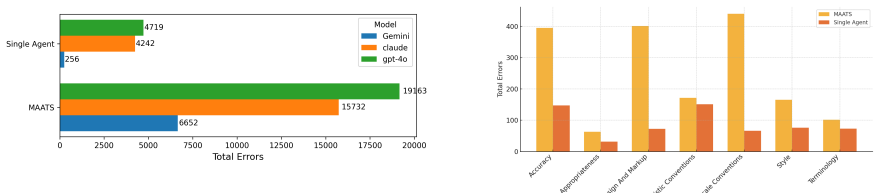
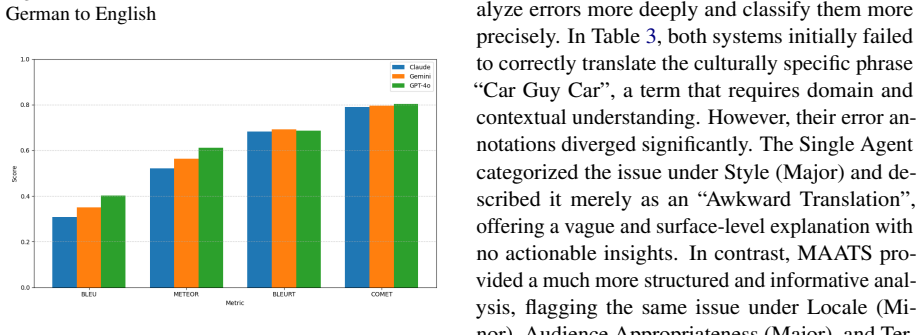
On the paper's own terms, MAATS's core discovery is that MQM-category specialization is what unlocks better refinements: each evaluator agent sees only one slice of the error space, so the same base model, prompted separately as Accuracy, Fluency, Style, Terminology, Locale Convention, Audience Appropriateness, and Design and Markup agents, finds roughly 450% more translation issues than a single self-refinement agent, and the Editor agent's severity-priority rule converts those annotations into a corrected sentence. Across three base LLMs and eleven translation directions, MAATS achieves higher BLEU, METEOR, BLEURT, and COMET scores than both baselines, with significance concentrated in the neural metrics; a confusion-matrix comparison against human MQM labels shows more true positives and fewer false negatives, especially for Accuracy; and professional translators ranked MAATS first in an English-to-Chinese preference test. The paper reads these results as evidence that black-box LLM translation can be steered toward semantic and contextual fidelity rather than surface fluency by mirroring the roles of a human translation team.
Load-bearing premise
The load-bearing premise is that the single-agent baseline is a fair comparison: it runs one self-refinement pass, while MAATS runs seven evaluator agents plus an editor, and the paper assumes those extra inference passes and the per-category division of labor do not by themselves explain the gains.
Editorial extensions
If this is right
- MAATS is an inference-time architecture: with the same base LLM, users can get better translations by replacing one self-refinement pass with seven MQM-category evaluators plus an editor.
- Because statistical significance is strongest for COMET and BLEURT and for distant language pairs, MAATS is most valuable where semantic fidelity matters and where single agents struggle most.
- The MQM-aligned annotations make the refinement process auditable: each change can be traced to a category and severity, which supports translator review and quality-control workflows.
- The paper demonstrates the architecture on eleven translation directions and three base LLMs, indicating that the gain is not tied to one model or one language pair.
Reading between the lines
- Inference: the current comparison conflates architecture with inference budget, since the single-agent baseline runs one self-refinement pass while MAATS runs seven evaluator agents plus an editor; a budget-matched single-agent ablation is the natural next experiment and would tighten the causal claim.
- Inference: the paper's own limitation section shows MQM lacks dimensions for emotional tone, irony, and rhetorical structure; adding an affective or discourse-level agent is a testable extension that could address the 'literature class hatred' failure the paper reports.
- Inference: if the gain comes from independent error perspectives, the architecture should transfer to other generation tasks with structured quality dimensions, such as summarization or code review, where an editor can merge category-specific critiques.
Signed reviews
Editorial analysis
A structured set of objections, weighed in public.
Referee Report
Summary. This manuscript introduces MAATS, a multi-agent translation refinement system in which a translator agent produces an initial translation, seven specialized agents annotate errors using MQM categories, and an editor agent produces a final revision. The authors evaluate MAATS against zero-shot and single-agent self-refinement baselines across three LLMs and eleven English/other language directions using BLEU, METEOR, BLEURT, and COMET, a confusion-matrix comparison with human MQM annotations, a small human preference ranking for English-to-Chinese, and qualitative case studies. The central claim is that the MQM-decomposed multi-agent architecture yields consistent, statistically significant translation-quality gains over single-agent self-correction.
Significance. The paper is potentially useful: it releases code and data, documents all prompts in appendices, and the qualitative case studies are instructive. The MQM-decomposed evaluation idea is a sensible and interpretable way to structure LLM-based translation refinement, and the limitation section honestly acknowledges dimensions such as tone, irony, and stance that the MQM taxonomy does not cover. However, the evidence for the central causal claim is currently incomplete: the single-agent baseline is not matched in inference budget, the human preference results are below chance for two of three models, and the significance claims in the abstract exceed what Table 2 and Figure 5 show. With a compute-matched baseline and corrected statistical reporting, the architecture claim could become solid.
major comments (4)
- [Appendix A and Section 2.3] The single-agent baseline performs one self-refinement pass (initial translation plus one review/refine, roughly two LLM calls per sentence), while MAATS uses a translator, seven MQM evaluators, and an editor (roughly nine calls). The appendix calls the baseline 'essentially an ablated version of MAATS,' but this comparison removes both the MQM decomposition and most of the inference budget simultaneously. Since the abstract credits the gains to the 'modular agent roles' and the MQM framework, a budget-matched baseline (e.g., a single agent given an equal number of self-refinement passes or an equal token budget) is required to rule out 'more refinement helps' as the explanation for the automatic-metric improvements in Table 2 and Figure 2. This missing control is load-bearing for the title claim.
- [Section 3, Figure 5 and Appendix C] The abstract states MAATS achieves 'statistically significant gains in both automatic metrics and human assessments,' but the reported human win rates against the single-agent baseline are 62.1% for GPT-4o, 48.3% for Claude-3-haiku, and 49.2% for Gemini-2.0-flash. Two of the three rates are below chance, no significance test or confidence interval is reported, and the Borda-count aggregation over three annotators does not by itself support significance. The sentence 'MAATS consistently outperformed both baselines' in the human-evaluation paragraph is therefore not supported by the data; the claim should be limited to GPT-4o or re-analyzed with per-sentence bootstrap or sign tests.
- [Section 3, Table 2] The paper's own pairwise significance table shows many language/model combinations with no significant gains on any metric (e.g., Gemini EN_DE 0/4, Claude RU_EN 1/4) and several with only BLEU significance, so the unqualified 'statistically significant gains' in the abstract is broader than the evidence. The aggregate claim should be conditioned on model, language direction, and metric, and the manuscript should report the bootstrap confidence intervals or effect sizes that underlie the summaries in Figures 10-12.
- [Section 3, Table 1 and Appendix H] The confusion-matrix evaluation compares MAATS's error annotations with human MQM labels using the same MQM taxonomy and severity definitions that MAATS's evaluator prompts embed. This creates a partial circularity: higher true-positive and lower false-negative counts relative to the single-agent baseline may reflect that MAATS is explicitly prompted to emit that label inventory. The claim that MAATS is 'better at error detection' should be restated as 'better at reproducing MQM-format annotations,' and should be supplemented by an evaluation not built on the same taxonomy (e.g., direct human quality judgments on the same outputs) or by reporting the severity and false-positive distribution that the authors acknowledge.
minor comments (7)
- [Figure 1 caption] The caption contains the typo 'Zeor-Shot'; it should read 'Zero-Shot.'
- [Section 2.3 and Appendix D] The text uses 'ANOV A' in several places; this should be 'ANOVA.'
- [Figure 2 caption] The caption says 'Full-scale versions see Table 16,' but the full-scale versions are shown in Figure 16; there is no Table 16.
- [Section 3] The claim of 'an increase about 450%' is arithmetically incorrect: 41,547 divided by 9,217 is approximately 4.51, which is a roughly 351% increase, not 450%.
- [Appendix H] The prompt templates contain inconsistent placeholders, such as the Style prompt using '[style]' instead of severity labels, and several templates say 'If doesn't exit' instead of 'If doesn't exist.' These should be harmonized.
- [Throughout] The manuscript alternates between 'Locale Convention' and 'Locale Conventions' and between 'Audience Appropriateness' and 'Audience Appropriate'; the terminology should be made consistent.
- [Appendix C] The appendix says each annotator evaluated approximately 150 samples per LLM system; it should specify whether the three annotators evaluated the same or disjoint sentences, since this affects how Borda scores aggregate and whether inter-annotator agreement can be reported.
Circularity Check
No significant circularity: MAATS's gains are evaluated against external benchmarks and human judgments, not reduced to its own inputs or fitted parameters.
full rationale
The paper's central claim is that a multi-agent architecture using MQM-category evaluators plus an editor improves translation quality over zero-shot and single-agent self-refinement. I inspected the derivation chain for circular reductions. The MQM framework is adopted from external sources (Unbabel's Typology 3.0 and Lommel et al. 2024), not from the authors' prior work, and no self-citation is load-bearing. The system is not trained on human MQM labels; the MAATS evaluator prompts are fixed few-shot prompts, and the human MQM reference data are independently produced. Therefore the confusion-matrix comparison measures empirical agreement between MAATS-generated annotations and human annotations under a shared taxonomy, rather than equality by construction. The human preference ranking is performed by three professional translators using MQM criteria, which is a legitimate external evaluation even though MAATS was designed around MQM categories; the outcome is not logically forced. The difference in the number of LLM inference passes between MAATS and the single-agent baseline is a real experimental confound, but it is a limitation in attribution, not a circular derivation: the paper does not define MAATS's performance in terms of the baseline, nor fit parameters to the test data. No quoted equation or definition reduces a claimed result to its input. Accordingly, the appropriate finding is no significant circularity.
Assumptions & free parameters
free parameters (3)
- LLM sampling temperature =
0 to 0.3
- Single-agent refinement rounds =
1 pass
- Test subset size =
about 200 sentences per direction
assumptions (4)
- domain assumption The MQM taxonomy is an adequate error space for driving and evaluating translation quality.
- domain assumption Automatic metrics (BLEU, METEOR, BLEURT, COMET) are valid proxies for translation quality at roughly 200 sentences per direction.
- domain assumption The human-labeled MQM reference data used for the confusion matrices are independent and matched across systems.
- standard math Standard assumptions of ANOVA and paired bootstrap resampling hold across the many comparisons.
Cite this review
Pith. "Pith review of MAATS: A Multi-Agent Automated Translation System Based on MQM Evaluation." pith.science (2026). https://pith.science/paper/JL5ZCDCA
@misc{pith2026250514848,
  author       = {Pith},
  title        = {Pith review of: MAATS: A Multi-Agent Automated Translation System Based on MQM Evaluation},
  year         = {2026},
  howpublished = {\url{https://pith.science/paper/JL5ZCDCA}},
  note         = {Machine review of arXiv:2505.14848}
}
read the original abstract
We present MAATS, a Multi Agent Automated Translation System that leverages the Multidimensional Quality Metrics (MQM) framework as a fine-grained signal for error detection and refinement. MAATS employs multiple specialized AI agents, each focused on a distinct MQM category (e.g., Accuracy, Fluency, Style, Terminology), followed by a synthesis agent that integrates the annotations to iteratively refine translations. This design contrasts with conventional single-agent methods that rely on self-correction. Evaluated across diverse language pairs and Large Language Models (LLMs), MAATS outperforms zero-shot and single-agent baselines with statistically significant gains in both automatic metrics and human assessments. It excels particularly in semantic accuracy, locale adaptation, and linguistically distant language pairs. Qualitative analysis highlights its strengths in multi-layered error diagnosis, omission detection across perspectives, and context-aware refinement. By aligning modular agent roles with interpretable MQM dimensions, MAATS narrows the gap between black-box LLMs and human translation workflows, shifting focus from surface fluency to deeper semantic and contextual fidelity.
Figures


Figures from the paper (10 more)




Forward citations
Cited by 1 Pith paper
-
Building Large-Scale English-Romanian Literary Translation Resources with Open Models
LoRA-fine-tuning a 12B open model on 15,000 GPT-o3 fable translations yields rubric scores close to GPT-o3 (4.83 vs 4.92) for English-to-Romanian literary translation at roughly one percent of the API cost.
Reference graph
Works this paper leans on
-
[1]
Addition: Extra words are added that are not in the source and do not improve meaning
-
[2]
Mistranslation: The meaning is incorrectly conveyed due to wrong word choice or unnatural phrasing, even if grammatically fine
-
[3]
MT Hallucination: The translation is fluent but entirely unrelated to the source (e.g., invented or repeated content)
-
[4]
Omission: Important content from the source is missing, affecting meaning
-
[5]
Untranslated: Source text appears in the target without translation (except named entities)
-
[6]
Wrong Named Entity: Errors in proper names or entities (e.g., spelling, translation, or form issues). Error Severity Levels: – Critical: Inhibits comprehension of the text. – Major: Disrupts the flow of the text but the intended meaning remains understandable. – Minor: Technical errors that do not significantly hinder comprehension. Example Source (Englis...
-
[7]
Wi-Fi” includes an unnecessary hyphen in Spanish; the correct spelling is “Wifi
Word Order: Words appear in an unnatural or incorrect sequence, affecting sentence flow or clarity. Severity Levels Critical: Severely disrupts comprehension; the sentence may become unreadable or misleading. Major: Breaks the grammatical flow or makes reading difficult, but the general meaning is still clear. Minor: Small errors (e.g., typos or punctuati...
-
[8]
Culture-Specific Reference: A metaphor, idiom, term, or expression is used that does not fit the audience’s cultural context, making the message unclear or inappropriate
Show all 30 references
-
[9]
お客様ごとに担当者 が異なりますので
Wrong Language Variety: The translation uses a different regional dialect, spelling, or phrasing than what the audience expects (e.g., UK English instead of US English). Severity Levels Critical: Severely hinders understanding or creates major cultural offense or disconnect. M...
-
[10]
they was
Agreement: Issues where words do not agree in gender, number, case, or person (e.g., “they was” instead of “they were”)
-
[11]
internet
Capitalization: Incorrect use of upper- or lowercase letters (e.g., “internet” vs. “Internet,” or “hello” at the start of a sentence)
-
[12]
He go to school
Grammar: Problems with morphology or syntax such as verb tense, word form, or function words (e.g., “He go to school” instead of “He goes to school”)
-
[13]
Punctuation: Misuse or omission of punctuation marks, including missing closing quotation marks, incorrect sentence endings, or replacing a colon with a comma
-
[14]
co-operate
Spelling: Misspelled words, missing accents or diacritics, or incorrect hyphenation within a word (e.g., “co-operate” vs. “cooperate”)
-
[15]
in credible
Whitespace: Extra or missing spaces between words or characters (e.g., “in credible” instead of “incredible”; “nextto” instead of “next to”)
-
[17]
Address Format: The structure of an address does not follow the local convention (e.g., writing city before postal code in a region where the reverse is standard)
-
[18]
$100” instead of “100C
Currency Format: Currency symbols, abbreviations, or placement are incorrect (e.g., using “$100” instead of “100C” for European locales)
-
[19]
03/04/2023
Date/Time Format: Date or time expressions do not align with the regional norm (e.g., “03/04/2023” for UK should mean 3 April, not March 4)
2023
-
[20]
5ft” instead of “1.52m
Measurement Format: Use of measurement units (e.g., inches, meters, grams) that are inappropriate for the locale or formatted incorrectly (e.g., “5ft” instead of “1.52m”)
-
[21]
1,000.00
Number Format: Digits, separators, or groupings deviate from locale rules (e.g., “1,000.00” in US vs. “1.000,00” in many EU countries)
-
[22]
04/03/2023
Telephone Format: Phone numbers do not follow regional presentation (e.g., missing country code or incorrect spacing). Example Source (Chinese): 活动时间:2023年4月3日 Target (English): Event date: 04/03/2023 Locale: United Kingdom MQM annotations: critical: locale_conventions/date_ti...
2023
-
[23]
Company Style: The translation fails to comply with company or client-specific guidelines (e.g., using passive voice where active is required)
-
[24]
Do Not Translate: A phrase or brand name was translated even though it should have been left in the original language, per client instructions
-
[25]
Sign in” and “Log in
Inconsistency: Key terms, expressions, or stylistic choices are not used consistently throughout the content (e.g., switching between “Sign in” and “Log in”)
-
[26]
Lacks Creativity: The translation is correct but lacks variation, nuance, or marketing appeal expected by the client, especially in creative or promotional content
-
[27]
Register: The formality level is inappropriate for the context (e.g., too casual in a legal document or too formal in a gaming app)
-
[28]
Severity Levels Critical: Severely affects readability or makes the tone completely inappropriate or confusing
Unnatural Flow: The translation sounds robotic, stilted, or too close to the source structure, making it awkward in the target language. Severity Levels Critical: Severely affects readability or makes the tone completely inappropriate or confusing. Major: Clearly disrupts the ...
-
[29]
Term Not Applied: A required glossary term was not used; a different or incorrect term was inserted instead, violating glossary rules
-
[30]
серийный номер
Wrong Term: The glossary term appears but is used incorrectly in context—this includes typos, capitalization issues, plural/singular mismatches, or improper grammatical inflection. Severity Levels Critical: Glossary misuse leads to confusion, misinterpretation, or disrupts key...
-
[2020]
Please review your trans- lation above. Identify any errors or improvements and then provide a corrected translation
Bleurt: Learning robust metrics for text gener- ation. In Proceedings of the 58th Annual Meeting of the Association for Computational Linguistics, pages 7881–7892. Minghao Wu, Yulin Yuan, Gholamreza Haffari, and Longyue Wang. 2024. (perhaps) beyond human translation: Harnessin...
2024
Reviewed August 7, 2026 · model on record in the stance chip above.
Discussion (0). Continue with ORCID to comment.