REVIEW 2 major objections 6 minor 3 cited by
The Long Road to Alignment: Measuring Black Hole Spin Orientation with Expanding Gravitational-Wave Datasets
T0 review · 2 major / 6 minor · reviewed 2026-08-07 · deepseek-v4-flash
Pith's one-line read With simulated catalogs as large as 1500 binary black holes, the paper argues that the spin-tilt distribution's peak at alignment cannot be definitively established, while integrated measures such as the fraction of nearly aligned or…
desk verdict A careful, useful forecasting study that makes a solid case for measuring integrated tilt fractions, while its headline claim about the difficulty of finding an alignment peak is conditional on the assumed broad aligned component. read the letter →
The pith
A machine-rendered reading of the paper's core claim, the machinery that carries it, and where it could break.
The reading
What carries the argument
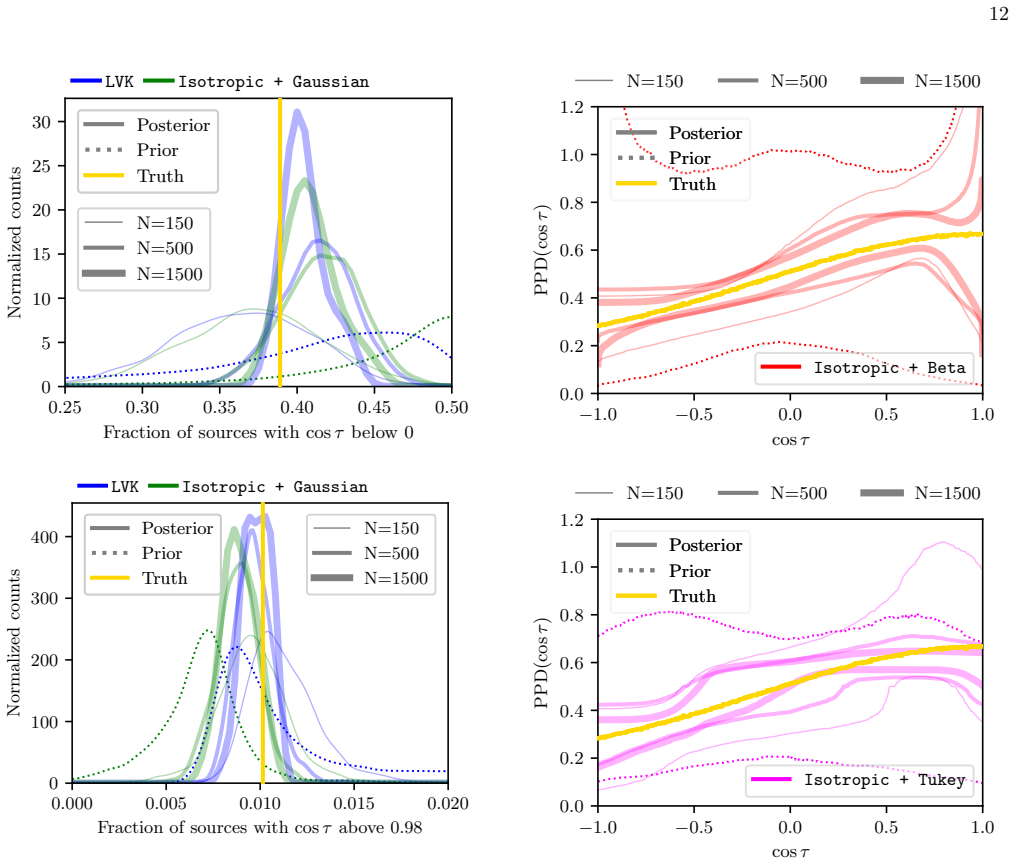
The central objects are parametric mixture models for the cosine of the spin tilt, $\cos\tau$, each combining an isotropic component with a preferentially-aligned component: the LVK model (a Gaussian fixed at $\cos\tau = 1$), the Isotropic + Gaussian model (Gaussian location free), and the more elastic Isotropic + Beta and Isotropic + Tukey models. These are fed into a hierarchical Bayesian population analysis whose likelihood marginalizes individual-event posteriors and corrects for selection effects through a simulated detectable-source catalog. The key diagnostic that carries the argument is the posterior predictive distribution (PPD) of $\cos\tau$ and integrals of it, rather than the marginalized hyper-parameters such as the aligned fraction $f_a$ or the Gaussian mean $\mu_{\cos\tau}$, because the hyper-parameters are strongly correlated while the PPD-based fractions remain robust across models.
What would settle it
Run the same hierarchical analysis on real LIGO-Virgo-KAGRA O4 and O5 catalogs of roughly 300, 500, and 1500 binary black holes; if the posterior predictive distribution for $\cos\tau$ shows a resolved peak at $\cos\tau = 1$ whose 90% credible interval excludes the broad-plateau shapes reported here, the paper's claim that 1500 sources cannot establish alignment is falsified for nature's actual distribution. A dedicated simulation injecting a narrow aligned component with $\sigma_{\cos\tau} \approx 0.3$ would also directly test the paper's stated caveat that a narrower peak would be easier to recover.
Extended reading notes
Core claim
The paper's central result is that measuring the astrophysical spin-tilt distribution of binary black holes is far harder than measuring the overall distribution of masses or redshifts. Using catalogs of 150, 500, and 1500 sources drawn from a population consistent with GWTC-3 and injected with a mass-ratio-dependent alignment fraction, the authors find: spurious peaks away from perfect alignment can appear even with 300 sources; a definitive peak at $\cos\tau = 1$ remains elusive even with 1500; integrated fractions (e.g., fraction with $\cos\tau \leq 0$ or $\cos\tau \gtrsim 0.98$) are recovered accurately by nearly all models and achieve relative 90% credible uncertainties of roughly 20--80% at 1500 sources; and even with the largest catalogs, a true mass-ratio--tilt correlation cannot be definitively detected, with the simpler no-correlation model slightly preferred at every catalog size. The message the authors intend is that model-independent, integrated statements about the tilt distribution are more informative than the marginalized posteriors of individual model parameters, which suffer strong degeneracies.
Load-bearing premise
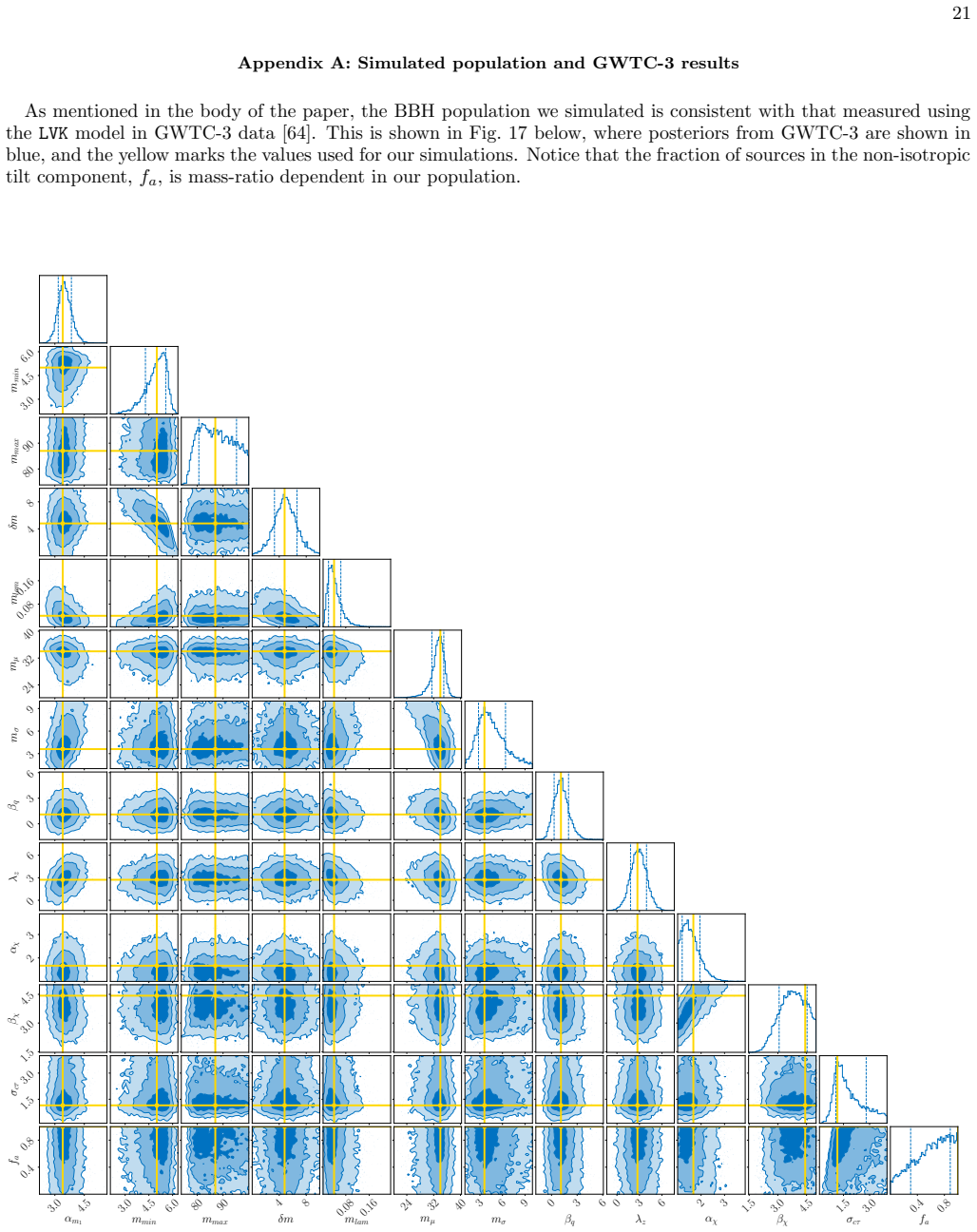
The simulated true spin-tilt population uses a broad preferentially-aligned Gaussian with $\sigma_{\cos\tau} = 1.15$, consistent with GWTC-3; if the real astrophysical distribution is significantly narrower, the conclusion that alignment peaks cannot be established even with 1500 sources would fail, as the authors themselves state.
Editorial extensions
If this is right
- Even if the true spin-tilt distribution peaks at perfect alignment, a catalog of up to 300 binaries can easily produce a measured peak away from $\cos\tau = 1$, though such spurious peaks become less frequent as catalogs grow.
- The location of the preferentially-aligned component, e.g., $\mu_{\cos\tau}$, stays poorly constrained even at 1500 sources, so claims that the GWTC-3 data require a peak away from alignment are not secure.
- Integrated fractions, such as the fraction of binaries with $\cos\tau \leq 0$ or with tilts within $10^\circ$ of alignment, are measured accurately by most models and achieve relative 90% credible uncertainties of roughly 20--80% at 1500 sources.
- Even a deliberately injected mass-ratio--tilt correlation cannot be revealed at any catalog size considered; the simpler uncorrelated model is slightly preferred by Bayes factors at 150, 500, and 1500 events.
- Population-synthesis predictions and future observational statements should be phrased as integrated fractions of the tilt distribution rather than as parameters of any specific parametric model.
Reading between the lines
- This is an extension beyond the paper: if O4 data (roughly 300 binaries) shows a tilt-distribution peak away from alignment, this paper's results imply the peak may disappear as more sources are added, so observers should hesitate before assigning it an astrophysical origin.
- This is an extension beyond the paper: the paper's recommendation implies that next-generation detectors, which will produce hundreds of thousands of binaries, may finally resolve the tilt-peak question, but only if analysts continue using PPD-based integrated quantities rather than raw hyper-parameters.
- This is an extension beyond the paper: one could test the paper's limits by rerunning its pipeline with a deliberately narrow aligned component (e.g., $\sigma_{\cos\tau} \approx 0.3$) or with a different spin-magnitude distribution; the paper itself states that such changes would make the alignment peak easier to recover, so those simulations would quantify how much easier.
Editorial analysis
A structured set of objections, weighed in public.
Referee Report
Summary. The paper is an injection-recovery forecast of how well future catalogs of binary black hole (BBH) mergers will constrain the astrophysical distribution of spin tilts. The authors simulate 1599 detectable BBHs with an O4-equivalent network and a GWTC-3-consistent population (mass, spin-magnitude, and redshift hyperparameters), injecting a mass-ratio-dependent fraction of preferentially aligned spins with width σcτ = 1.15 (Sec. II, Eqs. 1–2). Single-event posteriors are produced with Bilby; catalogs of 69–1500 sources are then analyzed with four tilt models (LVK, Isotropic + Gaussian, Isotropic + Beta, Isotropic + Tukey), with and without a q-dependent alignment fraction, using a 10.7-million-source selection function. The central findings are: (a) spurious peaks away from perfect alignment can occur with up to ~300 sources; (b) even at 1500 sources, a definitive peak at alignment is difficult to establish; (c) integrated fractions (cos τ ≤ 0 and cos τ ≥ 0.98) are recovered by most models with relative 90% credible uncertainties of roughly 20–80% at 1500 sources; and (d) no model, including the exact generator of the data, establishes the mass-ratio–tilt correlation, with the simplest uncorrelated LVK model mildly favored in Bayes factors (Table I). The paper recommends quoting integrated, posterior-predictive quantities instead of marginalized hyperparameters.
Significance. If its claims hold, this paper is a valuable and sobering forecast for the spin-tilt program of the LIGO-Virgo-KAGRA collaboration: it quantifies, at the ~1500-event scale, the difficulty of pinning down a peak at alignment, the robustness of integrated fractions, and the inconclusiveness of a mass-ratio–tilt correlation even when the analysis model is the exact generator of the data. The work is technically careful and unusually transparent: an injection-recovery pipeline with matched-filter detectability (Sec. II), a 10.7-million-source selection-function catalog (Sec. III), explicit variance-control thresholds (Sec. III B), multiple population models including the true generator, and honest reporting of the models' failures (Isotropic + Tukey's underestimate at cos τ ≳ 0.6; Isotropic + Beta's aligned-fraction underestimate in Sec. V B 2). The posterior samples are promised on Zenodo. Because this is an injection-recovery study, the assumed truth is a scenario choice, not a circularity; the open question is the scenario's range of validity.
major comments (2)
- [Sec. II / Sec. V B 1 / Sec. VI; abstract claim (b)] The headline finding that 'establishing a definitive peak at alignment remains difficult even with 1500 detections' (abstract, claim b; Sec. V B 1) is demonstrated for a single true spin-tilt width, σcτ = 1.15 (Sec. II, Eqs. 1–2). The GWTC-3 posterior for σcτ shown in Fig. 17 has broad support around the adopted value, plausibly extending to values substantially below 1, and the paper itself concedes in Sec. VI (Outlook, item a) that a significantly narrower aligned component would make the peak easier to reveal. Although Sec. V A acknowledges that the answer depends on the true distribution, the abstract states claim (b) without this conditioning, and the paper neither marginalizes the forecast over the GWTC-3 posterior for σcτ nor maps how the conclusion varies with σcτ. A reader therefore cannot determine whether the 'long road to alignment' is an inherent property of GW data at the 1500-event scale or an artifact of the chosen σcτ = 1.15. I recommend either (i) adding at least one analysis at N = 500–1500 with a narrower aligned component inside the GWTC-3 90% region (e.g., σcτ ≈ 0.5–0.7) to identify where the conclusion flips, or (ii) rephrasing claim (b) in the abstract and conclusions to be explicitly conditional on a broad preferentially-aligned component of GWTC-3-consistent width. This is the load-bearing point for the paper's headline claim.
- [Sec. V B (catalogs of 150/500/1500 sources)] The quantitative results supporting claims (b) and (c)—for example µcτ = 0.74+0.13−0.30 and an aligned fraction of 0.9+0.1−0.1% at N = 1500 (Sec. V B 1)—each come from a single catalog realization, and the text does not state whether the 150, 500, and 1500 catalogs are nested draws from the 1599-event pool. Section V A shows substantial realization-to-realization scatter at N = 69–300 (Fig. 4), and several entries in Tabs. II–III evolve non-monotonically with catalog size (e.g., the Isotropic + Beta slice at cos τ = 0.99 moves from 0.67 at N = 150 to 0.43 at N = 1500). If the catalogs are nested, that non-monotonicity is driven by the added sources; if they are independent, it reflects draw variance. Either way, the abstract's quantitative precision claim ('relative 90% credible uncertainties of ~20–80% with 1500 sources') should be accompanied by a statement of how representative the single realization is; a second realization at N = 1500, or an explicit nested-draw declaration, would settle the question.
minor comments (6)
- [Sec. VI (Outlook)] The sentence 'we are always able to correctly infer the underlying BBH distributions within uncertainties for all our models and parameters (App. B)' is stronger than the results in Sec. V B 2, where the Isotropic + Tukey model at N = 1500 places the truth outside its 90% credible interval for cos τ ≳ 0.6 and the Isotropic + Beta model reports the aligned fraction as 0.6+0.2−0.2% against a true value of 1.0%; please qualify the sentence to match those results.
- [Footnote 2] Footnote 2 ('Ask me about this number next time you see me at a conference') is out of place in a journal article; remove it or move the explanation into the main text or acknowledgments.
- [Eq. (9)] Eq. (9) contains a typesetting error: 'p(D↑θ|Hζ)' should presumably read 'p(D↑|θ, Hζ)'.
- [Sec. V A / Fig. 6] The three 'exemplary catalogs' shown per size in Fig. 6 are deliberately selected (flat, off-peak, on-peak PPD); please report how many of the 20 catalogs fall into each class at each size so the reader can gauge the rates behind the qualitative claims.
- [References [74] and [85]] The reference list contains LaTeX artifacts (e.g., 'howpublished = ...' in Ref. [74] and '10.1007/978-981-15-4702-7 45-1' in Ref. [85]) that should be cleaned in the published version.
- [Abstract / Tabs. IV–V] The quoted range 'relative 90% credible uncertainties of ~20%–80% with 1500 sources' is hard to reconcile with the tables for the two quantities named in the abstract: at N = 1500 the cos τ ≤ 0 fraction has relative uncertainties of order 3–8% and the cos τ ≥ 0.98 fraction of order 11–33%, with the ~80% end appearing only for the nearly-anti-aligned fraction (cos τ ≤ −0.98) or at smaller catalog sizes; please clarify which quantities the range refers to.
Circularity Check
No circular step found: the study is an injection-recovery forecast whose conclusions are about the measurement pipeline, not about the simulated truth; the self-citation to Ref. [64] is a model dependency, not a load-bearing logical loop.
full rationale
The paper's derivation chain is self-contained. The 'true' population in Sec. II (Eqs. 1-2) is an explicit input, and the paper never presents the recovered values of that input as an astrophysical prediction; it uses injection into simulated noise, single-event parameter estimation, and hierarchical inference to characterize how often a known truth is recovered for catalogs of 69-1500 events (Secs. III-V). Claims (a)-(d) are statements about estimator behavior: spurious peaks in mu_c_tau occur in some catalogs despite the truth being at cos tau = 1; the correlated Isotropic+Gaussian model, which can exactly match the truth, is still not favored over simpler models; integrated fractions contain the truth and shrink as sources are added. These are simulation outputs, not identities with the inputs. The models from Ref. [64] are adopted as analysis tools and explicitly identified; the paper even labels the perfectly-matching model an 'unrealistic best case scenario' (Sec. IV), which strengthens rather than creates a loop. The main limitation, acknowledged in Sec. VI, is that the headline 'long road to alignment' is conditioned on the simulated sigma_c_tau = 1.15 and could reverse for a significantly narrower aligned component; this is a robustness caveat, not circularity. Self-citations (notably Ref. [64]) are present but not load-bearing: the central conclusions do not reduce to the cited work, and independent corroborations are cited for the GWTC-3 peak-away-from-unity result.
Assumptions & free parameters
free parameters (5)
- fq=1 =
1
- σcτ =
1.15
- µcτ =
1
- n =
2
- GWTC-3-consistent population hyperparameters (αm1, mmin, mmax, mlam, mµ, mσ, δm, βq, αχ, βχ, λz) =
Median values of the LVK GWTC-3 hyper posterior
assumptions (5)
- standard math Hierarchical Bayesian likelihood and selection-effect formalism (Eqs. 3-9)
- domain assumption The true population is drawn from the chosen parametric model (Power Law + Peak, beta spin magnitudes, power-law redshift, and the cos-tilt mixture of Eq. 1)
- domain assumption IMRPhenomXP waveform is sufficient and higher-order modes can be neglected for the simulated injections and recovery
- domain assumption Detectability is defined by matched-filter network SNR > 11, following Ref. [75]
- ad hoc to paper The correlation functional form of Eq. 2 (exponential mapping of mass ratio to aligned fraction) is a plausible scenario
Cite this review
Pith. "Pith review of The Long Road to Alignment: Measuring Black Hole Spin Orientation with Expanding Gravitational-Wave Datasets." pith.science (2026). https://pith.science/paper/22KYK7XQ
@misc{pith2026250514875,
  author       = {Pith},
  title        = {Pith review of: The Long Road to Alignment: Measuring Black Hole Spin Orientation with Expanding Gravitational-Wave Datasets},
  year         = {2026},
  howpublished = {\url{https://pith.science/paper/22KYK7XQ}},
  note         = {Machine review of arXiv:2505.14875}
}
abstract
Measuring the distribution of spin tilts-the angles between the spin vectors and the binary orbital angular momentum-in stellar-mass binary black holes detected by LIGO-Virgo-KAGRA would provide valuable insight into their astrophysical origins. Analyses of the 69 binary black holes detected through LIGO-Virgo-KAGRA's third observing run yielded model-dependent conclusions, particularly regarding whether the spin tilt distribution exhibits a peak near alignment, as expected for binaries formed in galactic fields. In this work, we simulate populations of up to 1500 binary black hole systems with parameters consistent with the default GWTC-3 analysis, while introducing a correlation that favors small spin tilts for binaries with mass ratios near unity. We find that: (a) spurious peaks away from perfect alignment are possible even with catalogs of up to 300 sources; (b) establishing a definitive peak at alignment remains difficult even with 1500 detections; (c) integrated measurements -- such as the fraction of events with tilt angles smaller than $10^\circ$ or greater than $90^\circ$ -- are more robust and should be preferred, achieving relative $90\%$ credible uncertainties of $\sim20\%-80\%$ with 1500 sources; and (d) even with the largest simulated catalogs, evidence for a mass ratio-tilt correlation remains inconclusive. Our results suggest that identifying the formation channels of merging black holes using spin tilts will remain challenging, but that model-independent measurements may yield more informative insights over model parameters themselves.
Figures


Figures from the paper (13 more)







Forward citations
Cited by 3 Pith papers
-
When (not) to trust Monte Carlo approximations for hierarchical Bayesian inference
A unified error statistic E-hat measures information lost to Monte Carlo noise in hierarchical Bayesian inference, with a recommended cutoff of 0.2 bits.
-
A new group of low-spin $50-70M_\odot$ Black Holes and the high pair-instability mass cutoff
GWTC-4.0 reveals low-spin black holes up to ~68.5 Msun, implying a higher pair-instability mass cutoff and a lower 12C(alpha,gamma)16O rate.
-
The first decade of gravitational-wave measurements of black hole spins
A review summarizing formation-channel predictions, waveform effects, and population-level constraints on stellar-mass black hole spins from the first decade of gravitational-wave observations.
Reference graph
Works this paper leans on
-
[1]
Therefore, this parameter can always be compared across models and catalog sizes
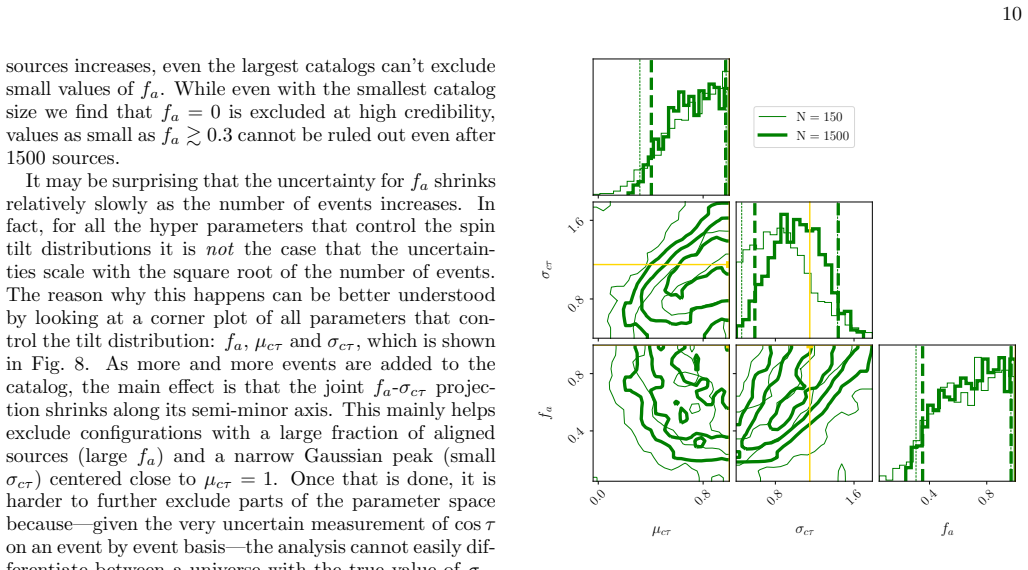
Uncorrelated models: LVK and Isotropic + Gaussian Hyper parameters The only thing that all models have in common, in addition to yielding a PPD for the same set of single- event parameters (masses, spins, redshift), is that they all include the fraction of sources in the non-isotropic component - fa- as one of their parameters. Therefore, this parameter c...
-
[2]
Those models have been introduced by Ref
Uncorrelated models - Isotropic + Beta and Isotropic + Tukey We now shift focus to the two other uncorrelated mod- els included in this work, where the non-isotropic com- ponent is either a (possibly singular) beta distribution or a Tukey window. Those models have been introduced by Ref. [64] and used to analyze GWTC-3 data. They are more generic than the...
-
[3]
This introduces another hyper parameter that we call n
Correlated models In this section we focus on the results obtained when the branching fraction between the two components of the tilt models is allowed to vary with the mass ratio. This introduces another hyper parameter that we call n. The mass ratio-dependent branching fraction is thus parametrized by two quantities that are measured from the data, fq=1...
-
[4]
B. P. Abbott et al.(LIGO Scientific, Virgo), Phys. Rev. Lett. 116, 061102 (2016), arXiv:1602.03837 [gr-qc]
arXiv 2016
-
[5]
Aasi et al.(LIGO Scientific), Class
J. Aasi et al.(LIGO Scientific), Class. Quant. Grav. 32, 074001 (2015), arXiv:1411.4547 [gr-qc]
arXiv 2015
-
[6]
F. Acernese et al. (VIRGO), Class. Quant. Grav. 32, 024001 (2015), arXiv:1408.3978 [gr-qc]
arXiv 2015
-
[7]
Y. Aso, Y. Michimura, K. Somiya, M. Ando, O. Miyakawa, T. Sekiguchi, D. Tatsumi, and H. Ya- mamoto (KAGRA), Phys. Rev. D 88, 043007 (2013), arXiv:1306.6747 [gr-qc]
arXiv 2013
-
[9]
A. H. Nitz, C. D. Capano, S. Kumar, Y.-F. Wang, S. Kastha, M. Sch¨ afer, R. Dhurkunde, and M. Cabero, Astrophys. J. 922, 76 (2021), arXiv:2105.09151 [astro- 18 ph.HE]
arXiv 2021
Show all 104 references
-
[10]
Olsen, T
S. Olsen, T. Venumadhav, J. Mushkin, J. Roulet, B. Za- ckay, and M. Zaldarriaga, Phys. Rev. D 106, 043009 (2022), arXiv:2201.02252 [astro-ph.HE]
2022 arXiv
-
[11]
org/superevents/public/O4/ (2024)
LIGO, Virgo, and KAGRA Collaborations, Public alerts during the O4 observing run, https://gracedb.ligo. org/superevents/public/O4/ (2024)
2024
-
[12]
docs.ligo.org/plan/ (2025)
LIGO, Virgo, and KAGRA Collaborations, LIGO- Virgo-KAGRA Observing Plans, https://observing. docs.ligo.org/plan/ (2025)
2025
-
[13]
Mapelli, Formation Channels of Single and Bi- nary Stellar-Mass Black Holes (2021) arXiv:2106.00699 [astro-ph.HE]
M. Mapelli, Formation Channels of Single and Bi- nary Stellar-Mass Black Holes (2021) arXiv:2106.00699 [astro-ph.HE]
2021 arXiv
-
[14]
T. A. Callister, Arxiv (2024), arXiv:2410.19145 [astro- ph.HE]
2024 arXiv
-
[15]
Favata, C
M. Favata, C. Kim, K. G. Arun, J. Kim, and H. W. Lee, Phys. Rev. D 105, 023003 (2022), arXiv:2108.05861 [gr- qc]
2022 arXiv
-
[16]
Belczynski, V
K. Belczynski, V. Kalogera, F. A. Rasio, R. E. Taam, A. Zezas, T. Bulik, T. J. Maccarone, and N. Ivanova, Astrophys. J. Suppl. 174, 223 (2008), arXiv:astro- ph/0511811
2008
-
[17]
J. J. Eldridge, E. R. Stanway, L. Xiao, L. A. S. McClel- land, G. Taylor, M. Ng, S. M. L. Greis, and J. C. Bray, Publications of the Astronomical Society of Australia 34, e058 (2017), arXiv:1710.02154 [astro-ph.SR]
2017 arXiv
-
[18]
Fragos, J
T. Fragos, J. J. Andrews, S. S. Bavera, C. P. L. Berry, S. Coughlin, A. Dotter, P. Giri, V. Kalogera, A. Kat- saggelos, K. Kovlakas, S. Lalvani, D. Misra, P. M. Srivastava, Y. Qin, K. A. Rocha, J. Rom´ an-Garza, J. G. Serra, P. Stahle, M. Sun, X. Teng, G. Trajcevski, N. H. Tra...
2023 arXiv
-
[19]
Riley et al
J. Riley et al. (COMPAS Team, Team COMPAS), Astrophys. J. Supp. 258, 34 (2022), arXiv:2109.10352 [astro-ph.IM]
2022 arXiv
-
[20]
Spera, M
M. Spera, M. Mapelli, N. Giacobbo, A. A. Trani, A. Bressan, and G. Costa, Mon. Not. Roy. Astron. Soc. 485, 889 (2019), arXiv:1809.04605 [astro-ph.HE]
2019 arXiv
-
[21]
C. L. Rodriguez, N. C. Weatherford, S. C. Coughlin, P. Amaro-Seoane, K. Breivik, S. Chatterjee, G. Fra- gione, F. Kıro˘ glu, K. Kremer, N. Z. Rui, C. S. Ye, M. Zevin, and F. A. Rasio, Astrophysical Journal Sup- plement Series 258, 22 (2022), arXiv:2106.02643 [astro- ph.GA]
2022 arXiv
-
[22]
Vitale, W
S. Vitale, W. M. Farr, K. Ng, and C. L. Rodriguez, Astrophys. J. Lett. 886, L1 (2019), arXiv:1808.00901 [astro-ph.HE]
2019 arXiv
-
[23]
A. Ray, I. Maga˜ na Hernandez, S. Mohite, J. Creighton, and S. Kapadia, Astrophys. J. 957, 37 (2023), arXiv:2304.08046 [gr-qc]
2023 arXiv
-
[24]
T. A. Callister and W. M. Farr, Phys. Rev. X14, 021005 (2024), arXiv:2302.07289 [astro-ph.HE]
2024 arXiv
-
[25]
A. M. Farah, T. A. Callister, J. M. Ezquiaga, M. Zevin, and D. E. Holz, Astrophys. J. 978, 153 (2025), arXiv:2404.02210 [astro-ph.CO]
2025 arXiv
-
[26]
Edelman, Z
B. Edelman, Z. Doctor, J. Godfrey, and B. Farr, As- trophys. J. 924, 101 (2022), arXiv:2109.06137 [astro- ph.HE]
2022 arXiv
-
[27]
Edelman, B
B. Edelman, B. Farr, and Z. Doctor, Astrophys. J. 946, 16 (2023), arXiv:2210.12834 [astro-ph.HE]
2023 arXiv
-
[28]
Golomb and C
J. Golomb and C. Talbot, Phys. Rev. D 108, 103009 (2023), arXiv:2210.12287 [astro-ph.HE]
2023 arXiv
-
[29]
Heinzel, M
J. Heinzel, M. Mould, and S. Vitale, Phys. Rev. D 111, L061305 (2025), arXiv:2406.16844 [astro-ph.HE]
2025 arXiv
-
[30]
Mandel, W
I. Mandel, W. M. Farr, A. Colonna, S. Stevenson, P. Tiˇ no, and J. Veitch, Mon. Not. Roy. Astron. Soc. 465, 3254 (2017), arXiv:1608.08223 [astro-ph.HE]
2017 arXiv
-
[31]
Heinzel, M
J. Heinzel, M. Mould, S. ´Alvarez-L´ opez, and S. Vitale, Phys. Rev. D 111, 063043 (2025), arXiv:2406.16813 [astro-ph.HE]
2025 arXiv
-
[32]
Toubiana, M
A. Toubiana, M. L. Katz, and J. R. Gair, Mon. Not. Roy. Astron. Soc. 524, 5844 (2023), arXiv:2305.08909 [gr-qc]
2023 arXiv
-
[33]
Tiwari and S
V. Tiwari and S. Fairhurst, Astrophys. J. Lett.913, L19 (2021), arXiv:2011.04502 [astro-ph.HE]
2021 arXiv
-
[34]
Godfrey, B
J. Godfrey, B. Edelman, and B. Farr, Arxiv (2023), arXiv:2304.01288 [astro-ph.HE]
2023 arXiv
-
[35]
Sadiq, T
J. Sadiq, T. Dent, and M. Gieles, Astrophys. J. 960, 65 (2024), arXiv:2307.12092 [astro-ph.HE]
2024 arXiv
-
[36]
Vitale, R
S. Vitale, R. Lynch, R. Sturani, and P. Graff, Class. Quant. Grav. 34, 03LT01 (2017), arXiv:1503.04307 [gr- qc]
2017 arXiv
-
[37]
Talbot and E
C. Talbot and E. Thrane, Astrophys. J.856, 173 (2018), arXiv:1801.02699 [astro-ph.HE]
2018 arXiv
-
[38]
Talbot and E
C. Talbot and E. Thrane, Phys. Rev. D 96, 023012 (2017), arXiv:1704.08370 [astro-ph.HE]
2017 arXiv
-
[39]
Fishbach, D
M. Fishbach, D. E. Holz, and W. M. Farr, Astrophys. J. Lett. 863, L41 (2018), arXiv:1805.10270 [astro-ph.HE]
2018 arXiv
-
[40]
T. A. Callister, C.-J. Haster, K. K. Y. Ng, S. Vitale, and W. M. Farr, Astrophys. J. Lett. 922, L5 (2021), arXiv:2106.00521 [astro-ph.HE]
2021 arXiv
-
[41]
Biscoveanu, T
S. Biscoveanu, T. A. Callister, C.-J. Haster, K. K. Y. Ng, S. Vitale, and W. M. Farr, Astrophys. J. Lett. 932, L19 (2022), arXiv:2204.01578 [astro-ph.HE]
2022 arXiv
-
[42]
Abbott et al.(LIGO Scientific, Virgo), Astrophys
R. Abbott et al.(LIGO Scientific, Virgo), Astrophys. J. Lett. 913, L7 (2021), arXiv:2010.14533 [astro-ph.HE]
2021 arXiv
-
[43]
Abbott et al
R. Abbott et al. (LIGO Scientific, VIRGO, KAGRA Scientific), arXiv e-prints , arXiv:2111.03634 (2021), arXiv:2111.03634 [astro-ph.HE]
2021 arXiv
-
[44]
Zevin, S
M. Zevin, S. S. Bavera, C. P. L. Berry, V. Kalogera, T. Fragos, P. Marchant, C. L. Rodriguez, F. Antonini, D. E. Holz, and C. Pankow, Astrophys. J. 910, 152 (2021), arXiv:2011.10057 [astro-ph.HE]
2021 arXiv
-
[45]
K. W. K. Wong, K. Breivik, K. Kremer, and T. Callis- ter, Phys. Rev. D 103, 083021 (2021), arXiv:2011.03564 [astro-ph.HE]
2021 arXiv
-
[46]
K. W. K. Wong and D. Gerosa, Phys. Rev. D 100, 083015 (2019), arXiv:1909.06373 [astro-ph.HE]
2019 arXiv
-
[47]
Colloms, C
S. Colloms, C. P. L. Berry, J. Veitch, and M. Zevin, Arxiv (2025), arXiv:2503.03819 [astro-ph.HE]
2025 arXiv
- [48]
-
[49]
Franciolini, V
G. Franciolini, V. Baibhav, V. De Luca, K. K. Y. Ng, K. W. K. Wong, E. Berti, P. Pani, A. Riotto, and S. Vitale, Phys. Rev. D 105, 083526 (2022), arXiv:2105.03349 [gr-qc]
2022 arXiv
-
[50]
A. Q. Cheng, M. Zevin, and S. Vitale, Astrophys. J. 955, 127 (2023), arXiv:2307.03129 [astro-ph.HE]
2023 arXiv
-
[51]
Heinzel, S
J. Heinzel, S. Biscoveanu, and S. Vitale, Phys. Rev. D 109, 103006 (2024), arXiv:2312.00993 [astro-ph.HE]
2024 arXiv
-
[52]
Gerosa, M
D. Gerosa, M. Kesden, E. Berti, R. O’Shaughnessy, and U. Sperhake, Phys. Rev. D 87, 104028 (2013), arXiv:1302.4442 [gr-qc]
2013 arXiv
-
[53]
Gerosa, R
D. Gerosa, R. O’Shaughnessy, M. Kesden, E. Berti, and U. Sperhake, Phys. Rev. D 89, 124025 (2014), 19 arXiv:1403.7147 [gr-qc]
2014 arXiv
-
[54]
W. M. Farr, S. Stevenson, M. Coleman Miller, I. Man- del, B. Farr, and A. Vecchio, Nature 548, 426 (2017), arXiv:1706.01385 [astro-ph.HE]
2017 arXiv
-
[55]
Mould and D
M. Mould and D. Gerosa, Phys. Rev. D 105, 024076 (2022), arXiv:2110.05507 [astro-ph.HE]
2022 arXiv
-
[56]
Varma, S
V. Varma, S. Biscoveanu, M. Isi, W. M. Farr, and S. Vitale, Phys. Rev. Lett. 128, 031101 (2022), arXiv:2107.09693 [astro-ph.HE]
2022 arXiv
-
[57]
Varma, M
V. Varma, M. Isi, S. Biscoveanu, W. M. Farr, and S. Vitale, Phys. Rev. D 105, 024045 (2022), arXiv:2107.09692 [astro-ph.HE]
2022 arXiv
-
[58]
Biscoveanu, Arxiv (2025), arXiv:2502.04278 [astro- ph.HE]
S. Biscoveanu, Arxiv (2025), arXiv:2502.04278 [astro- ph.HE]
2025 arXiv
-
[59]
Roulet, H
J. Roulet, H. S. Chia, S. Olsen, L. Dai, T. Venumad- hav, B. Zackay, and M. Zaldarriaga, Phys. Rev. D 104, 083010 (2021), arXiv:2105.10580 [astro-ph.HE]
2021 arXiv
-
[60]
Stevenson, C
S. Stevenson, C. P. L. Berry, and I. Mandel, Mon. Not. Roy. Astron. Soc. 471, 2801 (2017), arXiv:1703.06873 [astro-ph.HE]
2017 arXiv
-
[61]
P´ erigois, M
C. P´ erigois, M. Mapelli, F. Santoliquido, Y. Bouffanais, and R. Rufolo, Universe9, 507 (2023), arXiv:2301.01312 [astro-ph.HE]
2023 arXiv
-
[62]
C. L. Rodriguez, M. Zevin, C. Pankow, V. Kalogera, and F. A. Rasio, Astrophys. J. Lett. 832, L2 (2016), arXiv:1609.05916 [astro-ph.HE]
2016 arXiv
-
[63]
Marchant, K
P. Marchant, K. M. W. Pappas, M. Gallegos-Garcia, C. P. L. Berry, R. E. Taam, V. Kalogera, and P. Podsiadlowski, Astron. Astrophys.650, A107 (2021), arXiv:2103.09243 [astro-ph.SR]
2021 arXiv
-
[64]
C. L. Fryer and V. Kalogera, Astrophys. J. 554, 548 (2001), arXiv:astro-ph/9911312
2001 arXiv
-
[65]
Kalogera, Astrophys
V. Kalogera, Astrophys. J. 541, 319 (2000), arXiv:astro- ph/9911417
2000
-
[66]
C. L. Fryer, K. Belczynski, G. Wiktorowicz, M. Do- minik, V. Kalogera, and D. E. Holz, Astrophysics Jour- nal 749, 91 (2012), arXiv:1110.1726 [astro-ph.SR]
2012 arXiv
-
[67]
Vitale, S
S. Vitale, S. Biscoveanu, and C. Talbot, Astron. Astro- phys. 668, L2 (2022), arXiv:2209.06978 [astro-ph.HE]
2022 arXiv
-
[68]
Li, Y.-Z
Y.-J. Li, Y.-Z. Wang, S.-P. Tang, and Y.-Z. Fan, Phys. Rev. Lett. 133, 051401 (2024), arXiv:2303.02973 [astro- ph.HE]
2024 arXiv
-
[69]
M. V. van der Sluys, C. R¨ over, A. Stroeer, V. Raymond, I. Mandel, N. Christensen, V. Kalogera, R. Meyer, and A. Vecchio, Astrophys. J. Lett. 688, L61 (2008), arXiv:0710.1897 [astro-ph]
2008 arXiv
-
[70]
van der Sluys, I
M. van der Sluys, I. Mandel, V. Raymond, V. Kalogera, C. Rover, and N. Christensen, Class. Quant. Grav. 26, 204010 (2009), arXiv:0905.1323 [gr-qc]
2009 arXiv
-
[71]
Vitale, R
S. Vitale, R. Lynch, J. Veitch, V. Raymond, and R. Sturani, Phys. Rev. Lett. 112, 251101 (2014), arXiv:1403.0129 [gr-qc]
2014 arXiv
-
[72]
P¨ urrer, M
M. P¨ urrer, M. Hannam, and F. Ohme, Phys. Rev. D 93, 084042 (2016), arXiv:1512.04955 [gr-qc]
2016 arXiv
-
[73]
Vitale, R
S. Vitale, R. Lynch, V. Raymond, R. Sturani, J. Veitch, and P. Graff, Phys. Rev. D 95, 064053 (2017), arXiv:1611.01122 [gr-qc]
2017 arXiv
-
[74]
Dhani, S
A. Dhani, S. V¨ olkel, A. Buonanno, H. Estelles, J. Gair, H. P. Pfeiffer, L. Pompili, and A. Toubiana, Arxiv (2024), arXiv:2404.05811 [gr-qc]
2024
-
[75]
S. J. Miller, Z. Ko, T. Callister, and K. Chatziioannou, Phys. Rev. D 109, 104036 (2024), arXiv:2401.05613 [gr- qc]
2024 arXiv
-
[76]
Wysocki, J
D. Wysocki, J. Lange, and R. O’Shaughnessy, Phys. Rev. D 100, 043012 (2019)
2019
-
[77]
LIGO Scientific Collaboration, Noise curves used for Simulations in the update of the Observing Scenar- ios Paper, howpublished = https://dcc.ligo.org/ ligo-t2000012/public, note = LIGO-T2000012-v5, year = 2020
2020
-
[78]
Essick and M
R. Essick and M. Fishbach, Astrophys. J. 962, 169 (2024), arXiv:2310.02017 [gr-qc]
2024 arXiv
-
[79]
Ashton et al., Astrophys
G. Ashton et al., Astrophys. J. Suppl. 241, 27 (2019), arXiv:1811.02042 [astro-ph.IM]
2019 arXiv
-
[80]
I. M. Romero-Shaw et al., Mon. Not. Roy. Astron. Soc. 499, 3295 (2020), arXiv:2006.00714 [astro-ph.IM]
2020 arXiv
-
[81]
Pratten, S
G. Pratten, S. Husa, C. Garcia-Quiros, M. Colleoni, A. Ramos-Buades, H. Estelles, and R. Jaume, Phys. Rev. D 102, 064001 (2020), arXiv:2001.11412 [gr-qc]
2020 arXiv
-
[82]
Krishna, A
K. Krishna, A. Vijaykumar, A. Ganguly, C. Talbot, S. Biscoveanu, R. N. George, N. Williams, and A. Zim- merman, Arxiv (2023), arXiv:2312.06009 [gr-qc]
2023 arXiv
-
[83]
Talbot, A
C. Talbot, A. Farah, S. Galaudage, J. Golomb, and H. Tong, Arxiv (2024), arXiv:2409.14143 [astro-ph.IM]
2024 arXiv
-
[84]
T. J. Loredo and I. M. Wasserman, Astrophysical Jour- nal Supplement Series 96, 261 (1995)
1995
-
[85]
T. J. Loredo and I. M. Wasserman, Astrophys. J. 502, 75 (1998), arXiv:astro-ph/9701111
1998 arXiv
-
[86]
T. J. Loredo and D. Q. Lamb, Phys. Rev. D 65, 063002 (2002), arXiv:astro-ph/0107260
2002 arXiv
-
[87]
Mandel, W
I. Mandel, W. M. Farr, and J. R. Gair, Mon. Not. Roy. Astron. Soc. 486, 1086 (2019), arXiv:1809.02063 [physics.data-an]
2019 arXiv
-
[88]
Vitale, D
S. Vitale, D. Gerosa, W. M. Farr, and S. R. Taylor, Handbook of Gravitational Wave As- tronomy ”10.1007/978-981-15-4702-7 45-1” (2020), arXiv:2007.05579 [astro-ph.IM]
2020 arXiv
-
[89]
Thrane and C
E. Thrane and C. Talbot, Publications of the As- tronomical Society of Australia 36, e010 (2019), arXiv:1809.02293 [astro-ph.IM]
2019 arXiv
-
[90]
J. S. Speagle, MNRAS 493, 3132 (2020), https://academic.oup.com/mnras/article- pdf/493/3/3132/32890730/staa278.pdf
2020
-
[91]
Tiwari, Class
V. Tiwari, Class. Quant. Grav. 35, 145009 (2018), arXiv:1712.00482 [astro-ph.HE]
2018 arXiv
-
[92]
W. M. Farr, Research Notes of the American Astro- nomical Society 3, 66 (2019), arXiv:1904.10879 [astro- ph.IM]
2019 arXiv
-
[93]
Talbot and J
C. Talbot and J. Golomb, Mon. Not. Roy. Astron. Soc. 526, 3495 (2023), arXiv:2304.06138 [astro-ph.IM]
2023 arXiv
-
[94]
Essick, Research Notes of the AAS 5, 220 (2021)
R. Essick, Research Notes of the AAS 5, 220 (2021)
2021
- [95]
-
[96]
Lorenzo-Medina and T
A. Lorenzo-Medina and T. Dent, Class. Quant. Grav. 42, 045008 (2025), arXiv:2408.13383 [gr-qc]
2025 arXiv
-
[97]
Islam, A
T. Islam, A. Vajpeyi, F. H. Shaik, C.-J. Haster, V. Varma, S. E. Field, J. Lange, R. O’Shaughnessy, and R. Smith, Arxiv (2023), arXiv:2309.14473 [gr-qc]
2023
-
[98]
R. W. Kiendrebeogo et al., Astrophys. J. 958, 158 (2023), arXiv:2306.09234 [astro-ph.HE]
2023 arXiv
-
[99]
Damour, Phys
T. Damour, Phys. Rev. D 64, 124013 (2001), arXiv:gr- qc/0103018
2001
- [100]
-
[101]
Santamaria et al., Phys
L. Santamaria et al., Phys. Rev. D 82, 064016 (2010), arXiv:1005.3306 [gr-qc]
2010 arXiv
-
[102]
Abbott et al
R. Abbott et al. (LIGO Scientific, VIRGO, KA- GRA), arXiv e-prints , arXiv:2111.03606 (2021), 20 arXiv:2111.03606 [gr-qc]
2021 arXiv
-
[103]
Varma, S
V. Varma, S. E. Field, M. A. Scheel, J. Black- man, D. Gerosa, L. C. Stein, L. E. Kidder, and H. P. Pfeiffer, Phys. Rev. Research. 1, 033015 (2019), arXiv:1905.09300 [gr-qc]
2019 arXiv
-
[104]
Varma, S
V. Varma, S. E. Field, M. A. Scheel, J. Blackman, L. E. Kidder, and H. P. Pfeiffer, Phys. Rev. D 99, 064045 (2019), arXiv:1812.07865 [gr-qc]
2019 arXiv
-
[105]
Vitale and M
S. Vitale and M. Mould, Data for: The long road to alignment: Measuring black hole spin orientation with expanding gravitational-wave datasets (2025). 21 Appendix A: Simulated population and GWTC-3 results As mentioned in the body of the paper, the BBH population we simulated ...
2025
Reviewed August 7, 2026 · model on record in the stance chip above.
Discussion (0). Sign in to comment.