REVIEW 5 major objections 5 minor 2 cited by
Sculpting Features from Noise: Reward-Guided Hierarchical Diffusion for Task-Optimal Feature Transformation
T0 review · 5 major / 5 minor · reviewed 2026-08-07 · deepseek-v4-flash
Pith's one-line read DIFFT claims automated feature transformation is best modeled as reward-guided generation in a learned latent space, reporting better accuracy than ten baselines on all 14 datasets tested.
desk verdict A plausible new generative take on feature transformation with real efficiency gains, but the empirical claims outrun the current evidence. read the letter →
The pith
A machine-rendered reading of the paper's core claim, the machinery that carries it, and where it could break.
The reading
What carries the argument
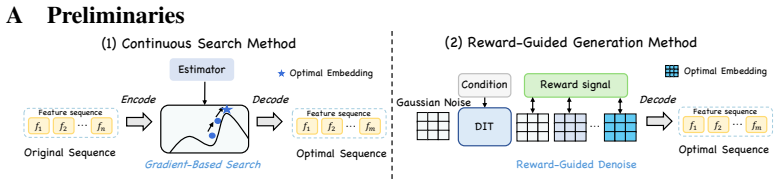
The load-bearing object is the reward-guided latent diffusion sampler. After a VAE encoder maps feature token sequences to embeddings and a GCN maps the transformed table to a condition vector, a Transformer denoiser learns the embedding distribution. At inference, the DDIM update in Equation (9) modifies the predicted noise by subtracting λ∇z(1/2)(Rψ(z)−a)2, so the reverse process follows the evaluator's reward gradient as well as the learned data distribution. The second mechanism is the semi-autoregressive decoder: it first samples the number of features T from pθ(T|z0), then generates each feature chunk's token sequence autoregressively in parallel, preserving intra-feature token dependencies while removing inter-feature order dependence.
What would settle it
On any of the 14 datasets, run DIFFT's reward guidance with the evaluator frozen, but restrict sampling to low-density regions of the latent space, decode the samples, and compare predicted evaluator reward with actual downstream F1 or RAE. If predicted and actual diverge sharply, or if the decoded features underperform the continuous-search baseline MOAT on the same data, the reward-guidance claim is falsified.
Extended reading notes
Core claim
DIFFT's central claim is that the optimal transformed feature set for a tabular dataset is best obtained by encoding candidate feature token sequences into a compact Gaussian latent space with a VAE, modeling the distribution of high-quality feature-set embeddings with a Transformer-based latent diffusion model conditioned on a graph embedding of the table, and then, during DDIM denoising, steering the trajectory with the gradient of a learned performance evaluator toward high-reward embeddings. The final embedding is decoded by a semi-autoregressive decoder that predicts the number of features and generates each feature's tokens in parallel. The paper reports that this pipeline outperforms ten baselines, including random, linear, reinforcement-learning, evolutionary, and continuous-search methods, on all 14 datasets, and that it trains roughly 25 times faster per epoch and infers more than 5 times faster than the continuous-search baseline MOAT.
Load-bearing premise
The whole pipeline rests on the evaluator network giving accurate reward predictions in latent regions where training embeddings are sparse; if it is miscalibrated there, the reward gradient steers sampling toward embeddings that look good but do not actually improve the downstream model.
Editorial extensions
If this is right
- Feature transformation can be treated as conditional generation, so improvements in diffusion modeling and reward guidance transfer directly to automated feature engineering.
- Because sampling is global rather than local, DIFFT-type methods should be more robust to initialization and step-size choices than continuous embedding search, a failure mode documented in earlier methods.
- Parallel decoding across features makes generative feature transformation practical at larger feature counts, since decoding time no longer grows with the full sequence length.
- The reward-guidance principle is downstream-model-agnostic: the same trained framework can be steered toward different learners by re-running reward-guided sampling with a different evaluator.
- On the paper's evidence, the method gives consistent accuracy improvements across 14 diverse tabular datasets, including high-dimensional ones with over 10,000 raw features.
Reading between the lines
- Editorial inference: the same reward-guided latent diffusion recipe could be lifted to other discrete structured search problems, such as neural architecture search, operator scheduling, or query rewriting, wherever a cheap evaluator can score candidate structures.
- Editorial inference: the central failure mode is evaluator miscalibration in low-density latent regions; one cheap safeguard would be to weight reward gradients by the diffusion model's estimated likelihood or to ensemble multiple evaluators.
- Editorial inference: because training data are collected by an RL agent, the quality ceiling of the embedding space is partly set by that collector's exploration; a testable extension is to close the loop by adding DIFFT's own generated features back into the training pool.
- Editorial inference: a task-agnostic version could pre-train the VAE and diffusion model once and fine-tune only the evaluator per dataset, cutting the per-task cost the paper flags as a limitation.
Editorial analysis
A structured set of objections, weighed in public.
Referee Report
Summary. The paper proposes DIFFT, a feature transformation method for tabular data based on reward-guided latent diffusion. A VAE maps feature token sequences into a latent space; an RL-collected dataset of transformed feature sets is used to train the VAE, a performance evaluator R_psi, and a latent diffusion model conditioned on GCN table embeddings. At inference, the reverse diffusion process is steered by evaluator gradients (Eq. 9) toward high predicted reward, and the resulting embedding is decoded by a semi-autoregressive decoder that predicts the number of features and generates each feature chunk in parallel. The paper claims that DIFFT consistently outperforms ten baselines on 14 benchmark datasets in accuracy, robustness, and training/inference efficiency.
Significance. If the empirical claims hold, DIFFT would be a meaningful step for automated feature transformation: it replaces combinatorial discrete search and initialization-sensitive continuous search with generative sampling, and the semi-autoregressive decoder is a sensible efficiency idea that avoids full autoregressive decoding while preserving intra-feature dependencies. The paper also ships public code and data, and Appendix E is candid about the per-task regeneration cost and width scaling limits. However, the central claim is entirely empirical, and the current evidence is not sufficient to support it: there are no variance estimates or significance tests, a likely train/inference mismatch in the conditioning setup, and no calibration analysis for the reward evaluator that drives the main contribution.
major comments (5)
- [§3.1–3.2, Table 1] Table 1 reports a single point estimate per method and dataset, and the manuscript does not describe a train/test split, cross-validation scheme, repeated-seed protocol, or significance test anywhere in Section 3 or Appendix D. Since the method has several stochastic components (VAE training, diffusion sampling, RL data collection), one run per dataset cannot support the claim in Section 3.2 that DIFFT 'consistently achieves the best results on all datasets.' Please report means and standard deviations over multiple seeds, specify how transformed features are constructed on train and test folds to rule out leakage through the evaluator or the condition, and add paired significance tests against the strongest baseline.
- [§2.4, Eq. (9); §2.2, Eq. (4)] The reward-guided update steers denoising with the gradient of (1/2)(R_psi(z)-a)^2, but R_psi is trained only on embeddings of feature sets collected by the RL agent in Appendix C, which may occupy a small region of the latent space. Guided diffusion can push samples into low-density regions where the evaluator's MSE fit in Eq. (4) is unconstrained, so high predicted reward need not imply high actual downstream performance. Please provide a calibration experiment on diffusion-generated latents (predicted reward versus actual downstream score after decoding), a sweep over the guidance strength lambda / reward scale mentioned in Appendix D.4, and a comparison of guided versus unguided sampling. Without such evidence, the reported gains could be an artifact of reward hacking rather than genuine feature-quality improvement.
- [§2.3, Appendix B, Eqs. (10)-(11)] The conditioning signal c is described as the GCN embedding of the table obtained by applying the candidate feature set to the raw data. At inference, the candidate feature set is not known before sampling, so this condition cannot be computed in the same way. If c is instead computed from the original raw table, then training and inference conditions differ and the text should say so explicitly; if c is computed from the transformed table, the model is conditioning on the very target it is supposed to generate. Please define exactly how c is obtained at inference and, if needed, retrain with a matched condition.
- [§3.3 Table 2, §3.5 Table 4] The ablation study covers only 2 of the 14 datasets (svmguide3 and openml_586), and the robustness check covers only SpectF, both without error bars. The statements that NoR and CS suffer 'significant performance drops' and that DIFFT 'consistently achieves the best performance across all downstream models' are therefore not supported by the presented evidence. Please run the ablations on a broader subset or all datasets, report variance, and extend the downstream-model robustness check to at least a few datasets with different sizes and feature counts.
- [§3.4, Table 3] Table 3 reports per-epoch training time, but total training time depends on the number of epochs and convergence criteria; Appendix D.4 states the diffusion model is trained for 800 epochs, yet no total wall-clock time is given. The claim of 'significantly less time to train' is therefore not fully supported. Please report end-to-end training time to the final reported results, including RL data collection and VAE/LDM training, and state the corresponding protocol for MOAT.
minor comments (5)
- [§2.4 and Appendix D.4] Eq. (9) defines lambda = 1/sigma^2, while Appendix D.4 says the 'reward scale' is set to 100; please clarify the relationship between these quantities and report the chosen value of lambda.
- [Figure 3] The figure appears to label its vertical axis 'Performance,' but the caption and text discuss decoding time; please relabel the axis with the time unit and ensure the data plotted are consistent with the claim about decoding speed.
- [Appendix D.2] The LDA baseline is cited to reference [3], which is Latent Dirichlet Allocation, not Linear Discriminant Analysis; please cite the correct LDA method.
- [§3.1 and Appendix D.2] The abbreviations RDG and ERG are used without expansion, and the regression metric '1-relative absolute error' is not defined with a formula; please add definitions.
- [§5] The conclusion refers to 'feature transformation and selection methods,' but the paper only studies feature transformation; please align the wording with the actual scope.
Circularity Check
No circularity: final metrics are measured by downstream models on test data, not by the fitted evaluator; reward guidance is adopted from external RCGDM and no equation reduces a prediction to its inputs.
full rationale
The derivation chain is self-contained in the sense required by the circularity rubric. DIFFT first collects candidate feature sequences via an RL agent (Appendix C), encodes them with a VAE, trains a latent diffusion model on the resulting embeddings, trains a performance evaluator Rψ, and then uses Rψ's gradients in Eq. (9) only as a sampling steering signal. The headline results in Table 1 are not computed from Rψ; they are F1 and 1-RAE scores obtained by training the actual downstream random forest on the decoded feature sets. Thus the central claim is not a fitted-input-called-prediction: the evaluator is not the source of the reported performance numbers. The reward-guidance update itself is explicitly adopted from RCGDM [41], an external method, and the approximation of classifier-based guidance is attributed to Dhariwal and Nichol [5]; no load-bearing argument reduces to an unverified self-citation. The paper's self-citations to GRFG [28], ELLM [6], and MOAT [29] appear either as baselines or as inspiration for the RL data collector, but the collector is fully described in Appendix C with its own agents, state representation, reward function, and algorithm, so it is not imported as a black-box uniqueness claim. The ablation variants (NoR, CS, NAR, AR) and robustness checks provide independent evidence for the contribution of reward guidance, diffusion, and semi-autoregressive decoding. The stated limitations in Appendix E concern scalability and per-task regeneration cost, not a hidden dependence of the derivation on its own conclusion. No step in the paper's claimed derivation reduces, by construction or by self-citation, to its own inputs.
Assumptions & free parameters
free parameters (4)
- VAE loss weights α, β, γ =
not reported
- Reward guidance strength λ = 1/σ² =
reward scale 100 (Appendix D.4)
- RL data collector budget (episodes N, steps T) =
not reported
- Latent dimension of VAE =
not reported
assumptions (5)
- domain assumption The postfix operator set O and pairwise feature operations can express useful transformations for the target datasets.
- domain assumption The RL data collector produces a diverse and representative sample of high and low performance feature sets.
- domain assumption The evaluator Rψ provides reliable reward gradients in regions of the latent space reached by sampling.
- domain assumption The latent space can be treated as approximately Gaussian so that DDIM sampling with evaluator gradients is valid.
- domain assumption Downstream performance metrics (F1 for classification, 1-RAE for regression) with random forest are the correct optimization targets.
Cite this review
Pith. "Pith review of Sculpting Features from Noise: Reward-Guided Hierarchical Diffusion for Task-Optimal Feature Transformation." pith.science (2026). https://pith.science/paper/WT2KHKZC
@misc{pith2026250515152,
  author       = {Pith},
  title        = {Pith review of: Sculpting Features from Noise: Reward-Guided Hierarchical Diffusion for Task-Optimal Feature Transformation},
  year         = {2026},
  howpublished = {\url{https://pith.science/paper/WT2KHKZC}},
  note         = {Machine review of arXiv:2505.15152}
}
read the original abstract
Feature Transformation (FT) crafts new features from original ones via mathematical operations to enhance dataset expressiveness for downstream models. However, existing FT methods exhibit critical limitations: discrete search struggles with enormous combinatorial spaces, impeding practical use; and continuous search, being highly sensitive to initialization and step sizes, often becomes trapped in local optima, restricting global exploration. To overcome these limitations, DIFFT redefines FT as a reward-guided generative task. It first learns a compact and expressive latent space for feature sets using a Variational Auto-Encoder (VAE). A Latent Diffusion Model (LDM) then navigates this space to generate high-quality feature embeddings, its trajectory guided by a performance evaluator towards task-specific optima. This synthesis of global distribution learning (from LDM) and targeted optimization (reward guidance) produces potent embeddings, which a novel semi-autoregressive decoder efficiently converts into structured, discrete features, preserving intra-feature dependencies while allowing parallel inter-feature generation. Extensive experiments on 14 benchmark datasets show DIFFT consistently outperforms state-of-the-art baselines in predictive accuracy and robustness, with significantly lower training and inference times.
Figures


Figures from the paper (1 more)
Forward citations
Cited by 2 Pith papers
-
Teaching Time Series to See and Speak: Forecasting with Aligned Visual and Textual Perspectives
TimesCLIP aligns image-based and text-based views of the same time series via contrastive learning to improve forecasting accuracy on several benchmarks, but the full multimodal model is not used on two of the six lon...
-
LLM-ML Teaming: Integrated Symbolic Decoding and Gradient Search for Valid and Stable Generative Feature Transformation
A product-of-experts decoder that blends a fine-tuned LLM's token probabilities with a gradient-searched sequence decoder produces more valid and stable feature transformations than either alone.
Reference graph
Works this paper leans on
-
[1]
Anurag Ajay, Yilun Du, Abhi Gupta, Joshua Tenenbaum, Tommi Jaakkola, and Pulkit Agrawal. Is conditional generative modeling all you need for decision-making? arXiv preprint arXiv:2211.15657, 2022
arXiv 2022
-
[2]
Training diffusion models with reinforcement learning
Kevin Black, Michael Janner, Yilun Du, Ilya Kostrikov, and Sergey Levine. Training diffusion models with reinforcement learning. arXiv preprint arXiv:2305.13301, 2023
arXiv 2023
-
[3]
Latent dirichlet allocation
David M Blei, Andrew Y Ng, and Michael I Jordan. Latent dirichlet allocation. Journal of machine Learning research, 3(Jan):993–1022, 2003
2003
-
[4]
Neural feature search: A neural architecture for automated feature engineering
Xiangning Chen, Qingwei Lin, Chuan Luo, Xudong Li, Hongyu Zhang, Yong Xu, Yingnong Dang, Kaixin Sui, Xu Zhang, Bo Qiao, et al. Neural feature search: A neural architecture for automated feature engineering. In 2019 IEEE International Conference on Data Mining (ICDM), pages 71–80. IEEE, 2019
2019
-
[5]
Diffusion models beat gans on image synthesis
Prafulla Dhariwal and Alexander Nichol. Diffusion models beat gans on image synthesis. Advances in neural information processing systems, 34:8780–8794, 2021
2021
-
[6]
Evolutionary large language model for automated feature transformation
Nanxu Gong, Chandan K Reddy, Wangyang Ying, Haifeng Chen, and Yanjie Fu. Evolutionary large language model for automated feature transformation. In Proceedings of the AAAI Conference on Artificial Intelligence, volume 39, pages 16844–16852, 2025
work page 2025
-
[7]
Nanxu Gong, Xinyuan Wang, Wangyang Ying, Haoyue Bai, Sixun Dong, Haifeng Chen, and Yanjie Fu. Unsupervised feature transformation via in-context generation, generator-critic llm agents, and duet-play teaming. arXiv preprint arXiv:2504.21304, 2025
arXiv 2025
-
[8]
Neuro-symbolic embedding for short and effective feature selection via autoregressive generation
Nanxu Gong, Wangyang Ying, Dongjie Wang, and Yanjie Fu. Neuro-symbolic embedding for short and effective feature selection via autoregressive generation. ACM Transactions on Intelligent Systems and Technology, 16(2):1–21, 2025
2025
Show all 42 references
-
[9]
Protein design with guided discrete diffusion
Nate Gruver, Samuel Stanton, Nathan Frey, Tim GJ Rudner, Isidro Hotzel, Julien Lafrance-Vanasse, Arvind Rajpal, Kyunghyun Cho, and Andrew G Wilson. Protein design with guided discrete diffusion. Advances in neural information processing systems, 36:12489–12517, 2023
2023
-
[10]
Efficient diffusion training via min-snr weighting strategy
Tiankai Hang, Shuyang Gu, Chen Li, Jianmin Bao, Dong Chen, Han Hu, Xin Geng, and Baining Guo. Efficient diffusion training via min-snr weighting strategy. In Proceedings of the IEEE/CVF international conference on computer vision, pages 7441–7451, 2023
2023
-
[11]
Classifier-free diffusion guidance
Jonathan Ho and Tim Salimans. Classifier-free diffusion guidance. arXiv preprint arXiv:2207.12598, 2022
2022 arXiv
-
[12]
The autofeat python library for automated feature engineering and selection
Franziska Horn, Robert Pack, and Michael Rieger. The autofeat python library for automated feature engineering and selection. In Machine Learning and Knowledge Discovery in Databases: International Workshops of ECML PKDD 2019, Würzburg, Germany, September 16–20, 2019, Proceedi...
2019
-
[13]
Reinforcement feature transformation for polymer property performance prediction
Xuanming Hu, Dongjie Wang, Wangyang Ying, and Yanjie Fu. Reinforcement feature transformation for polymer property performance prediction. In Proceedings of the 33rd ACM International Conference on Information and Knowledge Management, pages 4538–4545, 2024
2024
-
[14]
Planning with diffusion for flexible behavior synthesis
Michael Janner, Yilun Du, Joshua B Tenenbaum, and Sergey Levine. Planning with diffusion for flexible behavior synthesis. arXiv preprint arXiv:2205.09991, 2022
2022 arXiv
-
[15]
Deep feature synthesis: Towards automating data science endeavors
James Max Kanter and Kalyan Veeramachaneni. Deep feature synthesis: Towards automating data science endeavors. In 2015 IEEE international conference on data science and advanced analytics (DSAA), pages 1–10. IEEE, 2015
2015
-
[16]
Non-autoregressive machine translation with disentangled context transformer
Jungo Kasai, James Cross, Marjan Ghazvininejad, and Jiatao Gu. Non-autoregressive machine translation with disentangled context transformer. In International conference on machine learning, pages 5144–5155. PMLR, 2020
2020
-
[17]
Feature engineering for predictive modeling using reinforcement learning
Udayan Khurana, Horst Samulowitz, and Deepak Turaga. Feature engineering for predictive modeling using reinforcement learning. In Proceedings of the AAAI Conference on Artificial Intelligence, volume 32, 2018. 10
2018
-
[18]
Semi-supervised classification with graph convolutional networks
Thomas N Kipf and Max Welling. Semi-supervised classification with graph convolutional networks. arXiv preprint arXiv:1609.02907, 2016
2016 arXiv
-
[19]
Diffusion models for black-box optimization
Siddarth Krishnamoorthy, Satvik Mehul Mashkaria, and Aditya Grover. Diffusion models for black-box optimization. In International Conference on Machine Learning, pages 17842–17857. PMLR, 2023
2023
-
[20]
Principal components analysis (pca)
Andrzej Ma ´ckiewicz and Waldemar Ratajczak. Principal components analysis (pca). Computers & Geosciences, 19(3):303–342, 1993
1993
-
[21]
Diffusion models are minimax optimal distribution estimators
Kazusato Oko, Shunta Akiyama, and Taiji Suzuki. Diffusion models are minimax optimal distribution estimators. In International Conference on Machine Learning, pages 26517–26582. PMLR, 2023
2023
-
[22]
Learning to recover from multi-modality errors for non- autoregressive neural machine translation
Qiu Ran, Yankai Lin, Peng Li, and Jie Zhou. Learning to recover from multi-modality errors for non- autoregressive neural machine translation. arXiv preprint arXiv:2006.05165, 2020
2006 arXiv
-
[23]
High-resolution image synthesis with latent diffusion models
Robin Rombach, Andreas Blattmann, Dominik Lorenz, Patrick Esser, and Björn Ommer. High-resolution image synthesis with latent diffusion models. In Proceedings of the IEEE/CVF conference on computer vision and pattern recognition, pages 10684–10695, 2022
2022
-
[24]
Denoising diffusion implicit models
Jiaming Song, Chenlin Meng, and Stefano Ermon. Denoising diffusion implicit models. arXiv preprint arXiv:2010.02502, 2020
2010 arXiv
-
[25]
Insertion transformer: Flexible sequence generation via insertion operations
Mitchell Stern, William Chan, Jamie Kiros, and Jakob Uszkoreit. Insertion transformer: Flexible sequence generation via insertion operations. In International Conference on Machine Learning, pages 5976–5985. PMLR, 2019
2019
-
[26]
Genetic programming for feature construction and selection in classification on high-dimensional data
Binh Tran, Bing Xue, and Mengjie Zhang. Genetic programming for feature construction and selection in classification on high-dimensional data. Memetic Computing, 8:3–15, 2016
2016
-
[27]
Semi-autoregressive neural machine translation.arXiv preprint arXiv:1808.08583, 2018
Chunqi Wang, Ji Zhang, and Haiqing Chen. Semi-autoregressive neural machine translation.arXiv preprint arXiv:1808.08583, 2018
2018 arXiv
-
[28]
Group-wise reinforcement feature generation for optimal and explainable representation space reconstruction
Dongjie Wang, Yanjie Fu, Kunpeng Liu, Xiaolin Li, and Yan Solihin. Group-wise reinforcement feature generation for optimal and explainable representation space reconstruction. In Proceedings of the 28th ACM SIGKDD Conference on Knowledge Discovery and Data Mining, pages 1826–1...
2022
-
[29]
Reinforcement-enhanced autore- gressive feature transformation: Gradient-steered search in continuous space for postfix expressions
Dongjie Wang, Meng Xiao, Min Wu, Yuanchun Zhou, Yanjie Fu, et al. Reinforcement-enhanced autore- gressive feature transformation: Gradient-steered search in continuous space for postfix expressions. Advances in Neural Information Processing Systems, 36:43563–43578, 2023
2023
-
[30]
Towards data-centric ai: A comprehensive survey of traditional, reinforcement, and generative approaches for tabular data transformation
Dongjie Wang, Yanyong Huang, Wangyang Ying, Haoyue Bai, Nanxu Gong, Xinyuan Wang, Sixun Dong, Tao Zhe, Kunpeng Liu, Meng Xiao, et al. Towards data-centric ai: A comprehensive survey of traditional, reinforcement, and generative approaches for tabular data transformation. arXiv...
2025 arXiv
-
[31]
Knockoff-guided feature selection via a single pre-trained reinforced agent
Xinyuan Wang, Dongjie Wang, Wangyang Ying, Rui Xie, Haifeng Chen, and Yanjie Fu. Knockoff-guided feature selection via a single pre-trained reinforced agent. arXiv preprint arXiv:2403.04015, 2024
2024 arXiv
-
[32]
Mvdd: Multi-view depth diffusion models
Zhen Wang, Qiangeng Xu, Feitong Tan, Menglei Chai, Shichen Liu, Rohit Pandey, Sean Fanello, Achuta Kadambi, and Yinda Zhang. Mvdd: Multi-view depth diffusion models. In European Conference on Computer Vision, pages 236–253. Springer, 2024
2024
-
[33]
Traceable automatic feature transformation via cascading actor-critic agents
Meng Xiao, Dongjie Wang, Min Wu, Ziyue Qiao, Pengfei Wang, Kunpeng Liu, Yuanchun Zhou, and Yanjie Fu. Traceable automatic feature transformation via cascading actor-critic agents. In Proceedings of the 2023 SIAM International Conference on Data Mining (SDM), pages 775–783. SIAM, 2023
2023
-
[34]
Symmcompletion: High-fidelity and high- consistency point cloud completion with symmetry guidance
Hongyu Yan, Zijun Li, Kunming Luo, Li Lu, and Ping Tan. Symmcompletion: High-fidelity and high- consistency point cloud completion with symmetry guidance. In Proceedings of the AAAI Conference on Artificial Intelligence, volume 39, pages 9094–9102, 2025
2025
-
[35]
Self-optimizing feature generation via categorical hashing representation and hierarchical reinforcement crossing
Wangyang Ying, Dongjie Wang, Kunpeng Liu, Leilei Sun, and Yanjie Fu. Self-optimizing feature generation via categorical hashing representation and hierarchical reinforcement crossing. In 2023 IEEE International Conference on Data Mining (ICDM), pages 748–757. IEEE, 2023
2023
-
[36]
Topology-aware reinforcement feature space reconstruction for graph data
Wangyang Ying, Haoyue Bai, Kunpeng Liu, and Yanjie Fu. Topology-aware reinforcement feature space reconstruction for graph data. arXiv preprint arXiv:2411.05742, 2024
2024 arXiv
-
[37]
Feature selection as deep sequential generative learning
Wangyang Ying, Dongjie Wang, Haifeng Chen, and Yanjie Fu. Feature selection as deep sequential generative learning. ACM Transactions on Knowledge Discovery from Data, 18(9):1–21, 2024. 11
2024
-
[38]
Revolutionizing biomarker discovery: Leveraging generative ai for bio-knowledge-embedded continuous space exploration
Wangyang Ying, Dongjie Wang, Xuanming Hu, Ji Qiu, Jin Park, and Yanjie Fu. Revolutionizing biomarker discovery: Leveraging generative ai for bio-knowledge-embedded continuous space exploration. In Proceedings of the 33rd ACM International Conference on Information and Knowledg...
2024
-
[39]
Unsupervised generative feature transformation via graph contrastive pre-training and multi-objective fine- tuning
Wangyang Ying, Dongjie Wang, Xuanming Hu, Yuanchun Zhou, Charu C Aggarwal, and Yanjie Fu. Unsupervised generative feature transformation via graph contrastive pre-training and multi-objective fine- tuning. In Proceedings of the 30th ACM SIGKDD Conference on Knowledge Discovery...
2024
-
[40]
A survey on data-centric ai: Tabular learning from reinforcement learning and generative ai perspective
Wangyang Ying, Cong Wei, Nanxu Gong, Xinyuan Wang, Haoyue Bai, Arun Vignesh Malarkkan, Sixun Dong, Dongjie Wang, Denghui Zhang, and Yanjie Fu. A survey on data-centric ai: Tabular learning from reinforcement learning and generative ai perspective. arXiv preprint arXiv:2502.08828, 2025
2025 arXiv
-
[41]
Reward-directed conditional diffusion: Provable distribution estimation and reward improvement.Advances in Neural Information Processing Systems, 36:60599–60635, 2023
Hui Yuan, Kaixuan Huang, Chengzhuo Ni, Minshuo Chen, and Mengdi Wang. Reward-directed conditional diffusion: Provable distribution estimation and reward improvement.Advances in Neural Information Processing Systems, 36:60599–60635, 2023
2023
-
[42]
f1 ∗ f2, log f3, f4 + f5
Biao Zhang, Jiapeng Tang, Matthias Niessner, and Peter Wonka. 3dshape2vecset: A 3d shape representation for neural fields and generative diffusion models. ACM Transactions On Graphics (TOG), 42(4):1–16, 2023. 12 A Preliminaries Original Sequence𝑓! 𝑓"𝑓#…Feature sequence Estimat...
2023
Reviewed August 7, 2026 · model on record in the stance chip above.
Discussion (0). Sign in to comment.