REVIEW 4 major objections 6 minor 1 cited by
LLM-ML Teaming: Integrated Symbolic Decoding and Gradient Search for Valid and Stable Generative Feature Transformation
T0 review · 4 major / 6 minor · reviewed 2026-08-07 · deepseek-v4-flash
Pith's one-line read This paper claims that generative feature transformation can be made both valid and stable by teaming an LLM's symbolic token generation with gradient-steered search in a learned embedding space, fusing the two decoders' probabilities at…
desk verdict The paper's own Table 7 contradicts its central claim: the fine-tuned student LLM alone beats the full Teaming pipeline on OpenML 586, so the 5% improvement and error-reduction claims are unsupported as written. read the letter →
The pith
A machine-rendered reading of the paper's core claim, the machinery that carries it, and where it could break.
The reading
What carries the argument
The load-bearing mechanism is decoder teaming, a product-of-experts fusion where the next-token probability is the normalized product of the ML decoder's probability and the student LLM's probability: $P(w_t) \propto P_{\mathrm{ML}}(w_t \mid z_{\mathrm{new}}, w_{<t})^{\lambda} \cdot P_{\mathrm{LLM}}(w_t \mid \Gamma, w_{<t})^{1-\lambda}$, normalized over the vocabulary. The ML side is an encoder-evaluator-decoder pipeline: a bidirectional GRU encoder maps a postfix transformation sequence to an embedding, a two-layer MLP evaluator predicts downstream performance from that embedding, and an LSTM with a token classifier decodes the embedding back into a sequence; after joint training on reconstruction and prediction losses, the search updates the embedding by gradient ascent on the evaluator's predicted score and decodes the new embedding. Postfix notation is what makes the sequence representation computable and keeps the search space finite. The student LLM is fine-tuned on golden examples with a sequence-reconstruction task and a performance-prediction task to supply the second probability distribution. The decoder teaming is the point where the ML gradient search and the LLM's symbolic validity are combined into one action.
What would settle it
Run the full pipeline on a held-out dataset but replace the student LLM's token probabilities with a uniform distribution while keeping every other component fixed; if downstream performance and error rate do not change, the decoder-teaming combination is not the source of the reported gains and the central claim is not supported.
Extended reading notes
Core claim
The central claim is that valid syntax and stable search come from different components and can be fused at token-decoding time. LLMs reliably write legal postfix feature-transformation sequences but are unstable and biased toward simple operations; gradient-steered search in a learned embedding space gives reproducible improvement but decodes illegal tokens. The paper reports that training an encoder-evaluator-decoder on teacher-LLM golden examples, searching by gradient ascent on predicted downstream performance, distilling the same examples into a student LLM through reconstruction and performance-prediction tasks, and then combining the two decoders' next-token probabilities yields transformations that are both valid and stable. Across 23 datasets the full teaming policy achieves the best average rank of 1.83, outperforms LLM-only and ML-only baselines on both classification and regression tasks, and the ablation study shows the search component and the decoder-teaming component each contribute meaningful gains, with error rates reaching zero on several datasets.
Load-bearing premise
The whole pipeline depends on the small evaluator network's predicted scores staying accurate in the embedding regions the search climbs into, even though the evaluator was trained only on a finite set of teacher-written golden examples.
Editorial extensions
If this is right
- Teaming consistently outperforms existing feature-generation baselines on classification and regression tasks, with the best average rank of 1.83 across 23 datasets.
- The full teaming policy keeps the lowest error rate among compared configurations, and on several datasets the invalid-sequence rate drops to 0.00%.
- Teaming converges in fewer search epochs than the ML-only policy (8 vs 22 on one regression benchmark), reducing total search computation by about 53.4%.
- The framework stays strong across different teacher and student language models, with performance varying by only 2–3% across teacher choices in the backbone study.
Reading between the lines
- The same product-of-experts token fusion could be carried to other sequence-generation settings where one model enforces syntax and another supplies a smooth score landscape, such as program synthesis or SQL generation; a direct test would swap in those task's decoders and measure the validity-performance tradeoff.
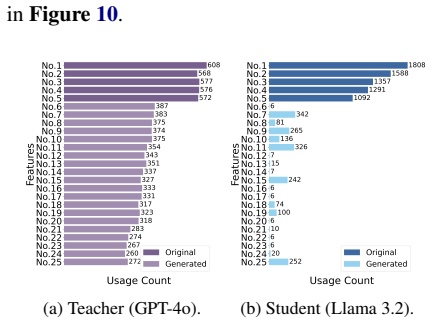
- The feature-usage analysis suggests LLMs attend to the meaning of tokenized column names; a probe that shuffles or anonymizes feature tokens and checks whether the usage preference flattens would separate genuine data understanding from token-order artifacts.
- Because the ML and LLM sides are trained independently, an iterative loop that feeds search-discovered sequences back into the student LLM and the evaluator could push the framework further; the paper's own limitation section points to end-to-end alignment as an open direction.
- A sharper stability measure than error rate would be run-to-run variance of downstream performance; comparing Teaming's variance against LLM-only baselines over repeated runs would quantify the stability gain directly.
Editorial analysis
A structured set of objections, weighed in public.
Referee Report
Summary. The paper proposes an LLM-ML teaming framework for generative feature transformation. It uses a teacher LLM to generate golden examples, trains an encoder-evaluator-decoder ML pipeline with gradient-based embedding search, fine-tunes a student LLM on the golden examples, and combines student LLM and ML decoder probabilities through a Product-of-Experts decoding rule. The authors report experiments on 23 classification and regression datasets and claim a 5% downstream performance improvement with roughly half of the error cases eliminated. The central mechanism is that LLMs provide syntactic validity while ML gradient search provides stability.
Significance. If the empirical claims held, the work would be a practical contribution to automated feature engineering, demonstrating a concrete way to combine symbolic generation with continuous optimization. The paper has clear strengths: a well-structured problem formulation, a modular four-step framework, comparisons against many baselines, an ablation study in Table 2, a robustness check in Figure 4, and a broad set of appendix studies. However, the paper's own Table 7 appears to contradict the central claim on the flagship OpenML 586 dataset, and the evaluation protocol is insufficiently specified. As written, the results section does not yet support the abstract's quantitative claims.
major comments (4)
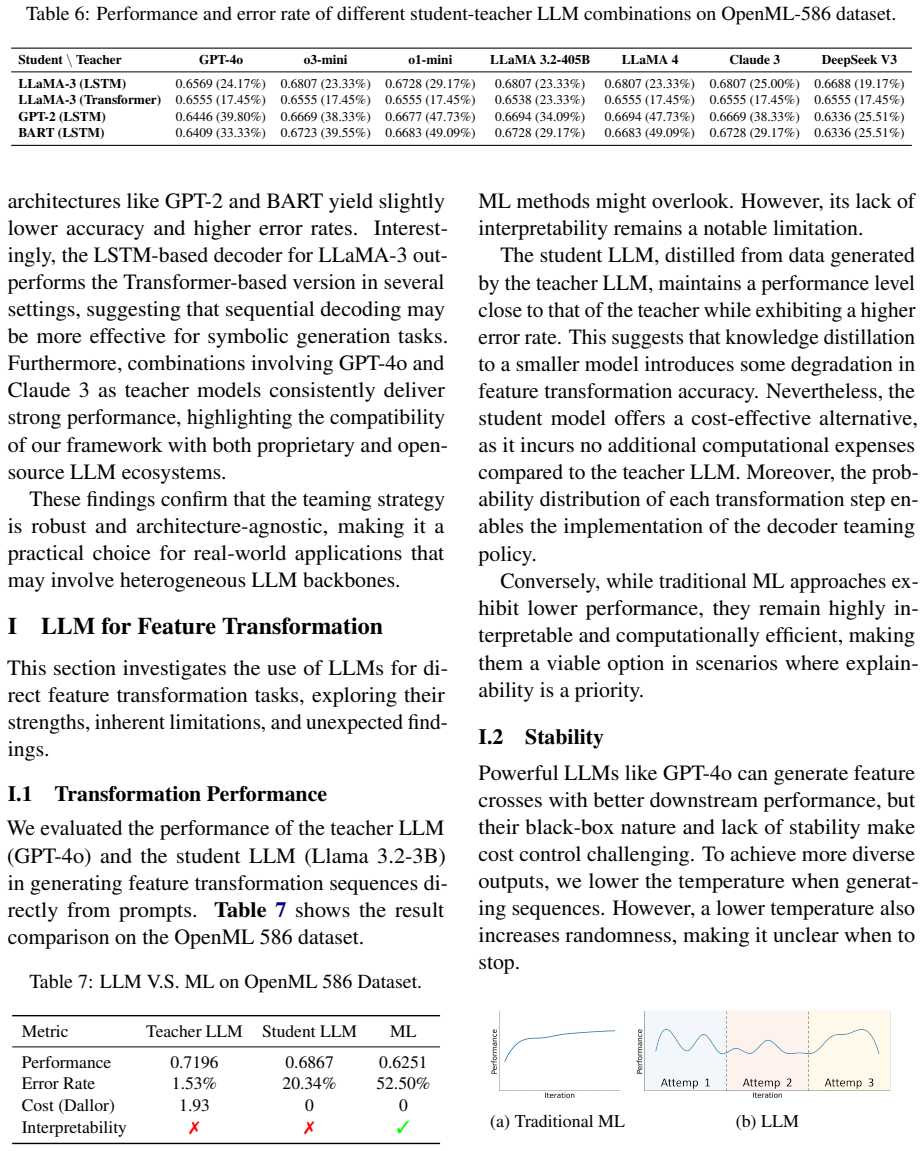
- [§4.6, Table 7; Tables 1 and 2; §4.3] On OpenML 586, Table 7 reports that the student Llama 3.2-3B, generating directly from prompts, achieves 0.6867 with a 20.34% error rate, while Tables 1 and 2 report that the full Teaming Policy achieves 0.6569 with a 24.17% error rate. The component that teaming is meant to augment therefore outperforms the integrated system on both downstream performance and validity on the same dataset. This contradicts the statement in §4.3 that 'Teaming consistently outperforms other methods across both classification and regression tasks' and the abstract's claim of reducing nearly half of the error cases. In addition, the same table reports the teacher LLM at 0.7196, also above the Teaming Policy. Please specify the exact protocol used for Table 7 (train/test split, downstream model, selection rule, number of runs) and reconcile these numbers; if the tables use different protocols, the comparison must be rerun under a common protocol.
- [§4.1; Tables 1, 2, 6, 7] No evaluation protocol is stated. The paper does not say how each dataset was split into training, validation, and test sets, which downstream model was used for the reported scores (the introduction mentions random forest only as an example), whether cross-validation was used, how many independent runs were averaged, or what the standard deviations were. Without this information, the point estimates in Tables 1, 2, 6, and 7 cannot be compared across methods or reproduced. Please report the full protocol, including multiple-seed statistics with error bars.
- [§3.3.2] The gradient search updates embeddings as z_new = z + eta times the gradient of the predicted score, then decodes the result. The ascent direction is the gradient of a two-layer MLP evaluator trained on a finite set of teacher-generated golden examples. If the evaluator is inaccurate in latent regions reached after several update steps, the decoded sequences may not improve downstream performance, and this is load-bearing for the claimed stability of the search. Please report the evaluator's held-out prediction error, the distribution of gradient-step magnitudes, and a comparison of predicted versus measured performance for the searched sequences, or otherwise validate the evaluator outside its training distribution.
- [Abstract; Tables 1 and 2] The abstract's quantitative claims—'5% improvement in downstream performance' and 'reducing nearly half of the error cases'—are not tied to any specific table or baseline. Table 1 shows gains of varying size over 'Original' across datasets, and Table 2 shows error-rate reductions that vary widely (for example, 35.00% to 5.00% on AP-omentum-ovary but 85.83% to 70.71% on German Credit). Please define the aggregate metric and report the exact computation behind the 5% and half-error claims.
minor comments (6)
- [Table 7] The header 'Cost (Dallor)' should read 'Cost (Dollar)'.
- [Appendix H] The word 'thried' should be 'tried'.
- [Appendix G] The text mentions 'FSNS' as a heavy pipeline, but FSNS is not defined or listed in Table 5; this appears to be a typo or a missing baseline description.
- [Throughout] The dataset name is written inconsistently as 'Openml 586' and 'OpenML 586' in different tables and text passages; please standardize.
- [§3.5, Eq. (2)] Please define the token vocabulary shared by the ML decoder and the LLM decoder, and clarify how the two decoders' vocabularies are aligned before the product is formed.
- [Abstract and §1] The statement 'The codes are available at this link' contains no URL; please provide a working link or an anonymized repository.
Circularity Check
No significant circularity: final results are measured downstream scores, not surrogate predictions; the mild self-referential training overlap is not definitional.
full rationale
The paper's derivation chain is not circular in the sense of reducing to its own inputs. The reported numbers in Tables 1, 2, and 3 are measured downstream performance (F1 or 1-RAE) of the final transformed features on the task datasets, not the evaluator's predicted scores. The evaluator in Section 3.3.2 is used only to provide gradient directions in latent space; the updated embedding is decoded into a sequence and that sequence is scored by a real downstream model. Thus the gradient-ascent step z_new = z + eta * grad_z(s_hat) does not by construction force the measured performance to match the training labels. Similarly, the student LLM's probability is combined with the ML decoder via Equation (2), but the final evaluation is again external to that combined probability. The main self-referential element is that the golden examples, the evaluator, and the student LLM are all produced by the same pipeline, and no separate validation set for the latent search is described; this is a mild training-evaluation overlap concern, not a definitional circularity. The paper itself acknowledges in its Limitations section that the ML and LLM components are trained independently, which is a transparency statement rather than a circular derivation. The Table 7 observation that the student LLM alone outperforms the full Teaming pipeline on OpenML 586 is a correctness and protocol-consistency concern, not a circularity one. No load-bearing self-citation chain, no fitted parameter renamed as a prediction, and no equation-level reduction of the claimed result to its own inputs was found.
Assumptions & free parameters
free parameters (4)
- lambda (teaming weight) =
not reported
- eta (embedding search step size) =
not reported
- alpha (joint loss weight) =
not reported
- M (number of golden examples) =
not reported
assumptions (4)
- domain assumption Teacher LLM (GPT-4o) generates golden examples that are high-quality and diverse enough to train both the evaluator and the student LLM.
- domain assumption The evaluator's predicted performance is a reliable proxy for actual downstream performance in the regions of embedding space visited by the gradient search.
- ad hoc to paper The product-of-experts normalization in Eq. 2 preserves the validity of the LLM and the stability of the ML decoder.
- standard math Postfix notation reduces the feature transformation search space to a finite set of size |O| + |X|^D + 3.
Cite this review
Pith. "Pith review of LLM-ML Teaming: Integrated Symbolic Decoding and Gradient Search for Valid and Stable Generative Feature Transformation." pith.science (2026). https://pith.science/paper/KQBY47MO
@misc{pith2026250609085,
  author       = {Pith},
  title        = {Pith review of: LLM-ML Teaming: Integrated Symbolic Decoding and Gradient Search for Valid and Stable Generative Feature Transformation},
  year         = {2026},
  howpublished = {\url{https://pith.science/paper/KQBY47MO}},
  note         = {Machine review of arXiv:2506.09085}
}
read the original abstract
Feature transformation enhances data representation by deriving new features from the original data. Generative AI offers potential for this task, but faces challenges in stable generation (consistent outputs) and valid generation (error-free sequences). Existing methods--traditional MLs' low validity and LLMs' instability--fail to resolve both. We find that LLMs ensure valid syntax, while ML's gradient-steered search stabilizes performance. To bridge this gap, we propose a teaming framework combining LLMs' symbolic generation with ML's gradient optimization. This framework includes four steps: (1) golden examples generation, aiming to prepare high-quality samples with the ground knowledge of the teacher LLM; (2) feature transformation sequence embedding and search, intending to uncover potentially superior embeddings within the latent space; (3) student LLM feature transformation, aiming to distill knowledge from the teacher LLM; (4) LLM-ML decoder teaming, dedicating to combine ML and the student LLM probabilities for valid and stable generation. The experiments on various datasets show that the teaming policy can achieve 5\% improvement in downstream performance while reducing nearly half of the error cases. The results also demonstrate the efficiency and robustness of the teaming policy. Additionally, we also have exciting findings on LLMs' capacity to understand the original data.
Figures


Figures from the paper (7 more)



Forward citations
Cited by 1 Pith paper
-
Teaching Time Series to See and Speak: Forecasting with Aligned Visual and Textual Perspectives
TimesCLIP aligns image-based and text-based views of the same time series via contrastive learning to improve forecasting accuracy on several benchmarks, but the full multimodal model is not used on two of the six lon...
Reference graph
Works this paper leans on
-
[1]
Ehtesamul Azim, Dongjie Wang, Tae Hyun Hwang, Yanjie Fu, and Wei Zhang. 2025. Biological pathway guided gene selection through collaborative reinforcement learning. arXiv preprint arXiv:2505.24155
work page Pith review arXiv 2025
-
[2]
Ehtesamul Azim, Dongjie Wang, Kunpeng Liu, Wei Zhang, and Yanjie Fu. 2024. Feature interaction aware automated data representation transformation. In Proceedings of the 2024 SIAM International Conference on Data Mining (SDM), pages 878--886. SIAM
work page 2024
-
[3]
Haoyue Bai, Guodong Chen, Wangyang Ying, Xinyuan Wang, Nanxu Gong, Sixun Dong, Giulia Pedrielli, Haoyu Wang, Haifeng Chen, and Yanjie Fu. 2025. Brownian bridge augmented surrogate simulation and injection planning for geological co \_2 storage. arXiv preprint arXiv:2505.18204
arXiv 2025
-
[4]
Haoyue Bai, Min Hou, Le Wu, Yonghui Yang, Kun Zhang, Richang Hong, and Meng Wang. 2023. Gorec: a generative cold-start recommendation framework. In Proceedings of the 31st ACM international conference on multimedia, pages 1004--1012
work page 2023
-
[5]
Haoyue Bai, Le Wu, Min Hou, Miaomiao Cai, Zhuangzhuang He, Yuyang Zhou, Richang Hong, and Meng Wang. 2024. Multimodality invariant learning for multimedia-based new item recommendation. In Proceedings of the 47th International ACM SIGIR Conference on Research and Development in Information Retrieval, pages 677--686
work page 2024
-
[6]
Privacy preserving generative feature transformation
Haoyue Bai, Wangyang Ying, Nanxu Gong, Xinyuan Wang, Hao Liu, and Yanjie Fu. Privacy preserving generative feature transformation
-
[7]
David M Blei, Andrew Y Ng, and Michael I Jordan. 2003. Latent dirichlet allocation. Journal of machine Learning research, 3(Jan):993--1022
2003
-
[8]
Xiangning Chen, Qingwei Lin, Chuan Luo, Xudong Li, Hongyu Zhang, Yong Xu, Yingnong Dang, Kaixin Sui, Xu Zhang, Bo Qiao, and 1 others. 2019. Neural feature search: A neural architecture for automated feature engineering. In 2019 IEEE International Conference on Data Mining (ICDM), pages 71--80. IEEE
work page 2019
Show all 69 references
-
[9]
Nanxu Gong, Sixun Dong, Haoyue Bai, Xinyuan Wang, Wangyang Ying, and Yanjie Fu. 2025 a . Agentic feature augmentation: Unifying selection and generation with teaming, planning, and memories. arXiv preprint arXiv:2505.15076
2025 arXiv
-
[10]
Nanxu Gong, Zijun Li, Sixun Dong, Haoyue Bai, Wangyang Ying, Xinyuan Wang, and Yanjie Fu. 2025 b . Sculpting features from noise: Reward-guided hierarchical diffusion for task-optimal feature transformation. arXiv preprint arXiv:2505.15152
2025 arXiv
-
[11]
Nanxu Gong, Chandan K Reddy, Wangyang Ying, Haifeng Chen, and Yanjie Fu. 2025 c . Evolutionary large language model for automated feature transformation. In Proceedings of the AAAI Conference on Artificial Intelligence, volume 39, pages 16844--16852
2025
-
[12]
Nanxu Gong, Xinyuan Wang, Wangyang Ying, Haoyue Bai, Sixun Dong, Haifeng Chen, and Yanjie Fu. 2025 d . Unsupervised feature transformation via in-context generation, generator-critic llm agents, and duet-play teaming. arXiv preprint arXiv:2504.21304
2025 arXiv
-
[13]
Nanxu Gong, Wangyang Ying, Dongjie Wang, and Yanjie Fu. 2025 e . Neuro-symbolic embedding for short and effective feature selection via autoregressive generation. ACM Transactions on Intelligent Systems and Technology, 16(2):1--21
2025
-
[14]
Sungwon Han, Jinsung Yoon, Sercan O Arik, and Tomas Pfister. 2024. Large language models can automatically engineer features for few-shot tabular learning. arXiv preprint arXiv:2404.09491
2024 arXiv
-
[15]
Zhuangzhuang He, Yifan Wang, Yonghui Yang, Peijie Sun, Le Wu, Haoyue Bai, Jinqi Gong, Richang Hong, and Min Zhang. 2024. Double correction framework for denoising recommendation. In Proceedings of the 30th ACM SIGKDD Conference on Knowledge Discovery and Data Mining, pages 1062--1072
2024
-
[16]
Noah Hollmann, Samuel M \"u ller, and Frank Hutter. 2023. Large language models for automated data science: Introducing caafe for context-aware automated feature engineering. Advances in Neural Information Processing Systems, 36:44753--44775
2023
-
[17]
Noah Hollmann, Samuel M \"u ller, and Frank Hutter. 2024. Large language models for automated data science: Introducing caafe for context-aware automated feature engineering. Advances in Neural Information Processing Systems, 36
2024
-
[18]
Franziska Horn, Robert Pack, and Michael Rieger. 2019. The autofeat python library for automated feature engineering and selection. In Joint European Conference on Machine Learning and Knowledge Discovery in Databases, pages 111--120. Springer
2019
-
[19]
Franziska Horn, Robert Pack, and Michael Rieger. 2020. The autofeat python library for automated feature engineering and selection. In Machine Learning and Knowledge Discovery in Databases: International Workshops of ECML PKDD 2019, W \"u rzburg, Germany, September 16--20, 201...
2020
-
[20]
Jeremy Howard. 2023. https://www.kaggle.com/datasets Kaggle dataset download . [EB/OL]
2023
-
[21]
Xuanming Hu, Dongjie Wang, Wangyang Ying, and Yanjie Fu. 2024. Reinforcement feature transformation for polymer property performance prediction. In Proceedings of the 33rd ACM International Conference on Information and Knowledge Management, pages 4538--4545
2024
-
[22]
Daniel P Jeong, Zachary C Lipton, and Pradeep Ravikumar. 2024. Llm-select: Feature selection with large language models. arXiv preprint arXiv:2407.02694
2024 arXiv
-
[23]
James Max Kanter and Kalyan Veeramachaneni. 2015. Deep feature synthesis: Towards automating data science endeavors. In 2015 IEEE international conference on data science and advanced analytics (DSAA), pages 1--10. IEEE
2015
-
[24]
Gjergji Kasneci and Enkelejda Kasneci. 2024. Enriching tabular data with contextual llm embeddings: A comprehensive ablation study for ensemble classifiers. arXiv preprint arXiv:2411.01645
2024 arXiv
-
[25]
Gilad Katz, Eui Chul Richard Shin, and Dawn Song. 2016. Explorekit: Automatic feature generation and selection. In 2016 IEEE 16th international conference on data mining (ICDM), pages 979--984. IEEE
2016
-
[26]
Maxim Khanov, Jirayu Burapacheep, and Yixuan Li. 2024. Args: Alignment as reward-guided search. arXiv preprint arXiv:2402.01694
2024 arXiv
-
[27]
Udayan Khurana, Horst Samulowitz, and Deepak Turaga. 2018. Feature engineering for predictive modeling using reinforcement learning. In Proceedings of the AAAI Conference on Artificial Intelligence, volume 32
2018
-
[28]
Udayan Khurana, Deepak Turaga, Horst Samulowitz, and Srinivasan Parthasrathy. 2016. Cognito: Automated feature engineering for supervised learning. In 2016 IEEE 16th international conference on data mining workshops (ICDMW), pages 1304--1307. IEEE
2016
-
[29]
Lingkai Kong, Haorui Wang, Wenhao Mu, Yuanqi Du, Yuchen Zhuang, Yifei Zhou, Yue Song, Rongzhi Zhang, Kai Wang, and Chao Zhang. 2024. Aligning large language models with representation editing: A control perspective. arXiv preprint arXiv:2406.05954
2024 arXiv
-
[30]
Jaris K \"u ken, Lennart Purucker, and Frank Hutter. 2024. Large language models engineer too many simple features for tabular data. arXiv preprint arXiv:2410.17787
2024 arXiv
-
[31]
Haozhou Li, Qinke Peng, Xinyuan Wang, Xu Mou, and Yonghao Wang. 2023 a . Sehf: A summary-enhanced hierarchical framework for financial report sentiment analysis. IEEE Transactions on Computational Social Systems, 11(3):4087--4101
2023
-
[32]
Haozhou Li, Xinyuan Wang, Hongkai Du, Wentong Sun, and Qinke Peng. 2024. Sade: A speaker-aware dual encoding model based on diagbert for medical triage and pre-diagnosis. In ICASSP 2024-2024 IEEE International Conference on Acoustics, Speech and Signal Processing (ICASSP), pag...
2024
-
[33]
Yinheng Li, Shaofei Wang, Han Ding, and Hang Chen. 2023 b . Large language models in finance: A survey. In Proceedings of the fourth ACM international conference on AI in finance, pages 374--382
2023
-
[34]
Hanghang Liu, Linyi Liu, and Clifford J Rosen. 2024 a . Pth and the regulation of mesenchymal cells within the bone marrow niche. Cells, 13(5):406
2024
-
[35]
Linyi Liu, Phuong T Le, J Patrizia Stohn, Hanghang Liu, Wangyang Ying, Roland Baron, and Clifford J Rosen. 2024 b . Calorie restriction in mice impairs cortical but not trabecular peak bone mass by suppressing bone remodeling. Journal of Bone and Mineral Research, 39(8):1188--1199
2024
-
[36]
Linyi Liu, Sha Leng, Junli Yue, Qian Lu, Weizhe Xu, Xiaowei Yi, Dingming Huang, and Lan Zhang. 2019. Edta enhances stromal cell--derived factor 1 --induced migration of dental pulp cells by up-regulating chemokine receptor 4 expression. Journal of Endodontics, 45(5):599--605
2019
-
[37]
Andrzej Ma \'c kiewicz and Waldemar Ratajczak. 1993. Principal components analysis (pca). Computers & Geosciences, 19(3):303--342
1993
-
[38]
Public . 2023 a . https://cplm.biocuckoo.cn/ Cplm dataset download . [EB/OL]
2023
-
[39]
Public . 2023 b . https://www.openml.org Openml dataset download . [EB/OL]
2023
-
[40]
Public . 2023 c . https://archive.ics.uci.edu/ Uci dataset download . [EB/OL]
2023
-
[41]
Jiahao Qiu, Yifu Lu, Yifan Zeng, Jiacheng Guo, Jiayi Geng, Huazheng Wang, Kaixuan Huang, Yue Wu, and Mengdi Wang. 2024. Treebon: Enhancing inference-time alignment with speculative tree-search and best-of-n sampling. arXiv preprint arXiv:2410.16033
2024 arXiv
-
[42]
Chandan Singh, Armin Askari, Rich Caruana, and Jianfeng Gao. 2023. Augmenting interpretable models with large language models during training. Nature Communications, 14(1):7913
2023
-
[43]
Binh Tran, Bing Xue, and Mengjie Zhang. 2016. Genetic programming for feature construction and selection in classification on high-dimensional data. Memetic Computing, 8:3--15
2016
-
[44]
Dongjie Wang, Yanjie Fu, Kunpeng Liu, Xiaolin Li, and Yan Solihin. 2022 a . Group-wise reinforcement feature generation for optimal and explainable representation space reconstruction. In Proceedings of the 28th ACM SIGKDD Conference on Knowledge Discovery and Data Mining, pag...
2022
-
[45]
Dongjie Wang, Yanyong Huang, Wangyang Ying, Haoyue Bai, Nanxu Gong, Xinyuan Wang, Sixun Dong, Tao Zhe, Kunpeng Liu, Meng Xiao, and 1 others. 2025 a . Towards data-centric ai: A comprehensive survey of traditional, reinforcement, and generative approaches for tabular data trans...
2025 arXiv
-
[46]
Dongjie Wang, Meng Xiao, Min Wu, Yuanchun Zhou, Yanjie Fu, and 1 others. 2023. Reinforcement-enhanced autoregressive feature transformation: Gradient-steered search in continuous space for postfix expressions. Advances in Neural Information Processing Systems, 36:43563--43578
2023
-
[47]
Xinyuan Wang, Haozhou Li, Dingfang Zheng, and Qinke Peng. 2024 a . Lcmdc: Large-scale chinese medical dialogue corpora for automatic triage and medical consultation. arXiv preprint arXiv:2410.03521
2024 arXiv
-
[48]
Xinyuan Wang, Yanchi Liu, Wei Cheng, Xujiang Zhao, Zhengzhang Chen, Wenchao Yu, Yanjie Fu, and Haifeng Chen. 2025 b . Mixllm: Dynamic routing in mixed large language models. arXiv preprint arXiv:2502.18482
2025 arXiv
-
[49]
Xinyuan Wang, Qinke Peng, Xu Mou, Haozhou Li, and Ying Wang. 2022 b . A hierarchal bert structure for native speaker writing detection. In 2022 China Automation Congress (CAC), pages 3705--3710. IEEE
2022
-
[50]
Xinyuan Wang, Dongjie Wang, Wangyang Ying, Rui Xie, Haifeng Chen, and Yanjie Fu. 2024 b . Knockoff-guided feature selection via a single pre-trained reinforced agent. arXiv preprint arXiv:2403.04015
2024 arXiv
-
[51]
Xinyuan Wang, Liang Wu, Liangjie Hong, Hao Liu, and Yanjie Fu. 2024 c . Llm-enhanced user-item interactions: Leveraging edge information for optimized recommendations. arXiv preprint arXiv:2402.09617
2024 arXiv
-
[52]
Ying Wang, Qinke Peng, Xu Mou, Xinyuan Wang, Haozhou Li, Tian Han, Zhao Sun, and Xiao Wang. 2022 c . A successful hybrid deep learning model aiming at promoter identification. BMC bioinformatics, 23(Suppl 1):206
2022
-
[53]
Meng Xiao, Dongjie Wang, Min Wu, Kunpeng Liu, Hui Xiong, Yuanchun Zhou, and Yanjie Fu. 2024. Traceable group-wise self-optimizing feature transformation learning: A dual optimization perspective. ACM Transactions on Knowledge Discovery from Data, 18(4):1--22
2024
-
[54]
Meng Xiao, Dongjie Wang, Min Wu, Ziyue Qiao, Pengfei Wang, Kunpeng Liu, Yuanchun Zhou, and Yanjie Fu. 2023. Traceable automatic feature transformation via cascading actor-critic agents. In Proceedings of the 2023 SIAM International Conference on Data Mining (SDM), pages 775--783. SIAM
2023
-
[55]
Jinglue Xu, Jialong Li, Zhen Liu, Nagar Anthel Venkatesh Suryanarayanan, Guoyuan Zhou, Jia Guo, Hitoshi Iba, and Kenji Tei. 2024. Large language models synergize with automated machine learning. arXiv preprint arXiv:2405.03727
2024 arXiv
-
[56]
Wangyang Ying, Haoyue Bai, Nanxu Gong, Xinyuan Wang, Sixun Dong, Haifeng Chen, and Yanjie Fu. 2025 a . Bridging the domain gap in equation distillation with reinforcement feedback. arXiv preprint arXiv:2505.15572
2025 arXiv
-
[57]
Wangyang Ying, Haoyue Bai, Kunpeng Liu, and Yanjie Fu. 2024 a . Topology-aware reinforcement feature space reconstruction for graph data. arXiv preprint arXiv:2411.05742
2024 arXiv
-
[58]
Wangyang Ying, Dongjie Wang, Haifeng Chen, and Yanjie Fu. 2024 b . Feature selection as deep sequential generative learning. ACM Transactions on Knowledge Discovery from Data, 18(9):1--21
2024
-
[59]
Wangyang Ying, Dongjie Wang, Xuanming Hu, Ji Qiu, Jin Park, and Yanjie Fu. 2024 c . Revolutionizing biomarker discovery: Leveraging generative ai for bio-knowledge-embedded continuous space exploration. In Proceedings of the 33rd ACM International Conference on Information and...
2024
-
[60]
Wangyang Ying, Dongjie Wang, Xuanming Hu, Yuanchun Zhou, Charu C Aggarwal, and Yanjie Fu. 2024 d . Unsupervised generative feature transformation via graph contrastive pre-training and multi-objective fine-tuning. In Proceedings of the 30th ACM SIGKDD Conference on Knowledge D...
2024
-
[61]
Wangyang Ying, Dongjie Wang, Kunpeng Liu, Leilei Sun, and Yanjie Fu. 2023. Self-optimizing feature generation via categorical hashing representation and hierarchical reinforcement crossing. In 2023 IEEE International Conference on Data Mining (ICDM), pages 748--757. IEEE
2023
-
[62]
Wangyang Ying, Cong Wei, Nanxu Gong, Xinyuan Wang, Haoyue Bai, Arun Vignesh Malarkkan, Sixun Dong, Dongjie Wang, Denghui Zhang, and Yanjie Fu. 2025 b . A survey on data-centric ai: Tabular learning from reinforcement learning and generative ai perspective. arXiv preprint arXiv...
2025 arXiv
-
[63]
Wangyang Ying, Lei Zhang, and Hongli Deng. 2020. Sichuan dialect speech recognition with deep lstm network. Frontiers of Computer Science, 14(2):378--387
2020
-
[64]
Tianping Zhang, Zheyu Aqa Zhang, Zhiyuan Fan, Haoyan Luo, Fengyuan Liu, Qian Liu, Wei Cao, and Li Jian. 2023. Openfe: Automated feature generation with expert-level performance. In International Conference on Machine Learning, pages 41880--41901. PMLR
2023
-
[65]
Xinhao Zhang, Jinghan Zhang, Banafsheh Rekabdar, Yuanchun Zhou, Pengfei Wang, and Kunpeng Liu. 2024. Dynamic and adaptive feature generation with llm. arXiv preprint arXiv:2406.03505
2024
-
[66]
Wayne Xin Zhao, Kun Zhou, Junyi Li, Tianyi Tang, Xiaolei Wang, Yupeng Hou, Yingqian Min, Beichen Zhang, Junjie Zhang, Zican Dong, and 1 others. 2023. A survey of large language models. arXiv preprint arXiv:2303.18223
2023 arXiv
-
[67]
Guanghui Zhu, Shen Jiang, Xu Guo, Chunfeng Yuan, and Yihua Huang. 2022. Evolutionary automated feature engineering. In Pacific Rim International Conference on Artificial Intelligence, pages 574--586. Springer
2022
-
[68]
online" 'onlinestring :=
ENTRY address archivePrefix author booktitle chapter edition editor eid eprint eprinttype howpublished institution journal key month note number organization pages publisher school series title type volume year doi pubmed url lastchecked label extra.label sort.label short.list...
-
[69]
write newline
" write newline "" before.all 'output.state := FUNCTION n.dashify 't := "" t empty not t #1 #1 substring "-" = t #1 #2 substring "--" = not "--" * t #2 global.max substring 't := t #1 #1 substring "-" = "-" * t #2 global.max substring 't := while if t #1 #1 substring * t #2 gl...
Reviewed August 7, 2026 · model on record in the stance chip above.
Discussion (0). Sign in to comment.