REVIEW 4 major objections 4 minor 63 references
A Qualitative Investigation into LLM-Generated Multilingual Code Comments and Automatic Evaluation Metrics
T0 review · 4 major / 4 minor · reviewed 2026-08-07 · deepseek-v4-flash
Pith's one-line read This paper shows that neural metrics like BERTScore, CodeBERTScore, and BARTScore cannot reliably tell correct from incorrect multilingual code comments, or real generations from random noise.
desk verdict A solid qualitative study with a valuable dataset and taxonomy, but the headline metric-failure claim needs quantitative support and label reliability checks before it lands. read the letter →
The pith
A machine-rendered reading of the paper's core claim, the machinery that carries it, and where it could break.
The reading
What carries the argument
The argument rests on two linked instruments. First is the open-coding error taxonomy: 26 error types grouped into model-specific, linguistic, semantic, and syntax categories, built through five iterative labeling rounds by six authors and used to label 12,500 model-generated comments. Second is the noise-overlap test: for each generated comment, the authors score a 'uniform noise' sequence (random tokens from the model's tokenizer, same length) and a 'targeted noise' sequence (random tokens sampled from the surrounding code) and compare metric distributions. The taxonomy supplies the qualitative evidence of what goes wrong; the noise-overlap test supplies the quantitative evidence that neural metrics fail to distinguish meaningful completions from meaningless ones. Expert correctness labels (correct/partial/incorrect) provide the reference against which metric separation is judged.
What would settle it
Re-label a random sample of the released 12,500 comments with multiple independent native speakers per language and compute, for each metric, the area under the ROC curve separating expert-correct from expert-incorrect comments; if any neural metric consistently reaches an AUC above roughly 0.9 across languages, the paper's claim that these metrics cannot reliably differentiate correct from incorrect comments would be falsified.
Extended reading notes
Core claim
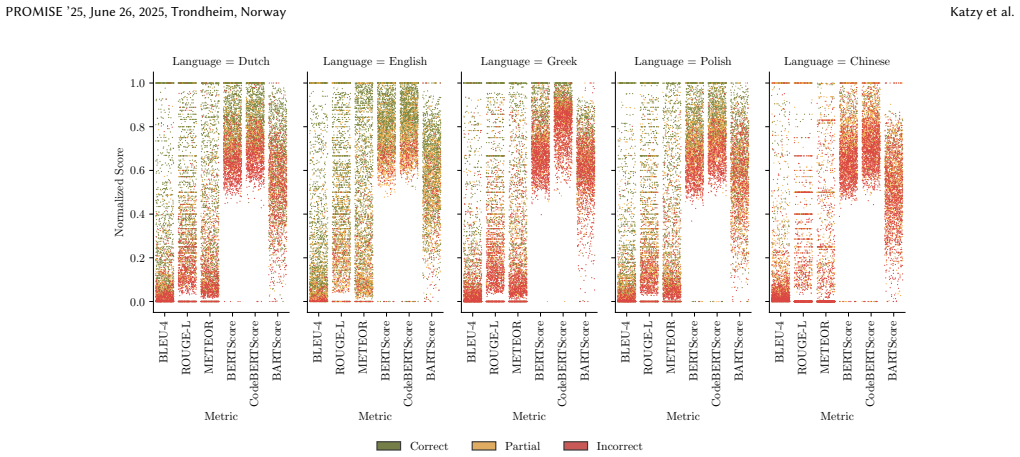
The central discovery is that modern neural evaluation metrics, despite their wide use, do not measure the correctness of generated code comments in multilingual settings. Across five languages and five 7B–8B code models, the authors show that expert-rated correct and incorrect comments receive substantially overlapping scores from BERTScore, CodeBERTScore, and BARTScore, and that these metrics also assign high scores to pure token noise sampled either uniformly from the tokenizer or from the surrounding code context. Word-level metrics like BLEU and ROUGE-L separate noise from real comments more clearly, though they score everything lower. The authors further find that models are often 'partially correct': they produce comments that are close but contain errors, and that Chinese, despite being well represented in training corpora, is the worst-performing language, while Greek shows the largest jump in linguistic errors (15.1× over English). The paper releases the 12,500 labeled generations to let others verify and build on these findings.
Load-bearing premise
The load-bearing premise is that the correctness labels assigned by a single native-speaker expert per language are reliable ground truth for judging the metrics; if those labels are noisy or biased, the reported overlap between correct and incorrect scores could change materially.
Editorial extensions
If this is right
- Automatic model rankings for non-English code comment generation are unreliable if based on neural metrics, because the metrics cannot separate correct from incorrect comments.
- Neural metrics overstate model quality: they score Chinese predictions nearly as high as English ones even though human raters mark Chinese correct 5.5× less often.
- Practitioners should keep human verification in the loop when generating comments in non-English languages, especially for languages like Greek where linguistic errors jump.
- Word-level metrics, while harsher, track human judgments across languages better than neural metrics in this study.
- The released dataset of 12,500 labeled comments gives a common benchmark for testing whether future metrics can separate correct from incorrect and real from noise.
Reading between the lines
- We infer that the noise-overlap test could serve as a cheap, model-agnostic sanity check for any new evaluation metric: before trusting a metric on real outputs, require that its score distribution for genuine predictions be clearly separated from uniform and targeted noise.
- If neural metrics compress differences between languages as much as the strip plots suggest, then published English-vs-non-English performance gaps for code models may be understated; the true gap could be larger than reported.
- Because linguistic errors rise far faster than semantic errors in non-English settings, we infer that improving tokenization and adding non-English code to training data may yield larger gains for multilingual code support than improving code reasoning alone.
- The finding that targeted noise scores below uniform noise for most languages suggests these metrics respond to surface overlap with the surrounding context rather than to meaning; a direct test would be to paraphrase a correct comment and see whether the score drops as much as for noise.
Editorial analysis
A structured set of objections, weighed in public.
Referee Report
Summary. The paper studies multilingual code-comment generation by five open-weight code LLMs (CodeGemma, CodeLlama, CodeQwen1.5, GraniteCode, StarCoder2) across five natural languages (Chinese, Dutch, English, Greek, Polish). Using a Fill-in-the-Middle setup with a three-token ground-truth prefix, the authors collect 12,500 model generations over 2,500 source files, label them through open coding, and derive a taxonomy of 26 error types. They further compare six automatic metrics (BLEU-4, ROUGE-L, METEOR, BERTScore, CodeBERTScore, BARTScore) against expert correctness labels and against two types of random noise. The central claims are that non-English generation introduces substantially more linguistic errors, that neural metrics assign high scores even when human raters judge outputs incorrect, and that neural metrics fail to separate correct from incorrect comments or real generations from noise. The dataset is publicly released.
Significance. If the central claims are supported, the paper provides a useful multilingual benchmark and a sobering result: commonly used neural metrics may give inflated and potentially misleading evaluations of non-English code-comment generation. The strengths of the work include the public release of 12,500 labeled generations, the use of open-weight models for reproducibility, a transparent qualitative methodology, and a taxonomy that can inform future multilingual code-generation research. However, the metric-reliability conclusions currently rest on visual inspection of strip plots and on expert labels whose reliability is not quantified, and the priming design introduces a systematic overlap with the reference. These load-bearing issues need to be addressed before the central negative claims can be accepted.
major comments (4)
- [§6.4 and Figure 4 (also §6.3 and Figure 3)] The central claim that neural metrics fail to reliably separate correct from incorrect comments, and real comments from noise, is supported only by visual overlap in strip plots. The abstract states a 'significant score overlap,' but no statistical test, confidence interval, or effect size is reported. I recommend adding quantitative separation measures per metric and per language, for example the area under the ROC curve for distinguishing correct vs. incorrect (or correct+partial vs. incorrect), rank-biserial correlation, or an overlap coefficient, with confidence intervals. The same applies to the noise-vs-real comparison in §6.3, where 'significant overlap' should be quantified rather than asserted from Figure 3.
- [§4.2 and §8] The correctness labels are the ground truth against which metric trustworthiness is judged, yet the manuscript reports no inter-rater reliability, no double-labeling proportion, and no adjudication procedure for the final 12,500 labels. Section 8 concedes that labeling bias remains a risk, but the concession does not quantify its effect. If each language was labeled by a single native-level author, label noise or systematic bias could directly create or inflate the observed score overlap in Figure 4, for example by placing near-correct paraphrases in the 'partial' bucket or by mislabeling copied erroneous comments. I request a reliability analysis (e.g., Cohen's kappa or Krippendorff's alpha on a labeled subset) and a sensitivity analysis showing that the metric-overlap conclusions are stable under plausible label noise.
- [§4.1 and Figure 1] The inference protocol adds the first three tokens of the ground-truth comment as a priming prefix. Every prediction therefore shares a guaranteed token-level prefix with the reference comment, which inflates all n-gram-based metrics (BLEU, ROUGE, METEOR) and can also affect embedding- and likelihood-based neural metrics. This is especially relevant to the noise comparisons in §6.3, because random noise does not contain this prefix. The manuscript does not control for this artifact or discuss its direction and magnitude. I recommend either ablating the priming prefix from the scored portion of the prediction, reporting scores computed after removing the first three tokens, or explicitly quantifying how much of the metric overlap is attributable to this design choice.
- [§4.2 and Table 1 (MS-ME3)] The correctness definition in §4.2 states that a correct prediction must include all of the information in the original comment. However, the error taxonomy's MS-ME3 (Training Data Memorization) explicitly covers cases where 'the prediction is the same as the erroneous ground truth' (e.g., a comment containing a grammatical error or a factual mismatch with the code). Under the §4.2 definition, such a prediction would satisfy the 'include all information in the original comment' criterion and could be labeled correct, even though it is tagged as a memorization error. The manuscript does not specify how this conflict was resolved during labeling. This is not a cosmetic issue: it can directly affect the counts in Table 2 and the score distributions in Figure 4, and therefore the central metric-reliability conclusion.
minor comments (4)
- [§4.1] The sentence 'Finally, 500 random files were sampled for each language, resulting in 2,500 generated comments for each language' is imprecise: 500 files × 5 models yields 2,500 predictions per language, not 2,500 comments. Please rephrase to avoid confusing files with generated comments.
- [Figure 3] The y-axis label for the BARTScore panel appears garbled ('□12 □10 □8 ...'), and the panels use different effective scales (BLEU-4 appears to be on a 0-100 scale while the other metrics are normalized to 0-1). Please harmonize the axes or state the scaling explicitly for each panel.
- [§6.3] The statement that 'the targeted noise performed worse than the uniform noise for all languages except Chinese' is ambiguous: 'worse' could mean lower metric scores or higher overlap with real generations. Please specify the intended meaning and report the corresponding quantitative comparison.
- [§6.4] The strip plots are difficult to read because thousands of points overlap. Consider adding summary distributions (e.g., overlaid kernel densities or box plots) and quantitative separation statistics, which would also directly support the paper's central claim.
Circularity Check
No circularity: metric-trustworthiness conclusion is grounded in external expert labels and independent noise baselines.
full rationale
The paper's central claim is that neural metrics (BERTScore, CodeBERTScore, BARTScore) fail to separate expert-correct from expert-incorrect multilingual comments and also overlap with random noise. This claim is not derived by fitting or by self-citation: expert correctness labels (Section 4.2) are generated by native-speaker authors and are external to the metric scores; the noise distributions (Section 4.3) are constructed as random tokens independent of both labels and predictions; and the metric scores in Figures 3 and 4 are computed with public off-the-shelf metrics with no calibration against the human labels. The only self-citation with any load-bearing role is [12] as a starting point for the initial error taxonomy: 'An initial set of errors based on previous work [12, 46, 26] was selected and iteratively improved' (Section 4.2). That taxonomy was then revised over five iterations, and the final conclusions about metric reliability do not depend on the prior taxonomy. The acknowledged labeling-bias limitation (Section 8) is a validity threat to the human ground truth, not a circular reduction: noisy labels could in principle change the measured overlap, but this is a measurement-quality concern, not an identity between input and output. No equation is defined in terms of the quantity it predicts, no fitted parameter is renamed as a prediction, and no uniqueness theorem or external constraint is imported from the authors' prior work. The derivation chain is therefore self-contained with respect to its empirical inputs.
Assumptions & free parameters
free parameters (3)
- Priming token count =
3
- Inference limit threshold =
average comment length + 3 standard deviations
- Minimum comment length =
10 tokens
assumptions (5)
- ad hoc to paper The first 3 tokens of the ground-truth comment are given to the model during generation.
- domain assumption OpenSubtitles2016 word-frequency lists are a valid basis for sampling representative code files in each language.
- domain assumption Single-expert correctness labels are reliable ground truth.
- domain assumption Uniform noise and targeted noise are valid proxies for meaningless completions.
- domain assumption Visual score overlap implies metric failure.
Cite this review
Pith. "Pith review of A Qualitative Investigation into LLM-Generated Multilingual Code Comments and Automatic Evaluation Metrics." pith.science (2026). https://pith.science/paper/2O2ZSRUN
@misc{pith2026250515469,
  author       = {Pith},
  title        = {Pith review of: A Qualitative Investigation into LLM-Generated Multilingual Code Comments and Automatic Evaluation Metrics},
  year         = {2026},
  howpublished = {\url{https://pith.science/paper/2O2ZSRUN}},
  note         = {Machine review of arXiv:2505.15469}
}
read the original abstract
Large Language Models are essential coding assistants, yet their training is predominantly English-centric. In this study, we evaluate the performance of code language models in non-English contexts, identifying challenges in their adoption and integration into multilingual workflows. We conduct an open-coding study to analyze errors in code comments generated by five state-of-the-art code models, CodeGemma, CodeLlama, CodeQwen1.5, GraniteCode, and StarCoder2 across five natural languages: Chinese, Dutch, English, Greek, and Polish. Our study yields a dataset of 12,500 labeled generations, which we publicly release. We then assess the reliability of standard metrics in capturing comment \textit{correctness} across languages and evaluate their trustworthiness as judgment criteria. Through our open-coding investigation, we identified a taxonomy of 26 distinct error categories in model-generated code comments. They highlight variations in language cohesion, informativeness, and syntax adherence across different natural languages. Our analysis shows that, while these models frequently produce partially correct comments, modern neural metrics fail to reliably differentiate meaningful completions from random noise. Notably, the significant score overlap between expert-rated correct and incorrect comments calls into question the effectiveness of these metrics in assessing generated comments.
Figures


Figures from the paper (1 more)
Reference graph
Works this paper leans on
-
[1]
Toufique Ahmed, Premkumar Devanbu, Christoph Treude, and Michael Pradel
-
[2]
John Airey and Cedric Linder. 2006. Language and the experience of learning university physics in sweden. EUROPEAN JOURNAL OF PHYSICS Eur. J. Phys , 27, (May 2006), 553–560. doi: 10.1088/0143-0807/27/3/009
-
[3]
Satanjeev Banerjee and Alon Lavie. 2005. Meteor: an automatic metric for mt evaluation with improved correlation with human judgments. In Proceedings of the acl workshop on intrinsic and extrinsic evaluation measures for machine translation and/or summarization, 65–72
work page 2005
-
[4]
Mohammad Bavarian, Heewoo Jun, Nikolas Tezak, John Schulman, Christine McLeavey, Jerry Tworek, and Mark Chen. 2022. Efficient training of language models to fill in the middle. arXiv preprint arXiv:2207.14255
arXiv 2022
-
[5]
Samuel Boguslawski, Rowan Deer, and Mark G Dawson. 2025. Programming education and learner motivation in the age of generative ai: student and educator perspectives. Information and Learning Sciences , 126, 1/2, 91–109
work page 2025
-
[6]
A. R. Fabbri, Wojciech Kryscinski, Bryan McCann, Richard Socher, and Dragomir R. Radev. 2020. Summeval: re-evaluating summarization evaluation. Transac- tions of the Association for Computational Linguistics , 9, 391–409
work page 2020
-
[7]
Zhangyin Feng et al. 2020. CodeBERT: a pre-trained model for programming and natural languages. In Findings of the Association for Computational Lin- guistics: EMNLP 2020. Trevor Cohn, Yulan He, and Yang Liu, (Eds.) Association for Computational Linguistics, Online, (Nov. 2020)
work page 2020
-
[8]
GitHub. 2022. The state of the octoverse: global tech talent report 2022. Ac- cessed: 2024-11-13. (2022). octoverse.github.com/2022/global-tech-talent
work page 2022
Show all 63 references
-
[9]
Hubert Haider and Luka Szucsich. 2022. Theoretical Linguistics, 48, 1-2, 1–39. doi: doi:10.1515/tl-2022-2035
2022 doi
-
[10]
Xing Hu, Xin Xia, David Lo, Zhiyuan Wan, Qiuyuan Chen, and Thomas Zim- mermann. 2022. Practitioners’ expectations on automated code comment gener- ation. In Proceedings of the 44th international conference on software engineering
2022
-
[11]
Maliheh Izadi and et al. 2022. Codefill: multi-token code completion by jointly learning from structure and naming sequences. In Proceedings of the 44th International Conference on Software Engineering , 401–412
2022
-
[12]
Maliheh Izadi, Jonathan Katzy, Tim Van Dam, Marc Otten, Razvan Mihai Popescu, and Arie Van Deursen. 2024. Language models for code comple- tion: a practical evaluation. In Proceedings of the IEEE/ACM 46th International Conference on Software Engineering , 1–13. 6https://huggin...
2024
-
[13]
Juyong Jiang, Fan Wang, Jiasi Shen, Sungju Kim, and Sunghun Kim. 2024. A sur- vey on large language models for code generation.arXiv preprint arXiv:2406.00515
2024 arXiv
-
[14]
Jonathan Katzy, Maliheh Izadi, and Arie van Deursen. 2023. On the impact of language selection for training and evaluating programming language models. In 2023 IEEE 23rd International Working Conference on Source Code Analysis and Manipulation (SCAM). IEEE, 271–276
2023
-
[15]
Jacob Devlin Ming-Wei Chang Kenton and Lee Kristina Toutanova. 2019. Bert: pre-training of deep bidirectional transformers for language understanding. In Proceedings of naacL-HLT. Vol. 1. Minneapolis, Minnesota, 2
2019
-
[16]
Junaed Younus Khan and Gias Uddin. 2022. Automatic code documentation generation using gpt-3. (2022). eprint: 2209.02235
2022 arXiv
-
[17]
Fajri Koto, Nurul Aisyah, Haonan Li, and Timothy Baldwin. 2023. Large lan- guage models only pass primary school exams in Indonesia: a comprehensive test on IndoMMLU. In Proceedings of the 2023 Conference on Empirical Meth- ods in Natural Language Processing . Houda Bouamor, J...
2023 doi
-
[18]
M Lewis. 2019. Bart: denoising sequence-to-sequence pre-training for natural language generation, translation, and comprehension
2019
-
[19]
Liang, Chenyang Yang, and Brad A
Jenny T. Liang, Chenyang Yang, and Brad A. Myers. 2024. A large-scale survey on the usability of ai programming assistants: successes and challenges. In Pro- ceedings of the IEEE/ACM 46th International Conference on Software Engineering (ICSE ’24) Article 52. Association for C...
2024
-
[20]
Chin-Yew Lin. 2004. ROUGE: a package for automatic evaluation of summaries. In Text Summarization Branches Out. Association for Computational Linguistics, Barcelona, Spain, (July 2004), 74–81. https://aclanthology.org/W04-1013
2004
-
[21]
Pierre Lison and Jörg Tiedemann. 2016. OpenSubtitles2016: extracting large parallel corpora from movie and TV subtitles. In Proceedings of the Tenth Inter- national Conference on Language Resources and Evaluation (LREC’16) . Nicoletta Calzolari et al., (Eds.) European Language...
2016
-
[22]
Yinhan Liu. 2019. Roberta: a robustly optimized bert pretraining approach. arXiv preprint arXiv:1907.11692, 364
2019 arXiv
-
[23]
Irene López-Navarro, Ana Ibáñez Moreno, Miguel Angel Quintanilla, and Jesús Rey-Rocha. 2015. Why do i publish research articles in english instead of my own language? differences in spanish researchers’ motivations across scientific domains. Scientometrics, 103, 939–976
2015
-
[24]
Anton Lozhkov et al. 2024. Starcoder 2 and the stack v2: the next generation. (2024). https://arxiv.org/abs/2402.19173 arXiv: 2402.19173 [cs.SE]
2024 arXiv
-
[25]
Wenhan Lyu, Yimeng Wang, Tingting (Rachel) Chung, Yifan Sun, and Yixuan Zhang. 2024. Evaluating the effectiveness of llms in introductory computer science education: a semester-long field study. In Proceedings of the Eleventh ACM Conference on Learning @ Scale (L@S ’24). Assoc...
2024
-
[26]
Valerie R Mariana. 2014. The Multidimensional Quality Metric (MQM) frame- work: A new framework for translation quality assessment
2014
-
[27]
Tomas Mikolov, Kai Chen, Greg Corrado, and Jeffrey Dean. 2013. Efficient estimation of word representations in vector space. (2013). arXiv: 1301.3781
2013 arXiv
-
[28]
Mayank Mishra et al. 2024. Granite code models: a family of open foundation models for code intelligence. (2024). arXiv: 2405.04324 [cs.AI]
2024 arXiv
-
[29]
Hussein Mozannar, Gagan Bansal, Adam Fourney, and Eric Horvitz. 2024. Read- ing between the lines: modeling user behavior and costs in ai-assisted program- ming. In Proceedings of the 2024 CHI Conference on Human Factors in Computing Systems (CHI ’24) Article 142. Association ...
2024
-
[30]
Daye Nam, Andrew Macvean, Vincent Hellendoorn, Bogdan Vasilescu, and Brad Myers. 2024. Using an llm to help with code understanding. InProceedings of the IEEE/ACM 46th International Conference on Software Engineering , 1–13
2024
-
[31]
Rajathurai Nishanthi. 2020. Understanding of the importance of mother tongue learning. International Journal of Trend in Scientific Research and Development
2020
-
[32]
Jessica Ojo, Kelechi Ogueji, Pontus Stenetorp, and David Ifeoluwa Adelani
-
[33]
Yogendra Pal and Sridhar Iyer. 2015. Classroom versus screencast for native language learners: effect of medium of instruction on knowledge of program- ming. In Proceedings of the 2015 ACM Conference on Innovation and Technology in Computer Science Education (ITiCSE ’15). Asso...
2015 doi
-
[34]
Kishore Papineni, Salim Roukos, Todd Ward, and Wei-Jing Zhu. 2002. Bleu: a method for automatic evaluation of machine translation. In Proceedings of the 40th annual meeting of the Association for Computational Linguistics , 311–318
2002
-
[35]
Timo Pawelka and Elmar Juergens. 2015. Is this code written in english? a study of the natural language of comments and identifiers in practice. In 2015 IEEE International Conference on Software Maintenance and Evolution (ICSME)
2015
-
[36]
Edwin George Pulleyblank. 1995. Outline of classical Chinese grammar
1995
-
[37]
Jipeng Qiang, Yang Li, Chaowei Zhang, Yun Li, Yi Zhu, Yunhao Yuan, and Xindong Wu. 2023. Chinese idiom paraphrasing.Transactions of the Association for Computational Linguistics, 11, (July 2023), 740–754
2023
-
[38]
Baptiste Roziere et al. 2023. Code llama: open foundation models for code. arXiv preprint arXiv:2308.12950
2023 arXiv
-
[39]
Sai, Tanay Dixit, Dev Yashpal Sheth, Sreyas Mohan, and Mitesh M
Ananya B. Sai, Tanay Dixit, Dev Yashpal Sheth, Sreyas Mohan, and Mitesh M. Khapra. 2021. Perturbation CheckLists for evaluating NLG evaluation metrics. In Proceedings of the 2021 Conference on Empirical Methods in Natural Language Processing. Marie-Francine Moens, Xuanjing Hua...
2021
- [40]
-
[41]
Florian Tambon, Arghavan Moradi-Dakhel, Amin Nikanjam, Foutse Khomh, Michel C Desmarais, and Giuliano Antoniol. 2025. Bugs in large language models generated code: an empirical study. Empirical Software Engineering
2025
-
[42]
CodeGemma Team et al. 2024. Codegemma: open code models based on gemma. (2024). https://arxiv.org/abs/2406.11409 arXiv: 2406.11409 [cs.CL]
2024 arXiv
-
[43]
Gemma Team et al. 2024. Gemma: open models based on gemini research and technology. (2024). arXiv: 2403.08295
2024 arXiv
-
[44]
Qwen Team. 2024. Code with codeqwen1.5. (Apr. 2024). https://qwenlm.github .io/blog/codeqwen1.5/
2024
-
[45]
Qwen Team. 2024. Introducing qwen1.5. (Feb. 2024). https://qwenlm.github.io /blog/qwen1.5/
2024
-
[46]
Tezcan, Arda and Hoste, Veronique and Macken, Lieve. 2017. SCATE taxonomy and corpus of machine translation errors. eng. InTrends in E-tools and resources for translators and interpreters . Approaches to Translation Studies. Vol. 45. Pastor, Gloria Corpas and Durán-Muñoz, Isab...
2017
-
[47]
Anastasios Toumazatos, John Pavlopoulos, Ion Androutsopoulos, and Stavros Vassos. 2024. Still all Greeklish to me: Greeklish to Greek transliteration. InPro- ceedings of the 2024 Joint International Conference on Computational Linguistics, Language Resources and Evaluation (LR...
2024
-
[48]
Hugo Touvron et al. 2023. Llama 2: open foundation and fine-tuned chat models. arXiv preprint arXiv:2307.09288
2023 arXiv
-
[49]
Dimitra Irini Tzanidaki. 1995. Greek word order: towards a new approach. UCLWorking Paper in Linguistics, 7, 247–277
1995
-
[50]
Lieke Verheijen and Roeland van Hout. 2022. Manifold code-mixing in computer- mediated communication: the use of english in dutch youths’ informal online writing. Ampersand, 9, 100091. doi: https://doi.org/10.1016/j.amper.2022.10009 1
2022
-
[51]
Antonio Vitale, Rocco Oliveto, and Simone Scalabrino. 2024. A catalog of data smells for coding tasks. ACM TOSEM
2024
-
[52]
Tamás Kovács Florian Atzenhofer-Baumgartner Sandy Aoun Anguelos Nico- laou Daniel Luger Franziska Decker Florian Lamminger Georg Vogeler. 2022. Langdetect (revision 0215f72). (2022). doi: 10.57967/hf/0135
2022 doi
-
[53]
Chaozheng Wang, Zongjie Li, Cuiyun Gao, Wenxuan Wang, Ting Peng, Hail- iang Huang, Yuetang Deng, Shuai Wang, and Michael R. Lyu. 2024. Exploring multi-lingual bias of large code models in code generation. (2024)
2024
-
[54]
Witchel, Christopher I
Harry J. Witchel, Christopher I. Jones, Georgina A. Thompson, Carina E. I. Westling, Juan Romero, Alessia Nicotra, Bruno Maag, and Hugo D. Critchley
-
[55]
Ziang Xiao, Susu Zhang, Vivian Lai, and Q Vera Liao. 2023. Evaluating evalu- ation metrics: a framework for analyzing nlg evaluation metrics using mea- surement theory. In 2023 Conference on Empirical Methods in Natural Language Processing, EMNLP 2023. Association for Computat...
2023
-
[56]
Weizhe Yuan, Graham Neubig, and Pengfei Liu. 2021. Bartscore: evaluating generated text as text generation. NeurIPS, 34, 27263–27277
2021
-
[57]
Xiang Zhang, Senyu Li, Bradley Hauer, Ning Shi, and Grzegorz Kondrak. 2023. Don’t trust chatgpt when your question is not in english: a study of multilingual abilities and types of llms. (2023). arXiv: 2305.16339 [cs.CL]
2023 arXiv
-
[58]
Weinberger, and Yoav Artzi
Tianyi Zhang*, Varsha Kishore*, Felix Wu*, Kilian Q. Weinberger, and Yoav Artzi. 2020. Bertscore: evaluating text generation with bert. In International Conference on Learning Representations
2020
-
[59]
Shuyan Zhou, Uri Alon, Sumit Agarwal, and Graham Neubig. 2023. Code- BERTScore: evaluating code generation with pretrained models of code. In Proceedings of the 2023 Conference on Empirical Methods in Natural Language Processing. Houda Bouamor, Juan Pino, and Kalika Bali, (Eds...
2023
-
[60]
Albert Ziegler, Eirini Kalliamvakou, Shawn Simister, Ganesh Sittampalam, Al- ice Li, Andrew Rice, Devon Rifkin, and Edward Aftandilian. 2022. Productivity assessment of neural code completion. (2022). arXiv: 2205.06537 [cs.SE]
2022 arXiv
-
[2022]
Frontiers in Psychology, 13, 873844
Spelling errors in brief computer-mediated texts implicitly lead to linearly additive penalties in trustworthiness. Frontiers in Psychology, 13, 873844
-
[2024]
How good are large language models on african languages? (2024)
2024
-
[2025]
Can llms replace manual annotation of software engineering artifacts? In 2025 IEEE/ACM 22nd International Conference on Mining Software Repositories
2025
Reviewed August 7, 2026 · model on record in the stance chip above.
Discussion (0). Sign in to comment.