REVIEW 3 major objections 5 minor 7 cited by
Strong Coupling Expansion of Gluodynamics on a Lattice under Rotation
T0 review · 3 major / 5 minor · reviewed 2026-08-07 · deepseek-v4-flash
Pith's one-line read Analytic strong-coupling expansion predicts rotating gluon plasma deconfines at a lower temperature.
desk verdict The thermodynamic relation B = -ΔI/(2R²L) is the real result; the strong-coupling number B ≈ -0.022 is on shaky ground, and Eq. (4.23) has a dimensional typo that a referee should flag. read the letter →
The pith
A machine-rendered reading of the paper's core claim, the machinery that carries it, and where it could break.
The reading
What carries the argument
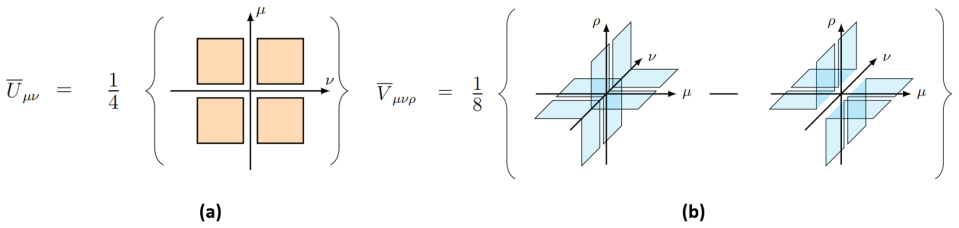
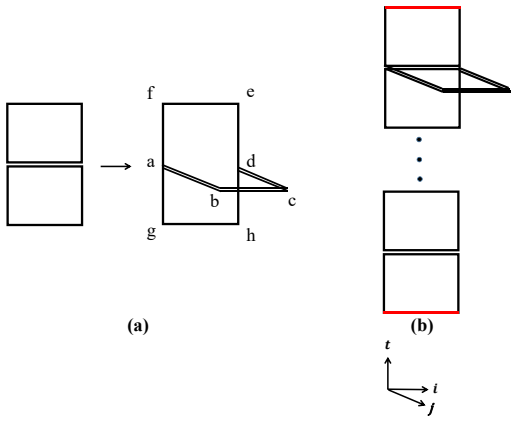
The machinery is the strong-coupling ladder expansion of the lattice path integral, organized by powers of $g^{-2}$. In the absence of rotation the leading connected diagram that couples Polyakov loops is a ladder of $N_t$ plaquettes spanning the temporal direction; under rotation, the only $O(\omega^2)$ correction that survives spatial-link integration is the replacement of two adjacent square plaquettes in that ladder by a pair of chair-type plaquettes, which yields an effective hopping term proportional to $-\lambda \omega^2(\bar{x}^2+\bar{y}^2)\,W^*W$. That replacement fixes both the sign and the magnitude of the temperature shift. A separate, diagram-independent part of the argument is the thermodynamic identity $B = -\Delta I/(2R^2 L)$, obtained from the coexistence of the two phases and the free-energy expansion $F = F_0 - \frac{1}{2} I \omega^2$.
What would settle it
A decisive check is to compute the next-order strong-coupling correction to the $\omega^2$ coefficient: if the sign of $B$ flips or its magnitude moves far from $-0.022$ at the transition point, the leading-order prediction is not robust. Independently, in the lattice simulation of Ref. [3] one can measure $\Delta I$ and $L$ and verify whether the shift coefficient obeys $B = -\Delta I/(2R^2 L)$.
Extended reading notes
Core claim
Working from the lattice action for gauge fields in a rotating frame, the paper expands the partition function in powers of $g^{-2}$ and integrates out the spatial links to order $\omega^2$. The surviving correction replaces a pair of adjacent square plaquettes in the temporal ladder by chair-type plaquettes, producing an effective Polyakov-loop action whose homogeneous part is shifted by $-\frac{1}{4} v^2 N N_t \lambda \eta |W|^2$. Minimizing the effective free energy with the same first-order transition condition as in the non-rotating case gives $T_d = T_d^{(0)}(1 + B v^2)$ with $B = -1/(12 \sigma a^2) \approx -0.022$ using $\sigma = (440\,\mathrm{MeV})^2$ and $a^{-1} = 228\,\mathrm{MeV}$. The paper also derives, before any strong-coupling input, the general identity $B = -\Delta I/(2R^2 L)$ from the equality of Gibbs free energies of the confined and deconfined phases at coexistence, and finds the string tension enhanced to $\sigma = \ln(3g^2)/a^2 + \omega^2 d^2/a^2$ for a quark-antiquark pair separated parallel to the rotation axis.
Load-bearing premise
The leading-order strong-coupling expansion is evaluated at the deconfinement transition even though the quantity the expansion is ordered in, $\lambda_0 \approx 0.086$, is not small, and the authors state that the $\omega^2$ coefficient may not be robust against higher-order corrections when extrapolated to the transition point.
Editorial extensions
If this is right
- If the leading-order strong-coupling value survives higher-order corrections, a rotating SU(3) gluon plasma deconfines at a lower temperature, with $B \approx -0.022$ for the lattice parameters of Ref. [3].
- Because $B = -\Delta I/(2R^2 L)$, the sign of the rotation shift reveals whether the deconfined phase has a larger moment of inertia than the confined phase; the computed negative $B$ implies $\Delta I > 0$ at the strong-coupling transition.
- The string tension of a heavy quark-antiquark pair aligned with the rotation axis is enhanced by rotation, so confinement becomes stronger away from the rotation axis within this approximation.
- The opposite sign from the lattice simulation $B = 0.7$ is attributed by the authors to the limited accuracy of the leading-order strong-coupling expansion at the transition, where the expansion parameter is not small.
Reading between the lines
- A model-independent test: because the identity $B = -\Delta I/(2R^2 L)$ requires only static quantities, a lattice simulation could check the rotation dependence of the transition by measuring the latent heat and the moment-of-inertia jump in a non-rotating ensemble, without simulating rotation at all.
- If the negative $B$ were to carry over to QCD with dynamical quarks, peripheral heavy-ion collisions would see deconfinement occur slightly earlier in the most vortical regions; with $|B| \approx 0.022$ and realistic boundary speeds the shift is a fraction of a percent, so the effect would be difficult to distinguish experimentally.
- The discrepancy between strong coupling and lattice simulation may reflect either truncation error or action-dependence of the rotation effect; a higher-order strong-coupling calculation, or the same calculation on a different lattice action sharing the transition, could separate the two possibilities.
Editorial analysis
A structured set of objections, weighed in public.
Referee Report
Summary. The manuscript presents a strong-coupling expansion of SU(3) lattice gluodynamics in a rotating frame. It constructs the grand canonical partition function with H − ωJ_z, writes the corresponding lattice action in a rotating metric, and derives an effective Polyakov-loop action to order ω². From this it obtains a shift of the deconfinement temperature, T_d = T_d^(0)(1 + B v²), with B ≈ −0.022, opposite to the lattice result B = 0.7. It also derives a general thermodynamic formula B = −ΔI/(2R²L) relating B to the latent heat and the discontinuity of the moment of inertia at the transition, and it computes a rotation correction to the string tension.
Significance. The thermodynamic relation (1.2) is the strongest part of the paper: it follows from the minimization conditions alone, is independent of the strong-coupling approximation, and provides a clean cross-check for lattice studies. The strong-coupling calculation is systematic and parameter-free, and the authors are explicit about its main limitation. However, because the numerical coefficient B is evaluated at λ0 ≈ 0.086, where the expansion parameter is not small, the sign of B is not established at a quantitative level; the manuscript's own caveat in Section 5 acknowledges this. The string-tension section contains a sign inconsistency that needs correction.
major comments (3)
- [§4.2, Eq. (4.23)] As printed, Eq. (4.23), ΔI = (1/2) N N_t λ0 η R² |W0|², is dimensionally inconsistent. Using F = T S_eff with T = 1/(N_t a), the rotation correction from Eq. (4.21) is ΔF = − N λ η v² |W|²/(4a), so the moment-of-inertia discontinuity is ΔI = R² N λ η |W|²/(2a), without the factor N_t and with an explicit 1/a. With the printed form, Eqs. (1.2) and (4.16) give B = −N_t/(12σ a) rather than Eq. (4.24). This appears to be a typographical omission, but it affects the central numerical result and should be corrected.
- [§4.2 and §5] The numerical prediction B ≈ −0.022 is obtained by inserting leading-order strong-coupling values at the transition, where λ0 ≈ 0.086 and, for N_t = 2, 1/g² ≈ 0.62. The next-order corrections are therefore not parametrically small, and the authors' own statement that the coefficient 'may not be robust against higher order corrections when extrapolated to the deconfinement transition point' applies directly to the sign claim made in the abstract and Introduction. I recommend either estimating the size of the next-order term or reformulating the headline claim as a leading-order result whose sign is not yet established.
- [§4.2, Eqs. (4.27)–(4.28)] There is a sign inconsistency in the string-tension calculation. Taking the logarithm of Eq. (4.27), e^{−βU(L)} = (1/(3g²))^{N_t M}(1 + N_t M ω² d²), gives βU(L) = N_t M ln(3g²) − N_t M ω² d², hence σ = (ln(3g²) − ω² d²)/a². Equation (4.28) has a plus sign, and the conclusion states that the string tension is enhanced by rotation. Either Eq. (4.27) or Eq. (4.28) has the wrong sign.
minor comments (5)
- [§3, Eq. (3.3)] The symbol F^q_yx in Eq. (3.3) should presumably be F^a_yx.
- [§4, Eq. (4.4)] The symbol \bar{r}² in Eq. (4.4) is not defined; it should be r².
- [§4.2, Eqs. (4.20)–(4.22)] The notation \bar{x}, \bar{y} is used before it is defined; please define it just before Eq. (4.20).
- [§4.2, sentence after Eq. (4.28)] The phrase 'we end up the the string tension' contains a duplicated article.
- [§1, Eq. (1.1)] The phrase 'the transition temperature to the leading order correction by a small linear speed v = ωR at the boundary' would be clearer as 'the leading-order correction to the transition temperature at small boundary speed v = ωR'.
Circularity Check
No significant circularity: the ω² coefficient is computed from independent strong-coupling inputs and an externally fixed lattice scale, not fitted to rotating data.
full rationale
The paper's central quantitative result, B ≈ −0.022, is obtained by a direct chain of derivation rather than by fitting or definitional identity. The general relation B = −ΔI/(2R²L) is derived from a free-energy expansion in Eqs. (3.13)–(3.17), where I[W,T] is defined as the coefficient of −ω²/2 in the Gibbs free energy and ΔI is its discontinuity at the deconfinement transition. The strong-coupling calculation then independently evaluates the two ingredients: the latent heat L in Eq. (4.16) from the unrotated effective potential of Ref. [10], and the moment-of-inertia discontinuity ΔI in Eq. (4.23) from the explicit strong-coupling rotation-correction diagrams. The external inputs σ = (440 MeV)² and a⁻¹ = 228 MeV are taken from the lattice reference [3], and the strong-coupling transition point λ₀ ≈ 0.086 is obtained by solving the unrotated effective potential. Nothing in this chain defines B in terms of itself, and no parameter is fitted to the rotation-dependent lattice data. The paper's own caveat in Sec. 5 that the leading-order coefficient 'may not be robust against higher order corrections' is an accuracy limitation, not a circularity. Self-citations to Refs. [4], [5], and [8] are contextual comparisons or companion work, and none of them supplies a premise that forces the sign or magnitude of B. The possible dimensional awkwardness of Eq. (4.23) is a technical correctness concern, not evidence that the derivation is circular. Therefore no circularity is identified.
Assumptions & free parameters
assumptions (5)
- domain assumption The rotating-frame lattice action of Eq. (3.2) from Yamamoto-Hirono [16], as used in the simulation [3], correctly describes gluodynamics with angular momentum.
- domain assumption The leading-order strong-coupling expansion, retaining only N = Nt ladder diagrams, is sufficient at the deconfinement transition.
- domain assumption The saddle-point (mean-field) approximation for the effective action of Polyakov loops is valid.
- domain assumption The homogeneous saddle point W = const plus a small inhomogeneous correction W1 is a good approximation despite the spatial inhomogeneity of rotation.
- domain assumption The relation λ = 2 exp(-σa/T), Eq. (4.13), connecting the strong-coupling parameter to physical temperature is valid at the transition.
Cite this review
Pith. "Pith review of Strong Coupling Expansion of Gluodynamics on a Lattice under Rotation." pith.science (2026). https://pith.science/paper/2SSZYDAF
@misc{pith2026250515487,
  author       = {Pith},
  title        = {Pith review of: Strong Coupling Expansion of Gluodynamics on a Lattice under Rotation},
  year         = {2026},
  howpublished = {\url{https://pith.science/paper/2SSZYDAF}},
  note         = {Machine review of arXiv:2505.15487}
}
abstract
The analytic strong coupling expansion of the gluodynamics under a rotation with an angular velocity $\omega$ is reported. While the expansion is systematic, free from additional assumptions, the deconfinement temperature determined by the onset of the Polyakov loop expectation value decreases with the angular velocity up to $\omega^2$, opposite to the tendency found in numerical simulations. As a by-product, a simple formula is obtained for the $\omega^2$ coefficient of the deconfinement temperature shift in terms of the latent heat and the discontinuity of the moment of inertia at the transition without rotation. This formula is independent of the strong coupling and may benefit further investigation of the subject.
Figures


Figures from the paper (2 more)

Forward citations
Cited by 7 Pith papers
-
Chromomagnetic condensation and perturbative confinement induced by imaginary rotation in SU(2) Yang-Mills Theory
In SU(2) Yang-Mills, imaginary rotation is shown to induce a chromomagnetic condensate and to turn the perturbative confinement transition first-order, with phase boundary approaching Ω̃_c = π/√3.
-
Static Quark-Antiquark Interactions Under Rotation
In quenched SU(3) lattice gluodynamics, imaginary rotation suppresses bare Polyakov free energies above Tc with a bulk shift well fit by A R_xy^2 + B, while the T≈0 static potential shows no significant rotation dependence.
-
A Chromomagnetic Mechanism for the Rotational Phase Transition of Gluonic Matter
Using a rotation–magnetic holographic dictionary calibrated to lattice QCD, the paper predicts real rotation raises T_c and induces a negative total moment of inertia in pure gluonic matter near deconfinement.
-
Unraveling the effect of rotation on the confinement/deconfinement transition of the quark-gluon plasma
Using a holographic rotating black hole, the quark-gluon plasma critical temperature decreases for a static observer but increases for a co-rotating observer, reconciling lattice and model results.
-
Imaginary Rotating Gluonic Matter at Strong Coupling
At strong coupling, imaginary rotation suppresses the Polyakov-loop interaction, so the predicted deconfinement temperature of pure gluonic matter increases with the imaginary angular velocity.
-
Chromomagnetic Condensate in Finite-Temperature SU(2) Yang-Mills Theory under Imaginary Rotation
At one loop, imaginary rotation in the SU(2) Savvidy model enhances the chromomagnetic condensate and effective coupling, can suppress the Nielsen-Olesen instability in a finite window, and gives a negative moment-of-...
-
Schwinger Effect in a Twice Anisotropic Holographic Model
In a twice anisotropic holographic QCD model, magnetic anisotropy lowers the Schwinger pair-production barrier while spatial anisotropy raises it.
Reference graph
Works this paper leans on
-
[1]
Global Λ hyperon polarization in nuclear collisions: evidence for the most vortical fluid,
STAR Collaboration, L. Adamczyk et al., “Global Λ hyperon polarization in nuclear collisions: evidence for the most vortical fluid,” Nature 548 (2017) 62–65, arXiv:1701.06657 [nucl-ex]
arXiv 2017
-
[2]
Globally polarized quark-gluon plasma in non-central A+A collisions,
Z.-T. Liang and X.-N. Wang, “Globally polarized quark-gluon plasma in non-central A+A collisions,” Phys. Rev. Lett. 94 (2005) 102301, arXiv:nucl-th/0410079
arXiv 2005
-
[3]
Influence of relativistic rotation on the confinement-deconfinement transition in gluodynamics,
V. V. Braguta, A. Y. Kotov, D. D. Kuznedelev, and A. A. Roenko, “Influence of relativistic rotation on the confinement-deconfinement transition in gluodynamics,” Phys. Rev. D 103 no. 9, (2021) 094515, arXiv:2102.05084 [hep-lat]
arXiv 2021
-
[4]
Gluodynamics and deconfinement phase transition under rotation from holography,
X. Chen, L. Zhang, D. Li, D. Hou, and M. Huang, “Gluodynamics and deconfinement phase transition under rotation from holography,” JHEP 07 (2021) 132, arXiv:2010.14478 [hep-ph]. 15
arXiv 2021
-
[5]
Phase diagram of holographic thermal dense QCD matter with rotation,
Y.-Q. Zhao, S. He, D. Hou, L. Li, and Z. Li, “Phase diagram of holographic thermal dense QCD matter with rotation,” JHEP 04 (2023) 115, arXiv:2212.14662 [hep-ph]
arXiv 2023
-
[6]
Confinement-deconfinement temperature for a rotating quark-gluon plasma,
N. R. F. Braga, L. F. Faulhaber, and O. C. Junqueira, “Confinement-deconfinement temperature for a rotating quark-gluon plasma,” Phys. Rev. D 105 no. 10, (2022) 106003, arXiv:2201.05581 [hep-th]
arXiv 2022
-
[7]
Rotation effect on the deconfinement phase transition in holographic QCD,
J.-H. Wang and S.-Q. Feng, “Rotation effect on the deconfinement phase transition in holographic QCD,” Phys. Rev. D 109 no. 6, (2024) 066019, arXiv:2403.01814 [hep-ph]
arXiv 2024
-
[8]
String tension and Polyakov loop in a rotating background,
J.-X. Chen, S. Wang, D. Hou, and H.-C. Ren, “String tension and Polyakov loop in a rotating background,” Phys. Rev. D 111 no. 2, (2025) 026020, arXiv:2410.04763 [hep-ph]
arXiv 2025
Show all 16 references
-
[9]
Deconfinement and chiral restoration phase transition under rotation from holography in an anisotropic gravitational background,
Y. Chen, X. Chen, D. Li, and M. Huang, “Deconfinement and chiral restoration phase transition under rotation from holography in an anisotropic gravitational background,” Phys. Rev. D 111 no. 4, (2025) 046006, arXiv:2405.06386 [hep-ph]
2025 arXiv
-
[10]
SU(N) Deconfinement Transition and the N State Clock Model,
M. Gross, J. Bartholomew, and D. Hochberg, “SU(N) Deconfinement Transition and the N State Clock Model,”. Report No. EFI- 83-35-CHICAGO, 1983
1983
-
[11]
Chiral effective model with the Polyakov loop,
K. Fukushima, “Chiral effective model with the Polyakov loop,” Phys. Lett. B 591 (2004) 277–284, arXiv:hep-ph/0310121
2004 arXiv
-
[12]
A Monte Carlo Study of SU(2) Yang-Mills Theory at Finite Temperature,
L. D. McLerran and B. Svetitsky, “A Monte Carlo Study of SU(2) Yang-Mills Theory at Finite Temperature,” Phys. Lett. B 98 (1981) 195
1981
-
[13]
Phase Transition from Strong Coupling Expansion,
J. Polonyi and K. Szlachanyi, “Phase Transition from Strong Coupling Expansion,” Phys. Lett. B 110 (1982) 395–398
1982
-
[14]
Monte Carlo Study of SU(2) Gauge Theory at Finite Temperature,
J. Kuti, J. Polonyi, and K. Szlachanyi, “Monte Carlo Study of SU(2) Gauge Theory at Finite Temperature,” Phys. Lett. B 98 (1981) 199
1981
-
[15]
Operator Ordering and Feynman Rules in Gauge Theories,
N. H. Christ and T. D. Lee, “Operator Ordering and Feynman Rules in Gauge Theories,” Phys. Rev. D 22 (1980) 939
1980
-
[16]
Lattice QCD in rotating frames,
A. Yamamoto and Y. Hirono, “Lattice QCD in rotating frames,” Phys. Rev. Lett. 111 (2013) 081601, arXiv:1303.6292 [hep-lat]. 16
2013 arXiv
Reviewed August 7, 2026 · model on record in the stance chip above.
Discussion (0). Sign in to comment.