REVIEW 4 major objections 5 minor 10 references
Protoknowledge Shapes Behaviour of LLMs in Downstream Tasks: Memorization and Generalization with Knowledge Graphs
T0 review · 4 major / 5 minor · reviewed 2026-08-07 · deepseek-v4-flash
Pith's one-line read The paper claims that a model's success at recalling knowledge-graph triples—topological protoknowledge—determines whether it can produce correct Text-to-SPARQL queries when no URI hints are given, and that this agreement exposes…
desk verdict Useful probe framework, but the Section 5.1 Agreement/Disagreement contrast is a base-rate artifact — the central 'shapes behaviour' claim needs a marginals-controlled dependence measure. read the letter →
The pith
A machine-rendered reading of the paper's core claim, the machinery that carries it, and where it could break.
The reading
What carries the argument
The machinery is a per-example correlation between two measurements. The first is a set of Knowledge Activation Tasks (KATs), each designed to isolate one protoknowledge form: URI recognition (lexical), direct and inverse subsumption (hierarchical), and SV?/?VO triple completion (topological). The second is the Speculative Protoknowledge for SPARQL (SPS) score, defined as $SPS = |T_{\text{predicted}} \cap T_{Q}| / |T_{Q}|$, which measures how many entity-property pairs from a gold query the model can reconstruct as valid triples, verified by SPARQL ASK queries. These two measurements are then combined in a Positive Agreement/Disagreement framework that classifies each query by whether correct query generation and correct protoknowledge activation coincide, which is what lets the paper attribute query success to memorized structure.
What would settle it
Take a structurally identical set of questions to QALD-9 but replace all entity and relation URIs with random, semantically uninformative identifiers, and run the No-URI condition. If a model with near-zero SPS still produces correct queries at non-trivial rates, or if Agreement no longer exceeds Disagreement, the claimed dependence on memorized protoknowledge would be refuted.
Extended reading notes
Core claim
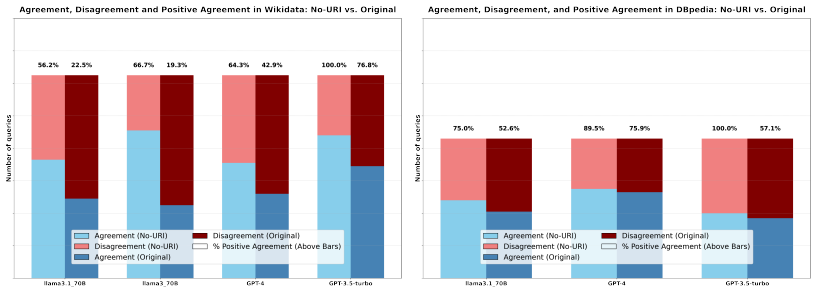
On the paper's own terms, the central discovery is that LLMs absorb knowledge-graph content as reusable protoknowledge in three distinguishable forms, and that the activation of each form can be measured by Knowledge Activation Tasks (KATs): label-to-URI recognition for lexical, direct and inverse subsumption for hierarchical, and subject-verb-object triple completion for topological protoknowledge. The paper's central result is that these measurements align with Text-to-SPARQL behavior: in the No-URI condition, successful query generation and successful triple completion agree more often than they disagree, and Positive Agreement—correct queries accompanied by correct protoknowledge activation—often reaches high ratios, including 100% for GPT-3.5 Turbo. The same alignment is present, though weaker, for lexical protoknowledge in the No-Label condition and for hierarchical protoknowledge on DBpedia. The paper presents this query-by-query agreement as a practical tool for exposing semantic-level data contamination in closed-pretraining models.
Load-bearing premise
The load-bearing premise is that a correct SPARQL query implies the model actually recalled the relevant knowledge-graph triples (and, for topological protoknowledge, that correct recall is required for a correct query); if query success can come from surface pattern-matching or from copying URIs in the prompt, the agreement statistics do not measure protoknowledge.
Editorial extensions
If this is right
- In the No-URI condition, a model's Text-to-SPARQL performance on QALD-9 can be anticipated from its SPS triple-completion scores: models that fail to recall a query's triples will generally fail to produce the query.
- In the Original condition, where URIs and labels are supplied, correct query generation no longer requires protoknowledge, so benchmarks that provide full context underestimate the role of memorized structure.
- Lexical protoknowledge (label-to-URI mapping) is what lets models keep working in the No-Label condition, especially on Wikidata's non-human-readable identifiers.
- The per-example Positive Agreement ratio offers a black-box profile of semantic-level data contamination for closed-pretraining models, complementing verbatim-memorization checks.
- Because protoknowledge is stronger for popular items, performance on frequent entities and properties should not be extrapolated to rare or out-of-distribution content.
Reading between the lines
- The same query-by-query agreement framework could be adapted to other structured tasks, such as Text-to-SQL, by defining schema protoknowledge through recall tasks over tables, columns, and foreign-key triples.
- If protoknowledge is frequency-driven, contamination audits should stratify Positive Agreement by entity popularity; a sharp drop on rare entities would indicate memorization of common web content rather than robust generalization.
- A testable extension the paper does not run: rerun the No-URI condition with entity and relation URIs replaced by random strings; a collapse in Agreement would confirm that success depends on memorized token-level structure rather than abstract graph reasoning.
- The paper's deliberate omission of the S?O triple-completion task suggests a full three-slot SPS would be an even stronger predictor, provided overly frequent properties are controlled for.
Editorial analysis
A structured set of objections, weighed in public.
Referee Report
Summary. The paper introduces the notion of 'protoknowledge' to describe how LLMs internalize Knowledge Graph content during pretraining and reuse it in downstream tasks. It distinguishes lexical, hierarchical, and topological forms, measures them through Knowledge Activation Tasks (URI recognition, subsumption, and triple completion), and analyzes their dependence on item popularity as evidence of semantic bias. It then examines Text-to-SPARQL performance under Original, No Label, and No URI prompting conditions and uses a Positive Agreement framework to claim that success in triple completion predicts success in query generation, particularly when URI hints are absent. The paper concludes that this framework offers a practical tool for detecting semantic-level data contamination in closed-pretraining models.
Significance. If the central claim were supported, the paper would provide a useful black-box method for linking internal KG recall to structured query generation and for probing contamination in models whose pretraining data is unavailable. The taxonomy of lexical, hierarchical, and topological protoknowledge and the KAT design are a reasonable starting point for such an analysis. However, the evidence as presented does not establish the claimed dependence: the main Agreement/Disagreement statistic is confounded by base rates, and the paper's own assumption about query success implying protoknowledge activation is contradicted by its Original-mode results. A reanalysis with margin-controlled dependence measures could make the contribution meaningful, but the current support is inadequate.
major comments (4)
- [§5.1 and Figure 3] The central evidence that 'Agreement consistently exceeds Disagreement' in the No URI setting is confounded by the marginal success rates. Under independence of query success (probability p) and SPS success (probability q), P(Agreement) = pq + (1-p)(1-q) and P(Disagreement) = p(1-q) + (1-p)q. In the No URI setting, Table 4 reports F1 values of 3.67–29.09 and Table 8 reports perfect SPS values mostly below 30%; for example, p=0.1 and q=0.2 already predict 74% Agreement against 26% Disagreement. The plotted contrast therefore carries no information about whether triple completion and query generation are statistically or causally related. The paper should report a margin-controlled statistic (e.g., Cohen's kappa, a chi-square test on the 2×2 table, or a permutation baseline) and should compare the observed Agreement against the independence prediction rather than against Disagreement alone.
- [§5.1, Figure 3, Original setting] The framework assumes that 'a correct SPARQL query implies successful activation of protoknowledge', and for topological protoknowledge it assumes the reverse as well. This is directly contradicted by the same figure: in the Original setting Disagreement dominates, which must include cases where the SPARQL query is correct while the corresponding triple completion is incorrect. If correct queries can be produced without successful triple recall, then query performance does not require the measured protoknowledge, and the Positive Agreement ratio is merely a conditional frequency rather than evidence of mediation. The paper must report the full 2×2 contingency table (query correct/incorrect by SPS correct/incorrect) and separate the two directional cells of Disagreement.
- [§4.4 and Limitations] Equation (1) defines SPS as |Tpredicted ∩ TQ| / |TQ|, where TQ is 'all entity-property pairs relevant to Qgold' and Tpredicted comes from the SV? and ?VO tasks. The Limitations paragraph states that the S?O task is deliberately omitted. This makes the metric's coverage unclear: if TQ contains triples whose property must be inferred from a subject-object pair, those triples can never appear in Tpredicted, so SPS will be systematically depressed and the Agreement analysis will be distorted. The paper should either restrict TQ to entity-property pairs testable by SV? and ?VO or report the proportion of Qgold triples covered by these two tasks.
- [§4.2, Table 1] The quantitative evidence for the popularity trend is not auditable in its current form. In the LF row for entities, the cell '3.11% (5/9)' is internally inconsistent: 5/9 is 55.6%, while 5/161 is 3.11%. Several other cells show the same mismatch between percentage and parenthetical ratio. Additionally, the hierarchical results in Tables 2 and 3 rest on supports as small as 2–5 items and are reported without any significance or confidence intervals. The semantic-bias claims need exact counts, internally consistent percentages, and at least exact binomial confidence intervals or an explicitly stated exploratory status.
minor comments (5)
- [§5.1, lexical PA analysis] The lexical Positive Agreement analysis excludes items below the 50th percentile of popularity without justification, and Table 12's explanation of the threshold is unclear; the paper should state the selection rule explicitly and, if possible, also report results on the full set.
- [Equation (1)] TQ and Tpredicted are not formally defined as sets, and the role of Perfect versus Soft matches in the SPS score is described only in prose; a precise set-theoretic definition would improve reproducibility.
- [Figure 3] The bars do not show the number of examples behind each percentage, even though the text notes that some ratios rest on very small counts (e.g., three examples for Llama-3_70B); adding per-bar n values is essential for interpreting the figure.
- [Section 5.1 and Table 6] The text states Llama-3_70B has hierarchical PA of 32/39, while Table 6 lists 32/40; these should be harmonized.
- [Throughout] There are several typos and minor wording issues, including 'categorizeprotoknowledge' in the abstract, 'hypotesize' in Section 5.1, 'benchmkarks' and 'Hierachical' in the Limitations paragraph, and the nonstandard use of 'overconfidence' in Section 4.5 to mean accuracy bias rather than confidence calibration.
Circularity Check
No circular derivation: the paper correlates two independently measured quantities; the Agreement statistic is a consistency check, not an identity or a fitted prediction.
full rationale
The paper’s chain is: define protoknowledge forms, measure them with Knowledge Activation Tasks, measure Text-to-SPARQL performance, then compare the two per query. Each measurement is obtained directly from model outputs on constructed test sets, and neither quantity is fitted to the other. The SPS score in Eq. 1 is defined from gold triples and model predictions; the Text-to-SPARQL F1 is computed from generated queries against gold answers. The Positive Agreement/Agreement statistics in Section 5.1 are conjunctions and disjunctions of these two measurements, not quantities derived from one another. No load-bearing parameter is fitted to the target result. The self-citation of Ranaldi et al. (2024) motivates the contamination setting but is not used as evidence for the present experiments. A statistical concern—that Agreement versus Disagreement is sensitive to base rates, so high agreement at low success rates can arise under independence—is a validity threat to the paper’s interpretation, not circularity. It does not make the derivation equivalent to its inputs. No circular step is exhibited.
Assumptions & free parameters
free parameters (3)
- popularity threshold for frequent/infrequent split =
mean or median triple-count threshold
- 50th-percentile exclusion in lexical PA =
exclude items below median popularity
- soft match tolerance in SPS =
Soft matches counted when URI is related to correct entity via a different property
assumptions (3)
- domain assumption Pretraining corpora of Closed-Pretraining models broadly reflect common web data
- ad hoc to paper A correct SPARQL query implies successful activation of the relevant protoknowledge; for topological protoknowledge the reverse also holds
- domain assumption Triple-count popularity in DBpedia and Wikidata is a valid proxy for frequency in pretraining data
invented entities (1)
-
protoknowledge
Cite this review
Pith. "Pith review of Protoknowledge Shapes Behaviour of LLMs in Downstream Tasks: Memorization and Generalization with Knowledge Graphs." pith.science (2026). https://pith.science/paper/3BBTSSM5
@misc{pith2026250515501,
  author       = {Pith},
  title        = {Pith review of: Protoknowledge Shapes Behaviour of LLMs in Downstream Tasks: Memorization and Generalization with Knowledge Graphs},
  year         = {2026},
  howpublished = {\url{https://pith.science/paper/3BBTSSM5}},
  note         = {Machine review of arXiv:2505.15501}
}
read the original abstract
We introduce the concept of protoknowledge to formalize and measure how sequences of tokens encoding Knowledge Graphs are internalized during pretraining and utilized at inference time by Large Language Models (LLMs). Indeed, LLMs have demonstrated the ability to memorize vast amounts of token sequences during pretraining, and a central open question is how they leverage this memorization as reusable knowledge through generalization. We then categorize protoknowledge into lexical, hierarchical, and topological forms, varying on the type of knowledge that needs to be activated. We measure protoknowledge through Knowledge Activation Tasks (KATs), analyzing its general properties such as semantic bias. We then investigate the impact of protoknowledge on Text-to-SPARQL performance by varying prompting strategies depending on input conditions. To this end, we adopt a novel analysis framework that assesses whether model predictions align with the successful activation of the relevant protoknowledge for each query. This methodology provides a practical tool to explore Semantic-Level Data Contamination and serves as an effective strategy for Closed-Pretraining models.
Figures


Figures from the paper (9 more)


Reference graph
Works this paper leans on
-
[3]
Format the output: Enclose the SPARQL query within <SPARQL></SPARQL> tags. Do not output anything else. Question: {question} Entities: {URI} ({label}), ... Relations: {URI} ({label}), ... Query: Figure 9: Original Approach Approach: No Label You are an expert in SPARQL and{KG_name}. Your task is to translate natural language questions into precise SPARQL ...
-
[8]
Format the output: Enclose the SPARQL query within <SPARQL></SPARQL> tags. Do not output anything else. Question: {question} Entities: {URI}, ... Relations: {URI}, ... Query: Figure 10: No Label Approach Approach: No URI You are an expert in SPARQL and{KG_name}. Your task is to translate natural language questions into precise SPARQL queries that retrieve...
-
[9]
Understand the input: Analyze the question and use the provided Entities and Relations to construct the query
-
[10]
Construct a valid SPARQL query: Use proper syntax and ensure the query retrieves accurate results from {KG_name}
-
[11]
Format the output: Enclose the SPARQL query within <SPARQL></SPARQL> tags. Do not output anything else. Question: {question} Query: Figure 11: No URI approach 15 H Protoknowledge Analysis Impact H.1 Protoknowledge Analysis Framework in brief Given a form of KG Protoknowledge and a Text-to- SPARQL query instance, we perform the following steps:
-
[12]
Extract a mini test set from the query, contain- ing relevant KG elements
-
[13]
Evaluate protoknowledge on this mini set us- ing Knowledge Activation Tasks (KATs)
-
[14]
H.2 Example of Framework Application on lexical form We report an example (Fig
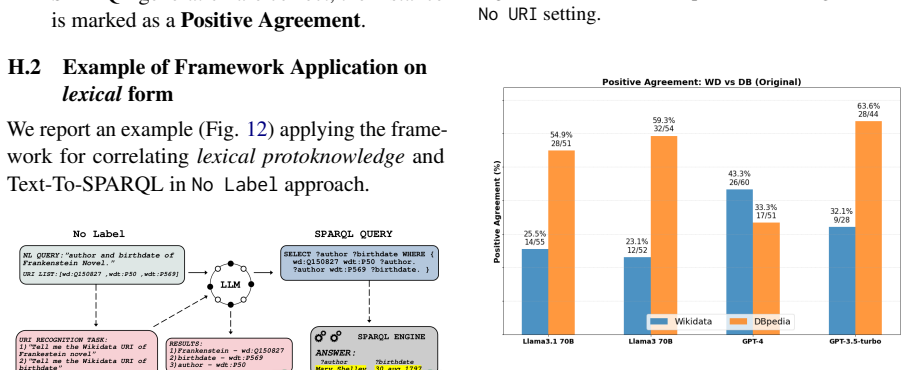
If both the protoknowledge evaluation and the SPARQL generation are correct, the instance is marked as a Positive Agreement. H.2 Example of Framework Application on lexical form We report an example (Fig. 12) applying the frame- work for correlating lexical protoknowledge and Text-To-SPARQL inNo Label approach. Figure 12: Lexical protoknowledge Impact ana...
Show all 10 references
-
[2023]
Preprint, arXiv:2202.07646
Quantifying memorization across neural lan- guage models. Preprint, arXiv:2202.07646. Jacopo D’Abramo, Andrea Zugarini, and Paolo Torroni
-
[2025]
Perfect" satisfaction of the triple, while S represents
Investigating large language models for text- to-SPARQL generation. In Proceedings of the 4th International Workshop on Knowledge-Augmented Methods for Natural Language Processing, pages 66– 80, Albuquerque, New Mexico, USA. Association for Computational Linguistics. Chunyuan ...
2024 arXiv
Reviewed August 7, 2026 · model on record in the stance chip above.
Discussion (0). Continue with ORCID to comment.