REVIEW 4 major objections 5 minor 36 references
SwarmDiff: Swarm Robotic Trajectory Planning in Cluttered Environments via Diffusion Transformer
T0 review · 4 major / 5 minor · reviewed 2026-08-07 · deepseek-v4-flash
Pith's one-line read SwarmDiff claims to be the first diffusion-based swarm planner, generating risk-aware Gaussian-mixture trajectories that keep macro planning near one second for up to 500 robots.
desk verdict Novel framework, but a missing square root in the CVaR term (Eq. 6) breaks the risk objective, so the safety claims need a rerun. read the letter →
The pith
A machine-rendered reading of the paper's core claim, the machinery that carries it, and where it could break.
The reading
What carries the argument
The central object is the Gaussian Mixture Model trajectory: each candidate macro path is a sequence of Gaussian states, each containing a mean position and a covariance, so a swarm plan is a distribution flow rather than a list of individual robot paths. Three mechanisms carry the argument: a Diffusion Transformer as the denoising network, which models long-range dependencies across the time horizon and is trained with a Wasserstein loss; cost-gradient guidance during reverse diffusion, combining a Conditional Value at Risk based obstacle cost computed from a linearly approximated signed distance field, a Wasserstein transport cost between consecutive Gaussian states, and a Gaussian-process smoothness prior; and a linear-programming step that assembles the sampled Gaussian trajectories into an optimal Gaussian mixture flow, which is then converted into individual reference trajectories by density control and tracked by distributed model predictive control with optimal reciprocal collision avoidance.
What would settle it
Run SwarmDiff in an environment where a narrow gap is narrower than the standard deviation of a Gaussian trajectory component but wider than the robot radius; if the planned macro path sends robots through with the reported minimum obstacle distance close to the safety margin while Monte Carlo sampling of the Gaussian states produces frequent collisions, the linearized Conditional Value at Risk cost has underestimated risk.
Extended reading notes
Core claim
SwarmDiff claims to be the first approach that applies generative diffusion models to large-scale swarm trajectory planning. It represents the whole swarm as a time-varying probability density, compresses that density into Gaussian mixture trajectories, and uses a diffusion transformer conditioned on the start and goal distributions and an Euclidean signed distance field obstacle map to denoise candidate Gaussian trajectories. Cost-gradient guidance from Wasserstein transport, Conditional Value at Risk collision risk, and a Gaussian-process smoothing term steers sampling toward risk-aware, smooth, globally coherent macroscopic plans. Individual robots then track these plans through density control and distributed model predictive control. In simulations with up to 500 robots, the macroscopic planning time stays around one second, and real-world tests with 10 robots confirm that the generated trajectories are executable.
Load-bearing premise
The collision-safety guarantees rest on approximating each Gaussian swarm component's signed distance to obstacles by a first-order Taylor expansion, so the risk estimate is only as accurate as that linearization for the actual distribution widths.
Editorial extensions
If this is right
- Macroscopic planning time stays near one second for swarms of 20 to 500 robots, so the planner's cost no longer grows with the number of robots.
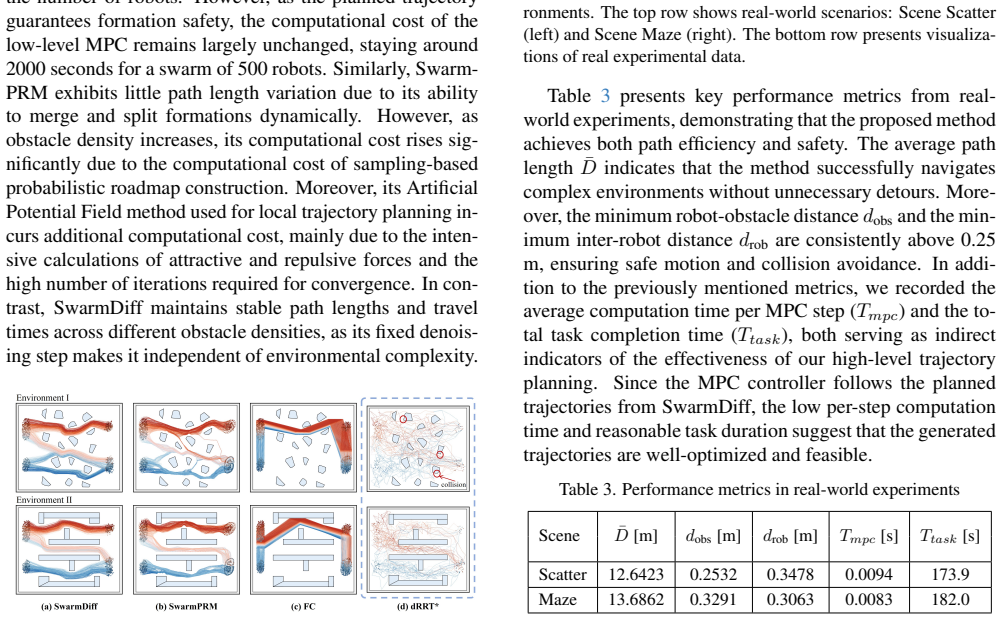
- Compared with sampling- and search-based baselines, SwarmDiff reports shorter or comparable path lengths while keeping minimum obstacle distances above the safety margin in both dense and narrow-passage maps.
- The Diffusion Transformer denoiser with flash attention produces macroscopic trajectories faster and with lower transport cost than a same-parameter temporal U-Net, supporting the claim that long-range attention helps trajectory coherence.
- The Conditional Value at Risk collision cost with environment conditioning produces risk-aware trajectories that remain valid when executed by distributed model predictive control on real robots, as shown by the 10-robot experiments.
- Because the denoising step count is fixed, planning time stays roughly constant as obstacle density increases, unlike roadmap-based methods whose cost grows with environment complexity.
Reading between the lines
- The macroscopic planning cost is independent of the number of robots, so the same framework should transfer to three-dimensional aerial swarms by replacing the two-dimensional signed distance field with a three-dimensional one; the paper only demonstrates two-dimensional ground robots.
- The linearly approximated Conditional Value at Risk collision cost could be replaced by an exact Gaussian obstacle-distance computation or a learned collision probability head, which would likely tighten the gap between planned minimum obstacle distance and true collision rates in narrow passages.
- Because the denoising budget is fixed, SwarmDiff could be used for online replanning in environments with moving obstacles without a large computational penalty; the paper does not test dynamic obstacle scenarios.
- The separation of macroscopic distribution planning from microscopic robot control suggests that safety guarantees could be strengthened by adding a per-robot safety filter at the execution layer, since the macroscopic Gaussian representation inherently smooths over individual robot positions.
Editorial analysis
A structured set of objections, weighed in public.
Referee Report
Summary. The paper proposes SwarmDiff, a hierarchical swarm trajectory planning framework in which a macroscopic swarm state is represented as a time-varying Gaussian mixture model (GMM), and a Diffusion Transformer (DiT) generates risk-aware Gaussian trajectories that are subsequently refined into an optimal GMM trajectory and tracked by distributed MPC. The authors introduce cost-gradient guidance combining collision cost (CVaR), Wasserstein transport cost, and a Gaussian-process smoothness prior, and they report simulations with up to 500 robots plus real-world experiments with 10 robots. The main claims are that SwarmDiff is the first generative diffusion approach for large-scale swarm trajectory planning and that it outperforms existing methods in computational efficiency, trajectory validity, and scalability.
Significance. If the claims hold, SwarmDiff would be a meaningful step toward scalable, risk-aware swarm planning: the hierarchical GMM representation avoids per-robot planning in high-dimensional state space, and the use of DiT with cost guidance is a plausible way to generate macroscopic trajectories with task adaptation. The reported wall-clock advantages over SwarmPRM, dRRT*, and FC are large and consistent, and the real-world validation on ten robots is a useful practical data point. The paper also includes ablation variants (SwarmDiffA, SwarmDiffB) that help isolate the contributions of ESDF conditioning and the Transformer backbone, which is a strength. However, several load-bearing issues—particularly a dimensional error in the CVaR collision cost and an unclearly fair baseline comparison—currently limit the support for the central validity and efficiency claims.
major comments (4)
- [§3.2.1, Eq. (6)] Equation (6) is dimensionally inconsistent: for η ~ N(-s(μ,O), nᵀΣn), the CVaR correction term must scale with the standard deviation, i.e., sqrt(nᵀΣn), not the variance nᵀΣn. As written, the term has units of length² while -s(μ,O) has units of length, so the risk estimate is not a length and systematically underestimates collision risk for narrow Gaussian states. Because c_obs (Eq. 7) and its gradient enter the denoising update in Eq. (5), the trajectory-validity and risk-awareness claims are not supported by the equations as written. This needs to be corrected and the simulations/experiments rerun or re-justified with the corrected risk term.
- [§4.1, Table 2 (dense row) and Table 1] The reported obstacle-clearance metric dobs does not support the claim of superior risk awareness or trajectory validity: in the dense environment of Table 2, SwarmPRM achieves dobs = 2.593 m while SwarmDiff achieves 1.012 m, and several Table 1 rows (e.g., 20 robots in Environment I: 4.7 vs 3.1) show the same pattern. If the intended safety claim is merely feasibility (dobs > 0) while maximizing efficiency, that should be stated explicitly; as presented, the data contradict the qualitative claim that SwarmDiff is more risk-aware than baselines.
- [§4.1, training data and Tables 1–2] The diffusion prior is trained on trajectories generated by SwarmPRM (Section 4.1, "Dataset Generation and Training"), and SwarmPRM is also the principal baseline. Consequently, the comparison against SwarmPRM is partly a distillation benchmark: SwarmDiff is expected to imitate SwarmPRM's trajectories and then improve them with cost guidance. To support the claim that SwarmDiff outperforms existing methods in trajectory validity, the authors should either compare against a baseline trained on an independent oracle or analyze the generalization gap between teacher and student trajectories.
- [§4.1 and Tables 1–2] The computational-efficiency claims are based on wall-clock times that mix implementations and hardware: SwarmDiff (including ablations) runs in Python/PyTorch on an RTX 4090 GPU, while FC and dRRT* run in MATLAB, presumably on CPU. Orders-of-magnitude time differences may therefore reflect implementation and hardware choices rather than algorithmic superiority. A controlled comparison—e.g., same language, same machine, or reporting CPU/GPU separately—is needed before the efficiency claim can be accepted as stated.
minor comments (5)
- [§3.2.1] The phrase "CVaR at risk level α, which captures the expected worst-case signed distance beyond the α-quantile" is imprecise: CVaR is an expectation of losses beyond the quantile, not a distance metric; consider rephrasing.
- [§3.1.2] The Wasserstein loss L(θ) = E[W(ε, εθ)] is defined only informally; please specify whether W is the W₂ metric on the joint state distribution and how it is computed for batched noise tensors.
- [§3.2.3, Eq. (10)] The matrices Φ_{t,t+1} and Q_{t,t+1} are not defined in the text; please provide their exact forms or a reference that specifies them for the proposed extended state s_t.
- [§4.1 and Table 1] In Table 1, the SwarmDiffB row for 50 robots lists identical values (2.08, 1.24, 180.3, 1.4, 0.264) for both Environment I and Environment II, which appears to be a copy-paste error; please verify and correct.
- [Throughout] There are several typographical and grammatical issues, e.g., "three random times trials per context" (Sec. 4.1) and "these methods often oversimplify motion models and lack obstacle avoidance mechanisms" (Sec. 1); a careful language pass is recommended.
Circularity Check
Training set is generated by the same-group SwarmPRM baseline, so the validity comparison against SwarmPRM is partly a distillation benchmark; the core cost-guidance derivation remains independent.
-
other
[Section 4.1, 'Dataset Generation and Training' and 'Baselines'; Tables 1-2]
"SwarmDiff is trained on a dataset of swarm Gaussian trajectories generated by extended PRM [16]. ... SwarmPRM [16]: A probabilistic roadmap-based method for swarm motion planning."
The baseline SwarmPRM is both the generator of SwarmDiff's training set and the primary comparison method in Tables 1-2. Since the diffusion prior is learned from SwarmPRM's feasible Gaussian trajectories, the reported trajectory-validity comparison against SwarmPRM is largely a distillation benchmark: the student model is evaluated against its own teacher. The dobs and drob validity numbers are therefore partly inherited from the training input rather than independently demonstrated. The computational-efficiency gain and the CVaR/Wasserstein cost-guidance components retain independent content, so this is partial, not total, circularity.
full rationale
The mathematical derivation chain in Sections 3.1-3.2 is self-contained: posterior sampling follows Bayes' rule and classifier guidance, and the three cost terms (CVaR collision cost, Wasserstein transport cost, and GP smoothness cost) are standard quantities not fitted to the paper's reported outcomes. The main circular content is in the evaluation design, not the algebra: the diffusion prior is trained on trajectories generated by SwarmPRM [16], a prior paper sharing four co-authors with this work, and SwarmPRM is then the headline baseline in Tables 1-2. This makes the validity comparison partly a test of how well the learned model reproduces its teacher, rather than an independent external benchmark. However, the efficiency advantage and the effects of the independent cost guidance are not forced by that training setup, so the central claim retains independent content. The skeptical note that Eq. (6) appears to omit the square root in the CVaR correction is a correctness/unit-consistency concern, not a circularity: it does not make any predicted quantity equal to an input by construction. No uniqueness theorem, ansatz-smuggling citation, or renaming of a known result was found, and external citations such as [7], [13], [15], and [23] provide independent support for the technical building blocks.
Assumptions & free parameters
free parameters (6)
- risk level alpha =
not reported
- safety margin epsilon =
not reported
- cost weights lambda_i =
not reported
- number of Gaussian trajectories K =
not reported
- diffusion steps T =
not reported
- MPC horizon N_MPC =
not reported
assumptions (5)
- domain assumption Optimal transport between two GMMs can be achieved by per-component-pair Gaussian trajectories with weight allocation (from [16])
- domain assumption First-order Taylor expansion of signed distance field over a Gaussian state is accurate
- domain assumption Spatial overlap of Gaussian components does not imply physical collision
- standard math Cost functions are non-negative and continuously differentiable
- standard math Bayes rule and Markovian reverse diffusion provide valid posterior sampling
Cite this review
Pith. "Pith review of SwarmDiff: Swarm Robotic Trajectory Planning in Cluttered Environments via Diffusion Transformer." pith.science (2026). https://pith.science/paper/UHHUH5BZ
@misc{pith2026250515679,
  author       = {Pith},
  title        = {Pith review of: SwarmDiff: Swarm Robotic Trajectory Planning in Cluttered Environments via Diffusion Transformer},
  year         = {2026},
  howpublished = {\url{https://pith.science/paper/UHHUH5BZ}},
  note         = {Machine review of arXiv:2505.15679}
}
read the original abstract
Swarm robotic trajectory planning faces challenges in computational efficiency, scalability, and safety, particularly in complex, obstacle-dense environments. To address these issues, we propose SwarmDiff, a hierarchical and scalable generative framework for swarm robots. We model the swarm's macroscopic state using Probability Density Functions (PDFs) and leverage conditional diffusion models to generate risk-aware macroscopic trajectory distributions, which then guide the generation of individual robot trajectories at the microscopic level. To ensure a balance between the swarm's optimal transportation and risk awareness, we integrate Wasserstein metrics and Conditional Value at Risk (CVaR). Additionally, we introduce a Diffusion Transformer (DiT) to improve sampling efficiency and generation quality by capturing long-range dependencies. Extensive simulations and real-world experiments demonstrate that SwarmDiff outperforms existing methods in computational efficiency, trajectory validity, and scalability, making it a reliable solution for swarm robotic trajectory planning.
Figures


Figures from the paper (1 more)
Reference graph
Works this paper leans on
-
[1]
Anurag Ajay, Yilun Du, Abhi Gupta, Joshua B Tenenbaum, Tommi S Jaakkola, and Pulkit Agrawal. Is conditional gen- erative modeling all you need for decision making? In The Eleventh International Conference on Learning Representa- tions, 2023. 2
work page 2023
-
[2]
Javier Alonso-Mora, Stuart Baker, and Daniela Rus. Multi- robot formation control and object transport in dynamic en- vironments via constrained optimization. The International Journal of Robotics Research, 36(9):1000–1021, 2017. 2, 6
work page 2017
-
[3]
Decentralized control of multiagent systems using local den- sity feedback
Shiba Biswal, Karthik Elamvazhuthi, and Spring Berman. Decentralized control of multiagent systems using local den- sity feedback. IEEE Transactions on Automatic Control, 67 (8):3920–3932, 2022. 1
work page 2022
-
[4]
Motion planning diffusion: Learning and planning of robot motions with diffusion models
Joao Carvalho, An T Le, Mark Baierl, Dorothea Koert, and Jan Peters. Motion planning diffusion: Learning and planning of robot motions with diffusion models. In 2023 IEEE/RSJ International Conference on Intelligent Robots and Systems (IROS) , pages 1916–1923. IEEE, 2023. 2, 4, 6
work page 2023
-
[5]
Decision transformer: Reinforce- ment learning via sequence modeling
Lili Chen, Kevin Lu, Aravind Rajeswaran, Kimin Lee, Aditya Grover, Misha Laskin, Pieter Abbeel, Aravind Srini- vas, and Igor Mordatch. Decision transformer: Reinforce- ment learning via sequence modeling. Advances in neural information processing systems, 34:15084–15097, 2021. 2
work page 2021
-
[6]
Density control of interacting agent systems
Yongxin Chen. Density control of interacting agent systems. IEEE Transactions on Automatic Control , 69(1):246–260,
-
[7]
Optimal transport for Gaussian mixture models.IEEE Access, 7:6269–6278, 2018
Yongxin Chen, Tryphon T Georgiou, and Allen Tannen- baum. Optimal transport for Gaussian mixture models.IEEE Access, 7:6269–6278, 2018. 5, 6
work page 2018
-
[8]
Decentralized navigation of multiple agents based on orca and model predictive control
Hui Cheng, Qiyuan Zhu, Zhongchang Liu, Tianye Xu, and Liang Lin. Decentralized navigation of multiple agents based on orca and model predictive control. In 2017 IEEE/RSJ International Conference on Intelligent Robots and Systems (IROS), pages 3446–3451. IEEE, 2017. 6
work page 2017
Show all 36 references
-
[9]
Diffusion policy: Visuomotor policy learning via action dif- fusion
Cheng Chi, Zhenjia Xu, Siyuan Feng, Eric Cousineau, Yilun Du, Benjamin Burchfiel, Russ Tedrake, and Shuran Song. Diffusion policy: Visuomotor policy learning via action dif- fusion. The International Journal of Robotics Research, page 02783649241273668, 2023. 2
2023
-
[10]
Search and res- cue with sparsely connected swarms
Ulrich Dah-Achinanon, Seyed Ehsan Marjani Bajestani, Pierre-Yves Lajoie, and Giovanni Beltrame. Search and res- cue with sparsely connected swarms. Autonomous Robots, 47(7):849–863, 2023. 1
2023
-
[11]
Flashattention: Fast and memory-efficient exact at- tention with io-awareness
Tri Dao, Dan Fu, Stefano Ermon, Atri Rudra, and Christo- pher R´e. Flashattention: Fast and memory-efficient exact at- tention with io-awareness. Advances in Neural Information Processing Systems, 35:16344–16359, 2022. 5
2022
-
[12]
Computing large convex re- gions of obstacle-free space through semidefinite program- ming
Robin Deits and Russ Tedrake. Computing large convex re- gions of obstacle-free space through semidefinite program- ming. In Algorithmic Foundations of Robotics XI: Selected Contributions of the Eleventh International Workshop on the Algorithmic Foundations of Robotics , pages...
2015
-
[13]
A wasserstein-type dis- tance in the space of gaussian mixture models.SIAM Journal on Imaging Sciences, 13(2):936–970, 2020
Julie Delon and Agnes Desolneux. A wasserstein-type dis- tance in the space of gaussian mixture models.SIAM Journal on Imaging Sciences, 13(2):936–970, 2020. 6
2020
-
[14]
Swarm robotics: Past, present, and future [point of view]
Marco Dorigo, Guy Theraulaz, and Vito Trianni. Swarm robotics: Past, present, and future [point of view]. Proceed- ings of the IEEE, 109(7):1152–1165, 2021. 1
2021
-
[15]
Denoising diffu- sion probabilistic models, 2020
Jonathan Ho, Ajay Jain, and Pieter Abbeel. Denoising diffu- sion probabilistic models, 2020. 2, 3, 5
2020
-
[16]
Swarm- prm: Probabilistic roadmap motion planning for large-scale swarm robotic systems
Yunze Hu, Xuru Yang, Kangjie Zhou, Qinghang Liu, Kang Ding, Han Gao, Pingping Zhu, and Chang Liu. Swarm- prm: Probabilistic roadmap motion planning for large-scale swarm robotic systems. In 2024 IEEE/RSJ International Conference on Intelligent Robots and Systems (IROS), pages ...
2024
-
[17]
Offline re- inforcement learning as one big sequence modeling prob- lem
Michael Janner, Qiyang Li, and Sergey Levine. Offline re- inforcement learning as one big sequence modeling prob- lem. Advances in neural information processing systems, 34: 1273–1286, 2021. 2
2021
-
[18]
Planning with diffusion for flexible behavior synthe- sis
Michael Janner, Yilun Du, Joshua B Tenenbaum, and Sergey Levine. Planning with diffusion for flexible behavior synthe- sis. arXiv preprint arXiv:2205.09991, 2022. 2, 4
2022 arXiv
-
[19]
Analyzing and improv- ing the image quality of stylegan
Tero Karras, Samuli Laine, Miika Aittala, Janne Hellsten, Jaakko Lehtinen, and Timo Aila. Analyzing and improv- ing the image quality of stylegan. In Proceedings of the IEEE/CVF conference on computer vision and pattern recognition, pages 8110–8119, 2020. 2
2020
-
[20]
Optimal virtual tube planning and control for swarm robotics
Pengda Mao, Rao Fu, and Quan Quan. Optimal virtual tube planning and control for swarm robotics. The International Journal of Robotics Research, 43(5):602–627, 2024. 2
2024
-
[21]
Tube rrt*: Effi- cient homotopic path planning for swarm robotics passing- through large-scale obstacle environments
Pengda Mao, Shuli Lv, and Quan Quan. Tube rrt*: Effi- cient homotopic path planning for swarm robotics passing- through large-scale obstacle environments. IEEE Robotics and Automation Letters, 2025. 2
2025
-
[22]
McGuire, Christophe de Wagter, Karl Tuyls, Hilbert J
Kimberly N. McGuire, Christophe de Wagter, Karl Tuyls, Hilbert J. Kappen, and Guido C.H.E. de Croon. Minimal navigation solution for a swarm of tiny flying robots to ex- plore an unknown environment. Science Robotics, 4, 2019. 1
2019
-
[23]
Continuous-time gaussian process motion planning via probabilistic inference
Mustafa Mukadam, Jing Dong, Xinyan Yan, Frank Dellaert, and Byron Boots. Continuous-time gaussian process motion planning via probabilistic inference. The International Jour- nal of Robotics Research, 37(11):1319–1340, 2018. 4, 6
2018
-
[24]
Metadiffuser: Diffusion model as conditional planner for offline meta-rl
Fei Ni, Jianye Hao, Yao Mu, Yifu Yuan, Yan Zheng, Bin Wang, and Zhixuan Liang. Metadiffuser: Diffusion model as conditional planner for offline meta-rl. In International Con- ference on Machine Learning, pages 26087–26105. PMLR,
-
[25]
Jungwon Park, Yunwoo Lee, Inkyu Jang, and H. Jin Kim. Dlsc: Distributed multi-agent trajectory planning in maze- like dynamic environments using linear safe corridor. IEEE Transactions on Robotics, 39(5):3739–3758, 2023. 1
2023
-
[26]
Scalable diffusion models with transformers
William Peebles and Saining Xie. Scalable diffusion models with transformers. In Proceedings of the IEEE/CVF Inter- national Conference on Computer Vision, pages 4195–4205,
-
[27]
Autoregressive denoising diffusion models for mul- tivariate probabilistic time series forecasting
Kashif Rasul, Calvin Seward, Ingmar Schuster, and Roland V ollgraf. Autoregressive denoising diffusion models for mul- tivariate probabilistic time series forecasting. In Interna- tional Conference on Machine Learning , pages 8857–8868. PMLR, 2021. 2
2021
-
[28]
Multi-robot motion planning with diffu- sion models
Yorai Shaoul, Itamar Mishani, Shivam Vats, Jiaoyang Li, and Maxim Likhachev. Multi-robot motion planning with diffu- sion models. arXiv preprint arXiv:2410.03072, 2024. 2
2024 arXiv
-
[29]
drrt*: Scalable and informed asymptotically-optimal multi-robot motion planning
Rahul Shome, Kiril Solovey, Andrew Dobson, Dan Halperin, and Kostas E Bekris. drrt*: Scalable and informed asymptotically-optimal multi-robot motion planning. Au- tonomous Robots, 44(3):443–467, 2020. 1, 6
2020
-
[30]
Deep unsupervised learning using nonequilibrium thermodynamics
Jascha Sohl-Dickstein, Eric Weiss, Niru Maheswaranathan, and Surya Ganguli. Deep unsupervised learning using nonequilibrium thermodynamics. In International confer- ence on machine learning, pages 2256–2265. PMLR, 2015. 2
2015
-
[31]
Dis- tributed predictive drone swarms in cluttered environments
Enrica Soria, Fabrizio Schiano, and Dario Floreano. Dis- tributed predictive drone swarms in cluttered environments. IEEE Robotics and Automation Letters, 7(1):73–80, 2021. 1
2021
-
[32]
Pre- dictive control of aerial swarms in cluttered environments
Enrica Soria, Fabrizio Schiano, and Dario Floreano. Pre- dictive control of aerial swarms in cluttered environments. Nature Machine Intelligence, 3(6):545–554, 2021. 1
2021
-
[33]
A survey of multi- modal deep generative models
Masahiro Suzuki and Yutaka Matsuo. A survey of multi- modal deep generative models. Advanced Robotics, 36(5-6): 261–278, 2022. 2
2022
-
[34]
Dif- fusion policies as an expressive policy class for offline rein- forcement learning
Zhendong Wang, Jonathan J Hunt, and Mingyuan Zhou. Dif- fusion policies as an expressive policy class for offline rein- forcement learning. In The Eleventh International Confer- ence on Learning Representations, 2023. 2
2023
-
[35]
Risk-aware non- myopic motion planner for large-scale robotic swarm using cvar constraints
Xuru Yang, Yunze Hu, Han Gao, Kang Ding, Zhaoyang Li, Pingping Zhu, Ying Sun, and Chang Liu. Risk-aware non- myopic motion planner for large-scale robotic swarm using cvar constraints. In 2024 IEEE/RSJ International Confer- ence on Intelligent Robots and Systems (IROS), pages ...
2024
-
[36]
Transporting robotic swarms via mean-field feedback control
Tongjia Zheng, Qing Han, and Hai Lin. Transporting robotic swarms via mean-field feedback control. IEEE Transactions on Automatic Control, 67(8):4170–4177, 2022. 1
2022
Reviewed August 7, 2026 · model on record in the stance chip above.
Discussion (0). Continue with ORCID to comment.