REVIEW 8 minor 2 cited by
Properties of Building Blocks Comprising Strongly Interacting Posts and Their Consideration in Advanced Coaxial Filter Designs
T0 review · 0 major / 8 minor · reviewed 2026-08-07 · deepseek-v4-flash
Pith's one-line read This paper argues that strongly coupled coaxial post pairs and triples must be modeled by the eigen-resonances of the whole block — the ones satisfying the cavity boundary conditions — not by one resonance per post, and that doing so lets…
desk verdict Clear, practical explanation of why strongly coupled post blocks should be modeled with whole-structure eigenmodes; worth careful refereeing despite no new hardware. read the letter →
The pith
A machine-rendered reading of the paper's core claim, the machinery that carries it, and where it could break.
The reading
What carries the argument
The load-bearing object is the set of eigen-resonances of the complete post-plus-housing structure, obtained from a full-wave eigenmode solution: for the transverse dual-post unit the even mode $\phi_e$ and odd mode $\phi_o$, and for the triple-post unit the three orthogonal modes of the footprint. These functions are eigenfunctions of the operator $\mathcal{L}$ with eigenvalues $\omega_e^2$ and $\omega_o^2$. The central identity is the 45-degree rotation $\phi_1=(\phi_e+\phi_o)/\sqrt{2}$, $\phi_2=(\phi_e-\phi_o)/\sqrt{2}$, which produces functions that are eigenfunctions only if the modes are degenerate; the size of the deviation is exactly the coupling coefficient $k=(\omega_e^2-\omega_o^2)/(\omega_e^2+\omega_o^2)$. Port coupling is described by the parameter $p=M_{s1}M_{1L}/(M_{s2}M_{2L})$ in the doublet and by the analogous constrained ratio in the triplet, and these ratios set the transmission-zero position through equations (8)-(10). Physically, the odd mode of the dual-post unit is excited through the evanescent $\mathrm{TE}_{20}$ waveguide mode while the $\mathrm{TE}_{10}$ mode provides an unavoidable bypass coupling; this is the mechanism by which moving the input and output ports relative to the symmetry plane changes $p$ and therefore moves the TZ from one side of the passband to the other. The resulting equivalent circuit is a transversal doublet or triplet, meaning each physical eigenmode connects directly to source and load with its own coupling coefficients rather than through a chain of localized resonators.
What would settle it
Take the triple-post configuration of Fig. 6 and, in a full-wave solver, move its spurious fundamental mode close to the passband (for example by increasing the spacing between the strongly coupled posts or changing their heights), then check whether the transmission-zero location still follows $\omega_z=(\omega_1+p\,\omega_2)/(1+p)$ independently of the spurious frequency. The paper predicts a growing deviation as the spurious mode approaches the band; if the truncated doublet model still predicts the full-wave TZ accurately with a nearby spurious mode, the central claim is wrong. A complementary check on the zero-shifting property: if adjusting only the post heights still moves the TZ to the other side of the passband while the spurious mode sits close, the paper's mechanism would be contradicted.
Extended reading notes
Core claim
The paper establishes that, for building blocks of two or three closely spaced posts in a metallic enclosure, the only resonances that faithfully represent the structure are the eigen-resonances of the whole block that satisfy all boundary conditions; these are the even and odd modes of the dual-post unit (and the three orthogonal modes of the triple-post unit), which are uncoupled by orthogonality. A similarity transformation to a basis of localized 'resonances' associated with individual posts produces a coupling matrix that yields the same overall frequency response by construction, but the new functions are not eigenfunctions unless the original modes are degenerate. When the coupling is strong, that error is large, and the localized matrix misrepresents sections where resonators share the same volume: it predicts, for example, a transmission zero below the passband for three identical posts with predominantly magnetic coupling, contrary to full-wave simulation and experiment. The correct transversal equivalent circuit — each physical eigenmode coupled directly to the input and output — yields explicit design formulas, namely the doublet TZ location $\omega_z=(\omega_{od}+p\,\omega_{sp})/(1+p)$ with $p=M_{s1}M_{1L}/(M_{s2}M_{2L})$, and the triple-post TZ location $\omega_z=(\omega_1+p\,\omega_2)/(1+p)+\mathcal{O}(1/\omega_{sp})$, and it preserves the zero-shifting property by which changing the signs of the resonance frequencies moves the TZ across the passband. The paper concludes that filters containing these blocks can be designed by well-established methods as long as the equivalent circuit contains only the physical resonances that contribute to the passband; the far-away spurious resonance should be pushed away and its small effect compensated by final dimension adjustments, not treated as a controllable extra resonator.
Load-bearing premise
The argument assumes that the two (or three) selected eigen-resonances of the block are the only modes relevant in the frequency range of interest; if any other mode of the structure moves close to the passband, the truncated doublet or triplet equivalent circuit and the derived transmission-zero formulas lose validity.
Editorial extensions
If this is right
- Dual-post and triple-post blocks can be inserted into higher-order filters and designed with conventional coupling-matrix synthesis, provided the matrix is written in the whole-block eigenmode basis; the paper demonstrates this on 2nd-, 3rd- and 4th-order examples.
- For a transverse dual-post unit, putting the input and output ports on the same side of the symmetry plane places the transmission zero below the passband, opposite sides places it above, and moving the ports toward the symmetry plane brings the TZ closer to the band regardless of the spurious even mode's frequency.
- An in-line dual-post unit has $p=-1$, which puts the TZ at infinity (an all-pole response), so it cannot create a finite TZ unless higher-order evanescent modes carry enough energy around the odd-mode resonance.
- For a triple-post unit, the single TZ's location is set by the two in-band resonances and is insensitive to the far-away spurious fundamental mode, so that mode can be left out of the design model and its effect absorbed by final dimension adjustments.
- The zero-shifting property — moving a TZ across the passband by changing the signs of the resonance frequencies, realized physically by adjusting post heights — is a real feature of these blocks and is captured by the transversal equivalent circuit, not by the similarity-transformed localized circuit.
Reading between the lines
- If the whole-block eigenmode principle is right, the same reasoning should apply to other multi-resonator assemblies whose fields share one volume, such as dielectric-loaded cavities or strongly coupled waveguide resonators: any localized-resonance model used in that regime should be checked against boundary-condition-satisfying modes before being trusted for design.
- The paper's formulas connecting port offset to $p$ and $p$ to TZ location could be turned into a direct pre-design mapping from geometry to transmission-zero frequency, avoiding optimization loops whenever the spurious-mode separation assumption holds.
- A testable criterion follows from the paper's argument: a coupling matrix is physically trustworthy for a strongly coupled section only if its entries can be varied independently by geometry; the paper's account predicts that localized dual-post and triple-post matrices will violate this independence because boundary conditions tie several elements together.
- The zero-shifting property, realized by post-height tuning, points toward tunable transmission zeros in reconfigurable coaxial filters, since it changes only resonance frequencies and leaves the coupling topology intact; the paper does not itself address tunable devices.
Editorial analysis
A structured set of objections, weighed in public.
Referee Report
Summary. This paper analyzes building blocks composed of strongly coupled coaxial posts, arguing that equivalent circuits based on individual post resonances are unreliable when the posts are strongly coupled because the local 'resonances' are not eigenmodes of the full structure. The authors derive a coupling coefficient k = D/S from the eigenproblem (Eq. 6) and provide formulas for transmission-zero locations in dual-post (Eqs. 7-9) and triple-post (Eq. 10) units. They then demonstrate a systematic design workflow using these physical resonances, with full-wave verified examples including a 2-order filter, a 4th-order box-section, and a triplet filter. The central claim is that using eigen-resonances of the complete structure allows standard filter design methods to succeed, whereas localized-resonance models obscure the physics and can fail to predict local behavior.
Significance. If the claims hold, this is a valuable conceptual contribution to filter design: it provides a first-principles justification for using transversal equivalent circuits in strongly coupled resonator configurations and demonstrates a practical design path that avoids overdetermined models. The derivation of k from the eigenproblem (Eq. 6) is elegant and general for linear two-state systems, and the design examples substantiate the qualitative claims. The paper also builds on prior experimental validation in [5]-[9], which is appropriate given its scope. The main limitation, acknowledged by the authors, is that the truncated equivalent circuit is valid only when non-selected resonances are sufficiently far from the passband; the paper states this assumption explicitly.
minor comments (8)
- [Section II, paragraph 2] The phrase 'violation of the boundary conditions' is imprecise: the rotated functions φ1 and φ2 are linear combinations of eigenfunctions and therefore satisfy the same metallic boundary conditions; they are not, however, single-frequency solutions of the eigenproblem (1). Please rephrase this sentence and the related conclusion (b).
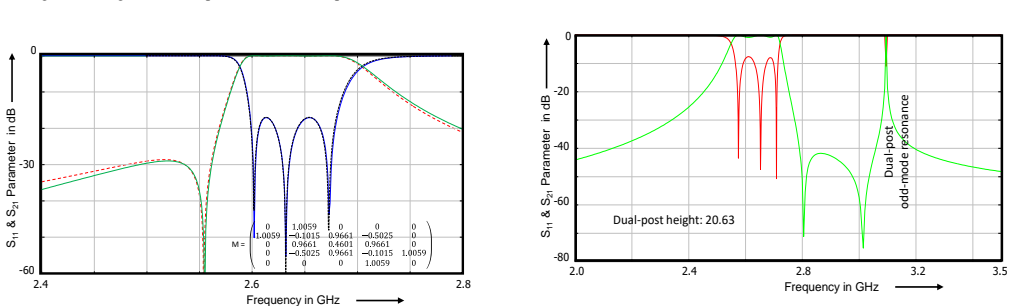
- [Section VI.B, Fig. 13 caption] The caption refers to 'configuration in Fig. xx'; please insert the correct figure number.
- [Section VII.B, Figs. 23 and 24 captions] Both captions refer to 'Fig. 14' but should reference the triple-post configuration in Fig. 22.
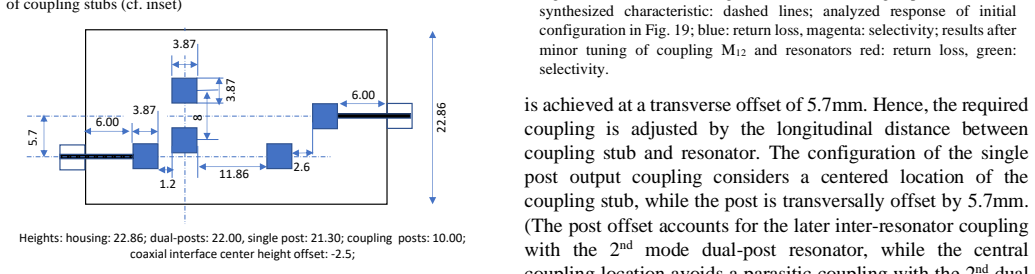
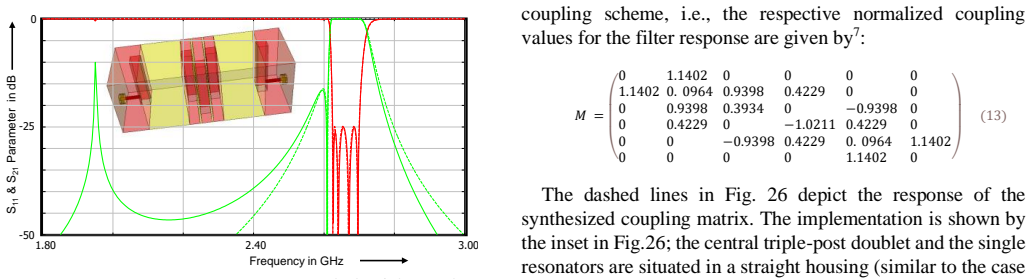
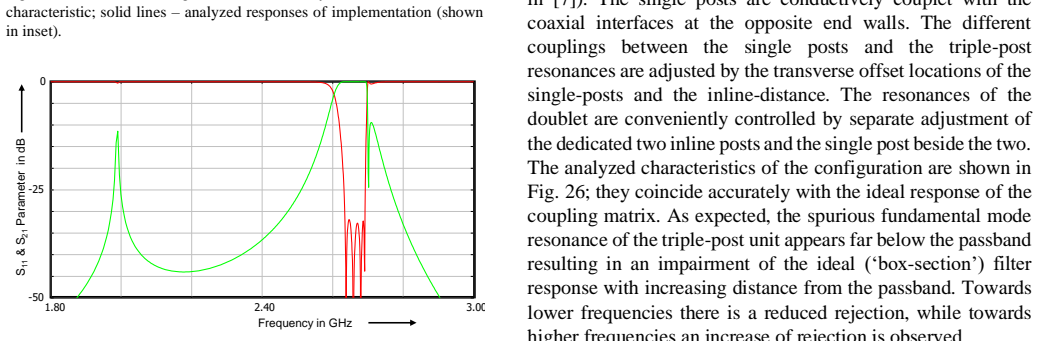
- [Section VII.C, Fig. 27 caption] The caption refers to 'inset Fig. 18'; this should be 'inset Fig. 26'.
- [Section VI, 2-order filter example] The normalized coupling matrix displayed after the specification of the 2-order filter example is typeset in a single line and is difficult to read; please present it as a standard 4x4 matrix.
- [Fig. 18 caption] Please correct the typo 'Retrun loss' to 'Return loss'.
- [Section VII.C] In the sentence 'The single posts are conductively couplet with the coaxial interfaces', 'couplet' should be 'coupled'.
- [Section VI.B, last paragraph] The sentence 'There is no advantage to a more elaborate higher order equivalent circuit model' is too categorical; the following sentences show only that the authors found no advantage for this configuration, so consider softening it.
Circularity Check
No significant circularity: the central derivations are self-contained, and the validation is external.
full rationale
The paper's main derivations do not reduce to their inputs. The coupling coefficient k = D/S is derived from the eigenproblem in Eqs. (3)-(6), not fitted to the target response. The transmission-zero formulas in Eqs. (7)-(10) follow from direct circuit analysis of the doublet and the transversal three-resonator model, with the stated large-spurious-resonance approximation made explicit. The paper's physical conclusions are tested against an external full-wave solver (µWaveWizard) and against measured results in the cited literature [5-9], which are not authored by the present authors. The self-citations [13,14] are used for known properties such as the TZ-shifting property of a doublet, but this property is also demonstrated by full-wave examples in Section VII, so the argument does not rest solely on self-citation. The statement that similarity transformations 'yield the correct frequency response (by construction)' is a mathematical fact about similarity transformations, not a circular definition of the paper's conclusions. The only notable assumption is that all non-selected resonances are far enough from the passband; the paper states this condition explicitly in Section II, and the conclusions are conditional on it. No step was found where a prediction is equivalent to a fitted parameter or where a load-bearing premise is imported only from the authors' prior work.
Assumptions & free parameters
assumptions (5)
- domain assumption The structure is lossless and homogeneous.
- domain assumption Input and output couplings are weak enough not to significantly affect the eigenmode field distributions.
- standard math Orthogonality of Maxwell eigenmodes in a given volume means the two (or three) resonances of the block are not coupled to each other.
- domain assumption All other resonances (spurious modes) are far enough from the frequency range of interest that they can be neglected.
- domain assumption The narrowband coupling-matrix representation is valid near the passband.
Cite this review
Pith. "Pith review of Properties of Building Blocks Comprising Strongly Interacting Posts and Their Consideration in Advanced Coaxial Filter Designs." pith.science (2026). https://pith.science/paper/M7VN6MEZ
@misc{pith2026250515729,
  author       = {Pith},
  title        = {Pith review of: Properties of Building Blocks Comprising Strongly Interacting Posts and Their Consideration in Advanced Coaxial Filter Designs},
  year         = {2026},
  howpublished = {\url{https://pith.science/paper/M7VN6MEZ}},
  note         = {Machine review of arXiv:2505.15729}
}
read the original abstract
Building blocks containing strongly coupled posts offer new possibilities for advanced coaxial (comb-line) filter designs. Equivalent circuits based on the individual resonances of the posts cannot be used to reliably describe the behavior of these structures because of the strong coupling between the posts. Instead, sets of electromagnetic (EM) resonances that satisfy the boundary conditions are used. The resulting equivalent circuit is either a fully transversal circuit or contains locally transversal sub-circuits depending on the strength of the coupling between the cascaded blocks. The validity of similarity transformations that result in topologies with unusual strong coupling coefficients is questionable despite the fact that they yield the correct frequency response. Such coupling matrices obscure the physics of the problem and fail to predict the correct behavior of filtering structures. However, topologies that match the layout of the posts can be used to optimize the filter in connection with a full-wave solver or measurement. Examples of dual-post and triple-post units are used to illustrate the key findings. The basic knowledge of the real functionality of these special resonator configurations allows their consideration in advanced filter implementations by well-established classic design methods, without limitation by the design approach. This is demonstrated by an example of a 2-order in-line filter implementation providing one transmission zero by using the combination of single and transverse dual-post resonators. This fundamental understanding of the special properties provides the pre-requisite for a variety of novel filter solutions.
Figures


Figures from the paper (19 more)





Forward citations
Cited by 2 Pith papers
-
Coupling phase interference effects in a multimode cavity magnonics system
Coupling phases—not just strengths—determine which cavity modes couple to magnons and can produce nonreciprocal transmission at antiresonances in a multimode cavity magnonics system.
-
Intrinsic Multi-Mode Interference for Passive Suppression of Purcell Decay in Superconducting Circuits
Breaking the symmetry of a transmon capacitor activates multi-mode interference that can suppress Purcell decay, shown analytically, in simulation, and in one four-qubit device.
Reference graph
Works this paper leans on
-
[5]
Evanescent mode filters using strongly coupled resonator pairs,
S. Bastioli, R. V. Snyder, “Evanescent mode filters using strongly coupled resonator pairs,” in IEEE MTT-S Int. Microw. Symp. Dig. , Seattle, WA, USA, Jun. 2013, pp. 1–3
work page 2013
-
[9]
Y. Zeng, Y. Yang, M. Yu, S. Bastioli, ‘Synthesis of Generalized Strongly Coupled Resonator Triplet Filters by Regulating Redundant Resonant Modes’, IEEE Trans. Microwave Theory and Tech. , vol. 70, no. 1 , pp. 864-875, Jan. 2022
work page 2022
-
[1]
R. J. Cameron, C. M. Kudsia, and R. R. Mansour, Microwave Filters for Communication Systems . Hoboken, NJ, USA: Wiley, 2007
work page 2007
-
[2]
Brian Thomas, ‘Cross -Coupling in Coaxial Cavity Filters —A Tutorial Overview’, IEEE Trans
J. Brian Thomas, ‘Cross -Coupling in Coaxial Cavity Filters —A Tutorial Overview’, IEEE Trans. Microwave Theory and Tech. , vol. 51, no. 4, pp. 1368-1376, April. 2003
work page 2003
-
[3]
S. Li, X. Wang, Y. Li, J. Wang, ‘Design of Compact Coaxial Cavity Bandpass Filter with High Selectivity’, 2019 IEEE MTT -S International Microwave Biomedical Conference (IMBioC), 2019
work page 2019
-
[4]
U. Rosenberg, ‘New `Planar' waveguide cavity elliptic function filters’, 25th European Microwave Conference , Proceedings, Sept., 1995
work page 1995
-
[6]
Design of In -Line Filters With Transmission Zeros Using Strongly Coupled Resonators Pairs
G. Macchiarella, S. Bastioli, R. V. Snyder, “Design of In -Line Filters With Transmission Zeros Using Strongly Coupled Resonators Pairs”, IEEE Trans. Microwave Theory and Tech ., vol. 66, no. 8, pp. 3836-3846, Aug. 2018
work page 2018
-
[7]
Design of In -Line Filters With Strongly Coupled Resonator Triplet
S. Bastioli, R. V. Snyder, G. Macchiarella, “Design of In -Line Filters With Strongly Coupled Resonator Triplet”, IEEE Trans. Microwave Theory and Tech., vol. 66, no. 12, pp. 5585-5592, Dec. 2018
work page 2018
Show all 14 references
-
[8]
Y. Zeng, Y. Yang, M. Yu, ‘Flexible Design of Generalized Strongly Coupled Resonator Triplet Filters by Regulating Redundant Resonant Modes’; IEEE MTT -S Int. Microw. Symp. Dig., USA, Jun. 2021, pp. 146ff
2021
-
[10]
Rosenberg, W
U. Rosenberg, W. Hägele, K. Beis, Patent: DE4319346 C2, Leitungsresonator (‚Line Resonator‘), Priority: 1993 -06-11 (cf., e.g., https://patents.google.com/patent/EP0632518A1/en )
1993
-
[11]
µWaveWizard from Mician GmbH, Bremen, Germany
-
[12]
Awai, ‘Meaning of Resonator’s Coupling Coefficient in Bandpass Filter Design’, Electronics and Communications in Japan, Part 2, Vol
I. Awai, ‘Meaning of Resonator’s Coupling Coefficient in Bandpass Filter Design’, Electronics and Communications in Japan, Part 2, Vol. 89, No. 6, 2006
2006
-
[13]
Rosenberg, S
U. Rosenberg, S . Amari; ‘ Novel Design Possibilities for Dual -Mode Filters Without Intracavity Couplings ’, IEEE Microwave and Wireless Component Letters,vol. 12, No. 8, pp. 296-298, Dec. 2002
2002
-
[14]
Amari, U
S. Amari, U. Rosenberg, ‘Characteristics of cross (bypass) coupling through higher/lower order modes and their applications in elliptic filter design’, IEEE Trans. Microwave Theory and Tech ., vol. 53, no. 10, pp. 3135-3141, Oct. 2005
2005
Reviewed August 7, 2026 · model on record in the stance chip above.
Discussion (0). Continue with ORCID to comment.