REVIEW 3 major objections 5 minor 13 references
Neuro-Argumentative Learning with Case-Based Reasoning
T0 review · 3 major / 5 minor · reviewed 2026-08-07 · deepseek-v4-flash
Pith's one-line read Classification can be a learned argumentation debate among training cases, with accuracy comparable to a single-layer neural network.
desk verdict A genuinely new neurosymbolic model with an evaluation that overstates its robustness; worth reviewing but needs a major revision. read the letter →
The pith
A machine-rendered reading of the paper's core claim, the machinery that carries it, and where it could break.
The reading
What carries the argument
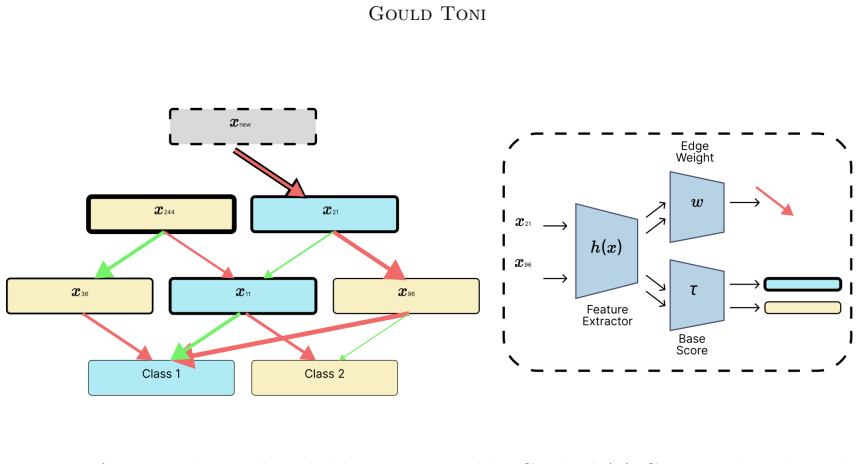
The load-bearing object is the edge-weighted Quantitative Bipolar Argumentation Framework built from the casebase: nodes are observed cases plus one target per class, edges carry negative weights for attacks and positive weights for supports, and every case's base score comes from $\tau_x(x_a)$. Strengths are updated by MLP gradual semantics, which at each iteration aggregates weighted neighbour strengths $\rho^{(i+1)}_a = \sum_{(b,a)\in E} w(b,a)\,\psi^{(i)}_b$ and then applies an influence step $\psi^{(i+1)}_a = \varphi(\varphi^{-1}(\tau(a)) + \rho^{(i+1)}_a)$; because ReLU is used and the iteration is differentiable, the functions $\tau_x$ and $w_{\succcurlyeq}$ can be learned by backpropagation. A post-processing step removes cycles by keeping only the stronger of each pair of opposing edges, and training adds a community-preservation rank regulariser to the cross-entropy loss. This machinery is what turns the intuition 'cases argue for their labels' into an end-to-end trainable classifier.
What would settle it
Run the exact model with the stated linear feature extractor on a nonlinear synthetic benchmark such as two interleaving moons or an XOR task, comparing against a small multi-layer network. If the debate model stays near chance on every random initialization while the multi-layer network learns, the claim of parity with neural networks is limited to linearly separable problems; if some initialization succeeds, the reported initialization sensitivity becomes the more pressing bottleneck.
Extended reading notes
Core claim
The central claim is that case-based classification can be redefined as an argumentation debate with learnable strengths: the training casebase becomes the set of arguments, target arguments represent classes, a new case attacks every argument it is irrelevant to, opposing labels attack, and matching labels support. Final strengths are computed with the MLP gradual semantics, an iterated aggregation-and-influence procedure, and the predicted label is the one attached to the target argument with the maximum final strength. The paper claims that with base scores and edge weights parameterized by a shared linear feature extractor $h(x_a)$ followed by sigmoids, the entire debate is trainable end-to-end by gradient descent, and that on Mushroom, Glioma, Breast Cancer, and Iris this reaches accuracy comparable to a single-layer neural network while outperforming AA-CBR and ANNA on binary-feature datasets. This would establish that interpretability via argumentation need not be purchased at the cost of classification performance.
Load-bearing premise
The model assumes that one learned linear scoring of the input features is expressive enough to decide both how strongly a case argues and which cases should attack or support one another; if that scoring cannot represent the decision boundary, the learned debate cannot classify well.
Editorial extensions
If this is right
- Every prediction is the winner of an explicit debate, so the final strength of each class target and the learned edge weights can be shown to a user as the reasoning behind the label.
- Feature importance and case importance are byproducts of training, since the same learned weights define base scores and relationship strengths.
- The differentiable argumentation layer is independent of the feature extractor, so replacing the linear projection with a CNN, RNN, or transformer is a direct extension the paper names as future work.
- On binary-feature datasets, Gradual AA-CBR clearly outperforms the symbolic AA-CBR and ANNA baselines, while on continuous and multi-class data it keeps pace with the neural network.
Reading between the lines
- A test the paper does not run: replace the linear projection $h(x_a)$ with an untrained random nonlinear embedding and retrain; if accuracy rises, the reported initialization sensitivity is a symptom of the linear feature extractor rather than of the debate semantics.
- Because every edge weight is an explicit judged relation between two cases, the learned graph could support counterfactual explanations, such as identifying which single case, if removed or relabelled, would flip a target's final strength.
- The community-preservation regulariser may squeeze out small but informative case clusters, so measuring per-class accuracy under different values of $\gamma$ would show whether the regularization helps all classes or mostly the majority class.
- If the initialization problem is solved, the debate structure gives humans a natural handle for contestation: a person can point at a specific case and its attack edges rather than at a vector of latent features.
Editorial analysis
A structured set of objections, weighed in public.
Referee Report
Summary. The paper introduces Gradual AA-CBR, a neurosymbolic classifier in which every training example is an argument in an edge-weighted quantitative bipolar argumentation framework. Base scores and edge weights are produced by a learned linear feature extractor through sigmoid functions, and classification is performed by comparing the final strengths, under MLP-style gradual semantics, of learned target arguments associated with each class. The authors report experiments on Mushroom, Glioma, Breast Cancer, and Iris, comparing against a simple neural network and, where applicable, against the symbolic AA-CBR and the ANNA pipeline, and they claim that Gradual AA-CBR performs comparably to NNs while outperforming existing AA-CBR formulations.
Significance. If the empirical claims were fully supported, this would be a useful contribution: an interpretable argumentation-based classifier that is trained end-to-end, handles multi-class and continuous features, and comes with public code. The formal definitions in Sections 3 and 4 are coherent, and the idea of learning base scores, edge weights, and target arguments jointly within a gradual argumentation framework is a plausible direction for neuro-argumentative learning. However, the central 'comparable to NNs' claim is currently supported only by best-observed results without error bars or a distribution over initializations, and the paper itself reports that the model fails to learn in most initial states on two of the three binary datasets. The contribution is therefore significant in principle, but the evidence presented is not yet sufficient to establish the headline claim.
major comments (3)
- [Section 5.1, Table 1] The central claim that Gradual AA-CBR 'performs comparably to NNs' is not supported by the reported experimental protocol. Section 5.1 states that the results are 'best-observed' and that the model learns from only 79% of initial states on Iris, 16% on Breast Cancer, and 11% on Glioma. With no error bars, no seed counts, and no performance distribution, the reported accuracy values may reflect a few lucky initializations, and the expected performance across the random initialization distribution could be far below the NN baseline. Please report results over all initializations, including failed runs, with mean/median/quantiles, success rates, and appropriate significance tests, and clearly state the selection rule used to produce the numbers in Table 1.
- [Section 4.2.1, Eq. (6)] The post-processing function P uses the indicator function X, which has zero derivative almost everywhere. The manuscript does not explain how gradients are computed through this non-differentiable step during backpropagation, e.g., whether a straight-through estimator, a subgradient, or a detached selection is used. As written, the claim that the QBAF structure is 'learned through gradient-based methods' is incomplete, and the absence of a learning signal for the edge-retention decision may well contribute to the initialization sensitivity reported in Section 5.1. Please clarify the gradient handling or replace P with a differentiable relaxation, and re-evaluate the model accordingly.
- [Section 5, Table 1 and Appendix B] The abstract's claim that Gradual AA-CBR 'significantly outperforms existing AA-CBR formulations' is broader than the evidence. The comparison to AA-CBR and ANNA is limited to two binary-feature datasets, with no statistical significance tests over repeated runs or splits, and the NN baseline is a single layer with no hidden units, so 'comparable to NNs' is a relatively weak claim. Please state the exact number of seeds and splits, report variability, and consider whether the wording of the empirical claims should be qualified to match the evidence.
minor comments (5)
- [Section 5.1] The sentence 'AA-CBR on the Iris dataset can learn in 79% of initial states tried' appears to refer to Gradual AA-CBR, not the symbolic AA-CBR, given the surrounding discussion; please correct this.
- [Section 6] The word 'intepretability' in the first sentence of the conclusion should be 'interpretability'.
- [Section 5.1 and Appendix B] The selection of hyperparameters T and gamma is described only briefly; please state explicitly whether these were chosen on the validation set and whether the reported test results are from the corresponding best validation configuration.
- [Figure 2] The visualization filters edges with magnitude greater than 0.1, but the caption does not explain how this threshold affects the interpretability claims; a brief clarification would help.
- [Section 2] The related work discussion is helpful, but it would benefit from a more explicit comparison with other differentiable argumentation-based classifiers, if any exist, to sharpen the novelty claim.
Circularity Check
No circular derivation: parameters are fit on training cases and evaluated on a held-out test set, with target arguments constructed from the training mean rather than from test labels.
full rationale
The derivation chain is self-contained. Equations (3)-(5) define a shared linear feature map h(x)=sum theta_k x_k, base scores tau=S(h theta_s), and exceptionalism w_succeq=S((h(xa)-h(xb))T); Equation (2) predicts by taking the target argument with maximum final strength under the MLP semantics of Definition 2. Algorithm 1 optimizes these parameters against categorical cross-entropy on training cases, and Table 1 reports performance on held-out test data, so no prediction is a fitted constant renamed as an output. The target cases are set to the training mean (Section 4.2.2), not to test labels, and Regularity Condition (1) is a design constraint linking w_sim to w_succeq, not a restatement of the performance claim. The paper cites prior work by the same group (e.g., Cyras et al. 2016; Gould et al. 2024; Proietti and Toni 2023) for background and baselines, but no load-bearing uniqueness theorem or fitted quantity is imported from those citations; the differentiable semantics come from Potyka (2021), which is external and not defined in terms of this paper's outputs. The experimental caveats in Section 5.1 (best-observed results; Gradual AA-CBR learning in only 16% and 11% of initial states on Breast Cancer and Glioma) and the non-differentiable indicator in Equation (6) are real robustness and optimization limitations, but they concern reproducibility rather than circularity: nothing in the derivation reduces the reported predictions to the paper's own assumptions by construction.
Assumptions & free parameters
free parameters (4)
- theta_k feature weights =
learned via gradient descent
- theta_s base-score scale =
learned
- Temperature T =
0.05
- Regularization weight gamma =
0.005
assumptions (4)
- standard math MLP gradual semantics, Definition 2, compute final argument strengths and are differentiable.
- domain assumption ReLU activation with pseudo-inverse phi^{-1} = max(0, x) is a valid choice for the semantics.
- ad hoc to paper Regularity conditions in Definition 4 ensure the desired reasoning behavior.
- ad hoc to paper The hard post-processing function P in Equation (6) can be trained through gradient-based methods.
invented entities (1)
-
Target arguments, one per class
Cite this review
Pith. "Pith review of Neuro-Argumentative Learning with Case-Based Reasoning." pith.science (2026). https://pith.science/paper/FTT76RS2
@misc{pith2026250515742,
  author       = {Pith},
  title        = {Pith review of: Neuro-Argumentative Learning with Case-Based Reasoning},
  year         = {2026},
  howpublished = {\url{https://pith.science/paper/FTT76RS2}},
  note         = {Machine review of arXiv:2505.15742}
}
read the original abstract
We introduce Gradual Abstract Argumentation for Case-Based Reasoning (Gradual AA-CBR), a data-driven, neurosymbolic classification model in which the outcome is determined by an argumentation debate structure that is learned simultaneously with neural-based feature extractors. Each argument in the debate is an observed case from the training data, favouring their labelling. Cases attack or support those with opposing or agreeing labellings, with the strength of each argument and relationship learned through gradient-based methods. This argumentation debate structure provides human-aligned reasoning, improving model interpretability compared to traditional neural networks (NNs). Unlike the existing purely symbolic variant, Abstract Argumentation for Case-Based Reasoning (AA-CBR), Gradual AA-CBR is capable of multi-class classification, automatic learning of feature and data point importance, assigning uncertainty values to outcomes, using all available data points, and does not require binary features. We show that Gradual AA-CBR performs comparably to NNs whilst significantly outperforming existing AA-CBR formulations.
Figures

Reference graph
Works this paper leans on
-
[1]
Input: Training data Dt, learning rate α, number of epochs E, semantics σ, base score function τx, edge weight functions w≽ and w≁, target arguments T ,
-
[2]
Initialize: Function parameters θ of τx, w≽ and w≁ randomly or using a specific initialization method
-
[4]
Fit the QBAF on the training data Dt, such that F := QBAFDt
-
[5]
For each case a := (xa, ya) in Dt F orward Pass:
-
[6]
Add case a as a new case to F , giving F ′ := QBAFDt,a
-
[7]
Compute the output ˆya := [σ(t1), σ(t2), ..., σ(tm)]⊤, for each target argument ti of F ′
-
[8]
Compute loss L(ˆya, ya) Backward Pass:
-
[9]
Compute the gradient of the loss with respect to the parameters ∇θL(ˆya, ya) Update Parameters:
Show all 13 references
-
[10]
Update parameters: θ := θ − α∇θL(ˆya, ya)
-
[11]
Output: Trained weights θ Appendix B. Experiment Details The baseline NN for all models was a single layer NN with an input size equal to the number of features in the dataset and the output size is the number of classes. It was trained with Categorical Cross Entropy Loss (Cia...
2014
-
[13]
There is also one real-valued feature, patient age, and one categorical feature, race, which we exclude as AA-CBR/ANNA require binary features. 15 Gould Toni For ANNA, an autoencoder with multiple hidden layer sizes, 5, 10, 15, 30 was tried, but no subset of features found lea...
-
[16]
Pietro Baroni, Antonio Rago, and Francesca Toni
URL http://dx.doi.org/10.1007/978-3-031-24628-9_16 . Pietro Baroni, Antonio Rago, and Francesca Toni. How many properties do we need for gradual argumentation? In Proceedings of the Thirty-Second AAAI Conference on Ar- tificial Intelligence and Thirtieth Innovative Application...
-
[2024]
Artur d’Avila Garcez and Lu ´ ıs C
URL https://arxiv.org/abs/2405.02079. Artur d’Avila Garcez and Lu ´ ıs C. Lamb. Neurosymbolic ai: the 3rd wave. Artificial Intelligence Review , 56(11):12387–12406, March 2023. ISSN 1573-7462. doi: 10.1007/ s10462-023-10448-w. URL http://dx.doi.org/10.1007/s10462-023-10448-w ....
2023 arXiv
Reviewed August 7, 2026 · model on record in the stance chip above.
Discussion (0). Continue with ORCID to comment.