REVIEW 4 major objections 5 minor 1 cited by
A Scalable Hierarchical Intrusion Detection System for Internet of Vehicles
T0 review · 4 major / 5 minor · reviewed 2026-08-07 · deepseek-v4-flash
Pith's one-line read A three-level hierarchical IDS detects IoV attacks with perfect accuracy using as few as 11 features.
desk verdict Perfect-accuracy claim on CIC-IoV2024 is unsubstantiated: feature selection precedes cross-validation, so the headline numbers reflect leakage, not generalization. read the letter →
The pith
A machine-rendered reading of the paper's core claim, the machinery that carries it, and where it could break.
The reading
What carries the argument
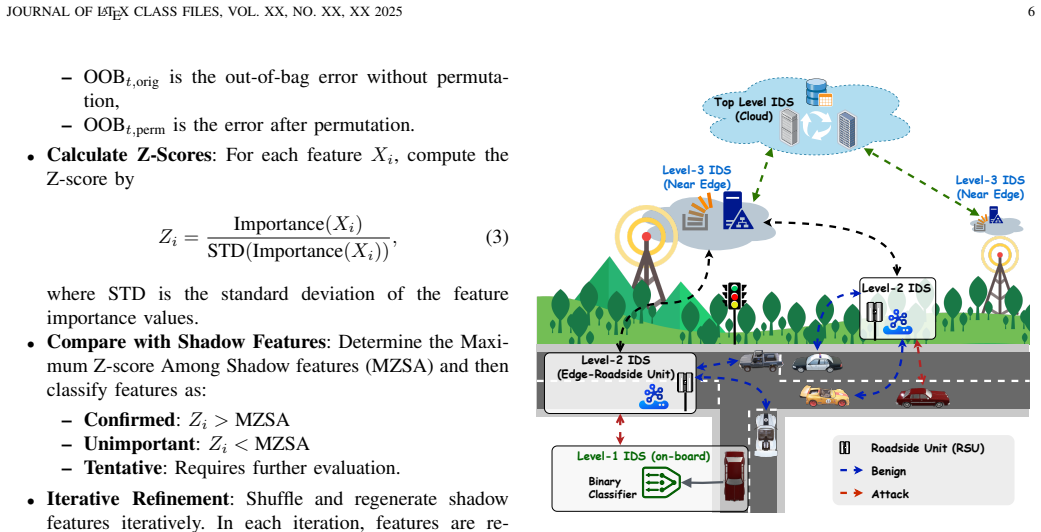
The load-bearing mechanism is a cascade of three classifiers whose outputs narrow the decision at each layer, paired with a two-stage feature-selection pipeline. Boruta, a wrapper around Random Forest, ranks features by comparing their importance against shuffled shadow copies; SHAP then refines the ranked list by quantifying each feature's contribution to the prediction. The cascade lets easy decisions stay at the vehicle (binary) and only suspicious traffic propagate to more detailed classifiers, so each level needs far fewer features than a flat 6-class model. The inclusion of the 45th-ranked feature at Level 3 is the specific detail that lifts macro F1 from 94.81% to 99.99%.
What would settle it
Repeat the whole pipeline with feature selection and the search for the 45th feature nested inside each cross-validation fold, so only training-fold data picks features; if the 100% accuracy drops when features are re-selected per fold, the reported scores are artifacts of selection leakage.
Extended reading notes
Core claim
The paper's central claim is that a three-level hierarchical classifier—benign/attack at the vehicle, DoS/spoofing at the roadside unit, and spoofing subtype at the near edge—detects attacks on the CIC-IoV2024 dataset with perfect accuracy while using a fraction of the available features. With 11 features, Random Forest attains 100% precision, recall, and F1 for the 2-class and 3-class tasks; with 18 features (the top 17 plus the 45th-ranked feature) it attains a macro F1 of 99.99% and a weighted F1 of 100% on the 6-class task. The same minimal feature sets also make Logistic Regression nearly perfect, and both models outperform a flat classifier and a federated-learning DNN baseline. The authors present this as evidence that hierarchical classification plus Boruta/SHAP feature selection is a practical route to scalable, decentralized IDS for IoV.
Load-bearing premise
The feature-selection steps—Boruta ranking, SHAP refinement, and the trial-and-error addition of the 45th feature—are run on the full CIC-IoV2024 dataset before the stratified 10-fold splits are made, so the near-perfect scores assume no information from test folds influenced which features were chosen.
Editorial extensions
If this is right
- If the reported accuracy holds outside the paper's setup, an on-board IDS needs only 11 features to flag attacks, keeping memory and computation low (13 KB model and roughly 0.002 s per instance).
- The hierarchy can be partitioned across vehicle, roadside unit, and near-edge/cloud layers, so no single node must classify everything and a cloud outage does not blind the lowest layer.
- Adding a new attack subtype would require retraining only the affected Level-3 classifier, and different levels can be retrained in parallel.
- On CIC-IoV2024, the approach beats the 95% accuracy of the dataset's baseline and matches or exceeds prior deep-learning detectors while using far fewer features.
- The SHAP analysis identifies which CAN-bus data bytes matter most for each attack class, offering interpretability that flat black-box detectors lack.
Reading between the lines
- A reader should treat the perfect 6-class scores as an upper bound: because the 18-feature set was chosen by trial-and-error on the full dataset, nested cross-validation that searches features inside each training fold would reveal how much of the gain is real.
- The near-perfect separation with a handful of data-byte features suggests CIC-IoV2024 attack classes are strongly distinguishable in raw CAN payloads, so transferring the method to another dataset would likely require a fresh feature-set search.
- The level structure is attack-taxonomy-dependent, meaning the framework transfers mainly by reassigning the hierarchy's leaves to a new dataset's attack types rather than by redesigning the cascade.
- If the feature-efficiency result generalizes, the practical bottleneck shifts from inference cost to communication: the forwarding of suspicious packets between levels, not model size, would set the real-time ceiling.
Editorial analysis
A structured set of objections, weighed in public.
Referee Report
Summary. The manuscript proposes a three-level hierarchical intrusion detection framework for the Internet of Vehicles. Level 1 is a binary benign/attack classifier deployed on the vehicle, Level 2 distinguishes DoS from spoofing at roadside units, and Level 3 identifies spoofing subtypes (gas, RPM, speed, steering wheel) at near-edge nodes, with training performed in the cloud. Using the CIC-IoV2024 dataset, the authors apply Boruta and SHAP feature selection, report 100% accuracy and F1-scores for 2-class and 3-class tasks with 11 features and for 6-class tasks with 18 features, and compare their results with federated learning and prior CIC-IoV2024 studies. They also report training/testing times and overhead estimates from a proposed network configuration.
Significance. If the reported results were valid, the paper would offer a lightweight, distributed IDS for IoV with a striking feature-reduction result on a recent benchmark. The hierarchical deployment concept is sensible, and the use of a current IoV dataset with class-wise metrics is a positive feature. However, the central empirical claim is invalidated by selection leakage: the feature subsets are chosen using full-dataset labels before the cross-validation splits are created, so the reported 100% figures are not unbiased generalization estimates. This is a load-bearing flaw, and no code or data is provided to verify alternative claims. The contribution of the paper as written is therefore not established.
major comments (4)
- [§III.A.3, §III.A.4, §IV.C, Table IV] Feature selection is performed on the full dataset before the stratified 10-fold splits are created: Section III.A.3 (Feature Selection) precedes Section III.A.4 (Dataset Partition), and Section IV.C states that the third-level feature set was finalized by trial and error, adding the 45th feature because it improved accuracy. Test-fold labels therefore influence which features and how many features are used, so the accuracy and F1 values in Tables III–V and Fig. 7 are not unbiased estimates of generalization. The macro-F1 jump from 94.81% to 99.99% in Table IV when the 45th feature is added is exactly the kind of optimistic result this protocol can produce. Feature selection must be nested inside each training fold, or performed only on a held-out training split, and the feature count must be chosen without access to validation or test labels.
- [§IV.H] The overfitting discussion does not address the selection leakage. Stating that 10-fold cross-validation was performed across clients and that features were chosen with a wrapper-based strategy does not protect against pre-CV feature selection; the cited FL cross-validation concerns the federated experiment, not the Boruta/SHAP selection. The claim in Section IV.H that the behavior is 'not merely due to data leakage or poor generalization' is therefore unsupported.
- [§III.B, §IV.F] The suitability and scalability of the framework for resource-constrained IoV are asserted rather than demonstrated. Section IV.F derives overhead values (13 KB memory, 0.13% response-time increase) from assumed parameters and the configuration in [59] and explicitly says that network simulations are future work; Section III.B is a deployment proposal rather than an evaluation. The real-time latency and resource-constraint claims are thus extrapolations rather than measured results.
- [§IV.E, §VI] The paper claims that the hierarchical approach outperforms flat classification, but no accuracy results for flat classifiers are presented anywhere in Section IV; Figs. 8 and 9 compare only training and testing times. Without a flat-versus-hierarchical accuracy comparison, the central architectural claim in Section VI that the hierarchical approach 'significantly outperformed traditional flat classification models' is not empirically supported.
minor comments (5)
- [§IV.B] The text around Eqs. (5)–(7) misdefines precision: it says high precision is needed to 'minimise false negatives (normal incorrectly detected as attack)', but that is false positives; recall is the metric that addresses false negatives. The sentence defining F1-score as 'the proportion of true positive identification relative to the total number of positive instances' is the definition of recall, not F1.
- [§IV.C, Fig. 7] The text says the 6-class scenario 'achieves a maximum F1-score of 99.65% with 17 or 18 top-ranked features', but Fig. 7(a) and Table IV report 100% weighted F1 and 99.99% macro F1 for the 17+45th feature set. Please clarify which feature set and which metric are being described.
- [Table V] The row 'Proposed Model (10 Features)' reports identical accuracy values (98.94%) for 2-class, 3-class, and 6-class tasks, which is implausible if these are separate classification tasks; clarify what is being compared.
- [§II.B, §V, Eq. (1)] There are several presentation issues: 'CI-CIoV2024' appears to be a typo for 'CIC-IoV2024'; Section V contains the phrase 'the superior of our proposed framework'; and Eq. (1) is introduced as 'calculated by 1.' rather than by a meaningful sentence.
- [Fig. 9] The caption says 'Level wise Testing time for single instance in Hierarchical and Flat classifier', but the surrounding text and figure appear to compare models rather than clearly showing both hierarchical and flat settings; please make the figure and caption consistent.
Circularity Check
Perfect-accuracy headline is produced by feature selection on the full dataset before the 10-fold splits, so the CV numbers are not independent of the test folds.
-
fitted input called prediction
[Section III (preamble) and Sections III.A.3–III.A.4]
"Next, the Boruta algorithm, in combination with RF, is applied to select the features, retaining the most relevant features. The resulting reduced dataset is then processed using a stratified cross-validation approach to ensure balanced class distribution across folds."
Feature selection is performed on the full CIC-IoV2024 dataset before the stratified 10-fold splits are created. The labels of every fold therefore participate in choosing the feature set, and the subsequent cross-validation evaluates a model whose input representation was already tuned to the same data. The reported 100% accuracy in Tables III–V is consequently a selection outcome, not an out-of-sample prediction. Min-Max scaling (Eq. 1) applied before the split adds a smaller leak of the same type.
-
fitted input called prediction
[Section IV.C and Fig. 6; Table IV]
"For the third level (GAS, SW, Speed, and RPM classification), 18 features were required to achieve 100% accuracy. Here, we need to include the 45th feature with first seventeen top features. We can skip features 18th to 44th from the ranked feature list. Our systematic approach involves ranking all features; however, through trial and error combined with SHAP analysis, we observed that features 18th to 44th contribute minimally to the outcome."
The 45th feature is added to the top-17 set because trial-and-error on the full data improves accuracy, and the paper then reports the resulting 18-feature classifier as a headline result. Table IV's macro F1 jump from 94.81% to 99.99% when the 45th feature is added is exactly the fitted improvement that motivated including it. The 'prediction' of perfect 6-class F1 is thus forced by the feature-selection criterion rather than by an independent test.
1 more flagged steps
-
other
[Section IV.H (Potential Overfitting Issue)]
"To ensure that this behavior is not merely due to data leakage or poor generalization, we performed 10-fold cross-validation across all clients in the federated setup. Moreover, the selected features were chosen carefully using a wrapper-based selection strategy, and the FL training was done across distributed clients with non-overlapping data."
This defense invokes cross-validation as a safeguard against leakage, but the 10-fold CV is performed after feature selection on the full dataset and the selected features include the trial-and-error 45th feature. The check therefore does not establish that the reported accuracy is independent of the feature-selection inputs, so the overfitting concern remains unresolved for the headline numbers.
full rationale
The central empirical claim of the paper is that only 11 features are needed for perfect 2-class and 3-class accuracy, and 18 features (top 17 plus the 45th) are enough for perfect 6-class accuracy. That claim is partially circular because the feature subset is selected using the full dataset labels before the stratified 10-fold splits are made, and Section IV.C explicitly describes trial-and-error refinement based on full-data accuracy. The reported cross-validation scores therefore measure a model whose input representation was fitted to the same data being tested. This is the fitted-input-called-prediction pattern rather than pure self-definition: the framework itself has independent content, and the perfect scores are not derived equationally from the method's definition. The self-citations [14], [15] appear only as related-work context and are not load-bearing for the main result, and no uniqueness theorem or ansatz is smuggled in via self-citation. The paper's own Section IV.H acknowledges that 100% accuracy in a real-world setting is unusual and deserves investigation, but it does not test whether the pre-CV selection invalidates the reported generalization estimates. Score 6 reflects substantial partial circularity in the headline numbers while recognizing that the hierarchical architecture and feature-ranking methodology are not themselves definitionally circular.
Assumptions & free parameters
free parameters (3)
- Selected feature set for 2-class and 3-class tasks =
11 features, exact identities not listed
- Selected feature set for 6-class task =
17 top-ranked features plus the 45th-ranked feature
- Number of cross-validation folds =
10
assumptions (3)
- domain assumption CIC-IoV2024 is a representative and correctly labeled IoV CAN bus security dataset
- ad hoc to paper Feature selection on the full dataset does not leak information into cross-validation test folds
- ad hoc to paper Deploying classifiers at vehicle, roadside, near-edge, and cloud layers preserves offline accuracy and meets real-time latency constraints
Cite this review
Pith. "Pith review of A Scalable Hierarchical Intrusion Detection System for Internet of Vehicles." pith.science (2026). https://pith.science/paper/BNXUQWQ3
@misc{pith2026250516215,
  author       = {Pith},
  title        = {Pith review of: A Scalable Hierarchical Intrusion Detection System for Internet of Vehicles},
  year         = {2026},
  howpublished = {\url{https://pith.science/paper/BNXUQWQ3}},
  note         = {Machine review of arXiv:2505.16215}
}
read the original abstract
Due to its nature of dynamic, mobility, and wireless data transfer, the Internet of Vehicles (IoV) is prone to various cyber threats, ranging from spoofing and Distributed Denial of Services (DDoS) attacks to malware. To safeguard the IoV ecosystem from intrusions, malicious activities, policy violations, intrusion detection systems (IDS) play a critical role by continuously monitoring and analyzing network traffic to identify and mitigate potential threats in real-time. However, most existing research has focused on developing centralized, machine learning-based IDS systems for IoV without accounting for its inherently distributed nature. Due to intensive computing requirements, these centralized systems often rely on the cloud to detect cyber threats, increasing delay of system response. On the other hand, edge nodes typically lack the necessary resources to train and deploy complex machine learning algorithms. To address this issue, this paper proposes an effective hierarchical classification framework tailored for IoV networks. Hierarchical classification allows classifiers to be trained and tested at different levels, enabling edge nodes to detect specific types of attacks independently. With this approach, edge nodes can conduct targeted attack detection while leveraging cloud nodes for comprehensive threat analysis and support. Given the resource constraints of edge nodes, we have employed the Boruta feature selection method to reduce data dimensionality, optimizing processing efficiency. To evaluate our proposed framework, we utilize the latest IoV security dataset CIC-IoV2024, achieving promising results that demonstrate the feasibility and effectiveness of our models in securing IoV networks.
Figures


Figures from the paper (6 more)


Forward citations
Cited by 1 Pith paper
-
Communication-Aware Quantum-Inspired Reinforcement Learning for Cyber-Resilient V2X Intrusion Detection and Mitigation
QIRL applies quantum-inspired DQN with amplitude-phase encoding and cost-sensitive MDP to intrusion detection in IoV, achieving 97.89% accuracy and 32.5 μs latency on CICIDS2017.
Reference graph
Works this paper leans on
-
[8]
Mth-ids: A multitiered hybrid intrusion detection system for internet of vehicles,
L. Yang, A. Moubayed, and A. Shami, “Mth-ids: A multitiered hybrid intrusion detection system for internet of vehicles,” IEEE Internet of Things Journal, vol. 9, no. 1, pp. 616–632, 2021
work page 2021
-
[59]
H. Li, Q. Zhang, L. Wu, and Z. Zhang, “Impact of communication performance measures for the internet of vehicles in an intersection scenario,” Simulation Modelling Practice and Theory , p. 103086, 2025
work page 2025
-
[1]
Security issues in internet of vehicles (iov): A comprehensive survey,
H. Taslimasa, S. Dadkhah, E. C. P. Neto, P. Xiong, S. Ray, and A. A. Ghorbani, “Security issues in internet of vehicles (iov): A comprehensive survey,” Internet of Things , vol. 22, p. 100809, 2023
work page 2023
-
[2]
L. Goasduff, “Gartner predicts outdoor surveillance cameras will be largest market for 5g internet of things solutions over next three years. 2019.”
work page 2019
-
[3]
Task offloading for edge-iov networks in the industry 4.0 era and beyond: A high-level view,
M. Talebkhah, A. Sali, V . Khodamoradi, T. Khodadadi, and M. Gordan, “Task offloading for edge-iov networks in the industry 4.0 era and beyond: A high-level view,” Engineering Science and Technology, an International Journal, vol. 54, p. 101699, 2024
work page 2024
-
[4]
Remote exploitation of an unaltered passenger vehicle,
C. Miller and C. Valasek, “Remote exploitation of an unaltered passenger vehicle,” Black Hat USA , vol. 2015, no. S 91, pp. 1–91, 2015
work page 2015
-
[5]
An effective intrusion detection approach based on ensemble learning for iiot edge computing,
M. Mohy-eddine, A. Guezzaz, S. Benkirane, and M. Azrour, “An effective intrusion detection approach based on ensemble learning for iiot edge computing,” Journal of Computer Virology and Hacking Techniques, pp. 1–13, 2022
work page 2022
-
[6]
Iids: Intelligent intrusion detection system for sustainable development in autonomous vehicles,
S. Anbalagan, G. Raja, S. Gurumoorthy, R. D. Suresh, and K. Dev, “Iids: Intelligent intrusion detection system for sustainable development in autonomous vehicles,” IEEE Transactions on Intelligent Transportation Systems, vol. 24, no. 12, pp. 15 866–15 875, 2023
work page 2023
Show all 59 references
-
[7]
Adversarial attacks on intrusion detection systems in in-vehicle networks of connected and autonomous vehicles,
F. Aloraini, A. Javed, and O. Rana, “Adversarial attacks on intrusion detection systems in in-vehicle networks of connected and autonomous vehicles,” Sensors, vol. 24, no. 12, p. 3848, 2024
2024
-
[9]
Ciciov2024: Advancing realistic ids approaches against dos and spoofing attack in iov can bus,
E. C. P. Neto, H. Taslimasa, S. Dadkhah, S. Iqbal, P. Xiong, T. Rahman, and A. A. Ghorbani, “Ciciov2024: Advancing realistic ids approaches against dos and spoofing attack in iov can bus,” Internet of Things , vol. 26, p. 101209, 2024
2024
-
[10]
Enhancing autonomous intrusion detection system with generative adversarial networks,
K. Kostage, D. West, T. Meinert, C. Qu, P. Calyam, and L. Mazzola, “Enhancing autonomous intrusion detection system with generative adversarial networks,” in 2024 IEEE 20th International Conference on e-Science (e-Science), 2024, pp. 1–10
2024
-
[11]
To- wards a hierarchical deep learning approach for intrusion detection,
F. Alin, A. Chemchem, F. Nolot, O. Flauzac, and M. Krajecki, “To- wards a hierarchical deep learning approach for intrusion detection,” in Machine Learning for Networking: Second IFIP TC 6 International Conference, MLN 2019, Paris, France, December 3–5, 2019, Revised Selected ...
2019
-
[12]
Hierarchical intrusion detection using machine learning and knowledge model,
M. Sarnovsky and J. Paralic, “Hierarchical intrusion detection using machine learning and knowledge model,” Symmetry, vol. 12, no. 2, p. 203, 2020
2020
-
[13]
A novel hierarchical intrusion detection system based on decision tree and rules-based models,
A. Ahmim, L. Maglaras, M. A. Ferrag, M. Derdour, and H. Janicke, “A novel hierarchical intrusion detection system based on decision tree and rules-based models,” in 2019 15th International Conference on Distributed Computing in Sensor Systems (DCOSS) . IEEE, 2019, pp. 228–233
2019
-
[14]
usfad based effective unknown attack detection focused ids framework,
M. A. Uddin, S. Aryal, M. R. Bouadjenek et al. , “usfad based effective unknown attack detection focused ids framework,” Scientific Reports, vol. 14, p. 29103, 2024. [Online]. Available: https: //doi.org/10.1038/s41598-024-80021-0
2024 doi
-
[15]
A dual-tier adaptive one-class classification ids for emerging cyberthreats,
M. A. Uddin, S. Aryal, M. R. Bouadjenek, M. Al-Hawawreh, and M. A. Talukder, “A dual-tier adaptive one-class classification ids for emerging cyberthreats,” Computer Communications, vol. 229, p. 108006, 2025
2025
-
[16]
A class-specific intrusion detection model: Hierarchical multi-class ids model,
A. Sarıkaya and B. G. Kılıc ¸, “A class-specific intrusion detection model: Hierarchical multi-class ids model,” SN Computer Science , vol. 1, pp. 1–11, 2020
2020
-
[17]
Intrusion detection system based on hybrid hierarchical classifiers,
N. Mohd, A. Singh, and H. S. Bhadauria, “Intrusion detection system based on hybrid hierarchical classifiers,” Wireless Personal Communi- cations, vol. 121, no. 1, pp. 659–686, 2021
2021
-
[18]
Meta-heuristic optimization algorithm-based hierarchical intrusion detection system,
K. A. ElDahshan, A. A. AlHabshy, and B. I. Hameed, “Meta-heuristic optimization algorithm-based hierarchical intrusion detection system,” Computers, vol. 11, no. 12, p. 170, 2022
2022
-
[19]
A hierarchical intrusion detection system based on extreme learning machine and nature-inspired optimization,
A. Alzaqebah, I. Aljarah, and O. Al-Kadi, “A hierarchical intrusion detection system based on extreme learning machine and nature-inspired optimization,” Computers & Security , vol. 124, p. 102957, 2023
2023
-
[20]
A novel multi-stage approach for hierarchical intrusion detection,
M. Verkerken, L. D’hooge, D. Sudyana, Y .-D. Lin, T. Wauters, B. V ol- ckaert, and F. De Turck, “A novel multi-stage approach for hierarchical intrusion detection,” IEEE Transactions on Network and Service Man- agement, vol. 20, no. 3, pp. 3915–3929, 2023
2023
-
[21]
P2sf- iov: A privacy-preservation-based secured framework for internet of vehicles,
R. Kumar, P. Kumar, R. Tripathi, G. P. Gupta, and N. Kumar, “P2sf- iov: A privacy-preservation-based secured framework for internet of vehicles,” IEEE Transactions on Intelligent Transportation Systems , vol. 23, no. 11, pp. 22 571–22 582, 2021
2021
-
[22]
Intrusion detection system using machine learning for vehicular ad hoc networks based on ton-iot dataset,
A. R. Gad, A. A. Nashat, and T. M. Barkat, “Intrusion detection system using machine learning for vehicular ad hoc networks based on ton-iot dataset,” IEEE Access, vol. 9, pp. 142 206–142 217, 2021
2021
-
[23]
A privacy-preserving-based secure framework using blockchain- enabled deep-learning in cooperative intelligent transport system,
R. Kumar, P. Kumar, R. Tripathi, G. P. Gupta, N. Kumar, and M. M. Has- san, “A privacy-preserving-based secure framework using blockchain- enabled deep-learning in cooperative intelligent transport system,” IEEE Transactions on Intelligent Transportation Systems , vol. 23, no....
2021
-
[24]
Federated intrusion detection in blockchain-based smart transportation systems,
M. Abdel-Basset, N. Moustafa, H. Hawash, I. Razzak, K. M. Sallam, and O. M. Elkomy, “Federated intrusion detection in blockchain-based smart transportation systems,” IEEE Transactions on Intelligent Transportation Systems, vol. 23, no. 3, pp. 2523–2537, 2021
2021
-
[25]
A technique for generating a botnet dataset for anomalous activity detection in iot networks,
I. Ullah and Q. H. Mahmoud, “A technique for generating a botnet dataset for anomalous activity detection in iot networks,” in 2020 IEEE International Conference on Systems, Man, and Cybernetics (SMC) . IEEE, 2020, pp. 134–140
2020
-
[26]
A new distributed architecture for evaluating ai-based security systems at the edge: Network ton iot datasets,
N. Moustafa, “A new distributed architecture for evaluating ai-based security systems at the edge: Network ton iot datasets,” Sustainable Cities and Society , vol. 72, p. 102994, 2021. JOURNAL OF LATEX CLASS FILES, VOL. XX, NO. XX, XX 2025 15
2021
-
[27]
A detailed analysis of the kdd cup 99 data set,
M. Tavallaee, E. Bagheri, W. Lu, and A. A. Ghorbani, “A detailed analysis of the kdd cup 99 data set,” in 2009 IEEE symposium on computational intelligence for security and defense applications . Ieee, 2009, pp. 1–6
2009
-
[28]
Unsw-nb15: a comprehensive data set for network intrusion detection systems (unsw-nb15 network data set),
N. Moustafa and J. Slay, “Unsw-nb15: a comprehensive data set for network intrusion detection systems (unsw-nb15 network data set),” in 2015 military communications and information systems conference (MilCIS). IEEE, 2015, pp. 1–6
2015
-
[29]
Empirical evaluation of attacks against ieee 802.11 enterprise networks: The awid3 dataset,
E. Chatzoglou, G. Kambourakis, and C. Kolias, “Empirical evaluation of attacks against ieee 802.11 enterprise networks: The awid3 dataset,” IEEE Access, vol. 9, pp. 34 188–34 205, 2021
2021
-
[30]
De- veloping realistic distributed denial of service (ddos) attack dataset and taxonomy,
I. Sharafaldin, A. H. Lashkari, S. Hakak, and A. A. Ghorbani, “De- veloping realistic distributed denial of service (ddos) attack dataset and taxonomy,” in 2019 international carnahan conference on security technology (ICCST). IEEE, 2019, pp. 1–8
2019
-
[31]
Distributed privacy-preserving collaborative intrusion detection systems for vanets,
T. Zhang and Q. Zhu, “Distributed privacy-preserving collaborative intrusion detection systems for vanets,” IEEE Transactions on Signal and Information Processing over Networks , vol. 4, no. 1, pp. 148–161, 2018
2018
-
[32]
Transfer learning based in- trusion detection scheme for internet of vehicles,
X. Li, Z. Hu, M. Xu, Y . Wang, and J. Ma, “Transfer learning based in- trusion detection scheme for internet of vehicles,” Information Sciences, vol. 547, pp. 119–135, 2021
2021
-
[33]
Intrusion detection on internet of vehicles via combining log-ratio oversampling, outlier detection and metric learning,
F. Jin, M. Chen, W. Zhang, Y . Yuan, and S. Wang, “Intrusion detection on internet of vehicles via combining log-ratio oversampling, outlier detection and metric learning,” Information Sciences, vol. 579, pp. 814– 831, 2021
2021
-
[34]
Intrusion detection system for cyberattacks in the internet of vehicles environment,
M. S. Korium, M. Saber, A. Beattie, A. Narayanan, S. Sahoo, and P. H. Nardelli, “Intrusion detection system for cyberattacks in the internet of vehicles environment,” Ad Hoc Networks , vol. 153, p. 103330, 2024
2024
-
[35]
Gids: Gan based intrusion detec- tion system for in-vehicle network,
E. Seo, H. M. Song, and H. K. Kim, “Gids: Gan based intrusion detec- tion system for in-vehicle network,” in 2018 16th annual conference on privacy, security and trust (PST) . IEEE, 2018, pp. 1–6
2018
-
[36]
Otids: A novel intrusion detection system for in-vehicle network by using remote frame,
H. Lee, S. H. Jeong, and H. K. Kim, “Otids: A novel intrusion detection system for in-vehicle network by using remote frame,” in 2017 15th Annual Conference on Privacy, Security and Trust (PST) . IEEE, 2017, pp. 57–5709
2017
-
[37]
Road: The real ornl automotive dynamometer con- troller area network intrusion detection dataset (with a comprehensive can ids dataset survey & guide),
M. E. Verma, M. D. Iannacone, R. A. Bridges, S. C. Hollifield, B. Kay, and F. L. Combs, “Road: The real ornl automotive dynamometer con- troller area network intrusion detection dataset (with a comprehensive can ids dataset survey & guide),” arXiv preprint arXiv:2012.14600 , 2020
2012 arXiv
-
[38]
Advancing vehicle security: Deep learning based solution for defending can networks in the internet of vehicles,
K. Aswal and H. Pathak, “Advancing vehicle security: Deep learning based solution for defending can networks in the internet of vehicles,” EAI Endorsed Transactions on Internet of Things , vol. 10, 2024
2024
-
[39]
Improving attack detection in iov systems using ga-based hyperparameter optimization,
M. F. G ¨ul and H. Bakir, “Improving attack detection in iov systems using ga-based hyperparameter optimization,” in 2024 8th International Artificial Intelligence and Data Processing Symposium (IDAP) , 2024, pp. 1–5
2024
-
[40]
Adversarial robustness of deep reinforcement learning- based intrusion detection,
M. A. Merzouk, C. Neal, J. Delas, R. Yaich, N. Boulahia-Cuppens, and F. Cuppens, “Adversarial robustness of deep reinforcement learning- based intrusion detection,” International Journal of Information Security, pp. 1–27, 2024
2024
-
[41]
Trans- forming in-vehicle network intrusion detection: Vae-based knowledge distillation meets explainable ai,
M. A. Yagiz, P. MohajerAnsari, M. D. Pese, and P. Goktas, “Trans- forming in-vehicle network intrusion detection: Vae-based knowledge distillation meets explainable ai,” arXiv preprint arXiv:2410.09043 , 2024
2024 arXiv
-
[42]
Advanced hybrid techniques for cyberattack detection and defense in iot networks,
Z. S. Mahdi, R. M. Zaki, and L. Alzubaidi, “Advanced hybrid techniques for cyberattack detection and defense in iot networks,” Security and Privacy, p. e471, 2024
2024
-
[43]
Evaluation of boruta algorithm in ddos detection,
N. Farhana, A. Firdaus, M. F. Darmawan, and M. F. Ab Razak, “Evaluation of boruta algorithm in ddos detection,” Egyptian Informatics Journal, vol. 24, no. 1, pp. 27–42, 2023
2023
-
[44]
Deep learning hybrid model with boruta-random forest opti- miser algorithm for streamflow forecasting with climate mode indices, rainfall, and periodicity,
A. M. Ahmed, R. C. Deo, Q. Feng, A. Ghahramani, N. Raj, Z. Yin, and L. Yang, “Deep learning hybrid model with boruta-random forest opti- miser algorithm for streamflow forecasting with climate mode indices, rainfall, and periodicity,” Journal of Hydrology , vol. 599, p. 126350, 2021
2021
-
[45]
Deployment of iov for smart cities: Applications, architecture, and challenges,
L.-M. Ang, K. P. Seng, G. K. Ijemaru, and A. M. Zungeru, “Deployment of iov for smart cities: Applications, architecture, and challenges,” IEEE Access, vol. 7, pp. 6473–6492, 2019
2019
-
[46]
Internet of vehicles: Motivation, layered architecture, network model, challenges, and future aspects,
O. Kaiwartya, A. H. Abdullah, Y . Cao, A. Altameem, M. Prasad, C.-T. Lin, and X. Liu, “Internet of vehicles: Motivation, layered architecture, network model, challenges, and future aspects,” IEEE Access , vol. 4, pp. 5356–5373, 2016
2016
-
[47]
Emerging technologies for 5g-iov networks: Applications, trends and opportuni- ties,
W. Duan, J. Gu, M. Wen, G. Zhang, Y . Ji, and S. Mumtaz, “Emerging technologies for 5g-iov networks: Applications, trends and opportuni- ties,” IEEE Network, vol. 34, no. 5, pp. 283–289, 2020
2020
-
[48]
Goodfellow, Y
I. Goodfellow, Y . Bengio, and A. Courville, Deep Learning. MIT Press, 2016, http://www.deeplearningbook.org
2016
-
[49]
Understanding the origins and variability of the fuel consumption gap: Lessons learned from laboratory tests and a real-driving campaign,
J. Pavlovic, G. Fontaras, M. Ktistakis, K. Anagnostopoulos, D. Komnos, B. Ciuffo, M. Clairotte, and V . Valverde, “Understanding the origins and variability of the fuel consumption gap: Lessons learned from laboratory tests and a real-driving campaign,” Environmental Sciences ...
2020
-
[50]
Vehicle fuel consumption prediction method based on driving behavior data collected from smartphones,
Y . Yao, X. Zhao, C. Liu, J. Rong, Y . Zhang, Z. Dong, and Y . Su, “Vehicle fuel consumption prediction method based on driving behavior data collected from smartphones,” Journal of Advanced Transportation , vol. 2020, no. 1, p. 9263605, 2020
2020
-
[51]
A linear systems perspective on intrusion detection for routing in reconfigurable wireless networks,
J. Zuniga-Mejia, R. Villalpando-Hernandez, C. Vargas-Rosales, and A. Spanias, “A linear systems perspective on intrusion detection for routing in reconfigurable wireless networks,” IEEE Access , vol. 7, pp. 60 486–60 500, 2019
2019
-
[52]
Llm-based continu- ous intrusion detection framework for next-gen networks,
F. Adjewa, M. Esseghir, and L. Merghem-Boulahia, “Llm-based continu- ous intrusion detection framework for next-gen networks,”arXiv preprint arXiv:2411.03354, 2024
2024 arXiv
-
[53]
Llama 2,
Meta AI, “Llama 2,” 2023, accessed: 02 April 2025. [Online]. Available: https://www.llama.com/llama2/
2023
-
[54]
(2023, jul) Inference characteristics of llama
Aman. (2023, jul) Inference characteristics of llama. Cursor. Accessed: 27 March 2025. [Online]. Available: https://www.cursor.com/en/blog/ llama-inference
2023
-
[55]
Sur- vey on the internet of vehicles: Network architectures and applications,
B. Ji, X. Zhang, S. Mumtaz, C. Han, C. Li, H. Wen, and D. Wang, “Sur- vey on the internet of vehicles: Network architectures and applications,” IEEE Communications Standards Magazine , vol. 4, no. 1, pp. 34–41, 2020
2020
-
[56]
A novel multi-service small-cell cloud radio access network for mobile backhaul and computing based on radio-over-fiber technologies,
C. Liu, L. Zhang, M. Zhu, J. Wang, L. Cheng, and G.-K. Chang, “A novel multi-service small-cell cloud radio access network for mobile backhaul and computing based on radio-over-fiber technologies,” Jour- nal of Lightwave Technology , vol. 31, no. 17, pp. 2869–2875, 2013
2013
-
[57]
Scikit-learn: Machine learning in python,
F. Pedregosa, G. Varoquaux, A. Gramfort, V . Michel, B. Thirion, O. Grisel, M. Blondel, P. Prettenhofer, R. Weiss, V . Dubourg et al. , “Scikit-learn: Machine learning in python,” the Journal of machine Learning research, vol. 12, pp. 2825–2830, 2011
2011
-
[58]
Communication-efficient learning of deep networks from decentralized data,
B. McMahan, E. Moore, D. Ramage, S. Hampson, and B. A. y Arcas, “Communication-efficient learning of deep networks from decentralized data,” in Artificial intelligence and statistics . PMLR, 2017, pp. 1273– 1282
2017
Reviewed August 7, 2026 · model on record in the stance chip above.
Discussion (0). Continue with ORCID to comment.