REVIEW 4 major objections 4 minor 3 cited by
Exploring parametrized dark energy models in interacting scenario
T0 review · 4 major / 4 minor · reviewed 2026-08-07 · deepseek-v4-flash
Pith's one-line read The paper claims that a simple interacting dark energy model, with coupling $Q = \beta H \rho_\phi$ and a linear-in-redshift equation of state, fits a Hubble constant of about 75.6 km/s/Mpc from Hubble plus cosmic-chronometer data…
desk verdict The paper's central H(z) does not satisfy the model's own equations, so the claimed Hubble-tension resolution is not a valid result. read the letter →
The pith
A machine-rendered reading of the paper's core claim, the machinery that carries it, and where it could break.
The reading
What carries the argument
The machinery is a two-fluid Friedmann system whose dark sectors communicate through the source term $Q=\beta H\rho_\phi$. The equation-of-state parametrization $w_\phi=w_0+w_1(1+z)$ sets how the dark-energy pressure evolves, and the algebraic choice $w_0=\beta/3$ is imposed so that the matter conservation equation can be integrated in closed form. These pieces assemble into the Hubble parameter of equation (16), which is then compared with expansion-rate and distance-modulus data through a Bayesian likelihood with $\Omega_{m0}=0.27$ fixed. The negative best-fit $\beta$ is the mechanism that makes dark energy decay into dark matter, and the paper credits that energy flow with raising the fitted $H_0$ for the Hubble+CC combination.
What would settle it
Evaluate equation (16) at $z=0$ with $\Omega_{m0}=0.27$ and the reported best-fit values of $H_0$, $w_1$, and $\beta$; if $H^2(0)$ does not equal the fitted $H_0^2$, the fitted Hubble parameter is not a self-consistent Friedmann solution, and the MCMC constraints derived from it would not apply to the model as defined.
Extended reading notes
Core claim
The central claim is the resolution of the Hubble tension in an interacting scenario with the coupling $Q=\beta H\rho_\phi$ and the linear redshift parametrization $w_\phi=w_0+w_1(1+z)$. By imposing the simplification $w_0=\beta/3$, the authors obtain closed-form expressions for $\rho_\phi(z)$, $\rho_m(z)$, and the Hubble parameter $H(z)$ given in their equation (16). Fitting this Hubble parameter to Hubble, Hubble+CC, and Pantheon+CC+BAO data with $\Omega_{m0}=0.27$ fixed, they report $H_0 = 66.93^{+2.25}_{-2.11}$, $H_0 = 75.6^{+1.42}_{-1.4}$, and $H_0 = 69.97^{+0.02}_{-0.05}$ km/s/Mpc, respectively, with a negative best-fit $\beta$ in every case. The negative $\beta$ is interpreted as energy flowing from dark energy into dark matter, which the paper argues is thermodynamically favored and consistent with recent BAO and supernova constraints. The model's effective equation of state crosses into the accelerating regime and later back into deceleration, so the authors conclude it avoids a future big rip.
Load-bearing premise
The load-bearing premise is that the approximate closed-form expression for the dark-matter density in equation (15) is accurate enough to represent the true matter density, so that the Hubble parameter in equation (16) used in the likelihood is the actual Friedmann solution of the model.
Editorial extensions
If this is right
- If the central claim is correct, a coupling proportional to $H\rho_\phi$ can move the Hubble-constant estimate from Hubble+CC data to about 75.6 km/s/Mpc, in line with the local distance-ladder value.
- The same model produces a present effective equation of state below $-1/3$ for all three datasets, so it drives the observed late-time acceleration.
- The effective equation of state re-enters the decelerating phase in the future, so the model avoids a big-rip end state.
- Negative best-fit $\beta$ in every fit implies dark energy decays into dark matter, a direction the paper argues is supported by thermodynamics and recent BAO and supernova observations.
- The reported AIC and BIC values indicate the interacting model fits the Hubble and cosmic-chronometer data at least as well as $\Lambda$CDM, with the Pantheon-based comparison showing only mild tension.
Reading between the lines
- A direct test is to release the constraint $w_0=\beta/3$ and fit $w_0$, $w_1$, and $\beta$ independently; if the high $H_0$ survives, the interaction itself is doing the work rather than the algebraic shortcut.
- The same interaction could be confronted with the full CMB likelihood and BAO distance measurements rather than the three compressed datasets, which would either corroborate or undercut the claimed resolution.
- The approximation used for $\rho_m(z)$ drops a homogeneous integration constant and higher-order terms; restoring them would change the expansion history at $z=0$ and would show how much of the reported $H_0$ shift depends on that approximation.
- Because interacting dark sectors alter the growth of cosmic structure, redshift-space distortion or growth-rate data could distinguish this model from $\Lambda$CDM more sharply than the expansion-rate fits presented here.
Editorial analysis
A structured set of objections, weighed in public.
Referee Report
Summary. The paper studies a spatially flat FRW universe with an interacting dark sector, taking the dark-energy equation of state as w_phi = w0 + w1(1+z) and the interaction as Q = beta H rho_phi. After imposing w0 = beta/3, the authors integrate the matter conservation equation and present a closed-form H(z), which they then fit to Hubble, cosmic-chronometer, and Pantheon samples using MCMC. Their central claim is that the Hubble+CC fit gives H0 = 75.6 km/s/Mpc, matching SH0ES and thereby resolving the Hubble tension, while Pantheon+CC+BAO gives an intermediate H0. The paper also reports effective equation-of-state, deceleration and jerk parameters, Om(z), and AIC/BIC comparisons with LambdaCDM.
Significance. If the derived H(z) were the correct Friedmann solution of the stated interacting model, the paper would provide a simple phenomenological example in which an interaction with Q proportional to H rho_phi reconciles SH0ES and Planck values, with a negative coupling meaning dark energy decays into dark matter. The analysis uses standard emcee/GetDist tools and multiple datasets, and the statistical comparison with LambdaCDM is a useful feature. However, the central derivation is internally inconsistent, and the reported H0 values and the Hubble-tension interpretation rest on that invalid H(z). The manuscript makes no parameter-free prediction: H0 is a fitted output, so the word 'resolution' would be an overstatement even if the derivation were correct. As it stands, the significance is conditional on correcting the equations and redoing the fits.
major comments (4)
- [Sec. 2.1, Eq. (15)] The solution for rho_m drops the homogeneous integration constant of Eq. (14) and truncates the exponential at first order in w1. Equation (14) is a first-order linear ODE whose general solution contains an arbitrary constant C in rho_m/(1+z)^3. Equation (15) sets C=0 and keeps only the terms shown, so rho_m0 = 3 beta w1 e^{-3w1} rho_phi0. For the Hubble+CC best fit (beta=-0.018, w1=-0.5), this gives Omega_m0 = r/(1+r) with r=3 beta w1 e^{-3w1} about 0.11, not the assumed 0.27. The model therefore has no independent matter density, and the matter sector is not solved correctly.
- [Sec. 2.1, Eq. (16)] Equation (16) does not satisfy H(0)=H0 for the stated parameters. Evaluating Eq. (16) at z=0 gives H^2(0)/H0^2 = (1-Omega_m0)(1 + 3 beta w1 e^{-3w1}). With Omega_m0=0.27 and the Hubble+CC best fit (beta=-0.018, w1=-0.5), this is approximately 0.818, so H(0) is about 0.904 H0 rather than H0. The prefactor (1-Omega_m0) multiplies the matter contribution as well, so Eq. (16) is not the normalized Friedmann equation coming from Eq. (1). Since this H(z) is the quantity fitted to the data, the reported H0=75.6 and the claimed Hubble-tension resolution are not supported by a valid expansion history of the model.
- [Sec. 2.1, Eq. (14)] The condition w0 = beta/3 is imposed 'for mathematical simplicity' to make the integral tractable. This is an extra ansatz, not a relation derived from the field equations or from the interaction. The paper should state explicitly that this restriction is part of the model definition, not a prediction, and the parameter count in the MCMC analysis should reflect that w0 is not independently free. The current Table 1 lists w0 as a derived parameter without acknowledging this imposed constraint.
- [Sec. 3 and Table 2] The dataset definitions are internally inconsistent. The text states that 77 Hubble-parameter data points from Ref. [24], including cosmic chronometer data, are used, and separately 57 data points from Ref. [23]. Table 1 labels one sample 'Hubble' with N=57 and another 'Hubble + CC' with N=77, while the Pantheon + CC + BAO sample in Table 2 has N=1105, which equals 1048 Pantheon points plus 57, not plus the 77-point sample. This ambiguity affects both the best-fit values and the BIC comparison, since BIC depends on N. Please clarify the exact composition of each sample and avoid double counting.
minor comments (4)
- [Sec. 2.1, after Eq. (11)] The symbol rho_phi0 is used without defining its relation to H0 and Omega_m0; the paper should explicitly state rho_phi0 = 3H0^2(1-Omega_m0) when deriving Eq. (16).
- [Sec. 1, references] Reference [4] is cited as observational evidence for cosmic acceleration, but it appears to be the SDSS ninth data release catalog; please verify and replace with the intended supernova or CMB reference.
- [Table 1, Pantheon + CC + BAO row] The reported H0 uncertainty of about 0.02-0.05 km/s/Mpc for the combined Pantheon+CC+BAO fit seems unexpectedly small for this kind of analysis; please confirm the posterior widths and the convergence of the MCMC chains.
- [Sec. 3.2, Table 2] The AIC and BIC comparisons do not state the number of parameters k used for the LambdaCDM model and for the proposed interacting model; please specify k explicitly in the table caption or text.
Circularity Check
Claimed Hubble-tension resolution reduces to the fitted value of the free parameter H0.
-
fitted input called prediction
[Section 3.1, Table 1; Section 4]
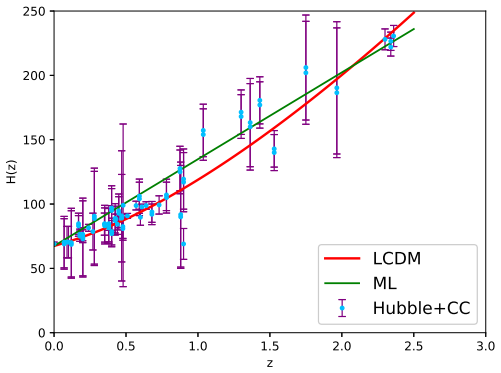
"we have set Ωm0 = 0.27 and H0, w1 and β are considered as free parameters. ... the Hubble parameter H0 = [40,80] km/s/Mpc ... For Hubble + CC dataset, value of H0 happens to be 75.6 km/s/Mpc which is consistent with the SH0ES result and resolves the Hubble tension."
H0 is one of the parameters varied in the MCMC fit, not a quantity derived from the model. The likelihood uses hth = Hth(z)/H0 with Eq. (16) normalized by an arbitrary H0^2, so H0 only fixes the overall amplitude; it is not predicted by the interaction or by the EoS parametrization. The reported 'resolution' of the Hubble tension is therefore the value assigned to this free parameter, i.e., the fitted input is relabeled as a successful outcome. Moreover, Eq. (16) does not satisfy H(0)=H0 for Ωm0=0.27 and the best-fit β,w1; the z=0 bracket is (1−Ωm0)(1+3βw1e^{−3w1})≈0.90, so the fitted 'H0' is not even the model's present expansion rate but a normalization constant compared with SH0ES. No model equation forces H0 to a SH0ES-like value; the wide prior [40,80] simply permits it.
full rationale
The derivation chain for ρφ and ρm is explicit and not circular: the EoS parametrization and Q are openly chosen ansatze, w0=β/3 is imposed for solvability rather than derived, and Brout et al. are cited only for the parametrization, not for the result. The AIC/BIC and cosmographic analyses are standard post-fit diagnostics. The circular element is confined to the central Hubble-tension claim: H0 is a free parameter with a wide flat prior, so the MCMC can place its amplitude anywhere in [40,80]; reporting H0=75.6 for Hubble+CC and calling this a resolution is reporting the fitted input, not a model prediction. The internal inconsistency of Eqs. (15)-(16) (dropped integration constant and linearized exponential) makes this worse: the fitted 'H0' is not the model's actual present expansion rate, but a normalization constant, so comparing it with SH0ES is even more clearly a renaming. This is a partial circularity of the fitted-input-called-prediction type; the rest of the paper is not circular.
Assumptions & free parameters
free parameters (4)
- beta =
-0.05 (Hubble), -0.018 (Hubble+CC), -0.07 (Pantheon+CC+BAO)
- w1 =
-0.36, -0.5, -0.51 per dataset
- H0 =
66.93, 75.6, 69.97 km/s/Mpc per dataset
- Omega_m0 =
0.27 (fixed by hand)
assumptions (5)
- standard math Spatially flat FRW metric and Einstein field equations with 8*pi*G = c = 1
- ad hoc to paper Dark energy and dark matter interact via Q = beta H rho_phi
- ad hoc to paper Equation of state w_phi = w0 + w1(1+z)
- ad hoc to paper Constraint w0 = beta/3 imposed to solve the conservation equation
- standard math Bayesian likelihood using chi-squared and MCMC with flat priors
Cite this review
Pith. "Pith review of Exploring parametrized dark energy models in interacting scenario." pith.science (2026). https://pith.science/paper/JPFJS3QH
@misc{pith2026250516438,
  author       = {Pith},
  title        = {Pith review of: Exploring parametrized dark energy models in interacting scenario},
  year         = {2026},
  howpublished = {\url{https://pith.science/paper/JPFJS3QH}},
  note         = {Machine review of arXiv:2505.16438}
}
abstract
In the present work, we have studied the dynamics of accelerating universe considering a simple parametrization of the equation of state parameter in an interacting scenario. In this toy model, the dark energy component is allowed to interact with the dark matter component through a source term. The expressions for various relevant cosmological parameters for the proposed parametrized model have been obtained and it has been found that the proposed model consistently drives the late time cosmic acceleration of the universe. We have also carried out the Bayesian analysis using recent observational datasets in order to obtain the best fit values of the model parameters. It has been found that the dark energy model with $Q \propto H\rho_{de}$ can provide a possible resolution of the Hubble tension in an interacting scenario where the dark energy component decays into the dark matter.
Figures


Figures from the paper (4 more)



Forward citations
Cited by 3 Pith papers
-
Exploring non-cold dark matter in a scenario of dynamical dark energy with DESI DR2 data
Using DESI DR2, Planck, and supernova data, a nonzero dark matter equation of state is preferred at 2.8 to 3.3 sigma only when dark energy is assumed to have a constant equation of state.
-
Alleviating the $H_0$ tension through the interacting dark energy model from quantum gravitational field theory in light of DESI DR2
With DESI DR2 BAO plus CMB and a SH0ES prior, the two-parameter eeΛCDM model gives δΛ=-0.41±0.14 and H0=71.9±1.0, easing the Hubble tension to 0.8σ, but SN datasets erase the signal.
-
Cosmological preference for a positive neutrino mass at 2.7$\sigma$: A joint analysis of DESI DR2, DESY5, and DESY1 data
A joint fit of DESI DR2, CMB, DESY5 and DESY1 data gives total neutrino mass 0.098 (+0.016, -0.037) eV, a 2.7 sigma preference for positive mass in the w0waCDM model.
Reference graph
Works this paper leans on
-
[24]
J. K. Singh, P. Singh, E. N. Saridakis, S. Myrzakul, New parametrization of the dark-energy equation of state with a single parameter (2023). arXiv:2304.03783
arXiv 2023
-
[23]
Cosmic acceleration with bulk viscosity in modified $f(Q)$ gravity
R. Solanki, S. K. J. Pacif, A. Parida, P. K. Sahoo, Cosmic acceleration with bulk viscosity in modified f(Q) gravity, Physics of the Dark Universe 32 (2021) 100820. arXiv:2105.00876, doi:10.1016/j.dark.2021.100820
work page Pith review arXiv 2021
-
[1]
A. G. Riess, A. V . Filippenko, P. Challis, A. Clocchiatti, A. Diercks, P. M. Garnavich, R. L. Gilliland, C. J. Hogan, S. Jha, R. P. Kirshner, et al., Observational evidence from supernovae for an accelerating universe and a cosmological constant, The Astronomical Journal 116 (3) (1998) 1009
work page 1998
-
[2]
S. Perlmutter, G. Aldering, G. Goldhaber, R. Knop, P. Nugent, P. G. Castro, S. Deustua, S. Fabbro, A. Goobar, D. E. Groom, et al., Measurements of ω and λ from 42 high-redshift supernovae, The Astrophysical Journal 517 (2) (1999) 565
work page 1999
- [3]
-
[4]
C. P. Ahn, R. Alexandroff, C. A. Prieto, S. F. Anderson, T. Anderton, B. H. Andrews, ´E. Aubourg, S. Bailey, E. Balbinot, R. Barnes, et al., The ninth data release of the sloan digital sky survey: first spectroscopic data from the sdss-iii baryon oscillation spectroscopic survey, The Astrophysical Journal Supplement Series 203 (2) (2012) 21
work page 2012
-
[5]
N. Jarosik, C. Bennett, J. Dunkley, B. Gold, M. Greason, M. Halpern, R. Hill, G. Hinshaw, A. Kogut, E. Komatsu, et al., Seven-year wilkinson microwave anisotropy probe (wmap*) observations: sky maps, systematic errors, and basic results, The Astrophysical Journal Supplement Series 192 (2) (2011) 14
work page 2011
-
[6]
B. Ratra, P. J. E. Peebles, Cosmological consequences of a rolling homogeneous scalar field, Phys. Rev. D 37 (1988) 3406–3427. doi:10.1103/PhysRevD.37.3406. URL https://link.aps.org/doi/10.1103/PhysRevD.37.3406
Show all 40 references
-
[7]
R. R. Caldwell, R. Dave, P. J. Steinhardt, Cosmological imprint of an energy component with general equation of state, Phys. Rev. Lett. 80 (1998) 1582–1585. doi:10.1103/PhysRevLett.80.1582. URL https://link.aps.org/doi/10.1103/PhysRevLett.80.1582
1998 doi
-
[8]
Caldwell, A phantom menace? cosmological consequences of a dark energy component with super-negative equation of state, Physics Letters B 545 (1–2) (2002) 23–29
R. Caldwell, A phantom menace? cosmological consequences of a dark energy component with super-negative equation of state, Physics Letters B 545 (1–2) (2002) 23–29. doi:10.1016/s0370-2693(02)02589-3. URL http://dx.doi.org/10.1016/S0370-2693(02)02589-3
2002 doi
-
[9]
R. R. Caldwell, M. Kamionkowski, N. N. Weinberg, Phantom energy: Dark energy with w < −1 causes a cosmic doomsday, Phys. Rev. Lett. 91 (2003) 071301. doi:10.1103/PhysRevLett.91.071301. URL https://link.aps.org/doi/10.1103/PhysRevLett.91.071301
2003 doi
-
[10]
M. C. Bento, O. Bertolami, A. A. Sen, Generalized chaplygin gas, accelerated expansion, and dark-energy-matter unification, Phys. Rev. D 66 (2002) 043507. doi:10.1103/PhysRevD.66.043507. URL https://link.aps.org/doi/10.1103/PhysRevD.66.043507 19
2002 doi
-
[11]
Bousso, The holographic principle, Reviews of Modern Physics 74 (3) (2002) 825–874
R. Bousso, The holographic principle, Reviews of Modern Physics 74 (3) (2002) 825–874. doi:10.1103/revmodphys.74.825. URL http://dx.doi.org/10.1103/RevModPhys.74.825
2002 doi
-
[12]
Fischler, L
W. Fischler, L. Susskind, Holography and cosmology (1998). arXiv:hep-th/9806039. URL https://arxiv.org/abs/hep-th/9806039
1998 arXiv
-
[13]
Di Valentino, O
E. Di Valentino, O. Mena, S. Pan, L. Visinelli, W. Yang, A. Melchiorri, D. F. Mota, A. G. Riess, J. Silk, In the realm of the Hubble tension—a review of solutions, Class. Quant. Grav. 38 (15) (2021) 153001. arXiv:2103.01183, doi:10.1088/1361-6382/ac086d
2021 arXiv
-
[14]
Zimdahl, D
W. Zimdahl, D. Pav ´on, Statefinder parameters for interacting dark energy, General Relativity and Gravitation 36 (2004) 1483–1491
2004
-
[15]
Zimdahl, Models of interacting dark energy, arXiv preprint arXiv:1204.5892 (2012)
W. Zimdahl, Models of interacting dark energy, arXiv preprint arXiv:1204.5892 (2012)
2012 arXiv
-
[16]
Del Campo, R
S. Del Campo, R. Herrera, D. Pav ´on, Interacting models may be key to solve the cosmic coincidence problem, Journal of Cosmology and Astroparticle Physics 2009 (01) (2009) 020
2009
-
[17]
Olivares, F
G. Olivares, F. Atrio-Barandela, D. Pavon, Observational constraints on interacting quintessence models, Physical Review D—Particles, Fields, Gravitation, and Cosmology 71 (6) (2005) 063523
2005
-
[18]
Sinha, M
S. Sinha, M. Banerjee, S. Das, Perturbation in an interacting dark universe, Physics of the Dark Universe 42 (2023) 101273
2023
-
[19]
S. Das, A. Al Mamon, Cosmic acceleration in non-canonical scalar field model: an interacting scenario, Astrophysics and Space Science 355 (2015) 371–380
2015
-
[20]
X. D. Nong, N. Liang, Testing the interacting dark energy model in a phenomenological scenario with gamma-ray bursts and pantheon+ type ia supernovae (2024). arXiv:2407.16644. URL https://arxiv.org/abs/2407.16644
2024 arXiv
-
[21]
Brout, D
D. Brout, D. Scolnic, B. Popovic, A. G. Riess, A. Carr, J. Zuntz, R. Kessler, T. M. Davis, S. Hinton, D. Jones, et al., The pantheon+ analysis: cosmological constraints, The Astrophysical Journal 938 (2) (2022) 110. 20
2022
-
[22]
B. Wang, E. Abdalla, F. Atrio-Barandela, D. Pav ´on, Dark matter and dark energy interactions: theoretical challenges, cosmological implications and observational signatures, Reports on Progress in Physics 79 (9) (2016) 096901. doi:10.1088/0034-4885/79/9/096901. URL http://dx....
2016 doi
-
[25]
D. M. Scolnic, D. Jones, A. Rest, Y . Pan, R. Chornock, R. Foley, M. Huber, R. Kessler, G. Narayan, A. Riess, et al., The complete light-curve sample of spectroscopically confirmed sne ia from pan-starrs1 and cosmological constraints from the combined pantheon sample, The Astr...
2018
-
[26]
L. E. Padilla, L. O. Tellez, L. A. Escamilla, J. A. Vazquez, Cosmological parameter inference with bayesian statistics, Universe 7 (7) (2021) 213
2021
-
[27]
Foreman-Mackey, W
D. Foreman-Mackey, W. M. Farr, M. Sinha, A. M. Archibald, D. W. Hogg, J. S. Sanders, J. Zuntz, P. K. Williams, A. R. Nelson, M. de Val-Borro, et al., emcee v3: A python ensemble sampling toolkit for affine-invariant mcmc, arXiv preprint arXiv:1911.07688 (2019)
2019 arXiv
-
[28]
Lewis, Getdist: a python package for analysing monte carlo samples, arXiv preprint arXiv:1910.13970 (2019)
A. Lewis, Getdist: a python package for analysing monte carlo samples, arXiv preprint arXiv:1910.13970 (2019)
2019 arXiv
-
[29]
Peng, The pantheon sample analysis of cosmological constraints under new models, arXiv preprint arXiv:2303.10095 (2023)
P. Peng, The pantheon sample analysis of cosmological constraints under new models, arXiv preprint arXiv:2303.10095 (2023)
2023 arXiv
-
[30]
A. R. Liddle, Information criteria for astrophysical model selection, Monthly Notices of the Royal Astronomical Society: Letters 377 (1) (2007) L74–L78. doi:10.1111/j.1745-3933.2007.00306.x. URL http://dx.doi.org/10.1111/j.1745-3933.2007.00306.x 21
2007
-
[31]
K. P. Burnham, D. R. Anderson, Multimodel inference: Understanding aic and bic in model selection, Sociological Methods & Research 33 (2) (2004) 261–304. arXiv:https://doi.org/10.1177/0049124104268644, doi:10.1177/0049124104268644. URL https://doi.org/10.1177/0049124104268644
2004 doi
-
[32]
Goswami, S
S. Goswami, S. Das, Study of pressure parametric dark energy model in the framework of f(Q) gravity, Int. J. Mod. Phys. D 33 (07n08) (2024) 2450031. doi:10.1142/S0218271824500317
2024 doi
-
[33]
R. E. Kass, A. E. Raftery, Bayes factors, 1995. URL https://api.semanticscholar.org/CorpusID:247708466
1995
-
[34]
Mandal, S
S. Mandal, S. Pradhan, P. K. Sahoo, T. Harko, Cosmological observational constraints on the power law f(q) type modified gravity theory, The European Physical Journal C 83 (12) (Dec. 2023). doi:10.1140/epjc/s10052-023-12339-4 . URL http://dx.doi.org/10.1140/epjc/s10052-023-12339-4
2023 doi
-
[35]
Camarena, V
D. Camarena, V . Marra, Impact of the cosmic variance onH0 on cosmological analyses, Phys. Rev. D 98 (2) (2018) 023537. arXiv:1805.09900, doi:10.1103/PhysRevD.98.023537
2018 arXiv
-
[36]
Roy, Exploring the possibility of interacting quintessence model as an alternative to the ΛCDM model, Gen
N. Roy, Exploring the possibility of interacting quintessence model as an alternative to the ΛCDM model, Gen. Rel. Grav. 55 (10) (2023) 115. arXiv:2302.10509, doi:10.1007/s10714-023-03160-1
2023 arXiv
-
[37]
Aghanim, et al., Planck 2018 results
N. Aghanim, et al., Planck 2018 results. VI. Cosmological parameters, Astron. Astrophys. 641 (2020) A6, [Erratum: Astron.Astrophys. 652, C4 (2021)]. arXiv:1807.06209, doi:10.1051/0004-6361/201833910
2020 arXiv
-
[38]
Sahni, A
V . Sahni, A. Shafieloo, A. A. Starobinsky, Two new diagnostics of dark energy, Phys. Rev. D 78 (2008) 103502. doi:10.1103/PhysRevD.78.103502. URL https://link.aps.org/doi/10.1103/PhysRevD.78.103502
2008 doi
-
[39]
Pav ´on, B
D. Pav ´on, B. Wang, Le chˆatelier–braun principle in cosmological physics, General Relativity and Gravitation 41 (2009) 1–5
2009
-
[40]
Li, P.-J
T.-N. Li, P.-J. Wu, G.-H. Du, S.-J. Jin, H.-L. Li, J.-F. Zhang, X. Zhang, Constraints on interacting dark energy models from the desi bao and des 22 supernovae data (2024). arXiv:2407.14934. URL https://arxiv.org/abs/2407.14934 23
2024 arXiv
Reviewed August 7, 2026 · model on record in the stance chip above.
Discussion (0). Sign in to comment.