REVIEW 3 major objections 6 minor 54 references
Extreme value statistics and eigenstate thermalization in kicked quantum chaotic spin-$1/2$ chains
T0 review · 3 major / 6 minor · reviewed 2026-08-07 · deepseek-v4-flash
Pith's one-line read The paper shows that the largest Schmidt eigenvalue (the top entanglement-spectrum value) of eigenstates of a kicked quantum chaotic spin-1/2 chain does not follow the Tracy-Widom distribution even at L=18; a Weibull-type extreme value…
desk verdict Convincing demonstration of Tracy-Widom failure in a kicked spin chain, but the Weibull-type claim is overreaching without finite-size scaling. read the letter →
The pith
A machine-rendered reading of the paper's core claim, the machinery that carries it, and where it could break.
The reading
What carries the argument
The central object is the entanglement spectrum of a bipartitioned eigenstate: the Schmidt coefficients $\{\lambda_i\}$ from the Schmidt decomposition of the state, with the maximum coefficient $\lambda_{\max}$ carrying the largest weight in entanglement properties. The machinery is the Fisher-Tippett-Gnedenko theorem, which states that the centered and rescaled maximum of many independent variables converges to one of three universal extreme-value families (Gumbel, Fr\'echet, Weibull) selected by the tail of the underlying density; the paper fits the generalized extreme-value form of Eq. (5) to $\lambda_{\max}$ to classify the tail. Supporting machinery includes the Marchenko-Pastur law for the bulk density of Schmidt eigenvalues, the Wishart ensemble (with unit trace) as the random-matrix model for the reduced density matrix, the Tracy-Widom distribution as the predicted law for the largest eigenvalue of large Wishart matrices, and the ETH ansatz for matrix elements of local observables.
What would settle it
Repeat the generalized extreme-value fit for the largest Schmidt eigenvalue at L=12, 14, 16, and 18 under the same centering and test the L=18 fit against the Tracy-Widom F1 distribution with a goodness-of-fit statistic; if xi moves systematically toward 0 as L grows, or if Tracy-Widom fits within error bars at L=18, the Weibull-type classification is a finite-size artifact rather than the asymptotic law.
Extended reading notes
Core claim
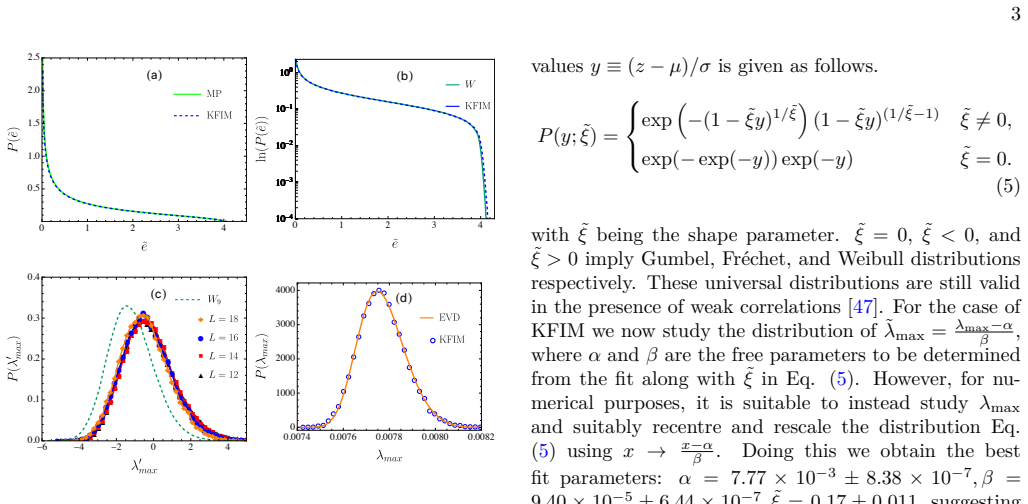
On the paper's own terms, the discovery is that the maximum Schmidt coefficient $\lambda_{\max}$ of eigenstates of the self-dual kicked field Ising model, centered and rescaled using the Wishart/Tracy-Widom scaling of Eq. (4), remains far from the Tracy-Widom $F_1$ distribution at the largest accessible size $L=18$. Fitting the generalized extreme-value distribution of Eq. (5) to the raw $\lambda_{\max}$ data yields $\alpha = 7.77\times 10^{-3}$, $\beta = 9.40\times 10^{-5}$, and shape $\xi = 0.17 \pm 0.011$; in the parametrization used, positive $\xi$ corresponds to the Weibull-type class of bounded-tail extremes. The paper contrasts this with the circular orthogonal ensemble, which converges quickly to the Tracy-Widom law as measured by the distance ratio $R$ and the Kullback-Leibler divergence, while the kicked chain's $R$ stays at $0.56$ and its KL divergence only begins to decrease after $L=14$. Separately, the paper establishes that the diagonal and off-diagonal ETH ansatz for the spin observable are satisfied, with fluctuations decaying as $2^{-L/2}$, and that the averaged spin autocorrelation function decays exponentially and saturates to a late-time value that decreases with $L$.
Load-bearing premise
The load-bearing premise is that the L=18 sample is large enough that the three-parameter generalized extreme-value fit tells us the true asymptotic tail; if the fitted shape parameter moves with system size, the Weibull-type label would not be the asymptotic law.
Editorial extensions
If this is right
- If the Weibull-type fit is the correct asymptotic law, then the largest entanglement-spectrum eigenvalue of local chaotic Floquet systems belongs to a different universality class from the Wishart/Tracy-Widom prediction.
- The deviation is specific to the kicked chain: the same statistics for the circular orthogonal ensemble converge to Tracy-Widom, so the standard RMT null model works for unstructured random unitaries but not for this structured Hamiltonian.
- Because the largest Schmidt eigenvalue dominates the entanglement entropy, its non-Tracy-Widom tail is the likely origin of previously reported deviations of entanglement-entropy statistics in this model.
- The ETH results imply that this non-RMT feature does not derail thermalization: local observables still thermalize in the eigenstate sense, and correlation functions show the expected ergodic decay and saturation.
- Random matrix ensembles beyond the Gaussian and circular classes may be needed to model many-body chaotic eigenstates; the paper offers the Weibull-type extreme value law as a fingerprint to be reproduced by such ensembles.
Reading between the lines
- A decisive check would be to track the fitted GEV shape parameter $\xi$ as a function of $L$; if $\xi$ trends toward $0$ or toward Tracy-Widom moments once $L$ is increased beyond 18, the Weibull-type conclusion would be a finite-size crossover rather than the asymptotic law.
- The same analysis applied to other chaotic models (e.g., random local Hamiltonians or dual-unitary circuits) would show whether bounded-tail extreme value statistics is a generic feature of local many-body chaos or specific to this kicked model.
- The paper's ETH finding suggests that entanglement-spectrum extremes probe a different layer of eigenstate structure than thermalization; a natural extension is to check whether the non-Tracy-Widom tail leaves a detectable signature in other ETH-violating observables or in out-of-time-order correlators at larger sizes.
- More data or better fits could test whether the 'Wishart with unit trace' null model itself needs amendment; a modified random matrix ensemble that encodes the tensor-product Hilbert space structure might reproduce the Weibull-type tail while keeping the Marchenko-Pastur bulk.
Editorial analysis
A structured set of objections, weighed in public.
Referee Report
Summary. The manuscript studies the kicked field Ising model (KFIM) at the self-dual point J=b=π/4, a paradigmatic many-body quantum chaotic Floquet spin-1/2 chain, and investigates whether all random-matrix-theory (RMT) properties hold for this system. The authors compute the reduced density matrix of eigenstates near phase ϕ=π/2, and analyze the statistics of the largest Schmidt eigenvalue. They report that, even at L=18 (subsystem dimension 2^9), the distribution of the centered and scaled largest Schmidt eigenvalue deviates from the Tracy–Widom distribution, and they fit a three-parameter generalized extreme value (GEV) distribution with shape parameter ξ=0.17±0.011, interpreting this as a Weibull-type extreme value law. They also demonstrate that the KFIM satisfies the diagonal and off-diagonal eigenstate thermalization hypothesis via scaling of matrix-element fluctuations of σ^z, and that the spin-spin autocorrelation function decays exponentially and saturates to a system-size-dependent value. The conclusion is that a quantum chaotic model can deviate from certain RMT statistics while still thermalizing.
Significance. If the core claim holds, the paper provides a useful counterexample to the common assumption that spectral RMT behavior in many-body quantum chaos implies all RMT statistical properties, and it complements earlier work on entanglement-statistics deviations in the KFIM. The numerical effort is substantial and carefully controlled: system sizes up to L=18 with ~10^4–10^6 eigenstates per size, comparison against finite-size Wishart and COE references, and explicit ETH scaling fits with quoted parameters. The deviation from Tracy–Widom is well documented through histograms, cumulants, and distance measures. However, the specific identification of a Weibull-type asymptotic law is not established: it rests on a single GEV fit at L=18, with no finite-size extrapolation of the shape parameter and no goodness-of-fit comparison against the finite-size Wishart distribution used elsewhere in the paper. The ETH and autocorrelation analyses are convincing and support the secondary claim that deviations in extreme-value statistics do not destroy thermalization. The paper's significance would be strengthened considerably if the extreme-value classification were placed on firmer statistical ground.
major comments (3)
- [Main text, paragraph after Eq. (5)] The Weibull-type classification rests entirely on a single three-parameter GEV fit at L=18, with fitted parameters α=7.77×10^-3, β=9.40×10^-5, ξ=0.17±0.011. The manuscript does not report the fitted shape parameter as a function of L, does not test the null hypothesis ξ=0 (Gumbel) against the fitted value, and does not compare the GEV fit with the finite-size Wishart reference W9 used elsewhere in the paper. Since the GEV family with three free parameters can absorb finite-size corrections and even mimic Tracy–Widom tails, the fitted ξ is not evidence for a distinct asymptotic extreme-value domain. This is load-bearing because the abstract asserts that the distribution 'follows the extreme value distribution of Weibull type.' I recommend adding a finite-size scaling analysis of (α, β, ξ) and applying the same GEV fit to the W9 and COE data as a control.
- [Main text, paragraph introducing Eq. (5)] The application of the Fisher–Tippett–Gnedenko theorem to the largest Schmidt eigenvalue is not justified without checking the relevant correlation conditions. The theorem concerns maxima of i.i.d. draws (or weakly dependent sequences satisfying mixing conditions); the largest eigenvalue of a Wishart matrix is known to follow the Tracy–Widom distribution, which lies in the Gumbel domain (ξ=0 under the manuscript's sign convention). The manuscript cites Ref. [47] for the weak-correlation extension, but does not verify that the KFIM entanglement spectrum satisfies those conditions. A concrete and easily implementable test would be to fit the same GEV form to the numerically obtained W9 distribution and to the COE distribution: if those fits also produce nonzero ξ, the interpretation of ξ=0.17 as a Weibull-type index would be untenable.
- [Table I and Fig. 2(c)] The paper's own convergence diagnostics are equally consistent with a slow crossover to Tracy–Widom rather than a distinct Weibull limit. Table I shows the KFIM mean, variance, and skewness moving monotonically toward the Tracy–Widom values as L increases (mean from -0.2067 to -0.4746 toward -1.207; variance from 2.057 to 1.741 toward 1.608; skewness from 0.5774 to 0.3257 toward 0.293), and Fig. 2(c) shows D_KL decreasing after L=14. The body text acknowledges this ambiguity ('it is difficult to conclude concretely... if the Tracy–Widom distribution is really achieved asymptotically'), but the abstract and conclusion present the Weibull classification as the definite outcome. The manuscript should either provide a quantitative asymptotic analysis supporting the Weibull limit or temper the claim to state that the distribution is not Tracy–Widom at accessible sizes and that a GEV fit at L=18 yields a Weibull-type shape parameter.
minor comments (6)
- [Eq. (6)] The text says Q(x) is the distribution obtained from experimental data and P(x) is the theoretical distribution, but the formula sums P(x) log(P(x)/Q(x)); the roles of P and Q should be clarified to avoid confusion about the sign and direction of the KL divergence.
- [Main text, paragraph on KL divergence] The sentence 'Due to the unclear trend for the KFIM case it is difficult to difficult to conclude concretely' contains a duplicated phrase 'difficult to'.
- [Fig. 2 caption and text] The text refers to 'Fig. 2(bd)' when citing panels of Fig. 2; this appears to be a typo for 'Fig. 2(b)-(d)' or similar.
- [Numerical details paragraph] The phrase 'trace out first L/2 spin' should be 'trace out the first L/2 spins' for grammatical correctness.
- [Paragraph after Eq. (7)] The phrase 'where the we take' contains an extra article; it should read 'where we take'.
- [References] References [19] and [20] appear to be the same paper (Pausch et al., 'Chaos and ergodicity across the energy spectrum of interacting bosons,' Phys. Rev. Lett. 126, 150601 (2021)) with only the arXiv metadata differing; one of the two entries should be removed or replaced.
Circularity Check
No significant circularity: the Weibull-type claim is reported as a GEV fit benchmarked against independent Wishart/COE references; the sole self-citation is non-load-bearing.
full rationale
The paper's central claims are benchmarked against independent references: the Tracy–Widom deviation is established by direct comparison with numerically generated 2^9×2^9 Wishart matrices (10^6 samples) and COE matrices, with the Tracy–Widom F1 distribution itself validated against 2^18×2^18 Wishart matrices (Supplemental Fig. 6). The deviation (Fig. 1(c), Table I) is a data comparison, not a consequence of a fitted input. The Weibull-type classification is the report of a three-parameter generalized extreme value fit (Eq. 5) to KFIM L=18 data, yielding shape ξ = 0.17 ± 0.011; by the paper's own Eq. (5) convention, 'ξ > 0 implies Weibull,' so the label is a direct reading of the fit rather than a prediction derived from elsewhere. The fit was free to return ξ ≤ 0, and the paper's moment and KL-divergence data (Table I; Fig. 2(c)) independently show KFIM approaching Tracy–Widom, so the Weibull result is not forced by construction. This is standard curve fitting, not circularity. The single self-citation ([14], Gharibyan–Hanada–Shenker–Tezuka) supports only the textbook premise that level repulsion is used as a signature of quantum chaos and is non-load-bearing. The softness of the Weibull conclusion (single system size, no L-trend of ξ, no nested test of ξ=0 versus ξ=0.17) is a robustness and correctness concern, not a circularity concern, and the body text itself refrains from claiming the Tracy–Widom limit is excluded asymptotically. Verdict: no significant circularity.
Assumptions & free parameters
free parameters (3)
- alpha (location of GEV fit) =
7.77e-3 +/- 8.38e-7
- beta (scale of GEV fit) =
9.40e-5 +/- 6.44e-7
- xi (shape of GEV fit) =
0.17 +/- 0.011
assumptions (5)
- standard math Fisher-Tippett-Gnedenko theorem
- standard math Largest eigenvalue of Wishart matrices follows Tracy-Widom distribution
- domain assumption Reduced density matrix of ergodic eigenstates belongs to trace-restricted Wishart ensemble
- domain assumption COE is an appropriate reference ensemble for the KFIM
- domain assumption Eigenstate thermalization hypothesis ansatz
Cite this review
Pith. "Pith review of Extreme value statistics and eigenstate thermalization in kicked quantum chaotic spin-$1/2$ chains." pith.science (2026). https://pith.science/paper/CHBW3R7M
@misc{pith2026250516525,
  author       = {Pith},
  title        = {Pith review of: Extreme value statistics and eigenstate thermalization in kicked quantum chaotic spin-$1/2$ chains},
  year         = {2026},
  howpublished = {\url{https://pith.science/paper/CHBW3R7M}},
  note         = {Machine review of arXiv:2505.16525}
}
abstract
It is often expected (and assumed) for a quantum chaotic system that the presence of correlated eigenvalues implies that all the other properties as dictated by random matrix theory are satisfied. We demonstrate using the spin-$1/2$ kicked field Ising model that this is not necessarily true. We study the properties of eigenvalues of the reduced density matrix for this model, which constitutes the entanglement spectrum. It is shown that the largest eigenvalue does not follow the expected Tracy--Widom distribution even for the large system sizes considered. The distribution instead follows the extreme value distribution of Weibull type. Furthermore, we also show that such deviations do not lead to drastic change in the thermalization property of this system by showing that the models satisfy the diagonal and off-diagonal eigenstate thermalization hypothesis. Finally, we study the spin-spin autocorrelation function and numerically show that it has the characteristic behavior for chaotic systems: it decreases exponentially and saturates to a value at late time that decreases with system size.
Figures


Figures from the paper (4 more)


Reference graph
Works this paper leans on
-
[32]
Deviations from random matrix entanglement statistics for kicked quantum chaotic spin-$1/2$ chains
Tabea Herrmann, Roland Brandau, and Arnd Bäcker, “Deviations from random-matrix entanglement statistics for kicked quantum chaotic spin-1/2 chains,” Phys. Rev. E 111, L012104 (2025), arXiv:2405.07545 [quant-ph]
work page Pith review arXiv 2025
-
[47]
Extreme value statistics of correlated random variables: a pedagogical review
Satya N. Majumdar, Arnab Pal, and Grégory Schehr, “Extreme value statistics of correlated random vari- ables: A pedagogical review,” Physics Reports840, 1–32 (2020), arXiv:1910.10667 [cond-mat]
work page Pith review arXiv 2020
-
[1]
Charac- terization of Chaotic Quantum Spectra and Universality of Level Fluctuation Laws,
O. Bohigas, M. J. Giannoni, and C. Schmit, “Charac- terization of Chaotic Quantum Spectra and Universality of Level Fluctuation Laws,” Phys. Rev. Lett. 52, 1–4 (1984)
work page 1984
-
[2]
Spectral prop- ertiesofthelaplacianandrandommatrixtheories,
O Bohigas, MJ Giannoni, and C Schmit, “Spectral prop- ertiesofthelaplacianandrandommatrixtheories,”Jour- nal de Physique Lettres45, 1015–1022 (1984)
work page 1984
-
[3]
On the connec- tion between quantization of nonintegrable systems and statistical theory of spectra,
G Casati, F Valz-Gris, and I Guarnieri, “On the connec- tion between quantization of nonintegrable systems and statistical theory of spectra,” Lettere al Nuovo Cimento (1971-1985) 28, 279–282 (1980)
work page 1980
-
[4]
Semiclassical theory of spectral rigidity,
Michael Victor Berry, “Semiclassical theory of spectral rigidity,” Proceedings of the Royal Society of London. A. Mathematical and Physical Sciences 400, 229–251 (1985)
1985
-
[5]
M. L. Mehta, Random Matrices (Elsevier, San Diego, USA, 2004)
work page 2004
-
[6]
Peter J Forrester,Log-gases and random matrices (LMS-
Show all 54 references
-
[7]
Level cluster- ing in the regular spectrum,
Michael Victor Berry and Michael Tabor, “Level cluster- ing in the regular spectrum,” Proceedings of the Royal Society of London. A. Mathematical and Physical Sci- 6 ences 356, 375–394 (1977)
1977
-
[8]
The Berry-Tabor conjecture,
Jens Marklof, “The Berry-Tabor conjecture,” in Euro- pean Congress of Mathematics: Barcelona, July 10–14, 2000 Volume II(Springer, 2001) pp. 421–427
2000
-
[9]
Level repulsion in integrable and almost-integrable quantum spin models,
Theodore C. Hsu and J. C. Angle‘s d’Auriac, “Level repulsion in integrable and almost-integrable quantum spin models,” Phys. Rev. B 47, 14291–14296 (1993), arXiv:cond-mat/9211004 [cond-mat]
1993 arXiv
-
[10]
Quantum chaos in spin-fermion mod- els,
Gilles Montambaux, Didier Poilblanc, Jean Bellissard, and Clément Sire, “Quantum chaos in spin-fermion mod- els,” Phys. Rev. Lett.70, 497–500 (1993)
1993
-
[11]
Emergence of Quantum Chaos in Finite Interacting Fermi Systems,
Ph. Jacquod and D. L. Shepelyansky, “Emergence of Quantum Chaos in Finite Interacting Fermi Systems,” Phys. Rev. Lett. 79, 1837–1840 (1997), arXiv:cond- mat/9706040 [cond-mat]
1997
-
[12]
Level statistics in a heisenberg chain with random magnetic field,
Y. Avishai, J. Richert, and R. Berkovits, “Level statistics in a heisenberg chain with random magnetic field,” Phys. Rev. B66, 052416 (2002)
2002
-
[13]
Strong and Weak Thermalization of Infinite Noninte- grable Quantum Systems,
M. C. Bañuls, J. I. Cirac, and M. B. Hastings, “Strong and Weak Thermalization of Infinite Noninte- grable Quantum Systems,” Phys. Rev. Lett.106, 050405 (2011)
2011
-
[14]
Onset of Random Matrix Behavior in Scrambling Systems,
Hrant Gharibyan, Masanori Hanada, Stephen H. Shenker, and Masaki Tezuka, “Onset of Random Matrix Behavior in Scrambling Systems,” JHEP07, 124 (2018), [Erratum: JHEP 02, 197 (2019)], arXiv:1803.08050 [hep- th]
2018 arXiv
-
[15]
Random matrix theories in quantum physics: Common concepts,
Thomas Guhr, Axel Muller-Groeling, and Hans A. Wei- denmuller, “Random matrix theories in quantum physics: Common concepts,” Phys. Rept. 299, 189–425 (1998), arXiv:cond-mat/9707301 [cond-mat]
1998 arXiv
-
[16]
Colloquium: Area laws for the entanglement entropy,
J. Eisert, M. Cramer, and M. B. Plenio, “Colloquium: Area laws for the entanglement entropy,” Rev. Mod. Phys. 82, 277–306 (2010)
2010
-
[17]
Signatures of chaos in nonintegrable models of quan- tum field theories,
Miha Srdinšek, Tomaž Prosen, and Spyros Sotiriadis, “Signatures of chaos in nonintegrable models of quan- tum field theories,” Phys. Rev. Lett.126, 121602 (2021), arXiv:2012.08505 [cond-mat]
2021 arXiv
-
[18]
Multifractal dimensions for random matrices, chaotic quantum maps, and many-body systems,
ArndBäcker, MasudulHaque, andIvanM.Khaymovich, “Multifractal dimensions for random matrices, chaotic quantum maps, and many-body systems,” Phys. Rev. E 100, 032117 (2019), arXiv:1905.03099 [cond-mat]
2019 arXiv
-
[20]
Chaos and ergodicity across the energy spectrum of interacting bosons,
Lukas Pausch, Edoardo G. Carnio, Alberto Rodríguez, and Andreas Buchleitner, “Chaos and ergodicity across the energy spectrum of interacting bosons,” Phys. Rev. Lett.126, 150601 (2021), arXiv:2009.05295 [cond- mat.quant-gas]
2021 arXiv
-
[21]
Entanglement Entropy of Eigenstates of Quadratic Fermionic Hamiltonians,
Lev Vidmar, Lucas Hackl, Eugenio Bianchi, and Mar- cos Rigol, “Entanglement Entropy of Eigenstates of Quadratic Fermionic Hamiltonians,” Phys. Rev. Lett. 119, 020601 (2017), arXiv:1703.02979 [cond-mat.stat- mech]
2017 arXiv
-
[22]
Entanglement Entropy of Eigenstates of Quantum Chaotic Hamiltonians,
Lev Vidmar and Marcos Rigol, “Entanglement Entropy of Eigenstates of Quantum Chaotic Hamiltonians,” Phys. Rev. Lett.119, 220603 (2017), arXiv:1708.08453 [cond- mat.stat-mech]
2017 arXiv
-
[23]
Entanglement of midspectrum eigenstates of chaotic many-body systems: Reasons for deviation from random ensembles,
Masudul Haque, Paul A. McClarty, and Ivan M. Khaymovich, “Entanglement of midspectrum eigenstates of chaotic many-body systems: Reasons for deviation from random ensembles,” Phys. Rev. E 105 (2022), arXiv:2008.12782 [cond-mat]
2022 arXiv
-
[24]
Universal eigenstate entanglement of chaotic local Hamiltonians,
Yichen Huang, “Universal eigenstate entanglement of chaotic local Hamiltonians,” Nucl. Phys. B938, 594–604 (2019), arXiv:1708.08607 [quant-ph]
2019 arXiv
-
[25]
Universal entanglement of mid-spectrum eigenstates of chaotic local hamiltonians,
Yichen Huang, “Universal entanglement of mid-spectrum eigenstates of chaotic local hamiltonians,” Nuclear Physics B966, 115373 (2021)
2021
-
[26]
Characterizing quantum chaoticity of kicked spin chains,
Tabea Herrmann, Maximilian F. I. Kieler, and Arnd Bäcker, “Characterizing quantum chaoticity of kicked spin chains,” Phys. Rev. E108, 044213 (2023), arXiv:2306.09034 [quant-ph]
2023 arXiv
-
[27]
Exact Spectral Form Factor in a Minimal Model of Many-Body Quantum Chaos,
Bruno Bertini, Pavel Kos, and Tomaž Prosen, “Exact Spectral Form Factor in a Minimal Model of Many-Body Quantum Chaos,” Phys. Rev. Lett.121, 264101 (2018), arXiv:1805.00931 [nlin.CD]
2018 arXiv
-
[28]
General relation between quantum er- godicity and fidelity of quantum dynamics,
Tomaž Prosen, “General relation between quantum er- godicity and fidelity of quantum dynamics,” Phys. Rev. E 65, 036208 (2002), arXiv:quant-ph/0106149 [quant-ph]
2002 arXiv
-
[29]
Entan- glement spreading in a minimal model of maximal many- body quantum chaos,
Bruno Bertini, Pavel Kos, and Tomaž Prosen, “Entan- glement spreading in a minimal model of maximal many- body quantum chaos,” Phys. Rev. X9, 021033 (2019), arXiv:1812.05090 [cond-mat.stat-mech]
2019 arXiv
-
[30]
Transition from quantum chaos to localization in spin chains,
Petr Braun, Daniel Waltner, Maram Akila, Boris Gutkin, and Thomas Guhr, “Transition from quantum chaos to localization in spin chains,” Phys. Rev. E101, 052201 (2020), arXiv:1902.06265 [cond-mat.stat-mech]
2020 arXiv
-
[31]
Statis- tics of the spectral form factor in the self-dual kicked Ising model,
Ana Flack, Bruno Bertini, and Tomaž Prosen, “Statis- tics of the spectral form factor in the self-dual kicked Ising model,” Phys. Rev. Res. 2, 043403 (2020), arXiv:2009.03199 [nlin.CD]
2020 arXiv
-
[33]
Particle-time duality in the kicked ising spin chain,
Maram Akila, Daniel Waltner, Boris Gutkin, and Thomas Guhr, “Particle-time duality in the kicked ising spin chain,” Journal of Physics A: Mathematical and Theoretical 49, 375101 (2016), arXiv:1602.07130 [nlin]
2016 arXiv
-
[34]
(Princeton university press, 2010)
2010
-
[35]
Many-bodyquantumchaos: Analyticconnectiontoran- dom matrix theory,
Pavel Kos, Marko Ljubotina, and Tomaz Prosen, “Many-bodyquantumchaos: Analyticconnectiontoran- dom matrix theory,” Phys. Rev. X 8, 021062 (2018), arXiv:1712.02665 [nlin.CD]
2018 arXiv
-
[36]
Influence Matrix Approach to Many-Body Floquet Dynamics,
Alessio Lerose, Michael Sonner, and Dmitry A. Abanin, “Influence Matrix Approach to Many-Body Floquet Dynamics,” Phys. Rev. X 11, 021040 (2021), arXiv:2009.10105 [cond-mat.str-el]
2021 arXiv
-
[37]
Random matrix ensembles associ- ated to compact symmetric spaces,
Eduardo Duenez, “Random matrix ensembles associ- ated to compact symmetric spaces,” Communications in mathematical physics 244, 29–61 (2004), arXiv:math- ph/0111005 [math-ph]
2004
-
[38]
Statistical theories of spectra: Fluc- tuations,
Charles E Porter, “Statistical theories of spectra: Fluc- tuations,” (Academic, New York). (1965)
1965
-
[39]
Quantum entanglement in con- densed matter systems,
Nicolas Laflorencie, “Quantum entanglement in con- densed matter systems,” Physics Reports 646, 1–59 (2016), arXiv:1512.03388 [cond-mat]
2016 arXiv
-
[40]
Polynomial filter diagonalization of large floquet unitary operators,
David J. Luitz, “Polynomial filter diagonalization of large floquet unitary operators,” SciPost Physics 11 (2021), arXiv:2102.05054 [cond-mat]
2021 arXiv
-
[41]
Stability of many-body local- ization in Floquet systems,
Piotr Sierant, Maciej Lewenstein, Antonello Scardicchio, and Jakub Zakrzewski, “Stability of many-body local- ization in Floquet systems,” Phys. Rev. B107, 115132 (2023), arXiv:2203.15697 [cond-mat.dis-nn]
2023 arXiv
-
[42]
See Supplemental Material at URL-will-be-inserted-by- publisher, with additional references [50–54], for addi- tional supporting results
-
[43]
Random covariance ma- trices: Universality of local statistics of eigenval- ues,
Terence Tao and Van Vu, “Random covariance ma- trices: Universality of local statistics of eigenval- ues,” The Annals of Probability40, 1285–1315 (2012), arXiv:0912.0966 [math]
2012 arXiv
-
[44]
On the distribution of the largest eigenvalueinprincipalcomponentsanalysis,
Iain M. Johnstone, “On the distribution of the largest eigenvalueinprincipalcomponentsanalysis,”TheAnnals of Statistics29, 295–327 (2001)
2001
-
[45]
Limiting forms of the frequency distribution of the largest or smallest member of a sample,
Ronald Aylmer Fisher and Leonard Henry Caleb Tip- pett, “Limiting forms of the frequency distribution of the largest or smallest member of a sample,” inMathemat- ical proceedings of the Cambridge philosophical society, Vol. 24 (Cambridge University Press, 1928) pp. 180–190
1928
-
[46]
Emil Julius Gumbel, Statistics of Extremes (Columbia University Press, New York, 1958)
1958
-
[48]
ExtremalTheory for Stochastic Processes,
M.R.LeadbetterandHolgerRootzen,“ExtremalTheory for Stochastic Processes,” The Annals of Probability16, 431–478 (1988)
1988
-
[49]
Quantifying quantum chaos through mi- crocanonical distributions of entanglement,
Joaquin F. Rodriguez-Nieva, Cheryne Jonay, and Vedika Khemani, “Quantifying quantum chaos through mi- crocanonical distributions of entanglement,” (2023), arXiv:2305.11940 [cond-mat.stat-mech]
2023 arXiv
-
[50]
Fading ergodicity,
Maksymilian Kliczkowski, Rafał Świętek, Miroslav Hop- jan, and Lev Vidmar, “Fading ergodicity,” Phys. Rev. B 110, 134206 (2024), arXiv:2407.16773 [cond-mat]
2024 arXiv
-
[51]
Matrix models for beta ensembles,
Ioana Dumitriu and Alan Edelman, “Matrix models for beta ensembles,” Journal of Mathematical Physics 43, 5830–5847 (2002)
2002
-
[52]
Quasiclassical method in the theory of superconductivity,
Anatoly I Larkin and Yu N Ovchinnikov, “Quasiclassical method in the theory of superconductivity,” Sov Phys JETP 28, 1200–1205 (1969)
1969
-
[53]
A bound on chaos,
Juan Maldacena, Stephen H. Shenker, and Douglas Stanford, “A bound on chaos,” JHEP 08, 106 (2016), arXiv:1503.01409 [hep-th]
2016 arXiv
-
[54]
Out-of-time-order correlators in quantum mechanics,
Koji Hashimoto, Keiju Murata, and Ryosuke Yoshii, “Out-of-time-order correlators in quantum mechanics,” JHEP 10, 138 (2017), arXiv:1703.09435 [hep-th]
2017 arXiv
-
[55]
Efficient way to do(or matrix free) arnoldi,
Henrik Schumacher, “Efficient way to do(or matrix free) arnoldi,” (2025), answer on Mathematica Stack Ex- change. 8 Supplemental Materials: Extreme value statistics and eigenstate thermalization in kicked quantum chaotic spin-1/2 chains Tanay Pathak and Masaki Tezuka A. Marche...
2025
Reviewed August 7, 2026 · model on record in the stance chip above.
Discussion (0). Sign in to comment.