REVIEW 5 major objections 5 minor 16 references
Auto-nnU-Net: Towards Automated Medical Image Segmentation
T0 review · 5 major / 5 minor · reviewed 2026-08-07 · deepseek-v4-flash
Pith's one-line read Automatically searching over training hyperparameters and network architectures improves nnU-Net's segmentation performance on six of ten Medical Segmentation Decathlon datasets and matches it on the rest, at comparable training cost.
desk verdict Useful AutoML wrapper around nnU-Net, but the headline claim only holds against stripped baselines without ensembling or post-processing; worth refereeing after a revised comparison. read the letter →
The pith
A machine-rendered reading of the paper's core claim, the machinery that carries it, and where it could break.
The reading
What carries the argument
The load-bearing mechanism is Regularized PriorBand, an extension of the multi-fidelity hyperparameter optimizer PriorBand that turns joint hyperparameter and architecture search into a two-objective problem: minimize $1 - \text{DSC}$ and training runtime. Regularized PriorBand replaces Successive Halving's single-cost selection with non-dominated sorting and crowding-distance ranking, so promising low-budget configurations are promoted toward higher training budgets only when they are accurate, fast, or a useful trade-off; the final incumbent is chosen by accuracy alone. Architecture search is enabled by encoding architectures as hyperparameters, either directly in a unified configuration space or through CFGUNet, which uses a context-free grammar to generate U-Net topologies with variable depth, block counts, normalization, and nonlinearities.
What would settle it
Run the original nnU-Net pipeline, including its default ensemble selection and post-processing, on the same ten MSD datasets and the same 5-fold splits, then compare mean test DSC against the 77.04% reported for Auto-nnU-Net; if full-pipeline nnU-Net's mean matches or exceeds that value, the claim of improving on nnU-Net on 6 of 10 datasets fails on its own comparison.
Extended reading notes
Core claim
The paper's central claim is that a joint hyperparameter and architecture search can replace nnU-Net's fixed and rule-based settings and improve segmentation performance on most tasks without increasing resource requirements. In 5-fold cross-validation on the Medical Segmentation Decathlon, Auto-nnU-Net outperforms nnU-Net's convolutional 3D U-Net baseline on eight of ten datasets and, on the official test platform, reaches a mean DSC of 77.04%, the highest among nnU-Net baselines, the HPO and HPO+HNAS ablations, and the MedSAM2 foundation model. The paper attributes this to searching over a configuration space that includes optimizer, learning rate, loss, foreground oversampling, augmentation strength, encoder type, feature counts, normalization, and activation, with training runtime as a second objective so that larger or slower models are only adopted when they improve accuracy. It also reports that training hyperparameters such as foreground oversampling and initial learning rate matter more than architectural choices, and that optimized configurations transfer partially across datasets.
Load-bearing premise
The headline comparison pits Auto-nnU-Net against stripped nnU-Net 3D U-Net baselines without post-processing or ensembling, and the paper's own limitations section allows that the original nnU-Net's full pipeline might do better than these stand-ins.
Editorial extensions
If this is right
- On six of the ten MSD datasets, Auto-nnU-Net's 5-fold cross-validation DSC exceeds every nnU-Net 3D U-Net baseline the paper compared against; on the remaining datasets it is at least on par.
- The highest mean test DSC of 77.04% on the official MSD leaderboard places Auto-nnU-Net ahead of all reported baselines, including the MedSAM2 foundation model, which trails nnU-Net on nine of ten datasets.
- Training runtime is an explicit optimization objective, and the Pareto-front analysis shows accuracy-runtime trade-offs on datasets like D03 and D04, with the HPO+HNAS variant cutting training time by a factor of 26 on D04.
- Hyperparameter-importance analysis (fANOVA) identifies foreground oversampling, initial learning rate, and SGD momentum as consistently influential, suggesting that fixed nnU-Net defaults for these choices are unlikely to be optimal across tasks.
- Optimized configurations transfer across datasets: the D03 (Liver) incumbent achieves the best DSC on four evaluation datasets, although transfer fails for some pairs such as D04 and D05.
Reading between the lines
- Because training hyperparameters dominate architecture choices in the paper's importance analysis, a cheaper HPO-only search at matched total budget may recover most of the gain; the paper's ablations point in this direction but do not fully isolate it.
- The cross-dataset transfer matrix suggests that a configuration repository or meta-learned initializer could warm-start future searches, reducing the substantial per-dataset optimization cost the paper reports; that is a natural extension the paper lists as future work.
- The runtime-aware selection rule matters most in continual or federated settings, where the same model is retrained repeatedly; the paper's Pareto analysis measures single-run savings, so cumulative savings over many retrainings are an untested but plausible consequence.
- Because MedSAM2 required ground-truth prompts and was excluded from the test leaderboard, the comparison against foundation models is incomplete; a fair test would need a prompt-free variant, which the paper did not have.
Editorial analysis
A structured set of objections, weighed in public.
Referee Report
Summary. The paper proposes Auto-nnU-Net, a framework that extends nnU-Net with hyperparameter optimization (HPO), neural architecture search (NAS), and hierarchical NAS (HNAS), jointly optimizing segmentation accuracy and training runtime via a new multi-objective method called Regularized PriorBand. The method is evaluated on all ten Medical Segmentation Decathlon (MSD) datasets using 5-fold cross-validation and official test-set submissions, comparing against three stripped nnU-Net 3D U-Net configurations (Conv, ResM, ResL) and a MedSAM2 baseline. The central claim, stated in the abstract and conclusion, is that Auto-nnU-Net 'substantially improves' nnU-Net on 6 of 10 datasets while remaining on par on the others and maintaining practical resource requirements.
Significance. If the central claim were supported, the paper would make a valuable contribution: it introduces a full AutoML pipeline for the widely used nnU-Net framework, extends PriorBand to multi-objective joint architecture and hyperparameter search, and provides an unusually comprehensive evaluation on all ten MSD datasets, including official test-set scores. The authors also release their code, and the study is large-scale (approximately 60k GPU hours). However, the significance is currently limited by a baseline-comparison issue that the authors themselves acknowledge in the Limitations paragraph: all nnU-Net baselines are 3D U-Nets without the ensembling and post-processing components that are integral to the original nnU-Net pipeline. Because the headline claim is framed as improving 'nnU-Net' rather than a stripped variant, the evidence does not yet support it.
major comments (5)
- [Section 7, Table 1, Table 6] The central claim that Auto-nnU-Net 'substantially improves the segmentation performance of nnU-Net' is not supported by the baselines used. All nnU-Net baselines are the 3D U-Net without ensembling or post-processing, as explicitly stated in the Limitations paragraph ('This study, including results for both nnU-Net and Auto-nnU-Net, is based on the 3D U-Net architecture without post-processing or ensembling, which may not fully reflect the original nnU-Net's performance'). The original nnU-Net pipeline includes both ensembling and post-processing as default inference components, and these are known to typically increase DSC. The observed improvements over the strongest stripped baseline (Table 1) are small (e.g., D01 +0.24, D02 +0.10, D04 +0.32) and could be erased if the full nnU-Net pipeline recovers even a fraction of a point. To support the abstract's claim, the authors must either add a full nnU-Net baseline (or cite published full-nnU-Net test-set results) or reframe the claim as improving the stripped 3D U-Net component of nnU-Net.
- [Abstract, Section 6.1, Table 1, Table 6] The abstract's claim of improvement on '6 out of 10 datasets' is inconsistent with the official test-set results reported in Table 1, where Auto-nnU-Net is the best-performing method on only five datasets (D01, D02, D04, D05, D10); Section 6.1 correctly states 'ranking best on five out of ten datasets.' The '6 out of 10' figure appears to derive from Table 6 (5-fold cross-validation), where Auto-nnU-Net beats the best stripped baseline on D01, D02, D04, D05, D06, and D10. The abstract and main text should report the same numbers, or explicitly distinguish between validation and test-set claims, to avoid overstating the result.
- [Section 5.3, Table 1] The optimization is run with 'one random seed' (Section 5.3), and no statistical significance testing is reported. Most improvements over the best stripped baseline in Table 1 are small (e.g., D01 +0.24, D02 +0.10, D04 +0.32) relative to the reported standard deviations (e.g., D01 ±24.3, D10 ±32.0). Without multiple optimization seeds or paired significance tests, the word 'substantially' in the abstract is not statistically justified. The authors should either add a significance analysis (e.g., paired tests across folds or bootstrap intervals) or soften the claim to describe the observed differences without causal or generalizing language.
- [Section 5.2, Appendix D.2.1, Table 6] The MedSAM2 baseline is not a fair comparison: it is fine-tuned for only 100 epochs instead of the 1000 used by the original method (Appendix D.2.1), and its inference requires ground-truth-derived bounding-box prompts. The paper acknowledges this, but still labels MedSAM2 as a 'state-of-the-art competitor' in Section 5.2 and uses it in the Pareto-front comparisons. This baseline choice should be clearly disclosed in the main text, and the comparison should be interpreted as indicative rather than as a head-to-head evaluation.
- [Section 5 (Introduction of 'practical resource requirements')] The paper emphasizes that Auto-nnU-Net 'maintain[s] practical resource requirements,' but the total search cost is approximately 60,000 GPU hours (Appendix A). The Pareto-front analyses (e.g., Figure 4) refer to training runtime of individual configurations, not the total optimization budget. The authors should specify whether 'practical resource requirements' refers to the inference/training cost of the final selected model or to the total search cost, and discuss the trade-off accordingly.
minor comments (5)
- [Section 3 (Related Work)] There is a typo: 'Rule-baesd' should be 'Rule-based'.
- [Appendix C.2] The algorithm is referred to as 'Algoritm 2'; please correct to 'Algorithm 2'.
- [Table 1 caption] The phrase 'all test set instance DCSs' should be 'DSC scores' or 'Dice scores' for clarity.
- [Section 6.1, Figure 2 caption] The caption states 'Detailed results for each dataset are stated in Appendix E,' but the figure is already in the main text; consider referring to specific tables for consistency.
- [Appendix D.2.3, Table 4] In the NAS hyperparameter rows, 'Activation' and 'Normalization' are listed as NAS hyperparameters, but they also affect the decoder; clarify the scope of these choices in the text.
Circularity Check
No circularity: the central claim is an empirical comparison on the public MSD test set, not a derivation from fitted inputs or self-cited premises.
full rationale
The paper's central claim is an empirical benchmark result: Auto-nnU-Net's test DSCs on the Medical Segmentation Decathlon are obtained through 5-fold cross-validation and the official MSD test submission platform (Table 1), so the headline improvement over nnU-Net baselines does not reduce by construction to any fitted constant or relabeled prediction. PriorBand and the CFG-based HNAS search space are adopted as off-the-shelf components from cited prior work, and the paper's own contribution (Regularized PriorBand) is presented as a new selection rule in Algorithm 2 rather than as evidence for the benchmark outcome. No load-bearing argument depends on a self-citation chain: the comparison against nnU-Net is against independent training runs. The limitations passage in Section 7 explicitly admits that results are 'based on the 3D U-Net architecture without post-processing or ensembling, which may not fully reflect the original nnU-Net's performance'; this is a real external-validity concern about whether the baselines represent full nnU-Net, but it is a correctness and comparison-adequacy issue, not a circularity issue, because the measured quantities are not themselves defined in terms of the conclusion. No step in the paper's derivation chain equates an output with an input by definition, and no fitted parameter is later presented as a prediction.
Assumptions & free parameters
assumptions (4)
- domain assumption Successive Halving evaluations at lower budgets approximate performance at the full 1000-epoch budget.
- domain assumption 5-fold cross-validation scores on MSD training splits are predictive of official test-set ranks.
- ad hoc to paper The simplified nnU-Net baselines (3D U-Net Conv, ResM, ResL without ensembling or post-processing) are adequate comparators for the claim of improving nnU-Net.
- domain assumption Non-dominated sorting with crowding distance selects configurations that balance accuracy and runtime without hurting final accuracy.
Cite this review
Pith. "Pith review of Auto-nnU-Net: Towards Automated Medical Image Segmentation." pith.science (2026). https://pith.science/paper/6WUL35GT
@misc{pith2026250516561,
  author       = {Pith},
  title        = {Pith review of: Auto-nnU-Net: Towards Automated Medical Image Segmentation},
  year         = {2026},
  howpublished = {\url{https://pith.science/paper/6WUL35GT}},
  note         = {Machine review of arXiv:2505.16561}
}
read the original abstract
Medical Image Segmentation (MIS) includes diverse tasks, from bone to organ segmentation, each with its own challenges in finding the best segmentation model. The state-of-the-art AutoML-related MIS-framework nnU-Net automates many aspects of model configuration but remains constrained by fixed hyperparameters and heuristic design choices. As a full-AutoML framework for MIS, we propose Auto-nnU-Net, a novel nnU-Net variant enabling hyperparameter optimization (HPO), neural architecture search (NAS), and hierarchical NAS (HNAS). Additionally, we propose Regularized PriorBand to balance model accuracy with the computational resources required for training, addressing the resource constraints often faced in real-world medical settings that limit the feasibility of extensive training procedures. We evaluate our approach across diverse MIS datasets from the well-established Medical Segmentation Decathlon, analyzing the impact of AutoML techniques on segmentation performance, computational efficiency, and model design choices. The results demonstrate that our AutoML approach substantially improves the segmentation performance of nnU-Net on 6 out of 10 datasets and is on par on the other datasets while maintaining practical resource requirements. Our code is available at https://github.com/automl/AutoNNUnet.
Figures


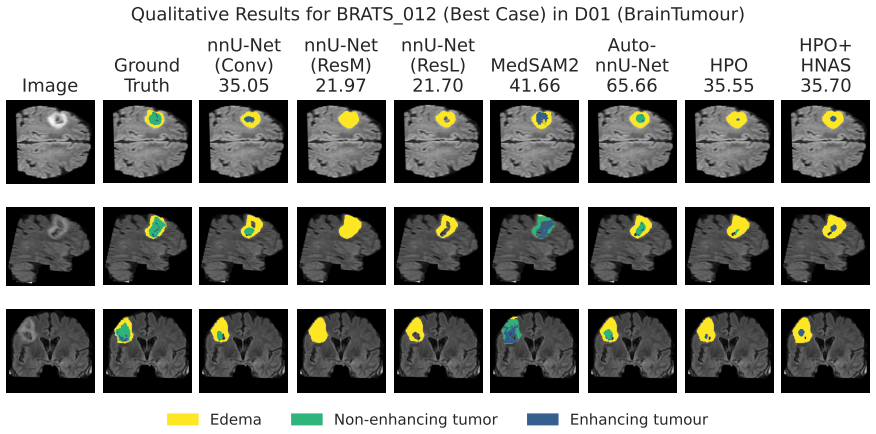
Figures from the paper (11 more)


Reference graph
Works this paper leans on
-
[1]
MO-DEHB: Evolutionary-based Hyperband for Multi-Objective Optimization
G. J. Aguiar et al. (2019). “A meta-learning approach for selecting image segmentation algorithm”. In: Pattern Recognition Letters. M. J. Ali, M. Essaid, L. Moalic, and L. Idoumghar (2024). “A review of AutoML optimization techniques for medical image applications”. In: Computerized Medical Imaging and Graphics 118, p. 102441. M. Antonelli et al. (2022). ...
work page Pith review arXiv 2019
-
[2]
Since the default for this dataset is four, it is associated with the highest probability
We begin by sampling the number of stages using its associated production rule, which allows the U-Net to contain two, three, or four stages. Since the default for this dataset is four, it is associated with the highest probability. Here, we consider the network to consist of three stages. Subsequently, the encoder and decoder 20 are sampled. In our examp...
work page 2019
-
[10]
Polynomial Learning Rate Policy with Warm Restart for Deep Neural Network
P. Mishra and K. Sarawadekar (2019). “Polynomial Learning Rate Policy with Warm Restart for Deep Neural Network”. In: TENCON 2019 - 2019 IEEE Region 10 Conference (TENCON), Kochi, India, October 17-20, 2019 . IEEE. V. Nair and G. Hinton (2010). “Rectified linear units improve restricted boltzmann machines”. In: Proc. of ICML’10. E. Öztürk et al. (2022). “...
work page 2019
-
[11]
For a detailed outline of PriorBand, we refer to Appendix B.1
are highlighted. For a detailed outline of PriorBand, we refer to Appendix B.1. In Line 21, we apply non-dominated sorting on the set of observations, i.e., candidate configurations𝑃 in the current stage of SH. The subroutine returns a list of fronts, where the first front is the actual Pareto front of𝑃 and each subsequent the updated Pareto front after r...
work page 2023
-
[13]
Adam: A Method for Stochastic Optimization
D. Kingma and J. Ba (2015). “Adam: A Method for Stochastic Optimization”. In: Proc. of ICLR’15. A. Kirillov et al. (2023). “Segment Anything”. In: Proc. of ICCV’23. L. Li, K. Jamieson, G. DeSalvo, A. Rostamizadeh, and A. Talwalkar (2017). “Hyperband: Bandit-Based Configuration Evaluation for Hyperparameter Optimization”. In: Proc. of ICLR’17. S. Liang et ...
work page 2015
-
[14]
is an image segmentation foundation model pre-trained on a dataset containing 1M images and 1B ground-truth segmentation masks. Unlike task-specific models, e.g., U-Nets, which need to be trained from scratch for each new segmentation dataset, the pre-training enables foundation models to generalize across diverse datasets and reduces the need for extensi...
work page 2024
-
[15]
Segment Anything in Medical Images and Videos: Benchmark and Deployment
J. Ma et al. (2024b). “Segment Anything in Medical Images and Videos: Benchmark and Deployment”. In: arXiv:2408.03322v1 [eess.IV]. A. L. Maas, A. Y. Hannun, and A. Y. Ng (2013). “Rectifier Nonlinearities Improve Neural Network Acoustic Models”. In: Proc. of ICML’13. N. Mallik et al. (2023). “PriorBand: Practical Hyperparameter Optimization in the Age of D...
arXiv 2024
-
[16]
and adds a memory attention module to condition the current frame on the previous one. The video segmentation capabilities of SAM2 enable MedSAM2 to represent 3D volumes as a sequence of 2D frames and produce improved 3D medical image segmentations compared to MedSAM. SAM2 was originally designed for interactive image and video segmentation and requires a...
work page 2023
Show all 16 references
-
[17]
(2017) and Mallik et al
We set the reduction factor𝜂 to the default value of 3 as proposed by Li et al. (2017) and Mallik et al. (2023). We round budgets to full epochs. With the initial evaluation of the default configuration at the maximum fidelity, this leads to 129 evaluated configurations and a ...
2017
-
[36]
Auto-WEKA: combined selection and Hyperparameter Optimization of classification algorithms
A. L. Simpson et al. (2019).A large annotated medical image dataset for the development and evaluation of segmentation algorithms. D. Stoll et al. (2023). Neural Pipeline Search (NePS) . url: https://github.com/automl/neps. R. Szeliski (2022). Computer Vision - Algorithms and ...
2019 arXiv
-
[241]
Hiera: A Hierarchical Vision Transformer without the Bells-and-Whistles
C. Ryali et al. (2023). “Hiera: A Hierarchical Vision Transformer without the Bells-and-Whistles”. In: Proc. of ICML’23. N. Schilling, M. Wistuba, and L. Schmidt-Thieme (2016). “Scalable Hyperparameter Optimization with Products of Gaussian Process Experts”. In: Proc. of ECML/...
2023 arXiv
-
[340]
JAHS-Bench-201: A Foundation For Research On Joint Architecture And Hyperparameter Search
A. Bansal, D. Stoll, M. Janowski, A. Zela, and F. Hutter (2022). “JAHS-Bench-201: A Foundation For Research On Joint Architecture And Hyperparameter Search”. In: Proc. of NeurIPS’22. J. Bergstra and Y. Bengio (2012). “Random Search for Hyper-Parameter Optimization”. In: Journa...
2022 arXiv
-
[1135]
Learning Multiple Defaults for Machine Learning Algorithms
F. Pfisterer, J. van Rijn, P. Probst, A. Müller, and B. Bischl (2018). “Learning Multiple Defaults for Machine Learning Algorithms”. In: arXiv:1811.09409v3 [stat.ML]. S. Qin et al. (2023). “NG-NAS: Node growth neural architecture search for 3D medical image segmentation”. In: ...
2018 arXiv
-
[2015]
or instance normalization (InstanceNorm) (Ulyanov et al., 2016). 23 Type Hyperparameter Type Range / Values Default Value HPO Optimizer Categorical { SGD, Adam, AdamW} SGD HPO Momentum (SGD) Float (log) [ 0.5, 0.999] 0.99 HPO Initial Learning Rate Float (log) [ 1· 10−5, 0.1] 1...
2016
-
[2022]
is a collection of ten image segmentation datasets from the medical domain. By focusing on diversity with respect to clinical tasks, modalities, and data characteristics, the MSD aims to serve as a standard for the evaluation of image segmentation algorithms. The MSD is public...
-
[2023]
addresses this limitation by integrating prior configurations, e.g., expert beliefs, into the optimization process and improves the anytime performance of existing methods such as 𝜋BO (Hvarfner et al., 2022). By incorporating prior knowledge about well- performing regions in t...
2022
Reviewed August 7, 2026 · model on record in the stance chip above.
Discussion (0). Sign in to comment.