REVIEW 5 major objections 3 minor 1 cited by
Decoherence manipulation through entanglement dynamics: A photonic experiment
T0 review · 5 major / 3 minor · reviewed 2026-08-07 · deepseek-v4-flash
Pith's one-line read A single well-timed NOT gate between two damping stages can delay, hasten, or completely prevent entanglement sudden death.
desk verdict Genuine experimental progress on ESD control with a local NOT, but the main comparison leans on simulated baselines and the theory double-counts the NOT; worth refereeing after fixes. read the letter →
The pith
A machine-rendered reading of the paper's core claim, the machinery that carries it, and where it could break.
The reading
What carries the argument
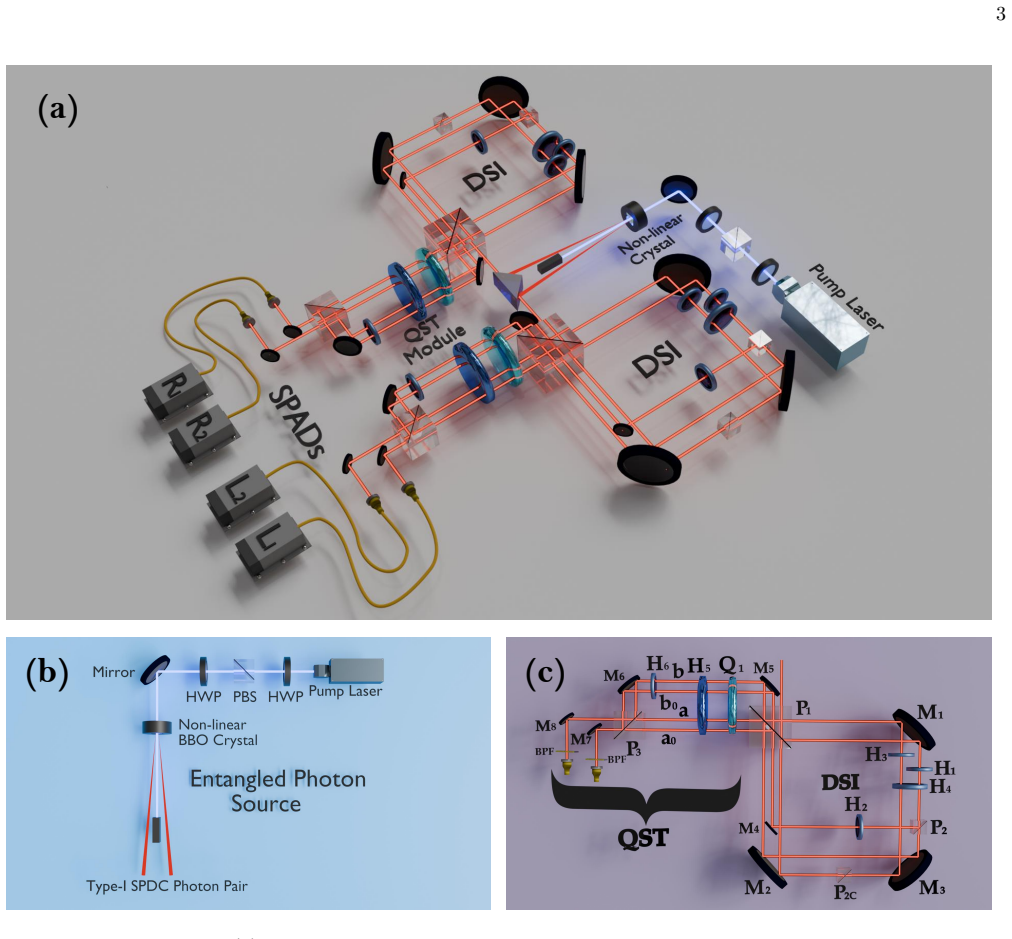
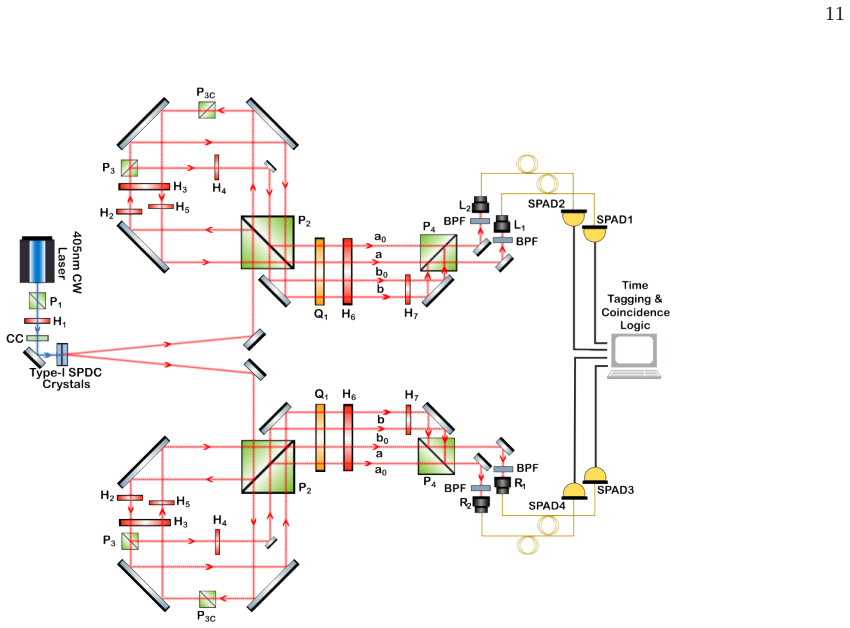
The load-bearing object is the composed three-stage map $$\rho(p,P)=\sum_{i,j}K_{ij}\,(\sigma_x\otimes\sigma_x)\,\rho(p,0)\,(\sigma_x\otimes\sigma_x)^\dagger K_{ij}^\dagger,$$ where the inner evolution $\rho(p,0)=\sum_i K_i\rho(0,0)K_i^\dagger$ uses the four Kraus operators of the new path-mismatch channel (Eq. 5), and the outer $K_{ij}=K_i\otimes K_j$ are the standard amplitude-damping Kraus operators (Eq. 2). The new channel's defining mechanism is the temporal-shift operator $X$ with $X[x(t)]=x(t+\delta t)$; photon pairs landing in mode $a_0$ arrive outside the coincidence window $\Delta t$ and are discarded, producing factors $\sqrt{z}$ with $z=\exp(-i\chi)$ in the channel's Kraus operators. The control knob is the NOT gate itself, a half-wave plate at $45^\circ$ acting as $\sigma_x$ on each qubit. This map translates a chosen first-damping strength $p$ into avoidance, delay, or hastening of the concurrence's finite-time death under the second damping strength $P$.
What would settle it
Run the same three state preparations (first-damping strengths $p=0$, $0.22$, and $0.43$) with the NOT half-wave plate replaced by a zero-degree plate or otherwise bypassed, perform quantum state tomography across the second-damping scan, and compare the measured concurrence-death points with the numerically evolved no-NOT curves; disagreement beyond the reported error bars would mean the claimed avoidance, delay, and hastening are not supported by direct measurement.
Extended reading notes
Core claim
The paper's central claim is that a carefully timed local NOT operation, applied to both qubits after an initial period of amplitude damping, can change the qualitative fate of bipartite entanglement: for a state with amplitudes $\alpha=0.55$ and $\beta=0.835$, the NOT completely prevents ESD when the first damping strength is $p=0$, delays the ESD point from $P=0.62$ to $P=0.93$ at $p=0.22$, and hastens it from $P=0.84$ to $P=0.6$ at $p=0.43$. This is reported as the first experimental demonstration of controlled and complete manipulation of ESD. The no-NOT comparison curves were not measured directly; as the paper states, those curves are obtained by numerically evolving the measured $P=0$ state under the damping channel. The experiment additionally establishes a new amplitude-damping channel, produced by a path mismatch that sends some photon pairs outside the coincidence window, with Kraus operators that mimic correlated amplitude damping.
Load-bearing premise
The load-bearing premise is that the unmeasured no-NOT curves, obtained by numerically evolving the measured initial state through the damping channel, faithfully reproduce what the experiment would have shown without the NOT operation, including for the new path-mismatch channel whose model is supplied by the companion paper.
Editorial extensions
If this is right
- For the state $\alpha=0.55$, the theory fixes three windows in the first-damping parameter: $p<0.17$ avoids ESD, $0.17<p<0.28$ delays it, and $p>0.28$ hastens it; the experiment demonstrates one representative from each window.
- Without the NOT operation the predicted death points are $P=0.48$, $0.62$, and $0.84$ for the three runs; with the NOT operation data show no death, death at $P=0.93$, and death at $P=0.6$ respectively.
- The new path-mismatch channel is characterized independently, including with a separable input, and its purity decay distinguishes it from a conventional amplitude-damping channel.
- Because the NOT is a single local operation applied once, the approach offers a more experimentally viable alternative to repeated-intervention strategies such as dynamical decoupling or weak-measurement reversal.
Reading between the lines
- Editorial inference: the predicted boundaries at $p=0.17$ and $p=0.28$ for $\alpha=0.55$ mean a dense scan of $p$ across the range 0 to 0.5 should reveal sharp crossover points in the death location, providing a quantitative test beyond the three representative runs.
- Editorial inference: because the path-mismatch time shift $\delta t$ relative to the coincidence window $\Delta t$ sets which photon pairs are discarded, the same interferometer could be tuned to interpolate continuously between independent and correlated amplitude damping, making it a flexible noise channel for other protocols.
- Editorial inference: the single NOT operation could be concatenated—alternating damping and flips—and an optimal flip schedule might protect entanglement longer than any one flip, a direction the paper does not explore.
Editorial analysis
A structured set of objections, weighed in public.
Referee Report
Summary. The manuscript reports a photonic experiment implementing a protocol, proposed in earlier theoretical work, that applies local NOT operations between two successive amplitude-damping stages to manipulate the decay of bipartite entanglement. The authors introduce a new type of amplitude-damping-like channel arising from temporal mismatch of spatial modes in a displaced Sagnac interferometer, characterize it, and present concurrence-versus-damping-parameter data for three regimes: avoidance, delay, and hastening of entanglement sudden death (ESD). The paper claims the first experimental demonstration of controlled and complete manipulation of ESD.
Significance. If the claims hold, the work would be a notable experimental advance: it would show that a single local unitary inserted between two damping stages can change the qualitative fate of entanglement, and it would introduce a photonic implementation of a correlated-amplitude-damping-like channel. The manuscript includes a fairly detailed error analysis and builds on a concrete theoretical framework from Refs. [23,24,31]. The main weakness is that the comparative statements (hastening, delay, avoidance) are established against numerically simulated no-NOT baselines rather than measured control arms, and the new channel model is derived in an unpublished companion paper. These issues make the central claim less robust than the abstract suggests.
major comments (5)
- [Experimental detail / no-NOT comparison] The central claims of hastening, delaying, and avoiding ESD are comparative statements, but the no-NOT arm was never measured. The paper states: “data could only be acquired for the configuration that included the NOT operation... we used the initially measured state corresponding to P=0 and numerically evolved it under the damping channel.” This makes the simulated baseline load-bearing: the observed with-NOT concurrence trajectories are only evidence of manipulation if the numerical evolution is a faithful surrogate for the unmeasured control configuration. The authors should either measure the no-NOT arm or explicitly reframe the claims as consistency with theoretical predictions rather than an experimental demonstration of manipulation. This issue is decisive for the paper’s central assertion.
- [The new damping channel, Eqs. (4)-(5)] The derivation of the new channel is delegated entirely to the unpublished companion Ref. [33]. Equations (4)-(5) and Appendix A state the map and Kraus operators, but the physical justification for the X-operator eigenvalue assignment (Re(sqrt(z))=1 or 0) and for the specific form of the channel is not contained in this manuscript. Since both the characterization in Fig. 2 and the simulated no-NOT baselines rely on this model, the reader cannot independently verify the channel. The authors should include a self-contained derivation or provide a complete process-tomography validation of the channel within this paper.
- [Eq. (4) versus Eq. (1)] Equation (1) defines the amplitude-damping channel with |V> as the excited state decaying to |H>. Equation (4), however, maps |HH> to |VV> with unit amplitude, which is the opposite direction (damping would keep |HH> unchanged and only partially deplete |VV>). The manuscript states that H and V are ground and excited states respectively, but the map in Eq. (4) appears to be a population-inverting (anti-damping) process. Please clarify the basis convention or explain how this inverted term arises in the DSI setup; otherwise the interpretation of the “damping parameter p” and the simulated evolution are ambiguous.
- [Supplementary Figs. 18-19 vs. main text Figs. 4-6] The main text reports all three manipulation demonstrations using alpha = 0.55 (Figs. 4-6), but the supplementary figures for avoidance and delay use alpha = 0.45 and alpha = 0.50, respectively. The manuscript does not state whether these are independent experimental runs or which dataset is the primary evidence. This inconsistency needs to be resolved to allow the reader to assess which data support the central claim.
- [Fig. 2 and fitting procedure] The characterization of the new channel in Fig. 2 is described only as “fitted with the evolution of the initially prepared state using the derived Kraus operators.” No fit parameters, residuals, or confidence intervals are provided. Because the new channel is central to the whole protocol, the manuscript should report quantitative measures of agreement (e.g., reduced chi-square, fidelity between measured and predicted density matrices) to make the validation convincing.
minor comments (3)
- [Appendix B, Eq. (B2)] The expression for Err_NOT contains a malformed second derivative ∂^2/∂θ and appears to have a missing closing parenthesis; it should likely be δU_NOT = (∂U_NOT/∂θ)δθ evaluated at θ=π/4.
- [Throughout] There are several typographical issues, such as “45^o angle” and “a0(See Fig. 1)”, and inconsistent notation where H1/H4 and H2/H3 are used for the damping parameters and NOT gate in different places. A careful proofread would improve clarity.
- [Fig. 3 caption] The caption says the initial state “closely approximates a maximally entangled state” with concurrence 0.82; a concurrence of 0.82 is markedly below 1, so the phrase “closely approximates” is misleading. Consider wording such as “a state with reduced purity due to systematic errors.”
Circularity Check
Partial circularity: the new channel is deferred to the authors' own companion paper, and the no-NOT baseline used to define 'hastening/delay/avoidance' is a numerical output of the same damping model rather than an independent measured control.
-
self citation load bearing
[The new damping channel, Eqs. (4)-(5), and Appendix A; Supplementary Material B]
"Please refer to [33] for the detailed analysis and discussion. Including the temporal shift (or equivalently z), the Kraus operators are given by ..."
The paper's central novel ingredient is the path-mismatch damping channel. The map in Eq. (4) and the Kraus operators in Eq. (5) are not derived from measured data or from an independent first-principles argument in this work; the main text explicitly defers the analysis to the authors' own companion paper [33] (same group, 'To appear'). The Supplementary Material similarly says: 'Using the theoretical framework developed in our accompanying paper [33]...'. Both the with-NOT theoretical curves and the simulated no-NOT baseline are generated from these Kraus operators, so a load-bearing premise of the paper rests on a same-author, unpublished citation.
-
fitted input called prediction
[Experimental ESD manipulation results, Figs. 4-6; text after Fig. 6]
"data could only be acquired for the configuration that included the NOT operation. Removing the NOT operation would have required a major reconfiguration of the optical setup. To ensure a valid comparison between the condition when the NOT operation is applied and the one where it is not, for all our experimental runs (as represented by the solid lines in the figures), we used the initially measured state corresponding to P = 0 and numerically evolved it under the damping channel."
The headline claim is comparative: a NOT operation hastens, delays, or avoids ESD only relative to the no-NOT trajectory. That reference arm was not measured; it is produced by numerically evolving the measured P=0 initial state through the same damping-channel model (Eqs. 5-9) used to interpret all of the data. The solid blue 'expected' curves are therefore not independent experimental facts but outputs of the paper's own model. The classification of a run as avoidance, delay, or hastening is fixed by comparing measured with-NOT points to a model-generated baseline, so the experimental demonstration of 'manipulation' reduces, for the comparison axis, to the model's input assumptions rather than to a measured control arm.
full rationale
The with-NOT concurrence data themselves are genuine measurements, and the manipulation protocol originates in independent earlier theory [23,24], so this is not a fully circular paper. However, two load-bearing elements weaken the claimed first-principles/experimental derivation. First, the new path-mismatch ADC -- the channel that distinguishes this experiment from a standard two-ADC sequence -- is justified by citation to the authors' own unpublished companion [33], with only a restatement in Appendix A. Second, the central 'hastening/delay/avoidance' classification depends on a no-NOT baseline that was never measured; the paper instead simulates that baseline using the same damping model it uses to interpret the data. That makes the comparative claim partially self-supporting: the model generates the baseline, and the experimental result is then read as agreement with the model. A possible CPTP-normalization issue in Eq. (5) is a correctness concern, not a circularity concern. Overall circularity is partial: score 4.
Assumptions & free parameters
free parameters (3)
- Initial state amplitude alpha =
0.55 main text; 0.45 and 0.5 in supplementary runs
- First damping parameter p =
0, 0.22, 0.43
- Second damping parameter P =
swept 0 to 1; ESD at 0.93 in channel characterization
assumptions (4)
- domain assumption Amplitude damping can be implemented by the displaced-Sagnac HWP/PBS mapping with p = sin^2(2*theta)
- ad hoc to paper Temporally mismatched photons outside the coincidence window can be traced out, described by the X operator with Re(sqrt(z)) = 0 for delta-t > Delta-t
- domain assumption Numerically evolving the measured P=0 state through the ADC reproduces the unmeasured no-NOT experimental trajectory
- standard math Wootters concurrence computed from two-qubit tomography is the correct ESD witness
Cite this review
Pith. "Pith review of Decoherence manipulation through entanglement dynamics: A photonic experiment." pith.science (2026). https://pith.science/paper/7OKDP2CS
@misc{pith2026250516622,
  author       = {Pith},
  title        = {Pith review of: Decoherence manipulation through entanglement dynamics: A photonic experiment},
  year         = {2026},
  howpublished = {\url{https://pith.science/paper/7OKDP2CS}},
  note         = {Machine review of arXiv:2505.16622}
}
read the original abstract
Decoherence serves as a major obstacle to achieving higher efficiency in all quantum technologies. Thus, controlling and mitigating decoherence is currently an active research direction. In this work, we experimentally manipulate entanglement sudden death (ESD), a major manifestation of decoherence, in an all-photonic setup. We demonstrate a protocol that uses local unitary NOT operations along with a variant of amplitude-damping decoherence to influence the evolution of bipartite entangled states through an amplitude-damping channel. Our results obtained using the photonic test-bed demonstrate the ability to hasten, delay, or completely prevent ESD, thereby offering a potential avenue for improving and scaling various quantum architectures.
Figures


Figures from the paper (17 more)




Forward citations
Cited by 1 Pith paper
-
Effect of Weak Measurement Reversal on Quantum Correlations in a Correlated Amplitude Damping Channel, with a Neural Network Perspective
Two-qubit weak-measurement reversal protects quantum correlations better than single-qubit reversal under correlated amplitude damping, and a MATLAB neural network can interpolate trace distance discord from other cor...
Reference graph
Works this paper leans on
-
[33]
X.-W. Wang, S. Yu, D.-Y. Zhang, and C. Oh, Effect of weak measurement on entanglement distribution over noisy channels, Scientific reports 6, 22408 (2016)
work page 2016
-
[1]
Error in State preparation The error here comes from the least count of the rotation mount used to hold a half-wave plate that is crucial for creating different state parameters. A half-wave plate acting on the pump laser creates a pump polarization that is α|H⟩ + β|V ⟩, where α and β are complex coefficients. These coefficients directly correspond to the...
-
[2]
Error due to Polarizing Beam Splitters We use polarization entangled state for our experiment, making PBS an essential component for any state ma- nipulation and a major source of systematic errors in our experiment. An ideal PBS should transmit all horizontal components while reflecting vertical components of the incident light. In practice, imperfect co...
-
[3]
The damping parameter p of an ADC is related to the HWP rotation angle θ as p = sin2(2θ)
Errors due to waveplates in protocol implementation In our experimental implementation, a displaced-Sagnac setup incorporating PBSs and HWPs combinations is employed to realize the protocol for ESD manipulation. The damping parameter p of an ADC is related to the HWP rotation angle θ as p = sin2(2θ). Given the least count of 2 ◦ in our waveplate rotation ...
-
[4]
J. S. Bell, On the einstein podolsky rosen paradox, Physics Physique Fizika 1, 195 (1964)
1964
-
[5]
sin 2ϕ − g+δ2 cos 2ϕ) |H⟩ + (f−(1 − δ′
-
[6]
cos 2ϕ + g+δ2 sin 2ϕ) |V ⟩ , N2 = δ′ (sin 2ϕ + µ cos 2ϕ) |V ⟩ −(cos 2ϕ − µ sin 2ϕ) |H⟩ , N4 = (1 − δ′) (f+(1 − δ2)|H⟩ + g−δ′ 2|V ⟩) , N5 = X(1 − δ′) (g−(1 − δ′
-
[7]
sin 2ϕ − f+δ2 cos 2ϕ) |H⟩ + (g−(1 − δ′
Show all 49 references
-
[8]
cos 2ϕ + f+δ2 sin 2ϕ) |V ⟩ , (B37) Writing, P † 1 = F 2 ab⟨2| + F 4 ab⟨4| + F 5 a′b′⟨5| , (B38) We can write UT = P † 1 · U3, UT = |F ⟩⟨H0| + |G⟩⟨V0| , (B39) where, |F ⟩ = F 2 ab · M2 + F 4 ab · M4 + F 5 a′b′ · M5 , |G⟩ = F 2 ab · N2 + F 4 ab · N4 + F 5 a′b′ · N5 . (B40) Expli...
-
[9]
sin 2ϕ − g+δ2 cos 2ϕ) |Ha′⟩ + Xδ (1 − δ) (f−(1 − δ′
-
[10]
sin 2ϕ − g+δ2 cos 2ϕ) |Hb′⟩ + Xδ (1 − δ′) (f−(1 − δ′
-
[11]
cos 2ϕ + g+δ2 sin 2ϕ) |Va′⟩ + Xδδ ′ (f−(1 − δ′
-
[12]
cos 2ϕ + g+δ2 sin 2ϕ) |Vb′⟩ . (B41) and |G⟩ = δ′ (sin 2ϕ + µ cos 2ϕ) (δ′ 1|Va⟩ + (1 − δ′ 1)|Vb⟩) − δ′ (cos 2ϕ − µ sin 2ϕ) ((1 − δ1)|Ha⟩ + δ1|Hb⟩) + (1 − δ′)f+(1 − δ2) (δ|Ha⟩ + (1 − δ)|Hb⟩) + (1 − δ′)g−δ′ 2 ((1 − δ′)|Va⟩ + δ′|Vb⟩) + X(1 − δ′) (g−(1 − δ′
-
[13]
sin 2ϕ − f+δ2 cos 2ϕ) (δ|Ha′⟩ + (1 − δ)|Hb′⟩) + X(1 − δ′) (g−(1 − δ′
-
[14]
(B42) Putting all these together, we can write U A = |F ⟩⟨H0| + |G⟩⟨V0| +
cos 2ϕ + f+δ2 sin 2ϕ) ((1 − δ′)|Va′⟩ + δ′|Vb′⟩) . (B42) Putting all these together, we can write U A = |F ⟩⟨H0| + |G⟩⟨V0| + . . . , (B43) where . . .represents contributions from input paths |1⟩ which we have neglected. The total unitary operator is then UT = U A ⊗ U B = |GG⟩⟨...
-
[15]
Schlosshauer, Decoherence, the measurement problem, and interpretations of quantum mechanics, Rev
M. Schlosshauer, Decoherence, the measurement problem, and interpretations of quantum mechanics, Rev. Mod. Phys. 76, 1267 (2005)
2005
-
[16]
From doing the optical evolution, it can be seen that this part of the experimental design exactly creates the quantum mapping described by Eq
To test the second damping channel, we keep the HWP H2 at its fast axis throughout the run of the experiment and rotate H4 and H5 simultaneously by the same angles from zero to 45 o angle. From doing the optical evolution, it can be seen that this part of the experimental desi...
-
[17]
Einstein, B
A. Einstein, B. Podolsky, and N. Rosen, Can quantum-mechanical description of physical reality be considered complete?, Phys. Rev. 47, 777 (1935)
1935
-
[18]
Bohm and Y
D. Bohm and Y. Aharonov, Discussion of experimental proof for the paradox of einstein, rosen, and podolsky, Phys. Rev. 108, 1070 (1957)
1957
-
[19]
Yu and J
T. Yu and J. H. Eberly, Finite-time disentanglement via spontaneous emission, Phys. Rev. Lett. 93, 140404 (2004)
2004
-
[20]
Yu and J
T. Yu and J. H. Eberly, Sudden death of entanglement, Science 323, 598 (2009)
2009
-
[21]
M. P. Almeida, F. de Melo, M. Hor-Meyll, A. Salles, S. P. Walborn, P. H. S. Ribeiro, and L. Davidovich, Environment- induced sudden death of entanglement, Science 316, 579 (2007)
2007
-
[22]
Viola, E
L. Viola, E. Knill, and S. Lloyd, Dynamical decoupling of open quantum systems, Phys. Rev. Lett. 82, 2417 (1999)
1999
-
[23]
M. J. Biercuk, H. Uys, A. P. VanDevender, N. Shiga, W. M. Itano, and J. J. Bollinger, Optimized dynamical decoupling in a model quantum memory, Nature 458, 996 (2009)
2009
-
[24]
J. Du, X. Rong, N. Zhao, Y. Wang, J. Yang, and R. Liu, Preserving electron spin coherence in solids by optimal dynamical decoupling, Nature 461, 1265 (2009)
2009
-
[25]
A. M. Souza, G. A. ´Alvarez, and D. Suter, Robust dynamical decoupling, Philosophical Transactions of the Royal Society A: Mathematical, Physical and Engineering Sciences 370, 4748 (2012)
2012
-
[26]
Maniscalco, F
S. Maniscalco, F. Francica, R. L. Zaffino, N. Lo Gullo, and F. Plastina, Protecting entanglement via the quantum zeno effect, Phys. Rev. Lett. 100, 090503 (2008)
2008
-
[27]
Oliveira Jr, R
J. Oliveira Jr, R. Rossi Jr, and M. Nemes, Protecting, enhancing, and reviving entanglement, Phys. Rev. A—Atomic, Molecular, and Optical Physics 78, 044301 (2008)
2008
-
[28]
Kondo, Y
Y. Kondo, Y. Matsuzaki, K. Matsushima, and J. G. Filgueiras, Using the quantum zeno effect for suppression of decoher- ence, New Journal of Physics 18, 013033 (2016)
2016
-
[29]
Long, W.-T
X. Long, W.-T. He, N.-N. Zhang, K. Tang, Z. Lin, H. Liu, X. Nie, G. Feng, J. Li, T. Xin, et al., Entanglement-enhanced quantum metrology in colored noise by quantum zeno effect, Phys. Rev. Lett. 129, 070502 (2022)
2022
-
[30]
Man, Y.-J
Z.-X. Man, Y.-J. Xia, and N. B. An, Manipulating entanglement of two qubits in a common environment by means of weak measurements and quantum measurement reversals, Phys. Rev. A—Atomic, Molecular, and Optical Physics 86, 012325 (2012)
2012
-
[31]
Q. Sun, M. Al-Amri, L. Davidovich, and M. S. Zubairy, Reversing entanglement change by a weak measurement, Phys. Rev. A—Atomic, Molecular, and Optical Physics 82, 052323 (2010)
2010
-
[32]
J. Y. Lee, C.-M. Jian, and C. Xu, Quantum criticality under decoherence or weak measurement, PRX quantum 4, 030317 (2023)
2023
-
[34]
A. N. Korotkov and K. Keane, Decoherence suppression by quantum measurement reversal, Phys. Rev. A—Atomic, Molecular, and Optical Physics 81, 040103 (2010)
2010
-
[35]
Lee, Y.-C
J.-C. Lee, Y.-C. Jeong, Y.-S. Kim, and Y.-H. Kim, Experimental demonstration of decoherence suppression via quantum measurement reversal, Optics Express 19, 16309 (2011)
2011
-
[36]
Kim, J.-C
Y.-S. Kim, J.-C. Lee, O. Kwon, and Y.-H. Kim, Protecting entanglement from decoherence using weak measurement and quantum measurement reversal, Nature Physics 8, 117 (2012)
2012
-
[37]
A. R. Rau, M. Ali, and G. Alber, Hastening, delaying, or averting sudden death of quantum entanglement, EPL 82, 10.1209/0295-5075/82/40002 (2008)
2008 doi
-
[38]
M. Ali, G. Alber, and A. R. P. Rau, Manipulating entanglement sudden death of two-qubit x-states in zero- and finite- temperature reservoirs, Journal of Physics B: Atomic, Molecular and Optical Physics 42, 025501 (2008)
2008
-
[39]
Yeo and A
Y. Yeo and A. Skeen, Time-correlated quantum amplitude-damping channel, Phys. Rev. A 67, 064301 (2003)
2003
-
[40]
X. Xiao, Y. Yao, Y.-M. Xie, X.-H. Wang, and Y.-L. Li, Protecting entanglement from correlated amplitude damping channel using weak measurement and quantum measurement reversal, Quantum Information Processing 15, 3881 (2016)
2016
-
[41]
neng Guo, Q
Y. neng Guo, Q. long Tian, K. Zeng, and Z. da Li, Quantum coherence of two-qubit over quantum channels with memory, Quantum Information Processing 16, 10.1007/s11128-017-1749-x (2017). 21
2017 doi
-
[42]
X.-L. Zong, W. Song, M. Yang, and Z.-L. Cao, Enhancing entanglement of two-qubit states from amplitude damping channel using single-qubit unitary operation and local filtering operation, International Journal of Quantum Information 19, 2150007 (2021), https://doi.org/10.1142/S...
2021 doi
-
[43]
Y. L. Li, C. J. Zu, and D. M. Wei, Enhance quantum teleportation under correlated amplitude damping decoherence by weak measurement and quantum measurement reversal, Quantum Information Processing 18, 10.1007/s11128-018-2114-4 (2019)
2019 doi
-
[44]
He and H
Z. He and H. S. Zeng, Enhancing entanglement of assistance using weak measurement and quantum measurement reversal in correlated amplitude damping channel, Quantum Information Processing 19, 10.1007/s11128-020-02791-6 (2020)
2020 doi
-
[45]
Singh, S
A. Singh, S. Pradyumna, A. R. P. Rau, and U. Sinha, Manipulation of entanglement sudden death in an all-optical setup, J. Opt. Soc. Am. B 34, 681 (2017)
2017
-
[46]
Singh and U
A. Singh and U. Sinha, Entanglement protection in higher-dimensional systems, Physica Scripta 97, 085104 (2022)
2022
-
[47]
K. Sen, A. S. Roy, S. R. Behera, S. Ray, A. R. P. Rau, and U. Sinha, Manipulating decoherence: Towards a universal framework, To appear (2025)
2025
-
[48]
Sinha, S
U. Sinha, S. R. Behera, and M. Layal, Chapter One - Photon sources and their applications in quantum science and technologies, edited by T. D. Visser, Progress in Optics, Vol. 68 (Elsevier, 2023) pp. 1–65
2023
-
[49]
W. K. Wootters, Entanglement of formation of an arbitrary state of two qubits, Phys. Rev. Lett. 80, 2245 (1998)
1998
Reviewed August 7, 2026 · model on record in the stance chip above.
Discussion (0). Continue with ORCID to comment.