REVIEW 2 major objections 5 minor 45 references
Boundedness and decay of waves on spatially flat decelerated FLRW spacetimes
T0 review · 2 major / 5 minor · reviewed 2026-08-07 · deepseek-v4-flash
Pith's one-line read This paper claims that on every spatially flat decelerated FLRW spacetime with scale factor $t^q$ for $0<q<1$, solutions of the linear wave equation satisfy uniform twisted-energy bounds, integrated local energy decay, and an…
desk verdict Solid physical-space proof of the full decelerated FLRW wave-decay package, but the abstract's 'optimal' claim outruns the upper-bound theorems—worth a serious referee, not a desk reject. read the letter →
The pith
A machine-rendered reading of the paper's core claim, the machinery that carries it, and where it could break.
The reading
What carries the argument
The central mechanism is the twisted energy-momentum tensor (1.21) with twisting function $\beta=t^{-q}$, which replaces $\partial_t\psi$ by the twisted derivative $\partial_t(t^q\psi)$; its divergence identity (1.22) converts wave solutions into spacetime currents. A potential $V=-q(2q-1)t^{-2}$ appears, and its sign change at $q=1/2$ forces a second twisting function $\beta'=t^{q-1}$ for $q>1/2$. The decay engine is the $r^p$ multiplier: applying $t^{-\mu_q}r^{p-1}\partial_v$ to $\varphi=rt^q\psi$ produces identity (3.16) in which every term is a boundary term or has a favorable sign except the mixed error $2r^{p-2}(\gamma-r^2W)\varphi\,\partial_v\varphi$; this error is absorbed using $\gamma=q|1-2q|/|1-q|^2$ and the pointwise bound $rt^{q-1}\le C$. The requirement $2\sqrt{\gamma}<p<2-2\sqrt{\gamma}$ is what produces the admissible range and the parameter $\sigma_q$.
What would settle it
Evolve the radiation-case equation $q=1/2$, which is equivalent to the flat wave equation, with smooth compactly supported data and test the predicted pointwise bound $|\psi|\lesssim 1/t$ in the interior and the $r^2$ weighted estimate (3.13): any data that violate either bound would falsify Theorem 1.3 and Corollary 1.4 in that range. For $q$ between $1/2$ and $1$, a numerical evolution of compact data with finite $E_q[\psi_0,\psi_1]$ should exhibit energy decay at least $\tau^{-(2-\sigma)}$ for every $\sigma>\sigma_q$; a slower measured rate would disprove Proposition 4.1.
Extended reading notes
Core claim
On its own terms, the central discovery is that the three standard ingredients of the $r^p$-method hold for the linear wave equation $\Box_{g_q}\psi=0$ on all spatially flat decelerated FLRW spacetimes. For $0<q<1$ and $\varepsilon\ge0$ small, the twisted flux $E_q^\varepsilon[\psi](\tau)$ defined in (1.12) is non-increasing along the hyperboloidal-null foliation; the integrated local energy decay estimate (1.7) holds with weight $\mu_q^\varepsilon$; and for $\varphi=rt^q\psi$ the wave-zone estimate (1.10) holds for all $0<p<\max\{1,2-\sigma_q\}$, where $\sigma_q=2\sqrt{q|1-2q|}/|1-q|^2$. Given these, Corollary 1.4 concludes that for $q\ne1/3$ the energy decays as $\tau^{-(2-\sigma)}$ with arbitrary $\sigma>\sigma_q$ when $\sigma_q<1$ and as $\tau^{-1}$ with a small power loss when $\sigma_q\ge1$, and that $\psi$, $\partial_t\psi$, and the null derivatives decay at the explicit rates listed in (1.11). In the wave zone the $\psi$ rates are optimal for $q\le1/2$ and almost optimal near $q=1/2$.
Load-bearing premise
The hierarchy stands or falls on the uniform inequality $rt^{q-1}\le C$ in the future domain; that bound is what turns the mixed $r$-$t$ error terms into absorbable ones, and it holds only for $q<1$, so the method as written cannot cross into $q\ge1$.
Editorial extensions
If this is right
- Uniform energy boundedness holds for the twisted flux in both regimes $q\le1/2$ and $q>1/2$, with no growth along the foliation.
- Integrated local energy decay controls the spacetime integral of a local energy density across the whole decelerated range, with an extra $t$-weight $\mu_q^\varepsilon$ only for $q>1/2$.
- The $r^p$ hierarchy holds in the wave zone for $p<\max\{1,2-\sigma_q\}$, and in the radiation case $q=1/2$ it extends to $p\le2$.
- Energy decay is $\tau^{-(2-\sigma)}$ for $q<(1+2\sqrt2)/7$ and $\tau^{-1}$ up to an $\varepsilon$ loss for $q\ge(1+2\sqrt2)/7$; pointwise decay of $\psi$ and its derivatives follows with the rates in (1.11).
- The estimates for first derivatives in Corollary 1.4 provide explicit rates for $\partial_t\psi$, $\partial_u\psi$, and $\partial_v\psi$, with a logarithmic factor in the radiation case.
Reading between the lines
- The compact-support assumption is not essential: replacing it by a finite twisted weighted flux on $\Sigma_{\tau_0}$ should give the same decay statements, so the results likely extend to all data with the weighted initial energy (4.4).
- The $\varepsilon$ loss above the threshold $q=(1+2\sqrt2)/7$ is probably a limitation of this multiplier family rather than a property of the equation; a multiplier tuned to the region $u\le0$ may remove the loss.
- Because the $r^p$-method is designed for quasilinear problems, the linear estimates here are a natural first input for proving small-data global existence of nonlinear wave equations on these backgrounds under a null condition.
- The excluded case $q=1/3$ is a technical gap rather than a real obstruction: the $0<p<1$ estimates remain valid, and a modified corollary with an arbitrarily small loss should close it.
Editorial analysis
A structured set of objections, weighed in public.
Referee Report
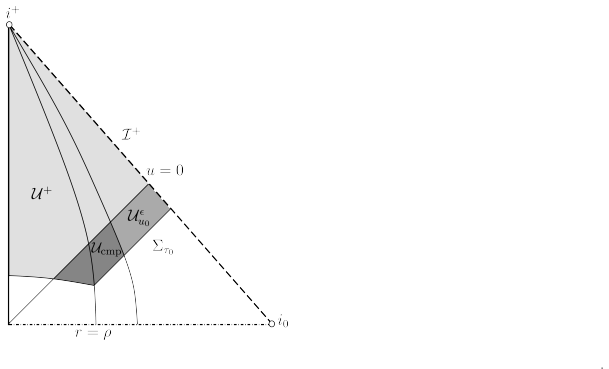
Summary. The paper studies the linear wave equation □_{g_q}ψ=0 on spatially flat FLRW spacetimes M=(0,∞)_t×R^3 with g_q=-dt²+t^{2q}δ_{ij}dx^i dx^j, where 0<q<1 is the decelerated regime. Using twisted energy-momentum currents imported from Dafermos–Holzegel–Rodnianski–Taylor, it proves three main ingredients: uniform boundedness of a twisted energy flux (Theorem 1.1), integrated local energy decay (Theorem 1.2), and a hierarchy of r^p-weighted estimates in the spirit of the Dafermos–Rodnianski method (Theorem 1.3). From these, Corollary 1.4 derives energy decay and pointwise decay of ψ and its first derivatives, with rates split according to q=1/2, q<1/2, 1/2<q<(1+2√2)/7, and q≥(1+2√2)/7; the case q=1/3 is explicitly excluded from the corollary. The proofs are divided into q≤1/2 and q>1/2, and the key Lemma 2.2 controls mixed r-t error terms through the inequality rt^{q-1}≤C, which is precisely the mechanism that uses q<1.
Significance. If the main estimates are correct, the paper provides a self-contained physical-space proof of energy and pointwise decay for waves on decelerated FLRW spacetimes, avoiding the Bessel-function representation used in earlier work by Natário–Rossetti and Wirth. It also extends the Dafermos–Rodnianski r^p method to a class of non-stationary, expanding, conformally flat backgrounds. The paper's strengths are its explicit twisted divergence identities, its transparent multiplier choices, and the fact that the main estimates are derived from inequalities rather than from fitting parameters. The chain from energy boundedness to ILED to r^p estimates and finally to pointwise decay is internally consistent as far as I have checked, and no circularity is evident.
major comments (2)
- [Abstract and Section 1.2, Corollary 1.4] The abstract claims that the wave-zone pointwise decay is "optimal" in the radiation and sub-radiation cases and "almost optimal" around the radiation case. The body of the paper, however, proves only upper bounds: Corollary 1.4 and Propositions 4.4 and 4.7 give estimates of the form |ψ|≲C τ^{σ/2}/t, but no matching lower bounds or asymptotic profiles are established for any q. In particular, the t^{-1} bound for q=1/2 is not shown to be attained by generic solutions. The optimality assertion is therefore not supported by the theorems. I recommend either removing or softening this claim, or adding matching lower-bound statements.
- [Remark 1.5 and Corollary 1.4] Corollary 1.4 explicitly assumes q≠1/3, while the abstract advertises results across the entire decelerated regime. Remark 1.5 only sketches an "analogous" modified statement for q=1/3 with an arbitrarily small loss, but no proof is given in the paper. If the all-q claim is to be retained, the q=1/3 decay statement should be proved in the text; otherwise the abstract and the theorem statements should be reworded to state the exclusion prominently. This is a boundary-case gap in an otherwise coherent proof structure.
minor comments (5)
- [Lemma 2.4] The statement of Lemma 2.4 says h1(τ)≲C/τ^{1−σ}, but the proof ends with h1(τ)≲C/τ^{2−σ}. If the stronger decay is intended, the statement should be updated; if the weaker decay is intended, the final line of the proof should be corrected.
- [Equation (1.8)] The displayed definition of σ_q is typeset ambiguously: it is hard to tell whether the denominator |1−q|^2 is inside or outside the square root. Since the admissible p-range in Theorem 1.3 depends on this quantity, the formula should be typeset with an unambiguous fraction.
- [Throughout] There are several typos and spacing inconsistencies: "FLR W" appears with inconsistent spacing, "Lorentizian" should be "Lorentzian", "Grönwall" is spelled with variations, and "Klien–Gordon" in the related-works section should be "Klein–Gordon". In Section 3.3 the region D^{τ2}_{τ2} appears where D^{τ2}_{τ1} is meant.
- [Remark 1.8] In Remark 1.8, the Sobolev inequality (2.15) is stated for functions on T^3 but the displayed norm is written as L∞(S2); this should be corrected to L∞(T^3).
- [Section 4 and (4.1)] For q≥(1+2√2)/7, all decay statements contain an arbitrary ε>0 loss, and the constants in Corollary 1.4 depend on ε, but the paper does not track the dependence or give even a qualitative range for admissible ε. The phrase "almost optimal around the radiation case" should be made quantitative, or the statement should be limited to the upper-bound nature of the estimate.
Circularity Check
No significant circularity: the energy, ILED, and r^p estimates are derived by explicit multiplier computations, and the decay corollary is a direct application of an abstract hierarchy lemma with no fitted parameters.
full rationale
The paper's derivation chain is self-contained. Theorem 1.1 is proved from the twisted divergence identity (2.4) with explicit vector-field multipliers and twisting functions in Propositions 3.1 and 3.4. Theorem 1.2 follows from the same identity with multipliers such as Y1 = ∂r and Y2 = (1+r)^(-δ)∂r, with all boundary and error terms controlled by energy boundedness and Lemma 2.2. Theorem 1.3 is obtained from the pointwise identities (3.16) and (3.41), where every error term is absorbed either by the favourable left-hand-side terms using the bound rt^(q-1) ≤ C or by Gronwall's inequality in the compact region. The decay results in Corollary 1.4 are then a direct consequence of the abstract hierarchical Lemma 2.4 applied to these proven estimates, together with Sobolev and interpolation inequalities. No parameter is fitted to data and no 'prediction' is a restatement of an input: the energy flux whose decay is proved is a fixed weighted flux, not a quantity tuned to force the advertised rate. The only imported identities are the standard twisted energy-momentum divergence formulas from [10, Appendix A.2], which are cited as background algebraic identities rather than as a substitute for the main argument; [10] is not authored by the present author, and in any case the identities do not assert the paper's conclusions. The abstract's claim that the wave-zone pointwise decay is 'optimal' or 'almost optimal' goes beyond what the upper-bound theorems prove, since no matching lower bound is established, but that is an overstatement of the results, not a circularity in the derivation.
Assumptions & free parameters
assumptions (5)
- domain assumption FLRW metric g_q = -dt^2 + t^{2q}((dx^1)^2+(dx^2)^2+(dx^3)^2) with 0<q<1 and R^3 spatial topology is the background, and the wave operator is given by (1.2).
- standard math The twisted divergence identity (2.4) for the twisted energy-momentum tensor is accepted from Dafermos-Holzegel-Rodnianski-Taylor [10, Appendix A.2].
- standard math Sobolev inequalities (2.13)-(2.16), H^2 embeddings on R^3 and S^2, the interpolation Lemma 2.5, and Grönwall's inequality Lemma 2.7.
- domain assumption Initial data are compactly supported smooth on the partially null hypersurface Σ_{τ0}.
- domain assumption The bound rt^{q-1} ≤ C of Lemma 2.2 holds uniformly on the future domain of dependence.
Cite this review
Pith. "Pith review of Boundedness and decay of waves on spatially flat decelerated FLRW spacetimes." pith.science (2026). https://pith.science/paper/DL2SXKUO
@misc{pith2026250516794,
  author       = {Pith},
  title        = {Pith review of: Boundedness and decay of waves on spatially flat decelerated FLRW spacetimes},
  year         = {2026},
  howpublished = {\url{https://pith.science/paper/DL2SXKUO}},
  note         = {Machine review of arXiv:2505.16794}
}
abstract
We study the linear wave equation on a class of spatially homogeneous and isotropic Friedmann-Lema\^itre-Robertson-Walker (FLRW) spacetimes in the decelerated regime with spatial topology $\mathbb{R}^3$. Employing twisted $t$-weighted multiplier vector fields, we establish uniform energy bounds and derive integrated local energy decay estimates across the entire range of the decelerated expansion regime. Furthermore, we obtain a hierarchy of $r^p$-weighted energy estimates \`a la the Dafermos-Rodnianski $r^p$-method, which leads to energy decay estimates. As a consequence, we demonstrate pointwise decay estimates for solutions and their derivatives. In the wave zone, this pointwise decay is optimal in the "radiation" and "sub-radiation" cases, and almost optimal around the radiation case.
Figures

Reference graph
Works this paper leans on
-
[1]
Bilal Abbasi and Walter Craig,On the initial value problem for the wave equation in Friedmann–Robertson–Walker space–times, Proceedings of the Royal Society A: Mathematical, Physical and Engineering Sciences470(2014), no. 2169, 20140361. 43
work page 2014
-
[2]
Lars Andersson and David Fajman,Nonlinear stability of the Milne model with matter, Communications in Mathematical Physics378(2020), no. 1, 261–298
work page 2020
-
[3]
Lars Andersson and Vincent Moncrief,Einstein spaces as attractors for the Einstein flow, Journal of differential geometry 89(2011), no. 1, 1–47
work page 2011
-
[4]
Yannis Angelopoulos, Stefanos Aretakis, and Dejan Gajic,Late-time asymptotics for the wave equation on spherically symmetric, stationary spacetimes, Advances in Mathematics323(2018), 529–621
work page 2018
-
[5]
,A vector field approach to almost-sharp decay for the wave equation on spherically symmetric, stationary space- times, Annals of PDE4(2018), 1–120
work page 2018
-
[6]
Hamed Barzegar and David Fajman,Stable cosmologies with collisionless charged matter, Journal of Hyperbolic Differential Equations19(2022), no. 04, 587–634
work page 2022
-
[7]
Volker Branding, David Fajman, and Klaus Kr¨ oncke,Stable cosmological Kaluza–Klein spacetimes, Communications in Mathematical Physics368(2019), 1087–1120
work page 2019
-
[8]
2, European Mathematical Society, 2007
Demetrios Christodoulou,The formation of shocks in 3-dimensional fluids, Vol. 2, European Mathematical Society, 2007
work page 2007
Show all 45 references
-
[9]
01, 35–58
Jo˜ ao L Costa, Jos´ e Nat´ ario, and Pedro FC Oliveira,Decay of solutions of the wave equation in expanding cosmological spacetimes, Journal of Hyperbolic Differential Equations16(2019), no. 01, 35–58
2019
-
[10]
Mihalis Dafermos, Gustav Holzegel, Igor Rodnianski, and Martin Taylor,Quasilinear wave equations on asymptotically flat spacetimes with applications to kerr black holes, arXiv preprint arXiv:2212.14093 (2022)
2022 arXiv
-
[11]
Mihalis Dafermos and Igor Rodnianski,A new physical-space approach to decay for the wave equation with applications to black hole spacetimes, XVIth international congress on mathematical physics: (with dvd-rom), 2010, pp. 421–432
2010
-
[12]
Maxime Van de Moortel,An extension of ther p method for wave equations with scale-critical potentials and first-order terms, arXiv preprint arXiv:2505.13711 (2025), available at2505.13711
2025 arXiv
-
[13]
Geren, and Rainer K
Jurgen Ehlers, P. Geren, and Rainer K. Sachs,Isotropic solutions of the Einstein–Liouville equations, Journal of Mathemat- ical Physics9(196809), no. 9, 1344–1349, available athttps://pubs.aip.org/aip/jmp/article-pdf/9/9/1344/19089486/ 1344_1_online.pdf
-
[14]
David Fajman, Maciej Maliborski, Maximilian Ofner, Todd Oliynyk, and Zoe Wyatt,Phase transition between shock formation and stability in cosmological fluids, arXiv preprint arXiv:2405.03431 (2024)
2024 arXiv
-
[15]
David Fajman, Maximilian Ofner, Todd Oliynyk, and Zoe Wyatt,Stability of fluids in spacetimes with decelerated expan- sion, arXiv preprint arXiv:2501.12798 (2025)
2025 arXiv
-
[16]
David Fajman, Maximilian Ofner, and Zoe Wyatt,Slowly expanding stable dust spacetimes, Archive for Rational Mechanics and Analysis248(2024), no. 5, 83
2024
-
[17]
Grigorios Fournodavlos,Future dynamics of FLR W for the massless-scalar field system with positive cosmological constant, Journal of Mathematical Physics63(2022), no. 3
2022
-
[18]
Anahit Galstian, Tamotu Kinoshita, and Karen Yagdjian,A note on wave equation in Einstein and de Sitter space-time, Journal of mathematical physics51(2010), no. 5
2010
-
[19]
Anahit Galstian and Karen Yagdjian,Microlocal analysis for waves propagating in Einstein & de Sitter spacetime, Math- ematical Physics, Analysis and Geometry17(2014), 223–246
2014
-
[20]
01, 87–188
Mahir Hadˇ zi´ c and Jared Speck,The global future stability of the FLR W solutions to the dust-Einstein system with a positive cosmological constant, Journal of Hyperbolic Differential Equations12(2015), no. 01, 87–188
2015
-
[21]
Hawking and George F
Stephen W. Hawking and George F. R. Ellis,The large scale structure of space-time, Cambridge Monographs on Mathe- matical Physics, Cambridge University Press, 1973
1973
-
[22]
Daoyin He, Yaqing Sun, and Kangqun Zhang,Global existence for small amplitude semilinear wave equations with time- dependent scale-invariant damping, arXiv preprint arXiv:2501.01670 (2025)
2025 arXiv
-
[23]
Joseph Keir,The weak null condition and global existence using thep-weighted energy method, arXiv preprint arXiv:1808.09982 (2018)
2018 arXiv
-
[24]
Section A, Physique Th´ eorique35(1981), no
Sergiu Klainerman and Peter Sarnak,Explicit solutions of□u= 0on the Friedmann-Robertson-Walker space-times, Annales de l’institut Henri Poincar´ e. Section A, Physique Th´ eorique35(1981), no. 4, 253–257
1981
-
[25]
Christian L¨ ubbe and Juan Antonio Valiente Kroon,A conformal approach for the analysis of the non-linear stability of radiation cosmologies, Annals of Physics328(2013), 1–25
2013
-
[26]
Elliot Marshall,Instability of slowly expanding FLR W spacetimes, arXiv preprint arXiv:2502.08095 (2025), available at 2502.08095
2025 arXiv
-
[27]
7, 232 –236
Akitaka Matsumura,Energy decay of solutions of dissipative wave equations, Proceedings of the Japan Academy, Series A, Mathematical Sciences53(1977), no. 7, 232 –236
1977
-
[28]
Georgios Moschidis,Ther p-weighted energy method of Dafermos and Rodnianski in general asymptotically flat spacetimes and applications, Annals of PDE2(2016), 1–194. 44
2016
-
[29]
Makoto Nakamura and Takuma Yoshizumi,Finite time blow-up of semi-linear Klein-Gordon equations with positive initial energy in FLR W spacetimes, arXiv preprint arXiv:2505.09077 (2025), available at2505.09077
2025 arXiv
-
[30]
Jos´ e Nat´ ario and Flavio Rossetti,Explicit formulas and decay rates for the solution of the wave equation in cosmological spacetimes, Journal of Mathematical Physics64(2023), no. 3
2023
-
[31]
Todd A Oliynyk,Future stability of the FLR W fluid solutions in the presence of a positive cosmological constant, Com- munications in Mathematical Physics346(2016), 293–312
2016
-
[32]
Hans Ringstr¨ om,On the topology and future stability of the universe, Oxford University Press, 2013
2013
-
[33]
Robertson,On the foundations of relativistic cosmology, Proceedings of the National Academy of Sciences15 (1929), no
Howard P. Robertson,On the foundations of relativistic cosmology, Proceedings of the National Academy of Sciences15 (1929), no. 11, 822–829, available athttps://www.pnas.org/doi/pdf/10.1073/pnas.15.11.822
1929 doi
-
[34]
,Relativistic cosmology, Reviews of Modern Physics5(1933Jan), 62–90
-
[35]
,Kinematics and world-structure, Astrophysical Journal82(November 1935), 284
1935
-
[36]
Igor Rodnianski and Jared Speck,The stability of the irrotational Euler–Einstein system with a positive cosmological constant, arXiv preprint arXiv:0911.5501 (2009)
2009 arXiv
-
[37]
17, 175004
Flavio Rossetti and Alex Va˜ n´ o-Vi˜ nuales,Decay of solutions of the wave equation in cosmological spacetimes—a numerical analysis, Classical and Quantum Gravity40(2023), no. 17, 175004
2023
-
[38]
,Hyperboloidal approach for linear and non-linear wave equations in FLR W spacetimes, arXiv preprint arXiv:2502.20520 (2025)
2025 arXiv
-
[39]
3, 515–600
Volker Schlue,Decay of linear waves on higher-dimensional Schwarzschild black holes, Analysis & PDE6(2013), no. 3, 515–600
2013
-
[40]
3, 633–715
Jared Speck,The nonlinear future stability of the FLR W family of solutions to the Euler–Einstein system with a positive cosmological constant, Selecta Mathematica18(2012), no. 3, 633–715
2012
-
[41]
,The stabilizing effect of spacetime expansion on relativistic fluids with sharp results for the radiation equation of state, Archive for Rational Mechanics and Analysis210(2013), 535–579
2013
-
[42]
Martin Taylor,Future stability of expanding spatially homogeneous FLR W solutions of the spherically symmetric Einstein– massless Vlasov system with spatial topologyR 3, Journal of Mathematical Physics65(2024), no. 2
2024
-
[43]
Kimitoshi Tsutaya and Yuta Wakasugi,Existence of solutions of semilinear wave equations with time-dependent propaga- tion speed and time derivative nonlinearity, 2025
2025
-
[44]
1, 57 –65
Hiroshi Uesaka,The total energy decay of solutions for the wave equation with a dissipative term, Journal of Mathematics of Kyoto University20(1980), no. 1, 57 –65
1980
-
[45]
1, 101–124
Jens Wirth,Solution representations for a wave equation with weak dissipation, Mathematical methods in the applied sciences27(2004), no. 1, 101–124. 45
2004
Reviewed August 7, 2026 · model on record in the stance chip above.
Discussion (0). Continue with ORCID to comment.