REVIEW 5 major objections 5 minor 4 cited by
Rotatable Antenna Enabled Wireless Communication and Sensing: Opportunities and Challenges
T0 review · 5 major / 5 minor · reviewed 2026-08-07 · deepseek-v4-flash
Pith's one-line read The paper claims that rotating each antenna's boresight direction adds a spatial degree of freedom that improves coverage, interference mitigation, and sensing resolution without adding antenna elements or deployment space.
desk verdict A competent survey/tutorial on rotatable antennas whose central claims are plausible but whose validation rests on the authors' own idealized pattern model and weak baselines; worth refereeing, but it should be framed and read as an overview, not a proof of concept. read the letter →
The pith
A machine-rendered reading of the paper's core claim, the machinery that carries it, and where it could break.
The reading
What carries the argument
The key object is the rotatable antenna's reconfigurable boresight direction — the direction in which the antenna radiates maximum power — treated as an additional design variable alongside conventional beamforming weights. The radiation pattern is assumed to keep its intrinsic shape during rotation, with only the pointing direction changing; the pattern model from the authors' companion work [5] is used in the simulations. This boresight rotation is what enables array-level beamforming gains to be complemented by element-level directional gain, near-field focusing, and angular diversity for sensing.
What would settle it
Measure the realized far-field gain pattern of a mechanically or electronically rotated antenna at multiple steering angles and compare it with the ideal pattern-rotation model used in the paper's simulations; if the boresight gain drops by more than 1 dB at 30° rotation or the 3 dB beamwidth changes by more than 10%, the claimed coverage and multiplexing gains would shrink in proportion.
Extended reading notes
Core claim
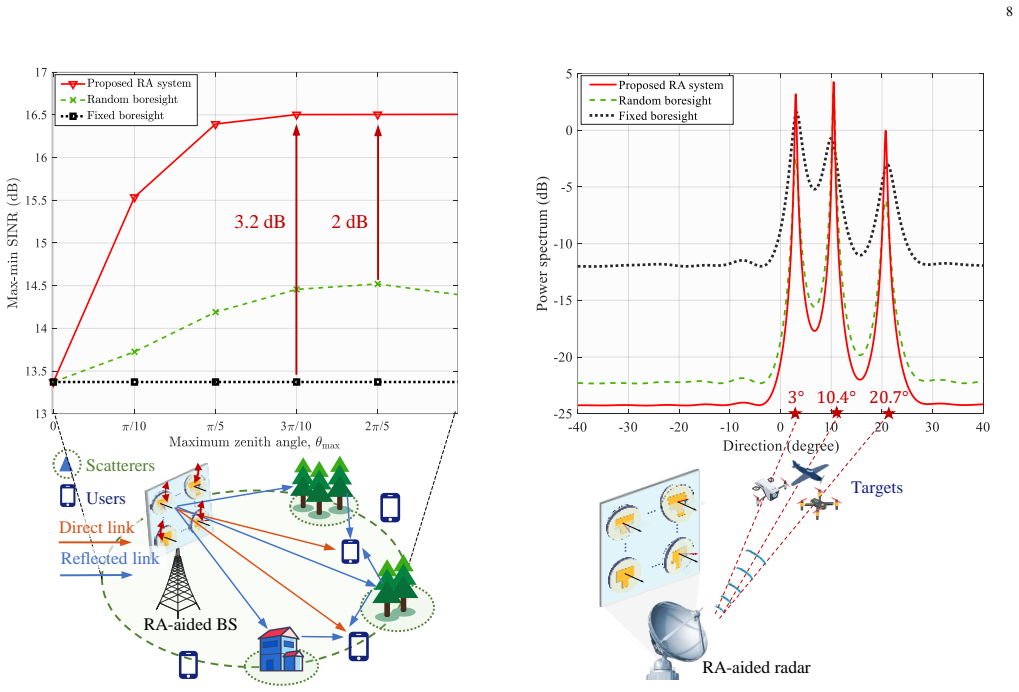
The central claim is that independently rotating the 3D boresight of each antenna — via motors, MEMS, or electronic beam-steering — turns the radiation pattern itself into a reconfigurable resource. Whereas fixed arrays steer only by array-weight adjustment, RA arrays add element-level beamforming: each antenna's main lobe can be aimed at a user, away from an interferer, or at a target, so the array can create subchannel orthogonality, achieve near-field beam focusing, and scan wide angular regions with few elements. The paper reports experimental evidence at 5.8 GHz that an RA transmitter maintains stable received SNR as a user moves across a ±60° azimuth span, while a fixed antenna degrades; simulations at 2.4 GHz show up to 2 dB and 3.2 dB max-min SINR gains over random and fixed boresight baselines, and sharper spatial power spectra for three-target sensing.
Load-bearing premise
The paper's performance claims rest on the assumption that an antenna's radiation pattern keeps its shape during rotation and only the boresight direction changes; real actuators and electronic steering can distort the pattern, change gain with angle, and introduce pointing errors and latency.
Editorial extensions
If this is right
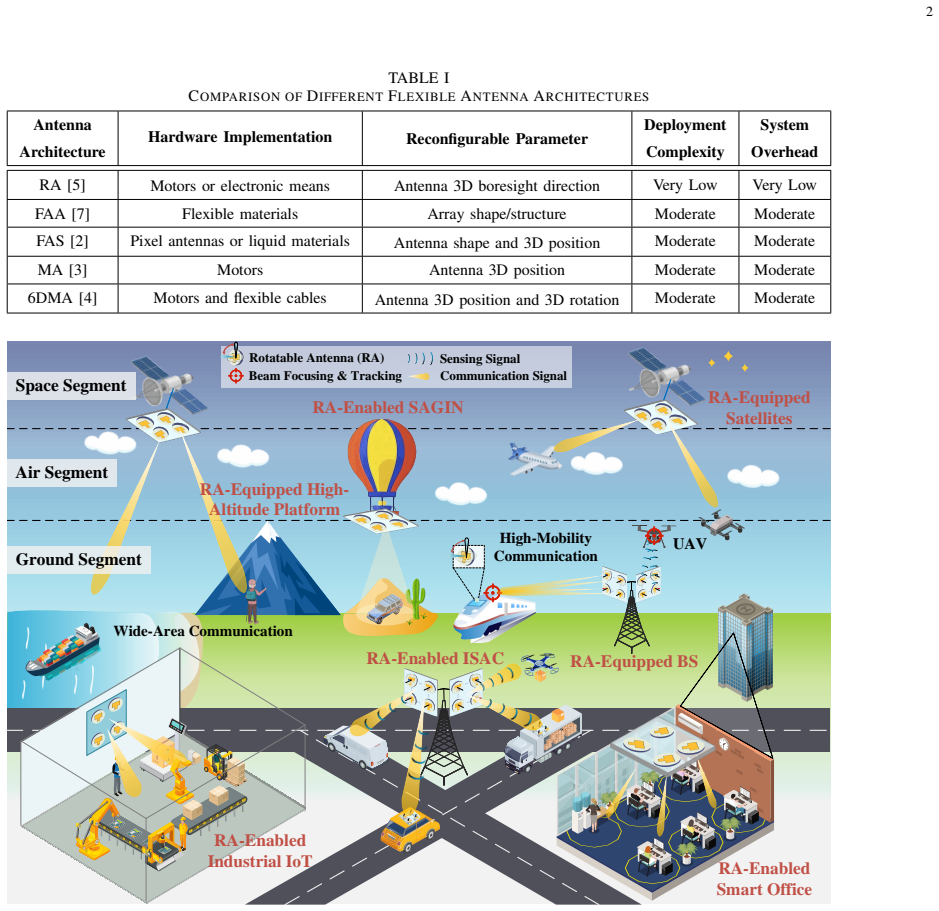
- If RA's gains hold, base stations can serve aerial and spaceborne users without adding antenna elements, extending coverage from ground-only to full 3D space.
- RA arrays can mitigate strong interference by pointing low-gain lobes toward interferers, reducing reliance on complex precoding and equalization.
- In LoS or near-field channels where fixed MIMO rank collapses, RA's angular separation can restore spatial multiplexing gains.
- For integrated sensing and communication, RA allows some antennas to track communication users while others scan sensing targets, easing beam-steering conflicts.
- Sparse RA arrays can achieve fine sensing resolution with a large aperture, but grating-lobe concerns in communication require context-aware configuration.
Reading between the lines
- A natural next step not in the paper is combining rotation with translation (as in 6DMA) to see whether joint position-orientation optimization gives super-additive gains beyond either alone.
- The paper's ideal pattern-rotation model implies a testable prediction: if a real electronically steered antenna's gain changes with steering angle, the coverage and rank gains would degrade by a quantifiable amount; measuring this deviation would calibrate the model.
- RA's sequential scanning could be exploited for environment learning, turning the array into a low-cost radar-like mapper that builds channel maps over time — an extension not developed in the article.
- For low-earth-orbit satellite links, RA's fast electronic steering could enable beam tracking without gimbals, but the pointing-error and vibration limits noted in the paper suggest a need for closed-loop compensation.
Editorial analysis
A structured set of objections, weighed in public.
Referee Report
Summary. Rotatable antenna (RA) technology is introduced as a flexible-antenna architecture that independently adjusts the 3D boresight direction of each antenna element via mechanical or electronic means. The paper surveys hardware implementations, the radiation-pattern model, and the claimed advantages for communication (interference mitigation, spatial multiplexing, flexible beamforming) and sensing (resolution, coverage, multi-target/dimensional sensing). It also discusses applications (MTC, SAGIN, indoor sensing/localization, ISAC), design challenges (rotational scanning scheduling, channel estimation, boresight optimization, antenna configuration), and presents one indoor experiment and simulations as validation. The central qualitative claim is plausible, but the validation is thin: the experiment only demonstrates mechanical beam tracking, and the simulations rely on an idealized self-pattern model from the authors' prior work with weak baselines and unspecified configuration details.
Significance. If the reported gains are confirmed under more realistic conditions, RA offers a compact and cost-effective complement to position-based flexible antennas, potentially extending coverage to aerial nodes and enabling agile ISAC with existing hardware. The paper's systematic taxonomy of RA hardware, challenges, and forward-looking solutions is a useful reference for the community, and the simulation results constitute falsifiable predictions that could guide subsequent experimental work. The main weakness is that the validation is not yet convincing: the single experiment tests only a known effect, and the simulation setup is under-specified and not compared against an optimized fixed-array baseline. The significance is therefore moderate and conditional on stronger validation.
major comments (5)
- [Section VI.B] The simulation validation of multi-user communication and multi-target sensing uses the radiation-pattern model from the authors' prior preprint [5] with no independent measurement, full-wave simulation, or sensitivity analysis. Because the pattern shape is the central physical assumption that distinguishes RA from fixed antennas, the reported 2–3.2 dB SINR improvements (Fig. 4) and sharper sensing peaks (Fig. 5) may be artifacts of an idealized high-directivity pattern rather than a robust property of boresight reconfigurability. Please add a measured pattern or full-wave validation, or at least a sensitivity study over beamwidth, sidelobe level, and gain.
- [Section VI.B] The baselines are random boresight and fixed boresight on the same RA hardware; the paper does not compare against a conventional fixed UPA with optimized digital precoding, which is the standard alternative in the wireless literature. Without that baseline, the claimed gains do not establish that boresight reconfigurability offers an intrinsic advantage over well-designed fixed arrays under the same aperture and power constraints. Please include such a baseline or explicitly justify its exclusion.
- [Section VI.B, Fig. 5] The sensing comparison is not reproducible as reported: the text specifies only 'three targets under LoS channels' and 'spatial power spectrum,' but omits the array geometry, received-signal model, noise level, number of snapshots, and spectral-estimation method (e.g., Bartlett, Capon, MUSIC). The claim of 'much sharper peaks' needs a quantitative metric such as 3-dB angular resolution or sidelobe level, together with the full simulation setup, before the sensing advantage can be assessed.
- [Section VI.A, Fig. 3] The single experiment is a one-user, one-antenna mechanical tracking demonstration at 5.8 GHz; the figure shows received SNR versus azimuth angle without error bars, trial count, or detailed antenna-prototype parameters. The text states this 'validates the effectiveness of RA for enhancing communication coverage performance,' but the experiment does not exercise spatial multiplexing, interference mitigation, or sensing. Please either add a more complete experimental protocol with statistical uncertainty, or explicitly frame the result as a proof-of-concept for beam alignment only.
- [Section V.D vs Section VI.B] The paper concedes in Section V.D that mechanical vibrations, jitters, and thermal variations induce pointing errors that degrade performance (citing [15]), yet the simulations in Section VI.B omit all such effects. Since the experimental RA is mechanically driven, this omission makes the simulation results an ideal-case upper bound. Please incorporate a pointing-error model with typical azimuth/zenith error magnitudes, or clearly state that the simulations assume perfect boresight control and discuss the expected degradation in the conclusions.
minor comments (5)
- [Figures 3–5] In the submitted PDF, Figures 3, 4, and 5 appear to use the same placeholder image; the actual plots, axis labels, and legends are not visible. Please ensure the camera-ready version contains the distinct graphs with full captions.
- [Section VI.B] The radiation pattern from [5] is not described in the paper; a brief summary of key parameters (boresight gain, half-power beamwidth, sidelobe level) would make the simulations self-contained.
- [Section VI.B] The number of random user/target realizations, the channel generation procedure, and the boresight optimization algorithm are not specified; please report these details to support reproducibility.
- [Section II] The statement that RA 'preserves the intrinsic shape of its radiation pattern' during rotation is made without caveats; a brief note on the conditions under which this holds (e.g., ideal steering, small-angle mechanical rotation) would clarify the modeling limits.
- [Table I] The qualitative rating 'Very Low' for RA deployment complexity and system overhead may be optimistic given the actuator and control-loop requirements; consider adding a footnote on hardware cost and maintenance.
Circularity Check
The simulation 'validation' compares the optimized RA to a fixed-boresight baseline that is itself one feasible point of the RA boresight optimization, making the reported 3.2 dB gain over fixed boresight a mathematical certainty rather than an independently validated prediction.
-
fitted input called prediction
[Section VI.B, Simulation Results: Multi-User Communication and Multi-Target Sensing (Figs. 4 and 5)]
"we compare them against two baseline systems: 1) Random boresight, where each antenna’s boresight direction is randomly generated within its feasible boresight range; and 2) Fixed boresight, where each antenna’s boresight is aligned with its default (normal) direction. ... the proposed RA system consistently outperforms both baseline schemes across all values of θmax, achieving up to 2 dB and 3.2 dB improvements compared to random boresight and fixed boresight, respectively."
The fixed-boresight baseline (each antenna at its default normal direction) is one feasible point of the RA boresight optimization. Maximizing max-min SINR over the feasible boresight set is therefore guaranteed to achieve at least the fixed-boresight value; the reported 3.2 dB gain over fixed boresight is a mathematical consequence of comparing an optimizer to one of its own feasible candidates, not a validated empirical prediction. The same containment applies to the sensing power spectrum, where boresights aligned with targets trivially dominate default alignment. The use of the authors' own pattern model [5] makes the loop self-referential, but the baseline containment is the specific reduction.
full rationale
The paper is primarily an overview/tutorial; it contains no formal derivation whose conclusion is equivalent to its premises by definition. The experiment in Section VI.A demonstrates only that a mechanically rotated directional antenna can track a moving user, which is a known effect and not circular. The main circularity is in the simulation case study: the optimized RA is compared to a fixed-boresight baseline that is itself a feasible assignment of the RA boresight variables (all at their default normal direction). Consequently, the claim that RA 'consistently outperforms' fixed boresight by up to 3.2 dB is guaranteed by the structure of the optimization problem rather than by an independent validation of the RA concept. The comparison to random boresight and the experiment retain some independent content, so the paper is not wholly circular, but the central multi-user/sensing 'validation' partially reduces to construction. The self-citation to the authors' prior radiation-pattern model [5] is load-bearing for the simulation but is a modeling input rather than a fitted parameter; it compounds the evidentiary weakness without being a separate definitional circle. These are correctness/evidence concerns as well, but the fixed-boresight containment is enough to warrant a partial circularity score.
Assumptions & free parameters
assumptions (5)
- domain assumption The radiation pattern of a directional antenna is rigidly rotated with its boresight, preserving its shape and gain.
- domain assumption Boresight adjustment can be performed independently per antenna with latency and power small enough not to dominate the communication or sensing frame.
- domain assumption Existing fixed-antenna channel estimation remains valid for RA because antenna positions do not move.
- domain assumption The simulation's channel and geometry models (multipath for four users, LoS for three targets, semicircular placement) are representative of practical RA deployments.
- domain assumption Directional gain along the boresight improves SINR and sensing resolution without beam-alignment losses that cancel the gain.
Cite this review
Pith. "Pith review of Rotatable Antenna Enabled Wireless Communication and Sensing: Opportunities and Challenges." pith.science (2026). https://pith.science/paper/D2B2SGEU
@misc{pith2026250516828,
  author       = {Pith},
  title        = {Pith review of: Rotatable Antenna Enabled Wireless Communication and Sensing: Opportunities and Challenges},
  year         = {2026},
  howpublished = {\url{https://pith.science/paper/D2B2SGEU}},
  note         = {Machine review of arXiv:2505.16828}
}
read the original abstract
Non-fixed flexible antenna architectures, such as fluid antenna system (FAS), movable antenna (MA), and pinching antenna, have garnered significant interest in recent years. Among them, rotatable antenna (RA) is an emerging technology that offers significant potential to enhance wireless communication and sensing performance by flexibly adjusting the boresight of directional antennas. Specifically, RA can flexibly reconfigure its boresight direction via mechanical or electronic means, thereby improving communication channel conditions and/or enhancing sensing resolution and range. In this article, we first provide an overview of RA, covering its hardware architectures and radiation pattern characterization. We then illustrate how RA improves communication performance through interference mitigation, spatial multiplexing, and flexible beamforming, as well as sensing capabilities in terms of coverage, resolution, and multi-target/dimensional sensing. Furthermore, we highlight representative applications of RA and discuss key design challenges in RA systems, including rotational scanning scheduling, channel estimation/sensing, boresight optimization, and RA configuration. Finally, both experimental and simulation results are provided to validate the performance gains achieved by RA for both communication and sensing. Leveraging its unique capabilities in flexible antenna/array rotation to adapt to various communication/sensing requirements and channel conditions, RA is poised to become a key enabler of future intelligent, resilient, and agile wireless networks.
Figures


Figures from the paper (1 more)
Forward citations
Cited by 4 Pith papers
-
Beamforming and Phase Shift Design for STAR-RIS Assisted Secure Sensing and Communication in ISAC Systems
A hybrid BCD algorithm jointly optimizes BS beamforming and STAR-RIS coefficients to trade secrecy rate against CRB of eavesdropper DOA in a STAR-RIS ISAC system.
-
Wireless Communication with Cross-Linked Rotatable Antenna Array: Architecture Design and Rotation Optimization
A cross-linked rotatable antenna array, whose row and column tracks set each antenna's orientation, nearly matches fully flexible per-antenna rotation in simulated multiuser uplinks with only M+N motors instead of 2MN.
-
Intelligent Rotatable Antenna for Integrated Sensing, Communication, and Computation: Challenges and Opportunities
A review-and-demo paper argues that rotatable directional antennas can add spatial flexibility to integrated sensing, communication, and computing systems, but the prototype only tests beam tracking.
-
Polarforming for Wireless Networks: Opportunities and Challenges
Polarforming, which reconfigures antenna polarization with a single RF chain per antenna, is presented as a cost-effective way to exploit polarization degrees of freedom in wireless networks.
Reference graph
Works this paper leans on
-
[5]
Rotatable antenna enabled wireless communication: Modeling and optimization,
B. Zheng, Q. Wu, T. Ma, and R. Zhang, “Rotatable antenna enabled wireless communication: Modeling and optimization,” arXiv preprint arXiv:2501.02595v3, 2025
arXiv 2025
-
[15]
M. R. Hayal et al. , “Modeling and investigation on the performance enhancement of hovering UA V-based FSO relay optical wireless com- munication systems under pointing errors and atmospheric turbulence effects,” Opt. Quantum Electron., vol. 55, no. 625, pp. 1–23, Jul. 2023. BIOGRAPHIES Beixiong Zheng [SM] (bxzheng@scut.edu.cn) is an Associate Professor w...
work page 2023
-
[1]
Reconfigurable massive MIMO: Precoding design and channel estimation in the electromagnetic domain,
K. Ying et al. , “Reconfigurable massive MIMO: Precoding design and channel estimation in the electromagnetic domain,” IEEE Trans. Commun., vol. 73, no. 5, pp. 3423–3440, May 2021
work page 2021
-
[2]
K.-K. Wong, A. Shojaeifard, K.-F. Tong, and Y . Zhang, “Fluid antenna systems,” IEEE Trans. Wireless Commun. , vol. 20, no. 3, pp. 1950– –1962, Mar. 2021
work page 1950
-
[3]
Modeling and performance analysis for movable antenna enabled wireless communications,
L. Zhu, W. Ma, and R. Zhang, “Modeling and performance analysis for movable antenna enabled wireless communications,” IEEE Trans. Wireless Commun., vol. 23, no. 6, pp. 6234–6250, Jun. 2024. 9
work page 2024
-
[4]
6D movable antenna based on user distribution: Modeling and optimization,
X. Shao, Q. Jiang, and R. Zhang, “6D movable antenna based on user distribution: Modeling and optimization,” IEEE Trans. Wireless Commun., vol. 24, no. 1, pp. 355–370, Jan. 2025
2025
-
[6]
Localization with rotatable directional antennas for wireless sensor networks,
J.-R. Jiang, C.-M. Lin, and Y .-J. Hsu, “Localization with rotatable directional antennas for wireless sensor networks,” in Proc. 39th Int. Conf. Parallel Processing Workshops (ICPPW), Sep. 2010, pp. 542–548
work page 2010
-
[7]
Flexible antenna arrays for wireless communications: Modeling and performance evaluation,
S. Yang et al. , “Flexible antenna arrays for wireless communications: Modeling and performance evaluation,” IEEE Trans. Wireless Commun., vol. 24, no. 6, pp. 4937–4951, Jun. 2025
work page 2025
Show all 15 references
-
[8]
6D movable antenna enhanced wireless network via discrete position and rotation optimiza- tion,
X. Shao, R. Zhang, Q. Jiang, and R. Schober, “6D movable antenna enhanced wireless network via discrete position and rotation optimiza- tion,” IEEE J. Sel. Areas Commun. , vol. 43, no. 3, pp. 674–687, Mar. 2025
2025
-
[9]
A demo of radar sensing aided rotatable antenna for wireless communication system,
Q. Dai et al. , “A demo of radar sensing aided rotatable antenna for wireless communication system,” arXiv preprint arXiv:2502.21036v2 , 2025
2025 arXiv
-
[10]
Rotatable antenna enabled wireless communication system with visual recognition: A prototype implementation,
L. Dai et al., “Rotatable antenna enabled wireless communication system with visual recognition: A prototype implementation,” arXiv preprint arXiv:2502.17097v2, 2025
2025 arXiv
-
[11]
A V-band micromachined 2-D beam-steering antenna driven by magnetic force with polymer-based hinges,
C.-W. Baek et al., “A V-band micromachined 2-D beam-steering antenna driven by magnetic force with polymer-based hinges,” IEEE Trans. Microw. Theory Techn., vol. 51, no. 1, pp. 325–331, Jan. 2003
2003
-
[12]
Beam- switching antennas for 5G millimeter-wave wireless terminals,
K. Morshed, D. Karmokar, K. Esselle, and L. Matekovits, “Beam- switching antennas for 5G millimeter-wave wireless terminals,” Sensors, vol. 23, no. 14, pp. 6285–6285, Jul. 2023
2023
-
[13]
Electronically steered metasurface antenna,
M. Boyarsky, T. Sleasman, M. F. Imani, J. N. Gollub, and D. R. Smith, “Electronically steered metasurface antenna,” Sci. Rep. , vol. 11, no. 1, pp. 1–10, Feb. 2021
2021
-
[14]
Efficient multibeam large-angle nonmechanical laser beam steering from computer-generated holograms rendered on a liquid crystal spatial light modulator,
J. R. Lindle, A. T. Watnik, and V . A. Cassella, “Efficient multibeam large-angle nonmechanical laser beam steering from computer-generated holograms rendered on a liquid crystal spatial light modulator,” Appl. Opt., vol. 55, no. 16, pp. 4336–4341, Jun. 2016
2016
Reviewed August 7, 2026 · model on record in the stance chip above.
Discussion (0). Continue with ORCID to comment.