REVIEW 2 major objections 6 minor 1 cited by
GCAL: Adapting Graph Models to Evolving Domain Shifts
T0 review · 2 major / 6 minor · reviewed 2026-08-07 · deepseek-v4-flash
Pith's one-line read A pretrained graph model can be continually adapted to unlabeled out-of-distribution graphs without catastrophic forgetting by replaying compact generated memory graphs.
desk verdict The assembled method is solid and the ablations are honest, but the 'substantially outperforms existing methods' claim is unverified because the closest continual graph-memory baselines are cited yet absent from the comparison. read the letter →
The pith
A machine-rendered reading of the paper's core claim, the machinery that carries it, and where it could break.
The reading
What carries the argument
The load-bearing mechanism is the variational memory graph generator, a GNN whose top-$k$ selector reduces the current graph to $K$ latent node distributions; node features are sampled by reparameterization and edges are built from Gumbel-softmax Bernoulli weights. The generator is trained with three losses aligned to the lower bound in Theorem 3.1: a gradient-matching condensation loss that makes the memory graph mimic the current graph's training signal, a KL regularization loss pushing the latent distribution toward a Bernoulli-Gaussian prior, and a generation loss comparing summed hidden representations of the memory graph and the original graph. These losses are nested in a bilevel optimization: the model parameters adapted in the replay phase define the classifier used to supervise the memory graph's condensation loss.
What would settle it
Compute the exact negative log-likelihood of $\hat{G}_t$ under the generator's Bernoulli and Gaussian distributions and compare it with the squared-discrepancy generation loss across training steps; if the rankings disagree, Equation 14 is not implementing the third term of Equation 5, and the Theorem 3.1 bound no longer applies to the objective actually optimized.
Extended reading notes
Core claim
The paper's central claim is that catastrophic forgetting during graph domain adaptation is preventable without labels, provided the model stores and replays compact generated memory graphs. Each arriving graph $G_t$ is condensed by a variational generator $g(\Phi)$ into a much smaller graph $\hat{G}_t$ with $K \ll N_t$ nodes, trained toward the information-bottleneck goal $\max I(\hat{G}_t; \hat{Y}_t) - \beta I(\hat{G}_t; G_t)$ via a derived lower bound. The adaptation phase then minimizes the same information-maximization loss on the new graph and on all stored memories, so one unsupervised objective both adapts to the new domain and reinforces old ones. In the reported experiments, GCAL achieves the best average performance and average forgetting on Twitch-Explicit, Facebook-100, Elliptic, and OGB-Arxiv, and its ablations show that the regularization loss, generation loss, and exponential moving average updates each contribute positively.
Load-bearing premise
The entire forgetting-prevention claim rests on assuming that the generation loss—a squared difference between summed hidden node representations of the memory graph and the original graph—faithfully implements the log-probability term of the theoretical lower bound; if that proxy drops information that future replay needs, the retention guarantee can break.
Editorial extensions
If this is right
- A pretrained GNN can be updated online on unlabeled graph streams while retaining past-domain performance, so continual domain adaptation needs neither labels nor full retraining.
- Because each memory graph uses only a small fraction of the original nodes, replay storage stays compact even as the number of domains grows.
- The consistent gains over single-step adaptation baselines imply that memory replay, not stronger domain alignment, is the critical missing ingredient in graph continual adaptation.
- Removing any of the regularization loss, generation loss, or EMA updates lowers average performance on every dataset, so the full training recipe is needed for the reported result.
- The same framework works for regional shifts and temporal shifts, suggesting the mechanism is not tied to a particular kind of domain drift.
Reading between the lines
- Because the generation term is implemented as a summed-representation discrepancy rather than the exact log-probability of the generator, the information-bottleneck derivation is better read as motivation for the loss design than as a tight guarantee on what is optimized; a stricter guarantee would require bounding the discrepancy by the log-likelihood.
- The memory graphs are learned from the current model's soft pseudo-labels, so noisy early-domain predictions could be baked into the stored memories; an extension would be to weight replay by prediction confidence.
- As the number of domains grows, the stored memory pool grows linearly with the domain count, so at very long streams the compact-per-graph memories may still dominate the budget; testing larger domain counts would reveal the practical ceiling.
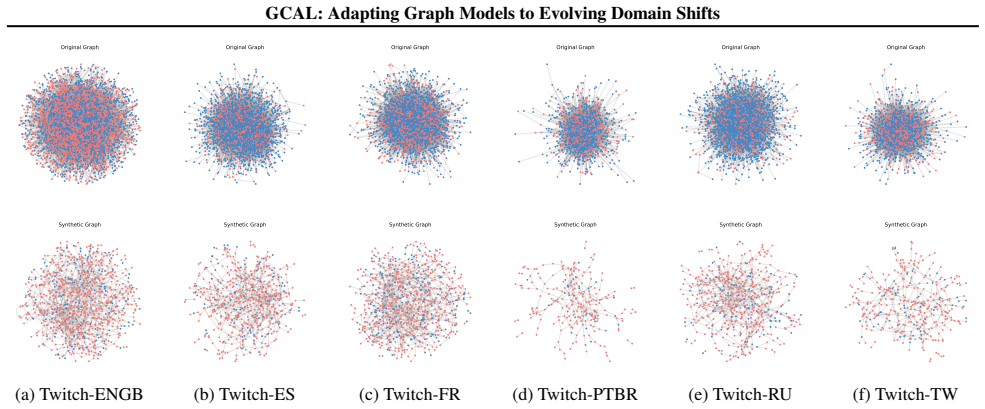
- The generated-graph visualizations suggest memories preserve coarse structure while dropping density, so a natural experiment is to check whether structure-aware fidelity measures predict replay value better than node-feature fidelity does.
Editorial analysis
A structured set of objections, weighed in public.
Referee Report
Summary. The paper proposes GCAL, a method for unsupervised continual adaptation of graph models to a sequence of evolving out-of-distribution graphs. At each step, GCAL performs test-time adaptation by information maximization on the new graph while replaying previously generated memory graphs, and then generates a small synthetic memory graph for the current graph using a variational GNN with a top-k selector, Gumbel-softmax edge sampling, and three losses derived from an information-bottleneck-style lower bound. The method is evaluated on Twitch-explicit, Facebook-100, Elliptic, and OGB-Arxiv, where it reports higher Average Performance (AP) and better Average Forgetting (AF) than eight baselines, with ablations, hyperparameter sensitivity, and backbone analyses. The central claim is that GCAL substantially outperforms existing methods in both adaptability and knowledge retention.
Significance. If the empirical claim holds, GCAL addresses a genuine and underexplored problem: unsupervised continual adaptation of graph models under evolving distribution shifts, where most prior graph domain adaptation methods are single-step and supervised continual graph learning methods do not apply. The paper has several strengths: it releases code, reports five-run means and standard deviations, provides ablations for each loss component, tests multiple GNN backbones, and includes a proof of the proposed lower bound. The variational memory generation module is a sensible design and the replay-without-labels idea is practically motivated. However, the significance is currently tempered by two gaps: the closest continual graph-memory baselines cited in the paper are absent from the comparison table, and the implemented generation loss is not actually connected to the derived lower bound. Both need to be addressed before the stated 'substantially outperforms' claim can be accepted.
major comments (2)
- [§4.2.1, Table 2] The central empirical claim that GCAL 'substantially outperforms existing methods' is not yet supported because Table 2 omits the closest competitors cited in the manuscript itself: CaT (Liu et al., 2023b), PUMA (Liu et al., 2023c), and Qiao et al. (ICLR 2025). These are memory-replay and graph-condensation methods for continual graph learning discussed in §D.1 and §D.3, and Qiao et al. (2025), by the same research group, appears to target the same unsupervised continuous reuse setting. None of them appears in Table 2 or Figure 3. If PUMA and CaT require supervised labels, the paper should state that explicitly and, where feasible, adapt them to the unsupervised protocol; Qiao et al. (2025) in particular should be compared directly or its exclusion justified in detail. Without these comparisons, the abstract and §4.2.1 overstate the state-of-the-art claim.
- [§3.2.1 (Theorem 3.1, Eq. 5) and §3.2.5 (Eq. 14)] The implemented generation loss is not the objective derived in Theorem 3.1. Equation 14 minimizes the squared L2 distance between summed hidden representations of the memory graph and the original graph, whereas the theorem's final term is E[log Pg(Ĝt|Gt, Zt)], a log-likelihood under the variational generator. No derivation shows that Eq. 14 is proportional to, or bounds, that log-likelihood. Moreover, the two β-dependent terms in Eq. 5 cancel algebraically: for a fixed generator distribution Pg, -βE[KL(Pg(Ĝt|Gt,Zt)||Q(Ĝt))] + βE[log Pg(Ĝt|Gt,Zt)] equals βE[log Q(Ĝt)], a prior cross-entropy that contains no term encouraging preservation of information from Gt. Thus the lower bound in Theorem 3.1 does not justify LGen as an information-preservation objective, and the claim that the generator is 'guided by a theoretical lower bound' is not established. The Table 3 ablation shows removing LGen costs only 0.3–0.9 points, so this is not the primary empirical weakness, but the theory-practice gap is load-bearing for the method's rationale and should be fixed by either deriving a bound for Eq. 14 or reformulating the theoretical claim.
minor comments (6)
- [§4.2.2 and Figure 4 caption] The text says GCAL 'predominantly displays lighter shades' compared to CoTTA in Figure 4, while the caption states that darker shades signify better performance; if lighter is worse, the sentence contradicts the claimed advantage, and if the figure or the sentence is wrong, the visual comparison needs to be corrected.
- [Figure 5] The horizontal axis is labeled 'Prompt Ratio' while the text and the surrounding discussion refer to the synthetic-node ratio K/Nt; the axis label should match the terminology used in §4.2.4.
- [Table 2] The caption mentions 'Full' as the upper bound, but no Full row appears in the table; the row should either be added or the caption should be adjusted.
- [§3.2.5, Eq. (14)] The notation \bu_i(Θ) and u_i(Θ) is not defined in the text, and the comparison of a sum over K generated-node representations with a sum over Nt original-node representations deserves a short explanation of how the two sets are aligned or pooled.
- [Appendix B and §4.3] There are several editorial slips: 'Detialed' in the appendix title, 'A void Forgetting' in §2, and 'mode parameters' where 'model parameters' is meant; these should be corrected.
- [§4.2.1, Table 2] For EERM and GTrans, AF is listed as N/A because they train new parameters at each graph, but AP is still reported; the paper should clarify how AP is computed for methods that cannot evaluate the final model on previous domains.
Circularity Check
No significant circularity: the IB lower bound is a self-contained variational derivation and the empirical claims are judged on external labeled metrics against external baselines.
full rationale
The derivation chain in GCAL is not circular. Theorem 3.1 (Eq. 5) is obtained by the standard variational decomposition of mutual information: dropping the nonnegative entropy term H(Yhat) lower-bounds I(Ghat;Yhat), and dropping the nonnegative KL(P(Ghat)||Q(Ghat)) lower-bounds -I(Ghat;Gt,Zt), while H(Ghat|Gt)>=0 lower-bounds I(Ghat;Zt|Gt). Each inequality uses only nonnegativity of entropy/KL, not the claim being proved, so the bound is an independent mathematical statement rather than an equation that presupposes its own conclusion. The three implemented losses are surrogates for the three bound terms: L_MGL is a gradient-matching approximation to E[log Pf(Yhat|Ghat)], L_Reg is the closed-form KL term, and L_Gen is a squared-distance proxy for E[log Pg(Ghat|Gt,Zt)]. The L_Gen proxy is a heuristic approximation rather than an equivalence, but this is a correctness/implementation gap, not a circular reduction; moreover the ablation (Table 3) shows removing LGen costs only 0.3-0.9 points, so the forgetting-prevention claim does not reduce to that proxy. The central empirical claim is evaluated with labeled AP/AF metrics on held-out test data against external methods (Tent, CoTTA, EATA, EERM, etc.), so the optimization objective (entropy minimization plus memory replay) is not the same quantity being measured. Self-citations such as Qiao et al. (ICLR 2025) appear in related work but are not used to justify the IB derivation or the benchmark comparisons. The absence of PUMA, CaT, and the authors' own ICLR 2025 method from Table 2 is a legitimate concern about the strength of the 'substantially outperforms' claim, but it is an empirical comparison gap, not a circularity of the derivation. No fitted parameter is renamed as a prediction, no uniqueness theorem is imported from the authors, and no known result is merely relabeled. Therefore the appropriate circularity score is 0.
Assumptions & free parameters
free parameters (5)
- β (information bottleneck trade-off) =
not reported
- λ1, λ2 (loss weights) =
not reported
- K (memory graph size) =
0.01 to 0.13 of original nodes depending on dataset
- q (Bernoulli prior for edges) =
not reported
- τ (Gumbel temperature) =
not reported
assumptions (4)
- domain assumption Graph information bottleneck objective (Eq. 3) is the correct criterion for memory graph generation.
- domain assumption Information maximization provides reliable pseudo-labels for both adaptation and memory condensation.
- domain assumption The variational generator parameterization (Gaussian node features, Bernoulli edges) can express informative memory graphs.
- domain assumption The variational prior Q(Ghat) = Bernoulli(q) x N(0,I) is a suitable reference distribution.
Cite this review
Pith. "Pith review of GCAL: Adapting Graph Models to Evolving Domain Shifts." pith.science (2026). https://pith.science/paper/PTZFYV5P
@misc{pith2026250516860,
  author       = {Pith},
  title        = {Pith review of: GCAL: Adapting Graph Models to Evolving Domain Shifts},
  year         = {2026},
  howpublished = {\url{https://pith.science/paper/PTZFYV5P}},
  note         = {Machine review of arXiv:2505.16860}
}
read the original abstract
This paper addresses the challenge of graph domain adaptation on evolving, multiple out-of-distribution (OOD) graphs. Conventional graph domain adaptation methods are confined to single-step adaptation, making them ineffective in handling continuous domain shifts and prone to catastrophic forgetting. This paper introduces the Graph Continual Adaptive Learning (GCAL) method, designed to enhance model sustainability and adaptability across various graph domains. GCAL employs a bilevel optimization strategy. The "adapt" phase uses an information maximization approach to fine-tune the model with new graph domains while re-adapting past memories to mitigate forgetting. Concurrently, the "generate memory" phase, guided by a theoretical lower bound derived from information bottleneck theory, involves a variational memory graph generation module to condense original graphs into memories. Extensive experimental evaluations demonstrate that GCAL substantially outperforms existing methods in terms of adaptability and knowledge retention.
Figures


Figures from the paper (5 more)




Forward citations
Cited by 1 Pith paper
-
Cross-Resolution Semantic Learning for Graph Domain Adaptation
CReSL improves graph domain adaptation by learning cross-resolution source-to-target routing and grafting target representations toward source class prototypes.
Reference graph
Works this paper leans on
-
[1]
Multimodal continual graph learning with neural architecture search
Cai, J., Wang, X., Guan, C., Tang, Y ., Xu, J., Zhong, B., and Zhu, W. Multimodal continual graph learning with neural architecture search. In Proceedings of the ACM Web Conference 2022, pp. 1292–1300,
work page 2022
-
[3]
Dziugaite, G. K., Roy, D. M., and Ghahramani, Z. Training generative neural networks via maximum mean discrep- ancy optimization. arXiv preprint arXiv:1505.03906 ,
-
[6]
reflects the dynamic and challenging nature of financial transactions
Visualized comparison of the original graphs (the first line) and generative graphs (the second line) of GCAL in the Twitch dataset. reflects the dynamic and challenging nature of financial transactions. Our training strategy begins by pretraining the model on selected graphs from each dataset, then continually adapting to the remaining unlabeled graph da...
work page 2017
-
[8]
We compare the results of incorporating these GNN backbones within our framework versus utilizing them individually as standalone models. Using our framework demonstrates remarkable enhancements, showing the effectiveness of our proposed techniques. Lastly, it is important to note that the consistent use of different backbones significantly enhances resul...
work page 2022
-
[9]
Revisit- ing batch normalization for practical domain adaptation
Li, Y ., Wang, N., Shi, J., Liu, J., and Hou, X. Revisit- ing batch normalization for practical domain adaptation. arXiv preprint arXiv:1603.04779,
-
[11]
Structural re-weighting improves graph domain adap- tation
Liu, S., Li, T., Feng, Y ., Tran, N., Zhao, H., Qiu, Q., and Li, P. Structural re-weighting improves graph domain adap- tation. In International Conference on Machine Learning, pp. 21778–21793. PMLR, 2023a. Liu, Y ., Qiu, R., and Huang, Z. Cat: Balanced continual graph learning with graph condensation. In 2023 IEEE International Conference on Data Mining ...
arXiv 2023
-
[12]
Sener, O. and Savarese, S. Active learning for convolutional neural networks: A core-set approach. arXiv preprint arXiv:1708.00489,
-
[13]
Single- view graph contrastive learning with soft neighborhood awareness
Sun, Q., Chen, C., Qiao, Z., Zheng, X., and Wang, K. Single- view graph contrastive learning with soft neighborhood awareness. In AAAI 2025,
work page 2025
Show all 28 references
-
[14]
All in one: Multi-task prompting for graph neural networks
Sun, X., Cheng, H., Li, J., Liu, B., and Guan, J. All in one: Multi-task prompting for graph neural networks. In Proceedings of the 29th ACM SIGKDD Conference on Knowledge Discovery and Data Mining, pp. 2120–2131, 2023b. Sun, X., Zhang, J., Wu, X., Cheng, H., Xiong, Y ., and L...
-
[15]
Graph attention networks.arXiv preprint arXiv:1710.10903,
Veliˇckovi´c, P., Cucurull, G., Casanova, A., Romero, A., Lio, P., and Bengio, Y . Graph attention networks.arXiv preprint arXiv:1710.10903,
-
[16]
Does graph prompt work? a data operation perspective with theoretical analysis
Wang, Q., Sun, X., and Cheng, H. Does graph prompt work? a data operation perspective with theoretical analysis. arXiv preprint arXiv:2410.01635, 2024b. Wang, X., Duan, M., Li, J., Ma, A., Xin, G., Xu, D., Li, Z., Liu, B., and Ma, Q. Marsgt: Multi-omics analysis for rare popul...
-
[18]
log P ( bGt|Gt, Zt) Q( bGt) # + KL(P ( bGt) ∥ Q( bGt)) ≥ −E bGt,Gt,Zt
12 GCAL: Adapting Graph Models to Evolving Domain Shifts A. Proof of Theorem 3.1. In the section of Variational Memory Graph Generation, we give Theorem 1 to define a lower bound of the information bottleneck for generating memory graphs bGt from the original graph Gt: Theorem...
2012
-
[19]
These networks vary greatly in size, density, and degree distribution
Regional Shifts: The Facebook-100 dataset comprises 100 snapshots of Facebook friendship networks from 2005, each representing users from a specific American university. These networks vary greatly in size, density, and degree distribution. Additionally, the Twitch-Explicit da...
2005
-
[20]
For baselines not originally designed for graphs, their architectures have been adapted to GCNs to ensure consistency in evaluation
enhances adaptation efficiency through entropy minimization and employs a Fisher-based regularizer to maintain performance across domain shifts. For baselines not originally designed for graphs, their architectures have been adapted to GCNs to ensure consistency in evaluation....
2011
-
[23]
and RieGrace (Sun et al., 2023a), which focus on maintaining essential parameters and structural topologies. Parameter isolation techniques allocate distinct parameters for new tasks to maintain those relevant to prior tasks (Niu et al.; Zhang et al., 2023a; 2022a), as seen in...
2024
-
[26]
Continual Test-Time Adaptation (CTTA), a critical facet of Continual Domain Adaptation, addresses the unique demands of non-static domains
leverage graph topology to improve adaptability, reducing discrepancies between source and target graphs via local and global consistencies and a graph domain discriminated loss, respectively. Continual Test-Time Adaptation (CTTA), a critical facet of Continual Domain Adaptati...
2022
-
[27]
and meta-networks in EcoTTA (Song et al., 2023), contribute to improved model normalization and adaptability. Despite these advancements, challenges such as noisy pseudo-labels and calibration issues persist, and a notable gap remains in unsupervised graph continual domain ada...
2023
-
[28]
Among recent innovations, GCDM (Liu et al., 2022), introduce graph-specific distribution alignment to enhance condensation effectiveness
utilize gradient alignment to synthesize representative samples that maintain the statistical properties of the original data, drawing from principles of traditional sampling (Sener & Savarese, 2017). Among recent innovations, GCDM (Liu et al., 2022), introduce graph-specific ...
2017
-
[2015]
and adversarial techniques (Dan et al., 2024; Qiao et al., 2023; Tzeng et al., 2017; Zhang et al., 2018), form the basis of this field. In graph-based domain adaptation, a variety of methods have been proposed (Ding et al., 2018; Jin et al., 2022; Liu et al., 2023a; Ma et al.,...
2024
-
[2016]
Gao, X., Chen, T., Zang, Y ., Zhang, W., Nguyen, Q. V . H., Zheng, K., and Yin, H. Graph condensation for inductive node representation learning. In 2024 IEEE 40th Inter- national Conference on Data Engineering (ICDE) , pp. 3056–3069. IEEE,
2024
-
[2017]
A., and Jin, W
Hashemi, M., Gong, S., Ni, J., Fan, W., Prakash, B. A., and Jin, W. A comprehensive survey on graph reduc- tion: Sparsification, coarsening, and condensation. arXiv preprint arXiv:2402.03358,
-
[2018]
Hierarchical prototype net- works for continual graph representation learning
Zhang, X., Song, D., and Tao, D. Hierarchical prototype net- works for continual graph representation learning. IEEE Transactions on Pattern Analysis and Machine Intelli- gence, 45(4):4622–4636, 2022a. Zhang, X., Song, D., and Tao, D. Sparsified subgraph memory for continual g...
2022 arXiv
-
[2020]
Praga: Prototype-aware graph adaptive aggregation for spatial multi-modal omics anal- ysis
9 GCAL: Adapting Graph Models to Evolving Domain Shifts Huang, X., Ma, Z., Meng, D., Liu, Y ., Ruan, S., Sun, Q., Zheng, X., and Qiao, Z. Praga: Prototype-aware graph adaptive aggregation for spatial multi-modal omics anal- ysis. In AAAI 2025,
2025
-
[2021]
Graph condensation via receptive field distribution matching
Liu, M., Li, S., Chen, X., and Song, L. Graph condensation via receptive field distribution matching. arXiv preprint arXiv:2206.13697,
-
[2022]
Kipf, T. N. and Welling, M. Semi-supervised classifica- tion with graph convolutional networks. arXiv preprint arXiv:1609.02907,
-
[2023]
Adaptive path-memory network for tempo- ral knowledge graph reasoning
Dong, H., Ning, Z., Wang, P., Qiao, Z., Wang, P., Zhou, Y ., and Fu, Y . Adaptive path-memory network for tempo- ral knowledge graph reasoning. In Proceedings of the Thirty-Second International Joint Conference on Artifi- cial Intelligence, pp. 2086–2094,
-
[2024]
Graph condensation for graph neural networks
Jin, W., Zhao, L., Zhang, S., Liu, Y ., Tang, J., and Shah, N. Graph condensation for graph neural networks. arXiv preprint arXiv:2110.07580,
-
[2025]
archive and revisit representative data from past tasks to alleviate the critical issue of catastrophic forgetting, as exemplified by ER-GNN (Zhou & Cao, 2021), SSM (Zhang et al., 2022b), SEM-curvature (Zhang et al., 2023b), PDGNNs (Zhang et al., 2024), and CaT (Liu et al., 20...
2021
Reviewed August 7, 2026 · model on record in the stance chip above.
Discussion (0). Sign in to comment.