REVIEW 4 major objections 5 minor 28 references
Resolving the $\Delta(1232)$ partial width anomaly: Complex pole residue is not a fundamental resonance property
T0 review · 4 major / 5 minor · reviewed 2026-08-07 · deepseek-v4-flash
Pith's one-line read The pole residue of a hadronic resonance is not a fundamental property: it is an amplitude-level quantity reshaped by all resonances with the same quantum numbers, so Δ(1232)'s apparent 105% partial width is an artifact.
desk verdict A conceptually sound, honestly presented argument that pole residues are not fundamental resonance properties, but the quantitative resolution of the Delta(1232) anomaly rests on an assumed factorization that deserves scrutiny. read the letter →
The pith
A machine-rendered reading of the paper's core claim, the machinery that carries it, and where it could break.
The reading
What carries the argument
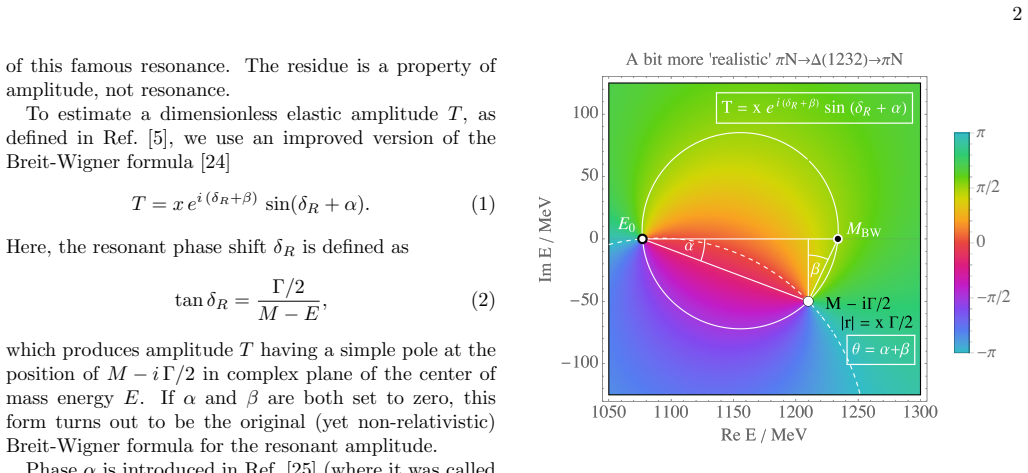
The two carrying objects are formulas. First, a minimally improved Breit-Wigner amplitude $T = x e^{i(\delta_R+\beta)} \sin(\delta_R+\alpha)$, with $\tan\delta_R = (\Gamma/2)/(M-E)$ placing the pole at $M - i\Gamma/2$ in the center-of-mass energy plane: the phase $\alpha$ makes the amplitude a simple zero at the elastic threshold $E_0$ via $\tan\alpha = (\Gamma/2)/(M-E_0)$, and $\beta$ encodes the shift between the pole mass $M$ and the Breit-Wigner mass through $\tan\beta = (M-M_{BW})/(\Gamma/2)$, so the elastic residue phase is predicted as $\theta = \alpha + \beta$. Second, the unitary-addition approximation $1 + 2iT \approx \prod_r (1 + 2iT^{(r)})$, which assembles the elastic $S$-matrix element as a product of single-resonance $S$-matrix elements so that resonances with identical quantum numbers can be combined — applied to the $f_0(500)/f_0(980)$ pair in $\pi\pi$ scattering and then to the three $P_{33}$ isobars. The first formula predicts residue phases that match empirical values for about two-thirds of the prominent resonances; the second is the mechanism by which partner poles redistribute a given pole's residue.
What would settle it
The decisive check is a controlled calculation: take an exactly solvable multi-channel model with known unitarity and two or more resonances sharing quantum numbers, compute the elastic pole residue of the lower resonance from the full amplitude and from the amplitude with the partner pole removed, and compare the shift with the paper's Eq. (6). If the residue is unchanged by the partner pole, or if Eq. (6) misses the exact shift, the paper's demonstration of the Δ(1232) anomaly collapses; if the shift matches, the residue is demonstrably an amplitude-level, context-dependent quantity.
Extended reading notes
Core claim
The central claim is stated plainly in the Letter: the complex pole residue is not a fundamental property of hadronic resonances; in the paper's words, 'the residue is a property of amplitude, not resonance.' Even if pole positions are fundamental, residue magnitudes and phases are fixed by the full scattering amplitude, and by S-matrix unitarity they depend on all other resonances that share the same quantum numbers. The empirical anchor is the Δ(1232) puzzle: every relevant analysis in the Review of Particle Properties finds the elastic residue 'partial width' $2|r|$ between 100 and 106 MeV against a total width of 93–100 MeV, a statistically significant ratio of 104.8±2.4%. By unitarily combining the three $P_{33}$ resonances Δ(1232), Δ(1600), and Δ(1920), the paper reproduces $2|r| = 102$ MeV for Δ(1232) — the same apparent violation — and takes that as confirmation that the residue is an amplitude-level quantity carrying interference from partner poles, not the resonance's own decay probability.
Load-bearing premise
The load-bearing premise is the unitary-product approximation of Eq. (6), $1 + 2iT \approx \prod_r (1 + 2iT^{(r)})$: the elastic $S$-matrix element is taken to be the product of the single-resonance $S$-matrix elements, an assumption the paper states openly because the full $S$-matrix is unknown — if this product is wrong, the specific 102 MeV reproduction of the Δ(1232) residue fails, although the broader unitarity argument could still stand.
Editorial extensions
If this is right
- The Δ(1232) anomaly stops being a crisis: a partial width read from a residue is not a probability, so it may exceed the total width, and no new physics is needed to explain it.
- Residue-derived couplings in meson spectroscopy and in particle-data tables are partial-wave-dependent; re-extracting the same resonance from another reaction or another fit should generally give a different residue, with the differences set by unitarity.
- The predicted residue phase $\theta = \alpha + \beta$ is a cheap consistency test: for any resonance whose pole position and Breit-Wigner mass are both known, the residue phase can be predicted and compared with fitted values.
- Combining partner resonances with the unitary product moves the Δ(1600) and Δ(1920) residue phases toward their empirical estimates, so the same interference reshapes all members of a partial wave, not only the lowest one.
Reading between the lines
- If residues are amplitude-level, then comparing 'pole couplings' across different analyses or reactions, say photoproduction versus hadronic scattering, carries a context-dependent scatter that is not a property of the resonance itself; quoting a residue without its partial wave is like quoting a regression coefficient without the other covariates.
- The same logic extends to near-threshold states whose residue magnitudes feed estimates of compositeness or molecular content: those estimates would inherit partner-pole interference, so the argument, if right, would shift how such quantities are interpreted.
- A natural next test would be to apply the unitary product to another multi-resonance partial wave with well-measured residues, such as the S11 sector containing N(1535) and N(1650), and predict the direction and size of each residue shift; the framework implies that the partial-width-exceeds-total fingerprint is generic to multi-resonance partial waves.
- The model's failures, about one-third of the cases, cluster where a channel opens near the pole mass, the Roper N(1440) being the textbook example, which suggests the $\alpha + \beta$ formula can serve as a background-free baseline whose deviations flag shadow poles and nearby thresholds.
Editorial analysis
A structured set of objections, weighed in public.
Referee Report
Summary. The paper argues that the complex pole residue of a hadronic resonance is not a fundamental, resonance-level property, using the Δ(1232) partial-width anomaly as the focal example. The authors introduce a minimally improved Breit-Wigner amplitude T = x exp(i(δ_R+β)) sin(δ_R+α) with residue phase θ = α + β, and show that for roughly two-thirds of prominent baryon and meson resonances the model predicts the empirically extracted elastic residue phase. They then invoke the unitary product approximation of Eq. (6), which multiplies single-resonance S-matrix factors to combine resonances in the same partial wave, and find that when Δ(1232), Δ(1600), and Δ(1920) are combined, the Δ(1232) elastic residue magnitude yields 2|r| = 102 MeV, moving toward the anomalous ratio Γ_par/Γ_tot ≈ 104.8% seen in Table I. The conclusion is that the residue magnitude is an amplitude-level quantity, not an intrinsic resonance property.
Significance. If the central claim is correct, it has practical consequences for hadron spectroscopy: resonance couplings and partial widths extracted from pole residues would be scheme- and environment-dependent, and the interpretation of PDG residue listings would need revision. The paper is honest about the assumed character of Eq. (6) and presents a falsifiable prediction for residue phases. The empirical anomaly in Table I is real and well documented. However, the evidence offered here is not yet decisive: the product approximation is an ansatz, the numerical match is not statistically quantified, and the model's free parameters for the multiresonance calculation are not fully specified.
major comments (4)
- [Eq. (6) and Section 4] Equation (6), 1 + 2iT ≈ ∏_r (1 + 2i T^(r)), is the load-bearing element of the 'resolution' of the Δ(1232) anomaly, yet it is introduced as an assumption because the full S-matrix elements are unknown. This is not a consequence of unitarity: for a multichannel unitary S-matrix, the (1,1) element of a product of unitary matrices is not the product of the (1,1) elements, and off-diagonal channel couplings contribute to the elastic amplitude at a pole. The reproduction of 102 MeV from a single-resonance value of 100 MeV is therefore a consistency check of the ansatz, not an independent confirmation that multiresonance unitarity produces the anomaly. The paper should validate Eq. (6) against at least one known coupled-channel model (e.g., the Jülich or Bonn-Gatchina models cited in Table I) or quantify the error incurred by the factorization.
- [Section 4, Δ(1232) calculation] The numerical result 2|r| = 102 MeV is not reproducible from the information given. Equation (1) contains the elastic branching fraction x for each resonance, and Eq. (6) combines the amplitudes of Δ(1232), Δ(1600), and Δ(1920), each with its own x. The paper does not state the values of x used for the two higher resonances, nor does it give an uncertainty estimate for the resulting 102 MeV. Without these inputs, the central numerical claim cannot be checked. The authors should provide the x values, the error propagation, and ideally a sensitivity study showing how 2|r| depends on the unknown branching fractions.
- [Fig. 2 and Section 2] The claim that 'roughly 2/3' of the analyzed resonances are 'in perfect agreement' with PDG residue phases is not quantified. There is no explicit list of which resonances count as successes, no definition of 'agreement' (tolerance in degrees? overlap of error bars?), and no statistical test such as a χ² per degree of freedom. The paper also explains the remaining third by invoking shadow poles and strong nearby-channel couplings, e.g., for N(1440), but this explanation is post hoc and is not tested against a quantitative criterion. These two issues weaken the evidence for the model's predictive power and should be addressed before the central claim is accepted.
- [Conclusions and Table I] The logical connection between the model and the conclusion is overstated. The statement that 'residues depend on all other resonances that have the same quantum numbers, due to scattering matrix unitarity' is a general property of amplitudes and does not require the product ansatz; the empirical Table I already demonstrates that 2|r| can exceed Γ_tot. What the paper adds is a specific approximate mechanism, but it does not show that the mechanism is the actual cause of the anomaly, nor does it prove that no exact unitary amplitude could assign a meaningful resonance-level partial width. A more modest wording—that the anomaly is consistent with multiresonance contamination rather than definitively explained by it—would better match the strength of the evidence.
minor comments (5)
- [Abstract and Section 2] The phrase 'all analyzes' on page 4 should be 'all analyses'.
- [Fig. 2 caption] The caption says 'Roughly 2/3 are in perfect agreement' without a criterion; this should be replaced by a quantitative statement or a supplementary table.
- [Eq. (3)] The definition tan α = (Γ/2)/(M - E_0) is ambiguous when the resonance mass is below threshold (M - E_0 < 0); the text should specify the chosen branch of α for such cases and whether any of the analyzed resonances fall in that category.
- [Reference [23]] Reference [23] is incomplete: the author list 'R. de Elvira, Kubis' should be completed, and the journal reference should include the year and volume consistently with the other references.
- [Section 3] The statement that the model 'completely ignores the threshold behavior' but still works is intriguing; a brief discussion of why the simple zero in Eq. (1) might be sufficient for the phase, despite the known k^{2l+1} momentum dependence, would help the reader assess the approximation.
Circularity Check
No significant circularity: the residue-phase predictions are parameter-free tests against independent PDG data, and the unitary product approximation is explicitly an assumption, not a disguised input.
full rationale
The paper's central claim is that the complex pole residue is not a fundamental resonance property, supported by two threads: (1) a simple Breit-Wigner-type model predicts elastic residue phases as θ = α + β, and (2) a unitary product approximation, Eq. (6), applied to the Δ(1232) partial wave yields a residue magnitude that reproduces the known anomaly. Thread (1) is not circular: α and β are computed from independent PDG inputs (pole position, elastic threshold, Breit-Wigner mass) with no free parameters, and the predicted phases are then compared against the independently extracted PDG residue phases. The relation θ = α + β is a property of the ansatz, not a fit to the data being predicted. Thread (2) is explicitly introduced as an assumption: the paper states, "Lacking the better option, in Ref. [24] it was assumed that the dominant part of the diagonal S-matrix element... will be the product of the same diagonal elements of all single-resonance S-matrices." This is an honest limitation, not a circularity: the product form is not claimed to be derived from unitarity, and its quantitative consequence (102 MeV vs. the input 100 MeV) is a computed prediction that does not use the anomaly as input. The self-citations (Refs. [24,25]) provide the model form, but the model is tested against external benchmark data (PDG analyses, Hoferichter phases), so the self-citations are not load-bearing in a circular way. The empirical support is admittedly partial—only roughly two-thirds of the residue phases agree and the Δ(1232) shift is small—but that is a correctness/fragility concern, not a circularity concern. No reduction of a prediction to its inputs by construction was found.
Assumptions & free parameters
free parameters (1)
- elastic branching fraction x for each resonance in Eq. (6) =
not reported in the paper
assumptions (3)
- domain assumption S-matrix unitarity holds and is implemented by the diagonal product approximation 1 + 2iT approximately equals the product over r of (1 + 2iT^(r)).
- ad hoc to paper The improved Breit-Wigner amplitude T = x e^(i(delta_R + beta)) sin(delta_R + alpha) with a simple zero at threshold is a valid representation of physical resonant amplitudes, so that the residue phase is theta = alpha + beta.
- domain assumption The PDG 2024 averages for pole positions, Breit-Wigner masses, and residue phases are accurate and their quoted errors are independent.
Cite this review
Pith. "Pith review of Resolving the $\Delta(1232)$ partial width anomaly: Complex pole residue is not a fundamental resonance property." pith.science (2026). https://pith.science/paper/4ZIAK6DW
@misc{pith2026250516880,
  author       = {Pith},
  title        = {Pith review of: Resolving the $\Delta(1232)$ partial width anomaly: Complex pole residue is not a fundamental resonance property},
  year         = {2026},
  howpublished = {\url{https://pith.science/paper/4ZIAK6DW}},
  note         = {Machine review of arXiv:2505.16880}
}
abstract
The resonant properties of excited hadrons are commonly identified with the complex pole positions and residues of the scattering amplitude. The mass and total decay width are given by position, whereas the partial width is given by the magnitude of the residue. If this identification was correct, the partial width of famous $\Delta(1232)$ would be larger than its total width. By using a simple model that predicts residue phases of prominent baryons $N^*$, $\Delta$, $\Lambda$, $\Sigma$, and low mass mesons, we resolve this anomaly and show that the residue cannot be a fundamental resonant property.
Figures


Figures from the paper (2 more)


Reference graph
Works this paper leans on
-
[1]
Breit and E
G. Breit and E. Wigner, Phys. Rev.49, 519 (1936)
1936
-
[2]
R. E. Cutkosky, C. P. Forsyth, R. E. Hendrick, and R. L. Kelly, Phys. Rev.D 20, 2839 (1979)
1979
-
[3]
Proc. 4th Conf. on Baryon Reso- nances in Toronto
R. E. Cutkosky, C. P. Forsyth, R. E. Hendrick, and R. L. Kelly,et al.: “Proc. 4th Conf. on Baryon Reso- nances in Toronto”, ed. N. Isgur, p. 19 (1980)
work page 1980
- [4]
-
[5]
H¨ ohler,Landolt-B¨ ornstein: Numerical Data and Func- tional Relationships in Science and TechnologyGroup 1, Volume 9, Subvolume b, Part 2, pg
G. H¨ ohler,Landolt-B¨ ornstein: Numerical Data and Func- tional Relationships in Science and TechnologyGroup 1, Volume 9, Subvolume b, Part 2, pg. 202, (Springer- Verlag, 1983)
1983
-
[6]
Batini´ c, I
M. Batini´ c, I. ˇSlaus, A. ˇSvarc, and B. M. K. Nefkens, Phys. Rev.C 51, 2310 (1995)
1995
-
[7]
Batini´ c, S
M. Batini´ c, S. Ceci, A. ˇSvarc, and B. Zauner, Phys. Rev.C 82, 038203 (2010)
2010
-
[8]
T. P. Vrana, S. A. Dytman and T. S. H. Lee, Phys. Rept. 328, 181-236 (2000) doi:10.1016/S0370-1573(99)00108-8 [arXiv:nucl-th/9910012 [nucl-th]]
work page Pith review arXiv 2000
Show all 28 references
-
[9]
R. A. Arndt, W. J. Briscoe, I. I. Strakovsky, and R. L. Workman, Phys. Rev.C 74045205 (2006)
2006
-
[10]
A. V. Anisovich, R. Beck, E. Klempt, V. A. Nikonov, A. V. Sarantsev and U. Thoma, Eur. Phys. J. A48, 15 (2012) doi:10.1140/epja/i2012-12015-8 [arXiv:1112.4937 [hep-ph]]
2012 arXiv
-
[11]
Sokhoyanet al.[CBELSA/TAPS], Eur
V. Sokhoyanet al.[CBELSA/TAPS], Eur. Phys. J. A51, no.8, 95 (2015) [erratum: Eur. Phys. J. A 51, no.12, 187 (2015)] doi:10.1140/epja/i2015-15187-7 [arXiv:1507.02488 [nucl-ex]]
2015 arXiv
-
[12]
R¨ onchen, M
D. R¨ onchen, M. D¨ oring, H. Haberzettl, J. Haiden- bauer, U. G. Meißner and K. Nakayama, Eur. Phys. J. A51, no.6, 70 (2015) doi:10.1140/epja/i2015-15070- 7 [arXiv:1504.01643 [nucl-th]]
2015 arXiv
-
[13]
R¨ onchen, M
D. R¨ onchen, M. D¨ oring, U. G. Meißner and C. W. Shen, Eur. Phys. J. A58, no.11, 229 (2022) doi:10.1140/epja/s10050-022-00852-1 [arXiv:2208.00089 [nucl-th]]
2022 arXiv
-
[14]
Hohler, F
G. Hohler, F. Kaiser, R. Koch and E. Pietarinen, Phys. Daten12N1, 1 (1979)
1979
-
[15]
D. M. Manley and E. M. Saleski, Phys. Rev.D 45, 4002 (1992)
1992
-
[16]
D. M. Manley, Phys. Rev.D 51, 4837 (1995)
1995
-
[17]
Shrestha and D
M. Shrestha and D. M. Manley, Phys. Rev. C 86, 055203 (2012) doi:10.1103/PhysRevC.86.055203 [arXiv:1208.2710 [hep-ph]]
2012 arXiv
-
[18]
B. C. Hunt and D. M. Manley, Phys. Rev. C99, no.5, 055205 (2019) doi:10.1103/PhysRevC.99.055205 [arXiv:1810.13086 [nucl-ex]]
2019 arXiv
-
[19]
Review of par- ticle physics,
S. Navaset al.[Particle Data Group], “Review of par- ticle physics,” Phys. Rev. D110, no.3, 030001 (2024) doi:10.1103/PhysRevD.110.030001
2024 doi
-
[20]
S. M. Flatt´ e, Phys. Lett.B63, 224 (1976)
1976
-
[21]
Kamano, S
H. Kamano, S. X. Nakamura, T. S. H. Lee and T. Sato, Phys. Rev. C92, no.2, 025205 (2015) [erratum: Phys. Rev. C95, no.4, 049903 (2017)] doi:10.1103/PhysRevC.92.025205 [arXiv:1506.01768 [nucl-th]]
2015 arXiv
-
[22]
A. V. Sarantsev, M. Matveev, V. A. Nikonov, A. V. Anisovich, U. Thoma and E. Klempt, Eur. Phys. J. A55, no.10, 180 (2019) doi:10.1140/epja/i2019-12880-5 [arXiv:1907.13387 [nucl-ex]]
2019 arXiv
-
[23]
In this Letter we show that the complex pole residue of a resonance is not its fundamental property
forf 0(500),ρmeson,f 0(980), andf 2(1270). In this Letter we show that the complex pole residue of a resonance is not its fundamental property. We use a minimally improved version of the Breit-Wigner formula [24], which includes the reaction threshold in addition to the resona...
1905 arXiv
-
[24]
Hoferichter, R
M. Hoferichter, R. de Elvira, Kubis, U.G. Meißner Phys. Lett.B 853138698 (2024); the presen- tation on PW A/ATHOS 2024, pg. 11,https: //indico.jlab.org/event/739/contributions/14301/ attachments/11087/17022/Talk_hoferichter.pdf, and private correspondence
2024
-
[25]
S. Ceci, M. Hadˇ zimehmedovi´ c, H. Osmanovi´ c, A. Percan, and B. Zauner, Sci. Rep.7, 45246 (2017)
2017
-
[26]
S. Ceci, M. Korolija, and B. Zauner Phys. Rev. Lett.111, 112004 (2013)
2013
-
[27]
S. Ceci, M. Vukˇ si´ c, and B. Zauner, arXiv:2005.11564 [hep-ph]
2005 arXiv
-
[28]
ˇSvarc, M
A. ˇSvarc, M. Hadˇ zimehmedovi´ c, R. Omerovi´ c, H. Osman- ovi´ c and J. Stahov, Phys. Rev. C89, no.4, 045205 (2014) doi:10.1103/PhysRevC.89.045205 [arXiv:1401.1947 [nucl-th]]
2014 arXiv
Reviewed August 7, 2026 · model on record in the stance chip above.
Discussion (0). Continue with ORCID to comment.