REVIEW 4 major objections 7 minor 50 references
Scalable and Interpretable Contextual Bandits: A Literature Review and Retail Offer Prototype
T0 review · 4 major / 7 minor · reviewed 2026-08-07 · deepseek-v4-flash
Pith's one-line read The paper proposes a two-level contextual bandit for retail offers: category-level logistic models predict clip probabilities, offer-level aggregation enables knowledge transfer, and tracked weight vectors exposed to LLMs provide…
desk verdict A clear, honest survey and prototype description whose central transfer-learning claim is unsupported by both the architecture and any experiments. read the letter →
The pith
A machine-rendered reading of the paper's core claim, the machinery that carries it, and where it could break.
The reading
What carries the argument
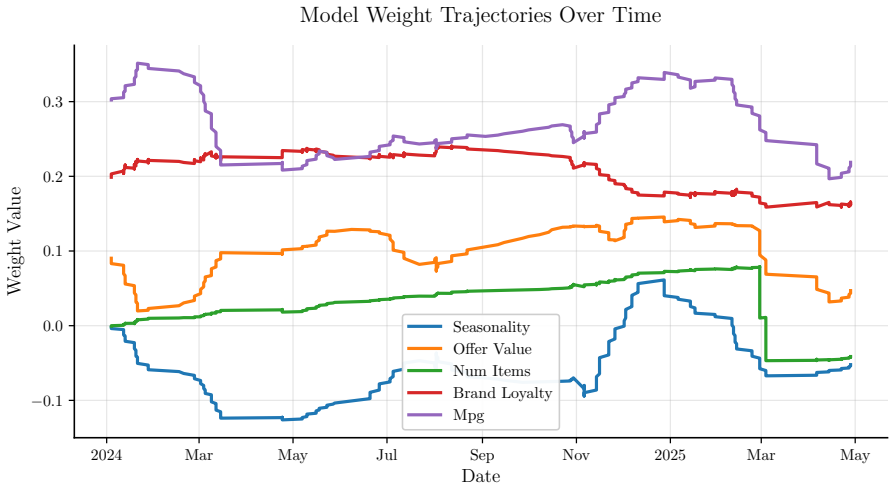
The carrying mechanism is a two-level contextual bandit whose core is a logistic-regression reward model trained with stochastic gradient descent, one model per product category, with predictions aggregated to offers and exploration via Beta-distributed randomized scoring. Per-member weight trajectories—the evolving coefficients on features like MPG (member purchase gap, i.e., time since last purchase), brand loyalty, seasonality, and offer value—are logged and made readable by an LLM, which is what turns the bandit into an interpretability device. The MPG, brand-loyalty, seasonality, and matrix-factorization scores are the predefined static features that define the context.
What would settle it
Replay the same retail transaction logs under identical features and compare the category-level logistic bandit against a per-offer logistic bandit and against LinUCB and LogisticTS, using real clip labels: if the category-level model does not achieve higher cumulative reward or optimal-action rate, the central knowledge-transfer claim fails. Separately, an LLM-generated member profile should be asked to predict the direction of the next weight update; chance-level accuracy would show the interpretability pipeline adds narrative but not predictive insight.
Extended reading notes
Core claim
The central claim is that a contextual bandit with category-level logistic regression and offer-level aggregation can improve learning efficiency and generalization in dynamic retail offer environments while keeping decisions transparent. Each category has its own logistic model that predicts the probability a member clips an offer, using static engineered features such as time since last purchase, brand loyalty, seasonality, offer value, and a matrix-factorization score. The category predictions are combined at the offer level, and exploration is injected by drawing a randomized score from a Beta distribution around the predicted probability. Because the model is logistic, the learned weights can be stored and traced per member; feeding those weight trajectories to an LLM yields user-level explanations and behavioral personas. The paper frames this two-level structure as an extension of standard CMAB methodology for multi-category contexts and as a scalable baseline suited to distributed training.
Load-bearing premise
The prototype's value rests on the assumption that a fixed, hand-picked set of features—purchase gap, brand loyalty, seasonality, offer value, and a matrix-factorization score—together with a stable, unchanging logistic relationship, is enough to predict whether a member will clip an offer.
Editorial extensions
If this is right
- If the two-level claim holds, offers can span multiple product categories and still be ranked by a single per-category set of models, which cuts the number of arms the bandit must learn separately.
- Knowledge transfer across similar offers would let the system generalize to newly introduced offers without retraining from scratch, a direct benefit for fast-changing retail catalogs.
- Transparent weight vectors would let stakeholders inspect, in real time, which features drive a given member's clipping behavior, without giving up the online learning loop.
- Because the base model is logistic regression with SGD, the approach can in principle be deployed on distributed computing infrastructures, giving a scalability story that neural or full posterior-sampling bandits do not automatically share.
- The prototype's explicit logging of weight trajectories provides a concrete, reproducible baseline against which future interpretable-bandit systems can be compared.
Reading between the lines
- A testable extension the paper leaves implicit: on the same logged transaction data, compare cumulative reward and optimal-action rate of the category-level model against a per-offer logistic bandit; if the category-level version is not better, the knowledge-transfer claim is not supported.
- The LLM interpretation step could be evaluated quantitatively by asking whether LLM-generated member profiles predict future clip behavior better than the raw weight vector alone; the paper presents example narratives but no such test.
- Weight-trajectory logs could double as a drift detector: sharp shifts in the seasonality or MPG coefficients are signals of non-stationarity, pointing to when to switch to discounted or sliding-window updates; the paper does not develop this use.
- Since the simulated reward is generated by the same logistic function the model learns, the prototype's learning dynamics may look better on synthetic replay than in real deployments; a fair test needs real clip feedback from a live or logged campaign.
Editorial analysis
A structured set of objections, weighed in public.
Referee Report
Summary. This manuscript pairs a survey of contextual multi-armed bandit (CMAB) algorithms—UCB, epsilon-greedy, Thompson sampling, and GLM/logistic bandits—with a description of a retail coupon-offer prototype. The prototype trains one logistic regression model per product category using online SGD updates, aggregates category-level predictions to the offer level, draws exploration scores from Beta distributions centered on the predicted probabilities, and exposes the resulting weight trajectories to an LLM for user-level explanations. The abstract claims that category-level modeling 'enables knowledge transfer across similar offers' and 'improves learning efficiency and generalization in dynamic environments,' and presents interpretability at scale via LLM-readable weights as a key contribution. The paper reports no quantitative experiments, no baseline comparisons, and no regret analysis; Section 6 explicitly lists benchmarking, regret analysis, and offline evaluation as future work.
Significance. If the prototype were validated, its contribution would be modest but real: per-category logistic bandits with LLM-readable weight traces are a plausible deployable design for retail offer selection, and interpretability of learned weights is a genuine practical concern. The literature review is broad and clearly organized, and Tables 1 and 2 are useful orienting summaries. The manuscript is also commendably explicit about its assumptions (stationarity, logistic reward, static features) and its limitations. These strengths do not offset the central problem: the paper makes empirical claims ('improves learning efficiency and generalization') that are supported neither by the algorithm as specified nor by any measured outcome. No code, data, or proofs are provided, and the key aggregation step is left undefined, so the described system cannot be reproduced or checked. This is a design proposal, not a validated result; as submitted, its headline claims are not supported.
major comments (4)
- [Abstract, §4, §5] The abstract's central claim—that category-level modeling 'enables knowledge transfer across similar offers' and 'improves learning efficiency and generalization'—is not realized by the algorithm as specified. Section 4 defines a separate logistic model per category with independent SGD updates (w ← w + η(y − σ(wᵀx))x), and Section 5 aggregates category predictions to offer level only through an unspecified 'weighted combination.' There is no hierarchical prior, no shared latent structure, and no similarity term linking categories; the matrix-factorization score, the only cross-offer input, is computed offline and used as a static bias term that is never updated by bandit feedback (§4). The one genuine sharing mechanism is that all offers within a category use the same category model, which is standard pooling rather than the knowledge-transfer mechanism advertised, and the paper never compares against per-offer models. Consequently, the claimed improvement in learning efficiency is not entailed by the architecture, and no evidence is given that the method outperforms simpler baselines.
- [§5, §6] The manuscript's performance claims have no experimental support. Section 6 concedes that the system has not been benchmarked against established baselines, that formal regret analysis has not been conducted, and that offline evaluation with logged bandit feedback remains future work. Yet Section 5 concludes with 'The results demonstrate the potential of the method,' and the metrics listed there (cumulative reward, regret, optimal action rate, per-round reward) never appear as a number, table, or plot anywhere in the text. Figures 1 and 2 show illustrative probability and weight traces for a single user-category pair, not performance measurements. The absence of any measured outcome leaves the abstract's improvement claim unverified; either the claims must be reduced to what the paper actually shows, or experiments must be added.
- [Abstract, §4, §6] The abstract promises improved performance 'in dynamic environments,' but Section 4 states that the implementation 'assumes a stationary environment, where reward distributions and context generation remain fixed,' and non-stationarity mechanisms such as D-LinUCB's discounted regression are deferred to future work in Section 6. In addition, the Beta-distributed exploration described in Section 4 (α = κ·p, β = κ·(1−p)) is a mean-preserving noise injection centered on the predicted probability rather than a posterior-based sampling scheme, and Section 6 acknowledges that it 'relies on heuristics without formal guarantees.' The evaluation design therefore does not match the abstract's framing, and the exploration mechanism's effect on learning is not demonstrated.
- [§5, §4, Algorithm 1] The proposed two-level mechanism is under-specified and not reproducible from the text. Section 5 says category-level predictions are combined at the offer level 'using a weighted combination that takes into account the offer's characteristics and the user's historical behavior,' but no formula for the weights is given, and Algorithm 1 does not define the combination. It is also not stated how an offer spanning multiple categories combines the corresponding category models. Similarly, Section 4 introduces the MPG, brand-loyalty, seasonality, and MF features but does not specify how the MF score is computed, what regularization (if any) is applied in the SGD updates, or how the 'backfitted on historical data' initialization works. As a result, the key innovation cannot be implemented from the manuscript alone.
minor comments (7)
- [§5] The text refers to 'the CAMB algorithm,' which is never defined; this appears to be a typo for CMAB or for the proposed prototype's name, and should be corrected.
- [§2.1, References] The sentence 'further analyzed by Chu et al. [11, 14]' misattributes reference [11] (Abbasi-Yadkori, Pál, and Szepesvári), and the regret bound O(d√T) is cited to [15] (Simchi-Levi and Xu, 2022), which concerns contextual bandits under realizability rather than the classic linear bandit setting; please re-check these attributions.
- [References [13]] The citation for the contextual-bandits Python package is incomplete; the standard attribution is D. Cortes, 'contextual_bandits,' and a version or repository identifier should be provided.
- [§5, Algorithm 1] Line 9 of Algorithm 1 says to 'Detect any significant changes in model coefficients,' but no detection criterion (threshold, statistical test, or window) is defined, and it is unclear how LLM insight generation is triggered.
- [Figures 1 and 2] The captions and surrounding text should state the data subset used (number of users, offers, categories, and rounds); without this context the traces cannot be interpreted, and no quantitative summary accompanies the plots.
- [§4] The SGD update is written without an explicit regularization term, while Section 2 repeatedly emphasizes L2 regularization in comparable systems; please clarify whether the prototype regularizes and, if so, how.
- [Abstract] The phrase 'extends standard CMAB methodology to support multi-category contexts' is vague, since standard CMAB already handles multi-dimensional contexts and multiple arms; please specify what the extension consists of.
Circularity Check
No significant circularity: the paper's central claims are unvalidated and the knowledge-transfer assertion is not entailed by the algorithm, but nothing in the derivation reduces to its own inputs.
full rationale
I walked the claimed derivation chain. The only formal model is the logistic regression update w <- w + eta(y - sigma(w^T x))x (Section 4), which is standard SGD and is not fitted to any target claim. The category-level and offer-level aggregation is described qualitatively (Section 5), so there is no equation in which a predicted quantity is defined in terms of the quantity it supposedly predicts. The MF score enters as a bias term and is not updated by bandit feedback, which undermines the abstract's 'knowledge transfer across similar offers' statement, but this is a mismatch between claim and architecture, not a circular derivation. Section 6 explicitly admits the absence of benchmarking, regret analysis, offline evaluation, and scaling tests; these are validation gaps, not circular reasoning. There are no load-bearing self-citations and no imported uniqueness theorems. The LLM-generated member profile is an illustrative interpretation of weight trajectories, not a fitted prediction used to derive the framework's claims. Therefore the paper contains no identifiable circular step.
Assumptions & free parameters
free parameters (4)
- Learning rate eta
- Positive sample boost multiplier alpha
- Exploration scaling factor kappa
- Model weight initialization
assumptions (5)
- domain assumption Reward follows a logistic model P(y=1|x;w)=sigmoid(w^T x)
- domain assumption Environment is stationary (reward distributions and context generation fixed)
- domain assumption Binary reward is a clip event
- domain assumption Hand-crafted features (MPG, brand loyalty, seasonality, offer value, MF score) are sufficient for clip prediction
- ad hoc to paper Beta-distributed randomized scoring provides valid exploration
Cite this review
Pith. "Pith review of Scalable and Interpretable Contextual Bandits: A Literature Review and Retail Offer Prototype." pith.science (2026). https://pith.science/paper/UDNEBNOB
@misc{pith2026250516918,
  author       = {Pith},
  title        = {Pith review of: Scalable and Interpretable Contextual Bandits: A Literature Review and Retail Offer Prototype},
  year         = {2026},
  howpublished = {\url{https://pith.science/paper/UDNEBNOB}},
  note         = {Machine review of arXiv:2505.16918}
}
read the original abstract
This paper presents a concise review of Contextual Multi-Armed Bandit (CMAB) methods and introduces an experimental framework for scalable, interpretable offer selection, addressing the challenge of fast-changing offers. The approach models context at the product category level, allowing offers to span multiple categories and enabling knowledge transfer across similar offers. This improves learning efficiency and generalization in dynamic environments. The framework extends standard CMAB methodology to support multi-category contexts, and achieves scalability through efficient feature engineering and modular design. Advanced features such as MPG (Member Purchase Gap) and MF (Matrix Factorization) capture nuanced user-offer interactions, with implementation in Python for practical deployment. A key contribution is interpretability at scale: logistic regression models yield transparent weight vectors, accessible via a large language model (LLM) interface for real-time, user-level tracking and explanation of evolving preferences. This enables the generation of detailed member profiles and identification of behavioral patterns, supporting personalized offer optimization and enhancing trust in automated decisions. By situating our prototype alongside established paradigms like Generalized Linear Models and Thompson Sampling, we demonstrate its value for both research and real-world CMAB applications.
Figures

Reference graph
Works this paper leans on
-
[1]
A survey on contextual multi-armed bandits
Qiufan Chen. A survey on contextual multi-armed bandits. Applied and Computational Engineering, 53:287–295, 2024
work page 2024
-
[2]
Introduction to multi-armed bandits
Aleksandrs Slivkins. Introduction to multi-armed bandits. Foundations and Trends in Machine Learning, 12(1-2):1–286, 2019
work page 2019
-
[3]
Finite-time analysis of the multiarmed bandit problem
Peter Auer, Nicol` o Cesa-Bianchi, and Paul Fischer. Finite-time analysis of the multiarmed bandit problem. Machine Learning, 47(2-3):235–256, 2002
2002
- [4]
-
[5]
Contextual bandits to increase user prediction accuracy in movie recommendation system
Yifan Chen and Lihong Li. Contextual bandits to increase user prediction accuracy in movie recommendation system. ITM Web of Conferences , 73:01018, 2025
work page 2025
-
[6]
Simulation-Based Benchmarking of Reinforcement Learning Agents for Personalized Retail Promotions
Yu Xia, Sriram Narayanamoorthy, Zhengyuan Zhou, and Joshua Mabry. Simulation-based benchmarking of reinforcement learning agents for personalized retail promotions. arXiv preprint arXiv:2405.10469, 2024
work page Pith review arXiv 2024
-
[7]
Resourceful contex- tual bandits
Ashwinkumar Badanidiyuru, John Langford, and Aleksandrs Slivkins. Resourceful contex- tual bandits. In Conference on Learning Theory (COLT) , volume 35 of JMLR Workshop and Conference Proceedings, pages 995–1018. PMLR, 2014
work page 2014
-
[8]
Contextual bandits for online markdown pricing for e-commerce
Uma Maheswari G, Srividhya Sethuraman, and Sharadha Ramanan. Contextual bandits for online markdown pricing for e-commerce. In Proceedings of the 7th Joint International Conference on Data Science & Management of Data (11th ACM IKDD CODS and 29th COMAD), CODS-COMAD ’24, pages 393–402, New York, NY, USA, 2024. Association for Computing Machinery
work page 2024
Show all 50 references
-
[9]
Bandit Algorithms
Tor Lattimore and Csaba Szepesv´ ari. Bandit Algorithms . Cambridge University Press, 2020
2020
-
[10]
Using confidence bounds for exploitation-exploration trade-offs
Peter Auer. Using confidence bounds for exploitation-exploration trade-offs. Journal of Machine Learning Research, 3:397–422, 2002
2002
-
[11]
Improved algorithms for linear stochastic bandits
Yasin Abbasi-Yadkori, D´ avid P´ al, and Csaba Szepesv´ ari. Improved algorithms for linear stochastic bandits. Advances in Neural Information Processing Systems 24 (NIPS 2011) , pages 2312–2320, 2011
2011
-
[12]
UCB algorithms for multi-armed bandits: Precise regret and adaptive inference
Qiyang Han, Koulik Khamaru, and Cun-Hui Zhang. UCB algorithms for multi-armed bandits: Precise regret and adaptive inference. arXiv preprint arXiv:2412.06126 , 2024
2024 arXiv
-
[13]
contextual-bandits: A python package for bandit algo- rithms, 2023
contextual-bandits developers. contextual-bandits: A python package for bandit algo- rithms, 2023
2023
-
[14]
Schapire
Wei Chu, Lihong Li, Lev Reyzin, and Robert E. Schapire. Contextual bandits with linear payoff functions. In Geoffrey Gordon, David Dunson, and Miroslav Dud ´ ık, editors, Pro- ceedings of the Fourteenth International Conference on Artificial Intelligence and Statis- tics (AIST...
2011
-
[15]
Bypassing the monster: A faster and simpler optimal algorithm for contextual bandits under realizability
David Simchi-Levi and Yunzong Xu. Bypassing the monster: A faster and simpler optimal algorithm for contextual bandits under realizability. Math. Oper. Res. , 47(3):1904–1931, August 2022
1904
-
[16]
Parametric ban- dits: The generalized linear case
Sylvain Filippi, Olivier Cappe, Aur´ elien Garivier, and Csaba Szepesv´ ari. Parametric ban- dits: The generalized linear case. In Advances in Neural Information Processing Systems 23 (NIPS 2010) , pages 586–594, 2010
2010
-
[17]
Neural Contextual Bandits with UCB- based Exploration
Dongruo Zhou, Quanquan Gu, and Lihong Li. Neural Contextual Bandits with UCB- based Exploration. Proceedings of the 37th International Conference on Machine Learning (ICML), pages 1239–1248, 2020
2020
-
[18]
Weighted linear bandits for non- stationary environments
Yoan Russac, Claire Vernade, and Olivier Capp´ e. Weighted linear bandits for non- stationary environments. CoRR, abs/1909.09146, 2019
1909
-
[19]
HELLINGER-UCB: A novel algo- rithm for stochastic multi-armed bandit problem and cold start problem in recommender system, 2024
Ruibo Yang, Jiazhou Wang, and Andrew Mullhaupt. HELLINGER-UCB: A novel algo- rithm for stochastic multi-armed bandit problem and cold start problem in recommender system, 2024
2024
-
[20]
Sutton and Andrew G
Richard S. Sutton and Andrew G. Barto. Reinforcement Learning: An Introduction. MIT Press, 1998
1998
-
[21]
The epoch-greedy algorithm for contextual multi-armed bandits
John Langford and Tong Zhang. The epoch-greedy algorithm for contextual multi-armed bandits. In Advances in Neural Information Processing Systems 20 (NIPS 2007) , pages 817–824, 2008
2007
-
[22]
Guarantees for epsilon-greedy reinforcement learning with function approximation
Christoph Dann, Yishay Mansour, Mehryar Mohri, Ayush Sekhari, and Karthik Sridharan. Guarantees for epsilon-greedy reinforcement learning with function approximation. 2022
2022
-
[23]
Adaptive ϵ-greedy exploration in reinforcement learning based on value differences
Michel Tokic. Adaptive ϵ-greedy exploration in reinforcement learning based on value differences. In R¨ udiger Dillmann, J¨ urgen Beyerer, Uwe D. Hanebeck, and Tanja Schultz, editors, KI 2010: Advances in Artificial Intelligence , pages 203–210, Berlin, Heidelberg,
2010
-
[24]
A tutorial on thompson sampling
Daniel Russo, Benjamin Van Roy, Abbas Kazerouni, Ian Osband, and Zheng Wen. A tutorial on thompson sampling. Foundations and Trends® in Machine Learning, 11(1):1– 96, 2018
2018
-
[25]
An empirical evaluation of thompson sampling
Olivier Chapelle and Lihong Li. An empirical evaluation of thompson sampling. InAdvances in Neural Information Processing Systems 24 (NIPS 2011) , pages 2249–2257, 2011
2011
-
[26]
Thompson sampling for contextual bandits with linear payoffs
Shipra Agrawal and Navin Goyal. Thompson sampling for contextual bandits with linear payoffs. In Sanjoy Dasgupta and David McAllester, editors, Proceedings of the 30th Inter- national Conference on Machine Learning (ICML-13) , volume 28 of JMLR Workshop and Conference Proceedi...
2013
-
[27]
Analysis of thompson sampling for the multi-armed bandit problem
Shipra Agrawal and Navin Goyal. Analysis of thompson sampling for the multi-armed bandit problem. In Conference on Learning Theory (COLT), volume 23 of JMLR Workshop and Conference Proceedings, pages 39.1–39.26. PMLR, 2012
2012
-
[28]
Thompson sampling in partially observable contextual bandits
Hongju Park and Mohamad Kazem Shirani Faradonbeh. Thompson sampling in partially observable contextual bandits. arXiv preprint arXiv:2402.10289 , 2024. 17
2024 arXiv
-
[29]
Engelhardt
Bianca Dumitrascu, Karen Feng, and Barbara E. Engelhardt. PG-TS: Improved thompson sampling for logistic contextual bandits. In Advances in Neural Information Processing Systems 31 (NeurIPS 2018) , pages 6023–6033, 2018
2018
-
[30]
Generalized thompson sampling for contextual bandits, 2013
Lihong Li. Generalized thompson sampling for contextual bandits, 2013
2013
-
[31]
Contextual bandit with herding effects: Algorithms and recommendation applications
Luyue Xu, Liming Wang, Hong Xie, and Mingqiang Zhou. Contextual bandit with herding effects: Algorithms and recommendation applications. arXiv preprint arXiv:2408.14432 , 2024
2024 arXiv
-
[32]
DISCO: An end-to-end bandit framework for personalised discount allocation
Jason Shuo Zhang, Benjamin Howson, Panayiota Savva, and Eleanor Loh. DISCO: An end-to-end bandit framework for personalised discount allocation. arXiv preprint arXiv:2406.06433, 2024
2024 arXiv
-
[33]
Online (multinomial) logistic bandit: Improved re- gret and constant computation cost
Yu-Jie Zhang and Masashi Sugiyama. Online (multinomial) logistic bandit: Improved re- gret and constant computation cost. In Advances in Neural Information Processing Systems 36 (NeurIPS 2023) , 2023
2023
-
[34]
Foster and Akshay Krishnamurthy
Dylan J. Foster and Akshay Krishnamurthy. Efficient first-order contextual bandits: Pre- diction, allocation, and triangular discrimination. In Advances in Neural Information Pro- cessing Systems 34 (NeurIPS 2021) , pages 16196–16208, 2021
2021
-
[35]
Introduction to online convex optimization
Elad Hazan. Introduction to online convex optimization. Foundations and Trends ® in Optimization, 2(3-4):157–325, 2016
2016
-
[36]
Online convex programming and generalized infinitesimal gradient as- cent
Martin Zinkevich. Online convex programming and generalized infinitesimal gradient as- cent. In Proceedings of the Twentieth International Conference on Machine Learning (ICML ’03) , pages 928–935, 2003
2003
-
[37]
Dual averaging methods for regularized stochastic learning and online optimiza- tion
Lin Xiao. Dual averaging methods for regularized stochastic learning and online optimiza- tion. Journal of Machine Learning Research , 11:2543–2596, 2010
2010
-
[38]
Online decision making with high-dimensional covari- ates
Hamsa Bastani and Mohsen Bayati. Online decision making with high-dimensional covari- ates. Operations Research, 68(1):276–294, 2020
2020
-
[39]
Foster and Alexander Rakhlin
Dylan J. Foster and Alexander Rakhlin. Beyond UCB: Optimal and Efficient Contextual Bandits with Regression Oracles. In Hal Daum´ e III and Aarti Singh, editors,Proceedings of the 37th International Conference on Machine Learning (ICML), volume 119 of Proceedings of Machine Le...
2020
-
[40]
Cecchi, and Irina Rish
Baihan Lin, Djallel Bouneffouf, Guillermo A. Cecchi, and Irina Rish. Contextual bandit with adaptive feature extraction. arXiv preprint arXiv:1802.00981 , 2018
2018 arXiv
-
[41]
Causal feature selection method for contextual multi-armed bandits in recommender system
Zhenyu Zhao and Yexi Jiang. Causal feature selection method for contextual multi-armed bandits in recommender system. arXiv preprint arXiv:2409.13888 , 2024
2024
-
[42]
Wide & deep learn- ing for recommender systems
Heng-Tze Cheng, Levent Koc, Jeremiah Harmsen, Tal Shaked, Tushar Chandra, Hrishi Aradhye, Glen Anderson, Greg Corrado, Wei Chai, Mustafa Ispir, Rohan Anil, Zakaria Haque, Lichan Hong, Vihan Jain, Xiaobing Liu, and Hemal Shah. Wide & deep learn- ing for recommender systems. In ...
2016
-
[43]
Ensemble contextual bandits for personalized recommendation
Liang Tang, Yexi Jiang, Lei Li, and Tao Li. Ensemble contextual bandits for personalized recommendation. In Proceedings of the 8th ACM Conference on Recommender Systems , RecSys ’14, page 73–80, New York, NY, USA, 2014. Association for Computing Machinery
2014
-
[44]
Constrained contextual bandit algorithm for limited-budget recommendation system
Yafei Zhao and Long Yang. Constrained contextual bandit algorithm for limited-budget recommendation system. Engineering Applications of Artificial Intelligence , 128:107558, 2024
2024
-
[45]
Portrait of an online shopper: Understanding and predicting consumer behavior
Farshad Kooti, Kristina Lerman, Luca Maria Aiello, Mihajlo Grbovic, Nemanja Djuric, and Vladan Radosavljevic. Portrait of an online shopper: Understanding and predicting consumer behavior. In Proceedings of the Ninth ACM International Conference on Web Search and Data Mining (...
2016
-
[46]
Partially observable contex- tual bandits with linear payoffs
Sihan Zeng, Sujay Bhatt, Alec Koppel, and Sumitra Ganesh. Partially observable contex- tual bandits with linear payoffs. arXiv preprint arXiv:2409.11521 , 2024
2024 arXiv
-
[47]
Linear contextual bandits with hybrid payoff: Revisited
Nirjhar Das and Gaurav Sinha. Linear contextual bandits with hybrid payoff: Revisited. arXiv preprint arXiv:2406.10131 , 2024
2024 arXiv
-
[48]
Shariff and O
R. Shariff and O. Sheffet. Differentially private contextual linear bandits. In Advances in Neural Information Processing Systems 31 (NeurIPS 2018) , pages 9809–9819, 2018
2018
-
[49]
Generalized linear bandits with local differential privacy
Yuxuan Han, Zhipeng Liang, Yang Wang, and Jiheng Zhang. Generalized linear bandits with local differential privacy. In A. Beygelzimer, Y. Dauphin, P. Liang, and J. Wortman Vaughan, editors, Advances in Neural Information Processing Systems , 2021. 19
2021
-
[2010]
Springer Berlin Heidelberg
Reviewed August 7, 2026 · model on record in the stance chip above.
Discussion (0). Sign in to comment.