REVIEW 4 major objections 5 minor 25 references
Systematic Evaluation of Machine-Generated Reasoning and PHQ-9 Labeling for Depression Detection Using Large Language Models
T0 review · 4 major / 5 minor · reviewed 2026-08-07 · deepseek-v4-flash
Pith's one-line read By breaking depression detection into eleven PHQ-9 subtasks, this paper shows LLM decisions are skewed by explicit keywords, and direct preference optimization lifts fully correct labeling on the hardest samples from 12.4% to 33.4%.
desk verdict A genuinely useful 11-subtask evaluation framework for LLM depression detection, with a plausible DPO tuning result that needs inter-annotator agreement and significance testing before the headline claim holds. read the letter →
The pith
A machine-rendered reading of the paper's core claim, the machinery that carries it, and where it could break.
The reading
What carries the argument
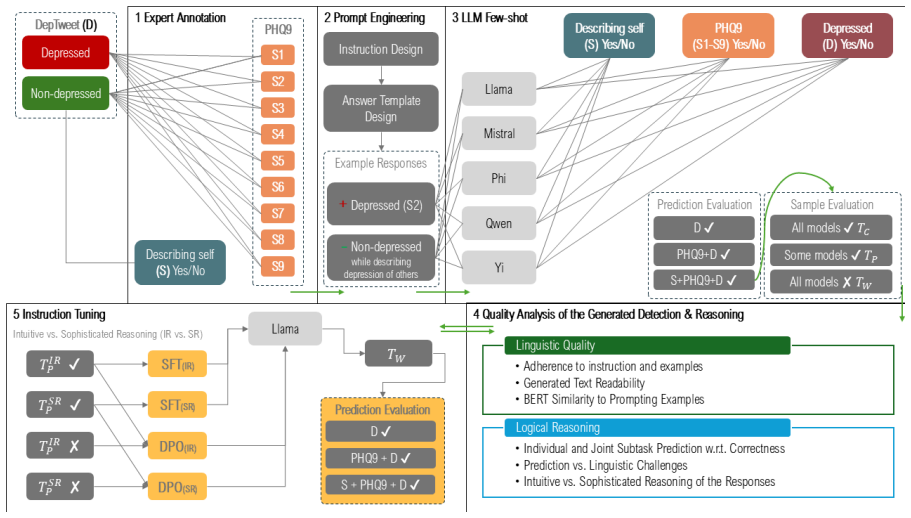
The load-bearing object is the 11-subtask decomposition of depression detection—self-reference S, nine PHQ-9 symptoms S1–S9, and final diagnosis D—which turns an opaque generation task into a checklist whose correctness can be measured as the ratio $C = N_c/N$ of fully correct label sets. Training samples are partitioned into all-correct (TC), partially correct (TP), and all-wrong (TW) collections based on unanimous agreement of the five LLMs. Preference pairs for DPO are correct and wrong responses drawn from TP, and evaluation is restricted to the hard TW set. 'Intuitive reasoning' (IR) takes the first label an LLM offers, while 'sophisticated reasoning' (SR) permits a revised second label; the DPO_SR variant, which uses the revised labels, yields the best joint correctness.
What would settle it
An independent annotation team scores the same 3,132 tweets for S and S1–S9, an inter-annotator agreement measure (e.g., Cohen's kappa) is computed, and the DPO_SR pipeline is re-run with the new labels; if the all-wrong correct ratio does not move from near 33% or the improvement over the 12.4% baseline shrinks substantially, the reported gain is partly an artifact of label noise.
Extended reading notes
Core claim
The paper's central claim is that the apparent competence of LLMs at depression detection hides a measurable, systematic weakness: high per-subtask accuracy collapses when all eleven PHQ-9-based subtask labels must be jointly correct, and the models' errors are correlated with the presence of explicit depression-related keywords. Human verification confirms that the models handle explicit depressive language better than implicit, and they exhibit a statistical bias toward 'depressed' when keywords are present and toward 'non-depressed' when they are absent. The mitigation is to use the few-shot model's own high-quality reasoning—selected by whether all subtask labels match human annotations—as preference pairs. Under the DPO objective, the joint correct ratio on the all-wrong subset rises from 12.4% to 33.4%, and false positives on keyword-mentioning samples drop, while false negatives on keyword-free samples rise. This is offered as evidence that careful qualification of machine-generated reasoning, combined with preference optimization, can improve and diagnose LLM mental-health screening.
Load-bearing premise
The human annotations of self-reference and the nine PHQ-9 symptoms are treated as ground truth in every accuracy figure and in the selection of DPO training pairs, yet no inter-annotator agreement is reported, so any noise or inconsistency in those labels propagates through the entire evaluation.
Editorial extensions
If this is right
- The correct-ratio metric makes LLM reasoning auditable in bulk: instead of reading every rationale, a system can check whether all eleven subtask labels match human annotations.
- DPO on correct-versus-wrong preference pairs from a task decomposition improves joint label accuracy more than SFT on correct responses alone, at least on the hardest samples.
- The keyword-bias result implies that LLM screening tools will miss implicit depression (higher false negatives on keyword-free posts) unless calibrated separately for keyword-mentioning and keyword-free text.
- Allowing an LLM to revise its own labels before using them as preference data (SR vs. IR) improves the DPO training signal, even when only a handful of responses differ.
- The TC/TP/TW partition provides a reusable diagnostic: a sample is 'hard' when all five LLMs get it wrong, which aligns with human-annotation groups that mix keyword-presence and depression status.
Reading between the lines
- If the DPO gain transfers to other base models and datasets, preference-based tuning on machine-generated reasoning could reduce the need for large human-annotated corpora in clinical NLP screening.
- A deployed depression screener would need decision thresholds tuned separately for MD and NMD groups, because the bias is asymmetric: tuning reduces false positives on keyword-mentioning posts at the cost of more false negatives on keyword-free posts.
- A direct test of generalizability would apply the same subtask decomposition and DPO pairing to other PHQ-based instruments or other psychiatric conditions (anxiety, PTSD) to see whether the keyword-presence bias is specific to depression language.
- The absence of inter-annotator agreement on the subtask labels is a concrete threat; an independent replication with a second annotation team and a kappa statistic would show whether the 33.4% figure is robust to annotation noise.
Editorial analysis
A structured set of objections, weighed in public.
Referee Report
Summary. The paper proposes a systematic framework for evaluating LLM reasoning in depression detection from tweets. The task is decomposed into 11 subtasks: one self-reference label (S), nine PHQ-9 symptom labels (S1–S9), and a final depression label (D). Human annotators label S and S1–S9 on 3,132 balanced tweets, and five open-source LLMs are evaluated in a few-shot setting against these labels, plus the original depression label. The authors then use quality-filtered, machine-generated responses from the partially correct set (TP) to train Llama-3.1-8B-Instruct via supervised fine-tuning (SFT) and direct preference optimization (DPO), and evaluate on the all-wrong set (TW). The central claim is that DPO improves joint subtask correctness from 12.4% (few-shot baseline) to 33.4% (DPO_SR) on TW (Table 4), and that LLMs exhibit statistical bias toward 'depression' when explicit depression keywords are present and toward 'non-depression' when such keywords are absent.
Significance. The framework is a useful decomposition of an interpretability-critical task, and the observation about keyword-driven bias in LLM depression detection is a concrete, falsifiable behavioral finding. The comparison of five open LLMs on a clinically grounded subtask set goes beyond the prior Mental-LLM evaluations and could guide future work on quality-controlled, machine-generated training data. The use of human labels to filter DPO pairs is methodologically sensible and avoids the self-referential circularity of using LLM judgments as ground truth. If the human annotation is reliable, the DPO improvement on the hardest subset is a meaningful result with potential practical value for mental-health screening. However, the paper does not provide code or release the human annotations, which limits reproducibility of the exact numbers.
major comments (4)
- [Section 3.1] The human-annotation gold standard lacks any inter-annotator agreement statistic. The text states that three psychology professionals and three graduate students annotated self-reference (S) and PHQ-9 symptoms (S1–S9), but it does not report Cohen's or Fleiss' kappa, describe adjudication of disagreements, or explain how the six annotations were aggregated into final labels. These labels are load-bearing in two ways: they determine which few-shot responses are 'correct' when forming DPO training pairs (Section 3.5), and they define the correct ratio C used to evaluate performance on TW (Table 4). Without agreement measures, the observed 12.4%→33.4% improvement could partly reflect fitting annotator idiosyncrasies rather than improving clinically meaningful joint labeling. Please report agreement statistics, describe the aggregation scheme, and ideally re-run the key experiments on a subset of samples with high annotator agreement to gauge robustness.
- [Section 4.4.2 / Table 4] The claim that 'the DPO approach achieves significant performance improvement' is not supported by significance testing. Table 4 reports a single evaluation on the TW subset (1,082 samples), with no confidence intervals, bootstrap, or tests (e.g., McNemar's test for paired accuracy). The differences between DPO and SFT (e.g., PHQ9 correct ratio 33.4% vs. 23.5%) may be real, but the paper provides no statistical evidence. Additionally, the evaluation is restricted to the all-wrong set, and the authors do not report whether the improvement generalizes to the full dataset or a held-out split. Please add uncertainty quantification or at least a clear statement about the statistical limitations, and consider reporting results on TP or a random held-out set.
- [Section 3.1 / Table 3] The origin of the depression label D is ambiguous. The human annotation described in Section 3.1 only mentions annotating S and S1–S9, not D. If D is taken directly from the original DepTweet label, then the joint correct ratio C mixes two different gold standards: human-annotated S/S1–S9 and the original binary depression label. This conflation affects both the 'correct' filtering in Section 3.5 and the performance numbers in Tables 3 and 4. Please specify explicitly whether D is human-annotated or taken from the original dataset, and discuss the implications. If D is from the original dataset, a robustness check using only the nine human-annotated subtasks would be informative.
- [Section 4.4.1] The conclusion that sophisticated reasoning (SR) 'might have more potential' than intuitive reasoning (IR) is based on a difference of only six responses in the training data. The paper states that 'six IR responses are replaced by two SR descriptions,' and the resulting difference in Table 4 (PHQ9 correct ratio 33.4% vs. 32.3%) is within the range of random fluctuation for a single run. This evidence is too thin to support the claim that SR is superior. Either temper this conclusion or design a more substantial ablation that varies the proportion of SR responses.
minor comments (5)
- [Table 2] The column headers in Table 2 are difficult to parse; the nesting of 'Depressed' and 'Non-depressed' with 'Annotation' is unclear. Please restructure the table so that each column clearly indicates the group and the annotation label, and add a note explaining what 'Yes' and 'No' refer to.
- [Section 4.3.1] The mean generation length is reported as '725 tokens' and then 'denoted as 735±135'; the two numbers conflict. Correct the typo and ensure the reported mean matches the standard deviation notation.
- [Figures 2 and 3] The acronym 'TP' is used both for 'true positive' in the figure captions and for the 'partially correct' set in Section 3.5. Use a distinct abbreviation (e.g., 'TP_set' or 'T_P') for the partially correct collection to avoid confusion.
- [Section 3.2.2] The phrase 'we develop two prompting examples that follow the defined steps' could be clarified: do these examples appear verbatim in the prompt, or are they used as templates? Please specify how they are integrated into the few-shot prompt.
- [References] Several references lack complete bibliographic details, for example, the ARXIV IDs for Xu et al. (2023), Widyasari et al. (2024), and Ivison et al. (2023) are missing. Please ensure all references follow the journal's format.
Circularity Check
No significant circularity: the DPO improvement claim is anchored to external human annotations and evaluated on a held-out hard subset.
full rationale
The paper's central claim, that DPO raises the joint PHQ-9 correct ratio from 12.4% to 33.4% on the all-wrong set TW (Table 4), is not circular. The ground-truth labels for all eleven subtasks come from human annotations by three psychology professionals and three graduate students (Section 3.1), which are external to the models and to the optimization procedure. DPO training pairs are formed from the partially correct collection TP using correct versus wrong few-shot responses (Section 3.5), where correctness is judged against those human annotations; this is a standard self-training/preference-optimization setup, not a case of the target being defined by the model's own outputs. Evaluation on TW is a held-out hard set whose samples were, by construction, not used to select DPO training pairs. The IR/SR comparison (Section 4.4.2) is a comparison of two training-data selection criteria and does not reduce to its inputs; the six-response difference is a statistical robustness concern, not circularity. The only self-citation (Wang et al., 2021) is a related-work reference on multimodal attention for Alzheimer's detection and is not load-bearing for any claim here. The paper's known weakness, namely the absence of inter-annotator agreement statistics for the Section 3.1 annotations, is a validity and reliability concern about the gold standard, not a circularity of the derivation chain. Consequently, no step in the paper's reasoning is equivalent to its inputs by construction.
Assumptions & free parameters
free parameters (1)
- annotation confidence threshold =
0.95
assumptions (4)
- domain assumption PHQ-9 symptom labels are a valid decomposition of depression detection from short social-media text.
- domain assumption The human annotations of self-reference and PHQ-9 symptoms are accurate and consistent.
- domain assumption DepTweet's expert confidence labels reliably indicate label quality.
- domain assumption Evaluating instruction tuning on the all-wrong set (TW) measures generalization to hard cases.
Cite this review
Pith. "Pith review of Systematic Evaluation of Machine-Generated Reasoning and PHQ-9 Labeling for Depression Detection Using Large Language Models." pith.science (2026). https://pith.science/paper/P57ONOTU
@misc{pith2026250517119,
  author       = {Pith},
  title        = {Pith review of: Systematic Evaluation of Machine-Generated Reasoning and PHQ-9 Labeling for Depression Detection Using Large Language Models},
  year         = {2026},
  howpublished = {\url{https://pith.science/paper/P57ONOTU}},
  note         = {Machine review of arXiv:2505.17119}
}
read the original abstract
Recent research leverages large language models (LLMs) for early mental health detection, such as depression, often optimized with machine-generated data. However, their detection may be subject to unknown weaknesses. Meanwhile, quality control has not been applied to these generated corpora besides limited human verifications. Our goal is to systematically evaluate LLM reasoning and reveal potential weaknesses. To this end, we first provide a systematic evaluation of the reasoning over machine-generated detection and interpretation. Then we use the models' reasoning abilities to explore mitigation strategies for enhanced performance. Specifically, we do the following: A. Design an LLM instruction strategy that allows for systematic analysis of the detection by breaking down the task into several subtasks. B. Design contrastive few-shot and chain-of-thought prompts by selecting typical positive and negative examples of detection reasoning. C. Perform human annotation for the subtasks identified in the first step and evaluate the performance. D. Identify human-preferred detection with desired logical reasoning from the few-shot generation and use them to explore different optimization strategies. We conducted extensive comparisons on the DepTweet dataset across the following subtasks: 1. identifying whether the speaker is describing their own depression; 2. accurately detecting the presence of PHQ-9 symptoms, and 3. finally, detecting depression. Human verification of statistical outliers shows that LLMs demonstrate greater accuracy in analyzing and detecting explicit language of depression as opposed to implicit expressions of depression. Two optimization methods are used for performance enhancement and reduction of the statistic bias: supervised fine-tuning (SFT) and direct preference optimization (DPO). Notably, the DPO approach achieves significant performance improvement.
Figures


Figures from the paper (1 more)

Reference graph
Works this paper leans on
-
[1]
Ana Antunes, Joana Campos, Manuel Guimar \ a es, Jo \ a o Dias, and Pedro A Santos. 2023. Prompting for socially intelligent agents with chatgpt. In Proceedings of the 23rd ACM International Conference on Intelligent Virtual Agents, pages 1--9
work page 2023
-
[2]
Zhuang Chen, Jiawen Deng, Jinfeng Zhou, Jincenzi Wu, Tieyun Qian, and Minlie Huang. 2024. Depression detection in clinical interviews with llm-empowered structural element graph. In Proceedings of the 2024 Conference of the North American Chapter of the Association for Computational Linguistics: Human Language Technologies (Volume 1: Long Papers), pages 8...
work page 2024
-
[3]
Davide Chicco and Giuseppe Jurman. 2020. The advantages of the matthews correlation coefficient (mcc) over f1 score and accuracy in binary classification evaluation. BMC genomics, 21:1--13
2020
-
[4]
Zheng Chu, Jingchang Chen, Qianglong Chen, Weijiang Yu, Tao He, Haotian Wang, Weihua Peng, Ming Liu, Bing Qin, and Ting Liu. 2023. A survey of chain of thought reasoning: Advances, frontiers and future. arXiv preprint arXiv:2309.15402
arXiv 2023
-
[5]
Munmun De Choudhury, Michael Gamon, Scott Counts, and Eric Horvitz. 2013. Predicting depression via social media. In Proceedings of the international AAAI conference on web and social media, volume 7, pages 128--137
work page 2013
-
[6]
somewhere along your pedigree, a bitch got over the wall!
Kristina S Despot, Ana Ostro s ki Ani \'c , and Tony Veale. 2023. “somewhere along your pedigree, a bitch got over the wall!” a proposal of implicitly offensive language typology. Lodz Papers in Pragmatics, 19(2):385--414
work page 2023
-
[7]
Larry S Goldman, Nancy H Nielsen, Hunter C Champion, and American Medical Association Council on Scientific Affairs. 1999. Awareness, diagnosis, and treatment of depression. Journal of general internal medicine, 14(9):569--580
work page 1999
-
[8]
Keith Harrigian, Carlos Aguirre, and Mark Dredze. 2020. Do models of mental health based on social media data generalize? In Findings of the association for computational linguistics: EMNLP 2020, pages 3774--3788
work page 2020
Show all 25 references
-
[9]
Hamish Ivison, Yizhong Wang, Valentina Pyatkin, Nathan Lambert, Matthew Peters, Pradeep Dasigi, Joel Jang, David Wadden, Noah A Smith, Iz Beltagy, and 1 others. 2023. Camels in a changing climate: Enhancing lm adaptation with tulu 2. arXiv preprint arXiv:2311.10702
2023 arXiv
-
[10]
Ganesh Jawahar, Beno \^ t Sagot, and Djam \'e Seddah. 2019. What does bert learn about the structure of language? In ACL 2019-57th Annual Meeting of the Association for Computational Linguistics
2019
-
[11]
Mohsinul Kabir, Tasnim Ahmed, Md Bakhtiar Hasan, Md Tahmid Rahman Laskar, Tarun Kumar Joarder, Hasan Mahmud, and Kamrul Hasan. 2023. Deptweet: A typology for social media texts to detect depression severities. Computers in Human Behavior, 139:107503
2023
-
[12]
Kurt Kroenke, Robert L Spitzer, and Janet BW Williams. 2001. The phq-9: validity of a brief depression severity measure. Journal of general internal medicine, 16(9):606--613
2001
-
[13]
Sihua Lyu, Xiaopeng Ren, Yihua Du, and Nan Zhao. 2023. Detecting depression of chinese microblog users via text analysis: Combining linguistic inquiry word count (liwc) with culture and suicide related lexicons. Frontiers in psychiatry, 14:1121583
2023
-
[14]
Rafael Rafailov, Archit Sharma, Eric Mitchell, Christopher D Manning, Stefano Ermon, and Chelsea Finn. 2024. Direct preference optimization: Your language model is secretly a reward model. Advances in Neural Information Processing Systems, 36
2024
-
[15]
Thomas Savage, Ashwin Nayak, Robert Gallo, Ekanath Rangan, and Jonathan H Chen. 2024. Diagnostic reasoning prompts reveal the potential for large language model interpretability in medicine. NPJ Digital Medicine, 7(1):20
2024
-
[16]
Edgar A Smith and RJ Senter. 1967. Automated readability index, volume 66. Aerospace Medical Research Laboratories, Aerospace Medical Division, Air …
1967
-
[17]
Ashish Vaswani, Noam Shazeer, Niki Parmar, Jakob Uszkoreit, Llion Jones, Aidan N Gomez, ukasz Kaiser, and Illia Polosukhin. 2017. Attention is all you need. Advances in neural information processing systems, 30
2017
-
[18]
Ning Wang, Yupeng Cao, Shuai Hao, Zongru Shao, and KP Subbalakshmi. 2021. Modular multi-modal attention network for alzheimer's disease detection using patient audio and language data. In Interspeech, pages 3835--3839
2021
-
[19]
Yubo Wang, Xueguang Ma, Ge Zhang, Yuansheng Ni, Abhranil Chandra, Shiguang Guo, Weiming Ren, Aaran Arulraj, Xuan He, Ziyan Jiang, and 1 others. 2024. Mmlu-pro: A more robust and challenging multi-task language understanding benchmark. arXiv preprint arXiv:2406.01574
2024 arXiv
-
[20]
Ratnadira Widyasari, David Lo, and Lizi Liao. 2024. Beyond chatgpt: Enhancing software quality assurance tasks with diverse llms and validation techniques. arXiv preprint arXiv:2409.01001
2024 arXiv
-
[21]
Xuhai Xu, Bingshen Yao, Yuanzhe Dong, Hong Yu, James Hendler, Anind K Dey, and Dakuo Wang. 2023. Leveraging large language models for mental health prediction via online text data. arXiv preprint arXiv:2307.14385
2023 arXiv
-
[22]
Kailai Yang, Tianlin Zhang, Ziyan Kuang, Qianqian Xie, and Sophia Ananiadou. 2023. Mentalllama: Interpretable mental health analysis on social media with large language models. arXiv preprint arXiv:2309.13567
2023 arXiv
-
[23]
Hamad Zogan, Imran Razzak, Shoaib Jameel, and Guandong Xu. 2023. Hierarchical convolutional attention network for depression detection on social media and its impact during pandemic. IEEE Journal of Biomedical and Health Informatics
2023
-
[24]
online" 'onlinestring :=
ENTRY address archivePrefix author booktitle chapter edition editor eid eprint eprinttype howpublished institution journal key month note number organization pages publisher school series title type volume year doi pubmed url lastchecked label extra.label sort.label short.list...
-
[25]
write newline
" write newline "" before.all 'output.state := FUNCTION n.dashify 't := "" t empty not t #1 #1 substring "-" = t #1 #2 substring "--" = not "--" * t #2 global.max substring 't := t #1 #1 substring "-" = "-" * t #2 global.max substring 't := while if t #1 #1 substring * t #2 gl...
Reviewed August 7, 2026 · model on record in the stance chip above.
Discussion (0). Sign in to comment.