REVIEW 5 major objections 8 minor 37 references
MetaSTH-Sleep: Towards Effective Few-Shot Sleep Stage Classification for Health Management with Spatial-Temporal Hypergraph Enhanced Meta-Learning
T0 review · 5 major / 8 minor · reviewed 2026-08-07 · deepseek-v4-flash
Pith's one-line read A few-shot sleep stage classifier with a spatial-temporal hypergraph inside MAML reports accuracies of 0.8052 on ISRUC and 0.7150 on UCD, beating six baselines and every baseline on every ISRUC subject.
desk verdict Plausible combination of hypergraph learning and MAML for few-shot sleep staging, but the evaluation's overlapping time windows undermine the central claim. read the letter →
The pith
A machine-rendered reading of the paper's core claim, the machinery that carries it, and where it could break.
The reading
What carries the argument
The load-bearing object is the dynamic spatial-temporal hypergraph constructed at every time step. A hyperedge can connect several nodes at once, so it encodes interactions among more than two EEG channels simultaneously, unlike a graph edge. Each master node selects candidate nodes for its spatial and temporal hyperedges by minimizing a reconstruction error; selected memberships form a sparse incidence matrix. Hyperedge embeddings are the average of member node embeddings, and a multi-head attention mechanism computes adaptive weights for a node's spatial and temporal hyperedges before an MLP produces the final node embedding. The whole learner, including hyperedge construction and attention, is meta-optimized with MAML, so a few inner-loop steps adapt the entire structure to a new subject.
What would settle it
Re-run the leave-one-subject-out protocol on both datasets with at least fifty random support/query splits and per-subject confidence intervals; if the accuracy gap over the strongest baseline falls inside the noise band, the claimed advantage is not established. As a second check, shuffle the EEG channel identities inside each hyperedge during training; if accuracy is unchanged, the hypergraph is memorizing random channel subsets instead of spatial structure.
Extended reading notes
Core claim
The central claim is that a spatial-temporal hypergraph can serve as the base learner inside MAML and deliver cross-subject few-shot sleep staging. At each time step the model treats channel-feature vectors at two adjacent instants $t-1$ and $t$ as nodes, builds spatial hyperedges connecting several channels within the same instant and temporal hyperedges connecting channels across the two instants, and learns node memberships by minimizing a reconstruction error. Hyperedge embeddings are pooled from member embeddings, then adaptively weighted per node by multi-head attention; the graph-level embedding is the mean of node embeddings. Meta-training over subjects yields an initialization that, after a few gradient steps on $K$ labeled epochs from an unseen subject, reaches 0.8052 accuracy on ISRUC and 0.7150 on UCD. This beats Random Forest, LSTM, CNN, GAT, vanilla MAML, and the CNN-based MetaSleepLearner, and it wins on all ten ISRUC subjects individually; ablations attribute roughly 3-4 accuracy points to the hypergraph construction and more than 16 points on ISRUC to multi-head attention.
Load-bearing premise
The load-bearing premise is that five random draws of the few labeled examples per subject, with no reported error bars, are stable enough to make the 2.5 to 3 point accuracy gains over the strongest baseline real rather than a product of subject- or channel-selection luck.
Editorial extensions
If this is right
- With only ten labeled samples per class for adaptation, the model reaches 0.8052 accuracy on ISRUC, so a short labeled excerpt from a new subject may suffice for automated staging support.
- Per-class F1 gains are largest for N1 (0.5803) and REM (0.8087) on ISRUC, the stages clinicians often find hardest to score.
- In subject-wise evaluation on all ten ISRUC subjects the model is never beaten by any baseline, indicating the adaptation generalizes beyond a single recording or subject.
- Ablations remove about 3-4 accuracy points when hypergraph construction is replaced by pairwise connections and more than 16 points on ISRUC when multi-head attention is removed, so both components carry the reported performance.
Reading between the lines
- The paper leaves untested whether temporal hyperedges spanning more than two adjacent instants would improve staging, since the current construction only links $t-1$ and $t$.
- No error bars are reported, so a replication computing per-subject confidence intervals over many splits is the natural next check; the 2.5-3 point margin over the strongest baseline is only meaningful if it exceeds that noise.
- If the learned hyperedge memberships are physiologically meaningful, the incidence matrices could be read as per-subject markers; the paper does not analyze them but they may carry clinical information beyond labels.
Editorial analysis
A structured set of objections, weighed in public.
Referee Report
Summary. The paper proposes MetaSTH-Sleep, a few-shot sleep stage classification framework that integrates a spatial-temporal hypergraph into the MAML meta-learning paradigm. The model dynamically constructs spatial and temporal hyperedges via a reconstruction-based mechanism, updates node embeddings with multi-head attention, and is trained with a meta-objective that combines cross-entropy and reconstruction losses. The authors report superior overall accuracy and per-class F1 scores on the ISRUC and UCD datasets relative to six baselines, along with subject-wise robustness, sensitivity analyses, and ablations.
Significance. If the reported results are reliable, the paper presents a plausible and potentially useful architectural combination: higher-order spatial-temporal modeling via hypergraphs within a meta-learning loop, applied to the clinically relevant problem of few-shot sleep stage classification. The manuscript includes a complete algorithm description, complexity analysis, and sensitivity studies, which aid reproducibility. However, the current evaluation has several load-bearing weaknesses: no error bars or significance tests, no comparison with the closest existing hypergraph baseline, a potential temporal leakage in support/query construction, and apparent test-set hyperparameter selection. These issues prevent the central empirical claim from being fully established.
major comments (5)
- [Section 4.2 and Fig. 8] The experimental setting states that for ISRUC, K=10 samples per class are used, constructing a 5-way 10-shot problem, yet Fig. 8 reports the best performance at 5-shot (accuracy 0.8136, F1 0.8052), and Table 2 reports overall accuracy 0.8052, which matches the F1 value at 5-shot. This inconsistency suggests that the main results in Table 2 may actually be for 5-shot rather than 10-shot. Please clarify which setting produced Table 2 and correct the text in Section 4.2 accordingly, since the central reported numbers depend on this choice.
- [Section 4.2 and Section 3] The input is defined as a two-step window X_{t-1:t} = {X_{t-1}, X_t}, and support and query sets are randomly sampled from the same subject's recording without any temporal exclusion radius. Consequently, a query sample at time t shares the raw frame X_{t-1} with a support sample at time t-1, and because sleep stages are strongly autocorrelated across adjacent epochs, query labels can be inferred from temporally adjacent support labels rather than from learned hypergraph meta-knowledge. This potential temporal leakage could inflate the reported few-shot adaptation performance and undermine the claim of generalization to new subjects. Please specify a temporal split (e.g., an exclusion radius or a chronological split) and re-run the experiments under that protocol.
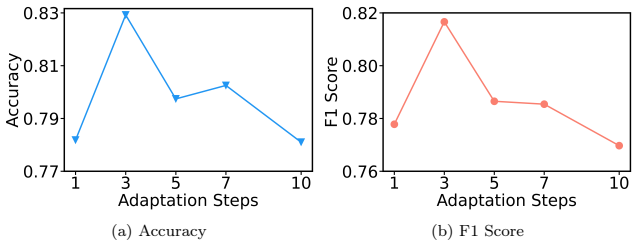
- [Section 4.4 (RQ4, Figs. 6-8)] The number of adaptation steps (3) and the support set size (5-shot) appear to be selected based on the sensitivity curves shown in Figs. 6-8. If these curves are computed on the meta-test subjects, the reported results are optimistically biased because the test set is used for model selection. Please select hyperparameters on a held-out validation subject (or an inner validation set) and then report performance on the test subjects with the chosen configuration, or explicitly state that the sensitivity analysis is conducted on a validation set.
- [Sections 2.3 and 4.3] The paper never compares against the spatial-temporal hypergraph method in reference [2], which is the closest existing approach to the proposed architecture. Since the paper's novelty claim rests on integrating a spatial-temporal hypergraph into meta-learning, a comparison against [2] (and ideally against [2] combined with meta-learning) is necessary to isolate the source of improvement. Please add this baseline and discuss the outcome, as the absence of this comparison leaves the incremental contribution unclear.
- [Section 4.2 and Tables 2-3] The results are reported as averages over five runs, but no standard deviations, confidence intervals, or significance tests are provided. Given that the margin over MSL is only 2.5-3 percentage points, the reader cannot determine whether the differences are statistically reliable or within run-to-run noise. Please report per-run variance and, where appropriate, paired statistical tests across subjects.
minor comments (8)
- [Sections 3.1 and 3.2.3] The symbol α is used both for the inner-loop learning rate in Eq. (1) and for the reconstruction loss weight in Eq. (10). Please use a distinct symbol (e.g., λ) for the loss weight to avoid confusion.
- [Section 3.2] The candidate node set in the reconstruction-based hyperedge construction (Eq. 4) is not defined. Please specify whether, for a spatial hyperedge, the candidate set includes all nodes at the same time step, and for a temporal hyperedge, all nodes at the adjacent time step.
- [Section 3.2] The text states that nodes with p_i > 0 are selected into the hyperedge, but no non-negativity constraint on the reconstruction coefficients p is described. If p is unconstrained, a negative coefficient would make the selection rule arbitrary; if a constraint is applied (e.g., softmax, ReLU, or a projected gradient), please describe it explicitly.
- [Section 3.2.2] The value embeddings V_spa and V_tem in Eq. (8) are not defined. Please provide the definitions (e.g., V_h = X W_V) so that the multi-head attention mechanism is fully specified.
- [Section 4.2] Please clarify what exactly is averaged over the five independent runs: whether the support/query sampling is re-drawn in each run and whether the reported numbers are the mean over runs for the same fixed test subjects.
- [Section 4.1 and Table 1] Please specify the sampling rate, number of EEG channels, and the number of epochs per subject for both ISRUC and UCD, as these details are essential for reproducing the few-shot setting and interpreting the results.
- [Abstract and Section 1] The introduction and abstract repeatedly emphasize multimodal physiological signals, but the methodology and experiments appear to use only EEG channels. Please clarify whether EOG, EMG, or other modalities were used in the experiments, and if not, temper the multimodal claims accordingly.
- [Throughout] There are several typos and grammatical issues, including "real-word datasets" (Section 4), "achieveing" (Section 4.4), "in contract" (Section 4.4), and capitalized "The framework" in the Conclusion. A careful proofreading pass is recommended.
Circularity Check
No material circularity: the empirical claims are self-contained and benchmarked against external baselines.
full rationale
The paper's central contribution is an empirical few-shot sleep-stage classifier combining a MAML meta-learner with a spatial-temporal hypergraph learner. The derivation is not circular: the model is trained on support sets and evaluated on query sets from left-out subjects (Section 4.2), and the reported accuracy gains in Tables 2 and 3 are measured against six external baselines, not reconstructed from a fitted parameter. The hypergraph reconstruction and attention mechanisms (Eqs. 4-11) are part of the learned model, not definitions of the target metric. Self-citations exist (references [2], [4], [11], [30], and [33] share authors with this paper), but none is load-bearing for the main claim: [2] is used only for ISRUC Subgroup 3 selection and complexity comparison, [4] and [30] provide general spatial-temporal and federated learning context, and [11] and [33] are related meta-learning works. The main accuracy claim is falsifiable against independent baselines and dataset labels. No equation reduces a stated prediction to its input by construction, and no fitted quantity is relabeled as a prediction. Thus there is no material circularity; any concerns about support/query temporal overlap or small-sample variance are methodological validity issues, not circularity.
Assumptions & free parameters
free parameters (7)
- inner-loop learning rate alpha =
0.001
- meta learning rate beta =
0.0005
- number of adaptation steps =
3
- support set size K =
10 for main results; 5 claimed best in RQ4
- tasks per meta-batch B =
3
- reconstruction loss weight alpha (Eq. 10) =
not stated
- hypergraph dimensions (d', d_a, heads) =
not reported
assumptions (5)
- domain assumption Each EEG channel can be treated as a node and hyperedges can capture meaningful spatial-temporal co-activation.
- domain assumption A pair of adjacent time steps (t-1, t) is enough temporal context.
- ad hoc to paper Reconstruction error with learnable coefficients p yields a hyperedge set that is stable and interpretable.
- domain assumption Meta-learning objectives with first-order MAML and small B=3 tasks converge to a generalizable initialization.
- standard math Standard math: gradient-based optimization of MAML and hypergraph aggregation.
Cite this review
Pith. "Pith review of MetaSTH-Sleep: Towards Effective Few-Shot Sleep Stage Classification for Health Management with Spatial-Temporal Hypergraph Enhanced Meta-Learning." pith.science (2026). https://pith.science/paper/4RPM6VDA
@misc{pith2026250517142,
  author       = {Pith},
  title        = {Pith review of: MetaSTH-Sleep: Towards Effective Few-Shot Sleep Stage Classification for Health Management with Spatial-Temporal Hypergraph Enhanced Meta-Learning},
  year         = {2026},
  howpublished = {\url{https://pith.science/paper/4RPM6VDA}},
  note         = {Machine review of arXiv:2505.17142}
}
read the original abstract
Accurate classification of sleep stages based on bio-signals is fundamental not only for automatic sleep stage annotation, but also for clinical health management and continuous sleep monitoring. Traditionally, this task relies on experienced clinicians to manually annotate data, a process that is both time-consuming and labor-intensive. In recent years, deep learning methods have shown promise in automating this task. However, three major challenges remain: (1) deep learning models typically require large-scale labeled datasets, making them less effective in real-world settings where annotated data is limited; (2) significant inter-individual variability in bio-signals often results in inconsistent model performance when applied to new subjects, limiting generalization; and (3) existing approaches often overlook the high-order relationships among bio-signals, failing to simultaneously capture signal heterogeneity and spatial-temporal dependencies. To address these issues, we propose MetaSTH-Sleep, a few-shot sleep stage classification framework based on spatial-temporal hypergraph enhanced meta-learning. Our approach enables rapid adaptation to new subjects using only a few labeled samples, while the hypergraph structure effectively models complex spatial interconnections and temporal dynamics simultaneously in EEG signals. Experimental results demonstrate that MetaSTH-Sleep achieves substantial performance improvements across diverse subjects, offering valuable insights to support clinicians in sleep stage annotation.
Figures


Figures from the paper (5 more)




Reference graph
Works this paper leans on
-
[2]
Y.Liu, Z.Zhao, T.Zhang, K.Wang, X.Chen, X.Huang, J.Yin, Z.Shen, Exploiting spatial-temporal data for sleep stage classification via hyper- graph learning, in: Proceedings of the IEEE International Conference on Acoustics, Speech and Signal Processing (ICASSP), 2024, pp. 5430– 5434
work page 2024
-
[1]
R. Boostani, F. Karimzadeh, M. Nami, A comparative review on sleep stage classification methods in patients and healthy individuals, Com- puter Methods and Programs in Biomedicine 140 (2017) 77–91
work page 2017
-
[3]
P. C. Ivanov, J. W. Wang, X. Zhang, Signal processing in network physi- ology: Quantifying network dynamics of organ interactions, in: Proceed- ings of the 28th European Signal Processing Conference (EUSIPCO), IEEE, 2021, pp. 945–949
work page 2021
- [4]
-
[5]
L. Fiorillo, A. Puiatti, M. Papandrea, P.-L. Ratti, P. Favaro, C. Roth, P. Bargiotas, C. L. Bassetti, F. D. Faraci, Automated sleep scoring: A review of the latest approaches, Sleep Medicine Reviews 48 (2019) 101204
work page 2019
-
[6]
Z. Jia, Y. Lin, J. Wang, R. Zhou, X. Ning, Y. He, Y. Zhao, Graph- sleepnet: Adaptive spatial-temporal graph convolutional networks for sleep stage classification, in: Proceedings of the 29th International Joint Conference on Artificial Intelligence (IJCAI), 2020, pp. 1324–1330
work page 2020
-
[7]
L. Feng, C. Cheng, M. Zhao, H. Deng, Y. Zhang, Eeg-based emotion recognition using spatial-temporal graph convolutional lstm with atten- tion mechanism, IEEE Journal of Biomedical and Health Informatics 26 (11) (2022) 5406–5417
work page 2022
- [8]
Show all 37 references
-
[9]
Eldele, M
E. Eldele, M. Ragab, Z. Chen, M. Wu, C.-K. Kwoh, X. Li, Self- supervised learning for label-efficient sleep stage classification: A com- prehensive evaluation, IEEE Transactions on Neural Systems and Re- habilitation Engineering 31 (2023) 1333–1342
2023
-
[10]
Banluesombatkul, P
N. Banluesombatkul, P. Ouppaphan, P. Leelaarporn, P. Lakhan, B. Chaitusaney, N. Jaimchariyatam, E. Chuangsuwanich, W. Chen, H. Phan, N. Dilokthanakul, et al., Metasleeplearner: A pilot study on fast adaptation of bio-signals-based sleep stage classifier to new individ- ual sub...
2020
-
[11]
J. Wang, J. Jin, T. Zhang, B. X. Chai, A. Di Pietro, D. Georgakopoulos, Leveraging auxiliary task relevance for enhanced bearing fault diagno- sis through curriculum meta-learning, arXiv preprint arXiv:2410.20351 (2024)
2024 arXiv
-
[12]
Z. Jia, Y. Lin, J. Wang, X. Ning, Y. He, R. Zhou, Y. Zhou, L.-w. H. Lehman, Multi-viewspatial-temporalgraphconvolutionalnetworkswith domain generalization for sleep stage classification, IEEE Transactions on Neural Systems and Rehabilitation Engineering 29 (2021) 1977–1986
2021
-
[13]
Zhang, Y
J. Zhang, Y. Wu, A new method for automatic sleep stage classification, IEEE Transactions on Biomedical Circuits and Systems 11 (5) (2017) 1097–1110
2017
-
[14]
Huang, W
B. Huang, W. Chen, C.-L. Lin, C.-F. Juang, J. Wang, Mlp-bp: A novel framework for cuffless blood pressure measurement with ppg and ecg sig- nals based on mlp-mixer neural networks, Biomedical Signal Processing and Control 73 (2022) 103404
2022
-
[15]
X. Shi, Z. Chen, H. Wang, D. Y. Yeung, W. K. Wong, W. C. Woo, Convolutional lstm network: A machine learning approach for precip- itation nowcasting, in: Proceedings of the 28th Conference on Neural Information Processing Systems (NeurIPS), 2015, pp. 802–810
2015
-
[16]
Zheng, F
H. Zheng, F. Lin, X. Feng, Y. Chen, A hybrid deep learning model with attention-based conv-lstm networks for short-term traffic flow predic- tion, IEEE Transactions on Intelligent Transportation Systems 22 (12) (2020) 6910–6920. 25
2020
-
[17]
Ienco, R
D. Ienco, R. Interdonato, Deep multivariate time series embedding clus- tering via attentive-gated autoencoder, in: Proceedings of the 24th Pacific-Asia Conference on Knowledge Discovery and Data Mining (PAKDD), 2020, pp. 318–329
2020
-
[18]
C. Sun, C. Chen, W. Li, J. Fan, W. Chen, A hierarchical neural network forsleepstageclassificationbasedoncomprehensivefeaturelearningand multi-flow sequence learning, IEEE Journal of Biomedical and Health Informatics 24 (5) (2019) 1351–1366
2019
-
[19]
Supratak, H
A. Supratak, H. Dong, C. Wu, Y. Guo, Deepsleepnet: A model for automatic sleep stage scoring based on raw single-channel eeg, IEEE Transactions on Neural Systems and Rehabilitation Engineering 25 (11) (2017) 1998–2008
2017
-
[20]
Z. Wu, S. Pan, F. Chen, G. Long, C. Zhang, S. Y. Philip, A compre- hensive survey on graph neural networks, IEEE Transactions on Neural Networks and Learning Systems 32 (1) (2020) 4–24
2020
-
[21]
A. Jain, A. R. Zamir, S. Savarese, A. Saxena, Structural-rnn: Deep learning on spatio-temporal graphs, in: Proceedings of the IEEE Con- ference on Computer Vision and Pattern Recognition (CVPR), 2016, pp. 5308–5317
2016
-
[22]
B. Yu, H. Yin, Z. Zhu, Spatio-temporal graph convolutional net- works: A deep learning framework for traffic forecasting, arXiv preprint arXiv:1709.04875 (2017)
2017 arXiv
-
[23]
Y. Seo, M. Defferrard, P. Vandergheynst, X. Bresson, Structured se- quence modeling with graph convolutional recurrent networks, in: Pro- ceedings of the 2018 International Conference on Neural Information Processing (ICONIP), 2018, pp. 362–373
2018
-
[24]
S. Yan, Y. Xiong, D. Lin, Spatial temporal graph convolutional networks for skeleton-based action recognition, in: Proceedings of the Thirty- Second AAAI Conference on Artificial Intelligence (AAAI), 2018, pp. 7444–7452
2018
-
[25]
C. Finn, P. Abbeel, S. Levine, Model-agnostic meta-learning for fast adaptation of deep networks, in: Proceedings of the 34th International Conference on Machine Learning (ICML), 2017, pp. 1126–1135. 26
2017
-
[26]
J. Wang, L. Zhang, Z. Sun, Y.-S. Ong, Meta-learning enhanced next poi recommendation by leveraging check-ins from auxiliary cities, in: Proceedingsofthe27thPacific-AsiaConferenceonKnowledgeDiscovery and Data Mining (PAKDD), Springer, 2023, pp. 322–334
2023
-
[27]
S. Moon, T. S. Kim, J. Ryu, W. H. Lee, Federated learning for sleep stage classification on edge devices via a model-agnostic meta-learning- based pre-trained model, in: Proceedings of the 2023 IEEE 13th In- ternational Conference on Consumer Electronics-Berlin (ICCE-Berlin), ...
2023
-
[28]
Lemkhenter, P
A. Lemkhenter, P. Favaro, Towards sleep scoring generalization through self-supervised meta-learning, in: Proceedings of the 2022 44th Annual InternationalConferenceofEngineeringinMedicineandBiologySociety (EMBC), 2022, pp. 2961–2966
2022
-
[29]
S.An, S.Kim, P.Chikontwe, S.H.Park, Dualattentionrelationnetwork with fine-tuning for few-shot eeg motor imagery classification, IEEE Transactions on Neural Networks and Learning Systems (2023)
2023
-
[30]
G. Lou, Y. Liu, T. Zhang, X. Zheng, Stfl: A temporal-spatial fed- erated learning framework for graph neural networks, arXiv preprint arXiv:2111.06750 (2021)
2021 arXiv
-
[31]
Khalighi, T
S. Khalighi, T. Sousa, J. M. Santos, U. Nunes, Isruc-sleep: A com- prehensive public dataset for sleep researchers, Computer Methods and Programs in Biomedicine 124 (2016) 180–192
2016
-
[32]
A. L. Goldberger, L. A. Amaral, L. Glass, J. M. Hausdorff, P. C. Ivanov, R. G. Mark, J. E. Mietus, G. B. Moody, C.-K. Peng, H. E. Stanley, Phys- iobank, physiotoolkit, and physionet: Components of a new research resource for complex physiologic signals, Circulation 101 (23) (2...
2000
-
[33]
J. Wang, T. Zhang, L. Zhang, Y. Bai, X. Li, J. Jin, Hyperman: Hypergraph-enhanced meta-learning adaptive network for next poi rec- ommendation, arXiv preprint arXiv:2503.22049 (2025)
2025 arXiv
-
[34]
Huang, B
W. Huang, B. Guo, Y. Shen, X. Tang, T. Zhang, D. Li, Z. Jiang, Sleep staging algorithm based on multichannel data adding and multifeature 27 screening, Computer Methods and Programs in Biomedicine 187 (2020) 105253
2020
-
[35]
Zhuang, M
L. Zhuang, M. Dai, Y. Zhou, L. Sun, Intelligent automatic sleep staging model based on cnn and lstm, Frontiers in Public Health 10 (2022) 946833
2022
-
[36]
H. Phan, F. Andreotti, N. Cooray, O. Y. Chén, M. De Vos, Joint clas- sification and prediction cnn framework for automatic sleep stage clas- sification, IEEE Transactions on Biomedical Engineering 66 (5) (2018) 1285–1296
2018
-
[37]
Demir, T
A. Demir, T. Koike-Akino, Y. Wang, D. Erdoğmuş, Eeg-gat: Graph attention networks for classification of electroencephalogram (eeg) sig- nals, in: Proceedings of the 44th Annual International Conference of Engineering in Medicine and Biology Society (EMBC), 2022, pp. 30–35. 28
2022
Reviewed August 7, 2026 · model on record in the stance chip above.
Discussion (0). Continue with ORCID to comment.