REVIEW 4 major objections 6 minor 60 references
A high-resolution molecular spin-photon interface at telecommunications wavelengths
T0 review · 4 major / 6 minor · reviewed 2026-08-07 · deepseek-v4-flash
Pith's one-line read An erbium molecular crystal gives a telecom-wavelength spin-photon interface, with optical readout that distinguishes spin states and magnetically inequivalent sites.
desk verdict A genuinely new molecular spin-photon interface at telecom wavelengths, with a solid central result and one soft spot: the sub-Kelvin optical spin-pumping claim needs an independent spin-population check. read the letter →
The pith
A machine-rendered reading of the paper's core claim, the machinery that carries it, and where it could break.
The reading
What carries the argument
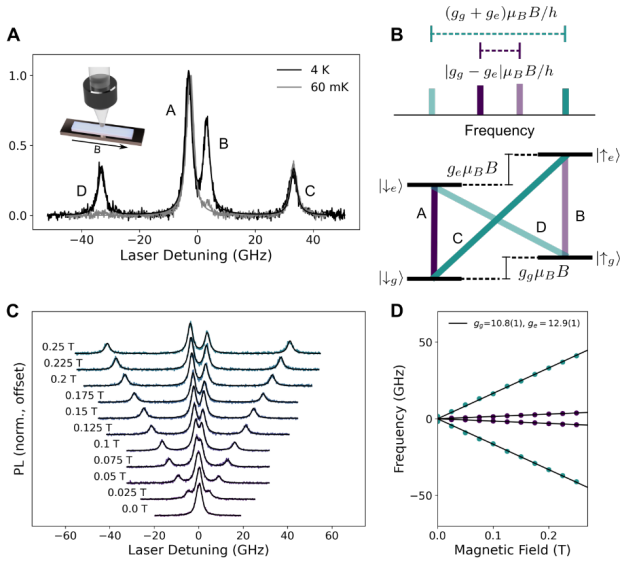
The load-bearing object is the erbium 4f spin-optical level structure within a low-symmetry molecular crystal. Optical transitions near 1.5 µm connect a $J=15/2$ ground manifold to a $J=13/2$ excited manifold, with crystal-field splitting isolating the lowest two levels of each manifold; an applied field Zeeman-splits these into an effective spin-1/2 pair, and a difference in effective g-factors between ground and excited states produces four resolvable optical transitions with splittings $|g_e-g_g|\mu_B B/h$ and $|g_e+g_g|\mu_B B/h$. This level structure, together with MHz-scale optical linewidths, lets spectral hole burning expose spin splittings, site inequivalence, and, at sub-Kelvin temperatures, optical pumping into a dark spin state.
What would settle it
Measure the electron spin population directly (for example with pulsed ESR or an optical readout scheme) at 80 mK while the resonant laser is on; if the population of the opposite spin sublevel does not rise as photoluminescence falls, the pumping-to-dark-spin-state interpretation is wrong.
Extended reading notes
Core claim
The central claim is that an organo-erbium crystal provides a high-resolution spin-photon interface in which optical state- and site-selection become possible for molecular spins. The paper demonstrates this with Cs[Er(hfa)4] diluted in isostructural Y(hfa)4: at 3.4 K the lowest optical transition has an inhomogeneous linewidth of 945(8) MHz, and two-tone hole burning bounds the homogeneous linewidth to 10.9(5) MHz. Under a magnetic field, the difference between ground- and excited-state g-factors ($g_g=10.8(1)$, $g_e=12.9(1)$) splits the optical spectrum into four resolved spin-dependent transitions, and the field-angle dependence reveals two magnetically inequivalent sites related by rotation. At roughly 80 mK, where spin relaxation is slow, resonant excitation produces a time-dependent photoluminescence decrease and a side-hole/anti-hole pattern showing population transfer into the opposite ground spin state. The paper concludes that this constitutes optical spin polarization and readout that distinguishes spin states and magnetically inequivalent sites in a molecular crystal.
Load-bearing premise
The optical spin polarization claim rests on the assumption that the time-dependent photoluminescence loss at about 80 mK comes from pumping molecules into the opposite electron spin state, rather than from photobleaching, spectral diffusion, or a metastable non-spin bottleneck.
Editorial extensions
If this is right
- Molecular lanthanide complexes can be used as telecom-wavelength spin-photon interfaces with resolution below the inhomogeneous linewidth.
- Erbium-based molecular qubits can be optically initialized and read out at sub-Kelvin temperatures, with microwave coherent control of the same ground state.
- Magnetically inequivalent sites in a molecular crystal can be distinguished all-optically, providing a route to multi-site or multi-qubit addressing.
- Because erbium emits at 1.5 µm, these molecular interfaces are compatible with silicon photonics and low-loss optical fiber, enabling on-chip and long-distance quantum links.
- The synthetic tunability of molecular ligands becomes a design handle for improving spin relaxation, linewidths, and integration geometries.
Reading between the lines
- Extending the same spectroscopy to single molecules in nanophotonic cavities could yield single-shot optical readout of a molecular spin, since the homogeneous linewidth is already in the meghertz range.
- The site-resolving capability suggests that inequivalent molecules could be used as individually addressable registers, not just as an ensemble, provided the sites can be spatially separated.
- Ligand deuteration and coordination-sphere engineering, already shown here to reduce quenching, may also slow spin relaxation enough to raise the optical pumping temperature above 80 mK.
- All-optical spin spectroscopy of excited-state spin dynamics, which is difficult to reach by ESR, becomes possible through the same side-hole/anti-hole pattern.
Editorial analysis
A structured set of objections, weighed in public.
Referee Report
Summary. The paper reports an organo-erbium molecular spin system, Er(hfa)4 diluted in Y(hfa)4, with a 1.5-µm optical transition and claims a high-resolution molecular spin-photon interface. The experiments include: photoluminescence excitation spectroscopy with MHz-scale inhomogeneous linewidths; pulsed ESR showing Rabi oscillations, Hahn-echo decay (Tm = 100 ns) and inversion recovery (T1 = 198 ns); magneto-optical PLE measurements that extract ground- and excited-state g-factors (gg = 10.8(1), ge = 12.9(1)), with gg in agreement with powder ESR (gz = 10.76); two-tone spectral hole burning that resolves a 10.9 MHz homogeneous linewidth and side-holes from ground- and excited-state spin splittings plus an additional splitting from two magnetically inequivalent sites; and sub-Kelvin optical experiments showing a time-dependent photoluminescence loss attributed to optical spin pumping into the opposite electronic spin state, supported by side-hole/anti-hole spectra with magnetic-field dependence.
Significance. If the central claims hold, this is a valuable demonstration: a chemically tunable molecular rare-earth system with a telecom-wavelength optical interface to electronic spin, including optical resolution of spin states and magnetically inequivalent sites. The agreement between the optically measured gg = 10.8(1) and the ESR-derived gz = 10.76 is a genuine external consistency check. The two-tone hole-burning and the temperature-dependent line assignments provide strong internal evidence for the spin-optical level structure. The work would open a practical route toward integrating molecular spin qubits with telecom photonics, and it introduces all-optical spin spectroscopy tools that could be broadly useful. The main weakness is that the sub-Kelvin 'optical spin polarization' claim relies on the assignment of PL depletion to spin pumping, and the reviewed text does not include the Methods or supplementary figures needed to fully verify the quantitative procedures.
major comments (4)
- [Fig. 5B and §5] The central claim of optical spin polarization rests on the assignment of the time-dependent photoluminescence loss at 80 mK to pumping into the opposite electronic spin state. The side-hole/anti-hole spectra in Fig. 5C,D are strong internal evidence, but they are interpreted within the same rate-equation picture that the optical-polarization claim assumes, and the manuscript provides no independent measurement of the pumped spin population at 80 mK, no pump-recovery curve on the expected T1 timescale, and no explicit control against a metastable non-spin bottleneck. Please add one of these (e.g., recovery kinetics after pump-off, power dependence of the depletion amplitude, or direct spin-population readout by ESR or spin-dependent absorption) or restrict the claim to spin-dependent readout rather than initialization.
- [Methods and Data availability] The Methods section and supplementary figures S2–S7 are not included in the reviewed text, so several quantitative statements cannot be checked: the spatially averaged 3.7 GHz inhomogeneous linewidth, the 8.66(1) µs optical lifetime, the thermalization and optical Boltzmann thermometry at 60 mK, and the pulse sequences and EOM sideband calibration used in Fig. 5. The data availability statement says the data 'will be made available' at Zenodo; for a manuscript whose claims are quantitative and partially model-based, the full Methods and a Zenodo DOI should be part of the revision.
- [Fig. 5C] The black 'simulation' curve in Fig. 5C is central to identifying the anti-hole pattern as evidence for spin transfer. Please state explicitly whether this simulation is a parameter-free prediction using the independently measured ge, gg, homogeneous linewidth, and laser parameters, or whether it is a fit with free parameters. If it is a fit, list the parameters and their uncertainties; otherwise the anti-hole assignment risks being partly circular.
- [Fig. 4F and §4] The site-resolved readout claim depends on the model of two magnetically inequivalent sites with g-tensors related by rotation. The text says the data 'can be modelled' by such a model but does not state which g-tensor components are fixed from Fig. 3 or ESR, what rotation axis and angle are used (presumably from the crystal structure), or what the fit quality is. Please provide these details and show residuals or confidence bounds for the two-site fit.
minor comments (6)
- [References] In the paragraph on deuteration, 'reduce quenching by C-H vibrations (43)' appears to cite reference 43 (Erbium-implanted materials), whereas the relevant work is reference 44 (Tan et al. on C-H/C-D quenching). Please correct the citation.
- [Fig. 1 caption] The Fig. 1 caption labels both the crystal packing and the experimental setup as panel '(B)'. The panels should be re-lettered consistently so that each figure panel has a unique label.
- [Fig. 5B caption] The caption is ambiguous: it states 'where no depletion is observed for zero applied magnetic field' without specifying which temperature or dataset this refers to. If the time-dependent loss in Fig. 5B was measured at B = 0, the spin-pumping interpretation requires additional justification, since the Zeeman sublevels are degenerate at zero field.
- [References] Several typographical errors appear in the reference list: reference 23 repeats author names ('Götzinger' and 'Sandoghdar' twice), reference 38 lists '301-209' (likely '301-309'), and reference 42 has 'Phy.s Rev. X' instead of 'Phys. Rev. X'.
- [Main text, §5] The symbol T_mxc is used without definition; please define it as the mixing-chamber temperature of the dilution refrigerator.
- [Fig. 4F] The text refers to 'the splitting between transitions C and D', but C and D are defined only in Fig. 3. Please restate the definitions here or point explicitly to the relevant panel in Fig. 3.
Circularity Check
No significant circularity: the spin-optical claims rest on independent measurements and cross-validated parameters, with no equation forced by definition or self-citation.
full rationale
The paper's central claims are supported by several independent measurements rather than by a self-referential derivation. The ground- and excited-state g-factors (gg = 10.8(1), ge = 12.9(1)) are extracted from the magnetic-field dependence of the PLE splittings (Fig. 3C,D) and then used to overlay the expected side-hole and anti-hole positions in the hole-burning spectra (Fig. 4C and Fig. 5D). This is a consistency check, not a circular prediction: the hole-burning data are not fit to recover those g-factors, and the optically measured gg is independently corroborated by powder ESR (gz = 10.76). The identification of the transitions in Fig. 3 is anchored by the temperature dependence of the PLE intensities, which provides an assignment of lower- and upper-ground-state origins that is separate from the spin-pumping interpretation. The sub-Kelvin spin-polarization claim rests primarily on the two-tone hole/anti-hole pattern in Fig. 5C,D, whose sign structure (positive anti-holes at the expected spin-splitting detunings) is a distinct observable from the time-dependent PL loss in Fig. 5B and provides internal evidence for transfer into the opposite spin state. Although the interpretation of the PL loss as spin pumping rather than a non-spin bottleneck is an assumption, that is a matter of experimental ambiguity, not circularity of the derivation. The self-citations present (e.g., ref. 42, which includes one of the present authors, cited alongside two independent erbium-in-solids linewidth references) are contextual and not load-bearing for any central claim. No uniqueness theorem is imported from the authors' prior work, and no equation is defined in terms of the quantity it is claimed to predict. The paper is therefore self-contained against external benchmarks for its main demonstrated results, and no circular step rises to the level required by the review criteria.
Assumptions & free parameters
free parameters (2)
- ground-state g-factor gg =
10.8(1)
- excited-state g-factor ge =
12.9(1)
assumptions (4)
- domain assumption The ground and excited manifolds are described by effective spin-1/2 doublets with anisotropic g-tensors and a linear Zeeman shift, giving transition frequencies split by |ge +/- gg| mu_B B / h.
- domain assumption At sub-Kelvin temperatures, spin-lattice relaxation is slow enough that optical cycling pumps population into the dark spin state.
- domain assumption The magnetically inequivalent sites are related by a rotation of the same g-tensor as suggested by crystal structure.
- domain assumption The perdeuterated Er(hfa)4 is isostructurally diluted in Y(hfa)4 and the optical transitions arise from isolated Er ions.
Cite this review
Pith. "Pith review of A high-resolution molecular spin-photon interface at telecommunications wavelengths." pith.science (2026). https://pith.science/paper/B2UPOGEK
@misc{pith2026250517195,
  author       = {Pith},
  title        = {Pith review of: A high-resolution molecular spin-photon interface at telecommunications wavelengths},
  year         = {2026},
  howpublished = {\url{https://pith.science/paper/B2UPOGEK}},
  note         = {Machine review of arXiv:2505.17195}
}
read the original abstract
Optically addressable electronic spins in polyatomic molecules are a promising platform for quantum information science with the potential to enable scalable qubit design and integration through atomistic tunability and nanoscale localization. However, optical state- and site-selection are an open challenge. Here we introduce an organo-erbium spin qubit in which narrow (MHz-scale) optical and spin transitions couple to provide high-resolution access to spin degrees of freedom with telecommunications frequency light. This spin-photon interface enables demonstration of optical spin polarization and readout that distinguishes between spin states and magnetically inequivalent sites in a molecular crystal. Operation at frequencies compatible with mature photonic and microwave devices opens a path for engineering scalable, integrated molecular spin-optical quantum technologies.
Figures


Figures from the paper (2 more)


Reference graph
Works this paper leans on
-
[1]
M. R. Wasielewski, M. D. E. Forbes, N. L. Frank, K. Kowalski, G. D. Scholes, J. Yuen- Zhou, M. A. Baldo, D. E. Freedman, R. H. Goldsmith, T. Goodson III, others, Exploiting chemistry and molecular systems for quantum information science. Nat. Rev. Chem. 4, 490– 504 (2020)
work page 2020
-
[2]
Advancing Chemistry and Quantum Information Science: An Assessment of Research Opportunities at the Interface of Chemistry and Quantum Information Science in the United States (National Academies of Science, Engineering, and Medicine, 2023). 6
work page 2023
-
[3]
S. K. Kumar, D. Hunger, M. Ruben, P. Goldner, D. Serrano, Spin- bearing molecules as optically addressable platforms for quantum technologies. Nanophotonics 13, 4357–4379 (2024)
work page 2024
-
[4]
S. L. Bayliss, D. W. Laorenza, P. J. Mintun, B. D. Kovos, D. E. Freedman, D. D. Awschalom, Optically addressable molecular spins for quantum information processing. Science 370, 1309–1312 (2020)
work page 2020
-
[5]
D. D. Awschalom, R. Hanson, J. Wrachtrup, B. B. Zhou, Quantum technologies with optically interfaced solid-state spins. Nat. Photonics 12, 516–527 (2018)
work page 2018
-
[6]
S. L. Bayliss, P. Deb, D. W. Laorenza, M. Onizhuk, G. Galli, D. E. Freedman, D. D. Awschalom, Enhancing spin coherence in optically addressable molecular qubits through host-matrix control. Phys. Rev. X 12, 31028 (2022)
work page 2022
-
[7]
S. Gorgon, K. Lv, J. Grüne, B. H. Drummond, W. K. Myers, G. Londi, G. Ricci, D. Valverde, C. Tonnelé, P. Murto, A. S. Romanov, D. Casanova, V . Dyakonov, A. Sperlich, D. Beljonne, Y . Olivier, F. Li, R. H. Friend, E. W. Evans, Reversible spin-optical interface in luminescent organic radicals. Nature 620, 538–544 (2023)
work page 2023
-
[8]
A. Privitera, A. Chiesa, F. Santanni, A. Carella, D. Ranieri, A. Caneschi, M. D. Krzyaniak, R. M. Young, M. R. Wasielewski, S. Carretta, and R. Sessoli, Room-Temperature Optical Spin Polarization of an Electron Spin Qudit in a Vanadyl -Free Base Porphyrin Dimer. Journal of the American Chemical Society 147 (1), 331-341 (2024)
work page 2024
Show all 60 references
-
[9]
Sutcliffe, N
E. Sutcliffe, N. P. Kazmierczak, R. G. Hadt, Ultrafast all- optical coherence of molecular electron spins in room-temperature water solution. Science 386, 888-892 (2024)
2024
-
[10]
C. M. Knaut, A. Suleymanzade, Y . C. Wei, D. R. Assumpcao, P. J. Stas, Y . Q. Huan, B. Machielse, E. N. Knall, M. Sutula, G. Baranes, N. Sinclair, C. De -Eknamkul, D. S. Levonian, M. K. Bhaskar, H. Park, M. Lončar, M. D. Lukin, Entanglement of nanophotonic quantum memory nodes...
2024
-
[11]
A. J. Stolk, K. L. van der Enden, M.-C. Slater, I. te Raa-Derckx, P. Botma, J. van Rantwijk, B. Biemond, R. A. J. Hagen, R. W. Herfst, W. D. Koek, A. J. H. Meskers, R. V ollmer, E. J. van Zwet, M. Markham, A. M. Edmonds, J. F. Geus, F. Elsen, B. Jungbluth, C. Haefner, C. Tresp...
2024
-
[12]
H. J. Kimble, The quantum internet. Nature 453, 1023–1030 (2008)
2008
-
[13]
Azuma, S
K. Azuma, S. E. Economou, D. Elkouss, P. Hilaire, L. Jiang, H. K. Lo, I. Tzitrin, Quantum repeaters: from quantum networks to the quantum internet. Rev. Mod. Phys. 95, 045006 (2023). 7
2023
-
[14]
C. W. Thiel, T. Böttger, R. L. Cone, Rare-earth-doped materials for applications in quantum information storage and signal processing. J. Lumin. 131, 353–361 (2011)
2011
-
[15]
Rančić, M
M. Rančić, M. P. Hedges, R. L. Ahlefeldt, M. J. Sellars, Coherence time of over a second in a telecom-compatible quantum memory storage material. Nat. Phys. 14, 50–54 (2018)
2018
-
[16]
C. Yin, M. Rancic, G. G. De Boo, N. Stavrias, J. C. Mccallum, M. J. Sellars, S. Rogge, Optical addressing of an individual erbium ion in silicon. Nature 497, 91–94 (2013)
2013
-
[17]
Gritsch, A
A. Gritsch, A. Ulanowski, J. Pforr, A. Reiserer, Optical single-shot readout of spin qubits in silicon. Nat. Commun. 16, 1–7 (2025)
2025
-
[18]
Zhong, P
T. Zhong, P. Goldner, Emerging rare -earth doped material platforms for quantum nanophotonics. Nanophotonics 8, 2003–2015 (2019)
2019
-
[19]
W. B. Gao, A. Imamoglu, H. Bernien, R. Hanson, Coherent manipulation, measurement and entanglement of individual solid-state spins using optical fields. Nat. Photonics 9, 363–373 (2015)
2015
-
[20]
Zhong, J
T. Zhong, J. M. Kindem, J. G. Bartholomew, J. Rochman, I. Craiciu, E. Miyazono, M. Bettinelli, E. Cavalli, V . Verma, S. W. Nam, F. Marsili, M. D. Shaw, A. D. Beyer, A. Faraon, Nanophotonic rare-earth quantum memory with optically controlled retrieval. Science 357, 1392–1395 (2017)
2017
-
[21]
S. Chen, M. Raha, C. M. Phenicie, S. Ourari, J. D. Thompson, Parallel single -shot measurement and coherent control of solid- state spins below the diffraction limit. Science 370, 592–595 (2020)
2020
-
[22]
Toninelli, I
C. Toninelli, I. Gerhardt, A. S. Clark, A. Reserbat-Plantey, S. Götzinger, Z. Ristanović, M. Colautti, P. Lombardi, K. D. Major, I. Deperasińska, W. H. Pernice, F. H. L. Koppens, B. Kozankiewicz, A. Gourdon, V . Sandoghdar, M. Orrit, Single organic molecules for photonic quant...
2021
-
[23]
Rattenbacher, A
D. Rattenbacher, A. Shkarin, J. Renger, T. Utikal, S. Götzinger, S. Götzinger, S. Götzinger, V . Sandoghdar, V . Sandoghdar, On-chip interference of scattering from two individual molecules. Optica 10, 1595–1601 (2023)
2023
-
[24]
Zirkelbach, B
J. Zirkelbach, B. Gurlek, M. Mirzaei, A. Shkarin, T. Utikal, S. Götzinger, V . Sandoghdar, Spectral splitting of a stimulated Raman transition in a single molecule. Phys . Rev. Res. 5, 43244 (2023)
2023
-
[25]
Nobakht, A
J. Nobakht, A. Pscherer, J. Renger, S. Götzinger, V . Sandoghdar, Cavity- mediated hybridization of several molecules in the strong coupling regime. arXiv:2501.00414v1 [cond-mat.mes-hall] (2024). 8
2024 arXiv
-
[26]
T. Xie, R. Fukumori, J. Li, A. Faraon, Scalable microwave -to-optical transducers at single photon level with spins. arXiv:2407.08879 [quant-ph] (2024)
2024 arXiv
-
[27]
Ruskuc, C.-J
A. Ruskuc, C.-J. Wu, E. Green, S. L. N. Hermans, J. Choi, A. Faraon, T. J. Watson, Scalable Multipartite Entanglement of Remote Rare-earth Ion Qubits. arXiv:2402.16224 [quant-ph] (2024)
2024 arXiv
-
[28]
Serrano, S
D. Serrano, S. K. Kuppusamy, B. Heinrich, O. Fuhr, D. Hunger, M. Ruben, P. Goldner, Ultra-narrow optical linewidths in rare -earth molecular crystals. Nature 603, 241–246 (2022)
2022
-
[29]
A. J. Shin, C. Zhao, Y . Shen, C. E. Dickerson, B. Li, H. Roshandel, D. B\’\im, T. L. Atallah, P. H. Oyala, Y . He, others, Toward liquid cell quantum sensing: Ytterbium complexes with ultranarrow absorption. Science 385, 651–656 (2024)
2024
-
[30]
S. K. Kuppusamy, E. Vasilenko, W. Li, J. Hessenauer, C. Ioannou, O. Fuhr, D. Hunger, M. Ruben, Observation of Narrow Optical Homogeneous Linewidth and Long Nuclear Spin Lifetimes in a Prototypical [Eu(trensal)] Complex. J . Phys. Chem. C 127, 10670–10679 (2023)
2023
-
[31]
Schlittenhardt, E
S. Schlittenhardt, E. Vasilenko, V . Unni C., N. Jobbitt, O. Fuhr, D. Hunger, M. Ruben, S. K. Kuppusamy, Spectral Hole -Burning Studies of a Mononuclear Eu(III) Complex Reveal Narrow Optical Linewidths of the 5D0→7F0 Transition and Seconds Long Nuclear Spin Lifetimes. ChemPhys...
2024
-
[32]
Caravan, J
P. Caravan, J. J. Ellison, T. J. Mcmurry, R. B. Lauffer, Gadolinium(III) Chelates as MRI Contrast Agents: Structure, Dynamics, and Applications. Chem. Rev. 99, 2293–2352 (1999)
1999
-
[33]
Shiddiq, D
M. Shiddiq, D. Komijani, Y . Duan, A. Gaita -Ariño, E. Coronado, S. Hill, Enhancing coherence in molecular spin qubits via atomic clock transitions. Nature 531, 348–351 (2016)
2016
-
[34]
N. F. Chilton, Molecular Magnetism. Annu. Rev. Mater. Res. 52, 79–101 (2022)
2022
-
[35]
J. D. Rinehart, J. R. Long, Exploiting single-ion anisotropy in the design of f-element single- molecule magnets. Chem. Sci. 2, 2078–2085 (2011)
2011
-
[36]
K. S. Pedersen, A. M. Ariciu, S. McAdams, H. Weihe, J. Bendix, F. Tuna, S. Piligkos, Toward molecular 4f single-ion magnet qubits. J. Am. Chem. Soc. 138, 5801–5804 (2016)
2016
-
[37]
Hussain, G
R. Hussain, G. Allodi, A. Chiesa, E. Garlatti, D. Mitcov, A. Konstantatos, K. S. Pedersen, R. De Renzi, S. Piligkos, S. Carretta, Coherent Manipulation of a Molecular Ln -Based Nuclear Qudit Coupled to an Electron Qubit. J. Am. Chem. Soc. 140, 9814–9818 (2018)
2018
-
[38]
Gaita-Arino, F
A. Gaita-Arino, F. Luis, S. Hill, E. Coronado, Molecular Spins for Quantum Computation. Nat. Chem. 11, 301-209 (2019). 9
2019
-
[39]
S. J. Lippard, A V olatile Inorganic Salt, Cs[Y(CF3COCHCOCF3)4]. J. Am. Chem. Soc. 88, 4300–4301 (1966)
1966
-
[40]
Basolo, R
F. Basolo, R. G. Pearson, W. DeW Horrocks, L. H. Pignolet, H. Bauer, J. Blanc, D. L. Ross, Geometry of the [Y(CF3COCHCOCF3),] - Ion. A New Eight-Coordinate Stereoisomer in the Dodecahedral Class. J. Am. Chem. Soc. 88, 5930–5931 (1966)
1966
-
[41]
C. M. Phenicie, P. Stevenson, S. Welinski, B. C. Rose, A. T. Asfaw, R. J. Cava, S. A. Lyon, N. P. De Leon, J. D. Thompson, Narrow Optical Line Widths in Erbium Implanted in TiO2. Nano. Lett. 19, 8928–8933 (2019)
2019
-
[42]
Gritsch, L
A. Gritsch, L. Weiss, J. Früh, S. Rinner, A. Reiserer, Narrow Optical Transitions in Erbium- Implanted Silicon Waveguides. Phy.s Rev. X 12, 041009 (2022)
2022
-
[43]
Stevenson, C
P. Stevenson, C. M. Phenicie, I. Gray, S. P. Horvath, S. Welinski, A. M. Ferrenti, A. Ferrier, P. Goldner, S. Das, R. Ramesh, R. J. Cava, N. P. De Leon, J. D. Thompson, Erbium - implanted materials for quantum communication applications. Phys . Rev. B 105, 224106 (2022)
2022
-
[44]
R. H. C. Tan, M. Motevalli, I. Abrahams, P. B. Wyatt, W. P. Gillin, Quenching of IR luminescence of erbium, neodymium, and ytterbium β -diketonate complexes by ligand C - H and C-D bonds. J. Phys. Chem. B 110, 24476–24479 (2006)
2006
-
[45]
Stoll, A
S. Stoll, A. Schweiger, EasySpin, a comprehensive software package for spectral simulation and analysis in EPR. J. Magn. Reson. 178, 42–55 (2006)
2006
-
[46]
E. L. Hahn, Spin echoes. Phys. Rev. 80, 580–594 (1950)
1950
-
[47]
L. G. Rowan, E. L. Hahn, W. B. Mims, Electron -Spin-Echo Envelope Modulation. Phy s. Rev. 137, A61 (1965)
1965
-
[48]
W. B. Mims, Phase memory in electron spin echoes, lattice relaxation effects in CaWO4: Er, Ce, Mn. Phys. Rev. 168, 370–389 (1968)
1968
-
[49]
H.-J. Lim, S. Welinski, A. Ferrier, P. Goldner, J. J. L. Morton, Coherent spin dynamics of ytterbium ions in yttrium orthosilicate. Phys. Rev. B 97, 64409 (2018)
2018
-
[50]
Orbach, Spin-Lattice Relaxation in Rare-Earth Salts
R. Orbach, Spin-Lattice Relaxation in Rare-Earth Salts. Proc. R. Soc. Lond. Ser. A 264, 458– 484 (1961)
1961
-
[51]
M. Lei, R. Fukumori, J. Rochman, B. Zhu, M. Endres, J. Choi, A. Faraon, Many-body cavity quantum electrodynamics with driven inhomogeneous emitters. Nature 617, 271–276 (2023)
2023
-
[52]
R. M. MacFarlane, R. M. Shelby, Homogeneous line broadening of optical transitions of ions and molecules in glasses. J. Lumin. 36, 179–207 (1987). 10
1987
-
[53]
A. M. Stoneham, Shapes of Inhomogeneously Broadened Resonance Lines in Solids. Rev . Mod. Phys. 41, 82 (1969)
1969
-
[54]
Golesorkhi, H
B. Golesorkhi, H. Nozary, A. Fürstenberg, C. Piguet, Erbium complexes as pioneers for implementing linear light-upconversion in molecules. Mater. Horiz. 7, 1279–1296 (2020)
2020
-
[55]
A. M. Dibos, M. Raha, C. M. Phenicie, J. D. Thompson, Atomic Source of Single Photons in the Telecom Band. Phys. Rev. Lett. 120 (2018)
2018
-
[56]
J. M. Kindem, A. Ruskuc, J. G. Bartholomew, J. Rochman, Y . Q. Huan, A. Faraon, Control and single-shot readout of an ion embedded in a nanophotonic cavity. Nature 580, 201–204 (2020)
2020
-
[57]
H.-C. Zhou, J. R. Long, O. M. Yaghi. Introduction to metal –organic frameworks. Chem. Rev. 112, 673-674 (2012)
2012
-
[58]
G. M. Sheldrick, SHELXT – Integrated space-group and crystal -structure determination. Acta Crystallogr. A Found. Adv. 71, 3–8 (2015)
2015
-
[59]
G. M. Sheldrick, SHELXT and SHELXL (University of Göttingen, Germany, 2015)
2015
-
[60]
O. V . Dolomanov, L. J. Bourhis, R. J. Gildea, J. A. K. Howard, H. Puschmann, OLEX2: A complete structure solution, refinement and analysis program. J. Appl. Cryst. 42, 339– 341 (2009). 11 Acknowledgments: We thank S. L. Bayliss and Y . Tsaturyan for helpful discussions. Fundi...
2009
Reviewed August 7, 2026 · model on record in the stance chip above.
Discussion (0). Sign in to comment.