REVIEW 4 major objections 8 minor 1 cited by
T$^2$: An Adaptive Test-Time Scaling Strategy for Contextual Question Answering
T0 review · 4 major / 8 minor · reviewed 2026-08-07 · deepseek-v4-flash
Pith's one-line read T2 adapts how hard an LLM thinks to each question, cutting token use by up to 25.2 percent while raising accuracy.
desk verdict Useful adaptive test-time scaling method with plausible accuracy gains, but the headline 25.2% token reduction counts only the final answer pass and is unverified as reported. read the letter →
The pith
A machine-rendered reading of the paper's core claim, the machinery that carries it, and where it could break.
The reading
What carries the argument
The key mechanism is the similar-example generation and multi-criteria selection loop. A question is tokenized and split by a fine-tuned RoBERTa classifier into structural tokens and replaceable typed entities, forming a template such as "Which is [adj], [place 1] or [place 2]?". An LLM then generates candidate similar questions that fit the template, each decomposed into subquestions linked by reasoning skills from a seven-skill taxonomy, with a synthetic reference document containing the facts needed for each subquestion. Selection scores each candidate by coverage, the fraction of required skills present in its reasoning path, plus the sum of uniqueness weights log((N+1)/(freq(s)+1)) that favor rarer skills. The highest-scoring example's reasoning path is then used to extract relevant document segments and to format a final answering prompt.
What would settle it
Run T2 on a fixed set of questions while deliberately corrupting the generated similar examples—for example, by injecting wrong facts into their reference documents—and check whether accuracy degrades. If accuracy stays high despite corrupted examples, the selected reasoning path is not actually driving the answer; if accuracy collapses, the method's gain depends entirely on the quality of synthetic examples. A second direct test: measure the end-to-end token cost including the auxiliary calls for generating and scoring similar questions, and compare that total against the reported 25.2 percent answering-pass reduction.
Extended reading notes
Core claim
T2 claims that an LLM's reasoning strategy for a question should be selected by analogy: generate a pool of structurally similar questions, each paired with a reference document and a step-by-step reasoning path built from a taxonomy of seven reasoning skills, then pick the path that best covers the skills needed and weights rare skills more heavily. This selected reasoning path is then used to filter the original document to relevant segments and to prompt the model to answer in a guided, single forward pass. The paper reports that this substitution of a tailored reasoning path for a uniform one improves ROUGE-L on all seven datasets for both a quick-thinking model (Qwen2.5-32B-Instruct) and a slow-thinking model (QwQ-32B-Preview), while using fewer tokens than self-consistency or the unguided slow-thinking baseline.
Load-bearing premise
The effectiveness of T2 rests on the assumption that a reasoning strategy which works well on generated similar questions will also work well on the original question, even though the original document and entities are different from the synthetic ones.
Editorial extensions
If this is right
- If T2's central claim holds, a deployed QA system could cut inference cost by roughly 10-25 percent on average while improving answer quality, because simple questions no longer trigger long chains of thought and complex ones do not waste tokens on irrelevant paths.
- The strategy-selection approach could be applied to other generative tasks with definable question structures, such as code generation from a specification, where the reasoning template would be the task skeleton and the fill-ins would be concrete inputs.
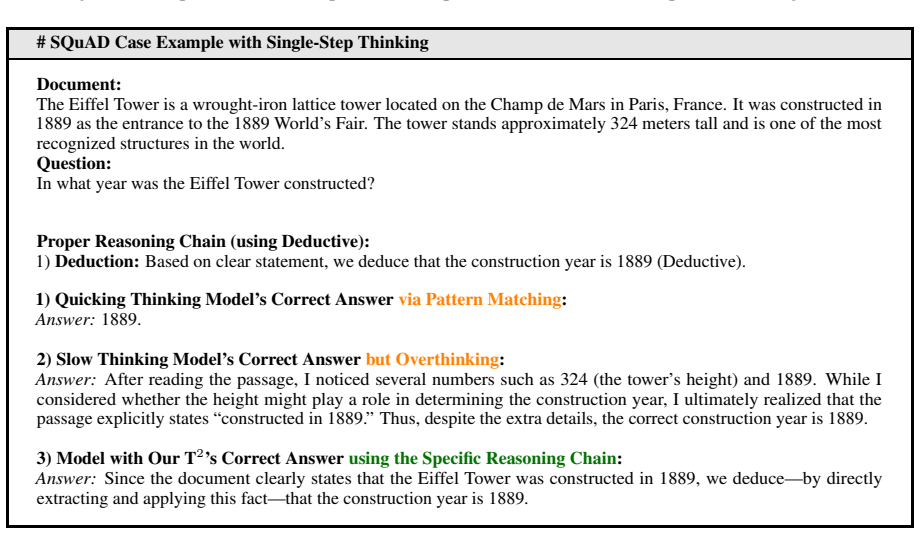
- The reported retrace-rate reduction suggests that reasoning paths chosen by analogy produce more decisive answers, which could reduce the need for post-hoc answer extraction or self-consistency voting in production.
- The finding that rare reasoning skills (analogical, decompositional) benefit most from the uniqueness weighting points toward a general recipe: when choosing demonstrations, weight by how distinctive the skill is, not just by how similar the surface text is.
Reading between the lines
- The 25.2 percent token reduction is measured on the final answering pass only; the auxiliary LLM calls for generating similar questions, scoring similarity, extracting relevant segments, and formatting prompts are largely treated as amortized. A reader comparing end-to-end cost should count those auxiliary calls, which the paper does not fully account for in its headline number.
- The framework implicitly assumes the generated similar questions and their reasoning paths are faithful—if the synthetic examples contain errors, the selected path could steer the model wrong with more confidence than a general prompt would. This makes the quality of the generation step (threshold delta and template variation) load-bearing for the whole method.
- Because the selection is greedy and one-shot, the method could likely be extended to iterative refinement where the model first tries the selected path and, if the answer is low-confidence, re-enters the selection loop with a different bias; the paper does not explore this, but the machinery of coverage and uniqueness scores would carry over directly.
Editorial analysis
A structured set of objections, weighed in public.
Referee Report
Summary. T2 is a test-time scaling framework for contextual question answering. It decomposes each question into a structural template and typed placeholders, uses an LLM to generate similar questions and reference documents that share the template, scores candidate examples by reasoning-skill coverage and uniqueness, and then uses the selected example's reasoning path to guide the final answer. The paper evaluates on seven QA datasets, reporting ROUGE-L and Exact Match improvements over quick- and slow-thinking baselines, and claims up to 25.2% token reduction. Appendices provide ablations of the selection components, example-number and threshold sensitivity, generation-method variations, domain/structure-bias checks, and a human evaluation.
Significance. The core idea—selecting a reasoning strategy from generated similar examples rather than from a hand-designed difficulty classifier—is a useful and reasonably original contribution to adaptive test-time scaling. The paper is thorough in its supporting analyses: the selection ablations (Appendix H), the sensitivity studies (Appendices J.3 and J.5), the structure-only and mis-domain checks (Appendix J.6), and the human evaluation (Appendix J.7) all give useful evidence about when the method works. If the efficiency claim can be substantiated with end-to-end cost accounting, the method would be practically valuable. However, the current efficiency accounting omits most of T2's LLM calls, and one component of the selection score is under-specified; both issues affect the headline claims.
major comments (4)
- [Section 3.4 / Appendix I (Tables 12–13, Figures 3 and 6)] The headline claim that T2 "reduces computational overhead by up to 25.2%" is computed from token counts that cover only the final answering forward pass. The full T2 pipeline invokes the LLM multiple times per question: generating similar questions and reference documents (Section 3.2), scoring each candidate question for similarity with an LLM prompt (Table 8), and extracting relevant segments for each reasoning skill (Algorithm 1, ExtractRelevantSegment). None of these calls is reflected in Tables 12–13 or Figures 3 and 6, and the input tokens of the final prompt (which include the selected example, reference documents, and reasoning path) are also not counted. The statement in Section 3.4 that T2 requires "only a single forward pass" is therefore misleading: the final QA call is one forward pass, but the framework itself is not. Because the 25.2% and 14.8% reductions are compared against baselines that consume only their reported output tokens, the efficiency advantage is unverified and could reverse under an end-to-end accounting. Please report total token consumption, wall-clock time, or API-call counts including all auxiliary steps, or qualify the efficiency claim accordingly.
- [Section 4.2.3 / Table 1] The accuracy comparison is not compute-matched. T2 spends substantial additional test-time compute on the auxiliary LLM calls listed above, while the quick- and slow-thinking baselines do not, yet the main results report only accuracy and final-pass token counts. Since the paper frames T2 as a test-time scaling method, the reader cannot tell whether the accuracy gains come from the proposed selection mechanism or simply from spending more inference compute. Please report accuracy at matched total compute budgets, or at least include total end-to-end token counts and wall-clock time for all methods in the main comparison. This is needed to support the joint claim of "superior accuracy" and "reduced computational overhead."
- [Section 3.1 / Appendix D] The question-decomposition step is internally inconsistent with its described implementation. The paper states that for "Which is taller, the Eiffel Tower or the Empire State Building?", the classifier identifies "taller" as a replaceable entity of type adj. However, Appendix D says the fine-tuned RoBERTa classifier detects whether a named entity or key number is present and assigns types such as Person, Location, Date, Organization, Number. An adjective like "taller" is neither a named entity nor a key number, so the described classifier cannot produce the [adj] placeholder in the running example. This is not cosmetic: the entire framework depends on extracting correct placeholders to generate similar questions. Please either describe the actual token-classification mechanism, including how non-entity replaceable tokens are handled, or correct the example and the appendix. If the classifier extracts only entities, the method's applicability to comparison questions like the running example is unsupported.
- [Section 3.3, Eq. (10)] The coverage term as written is not coverage of the original question's reasoning requirements. S is defined in Section 3.2 as the global taxonomy of seven reasoning skills, so cover(si,S)=|si∩S|/|S| measures how many of the seven global skills appear in the example's reasoning path, not how well the example matches the skills needed for the original question. No step in the paper estimates a required skill set for Q. Because Eq. (11) is the core selection mechanism, the paper should either define a target skill set for Q and measure coverage against it, or justify why global-skill diversity is the right selection criterion. As written, the "coverage" component of the selection score does not do what the text claims.
minor comments (8)
- [Abstract / Section 1] There are typos in the abstract and introduction ("This enables to adoption" and "delimma"); please copyedit.
- [Section 4.1 / Appendix D] The model name is written as "Qwen2.5-32B-Instract" in several places; it should be "Qwen2.5-32B-Instruct."
- [Appendix I / Figure 6] Appendix I renames T2 to "Flexible Reasoning Method (FReM)" in the text and in Figure 6; please use one consistent name throughout the paper.
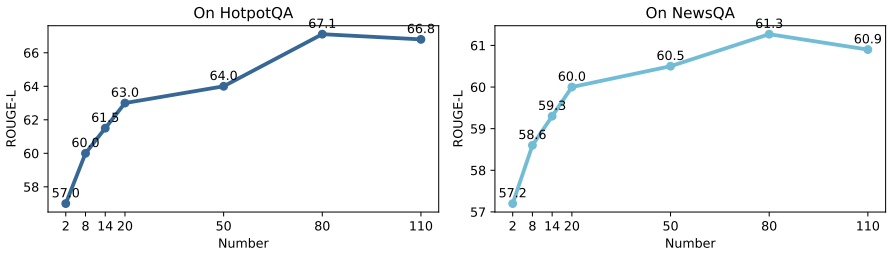
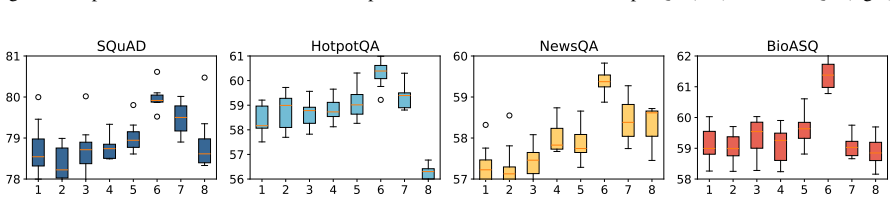
- [Section 4.1 / Appendix J] The main experiments do not state the chosen values of δ and M, although Figures 9 and 10 show that performance is sensitive to both; please report these settings.
- [Appendix G.1, Eq. (13)] Equation (13) defines Error as a per-question indicator ratio but the text describes it as a false discovery rate over retrieved facts; please align the formula with the stated metric, ideally using per-sentence counts.
- [Section 4.3 / Table 2] Table 2's header "Uniform Ours Improvement" does not specify the model and evaluation subset used; please clarify.
- [Section 3.3, Eq. (11)] Equation (11) adds a normalized coverage term (between 0 and 1) to an unnormalized sum of log-uniqueness scores; the relative weighting of the two terms is arbitrary and should be discussed or normalized.
- [Table 1] Table 1 reports single-run ROUGE-L values without variance or significance tests; adding standard errors or multiple runs would strengthen the comparison.
Circularity Check
No significant circularity: T2's accuracy results are judged against external ground truth, and no fitted parameter or self-citation chain is used as the basis for its predictions.
full rationale
The paper's derivation chain is empirical rather than formal: T2 generates similar questions, scores candidate reasoning strategies, and answers through a single guided forward pass, with final ROUGE-L and EM scores computed against standard benchmark ground truths (SQuAD, HotpotQA, BioASQ, etc.). No equation defines the reported predictions in terms of the method's own inputs: the selection score in Eq. (11) combines coverage and skill uniqueness, but the correctness of the chosen strategy is tested externally, not assumed by construction. The similarity threshold δ and example pool size M are tuned via ablations, but these are ordinary hyperparameters and are not renamed as results. The reasoning-skills taxonomy is attributed to independent cognitive-science sources, and the RoBERTa structure classifier is fine-tuned on the NERetrieve dataset, which is external to the benchmark evaluations. There is no load-bearing self-citation chain: the method's components are either defined in the paper or cite outside work. The main weakness, that the 25.2% token-reduction claim omits auxiliary LLM calls for example generation, similarity scoring, and segment extraction (Algorithm 1; Tables 12-13), is a measurement-completeness concern about the efficiency claim rather than a circularity, because the token counts are not defined to include the claimed conclusion and the accuracy comparison still uses independent ground truth. Accordingly, the paper is self-contained with respect to circularity, and no specific reduction of a claimed result to its own inputs can be exhibited.
Assumptions & free parameters
free parameters (3)
- Similarity threshold δ =
not explicitly stated (range 1-10)
- Number of similar examples M =
not stated
- Weighting between coverage and uniqueness in Eq. 11 =
1:1 additive
assumptions (4)
- domain assumption Similar question structure implies similar reasoning strategy.
- domain assumption The 7-skill taxonomy is sufficient for CQA reasoning.
- ad hoc to paper RoBERTa fine-tuned on NERetrieve can identify structural vs replaceable tokens, including non-entity words like 'taller'.
- domain assumption Synthetic reference documents for similar questions are factually coherent.
Cite this review
Pith. "Pith review of T$^2$: An Adaptive Test-Time Scaling Strategy for Contextual Question Answering." pith.science (2026). https://pith.science/paper/N6RVWEM5
@misc{pith2026250517427,
  author       = {Pith},
  title        = {Pith review of: T$^2$: An Adaptive Test-Time Scaling Strategy for Contextual Question Answering},
  year         = {2026},
  howpublished = {\url{https://pith.science/paper/N6RVWEM5}},
  note         = {Machine review of arXiv:2505.17427}
}
abstract
Recent advances in Large Language Models (LLMs) have demonstrated remarkable performance in Contextual Question Answering (CQA). However, prior approaches typically employ elaborate reasoning strategies regardless of question complexity, leading to low adaptability. Recent efficient test-time scaling methods introduce budget constraints or early stop mechanisms to avoid overthinking for straightforward questions. But they add human bias to the reasoning process and fail to leverage models' inherent reasoning capabilities. To address these limitations, we present T$^2$: Think-to-Think, a novel framework that dynamically adapts reasoning depth based on question complexity. T$^2$ leverages the insight that if an LLM can effectively solve similar questions using specific reasoning strategies, it can apply the same strategy to the original question. This insight enables to adoption of concise reasoning for straightforward questions while maintaining detailed analysis for complex problems. T$^2$ works through four key steps: decomposing questions into structural elements, generating similar examples with candidate reasoning strategies, evaluating these strategies against multiple criteria, and applying the most appropriate strategy to the original question. Experimental evaluation across seven diverse CQA benchmarks demonstrates that T$^2$ not only achieves higher accuracy than baseline methods but also reduces computational overhead by up to 25.2\%.
Figures


Figures from the paper (9 more)



Forward citations
Cited by 1 Pith paper
-
Towards Concise and Adaptive Thinking in Large Reasoning Models: A Survey
A comprehensive review that categorizes methods for shortening and adaptively triggering chain-of-thought reasoning in large language models.
Reference graph
Works this paper leans on
- [1]
-
[2]
Identify that the question is asking for the inventor of a significant historical device (decompositional)
-
[3]
Qwen2.5 technical report. Technical report. Wenkai Yang, Shuming Ma, Yankai Lin, and Furu Wei. 2025. Towards thinking-optimal scaling of test-time compute for llm reasoning.arXiv preprint arXiv:2502.18080. Zhilin Yang, Peng Qi, Saizheng Zhang, Yoshua Ben- gio, William W. Cohen, Ruslan Salakhutdinov, and Christopher D. Manning. 2018. HotpotQA: A dataset fo...
arXiv 2025
-
[4]
Tree of thoughts: Deliberate problem solving with large language models.Advances in neural information processing systems, 36:11809–11822. Zheng Yuan, Hongyi Yuan, Chengpeng Li, Guanting Dong, Keming Lu, Chuanqi Tan, Chang Zhou, and Jingren Zhou. 2023. Scaling relationship on learning mathematical reasoning with large language models. arXiv preprint arXiv...
arXiv 2023
- [8]
-
[9]
Alexander Graham Bell invented the telephone in 1876
The inventor is Alexander Graham Bell. (cause & effect) Generated Answer:"Alexander Graham Bell invented the telephone in 1876." Reasoning Skill Used:deductive, decompositional, deductive, cause & effect. Example 2:... Example 3:... Notes: Please make sure that the reasoning path is clear and includes each substep in the thought process. The output should...
work page 2022
-
[10]
First, I’ll recall the melting point of sodium, which is 97.8°C
-
[11]
Next, I’ll recall the melting point of potassium, which is 63.5°C
Show all 23 references
-
[12]
Comparing these values: 97.8°C > 63.5°C
-
[13]
Figure 7: Our original generated similar example
Therefore, sodium has a higher melting point than potassium. Figure 7: Our original generated similar example. Structure-Only Version Q:How does [PROPERTY] of [ENTITY_A] compare to [ENTITY_B]? A:I’ll approach this systematically:
-
[14]
First, I’ll determine the [PROPERTY] of [ENTITY_A], which is [V ALUE_A]
-
[15]
Next, I’ll determine the [PROPERTY] of [ENTITY_B], which is [V ALUE_B]
-
[16]
Comparing these values: [COMPARISON_OPERATION]
-
[17]
+mis domain
Therefore, [CONCLUSION_STATEMENT]. Figure 8: Structure-only version of our generated similar example. Method ROUGE-L Variation Noise Qwen2.5 w/ ours Random Fill 49.8 High Medium Guided Fill 52.6 Low Low Template Variation61.3High Low Table 18: Comparing different example const...
-
[18]
Quick Thinking Model’s Wrong Answer: Answer:The subject ofNowhere Boywas born in London
-
[19]
Slow Thinking Model’s Overthinking Answer: Answer:After a lengthy analysis of various biographical details concerning John Lennon, including his early childhood, multiple hints in his music and interviews, and a discussion of several English cities mentioned in relation to his...
-
[20]
Figure 11: HotpotQA Case Example with Multiple Answer Versions and Explicit Reasoning Chain
Model with Our T2’s Correct Answer: Answer:SinceNowhere Boyis a film about John Lennon (Document 2) and Document 1 confirms that John Lennon was born in Liverpool, we deduce that the subject of the film was born in Liverpool. Figure 11: HotpotQA Case Example with Multiple Answ...
-
[21]
Quicking Thinking Model’s Correct Answer via Pattern Matching: Answer:1889
-
[22]
constructed in 1889
Slow Thinking Model’s Correct Answer but Overthinking: Answer:After reading the passage, I noticed several numbers such as 324 (the tower’s height) and 1889. While I considered whether the height might play a role in determining the construction year, I ultimately realized tha...
-
[23]
Figure 12: SQuAD Case Example with Single-Step Thinking and Multiple Answer Versions
Model with Our T2’s Correct Answer using the Specific Reasoning Chain: Answer:Since the document clearly states that the Eiffel Tower was constructed in 1889, we deduce—by directly extracting and applying this fact—that the construction year is 1889. Figure 12: SQuAD Case Exam...
-
[128]
San Francisco
The learning rate is set to 2×10 −5. AdamW is used as the optimizer. A dropout rate of 0.1 is applied to prevent overfitting during fine-tuning. For LLM usage, We use two quick-thinking LLMs (Qwen2.5-32B-Instract(Yang et al., 2024), andGPT-4o(Hurst et al., 2024; Guo et al., 20...
2024
-
[2023]
InThe Twelfth Inter- national Conference on Learning Representations
Let’s verify step by step. InThe Twelfth Inter- national Conference on Learning Representations. Xinbei Ma, Yeyun Gong, Pengcheng He, Hai Zhao, and Nan Duan. 2023. Query rewriting for retrieval-augmented large language models.CoRR, abs/2305.14283. Yingqian Min, Zhipeng Chen, J...
2023 arXiv
-
[2024]
Yang Deng, Lizi Liao, Liang Chen, Hongru Wang, Wenqiang Lei, and Tat-Seng Chua
Are more llm calls all you need? towards the scaling properties of compound ai systems.Advances in Neural Information Processing Systems, 37:45767– 45790. Yang Deng, Lizi Liao, Liang Chen, Hongru Wang, Wenqiang Lei, and Tat-Seng Chua. 2023. Prompt- ing and evaluating large lan...
2023 arXiv
Reviewed August 7, 2026 · model on record in the stance chip above.
Discussion (0). Continue with ORCID to comment.