REVIEW 3 major objections 6 minor 79 references
From Reasoning to Generalization: Knowledge-Augmented LLMs for ARC Benchmark
T0 review · 3 major / 6 minor · reviewed 2026-08-07 · deepseek-v4-flash
Pith's one-line read Progressively prompting LLMs with ontology-structured core knowledge priors improves their abstract reasoning and generalization on the ARC benchmark, by about five absolute percentage points and up to 64.52% relative across four…
desk verdict A useful systematic evaluation of reasoning LLMs on ARC, but the headline KAAR gain is confounded by unmatched solver compute; the fix is straightforward. read the letter →
The pith
A machine-rendered reading of the paper's core claim, the machinery that carries it, and where it could break.
The reading
What carries the argument
The central object is the KAAR ontology of core knowledge priors, grouped into three dependency levels: objectness (image abstractions such as whole image, middle splits, multi-lines, and 4/8-connected components), geometry and topology plus numbers and counting (component attributes like size, shape, symmetry, holes, alongside relational and frequency statistics), and goal-directedness (ten predefined actions such as color change, movement, and extension, each with a schema for implementation details). After augmenting each level, KAAR invokes the RSPC backbone to generate a plan-guided Python program and checks it against training instances. The selection mechanism is the 'first abstraction whose solution solves all training instances'; if no abstraction succeeds, the code that passes the most training instances is chosen and evaluated on the test set.
What would settle it
Run a matched-compute control: give RSPC the same total solver budget KAAR spends (for instance, three invocations of up to four iterations per abstraction, or the equivalent number of repeated samples) but with no knowledge prompts, and compare test accuracy on the same 400 ARC tasks; if the gap shrinks toward zero, the staged priors are not the cause. A second falsifier is to inject staged but content-free priors of equal length and see whether the gain persists.
Extended reading notes
Core claim
On the ARC public evaluation set of 400 problems, KAAR—which encodes core knowledge priors into a dependency-based ontology and augments the model after each of three levels while invoking the repeated-sampling planning-aided code solver (RSPC) for up to four iterations per level—reports test accuracies of 35.0% with GPT-o3-mini, 21.75% with Gemini-2.0, 21.0% with QwQ-32B, and 12.75% with DeepSeek-R1-70B, compared with 30.75%, 16.75%, 14.25%, and 7.75% for RSPC alone. The same pattern holds for training-instance accuracy and for combined train-and-test accuracy, leading the authors to describe the improvement as model-agnostic. The paper also reports that repeated-sampling solvers beat refinement-based solvers on ARC, contrary to common findings on conventional code-generation benchmarks, and that planning-aided code generation closes much of the generalization gap between training and test accuracy.
Load-bearing premise
The central claim rests on the assumption that the extra solver invocations KAAR makes across its abstraction levels do not by themselves account for the measured gains.
Editorial extensions
If this is right
- Across all four evaluated LLMs, KAAR beats RSPC on test, training, and combined accuracy, with absolute test gains of 4.25 to 6.75 points and relative gains up to 64.52%.
- The ablation study shows that injecting all priors at once (KAAR*) costs 2.5 to 3.75 points compared with stage-wise injection, supporting the paper's claim that progressive augmentation reduces interference.
- Accuracy gains concentrate in movement tasks and in images with average size below 400 pixels; extension tasks and images larger than 20 by 20 remain largely unsolved.
- Repeated sampling with planning-aided code generation generalizes better on ARC than refinement-based approaches, so the best solver choice for ARC-type tasks differs from typical code-generation benchmarks.
- KAAR also raises cross-model coverage: the proportion of problems solved by the weakest model that are also solved by the strongest rises from 0.22 to 0.34, suggesting shared reasoning improvements across models.
Reading between the lines
- Because KAAR invokes the solver up to three times per abstraction (four iterations each) while the baseline gets twelve iterations total, a matched-compute control would be needed to separate the effect of the knowledge prompts from the effect of extra solver calls; this is my inference, not a claim the paper makes.
- The first-abstraction-that-passes-training heuristic is a likely ceiling on generalization: the paper itself shows cases where it stops at the no-abstraction stage and reproduces the baseline's overfit solution, which suggests learning to pick abstractions from the task itself is the next bottleneck.
- The same ontology machinery could be ported to other hierarchy-dependent reasoning domains such as robotic task planning or visual question answering, where object-level priors and goal-directed action schemas play a comparable role.
- A natural stress test for the paper's hypothesis is to replace the knowledge priors with matched-length random or irrelevant structured text: if the staged prompts are what matter, the random control should not reproduce the gains.
Editorial analysis
A structured set of objections, weighed in public.
Referee Report
Summary. This paper evaluates recent reasoning-oriented LLMs (GPT-o3-mini, Gemini-2.0-Flash-Thinking, DeepSeek-R1-70B, QwQ-32B) on the ARC public evaluation set of 400 tasks, comparing nine solver configurations formed from direct generation, repeated sampling, and refinement, with plan, standalone-code, or planning-aided-code outputs. It identifies repeated-sampling planning-aided code generation (RSPC) as the strongest backbone and introduces KAAR, which augments the LLM prompt with core knowledge priors organized into a three-level ontology derived from the authors' GPAR system, invoking RSPC after each augmentation stage. The paper reports that KAAR outperforms RSPC by roughly 5% absolute across all evaluated LLMs, with the largest relative gain of 64.52% on DeepSeek-R1-70B, and interprets this as evidence that progressively prompting with ontology-structured priors improves abstract reasoning and generalization.
Significance. If the reported gains were cleanly attributable to the knowledge priors, this would be a useful empirical contribution to LLM-based ARC solving: the paper provides a systematic comparison over the full public evaluation set, an explicitly described staged-prompting protocol, detailed failure analysis, and complete prompts and pseudocode in the appendix, and it honestly documents overfitting cases in Appendix A.9. The main result, however, is currently confounded by an unequal compute budget between KAAR and RSPC, so the causal claim in the abstract and Section 5 is not yet supported by the evidence presented. The systematic solver comparison and the public evaluation data are valuable independent of this issue, and the staged augmentation idea is worth exploring further once the compute-matching problem is addressed.
major comments (3)
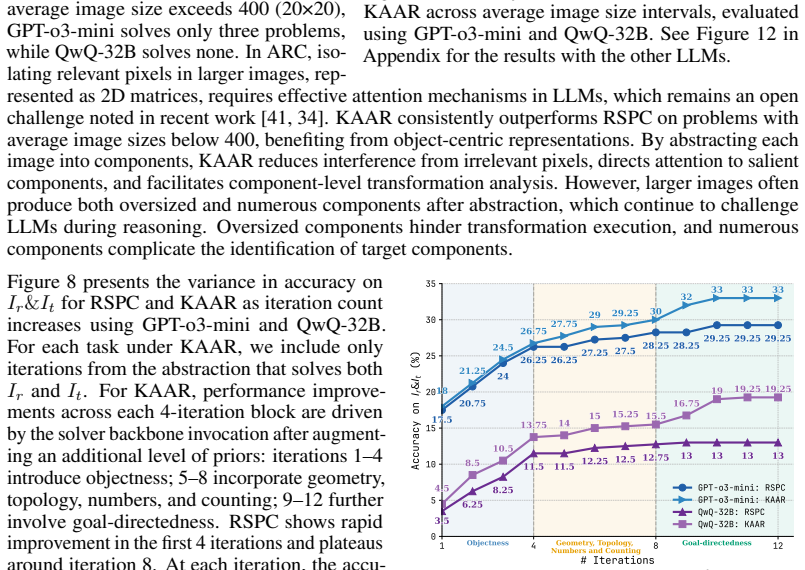
- [Section 5; Algorithm 1 (Appendix A.5)] The statement that KAAR allows the solver backbone (RSPC) up to 4 iterations per invocation, totaling 12 iterations, consistent with the non-augmented setting, is not a correct description of KAAR's total budget. Algorithm 1 invokes SolverBackbone three times per abstraction (Lines 6, 15, and 19), each with t=4, and the outer loop (Line 3) continues over abstractions until a solution passes Ir. KAAR's total solver-iteration budget is therefore 12×K, where K is the number of abstractions tried, plus the token cost of augmentation. RSPC, by contrast, receives exactly 12 iterations in total (Section 3). Because no matched-compute RSPC baseline is reported (Table 4 reports only KAAR token usage, and Figure 8 shows RSPC accuracy still increasing with iteration count until roughly iteration 8), the ~5% absolute gains in Table 2 may be partly attributable to additional test-time search rather than to knowledge augmentation. The central causal claim of the abstract and Section 5 requires a matched-compute control, for example RSPC run for 12×K iterations or with an equal token budget, before the gain can be attributed to the augmentation itself.
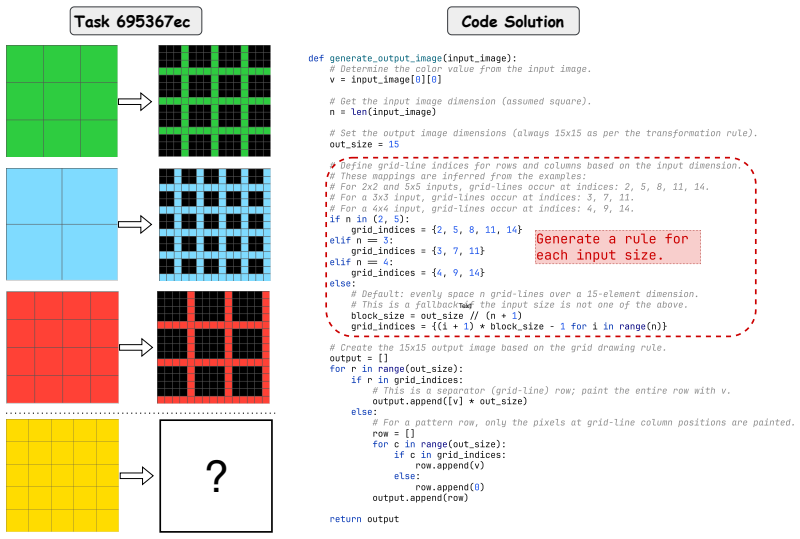
- [Section 5; Appendix A.9] The abstraction-selection rule reported in Section 5, which picks the first abstraction whose solution solves all training instances Ir (and otherwise selects the code passing the most training instances), is a training-set selection heuristic that can overfit. The paper itself documents two cases (695367ec and b1fc8b8e) in Appendix A.9 where KAAR starts with the 'no abstraction' variant, reproduces the same overfit RSPC solution that passes Ir, and terminates without exploring other abstractions. Consequently, the aggregate It figures in Table 2 average over cases in which KAAR is identical to RSPC and cases in which it consumes additional compute and abstractions. The paper should report the distribution of the abstraction index K at which each task terminates, and the proportion of tasks resolved by the 'no abstraction' variant, so that the contribution of the augmentation protocol can be separated from the baseline solver's behavior.
- [Table 2; Appendix A.4] Accuracy differences are reported without any measure of uncertainty or repeated runs. The open-source models are sampled with temperature 0.6, top-p 0.95, and top-k 40 (Appendix A.4), so the results are stochastic; a 5% absolute difference over 400 tasks may be within sampling noise. The paper should provide multiple seeds or confidence intervals (for example, a bootstrap over the 400 tasks) for the RSPC versus KAAR comparison before claiming that KAAR consistently outperforms RSPC across all LLMs.
minor comments (6)
- [Table 1] Some entries in the table are run together without separators (for example, '35.5052.5035.50' in the GPT-o3-mini Ir row), which makes the table very hard to read; adding spacing or visible column separators would improve clarity.
- [Figure 8] The caption describes the plot as 'Variance in accuracy with increasing iterations,' but the figure actually plots accuracy as a function of iteration count; the label 'variance' is a misnomer and should be replaced with something like 'Accuracy versus iterations.'
- [Appendix A.13, Prompt 2] The prompt contains a duplicated article: 'the the output images should be outputted as' should be 'the output images should be outputted as.'
- [Table 2] The column header 'Acc∆γAcc∆γAcc∆γ' lacks visible separation between the three metric groups, making it difficult to map columns to Ir, It, and Ir&It; use clearer headers with distinct column boundaries.
- [Algorithm 1, Line 18] The line 'AugmentGoalPriors←(M,Q,abs)' appears to be missing a function-call syntax; it should probably read 'AugmentGoalPriors(M,Q,abs)' or use an explicit assignment to a result variable.
- [Section 4 and Table 5] Listing 'no abstraction' among the 'abstractions' is confusing because it is explicitly the absence of abstraction; the paper should consistently distinguish this baseline variant from the actual abstraction methods, for instance by calling it 'no-abstraction baseline' throughout.
Circularity Check
No significant circularity: KAAR's gains are measured on held-out ARC test instances, and the reliance on the authors' prior GPAR work supplies method components, not the reported result.
full rationale
The paper's central claim is an empirical comparison: KAAR is reported to outperform RSPC on the ARC public evaluation set. The derivation chain is not circular because the test accuracy is obtained by executing LLM-generated code on held-out test inputs; the augmented priors are computed from the task's training inputs and test inputs via image-processing algorithms, not from the test outputs being predicted. The abstraction-selection rule ('first abstraction whose solution solves all training instances') is a training-set model-selection heuristic, and the paper separately reports test accuracy, so the prediction is not fitted to the target by construction. KAAR does inherit its priors from GPAR [10], a paper sharing authors with the present work, but that self-citation supplies the method's components and vocabulary rather than the empirical outcome: no uniqueness theorem is imported, no fitted parameter is renamed as a prediction, and the reported It numbers are not equal to any training-set fit. The skeptic's compute-budget asymmetry (KAAR can run up to 12 solver iterations per abstraction across multiple abstractions, while RSPC is limited to 12 total) is a potential threat to the causal attribution of the gain, but it is an experimental-validity concern, not circularity. The paper also self-documents failure cases and the 'no abstraction' degradation (Appendix A.9), which further shows the comparison is not definitionally forced. Therefore no circular step is exhibited.
Assumptions & free parameters
free parameters (3)
- solver iterations per augmentation stage =
4
- abstraction ordering and count =
19 abstractions ordered by simplicity
- sampling temperature, top-p, top-k =
0.6, 0.95, 40 for open-source models
assumptions (4)
- domain assumption ARC tasks are solvable using core knowledge priors (objectness, geometry/topology, numbers/counting, goal-directedness).
- domain assumption Connected-component and other image abstractions capture the true objectness of ARC tasks.
- ad hoc to paper Training-set success is a valid criterion for selecting the abstraction and solution to evaluate on test.
- ad hoc to paper Staged prompting reduces interference from irrelevant priors.
invented entities (3)
-
middle-vertical and middle-horizontal abstractions
-
multi-lines abstraction
-
three-level ontology of priors
Cite this review
Pith. "Pith review of From Reasoning to Generalization: Knowledge-Augmented LLMs for ARC Benchmark." pith.science (2026). https://pith.science/paper/ZA4TQASZ
@misc{pith2026250517482,
  author       = {Pith},
  title        = {Pith review of: From Reasoning to Generalization: Knowledge-Augmented LLMs for ARC Benchmark},
  year         = {2026},
  howpublished = {\url{https://pith.science/paper/ZA4TQASZ}},
  note         = {Machine review of arXiv:2505.17482}
}
read the original abstract
Recent reasoning-oriented LLMs have demonstrated strong performance on challenging tasks such as mathematics and science examinations. However, core cognitive faculties of human intelligence, such as abstract reasoning and generalization, remain underexplored. To address this, we evaluate recent reasoning-oriented LLMs on the Abstraction and Reasoning Corpus (ARC) benchmark, which explicitly demands both faculties. We formulate ARC as a program synthesis task and propose nine candidate solvers. Experimental results show that repeated-sampling planning-aided code generation (RSPC) achieves the highest test accuracy and demonstrates consistent generalization across most LLMs. To further improve performance, we introduce an ARC solver, Knowledge Augmentation for Abstract Reasoning (KAAR), which encodes core knowledge priors within an ontology that classifies priors into three hierarchical levels based on their dependencies. KAAR progressively expands LLM reasoning capacity by gradually augmenting priors at each level, and invokes RSPC to generate candidate solutions after each augmentation stage. This stage-wise reasoning reduces interference from irrelevant priors and improves LLM performance. Empirical results show that KAAR maintains strong generalization and consistently outperforms non-augmented RSPC across all evaluated LLMs, achieving around 5% absolute gains and up to 64.52% relative improvement. Despite these achievements, ARC remains a challenging benchmark for reasoning-oriented LLMs, highlighting future avenues of progress in LLMs.
Figures


Figures from the paper (20 more)






Reference graph
Works this paper leans on
-
[1]
Abdullah Ayub Khan, Asif Ali Laghari, and Shafique Ahmed Awan. Machine learning in computer vision: A review.EAI Endorsed Transactions on Scalable Information Systems, 8 (32), 2021
work page 2021
-
[2]
Daniel W Otter, Julian R Medina, and Jugal K Kalita. A survey of the usages of deep learning for natural language processing.IEEE transactions on neural networks and learning systems, 32(2):604–624, 2020
work page 2020
-
[3]
A survey of deep learning techniques for autonomous driving.Journal of field robotics, 37(3):362–386, 2020
Sorin Grigorescu, Bogdan Trasnea, Tiberiu Cocias, and Gigel Macesanu. A survey of deep learning techniques for autonomous driving.Journal of field robotics, 37(3):362–386, 2020
2020
-
[4]
Building machines that learn and think like people.Behavioral and brain sciences, 40:e253, 2017
Brenden M Lake, Tomer D Ullman, Joshua B Tenenbaum, and Samuel J Gershman. Building machines that learn and think like people.Behavioral and brain sciences, 40:e253, 2017
2017
-
[5]
On the measure of intelligence.arXiv preprint arXiv:1911.01547, 2019
François Chollet. On the measure of intelligence.arXiv preprint arXiv:1911.01547, 2019
arXiv 1911
-
[6]
Charles S Peirce. Questions concerning certain faculties claimed for man.The Journal of Speculative Philosophy, 2(2):103–114, 1868
-
[7]
Core knowledge.Developmental science, 10(1): 89–96, 2007
Elizabeth S Spelke and Katherine D Kinzler. Core knowledge.Developmental science, 10(1): 89–96, 2007
work page 2007
-
[8]
Program synthesis.Foundations and Trends® in Programming Languages, 4:1–119, 2017
Sumit Gulwani, Oleksandr Polozov, Rishabh Singh, et al. Program synthesis.Foundations and Trends® in Programming Languages, 4:1–119, 2017
work page 2017
Show all 79 references
-
[9]
Graphs, constraints, and search for the abstraction and reasoning corpus
Yudong Xu, Elias B Khalil, and Scott Sanner. Graphs, constraints, and search for the abstraction and reasoning corpus. InProceedings of the 37th AAAI Conference on Artificial Intelligence, AAAI, pages 4115–4122, 2023
2023
-
[10]
Generalized planning for the abstraction and reasoning corpus
Chao Lei, Nir Lipovetzky, and Krista A Ehinger. Generalized planning for the abstraction and reasoning corpus. InProceedings of the 38th AAAI Conference on Artificial Intelligence, AAAI, pages 20168–20175, 2024
2024
-
[11]
Chain-of-thought prompting elicits reasoning in large language models
Jason Wei, Xuezhi Wang, Dale Schuurmans, Maarten Bosma, Fei Xia, Ed Chi, Quoc V Le, Denny Zhou, et al. Chain-of-thought prompting elicits reasoning in large language models. In Proceedings of the 36th Advances in Neural Information Processing Systems, NeurIPS, pages 24824–24837, 2022
2022
-
[12]
Evaluating large language models trained on code.arXiv preprint arXiv:2107.03374, 2021
Mark Chen, Jerry Tworek, Heewoo Jun, Qiming Yuan, Henrique Ponde de Oliveira Pinto, Jared Kaplan, Harri Edwards, Yuri Burda, Nicholas Joseph, Greg Brockman, et al. Evaluating large language models trained on code.arXiv preprint arXiv:2107.03374, 2021
2021 arXiv
-
[13]
Competition-level code generation with alphacode.Science, 378:1092–1097, 2022
Yujia Li, David Choi, Junyoung Chung, Nate Kushman, Julian Schrittwieser, Rémi Leblond, Tom Eccles, James Keeling, Felix Gimeno, Agustin Dal Lago, et al. Competition-level code generation with alphacode.Science, 378:1092–1097, 2022
2022
-
[14]
Codet: Code generation with generated tests
Bei Chen, Fengji Zhang, Anh Nguyen, Daoguang Zan, Zeqi Lin, Jian-Guang Lou, and Weizhu Chen. Codet: Code generation with generated tests. InProceedings of the 11th International Conference on Learning Representations, ICLR, pages 1–19, 2023
2023
-
[15]
Coder reviewer reranking for code generation
Tianyi Zhang, Tao Yu, Tatsunori Hashimoto, Mike Lewis, Wen-tau Yih, Daniel Fried, and Sida Wang. Coder reviewer reranking for code generation. InProceedings of the 40th International Conference on Machine Learning, ICML, pages 41832–41846, 2023
2023
-
[16]
Lever: Learning to verify language-to-code generation with execution
Ansong Ni, Srini Iyer, Dragomir Radev, Veselin Stoyanov, Wen-tau Yih, Sida Wang, and Xi Victoria Lin. Lever: Learning to verify language-to-code generation with execution. In Proceedings of the 40th International Conference on Machine Learning, ICML, pages 26106– 26128, 2023
2023
-
[17]
Debug like a human: A large language model debugger via verifying runtime execution step by step
Li Zhong, Zilong Wang, and Jingbo Shang. Debug like a human: A large language model debugger via verifying runtime execution step by step. InFindings of the Association for Computational Linguistics: ACL 2024, pages 851–870, 2024. 10
2024
-
[18]
Planning-driven program- ming: A large language model programming workflow.arXiv preprint arXiv:2411.14503, 2024
Chao Lei, Yanchuan Chang, Nir Lipovetzky, and Krista A Ehinger. Planning-driven program- ming: A large language model programming workflow.arXiv preprint arXiv:2411.14503, 2024
2024 arXiv
-
[19]
Teaching large language models to self-debug
Xinyun Chen, Maxwell Lin, Nathanael Schärli, and Denny Zhou. Teaching large language models to self-debug. InProceedings of the 12th International Conference on Learning Representations, ICLR, 2024
2024
-
[20]
Program synthesis with large language models.arXiv preprint arXiv:2108.07732, 2021
Jacob Austin, Augustus Odena, Maxwell Nye, Maarten Bosma, Henryk Michalewski, David Dohan, Ellen Jiang, Carrie Cai, Michael Terry, Quoc Le, et al. Program synthesis with large language models.arXiv preprint arXiv:2108.07732, 2021
2021 arXiv
-
[21]
Livecodebench: Holistic and contamination free evaluation of large language models for code
Naman Jain, King Han, Alex Gu, Wen-Ding Li, Fanjia Yan, Tianjun Zhang, Sida Wang, Ar- mando Solar-Lezama, Koushik Sen, and Ion Stoica. Livecodebench: Holistic and contamination free evaluation of large language models for code. InProceedings of the 13th International Conferenc...
2025
-
[22]
Self-planning code generation with large language models.ACM Transactions on Software Engineering and Methodology, 33(7):1–28, 2023
Xue Jiang, Yihong Dong, Lecheng Wang, Fang Zheng, Qiwei Shang, Ge Li, Zhi Jin, and Wenpin Jiao. Self-planning code generation with large language models.ACM Transactions on Software Engineering and Methodology, 33(7):1–28, 2023
2023
-
[23]
Ashraful Islam, Mohammed Eunus Ali, and Md Rizwan Parvez
Md. Ashraful Islam, Mohammed Eunus Ali, and Md Rizwan Parvez. MapCoder: Multi-agent code generation for competitive problem solving. InProceedings of the 62nd Annual Meeting of the Association for Computational Linguistics, ACL, pages 4912–4944, 2024
2024
-
[24]
Evaluation of openai o1: Opportunities and challenges of agi.arXiv preprint arXiv:2409.18486, 2024
Tianyang Zhong, Zhengliang Liu, Yi Pan, Yutong Zhang, Yifan Zhou, Shizhe Liang, Zihao Wu, Yanjun Lyu, Peng Shu, Xiaowei Yu, et al. Evaluation of openai o1: Opportunities and challenges of agi.arXiv preprint arXiv:2409.18486, 2024
2024
-
[25]
Openai o3-mini.OpenAI, 2025
OpenAI. Openai o3-mini.OpenAI, 2025. URL https://openai.com/index/openai-o 3-mini/. Accessed: 2025-03-22
2025
-
[26]
Gemini 2.0 flash thinking.Google DeepMind, 2024
Google DeepMind. Gemini 2.0 flash thinking.Google DeepMind, 2024. URL https: //deepmind.google/technologies/gemini/flash-thinking/. Accessed: 2025-03-22
2024
-
[27]
Deepseek-r1: Incentivizing reasoning capability in llms via reinforcement learning.arXiv preprint arXiv:2501.12948, 2025
Daya Guo, Dejian Yang, Haowei Zhang, Junxiao Song, Ruoyu Zhang, Runxin Xu, Qihao Zhu, Shirong Ma, Peiyi Wang, Xiao Bi, et al. Deepseek-r1: Incentivizing reasoning capability in llms via reinforcement learning.arXiv preprint arXiv:2501.12948, 2025
2025 arXiv
-
[28]
Alibaba cloud unveils qwq-32b: A compact reasoning model with cutting-edge performance.Alibaba Cloud, 2025
Alibaba Cloud. Alibaba cloud unveils qwq-32b: A compact reasoning model with cutting-edge performance.Alibaba Cloud, 2025. URL https://www.alibabacloud.com/blog/alibab a-cloud-unveils-qwq-32b-a-compact-reasoning-model-with-cutting-edge-p erformance_602039. Accessed: 2025-03-22
2025
-
[29]
Piaget’s cognitive developmen- tal theory: Critical review.Education Quarterly Reviews, 2(3):517–524, 2019
Zana H Babakr, Pakstan Mohamedamin, and Karwan Kakamad. Piaget’s cognitive developmen- tal theory: Critical review.Education Quarterly Reviews, 2(3):517–524, 2019
2019
-
[30]
Can llm be a good path planner based on prompt engineering? mitigating the hallucination for path planning.arXiv preprint arXiv:2408.13184, 2024
Hourui Deng, Hongjie Zhang, Jie Ou, and Chaosheng Feng. Can llm be a good path planner based on prompt engineering? mitigating the hallucination for path planning.arXiv preprint arXiv:2408.13184, 2024
2024 arXiv
-
[31]
LLM-a*: Large language model enhanced incremental heuristic search on path planning
Silin Meng, Yiwei Wang, Cheng-Fu Yang, Nanyun Peng, and Kai-Wei Chang. LLM-a*: Large language model enhanced incremental heuristic search on path planning. InFindings of the Association for Computational Linguistics: EMNLP 2024, pages 1087–1102, 2024
2024
-
[32]
Large language models for mathematical reasoning: Progresses and challenges
Janice Ahn, Rishu Verma, Renze Lou, Di Liu, Rui Zhang, and Wenpeng Yin. Large language models for mathematical reasoning: Progresses and challenges. InProceedings of the 18th Conference of the European Chapter of the Association for Computational Linguistics: Student Research ...
2024
-
[33]
Contextual object detection with multimodal large language models.International Journal of Computer Vision, 133(2):825–843, 2025
Yuhang Zang, Wei Li, Jun Han, Kaiyang Zhou, and Chen Change Loy. Contextual object detection with multimodal large language models.International Journal of Computer Vision, 133(2):825–843, 2025. 11
2025
-
[34]
Llms and the abstraction and reasoning corpus: Successes, failures, and the importance of object-based representations.arXiv preprint arXiv:2305.18354, 2023
Yudong Xu, Wenhao Li, Pashootan Vaezipoor, Scott Sanner, and Elias B Khalil. Llms and the abstraction and reasoning corpus: Successes, failures, and the importance of object-based representations.arXiv preprint arXiv:2305.18354, 2023
2023 arXiv
-
[35]
Novelty and lifted helpful actions in generalized planning
Chao Lei, Nir Lipovetzky, and Krista A Ehinger. Novelty and lifted helpful actions in generalized planning. InProceedings of the International Symposium on Combinatorial Search, SoCS, pages 148–152, 2023
2023
-
[36]
Hypothesis search: Inductive reasoning with language models
Ruocheng Wang, Eric Zelikman, Gabriel Poesia, Yewen Pu, Nick Haber, and Noah Goodman. Hypothesis search: Inductive reasoning with language models. InProceedings of the 12 th International Conference on Learning Representations, ICLR, 2024
2024
-
[37]
H-arc: A robust estimate of human performance on the abstraction and reasoning corpus benchmark.arXiv preprint arXiv:2409.01374, 2024
Solim LeGris, Wai Keen V ong, Brenden M Lake, and Todd M Gureckis. H-arc: A robust estimate of human performance on the abstraction and reasoning corpus benchmark.arXiv preprint arXiv:2409.01374, 2024
2024 arXiv
-
[38]
Eval- uating spatial understanding of large language models.Transactions on Machine Learning Research, 2024
Yutaro Yamada, Yihan Bao, Andrew Kyle Lampinen, Jungo Kasai, and Ilker Yildirim. Eval- uating spatial understanding of large language models.Transactions on Machine Learning Research, 2024
2024
-
[39]
Dialectical language model evaluation: An initial appraisal of the commonsense spatial reasoning abilities of llms.arXiv preprint arXiv:2304.11164, 2023
Anthony G Cohn and Jose Hernandez-Orallo. Dialectical language model evaluation: An initial appraisal of the commonsense spatial reasoning abilities of llms.arXiv preprint arXiv:2304.11164, 2023
2023 arXiv
-
[40]
Do, Yan Xu, and Pascale Fung
Yejin Bang, Samuel Cahyawijaya, Nayeon Lee, Wenliang Dai, Dan Su, Bryan Wilie, Holy Love- nia, Ziwei Ji, Tiezheng Yu, Willy Chung, Quyet V . Do, Yan Xu, and Pascale Fung. A multitask, multilingual, multimodal evaluation of ChatGPT on reasoning, hallucination, and interactivity...
2023
-
[41]
Tackling the abstraction and reasoning corpus with vision transformers: the importance of 2d representation, positions, and objects.arXiv preprint arXiv:2410.06405, 2024
Wenhao Li, Yudong Xu, Scott Sanner, and Elias Boutros Khalil. Tackling the abstraction and reasoning corpus with vision transformers: the importance of 2d representation, positions, and objects.arXiv preprint arXiv:2410.06405, 2024
-
[42]
The raven’s progressive matrices: change and stability over culture and time
John Raven. The raven’s progressive matrices: change and stability over culture and time. Cognitive psychology, 41(1):1–48, 2000
2000
-
[43]
Measuring abstract reasoning in neural networks
David Barrett, Felix Hill, Adam Santoro, Ari Morcos, and Timothy Lillicrap. Measuring abstract reasoning in neural networks. InProceedings of the 37th International conference on machine learning, ICML, pages 511–520, 2018
2018
-
[44]
Task cognition and planning for service robots.Intelligence & Robotics, (1):119–142, 2025
Yongcheng Cui, Ying Zhang, Cui-Hua Zhang, and Simon X Yang. Task cognition and planning for service robots.Intelligence & Robotics, (1):119–142, 2025
2025
-
[45]
From show to tell: A survey on deep learning-based image captioning.IEEE transactions on pattern analysis and machine intelligence, (1):539–559, 2022
Matteo Stefanini, Marcella Cornia, Lorenzo Baraldi, Silvia Cascianelli, Giuseppe Fiameni, and Rita Cucchiara. From show to tell: A survey on deep learning-based image captioning.IEEE transactions on pattern analysis and machine intelligence, (1):539–559, 2022
2022
-
[46]
Visual question answering: from early developments to recent advances–a survey.arXiv preprint arXiv:2501.03939, 2025
Ngoc Dung Huynh, Mohamed Reda Bouadjenek, Sunil Aryal, Imran Razzak, and Hakim Hacid. Visual question answering: from early developments to recent advances–a survey.arXiv preprint arXiv:2501.03939, 2025
2025 arXiv
-
[47]
Object detection with deep learning: A review.IEEE transactions on neural networks and learning systems, 30(11): 3212–3232, 2019
Zhong-Qiu Zhao, Peng Zheng, Shou-tao Xu, and Xindong Wu. Object detection with deep learning: A review.IEEE transactions on neural networks and learning systems, 30(11): 3212–3232, 2019
2019
-
[48]
Augmented language models: a survey.Transactions on Machine Learning Research, 2023
Grégoire Mialon, Roberto Dessi, Maria Lomeli, Christoforos Nalmpantis, Ramakanth Pasunuru, Roberta Raileanu, Baptiste Roziere, Timo Schick, Jane Dwivedi-Yu, Asli Celikyilmaz, Edouard Grave, Yann LeCun, and Thomas Scialom. Augmented language models: a survey.Transactions on Mac...
2023
-
[49]
KnowAgent: Knowledge-augmented planning for LLM-based agents
Yuqi Zhu, Shuofei Qiao, Yixin Ou, Shumin Deng, Shiwei Lyu, Yue Shen, Lei Liang, Jinjie Gu, Huajun Chen, and Ningyu Zhang. KnowAgent: Knowledge-augmented planning for LLM-based agents. InFindings of the Association for Computational Linguistics: NAACL 2025, pages 3709–3732, 2025
2025
-
[50]
FreshLLMs: Refreshing large language models with search engine augmentation
Tu Vu, Mohit Iyyer, Xuezhi Wang, Noah Constant, Jerry Wei, Jason Wei, Chris Tar, Yun-Hsuan Sung, Denny Zhou, Quoc Le, and Thang Luong. FreshLLMs: Refreshing large language models with search engine augmentation. InFindings of the Association for Computational Linguistics: ACL ...
2024
-
[51]
Chain-of-knowledge: Grounding large language models via dynamic knowledge adapting over heterogeneous sources
Xingxuan Li, Ruochen Zhao, Yew Ken Chia, Bosheng Ding, Shafiq Joty, Soujanya Poria, and Lidong Bing. Chain-of-knowledge: Grounding large language models via dynamic knowledge adapting over heterogeneous sources. InProceedings of the 12th International Conference on Learning Re...
2024
-
[52]
Interleaving retrieval with chain-of-thought reasoning for knowledge-intensive multi-step questions
Harsh Trivedi, Niranjan Balasubramanian, Tushar Khot, and Ashish Sabharwal. Interleaving retrieval with chain-of-thought reasoning for knowledge-intensive multi-step questions. In Proceedings of the 61st Annual Meeting of the Association for Computational Linguistics, ACL, pag...
2023
-
[53]
Making language models better tool learners with execution feedback
Shuofei Qiao, Honghao Gui, Chengfei Lv, Qianghuai Jia, Huajun Chen, and Ningyu Zhang. Making language models better tool learners with execution feedback. InProceedings of the 2024 Conference of the North American Chapter of the Association for Computational Linguistics: Human...
2024
-
[54]
1st place solution + code and official documentation
J S Wind. 1st place solution + code and official documentation. https://www.kaggle.c om/competitions/abstraction-and-reasoning-challenge/discussion/154597 ,
-
[55]
Abstract visual reasoning enabled by language.arXiv preprint arXiv:2306.04091, 2023
Giacomo Camposampiero, Loic Houmard, Benjamin Estermann, Joël Mathys, and Roger Wattenhofer. Abstract visual reasoning enabled by language.arXiv preprint arXiv:2306.04091, 2023
2023 arXiv
-
[56]
An approach to solving the abstraction and reasoning corpus (arc) challenge.arXiv preprint arXiv:2306.03553, 2023
Tan John Chong Min. An approach to solving the abstraction and reasoning corpus (arc) challenge.arXiv preprint arXiv:2306.03553, 2023
2023 arXiv
-
[57]
Llms as a system of multiple expert agents: An approach to solve the abstraction and reasoning corpus (arc) challenge
John Chong Min Tan and Mehul Motani. Llms as a system of multiple expert agents: An approach to solve the abstraction and reasoning corpus (arc) challenge. InProceedings of the 2024 IEEE Conference on Artificial Intelligence, CAI, pages 782–787, 2024
2024
-
[58]
Reflection system for the abstraction and reasoning corpus
Kiril Bikov, Mikel Bober-Irizar, and Soumya Banerjee. Reflection system for the abstraction and reasoning corpus. InProceedings of the 2nd AI4Research Workshop: Towards a Knowledge- grounded Scientific Research Lifecycle, 2024
2024
-
[59]
The llm architect: Solving arc-agi is a matter of perspective
Daniel Franzen, Jan Disselhoff, and David Hartmann. The llm architect: Solving arc-agi is a matter of perspective. https://github.com/da-fr/arc-prize-2024/blob/main/the_ architects.pdf, 2024. Accessed: 2025-03-22
2024
-
[60]
Addressing the abstraction and reasoning corpus via procedural example generation.arXiv preprint arXiv:2404.07353, 2024
Michael Hodel. Addressing the abstraction and reasoning corpus via procedural example generation.arXiv preprint arXiv:2404.07353, 2024
2024 arXiv
-
[61]
The conceptarc bench- mark: Evaluating understanding and generalization in the arc domain.arXiv preprint arXiv:2305.07141, 2023
Arseny Moskvichev, Victor Vikram Odouard, and Melanie Mitchell. The conceptarc bench- mark: Evaluating understanding and generalization in the arc domain.arXiv preprint arXiv:2305.07141, 2023
2023 arXiv
-
[62]
Dunn, Hao Tang, Wei-Long Zheng, Yewen Pu, and Kevin Ellis
Wen-Ding Li, Keya Hu, Carter Larsen, Yuqing Wu, Simon Alford, Caleb Woo, Spencer M. Dunn, Hao Tang, Wei-Long Zheng, Yewen Pu, and Kevin Ellis. Combining induction and transduction for abstract reasoning. InProceedings of the 13th International Conference on Learning Representa...
2025
-
[63]
Hysynth: Context-free llm approximation for guiding program synthesis
Shraddha Barke, Emmanuel Anaya Gonzalez, Saketh Ram Kasibatla, Taylor Berg-Kirkpatrick, and Nadia Polikarpova. Hysynth: Context-free llm approximation for guiding program synthesis. InProceedings of the 38th Advances in Neural Information Processing Systems, NeurIPS, pages 156...
2024
-
[65]
–” denotes no priors, while “ALL
trained a probabilistic context-free grammar (PCFG) using LLM-generated plausible solutions to learn weighted functions. This enables the synthesizer to efficiently generate final program solutions. However, this approach requires a dedicated synthesizer for each DSL, limiting...
-
[66]
color change: color change involves modifying the value of a component, and the component size and position always does not change
-
[67]
movement: movement involves shifting the position of a component to a new location within the image, and the component size always does not change
-
[68]
extension: extending involves expanding the boundaries of a component to increase its size or reach within the image, and the component size always changes
-
[69]
completing: completing an image involves filling in missing or incomplete parts of a component to achieve a coherent and fully formed image
-
[70]
resizing: resizing involves altering the dimensions of a component by expanding or shrinking its size within the image
-
[71]
selecting: selecting involves identifying and isolating a specific component within the image as the output component, and the component size and color always does not change
-
[72]
copying: copying involves duplicating a component and either placing the duplicate in a new location or replacing the existing component within the image
-
[73]
flipping: flipping involves mirroring a component along a specified axis to reverse its orientation within the image. 40
-
[74]
rotation: rotation involves turning a component around a fixed point or center by a specified angle within the image
-
[75]
color change
cropping: cropping involves cutting out a specific portion of a component. Please select the best suitable one or multiple categories from the provided list that best describe the task. Format your response by starting with [start category] and ending with [ end category], num...
-
[76]
selecting
color chang [end category] If the task belongs to both "selecting" and "extension", your response should be: [start category]
-
[77]
================================= User ================================= If this task involves ${action}:
extension [end category] Prompt 13: Goal-directedness priors augmentation - target component idetification ================================ System ================================ You are an expert in analyzing grid-based image tasks, specifically in ${ action} components. ===...
-
[78]
- Refer to these components as TARGET components (e.g., component 1 in the first input image, component 2 and component 3 in the second input image, etc.)
Begin by identifying WHICH COMPONENTS are to be ${action} in all input images (training and test pairs). - Refer to these components as TARGET components (e.g., component 1 in the first input image, component 2 and component 3 in the second input image, etc.). - List ALL targe...
-
[79]
- These conditions must be based on common priorities across all targeted components and must differ from the unselected components
Determine the CONDITIONS used to select these TARGET components for ${ action} from each training and test input image. - These conditions must be based on common priorities across all targeted components and must differ from the unselected components. - For example: the size ...
-
[2020]
Accessed: 2025-03-22
2025
Reviewed August 7, 2026 · model on record in the stance chip above.
Discussion (0). Sign in to comment.