REVIEW 4 major objections 9 minor 74 references
The Discovery Engine: A Framework for AI-Driven Synthesis and Navigation of Scientific Knowledge Landscapes
T0 review · 4 major / 9 minor · reviewed 2026-08-07 · deepseek-v4-flash
Pith's one-line read The paper argues that a scientific field's literature can be compressed into a structured tensor on which AI agents can navigate, find gaps, and generate grounded hypotheses.
desk verdict A coherent, honestly limited framework proposal whose central claim about LLM extraction fidelity is unvalidated; treat it as a vision paper, not a demonstrated result. read the letter →
The pith
A machine-rendered reading of the paper's core claim, the machinery that carries it, and where it could break.
The reading
What carries the argument
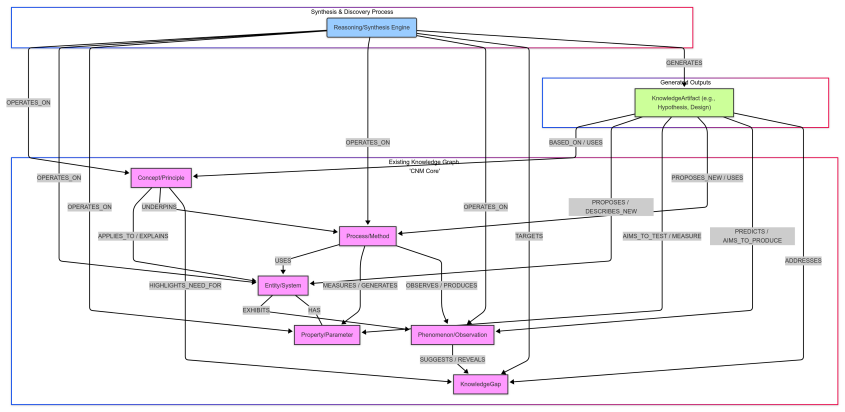
The load-bearing mechanism is the extraction-to-tensor pipeline. Guided by an adaptive template, an LLM distills each paper into structured knowledge artifacts with explicit evidence links; a self-consistent refinement loop adjusts the template as aggregated feedback reveals what it fails to capture. The artifacts are then encoded into the Conceptual Nexus Tensor $T_{\mathrm{CNM}}$, the paper's central computational object: its labeled modes index scientific components and relation types, while its entries quantify the existence or strength of interdependencies. Graph and vector views are unrolled projections of the same tensor for human use, so the tensor is what makes the framework simultaneously machine-operable and human-interpretable.
What would settle it
A concrete test is to run the proposed template-based distillation on a corpus of papers with manually curated structured annotations and to measure per-field precision and recall, especially for quantitative parameters, units, and relationship types. If extraction errors are frequent enough to change tensor entries materially, or if the required justifications do not actually support the extracted values, the CNM cannot sustain reliable gap analysis or hypothesis generation. A second check is whether the template-refinement loop converges to a stable schema when run repeatedly on the same corpus.
Extended reading notes
Core claim
The paper's core claim is that a field's knowledge can be represented not as documents but as a structured, evolving graph-and-tensor object, and that this object is the right substrate for AI-assisted discovery. In the proposed pipeline, an LLM is constrained by a field-specific template to extract granular 'knowledge artifacts' from each paper, with justifications and links to the source text; artifacts are aligned and integrated into the Conceptual Nexus Model graph, then encoded as the Conceptual Nexus Tensor $T_{\mathrm{CNM}}$, whose labeled modes index node and relation archetypes, context, and provenance and whose entries quantify the strength of interdependencies. Projections of the tensor yield the graph view for human navigation and vector-space views for similarity search. AI agents operate directly on the tensor or graph, using graph reasoning, tensor completion, and analogy-finding operations to surface gaps, inconsistencies, and candidate hypotheses. If the pipeline works at scale, the paper argues, scientific inquiry can move from document-centric reading to computation over a synthesized model of the field.
Load-bearing premise
The load-bearing premise is that a template-guided LLM can extract accurate, faithful knowledge components and justifications from scientific papers without significant hallucination or misinterpretation, because every graph, tensor entry, and agent-generated hypothesis inherits whatever noise the extraction step introduces.
Editorial extensions
If this is right
- A scientific field's literature becomes one queryable structure: papers are replaced as the unit of analysis by verifiable components that link concepts, methods, parameters, observations, and evidence.
- Knowledge gaps become systematically detectable, as missing template fields, sparse graph regions, contradictory clusters, and predictive holes can all be identified algorithmically.
- AI agents can propose hypotheses, experimental designs, or system configurations by analogical transfer and compositional assembly, with every proposed component traced back to source evidence.
- The representation is designed to be dynamic and FAIR, so the model can absorb new publications and revise its extraction schema as the field evolves, rather than freezing at a snapshot.
- If adopted, the framework could change how reproducibility is assessed, since methods, parameters, and quantitative claims are explicit and comparable across studies rather than embedded in prose.
Reading between the lines
- Inference: the paper claims extraction fidelity matters but does not measure it; an immediate next step would be a benchmark that scores template-based LLM extraction against a hand-annotated corpus of scientific papers.
- Inference: if the tensor representation matures, knowledge gaps could be quantified as low-rank or missing regions of the tensor, which suggests an information-theoretic rule for choosing which experiment to run next; the paper does not develop this.
- Inference: the same pipeline could be applied beyond journal articles, to datasets, protocols, patents, and lab notebooks, and to industrial or regulatory knowledge domains where traceability is essential; the paper only gestures at this scope.
- Inference: because the framework proposes replacing bibliometric influence with artifact-level verifiability scores, a testable long-run consequence is that those scores should predict whether a finding later replicates; that prediction is not part of the paper.
Editorial analysis
A structured set of objections, weighed in public.
Referee Report
Summary. The paper proposes the Discovery Engine (DE), a framework that uses LLMs guided by adaptive templates to distill scientific publications into structured knowledge artifacts, encodes these artifacts into a high-dimensional Conceptual Nexus Tensor (TCNM), unrolls the tensor into a Conceptual Nexus Model (CNM) knowledge graph, and lets AI agents navigate the graph to identify gaps, analogies, and hypotheses. The manuscript includes a Universal Concept Schema, a CSS-style template design, two case studies (an intelligent soft matter perspective and the DE platform's own UI design), and an open-source React/TypeScript frontend for graph visualization. The central claim is that this pipeline constitutes a new paradigm for AI-augmented scientific inquiry and accelerated discovery.
Significance. If the DE were shown to work quantitatively, it would be a significant contribution to scholarly knowledge infrastructure, with clear relevance to reproducibility, information overload, and AI-assisted hypothesis generation. The paper is commendably transparent: it explicitly lists LLM fidelity, template expressiveness, convergence, bias amplification, and scalability as validity limitations in Sec. IIA, and it provides a concrete frontend implementation and a detailed node/edge schema. However, as submitted, the paper is a well-structured vision statement rather than a demonstrated system. No extraction accuracy is measured, no baseline comparison is reported, no quantitative evidence supports the convergence of the self-consistent template loop, and the case studies are self-referential demonstrations of the workflow rather than external validations. The significance of the contribution therefore remains potential rather than established.
major comments (4)
- [Sec. IIA, 'LLM Fidelity Assumption'] The entire pipeline rests on the assumption that guided LLMs can accurately extract structured components and justifications from source texts, yet no measurement of extraction fidelity is provided. There are no precision, recall, F1, or human-agreement scores for extracted nodes, edges, parameters, or justification spans, and no gold-standard corpus is used. The paper's own LLM Fidelity Assumption concedes the risk, and the claim that extraction is 'verifiable' is not a substitute for correctness: a hallucinated extraction can carry a plausible but fabricated citation span. Because the CNM, TCNM, gap analysis, and hypothesis generation all inherit errors from this first stage, the central claim of evidence-grounded discovery is unsupported without a fidelity evaluation.
- [Sec. IIA and Fig. 2, self-consistent template refinement] The template refinement loop uses the LLM's own assessment of template fit as its feedback signal, with no external ground truth. The paper's Bias Amplification Risk explicitly acknowledges that systematic errors can be reinforced, yet the text claims the loop will 'converge towards a stable and useful state' and align the template with the 'inherent structure' of the literature. Neither convergence nor stability is demonstrated, and no stopping criterion or quantitative measure of template fit is defined. Consequently, the claim that the CNM mirrors the logical structure of the domain is not established; the loop could instead encode the LLM's prior biases.
- [Sec. VII A and VII B, case studies] Case Study 1 validates the DE using a perspective paper [48] that the DE itself helped produce, and Case Study 2 validates the DE by applying it to the design of the DE's own UI. These are self-referential demonstrations of the workflow, not external validations. Neither study tests whether the identified 'knowledge gaps' correspond to real scientific unknowns, whether the generated hypotheses are novel and informative, or whether the synthesized CNM is more accurate or useful than a conventional human literature review. No comparison against baselines (e.g., human annotation, standard IE methods, or topic modeling alone) is reported, so the abstract's claim of 'accelerated discovery' remains unsubstantiated.
- [Sec. IIB, Conceptual Nexus Tensor] The Conceptual Nexus Tensor is the paper's core formal object, but it is never defined precisely. The text states that an entry T_i,j,k,... 'would quantify the existence, strength, probability, or information-theoretic measure' of a relationship and lists several alternative population methods (direct encoding, tensor factorization, GNNs), but no concrete construction, mode normalization, sparsity structure, or tensor algebra is specified. Since AI agents are said to operate on this tensor using 'abstract mathematical and learned operations,' the lack of a formal specification makes the framework non-reproducible and prevents any evaluation of its central claims.
minor comments (9)
- [Abstract] The phrase 'Thislegacy system' should be 'This legacy system'.
- [Sec. IIA] The word 'pipline' should be 'pipeline'.
- [Fig. 2 caption] The caption says 'the corps of literature' but should be 'the corpus of literature'.
- [Sec. II] The phrase 'multi-faced way' should be 'multi-faceted way'.
- [Sec. IIA] The sentence 'These challenges represents the validity limitations of this stage' has a subject-verb agreement error; it should be 'represent'.
- [Sec. VI A / Sec. VII] There is an empty section header 'A. Case studies' under Section VI immediately followed by Section VII, which also carries the case studies; the numbering and structure should be cleaned up.
- [Reference [6]] Reference [6] (Mongillo and Tsodyks, 'Synaptic Theory of Working Memory') appears unrelated to the claim about narrative documents intertwining background and results; a citation on scientific communication or information overload would be more apt.
- [Sec. VI B] The mention of a 'process.md workflow' is informal and undefined; a formal reference to the repository or a description of the workflow would help reproducibility.
- [Appendix B] The mapping from the Universal Concept Schema node/edge archetypes to the modes of TCNM is not made explicit, which would be essential for reconstructing the tensor from extracted artifacts.
Circularity Check
Case-study validation is self-referential: the DE's success is demonstrated by artifacts the DE itself produced, and gap definitions are template-relative.
-
self citation load bearing
[Section VII A, Case Study 1]
"An initial corpus of key publications relevant to intelligent soft matter was processed using the Discovery Engine methodology (Sec. II). ... This led to the generation of a forward-looking perspective on the field, outlining key challenges, promising research directions, and a conceptual roadmap for realizing materials with true intelligent behavior [48]. ... This case study demonstrates how the Discovery Engine, through its iterative, AI-assisted, and collaborative approach to template refinement and knowledge synthesis, can facilitate the consolidation of an emerging scientific field."
The demonstration of the DE's utility is the perspective [48], which was itself generated using the DE pipeline described in the same section. Reference [48] is authored by Baulin et al., including the present first author, so it is not an independent external benchmark. The claim that the DE 'can facilitate consolidation' is supported by an artifact that the DE produced, making the evidence self-referential rather than an independent validation of the framework.
-
self citation load bearing
[Section VII B, Case Study 2]
"The principles of structured knowledge synthesis and agent-assisted generation inherent in the DE framework were meta-applied to inform the conceptual design of the DE platform itself—the interactive environment for human-AI collaboration detailed in complementary work [49]. ... This mirrored the 'process.md' workflow where AI provides initial drafts that humans then curate and enhance."
The DE is used to design the DE platform, and this meta-application is then presented as a case study demonstrating the framework's capabilities. The companion work [49] cited as the resulting design is authored by the same group (Lumiruusu, Friedman, Rahman, Baulin, Pashea). No external evaluation of the resulting platform's effectiveness is provided, so the success of the method is judged by the method's own self-designed output.
1 more flagged steps
-
self definitional
[Section II A and Section V A]
"Within the DE framework, concepts are operationalized through the structured set of components: nodes and edges (see Appendix B) defined by a given appropriate kind of template. ... Component Completeness Gaps arise when specific types of information, defined as essential by the template (e.g., specific parameters, control mechanisms, quantitative performance metrics), are consistently missing for certain classes of systems or concepts represented in the CNM."
Knowledge gaps of the 'Component Completeness' type are defined relative to the extraction template's own probes. The paper then presents these template-relative omissions as scientific knowledge gaps and as a 'data-driven map of the scientific frontier.' Because the template itself is produced and refined by the same LLM pipeline, the reported gaps are by construction the template's missing fields rather than independently established scientific unknowns. The concept representation and the gap analysis are mutually self-referential.
full rationale
No fitted equations or parameters appear, so there is no parameter-fitting circularity of the kind that would make quantitative predictions equal their inputs. The load-bearing circularity is in the validation strategy. Case Study 1 presents a perspective [48] produced through the Discovery Engine as the demonstration that the Discovery Engine 'can facilitate the consolidation of an emerging scientific field'; since [48] includes the present first author and was generated by the pipeline being validated, it is not independent evidence. Case Study 2 meta-applies the DE to design the DE's own platform and cites companion work [49] by the same authors, again making the demonstration self-referential. In addition, 'Component Completeness Gaps' are defined relative to the extraction template, so reporting them as scientific knowledge gaps is partly definitional: the missing fields are missing from the template by construction. The acknowledged LLM Fidelity Assumption is a serious unmeasured validity risk, but it is an assumption, not a circular step. Because the framework's central architecture is not derived from its own outputs and no quantitative prediction is fitted, the circularity is partial and located in the case-study evidence; score 5.
Assumptions & free parameters
assumptions (5)
- domain assumption LLM Fidelity Assumption: guided LLMs can accurately extract specified knowledge components and justifications without significant hallucination or misinterpretation.
- domain assumption Template Expressiveness Assumption: a structured, evolving template can adequately capture the richness and complexity of scientific concepts, including implicit assumptions and nuanced logical structures.
- domain assumption Convergence Assumption: the self-consistent template refinement loop converges to a stable, useful template rather than oscillating or diverging.
- domain assumption Universal Concept Schema completeness: a fixed set of node and edge archetypes can represent scientific knowledge across all fields.
- domain assumption Structural sufficiency for discovery: graph and tensor structure is enough to generate valid, novel hypotheses through analogies, gaps, and tensor completion.
invented entities (4)
-
Conceptual Nexus Tensor (TCNM)
-
Conceptual Nexus Model (CNM) graph
-
Universal Concept Schema (UCS) node and edge archetypes
-
Knowledge Gap Node
Cite this review
Pith. "Pith review of The Discovery Engine: A Framework for AI-Driven Synthesis and Navigation of Scientific Knowledge Landscapes." pith.science (2026). https://pith.science/paper/M23TO45J
@misc{pith2026250517500,
  author       = {Pith},
  title        = {Pith review of: The Discovery Engine: A Framework for AI-Driven Synthesis and Navigation of Scientific Knowledge Landscapes},
  year         = {2026},
  howpublished = {\url{https://pith.science/paper/M23TO45J}},
  note         = {Machine review of arXiv:2505.17500}
}
read the original abstract
The prevailing model for disseminating scientific knowledge relies on individual publications dispersed across numerous journals and archives. This legacy system is ill suited to the recent exponential proliferation of publications, contributing to insurmountable information overload, issues surrounding reproducibility and retractions. We introduce the Discovery Engine, a framework to address these challenges by transforming an array of disconnected literature into a unified, computationally tractable representation of a scientific domain. Central to our approach is the LLM-driven distillation of publications into structured "knowledge artifacts," instances of a universal conceptual schema, complete with verifiable links to source evidence. These artifacts are then encoded into a high-dimensional Conceptual Tensor. This tensor serves as the primary, compressed representation of the synthesized field, where its labeled modes index scientific components (concepts, methods, parameters, relations) and its entries quantify their interdependencies. The Discovery Engine allows dynamic "unrolling" of this tensor into human-interpretable views, such as explicit knowledge graphs (the CNM graph) or semantic vector spaces, for targeted exploration. Crucially, AI agents operate directly on the graph using abstract mathematical and learned operations to navigate the knowledge landscape, identify non-obvious connections, pinpoint gaps, and assist researchers in generating novel knowledge artifacts (hypotheses, designs). By converting literature into a structured tensor and enabling agent-based interaction with this compact representation, the Discovery Engine offers a new paradigm for AI-augmented scientific inquiry and accelerated discovery.
Figures


Figures from the paper (5 more)


Reference graph
Works this paper leans on
-
[48]
M. J. Healy and T. P. Caudell, Episodic memory: A hierarchy of spatiotemporal concepts, Neural Networks120, 40 (2019). 38
work page 2019
-
[1]
Initial Template Design and Distillation: A preliminary extraction template, based on the Universal Concept Schema (Appendix B) and tailored with probes spe- cific to soft matter and embodied intelligence, was used to guide LLMs in distilling knowledge artifacts from the selected papers
-
[2]
Iterative Template Refinement and CNM Construction:A diverse group of re- searchers active in fields contributing to intelligent soft matter engaged with the initial distilled components and the template itself. Through a series of iterative feedback cy- cles, managed within a collaborative environment built on Discovery Engine principles, the template wa...
-
[3]
CNM Synthesis and Gap Analysis:As the template converged towards a con- sensus representation reflecting the shared understanding of the involved experts and the literature corpus, a Conceptual Nexus Model for intelligent soft matter was con- structed. AI agents then analyzed this CNM to identify overarching themes (using methods similar to those in Sec. ...
-
[4]
Collaborative Perspective Generation: The synthesized CNM, along with the identified themes and gaps, served as the structured foundation for a collaborative effort involving domain experts and AI. This led to the generation of a forward-looking perspective on the field, outlining key challenges, promising research directions, and a conceptual roadmap for...
-
[5]
A. Tyson and B. Kennedy,Public Trust in Scientists and Views on Their Role in Policymaking, Tech. Rep. (Pew Research Center, 2024)
work page 2024
-
[6]
Distillation of HCI and KG Interaction Literature:A corpus of relevant re- search papers focusing on human-computer interaction (HCI) for complex data, knowl- edge graph visualization, explainable AI (XAI), and collaborative systems (including those cited throughout this manuscript, e.g., [43, 44, 50–54]) was processed using an early version of the Discov...
-
[7]
Synthesis of Design Principles and Feature Requirements:The distilled com- ponents were synthesized into a CNM focused on "KG Interaction Design." AI agents were then used to analyze this specialized CNM. • Pattern Identification: Agents identified recurring successful interaction patterns (e.g., multi-modal views, focus+context, provenance tracking) and ...
Show all 74 references
-
[8]
Knowledge Card
AI-Assisted Generation of Platform Concepts and UI Mockups:Working from these principles and the synthesized interaction patterns, designers collaborated with generative AI tools (LLMs prompted with the distilled requirements and design principles). This collaboration yielded ...
-
[9]
This mirrored the ‘process.md‘ workflow where AI provides initial drafts that humans then curate and enhance
Iterative Refinement:These AI-generated concepts were then iteratively refined by human designers and HCI experts, ensuring alignment with user needs and established HCI best practices. This mirrored the ‘process.md‘ workflow where AI provides initial drafts that humans then c...
-
[10]
World Model
necessitate a fundamental rethinking of how scientific knowledge is structured, dissemi- nated, and utilized. The traditional narrative publication, often distributed as a static PDF, 29 faces limitations in this new environment. The DE methodology and the resulting CNM struct...
-
[11]
M. Park, E. Leahey, and R. J. Funk, Papers and patents are becoming less disruptive over time, Nature613, 138 (2023)
2023
-
[12]
Baker, 1,500 scientists lift the lid on reproducibility, Nature533, 452 (2016)
M. Baker, 1,500 scientists lift the lid on reproducibility, Nature533, 452 (2016)
2016
-
[13]
G.Rong, Y.Chen, F.Ma,andT.Koch,40YearsofInterdisciplinaryResearch: Phases, Origins, and Key Turning Points (1981-2020) (2025)
2025
-
[14]
D. Kang, R. S. Danziger, J. Rehman, and J. A. Evans, Limited diffusion of scientific knowledge forecasts collapse, Nat Hum Behav9, 268 (2025), publisher: Nature Publishing Group
2025
-
[15]
Phillips, What is category theory to cognitive science? Compositional representation and comparison, Front
S. Phillips, What is category theory to cognitive science? Compositional representation and comparison, Front. Psychol.13, 1048975 (2022)
2022
-
[16]
Mongillo and M
G. Mongillo and M. Tsodyks, Synaptic Theory of Working Memory for Serial Order (2024). 35
2024
-
[17]
M. D. Wilkinson, M. Dumontier, I. J. Aalbersberg, G. Appleton, M. Axton, A. Baak, N. Blomberg, J.-W. Boiten, L. B. da Silva Santos, P. E. Bourne, J. Bouwman, A. J. Brookes, T. Clark, M. Crosas, I. Dillo, O. Dumon, S. Edmunds, C. T. Evelo, R. Finkers, A. Gonzalez- Beltran, A. J...
2016
-
[18]
Jacobsen, R
A. Jacobsen, R. De Miranda Azevedo, N. Juty, D. Batista, S. Coles, R. Cornet, M. Courtot, M. Crosas, M. Dumontier, C. T. Evelo, C. Goble, G. Guizzardi, K. K. Hansen, A. Hasnain, K. Hettne, J. Heringa, R. W. Hooft, M. Imming, K. G. Jeffery, R. Kaliyaperumal, M. G. Kersloot, C. ...
2020
-
[19]
Wooldridge, 1
M. Wooldridge, 1. WHAT ARE SOFTWARE AGENTS?, IEE Review (1996)
1996
-
[20]
P. A. Tsividis, J. Loula, J. Burga, N. Foss, A. Campero, T. Pouncy, S. J. Gershman, and J. B. Tenenbaum, Human-Level Reinforcement Learning through Theory-Based Modeling, Exploration, and Planning (2021), version Number: 1
2021
-
[21]
S. T. Piantadosi, D. C. Muller, J. S. Rule, K. Kaushik, M. Gorenstein, E. R. Leib, and E. Sanford, Why concepts are (probably) vectors, Trends in Cognitive Sciences28, 844 (2024)
2024
-
[22]
Kriegeskorte, M
N. Kriegeskorte, M. Mur, and P. A. Bandettini, Representational similarity analysis - connect- ing the branches of systems neuroscience, Front. Syst. Neurosci.2, 10.3389/neuro.06.004.2008 (2008), publisher: Frontiers
2008 doi
-
[23]
Kleyko, M
D. Kleyko, M. Davies, E. P. Frady, P. Kanerva, S. J. Kent, B. A. Olshausen, E. Osipov, J. M. Rabaey, D. A. Rachkovskij, A. Rahimi, and F. T. Sommer, Vector Symbolic Archi- tectures as a Computing Framework for Emerging Hardware, Proc. IEEE110, 1538 (2022), arXiv:2106.05268 [cs]. 36
2022 arXiv
-
[24]
Findability & Accessibility
suggests that the parameter space of core scientific principles within a domain might be learnable and navigable by AI, provided a sufficiently structured and verified knowledge representation like the CNM. A fundamental challenge in synthesizing scientific knowledge lies in t...
-
[25]
P. S. Jr, D. Summers-Stay, and Y. Aloimonos, A Computational Theory for Life-Long Learning of Semantics (2018), arXiv:1806.10755 [cs]
2018 arXiv
-
[26]
Yuan, A Categorical Framework of General Intelligence (2023), arXiv:2303.04571 [cs]
Y. Yuan, A Categorical Framework of General Intelligence (2023), arXiv:2303.04571 [cs]
2023 arXiv
-
[27]
Pan, Token Space: A Category Theory Framework for AI Computations (2024), arXiv:2404.11624 [math]
W. Pan, Token Space: A Category Theory Framework for AI Computations (2024), arXiv:2404.11624 [math]
2024 arXiv
-
[28]
H. Lu, Y. N. Wu, and K. J. Holyoak, Emergence of analogy from relation learning, Proceedings of the National Academy of Sciences116, 4176 (2019), publisher: Proceedings of the National Academy of Sciences
2019
-
[29]
D. A. Friedman, FieldSHIFT-2: Fully synthetic dissertations for all-by-all shifted domains (2024)
2024
-
[30]
Sejdinovic, A
D. Sejdinovic, A. Gretton, B. Sriperumbudur, and K. Fukumizu, Hypothesis testing using pairwise distances and associated kernels (with Appendix) (2012), arXiv:1205.0411 [cs]
2012 arXiv
-
[31]
M. J. Buehler, Agentic Deep Graph Reasoning Yields Self-Organizing Knowledge Networks (2025), arXiv:2502.13025 [cs]
2025 arXiv
-
[32]
O’Brien, J
T. O’Brien, J. Stremmel, L. Pio-Lopez, P. McMillen, C. Rasmussen-Ivey, and M. Levin, Ma- chine learning for hypothesis generation in biology and medicine: exploring the latent space of neuroscience and developmental bioelectricity, Digital Discovery3, 249 (2024), publisher: RSC
2024
-
[33]
Lloyd, Ultimate physical limits to computation, Nature406, 1047 (2000), publisher: Nature Publishing Group
S. Lloyd, Ultimate physical limits to computation, Nature406, 1047 (2000), publisher: Nature Publishing Group
2000
-
[34]
E. P. Wigner, The Unreasonable Effectiveness of Mathematics in the Natural Sciences, in Philosophical Reflections and Syntheses, edited by J. Mehra (Springer, Berlin, Heidelberg,
-
[35]
E. O. Buzbas, B. Devezer, and B. Baumgaertner, The logical structure of experiments lays the foundation for a theory of reproducibility, R. Soc. open sci.10, 221042 (2023)
2023
-
[36]
M. J. Buehler, Graph-Aware Isomorphic Attention for Adaptive Dynamics in Transformers (2025), arXiv:2501.02393 [cs]
2025 arXiv
-
[37]
M. J. Buehler, Self-Organizing Graph Reasoning Evolves into a Critical State for Continuous Discovery Through Structural-Semantic Dynamics (2025), arXiv:2503.18852 [cs]. 37
2025 arXiv
-
[38]
Margolis and S
E. Margolis and S. Laurence, Concepts, inThe Blackwell Guide to Philosophy of Mind, edited by S. P. Stich and T. A. Warfield (Wiley, 2003) 1st ed., pp. 190–213
2003
-
[39]
J. A. Fodor and Z. W. Pylyshyn, Connectionism and cognitive architecture: A critical analysis, Cognition 28, 3 (1988)
1988
-
[40]
T. S. Kuhn, The structure of scientific revolutions, 2nd ed., International encyclopedia of unified science No. 2,2 (Univ. of Chicago Press, Chicago, 1994)
1994
-
[41]
Rogers, O
A. Rogers, O. Kovaleva, and A. Rumshisky, A Primer in BERTology: What We Know About How BERT Works, Transactions of the Association for Computational Linguistics 8, 842 (2021)
2021
-
[42]
Novikov, N
A. Novikov, N. Vu, M. Eisenberger, E. Dupont, P.-S. Huang, A. Z. Wagner, S. Shirobokov, B. Kozlovskii, F. J. R. Ruiz, A. Mehrabian, M. P. Kumar, S. Chaudhuri, G. Holland, A. Davies, S. Nowozin, P. Kohli, and M. Balog, AlphaEvolve: A coding agent for scientific and algorithmic ...
2025
-
[43]
E. P. Frady, D. Kleyko, C. J. Kymn, B. A. Olshausen, and F. T. Sommer, Computing on Func- tions Using Randomized Vector Representations (in brief), inNeuro-Inspired Computational Elements Conference(ACM, Virtual Event USA, 2022) pp. 115–122
2022
-
[44]
W. Lu, R. K. Luu, and M. J. Buehler, Fine-tuning large language models for domain adap- tation: exploration of training strategies, scaling, model merging and synergistic capabilities, npj Comput Mater11, 1 (2025), publisher: Nature Publishing Group
2025
-
[45]
Balazevic, C
I. Balazevic, C. Allen, and T. Hospedales, TuckER: Tensor Factorization for Knowledge Graph Completion, in Proceedings of the 2019 Conference on Empirical Methods in Natural Lan- guage Processing and the 9th International Joint Conference on Natural Language Processing (EMNLP-...
2019
-
[46]
H. Ren, M. Galkin, M. Cochez, Z. Zhu, and J. Leskovec, Neural Graph Reasoning: Complex Logical Query Answering Meets Graph Databases (2023), version Number: 1
2023
-
[47]
M. M. Bronstein, J. Bruna, T. Cohen, and P. Veličković, Geometric Deep Learning: Grids, Groups, Graphs, Geodesics, and Gauges (2021), arXiv:2104.13478 [cs]
2021 arXiv
-
[49]
Grootendorst, BERTopic: Neural topic modeling with a class-based TF-IDF procedure (2022)
M. Grootendorst, BERTopic: Neural topic modeling with a class-based TF-IDF procedure (2022)
2022
-
[50]
Koupil and I
P. Koupil and I. Holubová, A unified representation and transformation of multi-model data using category theory, J Big Data9, 61 (2022)
2022
-
[51]
R. N. Shepard and S. Chipman, Second-order isomorphism of internal representations: Shapes of states, Cognitive Psychology1, 1 (1970)
1970
-
[52]
Besta, F
M. Besta, F. Memedi, Z. Zhang, R. Gerstenberger, G. Piao, N. Blach, P. Nyczyk, M. Copik, G. Kwaśniewski, J. Müller, L. Gianinazzi, A. Kubicek, H. Niewiadomski, A. O’Mahony, O. Mutlu, and T. Hoefler, Demystifying Chains, Trees, and Graphs of Thoughts (2025), arXiv:2401.14295 [cs]
2025
-
[53]
Sequeda, D
J. Sequeda, D. Allemang, and B. Jacob, Knowledge Graphs as a source of trust for LLM- powered enterprise question answering, Journal of Web Semantics85, 100858 (2025)
2025
-
[54]
Z. He, N. Xiong, H. Li, P. Shen, G. Zhu, and L. Zhang, The two-way knowledge interaction interface between humans and neural networks (2024), arXiv:2401.05461 [cs]
2024 arXiv
-
[55]
Manzoor, J
E. Manzoor, J. Tong, S. Vijayaraghavan, and R. Li, Expanding Knowledge Graphs with Hu- mans in the Loop (2023), arXiv:2212.05189 [cs]
2023 arXiv
-
[56]
Howson and P
C. Howson and P. Urbach,Scientific reasoning: The Bayesian approach, 3rd ed. (Open Court, Chicago, IL, 2006)
2006
-
[57]
Bechtel and L
W. Bechtel and L. Bich, Grounding cognition: heterarchical control mechanisms in biology, Phil. Trans. R. Soc. B376, 20190751 (2021)
2021
-
[58]
V. A. Baulin, A. Giacometti, D. A. Fedosov, S. Ebbens, N. R. Varela-Rosales, N. Fe- liu, M. Chowdhury, M. Hu, R. Füchslin, M. Dijkstra, M. Mussel, R. Van Roij, D. Xie, V. Tzanov, M. Zu, S. Hidalgo-Caballero, Y. Yuan, L. Cocconi, C.-M. Ghim, C. Cottin- Bizonne, M. C. Miguel, M....
2025 doi
-
[59]
Lumiruusu, D
J. Lumiruusu, D. Friedman, S. Rahman, V. Baulin, and A. Pashea, ResNei: Solution Design Document (2025), publisher: Active Inference Institute
2025
-
[60]
H. Li, G. Appleby, C. D. Brumar, R. Chang, and A. Suh, Knowledge Graphs in Practice: Characterizing their Users, Challenges, and Visualization Opportunities, IEEE Trans. Visual. Comput. Graphics30, 584 (2024), arXiv:2304.01311 [cs]. 39
2024 arXiv
-
[61]
Sarrafzadeh, A
B. Sarrafzadeh, A. Roegiest, and E. Lank, Hierarchical Knowledge Graphs: A Novel Infor- mation Representation for Exploratory Search Tasks (2020), arXiv:2005.01716 [cs] version: 1
2020 arXiv
-
[62]
Zhang, Z
S. Zhang, Z. Wang, C. Chen, Y. Dai, L. Ye, and X. Sun, Patterns for Representing Knowledge Graphs to Communicate Situational Knowledge of Service Robots, inProceedings of the 2021 CHI Conference on Human Factors in Computing Systems(2021) pp. 1–12, arXiv:2101.10602 [cs]
2021 arXiv
-
[63]
Meier and K
S. Meier and K. Glinka, To Classify is to Interpret: Building Taxonomies from Heterogeneous Data through Human-AI Collaboration, inMensch und Computer 2023(2023) pp. 395–401, arXiv:2307.16481 [cs]
2023 arXiv
-
[64]
Rahman, F
S. Rahman, F. Choi, H. Kim, D. Zhang, and E. Hruschka, Knowledge Acquisition and Inte- gration with Expert-in-the-loop (2024), arXiv:2402.03291 [cs]
2024 arXiv
-
[65]
K. J. Friston, T. FitzGerald, F. Rigoli, P. Schwartenbeck, and G. Pezzulo, Active inference: a process theory, Neural computation29, 1 (2017)
2017
-
[66]
Sejdinovic, B
D. Sejdinovic, B. Sriperumbudur, A. Gretton, and K. Fukumizu, Equivalence of distance-based and RKHS-based statistics in hypothesis testing, The Annals of Statistics41, 2263 (2013), publisher: Institute of Mathematical Statistics
2013
-
[67]
J.Hefford, V.Wang,andM.Wilson,CategoriesofSemanticConcepts(2020),arXiv:2004.10741 [cs] version: 1
2020 arXiv
-
[68]
Purvine, C
E. Purvine, C. Joslyn, and M. Robinson, A Category Theoretical Investigation of the Type Hierarchy for Heterogeneous Sensor Integration (2016), arXiv:1609.02883 [math]
2016 arXiv
-
[69]
Christino, S
L. Christino, S. Rezaeipourfarsangi, E. Milios, and F. V. Paulovich, A Theoretical Ap- proach for Structuring and Analysing Knowledge Provenance for Visual Analytics (2023), arXiv:2204.00585 [cs]
2023 arXiv
-
[70]
Ciaunica, M
A. Ciaunica, M. Levin, F. E. Rosas, and K. Friston, Nested Selves: Self-Organization and Shared Markov Blankets in Prenatal Development in Humans, Topics in Cognitive Science00, 1 (2023), _eprint: https://onlinelibrary.wiley.com/doi/pdf/10.1111/tops.12717
2023 doi
-
[71]
X. Zhao, M. Blum, R. Yang, B. Yang, L. M. Carpintero, M. Pina-Navarro, T. Wang, X. Li, H. Li, Y. Fu, R. Wang, J. Zhang, and I. Li, AGENTiGraph: An Interactive Knowledge Graph Platform for LLM-based Chatbots Utilizing Private Data (2024), arXiv:2410.11531 [cs]. 40
2024 arXiv
-
[72]
H. Li, G. Appleby, and A. Suh, A Preliminary Roadmap for LLMs as Assistants in Exploring, Analyzing, and Visualizing Knowledge Graphs (2024), arXiv:2404.01425 [cs]
2024 arXiv
-
[73]
Sarrafzadeh, A
B. Sarrafzadeh, A. Vtyurina, E. Lank, and O. Vechtomova, Knowledge Graphs versus Hierar- chies: An Analysis of User Behaviours and Perspectives in Information Seeking, inProceedings of the 2016 ACM on Conference on Human Information Interaction and Retrieval, CHIIR ’16 (Associ...
2016
-
[74]
M. G. Skjæveland, K. Balog, N. Bernard, W. Łajewska, and T. Linjordet, An Ecosystem for Personal Knowledge Graphs: A Survey and Research Roadmap, AI Open5, 55 (2024), arXiv:2304.09572 [cs]. 41
2024 arXiv
Reviewed August 7, 2026 · model on record in the stance chip above.
Discussion (0). Sign in to comment.