REVIEW 4 major objections 5 minor 76 references
Demonstration of Quantum-Secure Communications in a Nuclear Reactor
T0 review · 4 major / 5 minor · reviewed 2026-08-07 · deepseek-v4-flash
Pith's one-line read A quantum key distribution system encrypted live reactor data in a working nuclear reactor at 320 kbps.
desk verdict First QKD-in-reactor deployment with usable data, but the headline distances are emulated and the 'end-to-end' claim outruns the setup. read the letter →
The pith
A machine-rendered reading of the paper's core claim, the machinery that carries it, and where it could break.
The reading
What carries the argument
The carrying object is the phase-encoding decoy-state BB84 protocol in the T12 variant, which mixes signal states with one decoy and a vacuum state using asymmetric basis selection. The system is analysed with the standard secret key rate decomposition $SKR = R_{raw}\eta_{sift}g(E)$, where the raw rate comes from source repetition, detector efficiency, and channel transmissivity $t_{chan}=10^{-al/10}$, and the decoy states allow a lower bound on single-photon contributions. Around that hardware, the paper builds a communication model with eight parameters (signal count, sampling and reporting rates, precision, key-reusability factor, channel length, QBER, autonomy), three constraint conditions (latency inequality, key-availability inequality, post-failure uptime inequality), and a dynamic key pool whose size is updated by key contributions minus consumption. The model converts a fixed QKD measurement into operational decisions: whether a use case is feasible, how much lead time is needed, and how long secure communication survives a key-distribution failure.
What would settle it
Set up the same QKD hardware on a true 54 km and a true 140 km single-mode fiber link (or an installed dark-fiber route), compare the measured SKR and QBER against the attenuator-plus-delay-line data, and simultaneously log radiation dose and electromagnetic interference at the QKD rack during reactor operation to see whether QBER tracks those levels.
Extended reading notes
Core claim
The paper's central claim is that QKD is compatible with the operational constraints of a fully digital nuclear reactor's instrumentation and control environment. Using a commercial long-distance phase-encoding decoy-state BB84 QKD system, the authors report end-to-end real-time encryption and decryption of reactor data with a stable secret key rate of approximately 320 kbps and a QBER of about 3.8% at 54 km over a ten-hour period. The same setup encrypted 2,000 signals with OTP out to approximately 82 km, and the 68 core reactor signals out to approximately 135 km at 1 Hz; with AES-256 the distance reaches 140 km. The paper also derives and applies a dynamic key-pool model showing that a short QKD lead time removes the dead time at long distances, and that switching from OTP to AES-256 after a QKD failure extends encrypted uptime from under an hour to several hours or more.
Load-bearing premise
The load-bearing premise is that a bench of attenuators and a 32 km delay line reproduces what happens over 82–140 km of real single-mode fiber in terms of attenuation, dispersion, and polarization drift, and that the reactor control room's unmeasured radiation and electromagnetic environment is representative of future deployments.
Editorial extensions
If this is right
- At 54 km the system sustained a 320 kbps secret key rate with a 3.8% error rate over ten hours, which is enough to encrypt the reactor's core signals in real time at 1 Hz.
- OTP encryption of all 2,000 reactor signals is feasible up to about 82 km, and 68 core signals up to about 135 km at 1 Hz, with no key shortage once a short lead time is applied.
- AES-256 raises the maximum distance to 140 km for data-heavy use cases and, after a QKD failure, keeps encrypted communication available for hundreds of hours at short distances and at least tens of minutes at the longest distances.
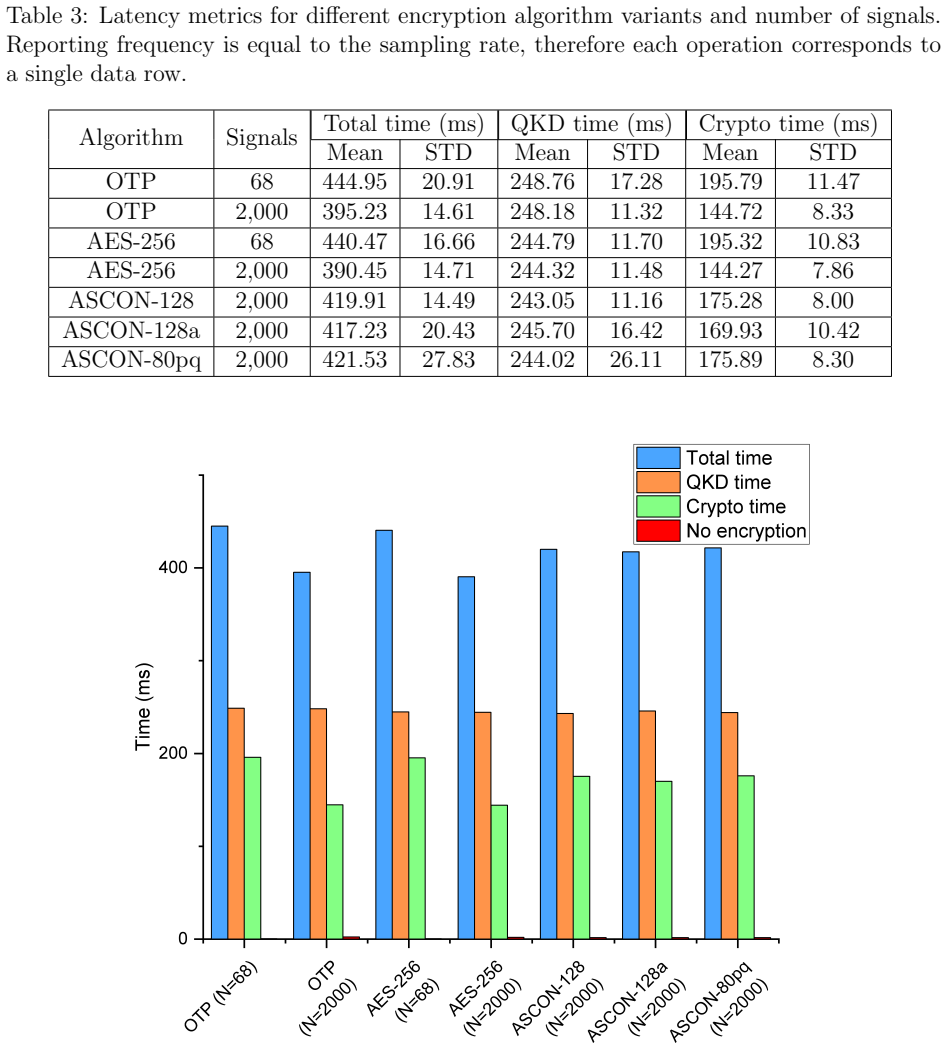
- QKD key request and delivery dominates end-to-end latency (about 245 ms), so the tested OTP, AES-256, and ASCON schemes all satisfy a 1 Hz reporting deadline, while 10 Hz reporting remains marginal.
- A dynamic key pool with a small QKD lead time removes the startup dead time observed at long distances and provides a reserve that can be drawn down during outages.
Reading between the lines
- Because distance was emulated with attenuators and a delay line, the headline distance figures would hold for real deployment only if that emulation faithfully reproduces fiber dispersion and polarization drift; the authors do not validate this against a physical link.
- If the emulation is faithful, the same eight-parameter model could be reused to size key pools and lead times for other critical infrastructure, such as power grids, dams, or remote industrial facilities, with minimal adaptation.
- The OTP-to-AES failover strategy suggests a graceful-degradation path for reactor communications that does not require reactor shutdown, which aligns with the stated nuclear-sector requirement of avoiding plant trips.
- A natural next experiment would be to run the same QKD hardware over a real dark fiber of comparable length and to log radiation dose and EMI in the reactor room, checking whether QBER tracks those environmental variables.
Signed reviews
Editorial analysis
A structured set of objections, weighed in public.
Referee Report
Summary. The paper reports an experimental demonstration of a commercial phase-encoding decoy-state BB84 QKD system (Toshiba QKD-LD) installed at Purdue's PUR-1 research reactor. The authors measure secret key rate (SKR) and quantum bit error rate (QBER) over emulated fiber lengths using a variable optical attenuator, fixed attenuators, and a 32 km delay line, and they combine these measurements with a key-pool bookkeeping model to evaluate key availability, required QKD lead times, and post-failure secure uptimes for two reactor monitoring use cases (68 core signals and 2,000 signals) with OTP, AES-256, and ASCON encryption. They also report end-to-end latency measurements for encrypted reactor data exchanged between two workstations over a local TCP/IP LAN.
Significance. The paper's value lies in the system integration and operational characterization: a commercial QKD system was operated for 10-hour intervals in a reactor control room, with stable SKR/QBER records, a clearly formulated key-availability model that uses measured SKR data as inputs rather than fitting the target results, and extensive latency measurements for multiple ciphers. The bookkeeping model for the dynamic key pool and the lead-time calculations are useful engineering contributions. However, the headline distances (82 km, 135 km, 140 km) are emulated with attenuators plus a 32 km delay line, and the encrypted reactor data path is a local LAN, not a fiber link spanning those distances. As a result, the abstract's 'complete end-to-end demonstration' over those distances overstates what was actually measured, and the transferability of the SKR-versus-distance results to real deployed fiber remains unvalidated.
major comments (4)
- [Section 6, Figure 7] The distance claims are based on an emulated channel, not deployed fiber. The 82 km, 135 km, and 140 km points are produced by combining a variable optical attenuator, two fixed 10 dB attenuators, and a 32 km GP800 delay line inserted between QKD-Alice and QKD-Bob. The paper reports no comparison with a real single-mode fiber link. A VOA adds loss but does not reproduce the chromatic dispersion, polarization-mode dispersion, connector/backscatter losses, or slow polarization drift of 82–140 km of SMF. Phase-encoding decoy-state BB84 is sensitive to phase instability and QBER, so the quoted 3.8% QBER at 54 km and 7.5% at 145 km are emulator values. The abstract and conclusions should qualify these distances as emulated, or the authors should add a real-fiber validation, before claiming a complete end-to-end demonstration at those distances.
- [Section 6, Figure 6] The encrypted reactor data did not travel over the emulated fiber at all. Terminals W_A and W_B communicate via a regular TCP/IP non-dedicated LAN, while the quantum and classical QKD channels are separate fibers intercepted by the attenuation and delay equipment. Therefore, the statement in the abstract that the system executed 'real-time encryption and decryption of 2,000 signals over optic fiber distances up to 82 km' describes a local data loop with an emulated QKD channel, not an end-to-end remote link spanning 82 km. The geographic remoteness and any distance-dependent effects on the encrypted data path are not demonstrated; the wording should be corrected or the experiment should be extended to send encrypted data over the same fiber span used for key generation.
- [Section 7.1 and Section 2] The paper claims 'unconditional secure remote communications' and 'information-theoretic security' for the OTP use case, but the security analysis is not presented. The SKR and QBER are the outputs of the commercial Toshiba system's internal T12 implementation, and no finite-key security parameters, security proof assumptions, or device calibration details are reported. If the security claim is intended as a central contribution, the manuscript must either cite the specific security proof and parameter regime applicable to the deployed system or explicitly state that the security level is that implemented by the vendor. Without this, the 'quantum-secure' wording is stronger than what the paper itself establishes.
- [Section 5 and Section 6] No radiation dose or electromagnetic interference measurements are reported for the reactor environment. The installation is in the PUR-1 control room, and Section 3 correctly notes that 'it remains to be shown whether radiation environments would affect QKD performance'; this work does not close that gap. The phrase 'under prototypic conditions on PUR-1' in the abstract should therefore be limited to the control-room environment, and the conclusions should not imply that operation in more demanding radiation or EMI environments has been demonstrated.
minor comments (5)
- [Section 4.5] The sentence 'Equations 26- 28 can be handful to determine...' contains a typo; 'handful' should be 'helpful'.
- [Section 7.3] The text refers to 'OPT' in 'unlike OPT, the block cipher defines a fixed key length'; this should be 'OTP'.
- [Section 7.1, Figures 7 and 8] Figure 7's x-axis starts at 60 km, but the text and Figure 8 report data at 50 km and 54 km; please clarify the exact set of replicated distances plotted in Figure 7.
- [Section 2, Equation (3)] Equation (3) uses g(E) without an explicit definition in the main text; the surrounding text describes error correction and privacy amplification, but a formal definition of g would improve readability.
- [Section 5 and Tables 4–8] The use-case results depend on the selection of 68 core signals and the assumption of 32-bit precision, both of which are motivated by domain knowledge; the manuscript should briefly state how sensitive the maximum achievable distances are to these choices, since a different signal set or precision would change the key consumption rates.
Circularity Check
No significant circularity: measured SKR/QBER drive an explicit bookkeeping model, and no derived quantity is equivalent to its own input.
full rationale
The paper's derivation chain is self-contained in the relevant sense. The central performance numbers (SKR, QBER, latency) are measurements taken from the commercial Toshiba QKD-LD system, not outputs of a model fitted to those same numbers. The maximum-distance claims are obtained by applying the explicit key-availability inequality n = N·p·fs·fenc ≤ SKR(l,E)·Δτef (Eq. 11) to the measured SKR-versus-distance curve, and the lead-time and post-failure uptime results are deterministic evaluations of the pool-balance Equation 20 against recorded QKD data. No equation reduces to a fitted value, and no target result is used to define its own input. The self-citations ([66], [67], [69]) provide stated input assumptions such as the 68-signal core set and 32-bit precision; these are domain inputs, not predictions derived in this paper, and they do not force the experimentally measured SKR/QBER values. A genuine limitation is explicitly acknowledged in Section 6: the 82–140 km channels are emulated with a variable optical attenuator, fixed attenuators, and a 32 km delay line, and the paper notes the delay line introduces 'potential time/frequency dispersion effects,' but no validation against a real fiber link is reported. That is an external-validity concern about whether emulated distances transfer to deployed fiber, not a circularity in the derivation chain.
Assumptions & free parameters
free parameters (6)
- Channel attenuation coefficient a =
0.2 dB/km
- Decoy state probabilities =
signal 1.661%, vacuum 1.466%
- Key reusability factors =
OTP=1, AES-256=0.006-0.17, ASCON=0.004
- Number of core signals =
68
- Precision p =
32 bits
- Lead time viability threshold =
5 hours
assumptions (6)
- standard math BB84 decoy-state security proofs and SKR formulas (Eqs 3-5)
- domain assumption The VOA+delay line emulation is equivalent to real fiber of same loss/length
- domain assumption Reactor control room environment is representative of advanced reactor I&C
- domain assumption PUR-1 data signals are representative of future reactor remote monitoring
- domain assumption KMS key pool is synchronized and identical at Alice and Bob
- ad hoc to paper ASCON-80pq is post-quantum secure
Cite this review
Pith. "Pith review of Demonstration of Quantum-Secure Communications in a Nuclear Reactor." pith.science (2026). https://pith.science/paper/ARRNYKOH
@misc{pith2026250517502,
  author       = {Pith},
  title        = {Pith review of: Demonstration of Quantum-Secure Communications in a Nuclear Reactor},
  year         = {2026},
  howpublished = {\url{https://pith.science/paper/ARRNYKOH}},
  note         = {Machine review of arXiv:2505.17502}
}
read the original abstract
Quantum key distribution (QKD), one of the latest cryptographic techniques, founded on the laws of quantum mechanics rather than mathematical complexity, promises for the first time unconditional secure remote communications. Integrating this technology into the next generation nuclear systems - designed for universal data collection and real-time sharing as well as cutting-edge instrumentation and increased dependency on digital technologies - could provide significant benefits enabling secure, unattended, and autonomous operation in remote areas, e.g., microreactors and fission batteries. However, any practical implementation on a critical reactor system must meet strict requirements on latency, control system compatibility, stability, and performance under operational transients. Here, we report the complete end-to-end demonstration of a phase-encoding decoy-state BB84 protocol QKD system under prototypic conditions on Purdue's fully digital nuclear reactor, PUR-1. The system was installed in PUR-1 successfully executing real-time encryption and decryption of 2,000 signals over optic fiber distances up to 82 km using OTP-based encryption and up to 140 km with AES-based encryption. For a core of 68 signals, OTP-secure communication was achieved for up to 135 km. The QKD system maintained a stable secret key rate of 320 kbps and a quantum bit error of 3.8% at 54 km. Our results demonstrate that OTP-based encryption introduces minimal latency while the more key-efficient AES and ASCON encryption schemes can significantly increase the number of signals encrypted without latency penalties. Additionally, implementation of a dynamic key pool ensures several hours of secure key availability during potential system downtimes. This work shows the potential of quantum-based secure remote communications for future digitally driven nuclear reactor technologies.
Figures


Figures from the paper (16 more)


Reference graph
Works this paper leans on
-
[1]
Advance Reactor Operational Tech- nology Architecture Categorization,
R. Fasano, A. Hahn, A. Haddad, and C. Lamb, “Advance Reactor Operational Tech- nology Architecture Categorization,” Sandia National Lab. (SNL-NM), Albuquerque, NM (United States), Tech. Rep. SAND2021-12084, Sep. 2021. [Online]. Available: https://www.osti.gov/biblio/1854723
-
[2]
Overview of Small Modular and Advanced Nuclear Reactors and Their Role in the Energy Transition,
J. K. Nøland, M. N. Hjelmeland, C. Hartmann, L. B. Tjernberg, and M. Korp ˚ as, “Overview of Small Modular and Advanced Nuclear Reactors and Their Role in the Energy Transition,”IEEE Transactions on Energy Conversion, pp. 1–12, 2025, conference Name: IEEE Transactions on Energy Conversion. [Online]. Available: https://ieeexplore.ieee.org/document/10841944
- [3]
-
[4]
Regulatory Guide 5.71, Cyber Security Programs for Nuclear Facilities,
U. NRC, “Regulatory Guide 5.71, Cyber Security Programs for Nuclear Facilities,”US NRC, Washington, DC, 2010
work page 2010
-
[5]
J. Son, T. Tak, and H. Inhye, “Modeling cryptographic algorithms validation and developing block ciphers with electronic code book for a control system at nuclear power plants,”Nuclear Engineering and Technology, vol. 55, no. 1, pp. 25–36, Jan. 2023. [Online]. Available: https://linkinghub.elsevier.com/retrieve/pii/S1738573322003527
work page 2023
-
[6]
J. Katz and Y. Lindell,Introduction to modern cryptography, third edition ed., ser. Chapman & Hall/CRC Cryptography and Network Security Series. Boca Raton London New York: CRC Press Taylor & Francis Group, 2021
work page 2021
-
[7]
The Impact of Quantum Computing on Present Cryptography,
V. Mavroeidis, K. Vishi, M. D. Zych, and A. Jøsang, “The Impact of Quantum Computing on Present Cryptography,”International Journal of Advanced Computer Science and Applications, vol. 9, no. 3, 2018, arXiv:1804.00200 [cs]. [Online]. Available: http://arxiv.org/abs/1804.00200
arXiv 2018
-
[8]
How to factor 2048 bit RSA integers in 8 hours using 20 million noisy qubits,
C. Gidney and M. Eker ˚ a, “How to factor 2048 bit RSA integers in 8 hours using 20 million noisy qubits,”Quantum, vol. 5, p. 433, Apr. 2021, publisher: Verein zur F¨ orderung des Open Access Publizierens in den Quantenwissenschaften. [Online]. Available: https://quantum-journal.org/papers/q-2021-04-15-433/
Show all 76 references
-
[9]
The End of Encryption? – The Era of Quantum Comput- ers,
P. Szikora and K. Laz´ anyi, “The End of Encryption? – The Era of Quantum Comput- ers,” inSecurity-Related Advanced Technologies in Critical Infrastructure Protection, T. A. Kov´ acs, Z. Nyikes, and I. F¨ urstner, Eds. Dordrecht: Springer Netherlands, 2022, pp. 61–72
2022
-
[10]
Analyzing the Impact of Quantum Computing on Current Encryption Techniques,
R. Azhari and A. N. Salsabila, “Analyzing the Impact of Quantum Computing on Current Encryption Techniques,”IAIC Transactions on Sustainable Digital Innovation (ITSDI), vol. 5, no. 2, pp. 148–157, Feb. 2024, number: 2. [Online]. Available: https://aptikom-journal.id/itsdi/arti...
2024
-
[11]
National Quantum Initiative
“National Quantum Initiative.” [Online]. Available: https://www.quantum.gov/
-
[12]
Meet Willow, our state-of-the-art quantum chip,
H. Neven, “Meet Willow, our state-of-the-art quantum chip,” Dec. 2024. [Online]. Available: https://blog.google/technology/research/google-willow-quantum-chip/
2024
-
[13]
Google wants to build a useful quantum computer by 2029,
J. Porter, “Google wants to build a useful quantum computer by 2029,” May 2021. [Online]. Available: https://www.theverge.com/2021/5/19/22443453/ google-quantum-computer-2029-decade-commercial-useful-qubits-quantum-transistor
2021
-
[14]
Google reveals quantum computing chip with ‘breakthrough’ achievements,
E. Roth, “Google reveals quantum computing chip with ‘breakthrough’ achievements,” Dec. 2024. [Online]. Available: https://www.theverge.com/2024/12/9/24317382/ google-willow-quantum-computing-chip-breakthrough
2024
-
[15]
AI and quantum computing: How IBM showed up at SXSW 2025,
M. Murphy, “AI and quantum computing: How IBM showed up at SXSW 2025,” Mar. 2025. [Online]. Available: https://research.ibm.com/blog/ ibm-research-sxsw-quantum-ai 30
2025
-
[16]
IBM quantum computers: evolution, performance, and future directions,
M. AbuGhanem, “IBM quantum computers: evolution, performance, and future directions,”The Journal of Supercomputing, vol. 81, no. 5, p. 687, Apr. 2025. [Online]. Available: https://doi.org/10.1007/s11227-025-07047-7
2025 doi
-
[17]
Transitioning organizations to post-quantum cryptography,
D. Joseph, R. Misoczki, M. Manzano, J. Tricot, F. D. Pinuaga, O. Lacombe, S. Leichenauer, J. Hidary, P. Venables, and R. Hansen, “Transitioning organizations to post-quantum cryptography,”Nature, vol. 605, no. 7909, pp. 237–243, May 2022, publisher: Nature Publishing Group. [O...
2022
-
[18]
Quantum key distribution: a survey on current vulnerability trends and potential implementation risks,
A. Brazaola-Vicario, A. Ruiz, O. Lage, E. Jacob, and J. Astorga, “Quantum key distribution: a survey on current vulnerability trends and potential implementation risks,”Optics Continuum, vol. 3, no. 8, pp. 1438–1460, Aug. 2024, publisher: Optica Publishing Group. [Online]. Ava...
2024
-
[19]
Quantum cryptography: Public key distribution and coin tossing,
C. H. Bennett and G. Brassard, “Quantum cryptography: Public key distribution and coin tossing,”Theoretical Computer Science, vol. 560, pp. 7–11, Dec. 2014. [Online]. Available: https://www.sciencedirect.com/science/article/pii/S0304397514004241
2014
-
[20]
Quantum Key Distribution (QKD) Protocols: A Survey,
A. I. Nurhadi and N. R. Syambas, “Quantum Key Distribution (QKD) Protocols: A Survey,” in2018 4th International Conference on Wireless and Telematics (ICWT). Nusa Dua: IEEE, Jul. 2018, pp. 1–5. [Online]. Available: https://ieeexplore.ieee.org/document/8527822/
2018
-
[21]
Decoy-state quantum key distribution with biased basis choice,
Z. Wei, W. Wang, Z. Zhang, M. Gao, Z. Ma, and X. Ma, “Decoy-state quantum key distribution with biased basis choice,”Scientific Reports, vol. 3, no. 1, p. 2453, Aug. 2013, number: 1 Publisher: Nature Publishing Group. [Online]. Available: https://www.nature.com/articles/srep02453
2013
-
[22]
Overcoming the rate–distance limit of quantum key distribution without quantum repeaters,
M. Lucamarini, Z. L. Yuan, J. F. Dynes, and A. J. Shields, “Overcoming the rate–distance limit of quantum key distribution without quantum repeaters,”Nature, vol. 557, no. 7705, pp. 400–403, May 2018, publisher: Nature Publishing Group. [Online]. Available: https://www.nature....
2018
-
[23]
Advances in quantum cryptography,
S. Pirandola, U. L. Andersen, L. Banchi, M. Berta, D. Bunandar, R. Colbeck, D. Englund, T. Gehring, C. Lupo, C. Ottaviani, J. L. Pereira, M. Razavi, J. Shamsul Shaari, M. Tomamichel, V. C. Usenko, G. Vallone, P. Villoresi, and P. Wallden, “Advances in quantum cryptography,”Adv...
2020
-
[24]
Security in quantum cryptography,
C. Portmann and R. Renner, “Security in quantum cryptography,”Reviews of Modern Physics, vol. 94, no. 2, p. 025008, Jun. 2022, publisher: American Physical Society. [Online]. Available: https://link.aps.org/doi/10.1103/RevModPhys.94.025008
2022 doi
-
[25]
Tight finite-key analysis for quantum cryptography,
M. Tomamichel, C. C. W. Lim, N. Gisin, and R. Renner, “Tight finite-key analysis for quantum cryptography,”Nature Communications, vol. 3, no. 1, 31 p. 634, Jan. 2012, publisher: Nature Publishing Group. [Online]. Available: https://www.nature.com/articles/ncomms1631
2012
-
[26]
Security of quantum key distribution with multiphoton components,
H.-L. Yin, Y. Fu, Y. Mao, and Z.-B. Chen, “Security of quantum key distribution with multiphoton components,”Scientific Reports, vol. 6, no. 1, p. 29482, Jul. 2016, number: 1 Publisher: Nature Publishing Group. [Online]. Available: https://www.nature.com/articles/srep29482
2016
-
[27]
Fundamental limits of repeaterless quantum communications,
S. Pirandola, R. Laurenza, C. Ottaviani, and L. Banchi, “Fundamental limits of repeaterless quantum communications,”Nature Communications, vol. 8, no. 1, p. 15043, Apr. 2017, publisher: Nature Publishing Group. [Online]. Available: https://www.nature.com/articles/ncomms15043
2017
-
[28]
Fundamental rate-loss tradeoff for optical quantum key distribution,
M. Takeoka, S. Guha, and M. M. Wilde, “Fundamental rate-loss tradeoff for optical quantum key distribution,”Nature Communications, vol. 5, no. 1, p. 5235, Oct. 2014, publisher: Nature Publishing Group. [Online]. Available: https://www.nature.com/articles/ncomms6235
2014
-
[29]
Improving Parameter Optimization in Decoy-State Quantum Key Distribution,
Z. Li and K. Wei, “Improving Parameter Optimization in Decoy-State Quantum Key Distribution,”Quantum Engineering, vol. 2022, pp. 1–9, Feb. 2022. [Online]. Available: https://www.hindawi.com/journals/que/2022/9717591/
2022
-
[30]
Continuous-mode quantum key distribution with digital signal processing,
Z. Chen, X. Wang, S. Yu, Z. Li, and H. Guo, “Continuous-mode quantum key distribution with digital signal processing,”npj Quantum Information, vol. 9, no. 1, pp. 1–8, Mar. 2023, number: 1 Publisher: Nature Publishing Group. [Online]. Available: https://www.nature.com/articles/...
2023
-
[31]
Advances in InGaAs/InP single-photon detector systems for quantum communication,
J. Zhang, M. A. Itzler, H. Zbinden, and J.-W. Pan, “Advances in InGaAs/InP single-photon detector systems for quantum communication,”Light: Science & Applications, vol. 4, no. 5, pp. e286–e286, May 2015, publisher: Nature Publishing Group. [Online]. Available: https://www.natu...
2015
-
[32]
Fast single-photon detectors and real-time key distillation enable high secret-key-rate quantum key distribution systems,
F. Gr¨ unenfelder, A. Boaron, G. V. Resta, M. Perrenoud, D. Rusca, C. Barreiro, R. Houlmann, R. Sax, L. Stasi, S. El-Khoury, E. H¨ anggi, N. Bosshard, F. Bussi` eres, and H. Zbinden, “Fast single-photon detectors and real-time key distillation enable high secret-key-rate quant...
2023
-
[33]
The Evolution of Quantum Key Distribution Networks: On the Road to the Qinternet,
Y. Cao, Y. Zhao, Q. Wang, J. Zhang, S. X. Ng, and L. Hanzo, “The Evolution of Quantum Key Distribution Networks: On the Road to the Qinternet,”IEEE Commu- nications Surveys & Tutorials, vol. 24, no. 2, pp. 839–894, 2022, conference Name: IEEE Communications Surveys & Tutorials
2022
-
[34]
A step towards global key distribution,
C. Kurtsiefer, P. Zarda, M. Halder, H. Weinfurter, P. M. Gorman, P. R. Tapster, and J. G. Rarity, “A step towards global key distribution,”Nature, vol. 419, no. 6906, pp. 450–450, Oct. 2002, publisher: Nature Publishing Group. [Online]. Available: https://www.nature.com/articl...
2002
-
[35]
Entanglement-based quantum communication over 144 km,
R. Ursin, F. Tiefenbacher, T. Schmitt-Manderbach, H. Weier, T. Scheidl, M. Lindenthal, B. Blauensteiner, T. Jennewein, J. Perdigues, P. Trojek, B. ¨Omer, M. F¨ urst, M. Meyenburg, J. Rarity, Z. Sodnik, C. Barbieri, H. Weinfurter, and A. Zeilinger, “Entanglement-based quantum c...
2007
-
[36]
Full-field implementation of a perfect eavesdropper on a quantum cryptography system,
I. Gerhardt, Q. Liu, A. Lamas-Linares, J. Skaar, C. Kurtsiefer, and V. Makarov, “Full-field implementation of a perfect eavesdropper on a quantum cryptography system,”Nature Communications, vol. 2, no. 1, p. 349, Jun. 2011. [Online]. Available: https://www.nature.com/articles/...
2011
-
[37]
Twin-field quantum key distribution over a 511 km optical fibre linking two distant metropolitan areas,
J.-P. Chen, C. Zhang, Y. Liu, C. Jiang, W.-J. Zhang, Z.-Y. Han, S.-Z. Ma, X.-L. Hu, Y.-H. Li, H. Liu, F. Zhou, H.-F. Jiang, T.-Y. Chen, H. Li, L.-X. You, Z. Wang, X.-B. Wang, Q. Zhang, and J.-W. Pan, “Twin-field quantum key distribution over a 511 km optical fibre linking two ...
2021
-
[38]
An integrated space-to-ground quantum communication network over 4,600 kilometres,
Y.-A. Chen, Q. Zhang, T.-Y. Chen, W.-Q. Cai, S.-K. Liao, J. Zhang, K. Chen, J. Yin, J.-G. Ren, Z. Chen, S.-L. Han, Q. Yu, K. Liang, F. Zhou, X. Yuan, M.-S. Zhao, T.-Y. Wang, X. Jiang, L. Zhang, W.-Y. Liu, Y. Li, Q. Shen, Y. Cao, C.-Y. Lu, R. Shu, J.-Y. Wang, L. Li, N.-L. Liu, ...
2021
-
[39]
600-km repeater-like quantum communications with dual-band stabilization,
M. Pittaluga, M. Minder, M. Lucamarini, M. Sanzaro, R. I. Woodward, M.-J. Li, Z. Yuan, and A. J. Shields, “600-km repeater-like quantum communications with dual-band stabilization,”Nature Photonics, vol. 15, no. 7, pp. 530–535, Jul. 2021, number: 7 Publisher: Nature Publishing...
2021
-
[40]
STRATEGIC REPORT Quantum Key Distribution (QKD) Systems,
M. Balcı, “STRATEGIC REPORT Quantum Key Distribution (QKD) Systems,” Tech. Rep., Jan. 2020
2020
-
[41]
I. B. Djordjevic,Physical-Layer Security and Quantum Key Distribution. Cham: Springer International Publishing, 2019. [Online]. Available: http://link.springer.com/ 10.1007/978-3-030-27565-5
2019 doi
-
[42]
Wolf,Quantum Key Distribution: An Introduction with Exercises, ser
R. Wolf,Quantum Key Distribution: An Introduction with Exercises, ser. Lecture Notes in Physics. Cham: Springer International Publishing, 2021, vol. 988. [Online]. Available: https://link.springer.com/10.1007/978-3-030-73991-1
2021 doi
-
[43]
The security of practical quantum key distribution,
V. Scarani, H. Bechmann-Pasquinucci, N. J. Cerf, M. Duˇ sek, N. L¨ utkenhaus, and M. Peev, “The security of practical quantum key distribution,”Reviews of Modern Physics, vol. 81, pp. 1301–1350, Jul. 2009, aDS Bibcode: 2009RvMP...81.1301S. [Online]. Available: https://ui.adsab...
2009
-
[44]
10-Mb/s Quantum Key Distribution,
Z. Yuan, A. Plews, R. Takahashi, K. Doi, W. Tam, A. W. Sharpe, A. R. Dixon, E. Lavelle, J. F. Dynes, A. Murakami, M. Kujiraoka, M. Lucamarini, Y. Tanizawa, H. Sato, and A. J. Shields, “10-Mb/s Quantum Key Distribution,”Journal of Light- wave Technology, vol. 36, no. 16, pp. 34...
2018
-
[45]
Quantum Key Distribution with High Loss: Toward Global Secure Communication,
W.-Y. Hwang, “Quantum Key Distribution with High Loss: Toward Global Secure Communication,”Physical Review Letters, vol. 91, no. 5, p. 057901, Aug. 2003, arXiv:quant-ph/0211153. [Online]. Available: http://arxiv.org/abs/quant-ph/0211153
2003 arXiv
-
[46]
Beating the Photon-Number-Splitting Attack in Practical Quantum Cryptography,
X.-B. Wang, “Beating the Photon-Number-Splitting Attack in Practical Quantum Cryptography,”Physical Review Letters, vol. 94, no. 23, p. 230503, Jun. 2005, publisher: American Physical Society. [Online]. Available: https://link.aps.org/doi/10. 1103/PhysRevLett.94.230503
2005
-
[47]
Decoy State Quantum Key Distribution,
H.-K. Lo, X. Ma, and K. Chen, “Decoy State Quantum Key Distribution,”Physical Review Letters, vol. 94, no. 23, p. 230504, Jun. 2005, publisher: American Physical Society. [Online]. Available: https://link.aps.org/doi/10.1103/PhysRevLett.94.230504
2005 doi
-
[48]
Computer Security Techniques for Nuclear Facilities,
I. A. E. Agency, “Computer Security Techniques for Nuclear Facilities,” International Atomic Energy Agency, Text, 2021, iSBN: 9789201235206 Publication Title: Computer Security Techniques for Nuclear Facilities. [Online]. Available: https://www.iaea.org/ publications/14729/com...
2021
-
[49]
An overview of methodologies for cybersecurity vulnerability assessments conducted in nuclear power plants,
J. Peterson, M. Haney, and R. A. Borrelli, “An overview of methodologies for cybersecurity vulnerability assessments conducted in nuclear power plants,”Nuclear Engineering and Design, vol. 346, pp. 75–84, May 2019. [Online]. Available: https://www.sciencedirect.com/science/art...
2019
-
[50]
AN ANALYSIS OF TECHNICAL SECURITY CONTROL REQUIREMENTS FOR DIGITAL I&C SYSTEMS IN NUCLEAR POWER PLANTS,
J.-G. Song, J.-W. Lee, G.-Y. Park, K.-C. Kwon, D.-Y. Lee, and C.-K. Lee, “AN ANALYSIS OF TECHNICAL SECURITY CONTROL REQUIREMENTS FOR DIGITAL I&C SYSTEMS IN NUCLEAR POWER PLANTS,”Nuclear Engineering and Technology, vol. 45, no. 5, pp. 637–652, Oct. 2013. [Online]. Available: ht...
2013
-
[51]
A Robust Cybersecurity Solution Platform Architecture for Digital Instrumentation and Control Systems in Nuclear Power Facilities,
F. Zhang, J. W. Hines, and J. B. Coble, “A Robust Cybersecurity Solution Platform Architecture for Digital Instrumentation and Control Systems in Nuclear Power Facilities,”Nuclear Technology, vol. 206, no. 7, pp. 939–950, Jul. 2020, publisher: Taylor & Francis eprint: https://...
2020
-
[52]
False Data Injection Detection in Nuclear Systems Using Dynamic Noise Analysis,
K. Gkouliaras, V. Theos, Z. Dahm, W. Richards, K. Vasili, and S. Chatzidakis, “False Data Injection Detection in Nuclear Systems Using Dynamic Noise Analysis,”IEEE Access, vol. 12, pp. 94 936–94 949, 2024, conference Name: IEEE Access. [Online]. Available: https://ieeexplore.i...
2024
-
[53]
Cyber Security System with FPGA-based Network Intrusion Detector for Nuclear Power 34 Plant,
J.-h. Roh, S.-k. Lee, C.-W. Son, C. Hwang, J. Kang, and J. Park, “Cyber Security System with FPGA-based Network Intrusion Detector for Nuclear Power 34 Plant,” inIECON 2020 The 46th Annual Conference of the IEEE Industrial Electronics Society, Oct. 2020, pp. 2121–2125, iSSN: 2...
2020
-
[54]
Goosewolf: An Embedded Intrusion Detection System for Advanced Programmable Logic Controllers,
D. Allison, K. McLaughlin, and P. Smith, “Goosewolf: An Embedded Intrusion Detection System for Advanced Programmable Logic Controllers,”Digital Threats: Research and Practice, vol. 4, no. 4, pp. 59:1–59:19, Oct. 2023. [Online]. Available: https://dl.acm.org/doi/10.1145/3617692
2023 doi
-
[55]
Field Programmable Gate Array- Based Reactor Protection Systems and Potential for Inclusion of Secure Elements to Improve Cybersecurity,
B. Karch, T. A. Gray, and M. T. Rowland, “Field Programmable Gate Array- Based Reactor Protection Systems and Potential for Inclusion of Secure Elements to Improve Cybersecurity,” Sandia National Lab. (SNL-NM), Albuquerque, NM (United States), Tech. Rep. SAND-2024-12082, Sep. ...
2024
-
[56]
Development of field programmable gate array–based encryption module to mitigate man-in-the-middle attack for nuclear power plant data communication network,
M. A. Elakrat and J. C. Jung, “Development of field programmable gate array–based encryption module to mitigate man-in-the-middle attack for nuclear power plant data communication network,”Nuclear Engineering and Technology, vol. 50, no. 5, pp. 780–787, Jun. 2018. [Online]. Av...
2018
-
[57]
Smart grid and nuclear power plant security by integrating cryptographic hardware chip,
N. Kumar, V. M. Mishra, and A. Kumar, “Smart grid and nuclear power plant security by integrating cryptographic hardware chip,”Nuclear Engineering and Technology, vol. 53, no. 10, pp. 3327–3334, Oct. 2021. [Online]. Available: https://linkinghub.elsevier.com/retrieve/pii/S1738...
2021
-
[58]
Quantum Communication Networks for Energy Applications: Review and Perspective,
H. P. Paudel, S. E. Crawford, Y.-L. Lee, R. A. Shugayev, M. N. Leuenberger, M. Syamlal, P. R. Ohodnicki, P. Lu, D. Mollot, and Y. Duan, “Quantum Communication Networks for Energy Applications: Review and Perspective,” Advanced Quantum Technologies, vol. 6, no. 10, p. 2300096, ...
2023 doi
-
[59]
Effect of electromagnetic disturbance on the practical QKD system in the smart grid,
F.-Y. Li, D. Wang, S. Wang, M. Li, Z.-Q. Yin, H.-W. Li, W. Chen, and Z.-F. Han, “Effect of electromagnetic disturbance on the practical QKD system in the smart grid,”Chinese Physics B, vol. 23, no. 12, p. 124201, Dec. 2014. [Online]. Available: https://iopscience.iop.org/artic...
2014 doi
-
[60]
Authentication of smart grid communications using quantum key distribution,
M. Alshowkan, P. G. Evans, M. Starke, D. Earl, and N. A. Peters, “Authentication of smart grid communications using quantum key distribution,”Scientific Reports, vol. 12, no. 1, p. 12731, Jul. 2022, number: 1 Publisher: Nature Publishing Group. [Online]. Available: https://www...
2022
-
[61]
Quantum Key Distribution Applicability to Smart Grid Cybersecurity Systems,
W. Grice, M. Olama, A. Lee, and P. Evans, “Quantum Key Distribution Applicability to Smart Grid Cybersecurity Systems,”IEEE Access, pp. 1–1, 2025, conference Name: IEEE Access. [Online]. Available: https://ieeexplore.ieee.org/abstract/document/ 10852309 35
2025
-
[62]
Trusted Node QKD at an Electrical Utility,
P. G. Evans, M. Alshowkan, D. Earl, D. D. Mulkey, R. Newell, G. Peterson, C. Safi, J. L. Tripp, and N. A. Peters, “Trusted Node QKD at an Electrical Utility,”IEEE Access, vol. 9, pp. 105 220–105 229, 2021, conference Name: IEEE Access. [Online]. Available: https://ieeexplore.i...
2021
-
[63]
Quantum Key Distribution for Critical Infrastructures: Towards Cyber-Physical Security for Hydropower and Dams,
A. Green, J. Lawrence, G. Siopsis, N. A. Peters, and A. Passian, “Quantum Key Distribution for Critical Infrastructures: Towards Cyber-Physical Security for Hydropower and Dams,”Sensors, vol. 23, no. 24, p. 9818, Jan. 2023, number: 24 Publisher: Multidisciplinary Digital Publi...
2023
-
[64]
Monitoring and Secure Communications for Small Modular Reactors,
M. Pantopoulou, S. Pantopoulou, M. Roberts, D. Kultgen, L. Tsoukalas, and A. Heifetz, “Monitoring and Secure Communications for Small Modular Reactors,” inDynamic Data Driven Applications Systems, E. Blasch, F. Darema, and A. Aved, Eds. Cham: Springer Nature Switzerland, 2024,...
2024
-
[65]
Investigating Wireless Quantum Key Distribution for Advanced Reactor Communications,
M. Roberts and A. Heifetz, “Investigating Wireless Quantum Key Distribution for Advanced Reactor Communications,” Argonne National Lab. (ANL), Argonne, IL (United States), Tech. Rep. ANL/NSE-21/49, Aug. 2021. [Online]. Available: https://www.osti.gov/biblio/1837006
2021
-
[66]
NuQKD: A Modular Quantum Key Distribution Simulation Framework for Engineering Appli- cations,
K. Gkouliaras, V. Theos, P. G. Evans, and S. Chatzidakis, “NuQKD: A Modular Quantum Key Distribution Simulation Framework for Engineering Appli- cations,”Advanced Physics Research, vol. 3, no. 7, p. 2400016, 2024, eprint: https://onlinelibrary.wiley.com/doi/pdf/10.1002/apxr.20...
2024 doi
-
[67]
Exploring the Feasibility of Quantum-Based Secure Communications for Nuclear Applications,
K. Gkouliaras, V. Theos, and S. Chatzidakis, “Exploring the Feasibility of Quantum-Based Secure Communications for Nuclear Applications,”Nuclear Technology, vol. 0, no. 0, pp. 1–20, 2024, publisher: Taylor & Francis eprint: https://doi.org/10.1080/00295450.2024.2368977. [Onlin...
2024
-
[68]
IEEE Standard for Floating-Point Arithmetic,
“IEEE Standard for Floating-Point Arithmetic,”IEEE Std 754-2019 (Revision of IEEE 754-2008), pp. 1–84, Jul. 2019, conference Name: IEEE Std 754-2019 (Revision of IEEE 754-2008). [Online]. Available: https://ieeexplore.ieee.org/document/8766229
2019
-
[69]
Characterizing Nuclear Cybersecurity States Using Artificial Intelligence/Machine Learning - Final Report,
S. Chatzidakis, V. Theos, K. Gkouliaras, Z. Dahm, K. Vasili, T. Miller, B. Jowers, J. Lawrence, J. Hollern, D. Eskins, K. Cottrell, and A. Kim, “Characterizing Nuclear Cybersecurity States Using Artificial Intelligence/Machine Learning - Final Report,” U.S. Nuclear Regulatory ...
2024
-
[70]
Efficient decoy-state quantum key distribution with quantified security,
M. Lucamarini, K. A. Patel, J. F. Dynes, B. Fr¨ ohlich, A. W. Sharpe, A. R. Dixon, Z. L. Yuan, R. V. Penty, and A. J. Shields, “Efficient decoy-state quantum key distribution with quantified security,”Optics Express, vol. 21, no. 21, pp. 36 24 550–24 565, Oct. 2013, publisher:...
2013
-
[71]
ETSI GS QKD 014: Quantum Key Distribution (QKD); Protocol and data format of REST-based key delivery API,
“ETSI GS QKD 014: Quantum Key Distribution (QKD); Protocol and data format of REST-based key delivery API,” Feb. 2019. [Online]. Available: https: //www.etsi.org/standards#page=1&search=QKD&title=1&etsiNumber=1&content= 1&version=0&onApproval=1&published=1&withdrawn=1&historic...
2019
-
[72]
G. P. Agrawal,Fiber-optic communication systems, 4th ed., ser. Wiley series in mi- crowave and optical engineering. New York: Wiley, 2010, no. 222
2010
-
[73]
Advanced Encryption Standard (AES),
National Institute of Standards and Technology (US), “Advanced Encryption Standard (AES),” National Institute of Standards and Technology (U.S.), Washington, D.C., Tech. Rep. NIST FIPS 197-upd1, May 2023. [Online]. Available: https: //nvlpubs.nist.gov/nistpubs/FIPS/NIST.FIPS.1...
2023
-
[74]
Status Report on the Final Round of the NIST Lightweight Cryptography Standardization Process,
M. S. Turan, K. McKay, D. Chang, L. E. Bassham, J. Kang, N. D. Waller, J. M. Kelsey, and D. Hong, “Status Report on the Final Round of the NIST Lightweight Cryptography Standardization Process,” Tech. Rep., 2023, publisher: Meltem Sonmez Turan, Kerry McKay, Donghoon Chang, Jin...
2023
-
[75]
Evaluat- ing Lightweight Cryptography Algorithms for Nuclear Environment Applications,
K. Gkouliaras, V. Theos, S. Yilmaz, S. Revankar, and S. Chatzidakis, “Evaluat- ing Lightweight Cryptography Algorithms for Nuclear Environment Applications,” in Transactions of the American Nuclear Society, vol. 131, Orlando, FL, Nov. 2024, pp. 388–391
2024
-
[76]
Lightweight, Post-Quantum Secure Cryptography Based on Ascon: Hardware Implementation in Automotive Applications,
H. P. Nguyen and Y. Chen, “Lightweight, Post-Quantum Secure Cryptography Based on Ascon: Hardware Implementation in Automotive Applications,”Electronics, vol. 13, no. 22, p. 4550, Jan. 2024, number: 22 Publisher: Multidisciplinary Digital Publishing Institute. [Online]. Availa...
2024
Reviewed August 7, 2026 · model on record in the stance chip above.
Discussion (0). Continue with ORCID to comment.