REVIEW 4 major objections 5 minor 2 cited by
Adaptive Semantic Token Communication for Transformer-based Edge Inference
T0 review · 4 major / 5 minor · reviewed 2026-08-07 · deepseek-v4-flash
Pith's one-line read One transformer-based model learns to choose which image tokens to transmit and how hard to compress them, and the paper claims this single adaptive system beats static digital and neural communication baselines by one to two orders of…
desk verdict Solid engineering integration, but the headline compression-ratio gain rests on an oracle upper envelope, not on the online controller's achievable performance. read the letter →
The pith
A machine-rendered reading of the paper's core claim, the machinery that carries it, and where it could break.
The reading
What carries the argument
The load-bearing machinery is the mask-computing token selection module, driven by a trainable budget token $b_0 = \alpha b_h + (1-\alpha)b_l$ appended to the image patch tokens. Before each of the first $s$ transformer blocks, a threshold model $l_t$ reads the budget token and a gating model $l_g$ scores each token; the recursive mask $M^l_j = \mathrm{ReLU}(l_g(h^{l-1}_j) - l_t(b^{l-1})) \cdot M^{l-1}_j$ permanently discards low-scoring tokens. The surviving $n_\alpha$ tokens then pass through one of several complex-valued autoencoders $(C^r_E, C^r_D)$ that map each token to $o_r$ complex symbols, giving total compression $\rho = o_r n_\alpha / p$. Around this sits a per-slot resource allocator: a virtual queue $Z(t+1)=\max(0, Z(t)+\mu(\rho(\gamma(t))-\rho_{th}))$ whose backlog penalizes over-use, and a greedy decision $\min_{\gamma} -V\Lambda(\gamma,\mathrm{SNR}) + Z(t)\rho(\gamma)$ over the discrete set of $(\alpha, r)$ pairs, with $\Lambda$ a precomputed accuracy table. The recursive mask gives the model its continuous, input-dependent trade-off curve, and the Lyapunov rule turns a long-term bandwidth constraint into an instantaneous, channel-dependent choice.
What would settle it
Compare the accuracy table $\Lambda$ predicted for each $(\alpha, r, \mathrm{SNR})$ against measured test accuracy on a channel distribution not seen in training, such as Rayleigh fading with SNR values outside $[-20,20]$ dB; if the Lyapunov policy's chosen $(\alpha, r)$ yields lower accuracy than the best static DJSCC baseline at equal average compression, or if the long-term constraint $\rho_{th}$ is violated, the central claim fails.
Extended reading notes
Core claim
The paper claims that adding a learnable token-selection layer and a set of per-token complex autoencoders to a split vision transformer produces an adaptive deep joint source-channel coding (DJSCC) system whose accuracy-compression trade-off dominates static neural and digital baselines. The encoder is trained once over token budgets $\alpha$ sampled uniformly in $(0,1]$ and over SNR values in $[-20,20]$ dB, so a single model can later interpolate between compression ratios that would otherwise require retraining a separate autoencoder per rate. At run time, a Lyapunov-drift controller observes SNR and a virtual queue of bandwidth usage, then greedily chooses the token budget $\alpha$ and compression ratio $r$ that maximize a precomputed accuracy proxy minus a penalty for queue backlog. Reported results show the adaptive model outperforming MobileNetV3-based and static ViT-based DJSCC baselines, and achieving up to one or two orders of magnitude better compression ratio than JPEG and resize digital schemes at equal accuracy, especially under tight bandwidth constraints and low SNR.
Load-bearing premise
The controller trusts a lookup table of classification accuracy measured on the training set for every compression ratio, token budget, and SNR combination; if that table misrepresents the real channel distribution or test data, the chosen settings will be suboptimal and the reported gains will not appear.
Editorial extensions
If this is right
- A single trained model can be deployed across a continuum of compression ratios, because the token budget $\alpha$ is sampled during training and read off at inference, eliminating per-rate retraining.
- At equal classification accuracy, the adaptive scheme requires one to two orders of magnitude fewer channel symbols than JPEG or resize digital transmission under the same SNR, which would translate to proportionally lower bandwidth or latency in an edge deployment.
- The dynamic allocator meets a long-term average bandwidth constraint through a virtual queue, so the system can ride fluctuations in channel quality without knowing the channel statistics in advance.
- Robust training with SNR sampled uniformly in $[-20,20]$ dB preserves accuracy at low SNR at a slight cost at high SNR, where noiseless-trained models perform marginally better.
Reading between the lines
- This suggests the accuracy proxy $\Lambda$ could be learned online from received feedback instead of precomputed on the training set, which would let the optimizer track non-stationary channel statistics without rebuilding the table.
- If the token selection layer generalizes across datasets, the transmitted tokens themselves double as an interpretability map, because the retained patches are the ones the ViT needs for the downstream task; this is an implication the paper notes only qualitatively.
- A natural stress test is to move from the single-user AWGN and slow-fading model to multiple users or fast fading; the Lyapunov queue extends straightforwardly to coupled resource constraints, but the proxy table would need to include interference, which is not demonstrated.
Editorial analysis
A structured set of objections, weighed in public.
Referee Report
Summary. The paper proposes an adaptive semantic token communication framework for transformer-based edge inference. A pretrained Vision Transformer is split between an edge device and a server; the encoder includes trainable token selection modules driven by a budget token and per-token gating, followed by a complex-valued token compression stage with multiple autoencoder pairs indexed by a ratio r. A Lyapunov stochastic optimization algorithm is introduced to select (α, r) online under a long-term average compression constraint. Experiments on Imagenette compare the proposal with static DJSCC baselines and capacity-achieving digital schemes, and the paper claims consistent outperformance, including one to two orders of magnitude improvement in compression ratio at fixed accuracy.
Significance. If the empirical claims hold, the paper would make a useful contribution to semantic communication and edge inference: a single model is shown to span many compression ratios through token selection, the token-selection mechanism is largely architecture-agnostic, and the Lyapunov formulation is a principled way to manage time-varying channels. The paper also explicitly releases code, which supports reproducibility. However, the current evidence base is substantially weaker than the headline claims: the main accuracy-compression curve is a post-hoc upper envelope over configurations, dynamic results depend on a training-set accuracy proxy without validation against distribution shift, and no uncertainty quantification is provided. These gaps are fixable but currently they block the central claims as stated.
major comments (4)
- [Section VI-A, Figures 6-7] The headline claim that the method 'consistently outperforms all baselines... achieving up to one or two orders of magnitude improvement in compression ratio' rests on a plotted curve that, as the text states, shows 'only the best-performing configurations for each ρ value.' This is an oracle upper envelope selected after the fact over the (α, r) grid, not the performance of any single decision rule. Algorithm 2 does not target an instantaneous compression ratio; it greedily maximizes the proxy Λ subject to a long-term average constraint. To support the claim, the authors should either report the accuracy actually achieved by the controller under the same test-time SNR dynamics, or explicitly frame Figures 6-7 as a configuration Pareto front and provide a concrete rule for selecting a configuration to meet a target ρ. Confidence intervals are also needed to distinguish this curve from selection noise.
- [Section V, 'Accuracy's proxy function' and Eqs. (10)-(13)] The dynamic controller in Section V uses a proxy Λ(γ, SNR) built by averaging classification accuracy over the training dataset for all combinations of r, α, and SNR. Both the per-slot decisions in Eq. (13) and the hyperparameter selection for V and μ are based on this proxy. If the training-set table is not representative of the test SNR distribution or the test data, the selected (α, r) pairs will be suboptimal and the reported gains in Section VI-B will not materialize. The paper should construct Λ on a separate validation split, report the controller's test performance under SNR distributions that were not used to build the proxy, and quantify sensitivity to the proxy's grid resolution. Without such checks, the dynamic-optimization results are only as reliable as the training-set table.
- [Section IV-B and Section V, Eq. (10)] The per-sample token budget is enforced only through the soft penalties in Eqs. (7) and (9), and at inference the masks are discretized. Nothing in the paper verifies that the actual number of transmitted tokens N(x, α) remains within ϵ of α·n after discretization. This matters because the compression ratio ρ(γ(t)) in Section V is defined as o_r·n_α/p, and the x-axes in Figures 6-7 use the same definition. If the real token count differs, both the reported compression ratios and the long-term average constraint satisfaction in Section VI-B may be inaccurate. Please report the empirical distribution of N(x, α) across the test set for each α, and recompute the reported ρ values and constraint compliance using actual transmitted symbol counts.
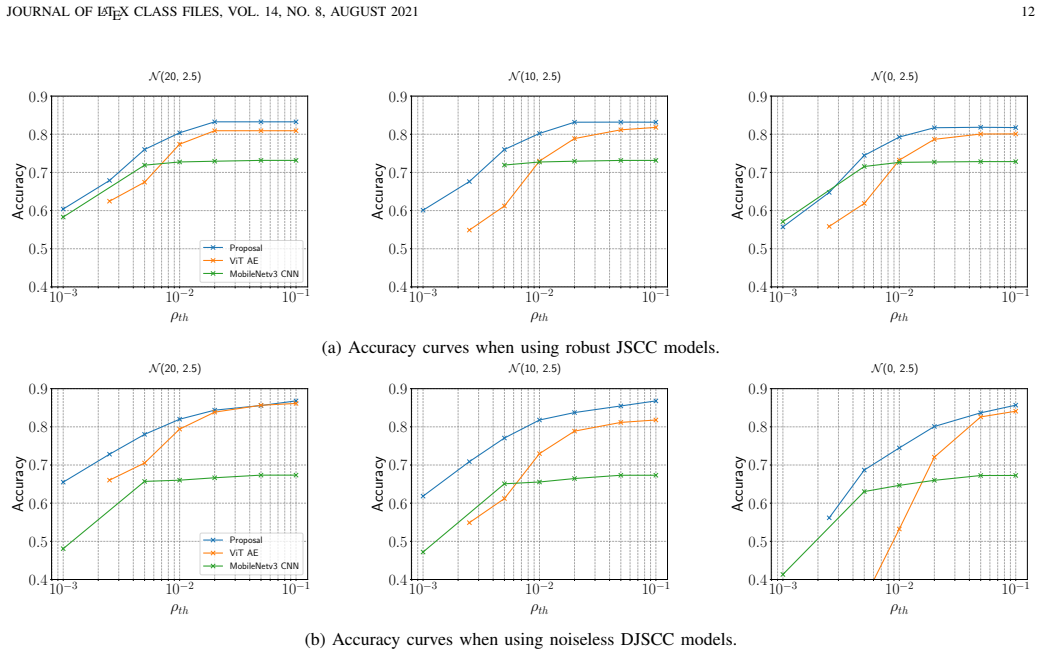
- [Section VI, all experiments] All accuracy numbers in Figures 6-8 and Table II appear to be single-run point estimates. Imagenette contains only 10,000 images, and many of the reported differences between the proposal and ViT AE are below one percentage point. The claim of 'consistent' outperformance cannot be assessed without repeated seeds, confidence intervals, or significance tests. This is especially important because the proposal's curve is an envelope over many configurations, which is prone to optimistic selection bias. Add at least three to five seeds and report means with error bars or bootstrap intervals.
minor comments (5)
- [Section I-B (Outline)] The outline says 'Section VIII draws the conclusions,' but the conclusions are in Section VII and there is no Section VIII; please correct the cross-reference.
- [Section VI-B and Table II] The threshold set is given as {0.005, 0.0025, 0.001, 0.02, 0.05, 0.01, 0.1}, but Table II has columns for 0.0025, 0.005, 0.01, 0.02, 0.05, and 0.1 only; clarify whether 0.001 was evaluated.
- [Table II caption] The 'P - R' notation in Table II is only explained in the caption; define it in the main text and consider using explicit two-column pairs to avoid ambiguity.
- [References] Reference [22] is missing its title, [47] and [51] are duplicates of the same ViT paper, and [46] and [48] are two entries for the same book; consolidate or disambiguate them.
- [Section IV-C] The definition of the per-token compression ratio contains the typo 'r = or/e'; this should be r = o_r/d, with o_r and e defined consistently with Table I.
Circularity Check
No significant circularity: the reported compression-accuracy gains are measured against external Shannon-capacity and neural baselines, not derived from the fitted accuracy proxy; the upper-envelope curve is an evaluation choice, not a circular reduction.
full rationale
The paper's central claims are supported by test-set accuracy measurements compared against external digital capacity-achieving baselines defined from Shannon's capacity and against separately trained neural DJSCC baselines, so the result is not equivalent to any fitted parameter by construction. The proxy function Λ in Section V is constructed by averaging training-set accuracy over configurations and is used only to drive the Lyapunov controller; the reported Section VI-B numbers are test accuracies, not evaluations of Λ itself, so the outcome is not a renamed fit. The Section VI-A curve is an upper envelope ('only the best-performing configurations for each ρ value ... are shown'), which is a legitimate capability-style evaluation for a model with a user-specified token budget, though it may overstate what the online controller realizes; this is a validity caveat, not a self-referential derivation. Self-citations [9], [35], [49] appear as background, prior work, and standard Lyapunov derivations, and they are not load-bearing evidence for the empirical gains. No equation reduces the claimed prediction to its own inputs.
Assumptions & free parameters
free parameters (5)
- Loss weights λs, λr =
λs=2, λr=1
- Lyapunov control parameters V and µ =
V ∈ {1,10,100,1000,10^4}, µ ∈ {1,10,100}, tuned per ρth
- Accuracy proxy Λ(γ, SNR) =
Average training accuracy for each (r, α, SNR) combination
- SNR training range =
U[-20,20] dB
- Budget margin ϵ =
Not specified
assumptions (5)
- standard math Lyapunov drift-plus-penalty theory guarantees mean rate stability of the virtual queue and satisfies the long-term average constraint.
- domain assumption The wireless channel is complex AWGN with block fading, with SNR known to the optimizer.
- domain assumption A ViT split at block s can be used as encoder/decoder, and its multi-head attention handles a variable number of tokens.
- ad hoc to paper The budget token b0 = α·bh + (1-α)·bl provides a sufficient conditioning signal for the threshold and gating models.
- domain assumption The training-set accuracy proxy Λ transfers to test-time performance.
invented entities (1)
-
Budget token b0
Cite this review
Pith. "Pith review of Adaptive Semantic Token Communication for Transformer-based Edge Inference." pith.science (2026). https://pith.science/paper/CN7C4NMP
@misc{pith2026250517604,
  author       = {Pith},
  title        = {Pith review of: Adaptive Semantic Token Communication for Transformer-based Edge Inference},
  year         = {2026},
  howpublished = {\url{https://pith.science/paper/CN7C4NMP}},
  note         = {Machine review of arXiv:2505.17604}
}
read the original abstract
This paper presents an adaptive framework for edge inference based on a dynamically configurable transformer-powered deep joint source channel coding (DJSCC) architecture. Motivated by a practical scenario where a resource constrained edge device engages in goal oriented semantic communication, such as selectively transmitting essential features for object detection to an edge server, our approach enables efficient task aware data transmission under varying bandwidth and channel conditions. To achieve this, input data is tokenized into compact high level semantic representations, refined by a transformer, and transmitted over noisy wireless channels. As part of the DJSCC pipeline, we employ a semantic token selection mechanism that adaptively compresses informative features into a user specified number of tokens per sample. These tokens are then further compressed through the JSCC module, enabling a flexible token communication strategy that adjusts both the number of transmitted tokens and their embedding dimensions. We incorporate a resource allocation algorithm based on Lyapunov stochastic optimization to enhance robustness under dynamic network conditions, effectively balancing compression efficiency and task performance. Experimental results demonstrate that our system consistently outperforms existing baselines, highlighting its potential as a strong foundation for AI native semantic communication in edge intelligence applications.
Figures


Figures from the paper (6 more)



Forward citations
Cited by 2 Pith papers
-
RIS-aided Latent Space Alignment for Semantic Channel Equalization
RIS-aided joint physical and semantic channel equalization, solved by alternating optimization or neural networks, outperforms separate alignment-and-transmission baselines in MIMO semantic communication simulations.
-
Low-Complexity Semantic Packet Aggregation for Token Communication via Lookahead Search
SemPA-Look groups tokens into packets using a leave-one-out residual semantic score and a fixed-width lookahead search, matching near-optimal ATS at linear text-encoding complexity.
Reference graph
Works this paper leans on
-
[9]
Adaptive semantic token selection for ai-native goal-oriented commu- nications,
A. Devoto, S. Petruzzi, J. Pomponi, P. Di Lorenzo, and S. Scardapane, “Adaptive semantic token selection for ai-native goal-oriented commu- nications,” IEEE Globecom Workshop: Generative Horizons: Exploring Goals through Semantic Communication , 2024
work page 2024
-
[35]
Conditional computation in neural networks: Principles and research trends,
S. Scardapane, A. Baiocchi, A. Devoto, V . Marsocci, P. Minervini, and J. Pomponi, “Conditional computation in neural networks: Principles and research trends,” Intelligenza Artificiale, vol. 18, no. 1, p. 175–190, Jul. 2024
work page 2024
-
[1]
6G networks: Beyond Shannon towards semantic and goal-oriented communications,
E. C. Strinati and S. Barbarossa, “6G networks: Beyond Shannon towards semantic and goal-oriented communications,” Computer Net- works, vol. 190, p. 107930, 2021
work page 2021
-
[2]
Goal- oriented and semantic communication in 6G AI-native networks: The 6G-GOALS approach,
E. C. Strinati, P. Di Lorenzo, V . Sciancalepore, A. Aijaz, M. Kountouris, D. G ¨und¨uz, P. Popovski, M. Sana, P. A. Stavrou, B. Soret et al., “Goal- oriented and semantic communication in 6G AI-native networks: The 6G-GOALS approach,” arXiv preprint arXiv:2402.07573 , 2024
arXiv 2024
-
[3]
Task-oriented communications for nextg: End-to-end deep learning and ai security aspects,
Y . E. Sagduyu, S. Ulukus, and A. Yener, “Task-oriented communications for nextg: End-to-end deep learning and ai security aspects,” IEEE Wireless Communications, vol. 30, no. 3, pp. 52–60, 2023
work page 2023
-
[4]
Token communications: A unified framework for cross-modal context-aware semantic communications,
L. Qiao, M. B. Mashhadi, Z. Gao, R. Tafazolli, M. Bennis, and D. Niyato, “Token communications: A unified framework for cross-modal context-aware semantic communications,” arXiv preprint arXiv:2502.12096, 2025
arXiv 2025
-
[5]
Enabling edge artificial intelligence via goal-oriented deep neural network splitting,
F. Binucci, M. Merluzzi, P. Banelli, E. C. Strinati, and P. Di Lorenzo, “Enabling edge artificial intelligence via goal-oriented deep neural network splitting,” in 2024 19th International Symposium on Wireless Communication Systems (ISWCS) . IEEE, 2024, pp. 1–6
work page 2024
-
[6]
SING: Semantic Image Communications using Null-Space and INN-Guided Diffusion Models,
J. Chen, S. F. Yilmaz, D. You, P. L. Dragotti, and D. G ¨und¨uz, “SING: Semantic Image Communications using Null-Space and INN-Guided Diffusion Models,” arXiv preprint arXiv:2503.12484 , Mar. 2025
arXiv 2025
Show all 55 references
-
[7]
Goal-oriented communications for the iot: System design and adaptive resource optimization,
P. Di Lorenzo, M. Merluzzi, F. Binucci, C. Battiloro, P. Banelli, E. C. Strinati, and S. Barbarossa, “Goal-oriented communications for the iot: System design and adaptive resource optimization,” IEEE Internet of Things Magazine, vol. 6, no. 4, pp. 26–32, 2023
2023
-
[8]
Deep learning enabled semantic communication systems,
H. Xie, Z. Qin, G. Y . Li, and B.-H. Juang, “Deep learning enabled semantic communication systems,” IEEE Transactions on Signal Pro- cessing, vol. 69, pp. 2663–2675, 2021
2021
-
[10]
Token-domain mul- tiple access: Exploiting semantic orthogonality for collision mitigation,
L. Qiao, M. B. Mashhadi, Z. Gao, and D. G ¨und¨uz, “Token-domain mul- tiple access: Exploiting semantic orthogonality for collision mitigation,” arXiv preprint arXiv:2502.06118 , 2025
2025 arXiv
-
[11]
Split computing and early exiting for deep learning applications: Survey and research challenges,
Y . Matsubara, M. Levorato, and F. Restuccia, “Split computing and early exiting for deep learning applications: Survey and research challenges,” ACM Comput. Surv., vol. 55, no. 5, Dec. 2022
2022
-
[12]
Towards efficient inference on mobile device via pruning,
Z. Wang and H. Tan, “Towards efficient inference on mobile device via pruning,” in 2024 10th International Conference on Big Data Computing and Communications (BigCom) , 2024, pp. 26–33
2024
-
[13]
Energy-aware inference offloading for dnn-driven applications in mobile edge clouds,
Z. Xu, L. Zhao, W. Liang, O. F. Rana, P. Zhou, Q. Xia, W. Xu, and G. Wu, “Energy-aware inference offloading for dnn-driven applications in mobile edge clouds,” IEEE Transactions on Parallel and Distributed Systems, vol. 32, no. 4, pp. 799–814, 2021
2021
-
[14]
Towards real-time inference offloading with distributed edge computing: The framework and algorithms,
Q. Chen, S. Guo, K. Wang, W. Xu, J. Li, Z. Cai, H. Gao, and A. Y . Zomaya, “Towards real-time inference offloading with distributed edge computing: The framework and algorithms,” IEEE Transactions on Mobile Computing, vol. 23, no. 7, pp. 7552–7571, 2024
2024
-
[15]
Wireless channel adaptive dnn split inference for resource-constrained edge devices,
J. Lee, H. Lee, and W. Choi, “Wireless channel adaptive dnn split inference for resource-constrained edge devices,” IEEE Communications Letters, vol. 27, no. 6, pp. 1520–1524, 2023
2023
-
[16]
Semantic edge computing and semantic communications in 6g networks: A unifying survey and research challenges,
M. Zhang, M. Abdi, V . R. Dasari, and F. Restuccia, “Semantic edge computing and semantic communications in 6g networks: A unifying survey and research challenges,”arXiv preprint arXiv:2411.18199, 2024
2024 arXiv
-
[17]
Energy-efficient cooperative inference via adaptive deep neural network splitting at the edge,
I. Labriji, M. Merluzzi, F. E. Airod, and E. C. Strinati, “Energy-efficient cooperative inference via adaptive deep neural network splitting at the edge,” in ICC 2023 - IEEE International Conference on Communica- tions, 2023, pp. 1712–1717
2023
-
[18]
Deep joint source-channel coding for semantic communications,
J. Xu, T.-Y . Tung, B. Ai, W. Chen, Y . Sun, and D. D. G ¨und¨uz, “Deep joint source-channel coding for semantic communications,” IEEE Communications Magazine, vol. 61, no. 11, pp. 42–48, 2023
2023
-
[19]
Joint source–channel coding: Fundamentals and recent progress in practical designs,
G ¨und¨uz, Deniz and Wigger, Mich `ele A and Tung, Tze-Yang and Zhang, Ping and Xiao, Yong, “Joint source–channel coding: Fundamentals and recent progress in practical designs,” Proceedings of the IEEE , 2024
2024
-
[20]
Deep joint source- channel coding for wireless image transmission,
E. Bourtsoulatze, D. B. Kurka, and D. G ¨und¨uz, “Deep joint source- channel coding for wireless image transmission,” IEEE Trans. on Cognitive Communications and Netw., vol. 5, no. 3, pp. 567–579, 2019
2019
-
[21]
Collaborative semantic communication for edge inference,
W. F. Lo, N. Mital, H. Wu, and D. G ¨und¨uz, “Collaborative semantic communication for edge inference,” IEEE Wireless Communications Letters, vol. 12, no. 7, pp. 1125–1129, 2023
2023
-
[22]
Yang and H.-S
M. Yang and H.-S. Kim, in ICASSP 2022-2022 IEEE International Conference on Acoustics, Speech and Signal Processing (ICASSP) . IEEE, 2022, pp. 5193–5197. JOURNAL OF LATEX CLASS FILES, VOL. 14, NO. 8, AUGUST 2021 14
2022
-
[23]
Nonlinear transform source-channel coding for semantic communications,
J. Dai, S. Wang, K. Tan, Z. Si, X. Qin, K. Niu, and P. Zhang, “Nonlinear transform source-channel coding for semantic communications,” IEEE Journal on Selected Areas in Communications , vol. 40, no. 8, pp. 2300– 2316, 2022
2022
-
[24]
Swinjscc: Taming swin transformer for deep joint source-channel coding,
K. Yang, S. Wang, J. Dai, X. Qin, K. Niu, and P. Zhang, “Swinjscc: Taming swin transformer for deep joint source-channel coding,” IEEE Transactions on Cognitive Communications and Networking , 2024
2024
-
[25]
Process- and-forward: Deep joint source-channel coding over cooperative relay networks,
C. Bian, Y . Shao, H. Wu, E. Ozfatura, and D. G ¨und¨uz, “Process- and-forward: Deep joint source-channel coding over cooperative relay networks,” IEEE Journal on Selected Areas in Communications , 2025
2025
-
[26]
Adaptive re- source allocation for semantic communication networks,
L. Wang, W. Wu, F. Zhou, Z. Yang, and Z. Qin, “Adaptive re- source allocation for semantic communication networks,” arXiv preprint arXiv:2312.01081, 2023
2023 arXiv
-
[27]
Semantic commu- nication with adaptive universal transformer,
Q. Zhou, R. Li, Z. Zhao, C. Peng, and H. Zhang, “Semantic commu- nication with adaptive universal transformer,” IEEE Wireless Communi- cations Letters, vol. 11, no. 3, pp. 453–457, 2021
2021
-
[28]
Multi- user goal-oriented communications with energy-efficient edge resource management,
F. Binucci, P. Banelli, P. Di Lorenzo, and S. Barbarossa, “Multi- user goal-oriented communications with energy-efficient edge resource management,” IEEE Transactions on Green Communications and Net- working, vol. 7, no. 4, pp. 1709–1724, 2023
2023
-
[29]
Training deep neu- ral networks with low precision multiplications,
M. Courbariaux, Y . Bengio, and J.-P. David, “Training deep neu- ral networks with low precision multiplications,” arXiv preprint arXiv:1412.7024, 2014
2014 arXiv
-
[30]
Integer quanti- zation for deep learning inference: Principles and empirical evaluation,
H. Wu, P. Judd, X. Zhang, M. Isaev, and P. Micikevicius, “Integer quanti- zation for deep learning inference: Principles and empirical evaluation,” arXiv preprint arXiv:2004.09602 , 2020
2004 arXiv
-
[31]
Llm. int8 (): 8-bit matrix multiplication for transformers at scale,
T. Dettmers, M. Lewis, Y . Belkada, and L. Zettlemoyer, “Llm. int8 (): 8-bit matrix multiplication for transformers at scale,” arXiv preprint arXiv:2208.07339, 2022
2022 arXiv
-
[32]
Knowledge distillation from internal representations,
G. Aguilar, Y . Ling, Y . Zhang, B. Yao, X. Fan, and C. Guo, “Knowledge distillation from internal representations,” in Proc. of the AAAI Confer- ence on Artificial Intelligence , vol. 34, no. 05, 2020, pp. 7350–7357
2020
-
[33]
Distilling the knowledge in a neural network,
G. Hinton, O. Vinyals, and J. Dean, “Distilling the knowledge in a neural network,” arXiv preprint arXiv:1503.02531 , 2015
2015 arXiv
-
[34]
Sparsity in deep learning: Pruning and growth for efficient inference and training in neural networks,
T. Hoefler, D. Alistarh, T. Ben-Nun, N. Dryden, and A. Peste, “Sparsity in deep learning: Pruning and growth for efficient inference and training in neural networks,” The Journal of Machine Learning Research, vol. 22, no. 1, pp. 10 882–11 005, 2021
2021
-
[36]
Adavit: Adaptive vision transformers for efficient image recognition,
L. Meng, H. Li, B.-C. Chen, S. Lan, Z. Wu, Y .-G. Jiang, and S.-N. Lim, “Adavit: Adaptive vision transformers for efficient image recognition,” in Proceedings of the IEEE/CVF Conference on Computer Vision and Pattern Recognition, 2022, pp. 12 309–12 318
2022
-
[37]
Dynamic neural networks: A survey,
Y . Han, G. Huang, S. Song, L. Yang, H. Wang, and Y . Wang, “Dynamic neural networks: A survey,” IEEE Transactions on Pattern Analysis and Machine Intelligence, vol. 44, no. 11, pp. 7436–7456, 2021
2021
-
[38]
Adaptive layer selection for efficient vision transformer fine-tuning,
A. Devoto, F. Alvetreti, J. Pomponi, P. D. Lorenzo, P. Minervini, and S. Scardapane, “Adaptive layer selection for efficient vision transformer fine-tuning,” 2024
2024
-
[39]
Adaptive computation modules: Granular conditional computation for efficient inference,
B. W ´ojcik, A. Devoto, K. Pustelnik, P. Minervini, and S. Scardapane, “Adaptive computation modules: Granular conditional computation for efficient inference,” 2023
2023
-
[40]
Switch transformers: scaling to trillion parameter models with simple and efficient sparsity,
W. Fedus, B. Zoph, and N. Shazeer, “Switch transformers: scaling to trillion parameter models with simple and efficient sparsity,” J. Mach. Learn. Res., vol. 23, no. 1, Jan. 2022
2022
-
[41]
Outrageously large neural networks: The sparsely-gated mixture-of-experts layer,
N. Shazeer, A. Mirhoseini, K. Maziarz, A. Davis, Q. Le, G. Hinton, and J. Dean, “Outrageously large neural networks: The sparsely-gated mixture-of-experts layer,” 2017
2017
-
[42]
Moefication: Transformer feed-forward layers are mixtures of experts,
Z. Zhang, Y . Lin, Z. Liu, P. Li, M. Sun, and J. Zhou, “Moefication: Transformer feed-forward layers are mixtures of experts,” 2022
2022
-
[43]
Goal-oriented communications based on recursive early exit neural networks,
J. Pomponi, M. Merluzzi, A. Devoto, M. P. Mota, P. D. Lorenzo, and S. Scardapane, “Goal-oriented communications based on recursive early exit neural networks,” 2024
2024
-
[44]
Bert loses patience: Fast and robust inference with early exit,
W. Zhou, C. Xu, T. Ge, J. McAuley, K. Xu, and F. Wei, “Bert loses patience: Fast and robust inference with early exit,” Advances in Neural Information Processing Systems , vol. 33, pp. 18 330–18 341, 2020
2020
-
[45]
Joint or disjoint: Mixing training regimes for early-exit models,
B. Krzepkowski, M. Michaluk, F. Szarwacki, P. Kubaty, J. Pomponi, B. W ˘Ałjcik, K. Adamczewski et al., “Joint or disjoint: Mixing training regimes for early-exit models,” arXiv preprint arXiv:2407.14320, 2024
2024 arXiv
-
[46]
Neely, Stochastic network optimization with application to commu- nication and queueing systems
M. Neely, Stochastic network optimization with application to commu- nication and queueing systems . Morgan & Claypool Publishers, 2010
2010
-
[47]
An image is worth 16x16 words: Trans- formers for image recognition at scale,
A. Dosovitskiy, L. Beyer, A. Kolesnikov, D. Weissenborn, X. Zhai, T. Unterthiner, M. Dehghani, M. Minderer, G. Heigold, S. Gelly, J. Uszkoreit, and N. Houlsby, “An image is worth 16x16 words: Trans- formers for image recognition at scale,” in International Conference on Learni...
2021
-
[48]
Neely, Stochastic Network Optimization with Application to Com- munication and Queueing Systems , 01 2010, vol
M. Neely, Stochastic Network Optimization with Application to Com- munication and Queueing Systems , 01 2010, vol. 3
2010
-
[49]
Wireless edge machine learning: Resource allocation and trade-offs,
M. Merluzzi, P. D. Lorenzo, and S. Barbarossa, “Wireless edge machine learning: Resource allocation and trade-offs,” IEEE Access , vol. 9, pp. 45 377–45 398, 2021
2021
-
[50]
FastAI imagenett,
“FastAI imagenett,” https://github.com/fastai/imagenette
-
[51]
An image is worth 16x16 words: Transformers for image recognition at scale,
A. Dosovitskiy, L. Beyer, A. Kolesnikov, D. Weissenborn, X. Zhai, T. Unterthiner, M. Dehghani, M. Minderer, G. Heigold, S. Gelly, J. Uszkoreit, and N. Houlsby, “An image is worth 16x16 words: Transformers for image recognition at scale,” 2021
2021
-
[52]
Searching for mobilenetv3,
A. Howard, M. Sandler, G. Chu, L.-C. Chen, B. Chen, M. Tan, W. Wang, Y . Zhu, R. Pang, V . Vasudevan et al. , “Searching for mobilenetv3,” in Proceedings of the IEEE/CVF international conference on computer vision, 2019, pp. 1314–1324
2019
-
[53]
Adam: A method for stochastic optimization,
D. P. Kingma, “Adam: A method for stochastic optimization,” arXiv preprint arXiv:1412.6980, 2014
2014 arXiv
-
[54]
Randaugment: Practical automated data augmentation with a reduced search space,
E. D. Cubuk, B. Zoph, J. Shlens, and Q. V . Le, “Randaugment: Practical automated data augmentation with a reduced search space,” in Proceedings of the IEEE/CVF conference on computer vision and pattern recognition workshops , 2020, pp. 702–703
2020
-
[55]
Vision transformers need registers,
T. Darcet, M. Oquab, J. Mairal, and P. Bojanowski, “Vision transformers need registers,” arXiv preprint arXiv:2309.16588 , 2023
2023 arXiv
Reviewed August 7, 2026 · model on record in the stance chip above.
Discussion (0). Sign in to comment.