REVIEW 5 major objections 6 minor 43 references
Symbolic Intermediaries as a Linguistic-Numerical Interface for LLM-Driven Geometric Reasoning
T0 review · 5 major / 6 minor · reviewed 2026-08-07 · deepseek-v4-flash
Pith's one-line read Symbolic regression turns simulator traces into equations an LLM critic can read, and the designer-critic loop cuts planar-mechanism error by up to 90 percent on individual tasks.
desk verdict Solid ablation of an LLM design-critique loop for planar mechanisms, but the abstract's GA and critique-analysis claims are nowhere in the body. read the letter →
The pith
A machine-rendered reading of the paper's core claim, the machinery that carries it, and where it could break.
The reading
What carries the argument
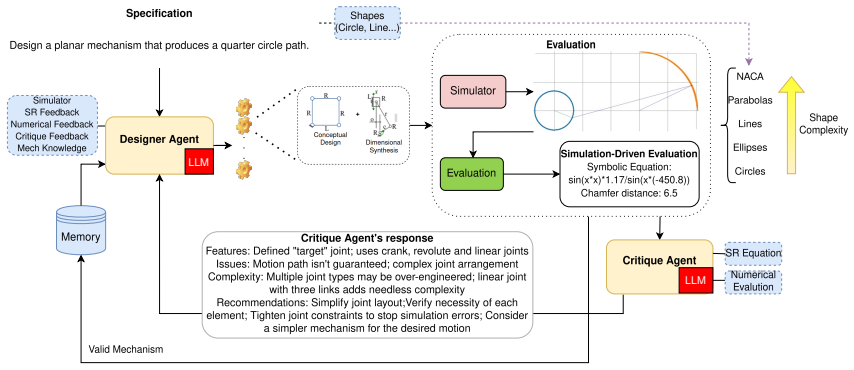
The load-bearing object is the symbolic intermediary: a compact analytical expression fitted by symbolic regression to the simulator's numeric trace, replacing raw point clouds with a shared symbolic vocabulary. It works as the linguistic-numerical interface between the designer agent, which writes linkage mechanism code; the critique agent, which checks correctness, error, complexity, and refinement against the surrogate; and the revision step that turns critique into new code. Alongside it, the design-critique loop and a memory of validated mechanisms carry the convergence: each cycle recomputes Chamfer distance and the surrogate, critiques, and revises until the distance falls below a small tolerance or the iteration budget runs out.
What would settle it
Re-run the full factorial ablation with at least twenty instances per shape and recompute the paired Wilcoxon test for feedback versus no feedback and for the model ordering; the claim survives only if the feedback effect stays significant and the parabola means, currently about 833 to 884 with standard errors of 16 to 67, still separate the models.
Extended reading notes
Core claim
The central claim is that numerical simulation traces become legible to LLMs when compressed into symbolic surrogates, so an automated critic can reason about geometric meaning rather than generic code structure. Concretely, the system uses symbolic regression to fit an analytical expression to the simulated end-effector path, and the designer, critique, and revision agents all share this expression as common ground. The paper reports that adding critic feedback significantly lowers Chamfer distance for all three tested model families (Llama, Gemma, Qwen), with up to 90 percent reduction on individual tasks and statistical significance on a paired Wilcoxon signed-rank test. It also reports that symbolic-regression prompts help mainly larger or reasoning-trained models, and that the interface shifts critique content from vague structural commentary to grounded geometric verification.
Load-bearing premise
The central comparisons rest on five randomly sampled point configurations per shape, and for several shapes the standard errors are as large as the reported differences; if a few extra instances change those means, the feedback and model-ranking claims lose support.
Editorial extensions
If this is right
- Any simulator that emits continuous output — robotics, CFD, structural analysis — becomes a candidate for the same symbolic-intermediary interface, not just planar mechanisms.
- The critique loop supplies two signals at once: it improves geometric fidelity measured by Chamfer distance and raises the semantic success rate, meaning more generated mechanisms actually parse and run.
- Because refinement happens entirely through prompts and memory, the method offers inference-time generalization: an LLM can take on new design tasks without parameter updates.
- The finding that symbolic-regression prompts help mainly larger or reasoning-trained models suggests a selection rule: feed surrogates to those architectures and keep numeric summaries for smaller dense models.
- A compact reasoning-trained model can outperform a much larger dense model on the hardest shape, indicating that training regimen can substitute for raw scale in spatially grounded tasks.
Reading between the lines
- The 19-53 percent advantage over the genetic-algorithm baseline appears in the abstract but not in the reproduced full-text tables, so a budget-matched replication is the first check needed before relying on that headline margin.
- Per-shape means rest on only five random point sets with four target points; bootstrapping twenty to fifty instances per shape would give a sturdier test of the model and component rankings.
- The symbolic-intermediary recipe should transfer to higher-dimensional simulators if the surrogate is fit to a projected coordinate or a scalar loss, since symbolic regression degrades as the trace dimension grows.
- A direct probe of the interface's mechanism: in a randomised study, strip the surrogate equation from half the critic prompts and measure how often critiques cite specific geometry; the interface predicts a sharp drop without the surrogate.
Editorial analysis
A structured set of objections, weighed in public.
Referee Report
Summary. The paper proposes a dual-agent LLM framework for planar mechanism synthesis in which a Designer agent generates executable mechanism code, a Critique agent reasons over symbolic surrogates obtained by symbolic regression, and a Revision step closes the loop. The authors introduce MSynth, a benchmark of six analytically defined planar curves, and run a full-factorial ablation over LLM family (Llama, Gemma, Qwen), shape, number of examples, memory, critique feedback, and symbolic-regression feedback. The body reports that critique feedback reduces Chamfer distance in many settings, that symbolic-regression prompts are more useful for larger or reasoning-oriented models, and that memory effects are model-specific. The top-level abstract additionally claims that all three LLM agents outperform a budget-matched genetic-algorithm baseline by 19--53% (up to 63% lower median error with feedback) and that analysis of critique entries shows a shift from generic structural commentary to grounded geometric verification; these claims do not appear in the experimental sections.
Significance. If the advertised genetic-algorithm comparison were present and the significance tests were fully reported, the claim that symbolic intermediaries enable LLM agents to outperform a conventional optimizer on planar mechanism synthesis would be a noteworthy result for neuro-symbolic reasoning and automated design. The paper does have genuine strengths: a full-factorial ablation design, transparent prompt templates in Appendices E--G, a new benchmark, and a clear pipeline description. However, the central comparative claim of the top-level abstract is absent from the body, and the reported statistical support is under-specified. As presented, the evidence substantiates only the narrower claim that critique feedback reduces Chamfer distance in many tested configurations, and even that claim is weakened by large standard errors relative to the reported differences.
major comments (5)
- [Abstract; Sections 2--3; Appendix K] The top-level abstract states that 'all three evaluated LLM agents outperform a budget-matched genetic-algorithm baseline by 19-53% (up to 63% lower median error with feedback),' but no genetic-algorithm baseline is defined, implemented, or reported anywhere in the manuscript. The experimental sections and Table 2 compare only LLM conditions (model, shape, #examples, memory, feedback, SR feedback) and never include a non-LLM optimizer. The full-text abstract on page 2 omits the GA claim entirely and instead claims only 'up to 90% on individual tasks' and 'statistically significant gains per the Wilcoxon signed-rank test.' Because the GA comparison is the headline contribution advertised in the abstract, its complete absence from the body is a load-bearing weakness: the paper does not support its central claim as written.
- [Abstract; Section 3.1; Appendices] The abstract also claims that 'analysis of the critique entries across three model architectures shows that the interface shifts reasoning from generic structural commentary to grounded geometric verification.' No such content analysis, coding scheme, or qualitative results are presented in Section 3 or in the appendices. The only critique-related results are quantitative Chamfer-distance and semantic-success numbers, which do not measure the type or grounding of the critique text. This second advertised contribution is therefore also unsupported.
- [Section 3.1; Table 2] The manuscript asserts that 'a paired Wilcoxon signed-rank test on the Chamfer distances showed a statistically significant difference between conditions' without reporting the test statistic, the number of paired observations, or the p-value. This matters because many of the reported differences in Table 2 are small relative to the standard errors: for example, Parabola means for Llama range from roughly 815 to 848 with standard errors of 30--85, and the Circle comparisons for Qwen have standard errors of 3--4 with means that differ by similar magnitudes. Without the test details, the claimed statistical significance of the feedback effect is not verifiable.
- [Section 3, Dataset; Appendix D; Table 2] The empirical comparisons rest on only five random instances per shape, each with n=4 target points, yet the paper draws model-level and component-level conclusions from these means. In Table 2, standard errors are frequently comparable to or larger than the differences being highlighted: for instance, the Parabola means of 833--884 have standard errors of 16--67, and the Qwen versus Llama Parabola comparison (833.09 versus 845.99) is well within one standard error. Such aggregate rankings could change with a small number of additional instances, so the claims of model-family superiority and of memory effects (Section 3.1, 'Memory and exemplars exhibit model-specific effects') are not robustly established.
- [Section 3.1, 'Equational prompts affect large-scale models and LRM'] The comparison of SR+feedback versus feedback without SR is reported only as aggregate means (140.00 versus 148.50, and a difference of about 6.94 when restricted to Mem=2), with no variance, confidence intervals, or paired test. Because the Parabola condition has Chamfer distances in the 800--900 range while other shapes are below about 15, these aggregate means are dominated by the Parabola values and can be shifted by a single outlier condition. The subsequent shape-level reductions are more informative but are still presented without error bars or significance tests; the claim that SR contributes to reducing the measured outcome needs this support.
minor comments (6)
- [Abstract] There is a typo in the abstract: 'exmaple' should be 'example.'
- [Page 1, footnote] The footnote 'anonymized' and the later 'anonymised' appear to be leftover anonymization markers; the authors should remove them in the final version.
- [Section 3.1, Figure 3] The caption 'Mean of improvement by Model and Fdbk' is grammatically awkward; consider 'Mean improvement by model and feedback condition.'
- [Section 3, Dataset] The text says 'then draw n∈{4} points along the curve,' which is a singleton set; this should be phrased as 'n=4 points' unless other values were actually used.
- [Table 2] The column headers 'Best chamf.' and 'Fcham' are not defined in the caption or the surrounding text; please clarify which quantity corresponds to the best Chamfer distance and which to the final Chamfer distance.
- [Section 3.1] The abbreviation 'LRM' (Large Reasoning Model) is used without expansion at first occurrence; please define it.
Circularity Check
No significant circularity; the missing GA baseline is an evidential gap, not a circular derivation.
full rationale
The paper's derivation chain is an empirical agentic search loop, not a reduction of outputs to inputs. The target analytical equation is given as part of the task specification and is inserted into the prompts, but the reported quantities are Chamfer distances measured after simulation against that same specification; this is the optimization objective, not a fitted parameter disguised as a prediction. The symbolic-regression surrogate is fitted to the simulated trajectory and fed back as critique material, which is a legitimate closed-loop control signal rather than a self-defined outcome: the final reported performance is computed from the simulator trace, not from the surrogate. There are no load-bearing self-citations: the cited prior work is external and is used for standard tools (PySR, ICP, PyLinkage) or general context. The 'uniqueness' style argument does not appear. The most serious weakness is that the abstract's claimed budget-matched genetic-algorithm baseline (19-53%) is nowhere defined, implemented, or reported in the full text; however, the absence of a comparison is an evidential/correctness problem, not circularity, because the paper does not derive that claim from its own fitted values or definitions. The manuscript's own full-text abstract makes the more modest claim of up to 90% improvement on individual tasks, and the tables support a weaker feedback-benefit statement with substantial noise; again, noise and missing baselines are not circularity. No quoted equation in the paper reduces by construction to an input, and no fitted value is renamed as a prediction. Score 0.
Assumptions & free parameters
free parameters (5)
- Target-point count n =
4
- Maximum revision iterations Rmax =
20
- Batch size b =
3
- Sampling temperature =
0.8
- PySR hyperparameters =
unspecified
assumptions (4)
- domain assumption PyLinkage simulations faithfully represent the planar mechanisms specified by the LLM-generated code.
- ad hoc to paper Five random instances per shape with n=4 sampled points are representative of each shape class for comparing models and ablations.
- domain assumption A symbolic-regression equation fitted to the simulated trajectory preserves enough geometric semantics for an LLM critic to reason about the mechanism.
- ad hoc to paper The target analytical equation can be supplied to the designer in the prompt, so the LLM does not have to infer the curve from sparse points alone.
Cite this review
Pith. "Pith review of Symbolic Intermediaries as a Linguistic-Numerical Interface for LLM-Driven Geometric Reasoning." pith.science (2026). https://pith.science/paper/YMCFME4L
@misc{pith2026250517607,
  author       = {Pith},
  title        = {Pith review of: Symbolic Intermediaries as a Linguistic-Numerical Interface for LLM-Driven Geometric Reasoning},
  year         = {2026},
  howpublished = {\url{https://pith.science/paper/YMCFME4L}},
  note         = {Machine review of arXiv:2505.17607}
}
read the original abstract
Large Language Models (LLMs) display reasoning capabilities over linguistic and symbolic objects but have limited capabilities to directly interpret the continuous numerical outputs of physics simulators, e.g., distances, curvatures, and trajectories that resist discrete tokenisation. Across spatially grounded engineering reasoning tasks, from mechanism design to motion planning, this defines a fundamental gap, which limits the wider application of LLMs within broader geometrical domains, for exmaple interfacing with physics simulators. We propose symbolic intermediaries, compact analytical expressions discovered via symbolic regression, as a structured interface that translates a simulator's numerical traces into a symbolic form, which language models can interpret, compare, and critique while preserving the original geometric semantics. Around this interface we build an agentic coordination-and-refinement loop: a design agent maps natural-language specifications to executable simulation code, a critique agent reasons over the shared symbolic vocabulary, and a revision step turns this feedback into grounded refinement decisions, enabling inference-time generalization without parameter updates. On the MSynth benchmark for planar mechanism synthesis, all three evaluated LLM agents outperform a budget-matched genetic-algorithm baseline by 19-53% (up to 63% lower median error with feedback), and analysis of the critique entries across three model architectures shows that the interface shifts reasoning from generic structural commentary to grounded geometric verification. The principle of translating continuous simulation outputs into symbolic forms generalises to any domain where simulator behaviour must be interpreted linguistically.
Figures

Figures from the paper (9 more)




Reference graph
Works this paper leans on
-
[1]
2022. https://doi.org/10.1115/DETC2022-89798 LINKS: A Dataset of a Hundred Million Planar Linkage Mechanisms for Data-Driven Kinematic Design , volume Volume 3A: 48th Design Automation Conference (DAC) of International Design Engineering Technical Conferences and Computers and Information in Engineering Conference. V03AT03A013
-
[2]
Ira H Abbott and Albert E Von Doenhoff. 2012. Theory of wing sections: including a summary of airfoil data. Courier Corporation
work page 2012
-
[3]
Shaoping Bai and Jorge Angeles. 2015. https://doi.org/10.1016/j.mechmachtheory.2015.08.010 Coupler-curve synthesis of four-bar linkages via a novel formulation . Mechanism and Machine Theory, 94:177--187
-
[4]
Vineet Bhat, Ali Umut Kaypak, Prashanth Krishnamurthy, Ramesh Karri, and Farshad Khorrami. 2024. https://arxiv.org/abs/2402.08546 Grounding llms for robot task planning using closed-loop state feedback . Preprint, arXiv:2402.08546
arXiv 2024
-
[5]
Miles Cranmer. 2023. https://arxiv.org/abs/2305.01582 Interpretable machine learning for science with pysr and symbolicregression.jl . Preprint, arXiv:2305.01582. This work is licensed under the Apache-2.0 license https://github.com/MilesCranmer/PySR/blob/master/LICENSE
arXiv 2023
-
[6]
Richardos Drakoulis. 2023. Iterative closest point. https://github.com/richardos/icp. Accessed: 2025-05-19
work page 2023
-
[7]
Hwang, Soumya Sanyal, Xiang Ren, Allyson Ettinger, Zaid Harchaoui, and Yejin Choi
Nouha Dziri, Ximing Lu, Melanie Sclar, Xiang Lorraine Li, Liwei Jiang, Bill Yuchen Lin, Sean Welleck, Peter West, Chandra Bhagavatula, Ronan Le Bras, Jena D. Hwang, Soumya Sanyal, Xiang Ren, Allyson Ettinger, Zaid Harchaoui, and Yejin Choi. 2023. https://openreview.net/forum?id=Fkckkr3ya8 Faith and fate: Limits of transformers on compositionality . In Thi...
2023
-
[8]
Hugo Farajallah. 2024. pylinkage : Python linkage builder and optimizer. https://github.com/HugoFara/pylinkage. GitHub repository (v0.6.0, released Oct 2 2024; accessed 2025-05-08); This work is licensed under the MIT License https://github.com/HugoFara/pylinkage/blob/main/LICENSE
work page 2024
Show all 43 references
-
[9]
Daocheng Fu, Wenjie Lei, Licheng Wen, Pinlong Cai, Song Mao, Min Dou, Botian Shi, and Yu Qiao. 2024. https://arxiv.org/abs/2402.01246 Limsim++: A closed-loop platform for deploying multimodal llms in autonomous driving . Preprint, arXiv:2402.01246
2024 arXiv
-
[10]
García-Marina, I
V. García-Marina, I. Fernández de Bustos, G. Urkullu, and R. Ansola. 2020. https://doi.org/10.1007/s11012-020-01250-x Optimum dimensional synthesis of planar mechanisms with geometric constraints . Meccanica, 55(11):2135–2158
2020 doi
-
[11]
u rtler, Dieter B \
Nico G \"u rtler, Dieter B \"u chler, and Georg Martius. 2021. Hierarchical reinforcement learning with timed subgoals. Advances in Neural Information Processing Systems, 34
2021
-
[12]
Mengkang Hu, Tianxing Chen, Qiguang Chen, Yao Mu, Wenqi Shao, and Ping Luo. 2024. https://arxiv.org/abs/2408.09559 Hiagent: Hierarchical working memory management for solving long-horizon agent tasks with large language model . Preprint, arXiv:2408.09559
2024 arXiv
-
[13]
Jie Huang and Kevin Chen-Chuan Chang. 2023. https://doi.org/10.18653/v1/2023.findings-acl.67 Towards reasoning in large language models: A survey . In Findings of the Association for Computational Linguistics: ACL 2023, pages 1049--1065, Toronto, Canada. Association for Comput...
2023 doi
-
[14]
brian ichter, Anthony Brohan, Yevgen Chebotar, Chelsea Finn, Karol Hausman, Alexander Herzog, Daniel Ho, Julian Ibarz, Alex Irpan, Eric Jang, Ryan Julian, Dmitry Kalashnikov, Sergey Levine, Yao Lu, Carolina Parada, Kanishka Rao, Pierre Sermanet, Alexander T Toshev, Vincent Van...
2023
-
[15]
E. N. Jacobs, K. E. Ward, and R. M. Pinkerton. 1933. https://ntrs.nasa.gov/citations/19930090976 The characteristics of 78 related airfoil sections from tests in the variable-density wind tunnel . Technical Report Report No. 460, National Advisory Committee for Aeronautics (NACA)
1933
-
[16]
Sumin Lee, Jihoon Kim, and Namwoo Kang. 2024. Deep generative model-based synthesis of four-bar linkage mechanisms with target conditions. arXiv preprint arXiv:2402.14882
2024 arXiv
-
[17]
Feng Lu and Evangelos Milios. 1997. Robot pose estimation in unknown environments by matching 2d range scans. Journal of Intelligent and Robotic systems, 18:249--275
1997
-
[18]
Aman Madaan, Niket Tandon, Prakhar Gupta, Skyler Hallinan, Luyu Gao, Sarah Wiegreffe, Uri Alon, Nouha Dziri, Shrimai Prabhumoye, Yiming Yang, Shashank Gupta, Bodhisattwa Prasad Majumder, Katherine Hermann, Sean Welleck, Amir Yazdanbakhsh, and Peter Clark. 2023. https://openrev...
2023
-
[19]
Roberto Martín-Martín, Clemens Eppner, and Oliver Brock. 2018. https://arxiv.org/abs/1806.06465 The rbo dataset of articulated objects and interactions . Preprint, arXiv:1806.06465
2018 arXiv
-
[20]
Reddy, and Amir Barati Farimani
Kazem Meidani, Parshin Shojaee, Chandan K. Reddy, and Amir Barati Farimani. 2024. https://openreview.net/forum?id=KZSEgJGPxu SNIP : Bridging mathematical symbolic and numeric realms with unified pre-training . In The Twelfth International Conference on Learning Representations
2024
-
[21]
Uzma Nawaz, Mufti Anees ur Rahaman, and Zubair Saeed. 2025. https://doi.org/10.1016/j.iswa.2025.200541 A review of neuro-symbolic ai integrating reasoning and learning for advanced cognitive systems . Intelligent Systems with Applications, 26:200541
2025
-
[22]
Amin Heyrani Nobari, Akash Srivastava, Dan Gutfreund, Kai Xu, and Faez Ahmed. 2024. https://arxiv.org/abs/2405.20592 Link: Learning joint representations of design and performance spaces through contrastive learning for mechanism synthesis . Preprint, arXiv:2405.20592
2024 arXiv
-
[23]
Anar Nurizada, Rohit Dhaipule, Zhijie Lyu, and Anurag Purwar. 2025. A dataset of 3m single-dof planar 4-, 6-, and 8-bar linkage mechanisms with open and closed coupler curves for machine learning-driven path synthesis. Journal of Mechanical Design, 147(4)
2025
-
[24]
Brenden K Petersen, Mikel Landajuela, T Nathan Mundhenk, Claudio P Santiago, Soo K Kim, and Joanne T Kim. 2021. Deep symbolic regression: Recovering mathematical expressions from data via risk-seeking policy gradients. In Proc. of the International Conference on Learning Repre...
2021
-
[25]
Krishan Rana, Jesse Haviland, Sourav Garg, Jad Abou-Chakra, Ian Reid, and Niko Suenderhauf. 2023. https://openreview.net/forum?id=wMpOMO0Ss7a Sayplan: Grounding large language models using 3d scene graphs for scalable task planning . In 7th Annual Conference on Robot Learning
2023
-
[26]
Neider Nadid Romero, Alexandre Campos, Daniel Martins, and Rodrigo S. Vieira. 2019. https://doi.org/10.1007/s42452-019-1511-3 A new approach for the optimal synthesis of four-bar path generator linkages . SN Applied Sciences, 1(11):1504
2019 doi
-
[27]
Michael Schmidt and Hod Lipson. 2009. https://doi.org/10.1126/science.1165893 Distilling free-form natural laws from experimental data . Science, 324(5923):81--85
2009 doi
-
[28]
Yu Shang, Yu Li, Keyu Zhao, Likai Ma, Jiahe Liu, Fengli Xu, and Yong Li. 2025. https://openreview.net/forum?id=mPdmDYIQ7f Agentsquare: Automatic LLM agent search in modular design space . In The Thirteenth International Conference on Learning Representations
2025
-
[29]
Parshin Shojaee, Kazem Meidani, Amir Barati Farimani, and Chandan K. Reddy. 2023. https://openreview.net/forum?id=0rVXQEeFEL Transformer-based planning for symbolic regression . In Thirty-seventh Conference on Neural Information Processing Systems
2023
-
[30]
Parshin Shojaee, Kazem Meidani, Shashank Gupta, Amir Barati Farimani, and Chandan K. Reddy. 2025. https://openreview.net/forum?id=m2nmp8P5in LLM - SR : Scientific equation discovery via programming with large language models . In The Thirteenth International Conference on Lear...
2025
-
[31]
Ramanpreet Singh, Vimal Kumar Pathak, Ashish Kumar Srivastava, Rakesh Kumar, and Abhishek Sharma. 2024. A new metaphor-less optimization algorithm for synthesis of mechanisms. International Journal on Interactive Design and Manufacturing (IJIDeM), 18(4):2371--2391
2024
-
[32]
Sebastian Sonntag, Vincent Br \"u njes, Janosch Luttmer, Burkhard Corves, and Arun Nagarajah. 2024. Machine learning applications for the synthesis of planar mechanisms—a comprehensive methodical literature review. In International Design Engineering Technical Conferences and ...
2024
-
[33]
L. W. Tsai. 1999. Systematic enumeration of parallel manipulators. In Parallel Kinematic Machines, pages 33--49, London. Springer London
1999
-
[34]
Adrian Vasiliu and Bernard Yannou. 2001. Dimensional synthesis of planar mechanisms using neural networks: application to path generator linkages. Mechanism and Machine Theory, 36(2):299--310
2001
-
[35]
Abhishek Venkataraman, Brent Griffin, and Jason J. Corso. 2018. https://arxiv.org/abs/1803.11147 Learning kinematic descriptions using spare: Simulated and physical articulated extendable dataset . Preprint, arXiv:1803.11147
2018 arXiv
-
[36]
Zishen Wan, Che-Kai Liu, Hanchen Yang, Chaojian Li, Haoran You, Yonggan Fu, Cheng Wan, Tushar Krishna, Yingyan Lin, and Arijit Raychowdhury. 2024. https://arxiv.org/abs/2401.01040 Towards cognitive ai systems\: a survey and prospective on neuro-symbolic ai . Preprint, arXiv:2401.01040
2024 arXiv
-
[37]
Lirui Wang, Yiyang Ling, Zhecheng Yuan, Mohit Shridhar, Chen Bao, Yuzhe Qin, Bailin Wang, Huazhe Xu, and Xiaolong Wang. 2024. https://openreview.net/forum?id=OI3RoHoWAN Gensim: Generating robotic simulation tasks via large language models . In The Twelfth International Confere...
2024
-
[38]
Yue Wu, Yewen Fan, So Yeon Min, Shrimai Prabhumoye, Stephen Marcus McAleer, Ruslan Salakhutdinov, Yonatan Bisk, Yuanzhi Li, and Tom Mitchell. 2024. https://openreview.net/forum?id=PKfAq8N4fK Agentkit: Structured LLM reasoning with dynamic graphs . In First Conference on Langua...
2024
-
[39]
Yufei Xiang, Yiqun Shen, Yeqin Zhang, and Nguyen Cam-Tu. 2024. https://doi.org/10.18653/v1/2024.emnlp-main.268 Retrospex: Language agent meets offline reinforcement learning critic . In Proceedings of the 2024 Conference on Empirical Methods in Natural Language Processing, pag...
2024 doi
-
[40]
Ke Yang, Yao Liu, Sapana Chaudhary, Rasool Fakoor, Pratik Chaudhari, George Karypis, and Huzefa Rangwala. 2025. https://openreview.net/forum?id=oWdzUpOlkX Agentoccam: A simple yet strong baseline for LLM -based web agents . In The Thirteenth International Conference on Learnin...
2025
-
[41]
Shunyu Yao, Jeffrey Zhao, Dian Yu, Nan Du, Izhak Shafran, Karthik Narasimhan, and Yuan Cao. 2023. ReAct : Synergizing reasoning and acting in language models. In International Conference on Learning Representations (ICLR)
2023
-
[42]
online" 'onlinestring :=
ENTRY address archivePrefix author booktitle chapter edition editor eid eprint eprinttype howpublished institution journal key month note number organization pages publisher school series title type volume year doi pubmed url lastchecked label extra.label sort.label short.list...
-
[43]
write newline
" write newline "" before.all 'output.state := FUNCTION n.dashify 't := "" t empty not t #1 #1 substring "-" = t #1 #2 substring "--" = not "--" * t #2 global.max substring 't := t #1 #1 substring "-" = "-" * t #2 global.max substring 't := while if t #1 #1 substring * t #2 gl...
Reviewed August 7, 2026 · model on record in the stance chip above.
Discussion (0). Continue with ORCID to comment.