REVIEW 3 major objections 4 minor 39 references
Fine-tuning the dispersion of active suspensions with oscillatory flows
T0 review · 3 major / 4 minor · reviewed 2026-08-07 · deepseek-v4-flash
Pith's one-line read Oscillatory flows can be tuned to control drift, dispersion, mixing, and separation of gyrotactic swimmers.
desk verdict Genuinely new combination of gyrotactic dispersion and oscillatory flow; internally consistent numerics, but the headline drift predictions lean on an unvalidated wall reflection rule. read the letter →
The pith
A machine-rendered reading of the paper's core claim, the machinery that carries it, and where it could break.
The reading
What carries the argument
The argument is carried by an individual-based microswimmer model, Eqs. (7)--(8): each cell is a point particle advected by the oscillatory channel flow plus a constant swimming velocity $V_s'\hat{\mathbf{p}}$, where the orientation angle $\theta$ evolves under gyrotactic torque $(1/2B')\cos\theta$, vorticity advection $\omega_z/2$, and rotational Brownian noise $\sqrt{2d_r'}\,dW_t$, with specular reflection at the walls. The control parameter is the Womersley number $\mathrm{Wo}=R'\sqrt{\Omega'/\nu'}$, which fixes the phase lag and shape of the velocity profile in Eq. (4). For the Eulerian comparison, the paper derives two-dimensional closed-form generalised-Taylor-dispersion expressions for the mean swimming direction $\mathbf{q}$ and diffusion tensor $\mathbf{D}$ as functions of shear rate, and feeds them into the advection--diffusion equation (11); the boundary criterion for that closure is $\mathrm{Wo}^2\,\mathrm{Sc}\sim 1$.
What would settle it
If a dilute suspension of gyrotactic algae in a vertical tube under a zero-net-flux oscillatory flow shows no centre-of-mass drift that varies with the Womersley number, or if the predicted near-coincident drift of two species at the crossover frequency does not occur, the drift and separation mechanism is falsified.
Extended reading notes
Core claim
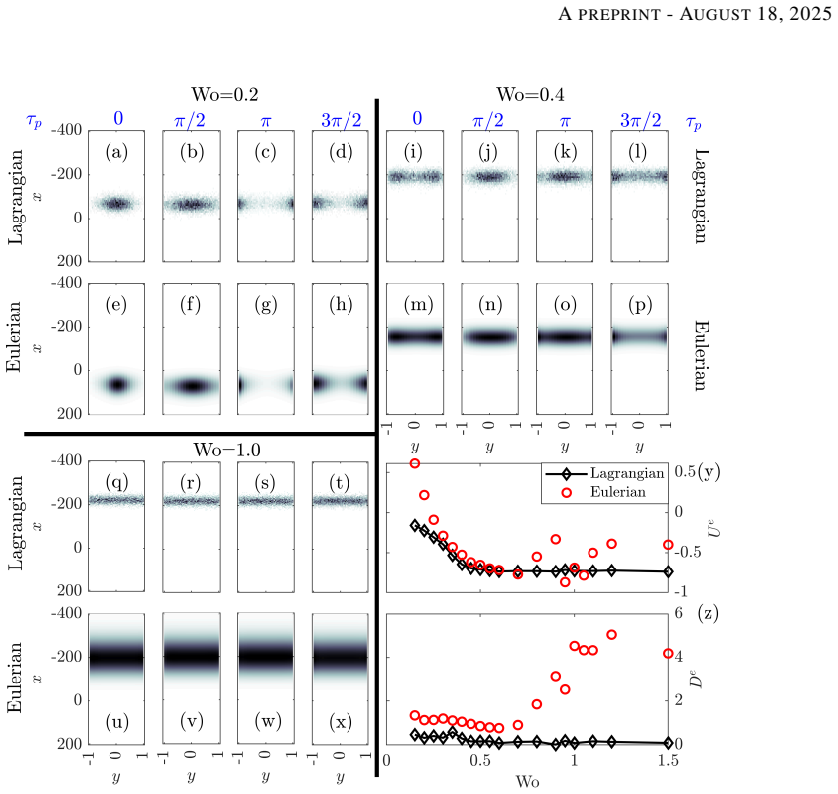
On the paper's own terms, the central discovery is that oscillatory flows give a suspension of gyrotactic swimmers a net drift whose sign and magnitude depend on the Womersley number, and that this same knob tunes axial dispersion and cross-channel mixing. At small-to-intermediate $\mathrm{Wo}$, the cells repeatedly alternate between centre-focused downwelling states, where they sample the fast core of the flow, and wall-spread upwelling states; the asymmetry of these two states in time and orientation produces drift, which for strongly gyrotactic algae peaks near $\mathrm{Wo}=0.106$ and changes sign near $\mathrm{Wo}=0.481$. At large $\mathrm{Wo}$, the oscillatory velocity profile flattens into plug-like motion, advection can no longer organise the population, and the cells revert to their intrinsic upward swimming bias, giving a drift of about $-0.73$ in the dimensionless units used. The paper further maintains that the Eulerian generalised-Taylor-dispersion description, with its quasi-steady mean orientation and diffusion tensor, agrees with the individual-based model only in a window of $\mathrm{Wo}$ and loses validity once $\mathrm{Wo}^2\,\mathrm{Sc}\gtrsim 1$, because the flow then changes on the same time scale as cell reorientation.
Load-bearing premise
The quantitative predictions hinge on the microswimmer equations (7)--(8): non-interacting point cells whose orientation obeys linear gyrotactic torque, vorticity advection, and rotational noise, and whose wall encounters are specular reflections; if real cells stick to walls, interact, or reorient differently, the predicted drift and separation speeds shift.
Editorial extensions
If this is right
- Oscillatory flows with zero mean flux can move gyrotactic cells net up or down depending on frequency; the drift peak occurs near $\mathrm{Wo}=0.106$ for the base parameters.
- Axial dispersion is largest at small $\mathrm{Wo}$ and falls off roughly as $\mathrm{Wo}^{-4}$ for large swimming Péclet number; the drift sign change coincides with a small local enhancement of dispersion.
- Cross-channel mixing of initially right-half particles speeds up sharply around $\mathrm{Wo}\sim 1$, giving a practical mixing window.
- Species with different gyrotactic biases separate in oscillatory flow; the relative drift between two model algae vanishes at a crossover Womersley number, analogous to gas-separation crossover frequencies.
- Eulerian simulations using generalised Taylor dispersion should not be used for $\mathrm{Wo}^2\,\mathrm{Sc}\gtrsim 1$; there the quasi-steady orientation averaging breaks, and Lagrangian or full orientation-resolved descriptions are needed.
Reading between the lines
- If the model transfers to real bioreactor suspensions, pulsing the flow rate rather than changing the mean flow becomes a non-invasive control that could keep cells suspended and mixed while a zero net flux protects fragile cells from pump damage.
- The predicted sign change of the excess drift with $\mathrm{Wo}$ implies a direct experimental calibration: tracking the cell cloud's centre of mass over a frequency sweep should show drift reversing near $\mathrm{Wo}\approx 0.48$ for strongly gyrotactic algae, a sharp test of the model.
- The claimed breakdown of the quasi-steady Eulerian closure at $\mathrm{Wo}^2\,\mathrm{Sc}\gtrsim 1$ suggests that future continuum models should carry orientation as an explicit degree of freedom in the fast-oscillation regime, rather than averaging it out.
Signed reviews
Editorial analysis
A structured set of objections, weighed in public.
Referee Report
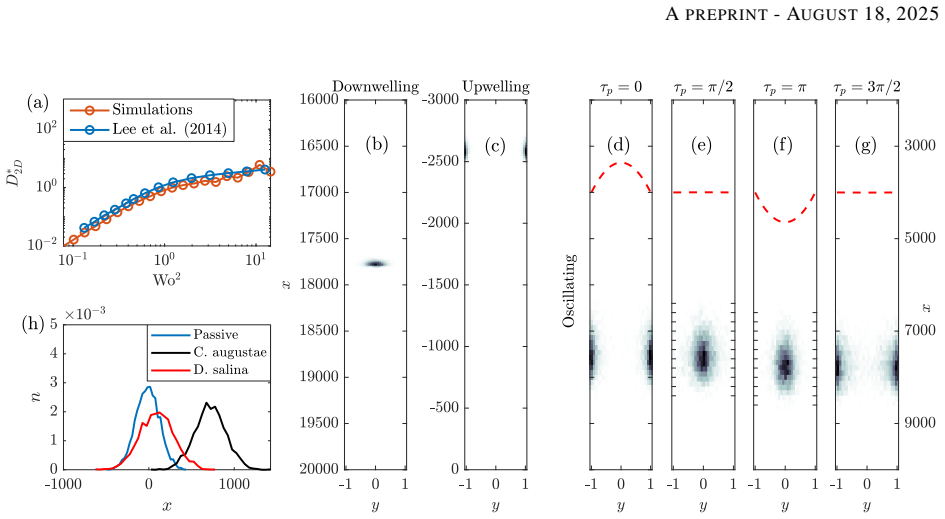
Summary. This paper investigates the dispersion, drift, mixing, and separation of gyrotactic microswimmers in a two-dimensional vertical channel driven by an oscillatory pressure gradient, i.e., Womersley flow. The authors present qualitative experiments with D. salina, an individual-based Lagrangian model (Eqs. 7-8) with specular wall reflection (Eq. 10), and an Eulerian advection-diffusion model with a generalized Taylor dispersion (GTD) closure developed in Appendix A.2. Comparing these approaches, they find that the Womersley number tunes the mean excess drift U_e, the effective axial diffusivity D_e, and the lateral mixing time t_mix; that different species can be separated near a crossover Wo approximately equal to 0.383; and that the Eulerian GTD closure breaks down when Wo^2 Sc is of order one or larger.
Significance. The central message, that oscillatory shear provides a tunable control knob for dispersion, mixing, and species separation of active suspensions, is potentially useful for bioreactor and cell-separation applications. The numerical work has credible internal checks: passive-particle simulations reproduce Lee et al.'s dispersion results (Fig. 2a), and the high-Wo drift limit approaches the analytic von Mises value -0.7281 for lambda = 2.2 (Appendix A.2 and Figs. 4a-c). The two-dimensional GTD closure is derived in closed form and checked against asymptotic limits. However, the headline quantitative predictions (drift sign and magnitude, separation crossover) are carried by the Lagrangian model, whose wall-reflection rule is not validated independently, and the experiments are only qualitative motivation. The contribution is significant if the model is taken as a predictive tool, but the claims need to be framed or tested more carefully.
major comments (3)
- [§4.4, Eq. (10), Fig. 5y] At Wo = 0.2 with PéR = 2 and βR = 1, the Lagrangian and Eulerian models predict opposite signs of the excess drift U_e, and the authors attribute this to the wall treatment, stating that specular reflection (Eq. 10) is 'a better representation' of real boundaries. However, no quantitative experimental test or independent measurement of cell-wall interactions is provided for the species and flows considered. Because the sign and magnitude of U_e in Figs. 4a-c and the separation crossover Wo ≈ 0.383 in inset A depend on how cells accumulate at the walls, the central claims rest on an unvalidated boundary condition. I request either a sensitivity study (e.g., partial absorption, slip, or reorientation at walls) or an explicit treatment of the wall rule as a modeling assumption whose consequences are mapped, with the claims softened accordingly.
- [§2, Figs. 1b-m] The experimental section is qualitative: only two Wo values are shown, and there are no measured drift velocities, dispersion coefficients, mixing times, or quantitative comparisons with the simulation parameters in Table 1. The abstract and conclusion present drift, separation, and tuning as findings of the study; given that the experiments only motivate the models, these results should be described as predictions of the individual-based model unless quantitative validation is added. This does not invalidate the theoretical contribution, but the wording should not imply experimental confirmation.
- [§4.3, Fig. 4] The quantitative claims in Fig. 4—the location of the drift maximum at Wo = 0.106, the sign change near Wo = 0.481, the separation crossover Wo ≈ 0.383, and the local extrema in D_e and t_mix—are based on single runs of 5000 particles with no error bars or convergence tests. Given the visible stochastic noise in the curves, I ask the authors to add uncertainty estimates (e.g., multiple seeds or bootstrapped confidence intervals) or to restrict claims to features that are robust across such estimates.
minor comments (4)
- [Conclusion, p. 12] The text reads 'the Womesley number, Wo'; this should be 'Womersley number.'
- [Appendix A.1] The sentence 'the non-dimensional reorientation rate is dr = 1/Wo^2 Sc' should read 'rotational diffusivity' rather than 'reorientation rate,' since dr is the dimensionless rotational diffusivity.
- [§4.3, first bullet] The phrase 'Strongly gravitactic particles do not accumulate in the centre and at walls as much and, therefore, have smaller drift' is ambiguous; please specify with respect to which species or parameter values this comparison is made.
- [§4.1, Eq. (15)] The definitions of V and tm are introduced quickly; please define them explicitly before using them in the formula for De*.
Circularity Check
No significant circularity; only a low-severity consistency-check issue in the Eulerian-Lagrangian comparison.
-
fitted input called prediction
[Section 4.4, Appendix A.2, Table 2]
"We use q and D obtained for C. augustae (see Appendix A.2) and Lagrangian simulations use the corresponding d′ r and B′ values. ... Solutions converge rapidly; an order three truncation is suitable for most purposes. Similar to [27], the solutions are well-fitted by the curves ... Diffusion values can also be fitted by curves, with D11 = F (σ; a11, c), D12 = −σF (σ; a12, c) and D22 = F (σ; a22, c)."
The Eulerian closure q and D are not independent data: they are curve fits to a truncated Fourier solution of the same Fokker-Planck orientation equation (Eq. 20) that the Lagrangian solver integrates stochastically (Eqs. 7-8), using the same d_r′ and B′. Consequently the Eulerian-Lagrangian agreement reported in Fig. 5 (and the divergence at larger Wo) is a consistency test of the GTD approximation against a direct solver of the same micro-model, not an independent validation of the microphysics. The paper’s principal drift/separation/mixing claims are carried by the Lagrangian model and are separately benchmarked against the passive-particle results of Lee et al. [34], so this issue is confined to the comparative role of Section 4.4 and does not make the central derivation circular.
full rationale
The headline results (drift, enhanced dispersion, mixing, species separation) are produced by the individual-based Lagrangian model, Eqs. (7)-(8), which is an explicit stochastic simulation rather than a closure fitted to those outputs. Section 4.1 validates the IBM against an external passive-particle calculation (Lee et al. [34]). The Eulerian model in Section 4.4 is presented as a quasi-steady GTD closure whose q and D are derived (and then algebraically fitted) from the same orientation Fokker-Planck dynamics; the Lagrangian-Eulerian comparison is therefore a consistency check of the closure, not an independent prediction, which is a minor circularity of benchmarking but not of the paper's main claims. The wall-reflection sensitivity flagged by the skeptic is a real modelling assumption (specular reflection via Eq. (10), supported by prior literature), but it is an unvalidated boundary condition and a correctness risk, not a circular reduction; no fitted parameter is relabelled as a prediction, and no load-bearing self-citation nor imported uniqueness theorem is used. The high-Wo drift limit −I0(λ)/I1(λ) is an analytical consequence of the same orientation model and is used only as an internal check.
Assumptions & free parameters
free parameters (3)
- GTD fitting coefficients for lambda=2.2 =
Table 2 values, e.g. q1: a0=7.281e-1, a2=7.52e-2, c2=3.584e-1, c4=6.06e-2
- lambda (dimensionless gyrotaxis strength) in the Table 2 fits =
2.2
- Strongly gyrotactic model species parameters =
B'=0.3 s, d'_r=0.01 s^-1
assumptions (6)
- domain assumption Suspension is dilute: particles are non-interacting and hydrodynamically passive.
- domain assumption No two-way coupling: the flow is the single-phase Womersley solution with no cell-induced back-reaction.
- domain assumption Gyrotactic orientation dynamics are captured by Eq. (6): gravitational torque with reorientation time B', vorticity advection, and rotational Brownian noise.
- domain assumption Specular reflection, Eq. (10), approximates cell-wall interaction.
- domain assumption Quasi-steady GTD closure: q and D from steady linear shear are applied locally in time and space in the Eulerian model.
- standard math Womersley flow solution, Taylor dispersion background, and stochastic calculus are valid.
Cite this review
Pith. "Pith review of Fine-tuning the dispersion of active suspensions with oscillatory flows." pith.science (2026). https://pith.science/paper/Q4G3QVWS
@misc{pith2026250517788,
  author       = {Pith},
  title        = {Pith review of: Fine-tuning the dispersion of active suspensions with oscillatory flows},
  year         = {2026},
  howpublished = {\url{https://pith.science/paper/Q4G3QVWS}},
  note         = {Machine review of arXiv:2505.17788}
}
read the original abstract
The combined impact of axial stretching and cross-stream diffusion on the downstream transport of solute is termed Taylor dispersion. The dispersion of active suspensions is qualitatively distinct: viscous and external torques can establish non-uniform concentration fields with weighted access to shear, modifying mean drift and effective diffusivity. It would be advantageous to fine-tune the dispersion for systems such as bioreactors, where mixing or particle separation can improve efficacy. Here, we investigate the dispersion of active suspensions in a vertical channel driven by an oscillatory pressure gradient - Womersley flow - using gyrotactic swimmers (bottom-heavy cells subject to viscous torques). Preliminary experimental results reveal interesting dispersion phenomena, highly dependent on the oscillation parameters, motivating theoretical investigation. Employing Lagrangian simulations, we find that oscillatory flows can induce drift and increase lateral and downstream dispersion, with periodic mixing between left and right sides. Such flows can also be used to separate species with different motile behaviour. Eulerian numerical schemes typically require an approach to averaging in orientational space, such as generalised Taylor dispersion, with assumptions on translational and rotational time scales. For an oscillatory timescale commensurate with cell dynamics, we reveal the limitations of such approximations, beyond which the averaging techniques collapse.
Figures


Figures from the paper (2 more)

Reference graph
Works this paper leans on
-
[35]
Smitha Maretvadakethope et al. “The interplay between bulk flow and boundary conditions on the distribution of microswimmers in channel flow”. In: Journal of Fluid Mechanics 976 (2023), A13
work page 2023
-
[1]
Dispersion of soluble matter in solvent flowing slowly through a tube
Geoffrey Ingram Taylor. “Dispersion of soluble matter in solvent flowing slowly through a tube”. In:Proceedings of the Royal Society of London. Series A. Mathematical and Physical Sciences 219.1137 (1953), pp. 186–203
work page 1953
-
[2]
On the dispersion of a solute in a fluid flowing through a tube
Rutherford Aris. “On the dispersion of a solute in a fluid flowing through a tube”. In: Proceedings of the Royal Society of London. Series A. Mathematical and Physical Sciences 235.1200 (1956), pp. 67–77
work page 1956
-
[3]
Individual and collective fluid dynamics of swimming cells
John O Kessler. “Individual and collective fluid dynamics of swimming cells”. In: Journal of Fluid Mechanics 173 (1986), pp. 191–205
work page 1986
-
[4]
M. A. Bees. “Advances in bioconvection”. In: Annual Review of Fluid Mechanics 52.1 (2020), pp. 449–476
work page 2020
-
[5]
Dispersion of biased swimming micro-organisms in a fluid flowing through a tube
Martin A Bees and Ottavio A Croze. “Dispersion of biased swimming micro-organisms in a fluid flowing through a tube”. In: Proceedings of the Royal Society A: Mathematical, Physical and Engineering Sciences 466.2119 (2010), pp. 2057–2077. 14 A PREPRINT - AUGUST 18, 2025
work page 2010
-
[6]
Development of suitable photobioreactor for algae production–A review
RN Singh and Shaishav Sharma. “Development of suitable photobioreactor for algae production–A review”. In: Renewable and Sustainable Energy Reviews 16.4 (2012), pp. 2347–2353
work page 2012
-
[7]
Biofouling in photobioreactors for marine microalgae
Ouassim Zeriouh et al. “Biofouling in photobioreactors for marine microalgae”. In: Critical reviews in biotech- nology 37.8 (2017), pp. 1006–1023
work page 2017
Show all 39 references
-
[8]
Evolution of photobioreactors: a review based on microalgal perspective
Imran Ahmad et al. “Evolution of photobioreactors: a review based on microalgal perspective”. In: IOP Confer- ence Series: Materials Science and Engineering. V ol. 1142. 1. IOP Publishing. 2021, p. 012004
2021
-
[9]
Commercial production of microalgae: ponds, tanks, tubes and fermenters
Michael A Borowitzka. “Commercial production of microalgae: ponds, tanks, tubes and fermenters”. In: Journal of biotechnology 70.1-3 (1999), pp. 313–321
1999
-
[10]
Algal biofilm reactors for integrated wastewater treatment and biofuel production: a review
Donghee Hoh, Stuart Watson, and Eunsung Kan. “Algal biofilm reactors for integrated wastewater treatment and biofuel production: a review”. In: Chemical Engineering Journal 287 (2016), pp. 466–473
2016
-
[11]
Dispersion of swimming algae in laminar and turbulent channel flows: consequences for photobioreactors
Ottavio A Croze et al. “Dispersion of swimming algae in laminar and turbulent channel flows: consequences for photobioreactors”. In: Journal of The Royal Society Interface 10.81 (2013), p. 20121041
2013
-
[12]
On the longitudinal dispersion of passive contaminant in oscillatory flows in tubes
P. C. Chatwin. “On the longitudinal dispersion of passive contaminant in oscillatory flows in tubes”. en. In: Journal of Fluid Mechanics 71.3 (Oct. 1975). Publisher: Cambridge University Press, pp. 513–527. ISSN : 1469-7645, 0022-1120. DOI: 10.1017/S0022112075002716
1975 doi
-
[13]
Diffusional separation of gases by sinusoidal oscillations
U. H. Kurzweg and M. J. Jaeger. “Diffusional separation of gases by sinusoidal oscillations”. In:The Physics of Fluids 30.4 (Apr. 1987). Publisher: American Institute of Physics, pp. 1023–1025. ISSN : 0031-9171. DOI: 10.1063/1.866300
1987 doi
-
[14]
Enhanced heat conduction in oscillating viscous flows within parallel-plate channels
U. H. Kurzweg. “Enhanced heat conduction in oscillating viscous flows within parallel-plate channels”. en. In: Journal of Fluid Mechanics 156 (July 1985). Publisher: Cambridge University Press, pp. 291–300. ISSN : 1469-7645, 0022-1120. DOI: 10.1017/S0022112085002105
1985 doi
-
[15]
Oscillating flow and separation of species in rectangular channels
A. Hacioglu and R. Narayanan. “Oscillating flow and separation of species in rectangular channels”. In: Physics of Fluids 28.7 (July 2016). Publisher: American Institute of Physics, p. 073602. ISSN : 1070-6631. DOI: 10. 1063/1.4954316
2016
-
[16]
Molecular diffusion in oscillating laminar flow in a pipe
L. P. Purtell. “Molecular diffusion in oscillating laminar flow in a pipe”. en. In:Physics of Fluids 24.5 (1981), p. 789. ISSN : 00319171. DOI: 10.1063/1.863450
1981 doi
-
[17]
Diffusion in oscillatory pipe flow
E. J. Watson. “Diffusion in oscillatory pipe flow”. en. In: Journal of Fluid Mechanics 133 (Aug. 1983), pp. 233–
1983
-
[18]
Enhanced dispersion in oscillatory flows
U. H. Kurzweg, G. Howell, and M. J. Jaeger. “Enhanced dispersion in oscillatory flows”. en. In: Physics of Fluids 27.5 (1984), p. 1046. ISSN : 00319171. DOI: 10.1063/1.864752
1984 doi
-
[19]
Physics of oscillatory flow and its effect on the mass transfer and separation of species
Aaron M. Thomas and R. Narayanan. “Physics of oscillatory flow and its effect on the mass transfer and separation of species”. In: Physics of Fluids 13.4 (Apr. 2001). Publisher: American Institute of Physics, pp. 859–
2001
-
[20]
Dispersion in a curved tube during oscillatory flow
M. K. Sharp et al. “Dispersion in a curved tube during oscillatory flow”. en. In: Journal of Fluid Mechanics 223 (Feb. 1991). Publisher: Cambridge University Press, pp. 537–563. ISSN : 1469-7645, 0022-1120. DOI: 10.1017/S0022112091001544
1991 doi
-
[21]
On solute transport in oscillatory flow through an annular pipe with a reactive wall and its application to a catheterized artery
B. S. Mazumder and Kajal Kumar Mondal. “On solute transport in oscillatory flow through an annular pipe with a reactive wall and its application to a catheterized artery”. en. In:The Quarterly Journal of Mechanics and Applied Mathematics 58.3 (Aug. 2005), pp. 349–365. ISSN : 1...
2005 doi
-
[22]
Dispersion of a solute in pulsatile non-Newtonian fluid flow through a tube
P. Nagarani and B. T. Sebastian. “Dispersion of a solute in pulsatile non-Newtonian fluid flow through a tube”. en. In: Acta Mechanica 224.3 (Mar. 2013), pp. 571–585. ISSN : 1619-6937. DOI: 10.1007/s00707-012-0753-6
2013 doi
-
[23]
Diffusive heat and mass transfer in oscillatory pipe flow
G. J. Brereton and S. M. Jalil. “Diffusive heat and mass transfer in oscillatory pipe flow”. In:Physics of Fluids29.7 (July 2017). Publisher: American Institute of Physics, p. 073601. ISSN : 1070-6631. DOI: 10.1063/1.4990976
2017 doi
-
[24]
Resonant alignment of microswimmer trajectories in oscillatory shear flows
Alexander Hope et al. “Resonant alignment of microswimmer trajectories in oscillatory shear flows”. In:Physical Review Fluids 1.5 (2016), p. 051201
2016
-
[25]
Microswimmer trapping in surface waves with shear
Francesco Michele Ventrella et al. “Microswimmer trapping in surface waves with shear”. In: Proceedings of the Royal Society A 479.2278 (2023), p. 20230280
2023
-
[26]
Foundation and challenges in modelling dilute active suspensions
L. Fung, H. Caldag, and M. A. Bees. “Foundation and challenges in modelling dilute active suspensions”. In: Philosophical Transactions A (2025), pp. 1–18. DOI: 10.1098/rsta.2024.0251
2025
-
[27]
Biased swimming cells do not disperse in pipes as tracers: a population model based on microscale behaviour
Rachel N Bearon, MA Bees, and OA Croze. “Biased swimming cells do not disperse in pipes as tracers: a population model based on microscale behaviour”. In: Physics of fluids 24.12 (2012)
2012
-
[28]
Gyrotactic swimmer dispersion in pipe flow: testing the theory
Ottavio A Croze, Rachel N Bearon, and Martin A Bees. “Gyrotactic swimmer dispersion in pipe flow: testing the theory”. In: Journal of Fluid Mechanics 816 (2017), pp. 481–506
2017
-
[29]
Taylor dispersion of gyrotactic swimming micro-organisms in a linear flow
NA Hill and MA Bees. “Taylor dispersion of gyrotactic swimming micro-organisms in a linear flow”. In:Physics of Fluids 14.8 (2002), pp. 2598–2605. 15 A PREPRINT - AUGUST 18, 2025
2002
-
[30]
Sheared bioconvection in a horizontal tube
OA Croze, EE Ashraf, and MA Bees. “Sheared bioconvection in a horizontal tube”. In: Physical biology 7.4 (2010), p. 046001
2010
-
[31]
A tale of three taxes: photo-gyro-gravitactic bioconvection
C Rosie Williams and Martin Alan Bees. “A tale of three taxes: photo-gyro-gravitactic bioconvection”. In: Journal of Experimental Biology 214.14 (2011), pp. 2398–2408
2011
-
[32]
Dispersion of a gyrotactic micro-organism suspension in a vertical pipe: the buoyancy–flow coupling effect
Bohan Wang, Weiquan Jiang, and Guoqian Chen. “Dispersion of a gyrotactic micro-organism suspension in a vertical pipe: the buoyancy–flow coupling effect”. In: Journal of Fluid Mechanics 962 (2023), A39
2023
-
[33]
Emergent asymmetry in confined bioconvection
Martin A Bees and Prasad Perlekar. “Emergent asymmetry in confined bioconvection”. In: Journal of Fluid Mechanics 1003 (2025), A21
2025
-
[34]
Taylor dispersion in oscillatory flow in rectangular channels
Jinkee Lee, Anubhav Tripathi, and Anuj Chauhan. “Taylor dispersion in oscillatory flow in rectangular channels”. en. In: Chemical Engineering Science 117 (2014). DOI: 10.1016/j.ces.2014.06.022
2014 doi
-
[36]
oomph-lib–An O bject-O riented M ulti-Phy sics Finite-Element Lib rary
Matthias Heil and Andrew L Hazel. “oomph-lib–An O bject-O riented M ulti-Phy sics Finite-Element Lib rary”. In: Fluid-structure interaction: Modelling, simulation, optimisation. Springer. 2006, pp. 19–49
2006
-
[37]
Motility-Induced Phase Separation Mediated by Bacterial Quorum Sensing
Wesley JM Ridgway et al. “Motility-Induced Phase Separation Mediated by Bacterial Quorum Sensing”. In: Physical Review Letters 131.22 (2023), p. 228302. 16
2023
- [244]
- [866]
Reviewed August 7, 2026 · model on record in the stance chip above.
Discussion (0). Continue with ORCID to comment.