REVIEW 3 major objections 3 minor 71 references
Primordial black holes through preheating instabilities in $\alpha$-attractor models
T0 review · 3 major / 3 minor · reviewed 2026-08-07 · deepseek-v4-flash
Pith's one-line read The paper argues that preheating self-resonance in α-attractor models produces 10^2–10^7 g primordial black holes, that the Press–Schechter mass fraction overproduces them and is excluded by Hawking-evaporation constraints, while the…
desk verdict Useful alpha-attractor extension of the preheating PBH program, but the PS-vs-KP exclusion is undercut by an epoch inconsistency and an underspecified threshold. read the letter →
The pith
A machine-rendered reading of the paper's core claim, the machinery that carries it, and where it could break.
The reading
What carries the argument
The load-bearing objects are the instability band—the range of comoving wavenumbers whose Hill-equation Floquet exponents are positive during self-resonance—and the $k$-dependent collapse threshold $\delta_c(k)$, defined numerically as the minimum initial density perturbation that reaches $O(1)$ before the end of preheating. The instability band decides which modes grow; the Jeans/sound-speed condition decides which of those can collapse; the threshold decides which reach nonlinearity in time. The abundance formulas then convert the variance $\sigma_k^2$ into a mass fraction, with the Khlopov–Polnarev formula $\beta(k)\simeq 0.056\,\sigma_k^5$ replacing the Press–Schechter Gaussian-integral estimate and suppressing collapse for anisotropic perturbations.
What would settle it
Run a full numerical-relativity or high-resolution lattice simulation of self-resonant preheating in an E-model with $\alpha = 10^{-3}$, extract the true collapse threshold and mass fraction, and compare with the $\beta$ values this paper reports: if the simulated abundance matches Press–Schechter and violates the evaporation constraints, the KP viability conclusion fails; if it matches the KP curve, the PS exclusion is confirmed.
Extended reading notes
Core claim
Self-resonance during the preheating epoch in $\alpha$-attractor models amplifies scalar perturbations within a broad instability band, and three criteria—membership in that band, wavelength above the effective Jeans length and below the Hubble radius, and density contrast above a per-mode time-to-collapse threshold—select the modes that collapse into PBHs with masses $10^{2}$–$10^{7}$ g. Using the resulting power spectrum, the paper finds that the Press–Schechter formalism gives mass fractions that overshoot the Hawking-evaporation bounds, whereas the Khlopov–Polnarev formalism, based on the fraction of perturbations spherical enough to collapse, keeps the same models inside the bounds. This is the paper's central claim: the PS formalism is excluded by evaporation constraints and the KP formalism is viable, so the nonspherical suppression of collapse is decisive for PBH abundance during preheating.
Load-bearing premise
The calculation leans on the numerically computed collapse threshold $\delta_c(k)$, whose normalization and nonlinearity cutoff are not specified; a different choice could move the Press–Schechter exclusion and the Khlopov–Polnarev survival by orders of magnitude.
Editorial extensions
If this is right
- The T- and E-models of $\alpha$-attractor inflation with small $\alpha$ can produce PBHs of $10^{2}$ to $10^{7}$ g during preheating, with masses growing as $\alpha$ decreases.
- The Press–Schechter formalism overproduces these PBHs and violates the Hawking-evaporation constraints (Planck remnants, LSP, and dark-matter production), so it is excluded in this scenario.
- The Khlopov–Polnarev formalism keeps the abundance below those constraints, leaving the small-$\alpha$ models viable.
- Lengthening preheating to roughly 12–13 e-folds pushes the instability band into the nonlinear regime, causing overproduction in Press–Schechter but not necessarily in Khlopov–Polnarev.
- The difference between the two formalisms means evaporation constraints cannot be used to rule out these models until nonspherical collapse is treated correctly.
Reading between the lines
- Editorial extension: because $\beta_{\rm PS}$ depends on $\delta_c(k)$ through a complementary error function, the reported PS exclusion is sensitive to how "reaches $O(1)$" is implemented numerically; the authors do not quantify this sensitivity.
- Editorial extension: the same instability band that forms PBHs should source a scalar-induced gravitational-wave background, so a future detection could be combined with the evaporation bounds to test whether the KP suppression is as strong as assumed.
- Editorial extension: adding inhomogeneity and spin factors to the KP estimate, as the paper's product formula suggests, would lower abundances further and make PBH formation during preheating harder to observe.
Editorial analysis
A structured set of objections, weighed in public.
Referee Report
Summary. This paper studies primordial black hole (PBH) formation during preheating in T- and E-model alpha-attractors. The authors use three criteria: a mode must lie in the self-resonance instability band, its wavelength must exceed the Jeans length, and its density contrast must exceed an alpha- and k-dependent threshold delta_c(k). With these criteria they compute the mass fraction beta(k) using both the Press-Schechter (PS) formalism, Eq. (5.2), and the Khlopov-Polnarev (KP) formalism, Eq. (5.3), and estimate PBH masses from the horizon mass at instability-band entry, Eq. (5.5). For alpha values near the authors' earlier gravitational-wave lower bounds, the resulting PBH masses lie in the roughly 10^2 to 10^7 g range. The authors find that the PS formalism overproduces PBHs relative to evaporating-PBH constraints while the KP formalism remains viable, and conclude that nonspherical effects are essential in preheating PBH calculations. The paper extends the authors' previous Starobinsky analysis to alpha-attractor models and imports the instability-band and Floquet results from their companion papers [26,27].
Significance. If the quantitative comparison is reliable, the paper makes a valuable point: PS-type estimates applied to matter-dominated preheating overproduce PBHs, while KP anisotropy suppression can bring predictions into agreement with evaporation constraints. The paper has real strengths: it uses numerical Mukhanov-Sasaki evolution cross-checked against Floquet theory (Fig. 5), validates the analytic sound speed against the full expression (Fig. 3), and compares explicitly with a wide set of observational constraints. However, the central quantitative claim is not currently reproducible. The numerical threshold delta_c(k) is defined only verbally, and the PS and KP formalisms are evaluated at different epochs without a stated convention for the relative normalization. These issues are load-bearing because they enter exponentially or through a fifth power in the abundances, so they must be resolved before the 'PS excluded, KP viable' conclusion can be accepted.
major comments (3)
- [Sec. 3, after Eq. (3.10)] The numerical computation of the threshold delta_c(k) is not specified. The text says it is 'the minimum value of the density perturbation that reaches O(1)', but it does not state the target nonlinearity value (e.g., 1 versus 1.06 versus 1.69), the initial-condition normalization for delta_k, the time at which the amplitude is read, or the numerical method used. Since delta_c(k) enters exponentially in the PS mass fraction (Eq. 5.2) and also gates which modes are counted in the KP formalism, this omission makes the central PS-vs-KP comparison unreproducible and could change the abundances by orders of magnitude. Please provide the full algorithm, including the definition of O(1), the normalization of delta_k, and the numerical scheme, or give a convergence study against an explicit convention.
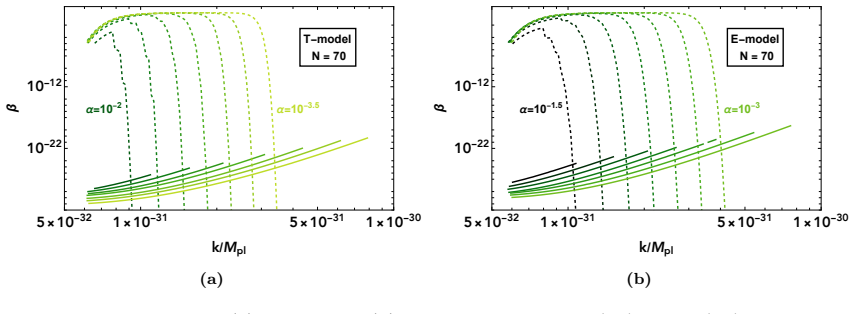
- [Sec. 5.1, Eq. (5.3) and Figs. 6-7] The evaluation epoch used for the two formalisms is inconsistent. The PS paragraph and the captions of Figs. 6 and 7 state that the mass fraction is evaluated 10 e-folds after the end of inflation (N=70), while the KP paragraph immediately after Eq. (5.3) states that the mass fraction is evaluated 'at the moment the perturbation crosses the IB and thus starts to amplify from a small value'. These epochs differ by roughly the duration of exponential self-resonant growth, during which sigma_k grows by many orders of magnitude. Because beta_KP is proportional to sigma_k^5 (Eq. 5.3) and beta_PS depends on erfc(delta_c/(sqrt(2) sigma_k)) (Eq. 5.2), the relative normalization of the two curves in Fig. 6 depends critically on which convention is used; moreover, if sigma_k at N=70 is used for the KP estimate, the condition sigma_k < 0.01 stated for the validity of Eq. (5.3) may be violated. Please specify one evaluation epoch for both formalisms, or quantify the sensitivity of the conclusion to this choice.
- [Sec. 6 and Abstract] The headline claim that 'the PS formalism is excluded by these constraints, which are based on Hawking radiation' is stronger than the analysis supports. The paper's own Sec. 6 states that for the mass range considered, the only active constraints are Planck remnants, LSP, and DM production, and it calls these 'highly theoretical' with the last two depending on the emitted particle mass. Since the remnant constraint rests on speculative end-of-evaporation physics, the conclusion should be reworded to reflect that the exclusion holds under specific assumptions about quantum gravity and particle physics, rather than presenting it as a robust Hawking-radiation constraint.
minor comments (3)
- [Captions of Figs. 6-7] The caption of Fig. 6 says the dashed and continuous curves correspond to 'KP (5.3) and PS (5.2) ... respectively', while the text of Sec. 5.1 says the PS formalism is shown by dashed curves and the KP formalism by continuous curves. These statements are mutually contradictory, making the central figure ambiguous. Please correct the caption and make it consistent with the text.
- [Sec. 5.2, caption of Fig. 7] The caption of Fig. 7 refers to Eq. (5.7) for the PBH mass, but the text explicitly does not use the critical-scaling formula (5.7) and instead computes masses from Eq. (5.5), arguing that perturbations are in the super-critical regime. The caption should cite Eq. (5.5).
- [Sec. 5.1 and Sec. 6] There are several small presentation errors: in Sec. 5.1 the reference appears as '[66?]'; in Sec. 6 'Einstein' is misspelled as 'Eintein'; and the statement that a preheating duration of 12-13 e-folds makes beta flat and equal to 1 is not supported by a figure or a quantitative derivation. These should be corrected or clarified.
Circularity Check
No definitional circularity: the PBH mass fractions are genuine outputs of the specified MS/Hill dynamics and the PS/KP formulas, and the external Hawking-evaporation constraints enter as benchmarks rather than as fitted inputs.
full rationale
Walking the derivation chain, I find no step in which a predicted quantity is identical by construction to an input, and no fitted parameter is renamed as a prediction. The instability band, Floquet exponents, and the allowed alpha range are imported from the authors' own prior work, e.g. Eq. (3.1) for l_inst is attributed to [27] and the alpha lower bounds are attributed to [26]; these are load-bearing self-citations, but they are independent prior physical results used as inputs, not fits to the evaporating-PBH constraints, and the paper also displays a full numerical Mukhanov-Sasaki solution in Fig. 5. The numerical threshold delta_c(k), defined as 'the minimum value of the density perturbation that reaches O(1)', is an operational collapse criterion calibrated from the same evolution that produces delta_k; this is a modeling assumption, not a parameter fitted to the PBH constraints, so the PS and KP abundances still emerge from the stated dynamics. The central PS-vs-KP comparison has a serious epoch ambiguity: the captions of Figs. 6 and 7 state that 'the evaluation is made 10 e-folds after the end of inflation', while the KP paragraph says 'the mass fraction is evaluated at the moment the perturbation crosses the IB and thus starts to amplify from a small value'. That inconsistency affects the reliability of the claimed exclusion of PS and viability of KP, but it is a correctness problem, not circularity: no equation in the paper reduces to its own input. The low score reflects the heavy self-reference in the input chain rather than any definitional or fitted-input circularity.
Assumptions & free parameters
free parameters (4)
- Nonlinearity threshold 'O(1)' =
Unspecified (order unity)
- Preheating duration =
10 e-folds after the end of inflation
- Collapse efficiency gamma =
1
- Maximum density contrast delta_max =
1
assumptions (7)
- domain assumption The instability band and Floquet exponents from [27] apply to the T/E alpha-attractor potentials studied here.
- domain assumption Density contrast is related to curvature perturbation by Eq. (4.7), as established in [9] for Starobinsky inflation.
- domain assumption The average sound speed approximation Eq. (3.7) is valid for oscillating scalar fields during preheating.
- domain assumption The collapse time for an overdensity is given by massive scalar field spherical collapse in Einstein-de Sitter, Eq. (3.9), and the threshold is the amplitude that reaches O(1).
- domain assumption Density perturbations follow Gaussian statistics in the Press-Schechter integral, Eq. (5.2).
- domain assumption The KP abundance formula beta = 0.056 sigma^5 (Eq. 5.3) is valid for all relevant modes (sigma < 0.01).
- domain assumption Standard big bang cosmology applies to the evaporating-PBH constraints; early matter domination modifies them negligibly.
Cite this review
Pith. "Pith review of Primordial black holes through preheating instabilities in $\alpha$-attractor models." pith.science (2026). https://pith.science/paper/QRVJAQHA
@misc{pith2026250517790,
  author       = {Pith},
  title        = {Pith review of: Primordial black holes through preheating instabilities in $\alpha$-attractor models},
  year         = {2026},
  howpublished = {\url{https://pith.science/paper/QRVJAQHA}},
  note         = {Machine review of arXiv:2505.17790}
}
abstract
In this work, we explore the production of primordial black holes (PBHs) within the context of $\alpha$-attractor inflationary models, focusing on the preheating phase following inflation. During this phase, self-resonance instabilities arise due to deviations of the inflationary potential from a quadratic form. PBH formation is analyzed using three criteria: (1) the perturbation must lie within the instability band, (2) its characteristic length must exceed the Jeans length, and (3) it must have sufficient time to collapse based on the estimations of massive scalar field spherical collapse in Einstein-de Sitter universe. Based on these criteria, we calculate the PBH mass fraction using the Press-Schechter (PS) and Khlopov-Polnarev (KP) formalisms. Our results show that the PS formalism tends to overestimate PBH abundance during preheating, as it neglects nonspherical effects. In contrast, the KP formalism yields more realistic predictions by incorporating such effects. We provide a detailed comparison with observational constraints from evaporating PBHs. Notably, the PS formalism is excluded by these constraints, which are based on Hawking radiation, while the KP formalism remains viable. These findings underscore the importance of accounting for nonspherical effects and accurate collapse dynamics in studies of PBH formation during preheating.
Figures


Figures from the paper (4 more)



Reference graph
Works this paper leans on
-
[9]
D. del Corral, P. Gondolo, K. S. Kumar and J. Marto,Revisiting primordial black holes formation from preheating instabilities: the case of Starobinsky inflation, JCAP 02 (2025) 009 [2311.02754]
work page Pith review arXiv 2025
-
[1]
Y. B. Zel’dovich and I. D. Novikov,The Hypothesis of Cores Retarded during Expansion and the Hot Cosmological Model, sovast 10 (1967) 602
work page 1967
-
[2]
Hawking,Gravitationally collapsed objects of very low mass, mnras 152 (1971) 75
S. Hawking,Gravitationally collapsed objects of very low mass, mnras 152 (1971) 75
work page 1971
-
[3]
B. J. Carr and S. W. Hawking,Black holes in the early Universe, mnras 168 (1974) 399
work page 1974
-
[4]
B. J. Carr,The primordial black hole mass spectrum., apj 201 (1975) 1
work page 1975
-
[5]
P. Villanueva-Domingo, O. Mena and S. Palomares-Ruiz,A brief review on primordial black holes as dark matter, Front. Astron. Space Sci.8 (2021) 87 [2103.12087]. – 16 –
arXiv 2021
-
[6]
B. Carr, K. Kohri, Y. Sendouda and J. Yokoyama,Constraints on primordial black holes, Rept. Prog. Phys.84 (2021) 116902 [2002.12778]
arXiv 2021
-
[7]
B. Carr and F. Kuhnel,Primordial black holes as dark matter candidates, SciPost Phys. Lect. Notes 48 (2022) 1 [2110.02821]
arXiv 2022
Show all 71 references
-
[8]
S. W. Hawking,Black hole explosions, Nature 248 (1974) 30
1974
-
[10]
Lemoine,Moduli constraints on primordial black holes, Phys
M. Lemoine,Moduli constraints on primordial black holes, Phys. Lett. B481 (2000) 333 [hep-ph/0001238]
2000 arXiv
-
[11]
PBHBeta: A Python Package for Calculating the Abundance of Primordial Black Holes
T. D. Gomez-Aguilar and L. E. Padilla, “PBHBeta: A Python Package for Calculating the Abundance of Primordial Black Holes.”https://pbhbeta.readthedocs.io/en, 2023
2023
-
[12]
PBHBeta
T. D. Gomez-Aguilar and L. E. Padilla, “PBHBeta.” https://github.com/TadeoDGAguilar/PBHBeta, 2023
2023
-
[13]
Martin, T
J. Martin, T. Papanikolaou and V. Vennin,Primordial black holes from the preheating instability in single-field inflation, Journal of Cosmology and Astroparticle Physics2020 (2020) 024
2020
-
[14]
Jedamzik, M
K. Jedamzik, M. Lemoine and J. Martin,Collapse of Small-Scale Density Perturbations during Preheating in Single Field Inflation, JCAP 09 (2010) 034 [1002.3039]
2010 arXiv
-
[15]
Martin, T
J. Martin, T. Papanikolaou and V. Vennin,Primordial black holes from the preheating instability in single-field inflation, JCAP 01 (2020) 024 [1907.04236]
2020 arXiv
-
[16]
Kallosh and A
R. Kallosh and A. Linde,Multi-field Conformal Cosmological Attractors, JCAP 12 (2013) 006 [1309.2015]
2013 arXiv
-
[17]
Kallosh and A
R. Kallosh and A. Linde,Universality Class in Conformal Inflation, JCAP 07 (2013) 002 [1306.5220]
2013 arXiv
-
[18]
D. I. Kaiser and E. I. Sfakianakis,Multifield Inflation after Planck: The Case for Nonminimal Couplings, Phys. Rev. Lett.112 (2014) 011302 [1304.0363]
2014 arXiv
-
[20]
Kallosh, A
R. Kallosh, A. Linde and D. Roest,Superconformal Inflationaryα-Attractors, JHEP 11 (2013) 198 [1311.0472]
2013 arXiv
-
[21]
Kallosh and A
R. Kallosh and A. Linde,Planck, LHC, andα-attractors, Phys. Rev. D91 (2015) 083528 [1502.07733]
2015 arXiv
-
[22]
Iacconi, M
L. Iacconi, M. Fasiello, J. Väliviita and D. Wands,Novel CMB constraints on theα parameter in alpha-attractor models, JCAP 10 (2023) 015 [2306.00918]
2023 arXiv
-
[23]
J. J. M. Carrasco, R. Kallosh, A. Linde and D. Roest,Hyperbolic geometry of cosmological attractors, Phys. Rev. D92 (2015) 041301 [1504.05557]
2015 arXiv
-
[24]
K. Alam, M. Bastero-Gil, K. Dutta and H. V. Ragavendra,Non-thermal moduli production during preheating inα-attractor inflation models, JCAP 11 (2023) 095 [2303.17383]
2023 arXiv
-
[25]
Krajewski, K
T. Krajewski, K. Turzyński and M. Wieczorek,On preheating inα-attractor models of inflation, Eur. Phys. J. C79 (2019) 654 [1801.01786]. – 17 –
2019 arXiv
-
[26]
del Corral, P
D. del Corral, P. Gondolo, K. S. Kumar and J. Marto,Scalar-Induced Gravitational Waves from self-resonant preheating inα-attractor models, 2504.17602
-
[27]
del Corral,Self-resonance during preheating: The case ofα-attractor models, Annals Phys
D. del Corral,Self-resonance during preheating: The case ofα-attractor models, Annals Phys. 470 (2024) 169824 [2406.04017]
2024 arXiv
-
[28]
W. H. Press and P. Schechter,Formation of galaxies and clusters of galaxies by selfsimilar gravitational condensation, Astrophys. J. 187 (1974) 425
1974
-
[29]
Harada, C.-M
T. Harada, C.-M. Yoo and K. Kohri,Threshold of primordial black hole formation, 1309.4201
-
[30]
M. Y. Khlopov and A. G. Polnarev,Primordial black holes as a cosmological test of grand unification, Physics Letters B97 (1980) 383
1980
-
[31]
A. G. Polnarev and M. Y. Khlopov,Primordial Black Holes and the ERA of Superheavy Particle Dominance in the Early Universe,
-
[32]
A. G. Polnarev and M. Y. Khlopov,Dustlike Stages in the Early Universe and Constraints on the Primordial Black-Hole Spectrum,
-
[33]
M. A. Markov and P. C. West, eds.,QUANTUM GRAVITY. PROCEEDINGS, 2ND SEMINAR, MOSCOW, USSR, OCTOBER 13-15, 1981, 1984
1981
-
[34]
J. H. MacGibbon,Can Planck-mass relics of evaporating black holes close the universe?, Nature 329 (1987) 308
1987
-
[35]
S. W. Hawking,Breakdown of Predictability in Gravitational Collapse, Phys. Rev. D14 (1976) 2460
1976
-
[36]
P. Chen, Y. C. Ong and D.-h. Yeom,Black Hole Remnants and the Information Loss Paradox, Phys. Rept. 603 (2015) 1 [1412.8366]
2015 arXiv
-
[37]
Aharonov, A
Y. Aharonov, A. Casher and S. Nussinov,The Unitarity Puzzle and Planck Mass Stable Particles, Phys. Lett. B191 (1987) 51
1987
-
[38]
J. D. Barrow, E. J. Copeland and A. R. Liddle,The Cosmology of black hole relics, Phys. Rev. D 46 (1992) 645
1992
-
[39]
B. J. Carr, J. H. Gilbert and J. E. Lidsey,Black hole relics and inflation: Limits on blue perturbation spectra, Phys. Rev. D50 (1994) 4853 [astro-ph/9405027]
1994 arXiv
-
[40]
K. S. Kumar and J. Marto,Towards a Unitary Formulation of Quantum Field Theory in Curved Space-Time: The Case of the Schwarzschild Black Hole, PTEP 2024 (2024) 123E01 [2307.10345]
2024 arXiv
-
[41]
K. S. Kumar and J. Marto,Hawking radiation with pure states, Gen. Rel. Grav.56 (2024) 143 [2407.18652]
2024 arXiv
-
[42]
Gondolo, P
P. Gondolo, P. Sandick and B. Shams Es Haghi,Effects of primordial black holes on dark matter models, Phys. Rev. D102 (2020) 095018 [2009.02424]
2020 arXiv
-
[43]
I. B. Zeldovich, A. A. Starobinskii, M. I. Khlopov and V. M. Chechetkin,Primordial black holes and the deuterium problem, Soviet Astronomy Letters3 (1977) 110
1977
-
[44]
S. K. Acharya and R. Khatri,CMB and BBN constraints on evaporating primordial black holes revisited, JCAP 06 (2020) 018 [2002.00898]
2020 arXiv
-
[45]
B. J. Carr, K. Kohri, Y. Sendouda and J. Yokoyama,New cosmological constraints on primordial black holes, Phys. Rev. D81 (2010) 104019 [0912.5297]. – 18 –
2010 arXiv
-
[46]
A. S. Josan, A. M. Green and K. A. Malik,Generalised constraints on the curvature perturbation from primordial black holes, Phys. Rev. D79 (2009) 103520 [0903.3184]
2009 arXiv
-
[47]
D. N. Page and S. W. Hawking,Gamma rays from primordial black holes., Astrophys. J. 206 (1976) 1
1976
-
[48]
Carr and F
B. Carr and F. Kuhnel,Primordial Black Holes as Dark Matter: Recent Developments, Ann. Rev. Nucl. Part. Sci.70 (2020) 355 [2006.02838]
2020 arXiv
-
[49]
Shafi, E
M. Shafi, E. J. Copeland, R. Mahbub, S. S. Mishra and S. Basak,Formation and decay of oscillons after inflation in the presence of an external coupling, Part-I: Lattice simulations, 2406.00108
-
[50]
J. C. Niemeyer,Small-scale structure of fuzzy and axion-like dark matter, 1912.07064
1912 arXiv
-
[51]
R. R. R. Reis,Domain of validity of the evolution of perturbations in Newtonian cosmology with pressure, Phys. Rev. D67 (2003) 087301
2003
-
[52]
J. A. R. Cembranos, A. L. Maroto and S. J. Núñez Jareño,Cosmological perturbations in coherent oscillating scalar field models, JHEP 03 (2016) 013 [1509.08819]
2016 arXiv
-
[53]
M. P. Hertzberg, J. Karouby, W. G. Spitzer, J. C. Becerra and L. Li,Theory of self-resonance after inflation. I. Adiabatic and isocurvature Goldstone modes, Phys. Rev. D 90 (2014) 123528 [1408.1396]
2014 arXiv
-
[54]
Escrivà,PBH Formation from Spherically Symmetric Hydrodynamical Perturbations: A Review, Universe 8 (2022) 66 [2111.12693]
A. Escrivà,PBH Formation from Spherically Symmetric Hydrodynamical Perturbations: A Review, Universe 8 (2022) 66 [2111.12693]
2022 arXiv
-
[55]
Martin, T
J. Martin, T. Papanikolaou, L. Pinol and V. Vennin,Metric preheating and radiative decay in single-field inflation, 2002.01820
2002 arXiv
-
[56]
S. M. C. V. Goncalves,Black hole formation from massive scalar field collapse in the Einstein-de Sitter universe, Phys. Rev. D62 (2000) 124006 [gr-qc/0008039]
2000 arXiv
-
[57]
V. F. Mukhanov, H. A. Feldman and R. H. Brandenberger,Theory of cosmological perturbations. Part 1. Classical perturbations. Part 2. Quantum theory of perturbations. Part
-
[58]
Extensions, Phys. Rept. 215 (1992) 203
1992
-
[59]
Baumann,Inflation, inTheoretical Advanced Study Institute in Elementary Particle Physics: Physics of the Large and the Small, pp
D. Baumann,Inflation, inTheoretical Advanced Study Institute in Elementary Particle Physics: Physics of the Large and the Small, pp. 523–686, 2011,0907.5424, DOI
2011 arXiv
-
[60]
A. G. Doroshkevich,Spatial structure of perturbations and origin of galactic rotation in fluctuation theory, Astrophysics 6 (1970) 1573
1970
-
[61]
Harada, C.-M
T. Harada, C.-M. Yoo, K. Kohri, K.-i. Nakao and S. Jhingan,Primordial black hole formation in the matter-dominated phase of the Universe, Astrophys. J. 833 (2016) 61 [1609.01588]
2016 arXiv
-
[62]
J. D. Barrow and B. J. Carr,Primordial black hole formation in an anisotropic Universe., Mon. Not. R. astr. Soc.182 (1978) 537
1978
-
[63]
J. C. Niemeyer and K. Jedamzik,Near-critical gravitational collapse and the initial mass function of primordial black holes, Phys. Rev. Lett.80 (1998) 5481 [astro-ph/9709072]
1998 arXiv
-
[65]
A. M. Green and A. R. Liddle,Critical collapse and the primordial black hole initial mass function, Phys. Rev. D60 (1999) 063509 [astro-ph/9901268]. – 19 –
1999 arXiv
-
[66]
A. D. Gow, C. T. Byrnes, P. S. Cole and S. Young,The power spectrum on small scales: Robust constraints and comparing PBH methodologies, JCAP 02 (2021) 002 [2008.03289]
2021 arXiv
-
[67]
Kokubu, K
T. Kokubu, K. Kyutoku, K. Kohri and T. Harada,Effect of Inhomogeneity on Primordial Black Hole Formation in the Matter Dominated Era, Phys. Rev. D98 (2018) 123024 [1810.03490]
2018 arXiv
-
[68]
Harada, C.-M
T. Harada, C.-M. Yoo, K. Kohri and K.-I. Nakao,Spins of primordial black holes formed in the matter-dominated phase of the Universe, Phys. Rev. D96 (2017) 083517 [1707.03595]
2017 arXiv
-
[69]
Maison,Nonuniversality of critical behavior in spherically symmetric gravitational collapse, Phys
D. Maison,Nonuniversality of critical behavior in spherically symmetric gravitational collapse, Phys. Lett. B366 (1996) 82 [gr-qc/9504008]
1996 arXiv
-
[70]
J. C. Niemeyer and K. Jedamzik,Dynamics of primordial black hole formation, Phys. Rev. D 59 (1999) 124013 [astro-ph/9901292]
1999 arXiv
-
[71]
D. W. Neilsen and M. W. Choptuik,Critical phenomena in perfect fluids, Class. Quant. Grav. 17 (2000) 761 [gr-qc/9812053]
2000 arXiv
-
[72]
Musco and J
I. Musco and J. C. Miller,Primordial black hole formation in the early universe: critical behaviour and self-similarity, Class. Quant. Grav.30 (2013) 145009 [1201.2379]
2013 arXiv
-
[73]
Snajdr, Critical collapse of an ultrarelativistic fluid in the Gamma —> 1 limit, Class
M. Snajdr, Critical collapse of an ultrarelativistic fluid in the Gamma —> 1 limit, Class. Quant. Grav. 23 (2006) 3333 [gr-qc/0508062]. – 20 –
2006 arXiv
Reviewed August 7, 2026 · model on record in the stance chip above.
Discussion (0). Sign in to comment.