REVIEW 3 major objections 6 minor 31 references
Understanding Gated Neurons in Transformers from Their Input-Output Functionality
T0 review · 3 major / 6 minor · reviewed 2026-08-07 · deepseek-v4-flash
Pith's one-line read Across 12 language models, transformer neurons show consistent depth-wise roles: early layers enrich, later layers deplete.
desk verdict Solid weight-geometry study with a likely-real layer trend; the enrichment/depletion labels are not yet backed by activation statistics, so treat the headline as descriptive. read the letter →
The pith
A machine-rendered reading of the paper's core claim, the machinery that carries it, and where it could break.
The reading
What carries the argument
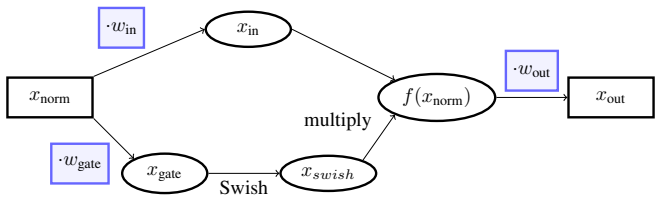
The carrying machinery is the three weight vectors of a gated neuron—$w_{\rm in}$, $w_{\rm gate}$, $w_{\rm out}$—and the three cosine similarities among them, reduced to two meaningful ones by the symmetry that flipping both $w_{\rm in}$ and $w_{\rm out}$ preserves behavior. The taxonomy places neurons by $\cos(w_{\rm in}, w_{\rm out})$ (positive means enrichment, negative means depletion, near zero means orthogonal output) and $|\cos(w_{\rm gate}, w_{\rm out})|$ (high means unconditional, low means conditional), with 0.5 as the threshold. The named device 'double checking' is the geometric fact that two orthogonal reading vectors can both have high similarity to a third concept direction, which shrinks the activation region to a quadrant-like intersection and enables more precise concept detection. This weight-geometry machine is what generates the layer-by-layer statistics and the six input–output classes.
What would settle it
Take a random sample of neurons the weights label as enrichment or depletion, run the model on a large corpus, and measure whether each neuron's positive activation actually adds or removes the detected direction from the residual stream, by comparing the residual stream projection along $w_{\rm in}$ before and after the MLP. If the weight-based labels fail to predict the sign of the change for most sampled neurons, the layer-trend claim would not correspond to functional behavior.
Extended reading notes
Core claim
The central claim, stated on the paper's own terms, is that gated neurons in language models can be classified by the relation between what they read and what they write, computed as $\cos(w_{\rm in}, w_{\rm out})$ and $|\cos(w_{\rm gate}, w_{\rm out})|$; this yields a complete taxonomy with six input–output classes rather than a sparse list of special neurons. Across all 12 models, the median $\cos(w_{\rm in}, w_{\rm out})$ starts positive, peaks in early-middle layers, and turns negative near the end, meaning early-middle layers are dominated by enrichment and conditional enrichment while late layers shift toward depletion. The authors further report that in Llama more than 80% of input manipulators are conditional enrichment neurons, and that gate and input weights are mostly near-orthogonal while still checking the same concept—a phenomenon they call double checking. They interpret enrichment as representation enrichment, the first step of factual recall, and depletion as residual sharpening, and they present case studies showing that negative Swish values can invert a neuron's behavior, a mechanism previous work had not exhibited.
Load-bearing premise
The load-bearing premise is that a neuron's functional class can be read from its raw weight vectors alone, ignoring bias terms and layer norms, without checking whether these cosine geometries predict which neurons actually activate and what they do on real inputs.
Editorial extensions
If this is right
- Because the classification uses only weights, it is exhaustive and fast: every neuron of an MLP gets an input–output class, whereas output-based functional-role schemes cover only a few percent of neurons.
- The consistent early-enrichment/late-depletion trend across 12 models supports the stages-of-inference view of transformer depth: early-middle layers perform feature engineering or representation enrichment, and final layers perform residual sharpening.
- The dominance of conditional enrichment—more than 80% of input manipulators in Llama—together with the near-orthogonality of $w_{\rm gate}$ and $w_{\rm in}$, implies that most neurons detect concepts with two independent checks rather than a single direction.
- Negative Swish values are functional: the case studies show depletion and proportional-change neurons relying on weakly negative gate activations to invert what they write, so treating Swish as essentially ReLU is not a safe simplification for gated models.
Reading between the lines
- A concrete validation the authors did not run: for a sample of neurons, compare the weight-based class with an activation-based measurement of whether positive activation increases or decreases the detected direction in the residual stream; agreement on most neurons would convert the geometric trend into a functional one.
- If the trend holds functionally, then model editing or factual-recall interventions should preferentially target enrichment neurons in early-middle layers and depletion neurons in the final layers, because those are the neurons that add or remove concept directions at the right time.
- The same read-versus-write geometry could classify attention heads, which also read from and write to the residual stream, extending the taxonomy beyond MLP neurons; the paper does not do this.
- The near-orthogonality of $w_{\rm gate}$ and $w_{\rm in}$ may reflect a robustness strategy under superposition: two independent checks for one concept reduce false-positive activation, a design principle that could generalize to other architectures.
Editorial analysis
A structured set of objections, weighed in public.
Referee Report
Summary. The paper proposes a weight-based taxonomy of gated MLP neurons in transformers. For each neuron with weights (win, wgate, wout), it computes the cosines cos(win,wout), |cos(wgate,wout)|, and |cos(wgate,win)|, and defines six IO classes: enrichment, depletion, conditional enrichment, conditional depletion, proportional change, and orthogonal output. The method is applied to 12 open-weight LLMs. The central empirical finding is that the median cos(win,wout) is positive in early-middle layers and negative in later layers across all 12 models, which the authors interpret as enrichment neurons dominating early-middle layers and depletion neurons dominating later layers. The paper also introduces the concept of 'double checking' and provides six case studies from OLMo-7B combining weight-based and activation-based analyses, plus an extensive appendix with per-model figures.
Significance. If the main claim holds, the paper contributes a cheap, exhaustive, and scalable tool for studying a relatively underexplored axis of neuron behavior: the interaction between what a neuron reads and what it writes. Strengths include the breadth of the empirical survey (12 models), the clearly presented weight-geometry plots, the open-source software, and the case studies that connect the taxonomy to functional roles from prior work. The main caveat is that the headline layer trend is currently a statement about weight geometry; whether it is a statement about input-output functionality on real data is not yet demonstrated. The paper's own Limitations section acknowledges that weight similarity is not one-to-one with semantic behavior, which is exactly the point that needs quantitative support.
major comments (3)
- [Section 4.3 / Table 1 / Section 5.1] The enrichment/depletion labels are assigned from cos(win,wout) and |cos(wgate,wout)| alone, but the residual-stream update is Swish(wgate·xnorm)·(win·xnorm)·wout. When Swish(wgate·xnorm) is negative, a neuron with cos(win,wout)>0 subtracts rather than adds the detected direction and therefore behaves as a depletion neuron in that context. The paper itself emphasizes that Swish is negative on weakly negative gate inputs (Section 3.2) and relies on this mechanism in the depletion case study (Section 6.2). No activation statistics are reported to show that neurons labeled 'conditional enrichment' have mostly positive Swish values on real inputs. Consequently, the central claim that 'enrichment neurons dominate early-middle layers' is currently a claim about weight geometry, not about verified input-output functionality. I request an aggregate activation-based check: for each class and layer, measure the fraction of neurons whose sign(Swish(wgate·xnorm)) is positive on a representative corpus, and re-report the layer trend using the sign-corrected direction of the update.
- [Section 4.4 / Figure 3] The discrete class counts that support statements such as 'the majority of these input manipulators (more than 80% in Llama) belong to just one class: conditional enrichment' depend on the arbitrary threshold tau=0.5. No sensitivity analysis is provided. Please vary tau (e.g., 0.3 and 0.7) and show that the class-composition trends and the early-to-late enrichment-to-depletion shift are stable, or report a continuous analogue, for example the joint density of cos(win,wout) and |cos(wgate,wout)| across layers, which Figure 5 only partially provides. Without this, the discrete-class statements are not robust to the choice of cutoff.
- [Section 3.1 / Limitations] The classification ignores bias terms and LayerNorm parameters, and all layer-level claims are computed purely from weights. Since the functional interpretation depends on the distribution of xnorm, and LayerNorm changes the norm and mean of xmid, the authors should either justify that these omissions do not affect the conclusions or add a validation on real activations. The paper's own Limitations section states that 'mathematical similarities of weights are insightful, but they should not be taken as one-to-one representations of semantic similarity.' This is precisely the concern that needs a quantitative answer; otherwise the abstract's phrase 'input-output functionality' overstates what has been measured.
minor comments (6)
- [Section 4.3] There is a LaTeX error in the line 'We first focus on on textbfenrichment and depletion'; it should read 'textbf{enrichment}'.
- [Section 4.4] The sentence 'such a neuron may write a concept different from but semantically related to the one it detects (say, Ireland -> Dublin) and thus be be similar to an enrichment neuron' contains a duplicated 'be'.
- [Figure 3] The stacked bar charts would benefit from a y-axis label (count or proportion); currently the numbers are printed but the axis is unlabeled, which makes the figure harder to scan.
- [Appendix F.2] The kurtosis threshold of 230.9736 is reported to four decimal places with no explanation of how it was derived; please state the exact criterion used.
- [Abstract / Section 7.4] The abstract says enrichment neurons are 'largely responsible for enriching concept representations, one of the first steps of factual recall,' while Section 7.4 presents this as a hypothesis and the conclusion states that ablation experiments are future work. Consider softening the abstract to 'consistent with' to match the strength of the evidence.
- [Section 7.2] The term 'double checking' is used in the Introduction and in Section 6.2 before it is formally defined in Section 7.2; consider defining it at first use.
Circularity Check
No circularity: the layer trend is a direct empirical statistic of weight cosines, not a quantity derived from a fitted parameter or a self-citation.
full rationale
The paper's central claim—enrichment neurons dominate early-middle layers while later layers tend toward depletion—is an observed statistical pattern over the cosine similarities of pretrained model weights. The taxonomy is defined directly from these cosines (Section 4.3, Table 1), and the layer trend is then read off from the resulting histograms (Figure 3, Appendix I). There is no fitted parameter that is later renamed as a prediction: the threshold tau=0.5 is set a priori as a 'relatively permissive cutoff' (Section 4.4), and the authors do not tune it to reproduce the layer trend. No self-citation is load-bearing; the references to prior work (e.g., Elhage et al., Gurnee et al., Geva et al.) are background and not used to force any conclusion. The concern that negative Swish values could make nominally 'enrichment' neurons behave as depletion neurons on real inputs is a validity threat about whether weight geometry predicts activation-gated behavior, but it is not a circularity: the paper's classification is explicitly parameter-based, and the layer claim is about the distribution of these weight-defined classes, not about a quantity that was derived from the claim itself. The explanatory sections (Sections 7.3–7.5) are explicitly framed as hypotheses and future ablation tests, not as derivations from the data. Therefore no step in the paper's derivation chain reduces to its own inputs by construction.
Assumptions & free parameters
free parameters (4)
- classification threshold tau =
0.5
- kurtosis threshold for prediction/suppression =
230.9736 (excess kurtosis)
- variance threshold for partition neurons =
0.0007
- attention (de)activation cutoff =
sqrt(2)/2 ≈ 0.7071
assumptions (4)
- domain assumption Residual stream states can be interpreted as intermediate predictions and directions correspond to concepts (linear representation hypothesis).
- domain assumption Biases and layer norm parameters can be ignored when characterizing neuron IO functionality.
- standard math Swish negative values can produce meaningful negative activations that flip a neuron's enrichment/depletion behavior.
- standard math Symmetry: flipping signs of win and wout preserves IO behavior; therefore the sign of cos(wgate,wout) is irrelevant.
invented entities (2)
-
Input manipulation (neuron class)
-
Double checking (circuit mechanism)
Cite this review
Pith. "Pith review of Understanding Gated Neurons in Transformers from Their Input-Output Functionality." pith.science (2026). https://pith.science/paper/DBJRVLWB
@misc{pith2026250517936,
  author       = {Pith},
  title        = {Pith review of: Understanding Gated Neurons in Transformers from Their Input-Output Functionality},
  year         = {2026},
  howpublished = {\url{https://pith.science/paper/DBJRVLWB}},
  note         = {Machine review of arXiv:2505.17936}
}
read the original abstract
Interpretability researchers have attempted to understand MLP neurons of language models based on both the contexts in which they activate and their output weight vectors. They have paid little attention to a complementary aspect: the interactions between input and output. For example, when neurons detect a direction in the input, they might add much the same direction to the residual stream ("enrichment neurons") or reduce its presence ("depletion neurons"). We address this aspect by examining the cosine similarity between input and output weights of a neuron. We apply our method to 12 models and find that enrichment neurons dominate in early-middle layers whereas later layers tend more towards depletion. To explain this finding, we argue that enrichment neurons are largely responsible for enriching concept representations, one of the first steps of factual recall. Our input-output perspective is a complement to activation-dependent analyses and to approaches that treat input and output separately.
Figures


Figures from the paper (7 more)



Reference graph
Works this paper leans on
-
[1]
01.AI, :, Alex Young, Bei Chen, Chao Li, Chengen Huang, Ge Zhang, Guanwei Zhang, Guoyin Wang, Heng Li, Jiangcheng Zhu, Jianqun Chen, Jing Chang, Kaidong Yu, Peng Liu, Qiang Liu, Shawn Yue, Senbin Yang, Shiming Yang, Wen Xie, Wenhao Huang, Xiaohui Hu, Xiaoyi Ren, Xinyao Niu, Pengcheng Nie, Yanpeng Li, Yuchi Xu, Yudong Liu, Yue Wang, Yuxuan Cai, Zhenyu Gu, ...
arXiv 2025
-
[2]
Nora Belrose, Zach Furman, Logan Smith, Danny Halawi, Igor Ostrovsky, Lev McKinney, Stella Biderman, and Jacob Steinhardt. 2023. https://arxiv.org/pdf/2303.08112 Eliciting latent predictions from transformers with the tuned lens
arXiv 2023
-
[3]
Nelson Elhage, Tristan Hume, Catherine Olsson, Nicholas Schiefer, Tom Henighan, Shauna Kravec, Zac Hatfield-Dodds, Robert Lasenby, Dawn Drain, Carol Chen, Roger Grosse, Sam McCandlish, Jared Kaplan, Dario Amodei, Martin Wattenberg, and Christopher Olah. 2022. https://transformer-circuits.pub/2022/toy_model/index.html Toy models of superposition
2022
-
[4]
Nelson Elhage, Neel Nanda, Catherine Olsson, Tom Henighan, Nicholas Joseph, Ben Mann, Amanda Askell, Yuntao Bai, Anna Chen, Tom Conerly, Nova DasSarma, Dawn Drain, Deep Ganguli, Zac Hatfield-Dodds, Danny Hernandez, Andy Jones, Jackson Kernion, Liane Lovitt, Kamal Ndousse, Dario Amodei, Tom Brown, Jack Clark, Jared Kaplan, Sam McCandlish, and Chris Olah. 2...
work page 2021
-
[5]
Amit Elhelo and Mor Geva. 2024. https://arxiv.org/abs/2412.11965 Inferring functionality of attention heads from their parameters . Preprint, arXiv:2412.11965
arXiv 2024
-
[6]
Team Gemma. 2024. https://doi.org/10.34740/KAGGLE/M/3301 Gemma
-
[7]
Mor Geva, Jasmijn Bastings, Katja Filippova, and Amir Globerson. 2023. https://doi.org/10.18653/v1/2023.emnlp-main.751 Dissecting recall of factual associations in auto-regressive language models . In Proceedings of the 2023 Conference on Empirical Methods in Natural Language Processing, pages 12216--12235, Singapore. Association for Computational Linguistics
-
[8]
Mor Geva, Avi Caciularu, Kevin Wang, and Yoav Goldberg. 2022. https://doi.org/10.18653/v1/2022.emnlp-main.3 Transformer feed-forward layers build predictions by promoting concepts in the vocabulary space . In Proceedings of the 2022 Conference on Empirical Methods in Natural Language Processing, pages 30--45, Abu Dhabi, United Arab Emirates. Association f...
Show all 31 references
-
[9]
Mor Geva, Roei Schuster, Jonathan Berant, and Omer Levy. 2021. https://doi.org/10.18653/v1/2021.emnlp-main.446 Transformer feed-forward layers are key-value memories . In Proceedings of the 2021 Conference on Empirical Methods in Natural Language Processing, pages 5484--5495, ...
2021 doi
-
[10]
Dirk Groeneveld, Iz Beltagy, Evan Walsh, Akshita Bhagia, Rodney Kinney, Oyvind Tafjord, Ananya Jha, Hamish Ivison, Ian Magnusson, Yizhong Wang, Shane Arora, David Atkinson, Russell Authur, Khyathi Chandu, Arman Cohan, Jennifer Dumas, Yanai Elazar, Yuling Gu, Jack Hessel, Tusha...
2024
-
[11]
Wes Gurnee, Theo Horsley, Zifan Carl Guo, Tara Rezaei Kheirkhah, Qinyi Sun, Will Hathaway, Neel Nanda, and Dimitris Bertsimas. 2024. https://arxiv.org/pdf/2401.12181 Universal neurons in gpt2 language models
2024 arXiv
-
[12]
Wes Gurnee, Neel Nanda, Matthew Pauly, Katherine Harvey, Dmitrii Troitskii, and Dimitris Bertsimas. 2023. https://arxiv.org/pdf/2305.01610 Finding neurons in a haystack: Case studies with sparse probing
2023 arXiv
-
[13]
Albert Q. Jiang, Alexandre Sablayrolles, Arthur Mensch, Chris Bamford, Devendra Singh Chaplot, Diego de las Casas, Florian Bressand, Gianna Lengyel, Guillaume Lample, Lucile Saulnier, Lélio Renard Lavaud, Marie-Anne Lachaux, Pierre Stock, Teven Le Scao, Thibaut Lavril, Thomas ...
2023 arXiv
-
[14]
Vedang Lad, Wes Gurnee, and Max Tegmark. 2024. https://arxiv.org/abs/2406.19384 The remarkable robustness of llms: Stages of inference? Preprint, arXiv:2406.19384
2024 arXiv
-
[15]
Joseph Miller and Clement Neo. 2023. https://www.lesswrong.com/posts/cgqh99SHsCv3jJYDS/we-found-an-neuron-in-gpt-2 We found an neuron in gpt-2
2023
-
[16]
Beren Millidge and Sid Black. 2022. https://www.lesswrong.com/posts/mkbGjzxD8d8XqKHzA/the-singular-value-decompositions-of-transformer-weight The singular value decompositions of transformer weight matrices are highly interpretable
2022
-
[17]
Morcos, David G.T
Ari S. Morcos, David G.T. Barrett, Neil C. Rabinowitz, and Matthew Botvinick. 2018. https://arxiv.org/pdf/1803.06959.pdf On the importance of single directions for generalization
2018 arXiv
-
[18]
Neel Nanda and Joseph Bloom. 2022. Transformerlens. https://github.com/TransformerLensOrg/TransformerLens
2022
-
[19]
Jingcheng Niu, Andrew Liu, Zining Zu, and Gerald Penn. 2024. https://arxiv.org/pdf/2405.02421 What does the knowledge neuron thesis have to do with knowledge?
2024 arXiv
-
[20]
nostalgebraist. 2020. https://www.lesswrong.com/posts/AcKRB8wDpdaN6v6ru/interpreting-gpt-the-logit-lens Interpreting gpt: The logit lens
2020
-
[21]
Kiho Park, Yo Joong Choe, and Victor Veitch. 2024. https://proceedings.mlr.press/v235/park24c.html The linear representation hypothesis and the geometry of large language models . In Proceedings of the 41st International Conference on Machine Learning, volume 235 of Proceeding...
2024
-
[22]
Alec Radford, Jeff Wu, Rewon Child, David Luan, Dario Amodei, and Ilya Sutskever. 2019. Language models are unsupervised multitask learners
2019
-
[23]
Cody Rushing and Neel Nanda. 2024. https://proceedings.mlr.press/v235/rushing24a.html Explorations of self-repair in language models . In Proceedings of the 41st International Conference on Machine Learning, volume 235 of Proceedings of Machine Learning Research, pages 42836--...
2024
-
[24]
Noam Shazeer. 2020. https://arxiv.org/pdf/2002.05202 Glu variants improve transformer
2020 arXiv
-
[25]
Luca Soldaini, Rodney Kinney, Akshita Bhagia, Dustin Schwenk, David Atkinson, Russell Authur, Ben Bogin, Khyathi Chandu, Jennifer Dumas, Yanai Elazar, Valentin Hofmann, Ananya Jha, Sachin Kumar, Li Lucy, Xinxi Lyu, Nathan Lambert, Ian Magnusson, Jacob Morrison, Niklas Muennigh...
2024
-
[26]
Alessandro Stolfo, Ben Wu, Wes Gurnee, Yonatan Belinkov, Xingyi Song, Mrinmaya Sachan, and Neel Nanda. 2024. https://arxiv.org/abs/2406.16254 Confidence regulation neurons in language models
2024 arXiv
-
[27]
Hugo Touvron, Thibaut Lavril, Gautier Izacard, Xavier Martinet, Marie-Anne Lachaux, Timoth \'e e Lacroix, Baptiste Rozi \`e re, Naman Goyal, Eric Hambro, Faisal Azhar, Aur \'e lien Rodriguez, Armand Joulin, Edouard Grave, and Guillaume Lample. 2023. https://arxiv.org/pdf/2302....
2023 arXiv
-
[28]
Shazeer, Niki Parmar, Jakob Uszkoreit, Llion Jones, Aidan N
Ashish Vaswani, Noam M. Shazeer, Niki Parmar, Jakob Uszkoreit, Llion Jones, Aidan N. Gomez, Lukasz Kaiser, and Illia Polosukhin. 2017. https://api.semanticscholar.org/CorpusID:13756489 Attention is all you need . In Neural Information Processing Systems
2017
-
[29]
Elena Voita, Javier Ferrando, and Christoforos Nalmpantis. 2024. https://doi.org/10.18653/v1/2024.findings-acl.75 Neurons in large language models: Dead, n-gram, positional . In Findings of the Association for Computational Linguistics: ACL 2024, pages 1288--1301, Bangkok, Tha...
2024 doi
-
[30]
An Yang, Baosong Yang, Binyuan Hui, Bo Zheng, Bowen Yu, Chang Zhou, Chengpeng Li, Chengyuan Li, Dayiheng Liu, Fei Huang, Guanting Dong, Haoran Wei, Huan Lin, Jialong Tang, Jialin Wang, Jian Yang, Jianhong Tu, Jianwei Zhang, Jianxin Ma, Jin Xu, Jingren Zhou, Jinze Bai, Jinzheng...
2024 arXiv
-
[31]
Susan Zhang, Stephen Roller, Naman Goyal, Mikel Artetxe, Moya Chen, Shuohui Chen, Christopher Dewan, Mona Diab, Xian Li, Xi Victoria Lin, Todor Mihaylov, Myle Ott, Sam Shleifer, Kurt Shuster, Daniel Simig, Punit Singh Koura, Anjali Sridhar, Tianlu Wang, and Luke Zettlemoyer. 2...
2022 arXiv
Reviewed August 7, 2026 · model on record in the stance chip above.
Discussion (0). Sign in to comment.